Offre d’emploi – Postdoctoral researcher in Medieval History (University of Amsterdam)

Specifications – (explanation)
Location : Amsterdam
Function types : Postdoc positions
Scientific fields : Language and Culture
Hours : 38.0 hours per week
Salary : € 3357 – € 3597
Education : Doctorate
Job number : 15-390
Translations : en
About employer : University of Amsterdam (UvA)
Short link : www.academictransfer.com/30438
AmsterdamJob description
The Amsterdam School for Culture ans History (ASCH) of the Faculty of Humanities currently has a vacant postdoctoral position as part of the NWO-funded Imagining a territory. Constructions and representations of late medieval Brabant, led by dr. Mario Damen.

This NWO funded project analyses how the interaction between prince, nobles and urban elites influenced the construction, perception, and representation of a territory. The test case will be the late medieval Duchy of Brabant, which still has historical and territorial significance for many people in present-day Belgium and the Netherlands. To underscore the fluidity and multiplicity of the concept of territory, this project sets out to disentangle the divergent, though sometimes overlapping, conceptions of what exactly Brabant was (or should be) in the eyes of different political actors, in this time before the availability of reliable scale maps. To answer the main research question the project takes a twofold approach. The postdoctoral researcher will explicate in a subproject entitled Representations of territory in late medieval Brabant, how the concept of territory was communicated to a wider audience. How did princes, nobles and urban elites use architecture, heraldry, historiography, and performances, to envisage and visualize territory? In four case studies these different media will be analyzed. In a second subproject entitled The multiplicity of territory in late medieval Brabant a PhD candidate will define ducal, noble, and urban conceptions of Brabant mainly through administrative sources, particularly those of the fourteenth century that reflect a turning point in the capturing of territory. The two subprojects will provide a completely new perspective on the concept of territory before cartography and state formation turned boundaries and territories into more fixed (but still changeable) geographical entities.

Tasks:

  • Doing research in archival and library collections;
  • submitting research results for three publications in international peer-reviewed academic journals;
  • writing an article for a volume of conference papers;
  • (co-)organization of an international conference (Amsterdam, January 2018);
  • presentations of intermediate research results at workshops and conferences preparing HIS-GIS application for the project (2018);
  • writing contributions to a project blog;
  • actively participating in project discussions and working as a peer reviewer for the team.

Requirements

The successful applicant must have:

  • MA and PhD degree in History or a closely related field such as Medieval Studies, Art History or Literary Studies,
  • high level of active and passive command of Dutch and English and a passive command of French and Latin;
  • demonstrable interest in the history of the late Middle Ages;
  • demonstrable command of paleographical skills;
  • experience in working with diverse primary (archival, iconographical, literary) sources;
  • willingness to utilize theoretical and comparative frameworks;
  • ability to work both independently and as part of a research team.

Conditions of employment
The candidate will be appointed at the Department of History, European Studies & Religious Studies of the Faculty of Humanities at the University of Amsterdam. The research will be carried out under the aegis of ASCH. The appointment, 38 hours per week, is for a period of three years. The intended starting date of the contract is 1 February 2016. The gross monthly salary (on full-time basis) will be €3.357 during the first year to €3.597 during the third year, in accordance with the Collective Labour Agreement for Dutch Universities.

Organisation

University of Amsterdam
With over 5,000 employees, 30,000 students and a budget of more than 600 million euros, the University of Amsterdam (UvA) is an intellectual hub within the Netherlands. Teaching and research at the UvA are conducted within seven faculties: Humanities, Social and Behavioural Sciences, Economics and Business, Law, Science, Medicine and Dentistry. Housed on four city campuses in or near the heart of Amsterdam, where disciplines come together and interact, the faculties have close links with thousands of researchers and hundreds of institutions at home and abroad.

The UvA’s students and employees are independent thinkers, competent rebels who dare to question dogmas and aren’t satisfied with easy answers and standard solutions. To work at the UvA is to work in an independent, creative, innovative and international climate characterised by an open atmosphere and a genuine engagement with the city of Amsterdam and society.
Department

Faculty of Humanities
The Amsterdam School for Culture ans History (ASCH) of the Faculty of Humanities currently has a vacant postdoctoral position as part of the NWO-funded Imagining a territory. Constructions and representations of late medieval Brabant, led by dr. Mario Damen. ASCH is one of the six research schools of the Amsterdam Institute for Humanities Research (AIHR). Established in 2014, ASCH brings together more than 300 academics, who participate in ca. 35 research groups. Its members study the historical dimension of culture and the cultural dimension of history.
Additional information

For further information, please contact:

Dr. M.J.M. Damen
T: +31 (0)20 525 8896

Source : Academic Transfer
Publié dans Offre d'emploi | Un commentaire

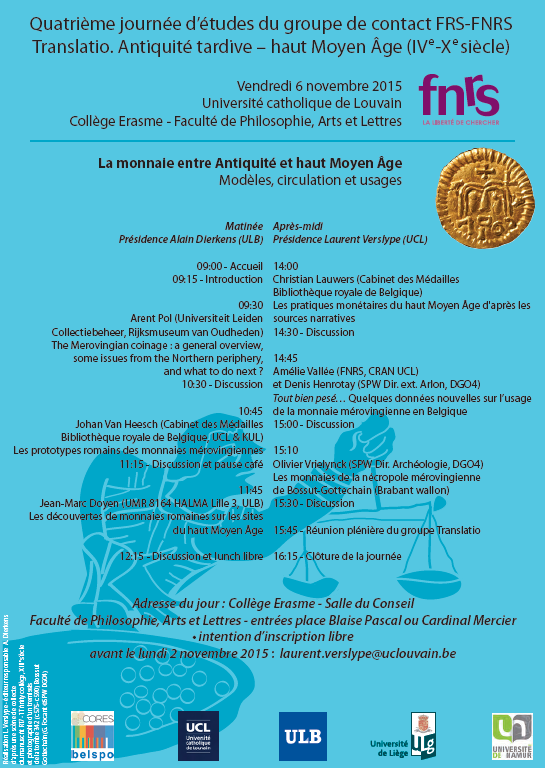
Journée d’étude – La monnaie entre Antiquité et haut Moyen Âge. Modèles, circulation et usages

Quatrième journée d’études du groupe de contact FRS-FNRS
Translatio. Antiquité tardive – haut Moyen Âge (IV -X siècle)
Vendredi 6 novembre 2015

Adresse du jour : Collège Erasme – Salle du Conseil
Faculté de Philosophie, Arts et Lettres – entrées place Blaise Pascal ou Cardinal Mercier

Intention d’inscription libre
avant le lundi 2 novembre 2015 : laurent.verslype@uclouvain.be

+7. TranbslatioProgramme :

Matinée
Présidence Alain Dierkens (ULB)

09:00 – Accueil
09:15 – Introduction

09:30 : Arent Pol (Universiteit Leiden Collectiebeheer, Rijksmuseum van Oudheden) – The Merovingian coinage : a general overview, some issues from the Northern periphery, and what to do next ?
10:30 – Discussion

10:45 : Johan Van Heesch (Cabinet des Médailles Bibliothèque royale de Belgique, UCL & KUL) – Les prototypes romains des monnaies mérovingiennes
11:15 – Discussion et pause café

11:45 : Jean-Marc Doyen (UMR 8164 HALMA Lille 3, ULB) – Les découvertes de monnaies romaines sur les sites du haut Moyen Âge
12:15 – Discussion et lunch libre

Après-midi
Présidence Laurent Verslype (UCL)

14:00 : Christian Lauwers (Cabinet des Médailles Bibliothèque royale de Belgique) – Les pratiques monétaires du haut Moyen Âge d’après les sources narratives
14:30 – Discussion

14:45 : Amélie Vallée (FNRS, CRAN UCL) et Denis Henrotay (SPW Dir. ext. Arlon, DGO4) – Tout bien pesé… Quelques données nouvelles sur l’usage de la monnaie mérovingienne en Belgique
15:00 – Discussion

15:10 : Olivier Vrielynck (SPW Dir. Archéologie, DGO4) – Les monnaies de la nécropole mérovingienne de Bossut-Gottechain (Brabant wallon)
15:30 – Discussion

15:45 – Réunion plénière du groupe Translatio
16:15 – Clôture de la journée

Source : HISTAR

Publié dans Colloque | Laisser un commentaire

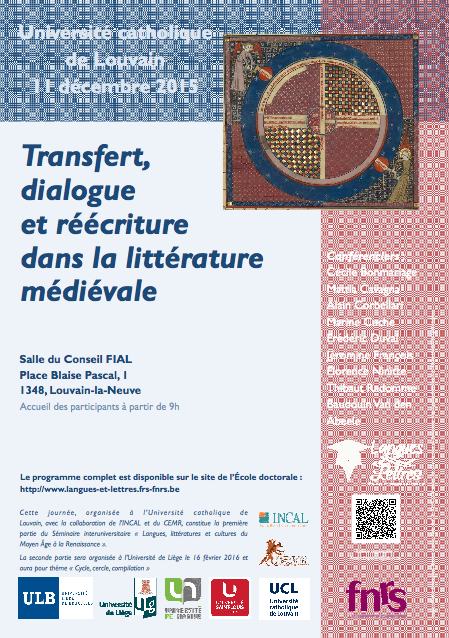
Journée d’étude – Transfert, dialogue et réécriture dans la littérature médiévale

Université catholique de Louvain
11 décembre 2015

Salle du Conseil FIAL Place Blaise Pascal, 1 1348, Louvain-la-Neuve
Informations et inscriptions : Mattia Cavagna
mattia.cavagna@uclouvain.be

Cette journée, organisée à l’Université catholique de Louvain, avec la collaboration de l’INCAL et du CEMR, constitue la première partie du Séminaire interuniversitaire « Langues, littératures et cultures du Moyen Âge à la Renaissance ». La seconde partie sera organisée à l’Université de Liège le 16 février 2016 et aura pour thème « Cycle, cercle, compilation »

Séminaire interuniversitaire « Langues, littératures et cultures du Moyen Âge à la Renaissance ».

Affiche UCLProgramme :

9h00 | Accueil des participants
Introduction de la journée, par Mattia Cavagna

9h30 | Le droit et la science : transmission, traduction et réception

Frédéric Duval (École nationale des Chartes, Paris), « Élaboration plurielle et transmission d’une traduction juridique : le cas des Authentiques »
Baudouin Van den Abeele (UCL), « Thomas de Cantimpré, Liber de natura rerum : un cas extrême de mouvance dans le genre encyclopédique »
11h00 | Pause café

11h30 | Translation linguistique, médiale, générique

Thibaut Radomme (UCL / U. de Lausanne), « La satire d’un monde bestourné chez Gervais du Bus et chez Chaillou de Pestain : les effets du bilinguisme latin-français dans le manuscrit BnF fr. 146 du Roman de Fauvel »
Marine Cuche (U. de Genève/UCL), « Enjeux de la réécriture biblique en latin et en ancien français : les paraphrases de Pierre Riga, Jean Malkaraume et Macé de la Charité (XIIe-XIVe siècles) »
13h00 | Repas de midi

14h30 | De l’Orient à Occident : apports et transferts

Cécile Bonmariage (UCL), « Écriture et réécritures dans les commentaires de textes avicénniens »
Florence Ninitte, (UCL), « Du dialogue religieux au monologue encyclopédique : citer le Coran dans le Miroir historial (XXIV, 63-67) »

16h00 | Pause café

16h30 | Réécritures et réception contemporaine

Alain Corbellari (U. de Lausanne / U. de Neuchâtel), « Quand l’hypertexte se fait hypotexte. Entre changement de paradigme et permanence des thèmes : succès et postérité des adaptations modernes de la littérature médiévale »
Jéromine François (U. de Liège), « Transferts fictifs de La Celestina : le Moyen Âge espagnol revu et corrigé par la narration hispano-américaine contemporaine »

19h30 | Banquet

Publié dans Colloque | Laisser un commentaire

Appel à contribution – Reinterpreting Space and Spatial Relationships

Ort : Helsinki
Veranstalter : Session organisers: Susanne Rau, University of Erfurt, Richard Rodger, University of Edinburgh
Datum : 24.08.2016 – 27.08.2016
Bewerbungsschluss : 31.10.2015
Url : https://www.uni-erfurt.de/projekt-geschichte-kulturen-neuzeit/

Kontakt :
Universität Erfurt, Historisches Seminar
Nordhäuser Str. 63, 99089 Erfurt
+49-361-737-4071
susanne.rau [at] uni-erfurt.de

13th International Conference on Urban History, European Association for Urban History, 2016: “Reinterpreting Cities”

Reinterpreting Space and Spatial Relationships (Main session 22)
Helsinki/Finland, 24-27 August 2016

In the rapidly changing environment of digital mapping new tools and techniques are emerging to build research capacity and facilitate analysis. These new tools are rarely adapted to historical questions even though the historiography of towns and cities is heavily focused on issues associated with space and hierarchies of spatial relationships. The capability of historical GIS to have a transformative effect on key issues in urban history warrants further examination.

The proposed session seeks to understand how new ways of analysing spatial relationships can contribute to the reinterpretation of city spaces and socio-economic relationships.

The organisers particularly welcome papers that:

  • present case studies of historical mapping relating to the internal arrangements – social, economic, environmental, political, and cultural – that facilitate a reinterpretation of the dynamics of spatial relationships in neighbourhoods, towns or cities;
  • consider how to deal with shifting internal city boundaries and city expansion;
  • engage with technical developments – for example, with the automated extraction of data from historical sources such as nominal lists, directories, and from maps; or 3D historical representations;
  • discuss ‘which tools for which purpose’ work best;
  • address licensing and copyright issues, or the relative merits of, say, OpenStreetMap or other mapping frameworks;
  • explore how urban historians in different countries are adapting to technical challenges, and whether longer term partnerships to develop international collaboration and funding initiatives would assist that adaptation;
  • examine how best practice can be distilled, both for research and teaching purposes; and how interactions between computer scientists and historians might be improved.

Keywords: mapping, space, spatial relationships, digital humanities
Period: medieval, early modern, modern

The session organisers encourage further contributions, bringing together scholars from various fields, e.g. history, geography, computer science.
Please submit a 300-word abstract online, via the EAUH 2016 website: https://eauh2016.net/

Deadline for paper proposals submission: October 31, 2015
Notification of paper acceptance: December 15, 2015

Suggestion for young scholars: The European Association for Urban History has bursaries for postgraduate doctoral and postdoctoral students without paid posts under 35 years (on 24th September 2016). The bursaries cover the full registration costs of students whose papers have been accepted for sessions, but all other costs (e.g. travel, accommodation) must be paid by the applicant. There will also be a limited number of Travel Bursaries to be announced later.

Source : H-Soz-Kult

Publié dans Appel à contributions | Laisser un commentaire

Séminaire – Séminaire d’histoire médiévale (Université Rennes-2)

Le séminaire a lieu le jeudi de 10h30 à 12h30 en salle N 104 de la Maison de la Recherche en Sciences sociales, Campus de Villejean

Organisation : florian.mazel@univ-rennes2.fr

CERHIOProgramme :

Jeudi 8 octobre 2015
Franck Mercier (Université Rennes 2)
« Comme un oeil dans les ténèbres… »: recherches sur la Flagellation du Christ de Piero della Francesca (vers 1460)

Jeudi 19 novembre
Carlo Sitter (Université de Sienne)
Que peut nous apprendre l’archéologie à propos de la durabilité des territoires ? Le cas des châteaux médiévaux de Toscane.

Séance incluse dans la journée d’étude « Archéogéographie et histoire médiévale » coorganisée avec le Master d’archéologie (M. Watteaux)

Jeudi 17 décembre
Ian Wood (Université de Leeds)
Colomban et le monde brittonique

Jeudi 21 janvier 2016
Jean-François Nieus (Université de Namur)
Pourquoi le monde anglo-normand ? L’essor du sceau aristocratique, 1066-1130.

Jeudi 11 février
Marie-Madeleine de Cevins (Université Rennes 2)
Pauvreté volontaire et économie en Europe centrale (v.1220-v.1550) : premiers résultats d’un programme ANR

Jeudi 31 mars
Massimo Vallerani (Université de Turin), titre en attente

Jeudi 7 avril
Sylvain Parent (École normale supérieure de Lyon)
La diplomatie au quotidien. Un nonce apostolique et sa comptabilité au temps de Jean XXII : Foulque de Sisteron (1321-1324)

Source : CERHIO

Publié dans Séminaire | Laisser un commentaire

Appel à contribution – Insider or Outsider ? The State of Medieval Iceland

Special session, The Arizona Center for Medieval and Renaissance Studies 2016 Conference: “Marginal Figures in the Global Middle Ages and Renaissance.” February 4-6, 2016.

Organizers: Daniel Najork (Arizona State University) and Sarah M. Anderson (Princeton University)

Iceland is notable for the continuity of its literary traditions, examples of which are extant from about the twelfth century onwards – not too long after the beginning of continuous settlement of the island in the early Middle Ages. The Icelandic language is renowned for its morphological and lexical conservatism, for the nearly complete lack of dialectal variation in the nine-hundred-year-long record of Icelandic (cf., e.g., the substantial dialectical variation found in Icelandic’s closest linguistic kin, Norwegian, through the same period), and for the success of its modern program of “language purism”. Until Norwegian overlordship commenced in 1262 CE, the island is also singular during the early medieval period (i.e., during the period of the Icelandic “commonwealth”, 930-1262 CE) for its kinglessness and for other cultural features not exampled elsewhere in the West. Both the linguistic and the literary continuity are crucial to the collective memory of Icelanders, and both emphasize Iceland’s special medieval legacy in the formation of Icelandic national identity. Yet, this identity can also seem frozen, monolithic, and fundamentally separated, island-like, from ideas that constitute the “medieval” elsewhere in the West, as if Iceland were, in fact, a real cultural ultimate Thule, not an imagined one.

This session raises the question of how medieval Iceland saw itself and of how it was – and is –  seen in relation to “mainland” Western medieval cultures and ideas. Is Iceland on the margins, even marginal, if rich cultural phenomena like chivalry and kingship sign what constitutes the medieval? Or is medieval Iceland a different but exceptional place, a society that produced mind-blowingly cerebral skaldic poetry and that extraordinary narrative form, the saga? Did this country start the gender-equality that we are just catching up with? Is Iceland the ultimate outsider during the Middle Ages, or the definitive insider, the place that produced an astute critique of, and alternative to, the medieval West? This session invites papers that put these and similar questions about Iceland’s outside / inside state into circulation.

Please send abstracts of 250-500 words to Daniel.Najork@asu.edu and sma@princeton.edu by November 23 at 4 PM EST.

Source : The Medieval Academy Blog

Publié dans Le réseau | Laisser un commentaire

Appel à contribution – Conquest: 1016, 1066

Ort : Oxford
Veranstaltungsort : Ioannou Centre and TORCH
Veranstalter : University of Oxford, Faculty of English
Datum : 21.07.2016 – 24.07.2016
Bewerbungsschluss : 31.10.2015
Url : http://www.english.ox.ac.uk/our-research/medieval/current-and-forthcoming-events/conquest-1016-1066

Paper proposals are invited for this interdisciplinary anniversary conference 21-24 July 2016 at the Ioannou Centre and TORCH, Oxford.

Papers may be on any topic relevant to the area, though the main suggested themes are listed below. Individual paper proposals (of 20 minutes’ length) are highly encouraged and are anticipated to make up the majority of the programme; proposals are also invited for consideration by a number of session organisers. Sessions which are filled may be replicated if enough paper proposals warrant it.

Sessions calling – proposals warmly invited

« Stories of migration in a century of conquest »

Programm :

Sessions will run in parallel for 90 minutes each. Paper proposals in the general call should be for 20 minute papers, which will be scheduled in sessions of 3 papers each; if groups of people wish to propose a session in a different format, they are welcome to submit linked proposals. Session and paper proposers are asked to nominate one or more of the thematic strands in which their session/paper would fit:

1) The Church; monasticism, clerical reform, theology, religious experience
2) Literature, authors, and patronage
3) Language and multilingualism, language contact
4) Institutions and governance; lordship; kingship
5) Warfare, battles, conduct in war, fighting men
6) Art and material culture; music; court life
7) Society and peoples
8) Trade and commerce
9) Space, movement, contact, networks; England and Europe, 9) England and Scandinavia
10) Historiography

Email paper proposals by 31 October 2015.

Source : H-Soz-Kult

Publié dans Appel à contributions | Laisser un commentaire

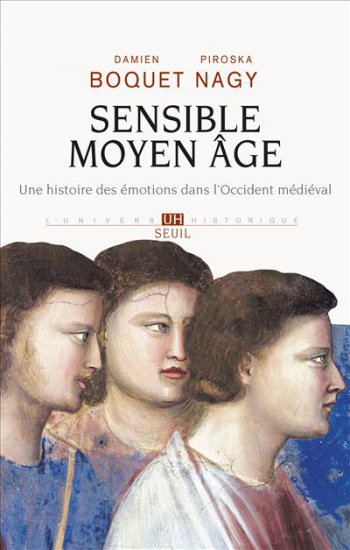
Publication – Damien Boquet et Piroska Nagy, « Sensible Moyen Âge. Une histoire des émotions dans l’Occident médiéval »

Que peut-on savoir de la vie affective du Moyen Âge ? Sur ce sujet longtemps négligé, les sources sont pourtant nombreuses : la littérature profane et spirituelle, l’iconographie, les chroniques, mais aussi la théologie et la médecine nous livrent mille indices sur la place des émotions dans la vie sociale.

De la colère d’un puissant à l’indignation du petit peuple, de la honte démonstrative d’une sainte à la crainte de la honte d’un grand, de l’amitié entre moines à la souffrance à l’imitation du Christ, de l’enthousiasme d’un groupe de croisés à la peur d’une ville entière face à la guerre ou à la peste qui approche, les exemples sont multiples. L’émotion n’est pas l’expression d’une confusion des esprits ni d’un chaos des règles sociales. Tous ces éclats de joie et de douleur, signes d’une humanité entière, produisent du sens qui ne se comprend que dans son contexte. Tout au long du millénaire médiéval, un modèle chrétien d’affectivité, élaboré à petite échelle dans les laboratoires monastiques, se construit, se répand, pénètre la société, tout en interagissant avec d’autres modèles, déjà présents ou en voie de construction parallèle, comme celui de la culture de cour.

L’émotion au Moyen Âge irrigue les relations sociales, dans une diversité d’interprétations et une vitalité culturelle qui impressionnent.

Sensible Moyen Âge

Damien Boquet est maître de conférences à l’université Aix-Marseille. Il a notamment publié L’Ordre de l’affect au Moyen Âge (CRAHM, 2005).

Piroska Nagy, professeure à l’Université du Québec à Montréal, est l’auteure de Le Don des larmes au Moyen Âge (Albin Michel, 2000).

Les deux historiens codirigent le projet de recherche EMMA, Émotions au Moyen Âge (http://emma.hypotheses.org).

Informations pratiques :
Damien Boquet et Piroska Nagy, Sensible Moyen Âge. Une histoire des émotions dans l’Occident médiéval, Paris, Seuil, 2015 (L’Univers historique). 480 pages – 25.00 € TTC.

Source : Seuil

Publié dans Publications | Laisser un commentaire

Colloque – Verzoekingen. Mystiek en identiteit in de moderne Vlaamse letterkunde

Colloquium georganiseerd door het Ruusbroecgenootschap (Universiteit Antwerpen) i.s.m. het Instituut voor de Studie van de Letterkunde in de Nederlanden (Universiteit Antwerpen) en de Erfgoedbibliotheek Hendrik Conscience

30 oktober, 13.30
Erfgoedbibliotheek Hendrik Conscience
Hendrik Conscienceplein 4
Nottebohmzaal

‘Verzoekingen’ verkent de wijzen waarop de mystieke traditie heeft door-gewerkt in de moderne Vlaamse letterkunde en onderzoekt de rol die de mystieke traditie heeft gespeeld in de constructie van de identiteiten van diverse actoren uit het literaire veld. Het colloquium kadert in de ‘Ruus-broec Encounters’: een reeks van vier activiteiten die het Ruusbroecgenoot-schap in 2015 organiseert om haar negentigjarig bestaan te vieren. Voor elk van deze activiteiten gaat het Ruusbroecgenootschap een partnerschap aan met een ander onderzoeksinstituut van binnen of buiten de Universiteit Antwerpen om de raakvlakken tussen het eigen onderzoekdomein en dat van de partners te exploreren.

Gelieve in te schrijven voor de derde ‘Ruusbroec Encounter’ voor 25 okto-ber via het inschrijvingsformulier. Voor meer informatie kunt u mailen of een kijkje nemen op onze website.

Een PDF-bestand met daarin de abstracts van de middag kunt u hier downloaden.

UA - Ruubroec90Programme :

13.30 : Welkomstwoord door Thom Mertens

13.45 : Frank Willaert – ‘Elke ware wetenschap wordt tenslotte apologie.’ Jozef van Mierlo, Vlaming, jezuïet en medioneerlandist
14.15 : Kevin Absillis en Marlou de Bont – ‘Och, Thomas a Kempis, als g’in een vliegmachien had gezete, oe boekske had duzend kieren iens zoo schoen gewest!’ Pallieter (1916) en de mystiek van het moderne leven
14.45 : Annette van Dijk – ‘Der Schöpfer einer neuen Religion, unserer Religion, losgelöst vom fremden Wesen, wie es durch Syrien, Ägypten und Rom uns eingefloßt worden ist.’ Cyriel Verschaeve en de Vlaamse mystiek
15.15 Vragen en discussie
15.30 : Koffie

16.00 : Veerle Fraeters – ‘Tot diepere vergoding.’ Marc. Eemans tussen Hadewijch en Bloemardinne
16.30 : Kris Humbeeck – ‘Mijn zonde is dat ik de geruchten van de wereld hoor.’ Hugo Claus en de mystiek
17.00 : Vragen en discussie
17.15 : Receptie

Source : Universiteit Antwerpen

Publié dans Colloque | Laisser un commentaire

Offre d’emploi – 2016 UCLA Library Special Collections Short-term Research Fellowships

The UCLA Library Special Collections Short-Term Library Research Fellowship Program supports the use of special collections materials by visiting scholars and UCLA graduate students. Collections that are administered by UCLA Library Special Collections and available for fellowship-supported research include materials in the humanities and social sciences, medicine, life and physical sciences, visual and performing arts, and UCLA history.

The fellowships

James and Sylvia Thayer Short-Term Research Fellowships

Thayer fellowships provide support for research in any collections administered by UCLA Library Special Collections. Stipends range from $500 to $2,500 and vary yearly; grants in 2014 averaged $1,530 and in 2015 averaged $1,300. Awards are funded by an endowment established by longtime UCLA benefactors James and Sylvia Thayer.

Barbara Rootenberg Library Research Fellowship in the History of Medicine and the Life Sciences

Rootenberg fellowships promotes the use of materials in History & Special Collections for the Sciences in UCLA Library Special Collections. One annual fellowship is awarded in the amount of $1,000. The award is named for Barbara Rootenberg, an alumna of the UCLA School of Library Science and an internationally-renowned antiquarian bookseller.

Ahmanson Research Fellowships for the Study of Medieval and Renaissance Manuscripts and Books

Ahmanson Fellowships support the use of medieval and Renaissance monographic and manuscript holdings in UCLA Library Special Collections: the Ahmanson-Murphy Collection of the Aldine Press; the Ahmanson-Murphy Collection of Early Italian Printing; the Elmer Belt Library of Vinciana; the Orsini Family Papers; the Medieval and Renaissance Manuscripts Collection; the Richard and Mary Rouse Collection of Medieval and Renaissance Manuscripts and Early Printed Books; and the Medieval and Renaissance Arabic and Persian Medical Manuscripts. The fellowships provide $2,500 per month for up to three months. Administered by the UCLA Center for Medieval and Renaissance Studies, this program requires an application separate from that for Thayer and Rootenberg fellowships; information is available on the Center for Medieval Renaissance Studies website.

Eligibility

Thayer and Rootenberg Fellowships: United States citizens and permanent residents with the legal right to work in the U.S. who are engaged in graduate-level, post-doctoral, or independent research are invited to apply. Research residencies may last up to three months between February 1 and December 11, 2016.

Ahmanson Fellowships: United States and international graduate students or scholars holding a PhD (or the foreign equivalent) who are engaged in graduate-level, postdoctoral, or independent research are invited to apply. Research residencies may last up to three months between July 1, 2016 and June 30, 2017.

Click here to apply

Source : The Medieval Academy Blog

Publié dans Offre d'emploi | Laisser un commentaire