Appel à contribution – The Construction of Meaning in Medieval Miscellaneous Manuscripts

29.09.2027 – 01.10.2027
Deadline : 01.10.2026
Herzog August Bibliothek

The question of what criteria determine whether items that appear together actually belong together arises in the case of medieval miscellaneous manuscripts already at the level of their materiality. The coexistence of heterogeneous elements on the same folio, within the same quire, or between the same set of book covers constitutes a material fact that calls for interpretation. Are the pragmatically motivated practices of writing into previously blank space and assembling loose materials into codicological units merely strategies for the efficient use of writing materials and the preservation of texts? Or do they also reflect intentional attempts to generate intertextual and intermedial meaning? More fundamentally, how can we methodologically determine whether the relationship between such elements is purely material or also constitutes semantic coherence? In recent years, the relationship between individual components and their integration into larger wholes has increasingly been studied from the perspective of structural relationality, with particular attention to the conditions that produce cohesion and coherence. Originating in textual linguistics and the study of textual unity, the concept of coherence has, above all in German medieval studies, increasingly been explored from a narratological perspective. Discussions have focused on the relationships between heterogeneous textual elements of different provenance and on the coherence of narratives, thereby addressing processes of narrative meaning making. Particular attention has been paid to gaps, omissions, and contradictions in medieval narrative literature and lyric poetry.
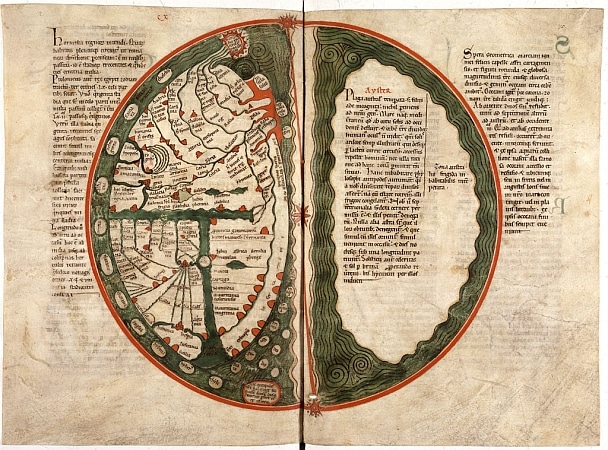
The conference, organised by the Medieval Studies Working Group, proposes a shift in perspective. Rather than concentrating on the so-called « irritation phenomena » (Christian Schneider), it seeks to explore the interdisciplinary potential of the concept of coherence by examining its transferability and applicability to questions of textual transmission and transmission contexts in medieval miscellaneous manuscripts. The conference invites an exploratory discussion of the extent to which the concept of coherence can be fruitfully applied to relationships between texts (both within transmission clusters and within seemingly self-contained sub collections), between text and image, text and paratext, text and musical notation, as well as to codicological units themselves.

The relationship between coherence and contingency in medieval miscellaneous manuscripts presents a methodological challenge in three respects. First, there is a terminological problem inherent in the conceptually ambiguous notion of the « miscellaneous manuscript. » Depending on the context, the term may refer either generally to any manuscript transmitting more than one text (a multiple-text manuscript) or, more specifically, to a deliberately planned collection of texts. Matters are further complicated by the subsequent combination of codicological units that may—or may not—have originally belonged together. Second, the historicity of coherence itself must be taken into account, since phenomena of coherence are inseparable from the historical development of the manuscript as an object. The involvement of multiple agents in the compilation, copying, deliberate rearrangement, and accidental rebinding of different codicological units gives rise to a range of distinct—and at times competing—notions of coherence, all of which must themselves be historicised. By what means are individual texts, text-image ensembles, and intermedial constellations connected within miscellaneous manuscripts, and from whose historical perspective do these relationships appear coherent? At what stage in the manuscript’s history such connections were established, and at what stage they were recognised, interpreted, or reshaped by later users? Third, any historically oriented research into the coherence of miscellaneous manuscripts—whether understood as units of textual transmission or as containing internally coherent sub-collections—must address the persistent problem of confirmation bias. Although this conference deliberately shifts the focus, in the spirit of the principle of charitable interpretation, away from inconsistency and towards coherence, it also calls for methodological reflection on the conditions under which patterns of coherence identified by modern scholarship may legitimately be regarded as historical features of medieval manuscripts, and where contingency provides the more convincing explanation. A conference devoted to the coherence of medieval miscellaneous manuscripts must therefore also engage in fundamental methodological reflection.

We welcome both theoretically informed contributions and case studies from all areas of medieval studies. Possible questions include, but are not limited to:
– How can relationships of coherence and equivalence within groups of texts be described?
– How is coherence established in intermedial constellations within manuscripts, especially in text-image relationships?
– To what extent can external and internal forms of coherence be distinguished?
– What functions do paratextual elements perform in their various verbal, non-verbal, and pictorial forms (e.g. headings, rubrication, chapter and section divisions, initials, or the division of texts into books)?
– Which elements provide structure across textual boundaries and thereby create connections between texts? What role codicological units do play in this process?
– Which strategies for creating coherence can be identified, including those related to processes of understanding and cognitive models?
– To what extent is it meaningful—or even possible—to distinguish between principles of external coherence (e.g. structural and paratextual features, episodicity, organisation principles, etc.) and internal coherence (e.g. repetition, doubling, equivalence, analogy, or correspondences on the textual and visual surface)?

Papers may be presented in either German or English. Please submit proposals of approximately 300 words (c. one page) by 1 October 2026 to: Tobias Daniels (Tobias.Daniels@mg.fak09.uni-muenchen.de)

Source : H-Soz-Kult
Publié dans Appel à contributions | Commentaires fermés sur Appel à contribution – The Construction of Meaning in Medieval Miscellaneous Manuscripts

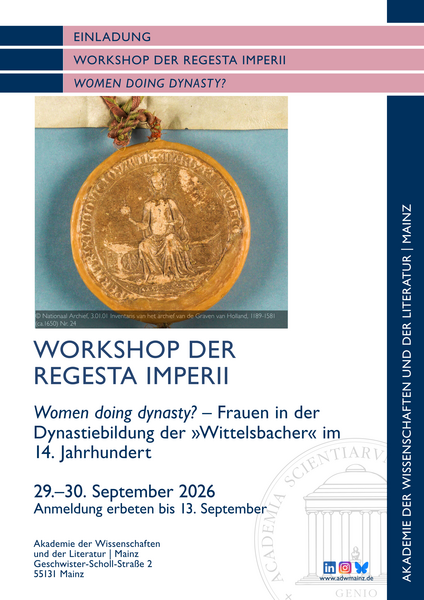
Colloque – Women doing dynasty? Frauen in der Dynastiebildung der „Wittelsbacher“ im 14. Jahrhundert

Um der Dynastiebildung des Hauses Bayern näherzukommen und zugleich eine neue Forschungsperspektive – weg vom « Mannesstamm » hin zu den weiblichen Verästelungen einer « Dynastie » – einzunehmen, veranstaltet die Arbeitsstelle Ludwig der Bayer der Regesta Imperii einen Workshop unter dem Titel « Women doing dynasty? – Frauen in der Dynastiebildung der ‚Wittelsbacher‘ im 14. Jahrhundert ».

Der Schwerpunkt liegt dabei auf Frauen des « Hauses Bayern » und seines Umfelds im 14. Jahrhundert, wobei bewusst offengelassen ist, wo eine Zugehörigkeit zu den « Wittelsbachern » beginnt bzw. endet: von Töchtern und Schwestern der bayerischen Herzöge über Ehefrauen, Witwen und Schwägerinnen zu Bediensteten oder Gattinnen von Getreuen. Dazu kommen Beispiele aus anderen zeitlichen und räumlichen Kontexten, um eine vergleichende Diskussion zu ermöglichen.

Der Workshop findet statt am 29. und 30. September 2026 an der Akademie der Wissenschaften und der Literatur Mainz. Um Anmeldung bis zum 13. September wird gebeten (dynastie-workshop@regesta-imperii.de).

Im Rahmen des Workshops soll ein Forschungsnetzwerk zu Ludwig dem Bayern und seiner Zeit eingerichtet werden. Die Teilnahme an diesem Programmpunkt (30. September, 17:20 Uhr) ist auf Anfrage per Zoom möglich.

Dienstag, 29. September 2026

13:00-13:30
Begrüßung
Michael Menzel (Berlin)

Einführung
Doris Bulach (Mainz) / Magdalena Weileder (Darmstadt)

Sektion 1: Für Erinnerung sorgen
Moderation: Cynthia Stöckle

13:30-14:00
Braut, Witwe, Anspruch – Frauenbilder als Ressource dynastischer Legitimation in der Historiographie am Beispiel der Kaiserinnen Adelheid (um 931–999) und Mathilde (1102–1167)
Jasmin Rubner (Wien)

14:00-14:30
Pfalzgräfin Heilika († 1170) und Herzogin Ludmilla († 1240) im Spiegel der klösterlichen Überlieferung
Gabriele Schlütter-Schindler (Straubing)

14:30-15:00
Katharina von Görz (um 1350–1391) als Initiatorin dynastischer Memoria in Andechs
Carola Fey (Erlangen/Mainz)

Pause

Sektion 2: Verbindungen herstellen
Moderation: Christina Abel

15:30-16:00
Handeln im dynastischen Interesse: Isabelle von Aragon und Friedrich der Schöne
Cristina Andenna (Saarbrücken)

16:00-16:30
Bayern und Tirol – Heiratsstrategien und ihre dynastischen Folgen (13.–15. Jahrhundert)
Julia Hörmann-Thurn und Taxis (Innsbruck)

16:30–17:00
Genealogische und politische Verflechtungen zwischen Wittelsbachern und Piasten an der Wende vom 13. zum 14. Jahrhundert: Die bayerischen Herzoginnen Anna († 1271) und Agnes von Schlesien Glogau († 1361) sowie Jutta († 1320) und Beatrix von Schlesien-Schweidnitz († 1322) und deren Töchter
Tobias Appl (Regensburg)

Pause

17:20–18:00
Vorstellung eines Netzwerks für Forschungen zu Ludwig dem Bayern und seiner Zeit
(Teilnahme per Zoom auf Anfrage möglich)

ab 19:00 Uhr
gemeinsames Abendessen

Mittwoch, 30. September 2026

Sektion 3: In Kontakt bleiben
Moderation: Julia Noll

9:00-9:30
Der Einfluss der Herkunftsfamilie auf die Herrschaftspraktiken weiblicher Adeliger – am Beispiel Mechthilds von Bayern (1275–1319) und Agnes’ von Bayern (1276–1340)
Corinna Turzyn (Hagen/Zell in Oberfranken)

9:30-10:00
Schwestern auf dem Thron: Die Sichtbarkeit weiblicher Macht im 14. Jahrhundert am Beispiel von Margarete und Philippa von Hennegau
Rebecca Lowton-Wilson (Düsseldorf)

10:00–10:30
Zwei ungleiche Brüder und ihre Nachkommen: Die Töchter der pfälzischen Wittelsbacher zur Zeit Ludwigs des Bayern
Heike Hawicks (Heidelberg)

Pause

Sektion 4: An Strippen ziehen
Moderation: Elena Scharnewski

10:30–11:00
Verhandlungen von und über Frauen. Fürstinnen als aktive und passive Vermittlerinnen bei der wittelsbachischen Übernahme Brandenburgs
Yannick Pultar (Mainz)

11:00–11:30
Mutter, Witwe – Regentin? Mechthild von Nassau († 1323), Jutta von Schlesien-Schweidnitz († 1320) und Agnes von Schlesien-Glogau († 1361) während der Vormundschaften über ihre Söhne
Linda Mosig (Heidelberg)

11:30–12:00
Ingeborg von Mecklenburg (um 1340–1395) in der Familie der Wittelsbacher: Weibliche Herrschaftsräume im regionalen Geflecht zwischen Altmark und Prignitz während der zweiten Hälfte des 14. Jahrhunderts
Sascha Bütow (Magdeburg)

12:30–13:00
Zusammenfassung
Tobias Fischer (München) / Sophie März (München)

Source : H-Soz-Kult

Publié dans Colloque | Commentaires fermés sur Colloque – Women doing dynasty? Frauen in der Dynastiebildung der „Wittelsbacher“ im 14. Jahrhundert

École d’été – 14e École d’été d’histoire économique. Régulations économiques et économies informelles aux époques médiévale et moderne

25, 26 et 27 août 2026 – Suse (Italie)

La 14e école d’été d’histoire économique qui se réunira à Suse (Piémont, Italie) les 25, 26 et 27 août 2026 aura pour thème « Régulations économiques et économies informelles aux époques médiévale et moderne ». Cette thématique permettra de poursuivre et d’approfondir celles qui ont été développées les années précédentes (la valeur des choses, la pauvreté, les biens communs, les moyens de paiement, la qualité, l’organisation du travail, les écritures de l’économie, entreprendre, la circulation des savoirs, le risque, les espaces du commerce, les économies de la nature, la guerre).

La 14e école d’été d’histoire économique se propose d’aborder le thème fondamental de la régulation qui englobe pour les économistes l’ensemble des règles explicites ou implicites qui organisent et encadrent la production, l’échange et la consommation. La notion englobe ainsi la question de la fixation et de la formation des prix, les contrôles de qualité et de quantité ainsi que la mesure de la valeur. C’est par conséquent une notion qui englobe l’ensemble de la sphère économique. Son existence entraîne, par antithèse, l’existence d’une sphère informelle, qui échappe ou tente d’échapper à toute forme d’organisation ou de contrôle. Bien que la notion soit utilisée essentiellement par les économistes, elle s’applique également les époques médiévale et moderne.

Programme

Jour 1 : mardi 25 août 2026

9 h Session 1 – L’historiographie médiévale et moderne

Laurent FELLER (Univ. Paris 1, LAMOP)
Anne CONCHON (Univ. Paris 1, IDHE.S)

10 h Discussion

10 h 30 Pause

11 h Session 2 – Le point de vue des économistes et des juristes

Agnès GRAMAIN (Univ. Lorraine, BETA)
Florent GARNIER (Univ. Toulouse Capitole, CTHDIP)

12 h Discussion

12 h 30 Repas

14 h 30 Session 3 – Régulation et encadrement des marchés

Maria GINATEMPO (Université de Sienne)
Aida CLEMENTE (Université de Foggia)

15 h 30 Discussion

16 h Pause

16 h 30 Session 4 – Session des doctorant.e.s et postdoctorant.e.s

coord. Emmanuel HUERTAS (Univ. Toulouse Jean-Jaurès, FRAMESPA)

Jour 2 : mercredi 26 août 2026

9 h Session 5 – Régulation de l’innovation

Luca MOLÀ (Université de Warwick)
Vincent DEMONT (Univ. Paris-Nanterre – IDHE.S)

10 h Discussion

10 h 30 Pause

11 h Session 6 – Session des doctorant.es et postdoctorant.es

coord. Julie CLAUSTRE (Univ. Paris-Cité, ECHELLES)

12 h Discussion

12 h 30 Repas

Après-midi : excursion dans le Val de Suse

Coord. Andrea ZONATO, archiviste

Jour 3 : jeudi 27 août 2026

9 h Session 7 – Règlement des contentieux

Aurélien MONTEL (Université Toulouse Jean-Jaurès, FRAMESPA)
Jean-Christophe BALOIS (Univ. Paris 8 Saint-Denis, IDHE.S)

10 h Discussion

10 h 30 Pause

11 h Session 8 – Session des doctorant.es et postdoctorant.es

coord. Cédric QUERTIER (CNRS, EFR)

12 h Discussion

12 h 30 Repas

14 h 30 Session 9 – Contournements : l’illicite et l’informel

Isabelle BRETTHAUER (Archives Nationales)
Virginie MARTIN (Univ. Paris 1 Panthéon-Sorbonne, IDHE.S)

15 h 30 Discussion

16 h Pause

16 h 30 Session 10 – Espace et territoire : encadrer et contrôler

Judicaël PETROWISTE (Univ. Paris Cité, ECHELLES) et Jean-François MOUFFLET (Archives Nationales)
Julien VILLAIN (Univ. Évry Paris-Saclay, IDHE.S)

17 h 30 Discussion

18 h 30 Fin des travaux de l’école d’été

Contact : Emmanuel Huertas (Univ. Toulouse 2) : emmanuel.huertas@univ-tlse2.fr

Organisation / comité scientifique

Anne-Laure Alard-Bonhoure | Université Paris 1 Panthéon-Sorbonne, LAMOP
Michela Barbot | CNRS/ENS Paris-Saclay, IDHE.S
Patrice Baubeau | Université Paris Nanterre, IDHE.S
Marc Bompaire | École pratique des Hautes Études, SAPRAT
Julie Claustre | Université Paris-Cité, Echelles
Anne Conchon  | Université Paris 1 Panthéon-Sorbonne, IDHE.S
Laurent Feller | Université Paris 1 Panthéon-Sorbonne, LAMOP
Alessio Fiore | Université de Turin
Florent Garnier | Univ. Toulouse Capitole, CTHDIP
Agnès Gramain | Université de Lorraine, BETA
Jérôme Hayez | CNRS, LAMOP
Emmanuel Huertas | Université Toulouse Jean Jaurès, FRAMESPA
Jean-François Moufflet | Archives Nationales
Cédric Quertier | CNRS, EFR

Participants

  1. Anne-Laure ALARD-BONHOURE (Univ. Paris 1 Panthéon-Sorbonne, LAMOP)
  2. Jean-Christophe BALOIS (Univ. Paris 8 Saint-Denis, IDHE.S)
  3. Isabelle BRETTHAUER (Archives Nationales)
  4. Julie CLAUSTRE (Univ. Paris-Cité, ECHELLES)
  5. Aida CLEMENTE (Université de Foggia)
  6. Anne CONCHON (Univ. Paris 1 Panthéon-Sorbonne, IDHE.S)
  7. Vincent DEMONT (Univ. Paris-Nanterre – IDHE.S)
  8. Laurent FELLER (Univ. Paris 1 Panthéon-Sorbonne, LAMOP)
  9. Alessio FIORE (Université de Turin)
  10. Florent GARNIER (Univ. Toulouse Capitole, CTHDIP)
  11. Maria GINATEMPO (Université de Sienne)
  12. Agnès GRAMAIN (Univ. de Lorraine, BETA)
  13. Jérôme HAYEZ (CNRS, LAMOP)
  14. Emmanuel HUERTAS (Univ. Toulouse Jean-Jaurès, FRAMESPA)
  15. Luca MOLÀ (Université de Warwick)
  16. Aurélien MONTEL (Université Toulouse Jean-Jaurès, FRAMESPA)
  17. Jean-François MOUFFLET (Archives Nationales)
  18. Judicaël PETROWISTE (Univ. Paris Cité, ECHELLES)
  19. Cédric QUERTIER (CNRS, EFR)
  20. Lorenzo TABARRINI (Université de Bologne)
  21. Julien VILLAIN (Univ. Évry Paris-Saclay), IDHE.S)

Doctorant.es – Postdoctorant.es

Tom Balbin-Estanguet
François Bartolomei
Magdé Bieliniené
Cécile Bournat-Querat
Jeanne Lefebvre
José Martin Mediero
Abily Matei
Joséphine Moulier-Clabris
Gauthier Pétigny (de)
Renaud Seyfried
Matteo Stroppiana
Seb Verlinden

Source : LAMOP – Hypothèses

Publié dans École d'été | Commentaires fermés sur École d’été – 14e École d’été d’histoire économique. Régulations économiques et économies informelles aux époques médiévale et moderne

Appel à contribution – Communities of Production and Reception in Medieval Hagiography

Leeds IMC 2027
July 5th-8th

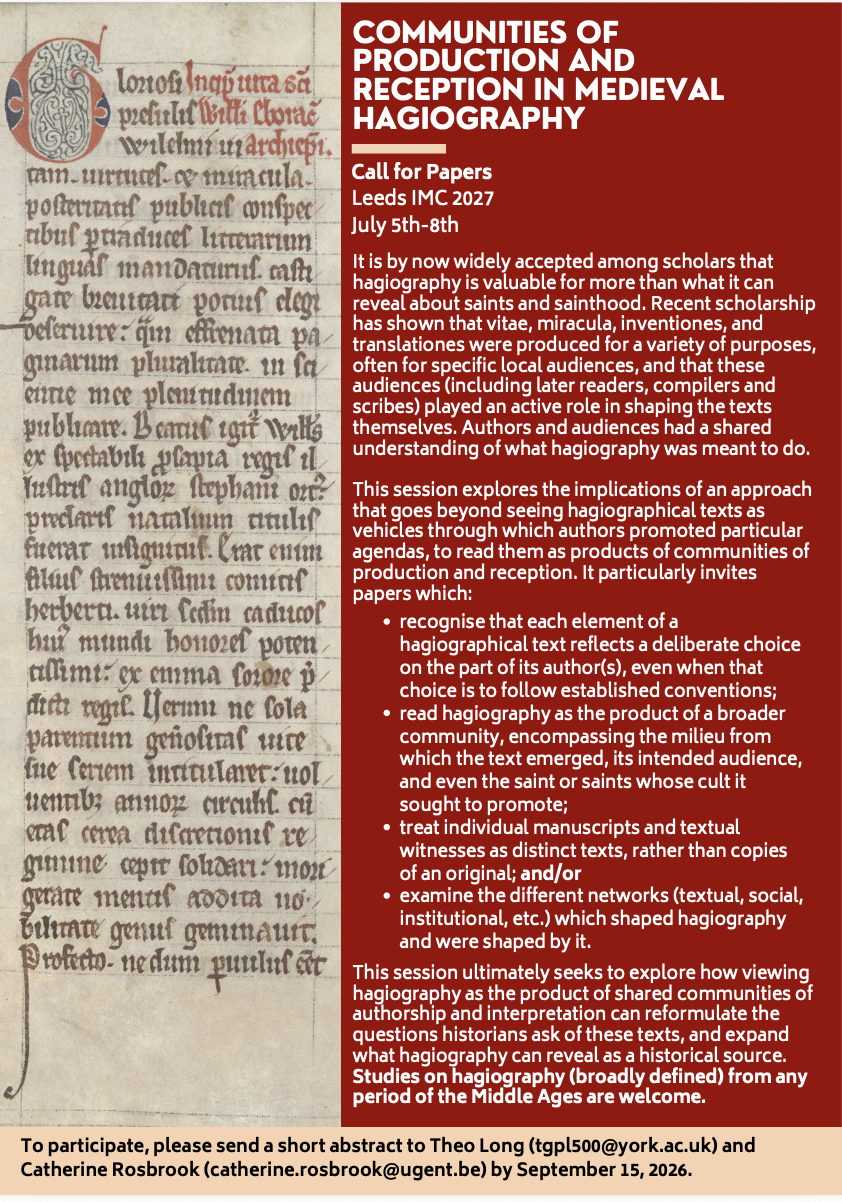
It is by now widely accepted among scholars that hagiography is valuable for more than what it can reveal about saints and sainthood. Recent scholarship has shown that vitae, miracula, inventiones, and translationes were produced for a variety of purposes, often for specific local audiences, and that these audiences (including later readers, compilers and scribes) played an active role in shaping the texts themselves. Authors and audiences had a shared understanding of what hagiography was meant to do.

This session explores the implications of an approach that goes beyond seeing hagiographical texts as vehicles through which authors promoted particular agendas, to read them as products of communities of production and reception. It particularly invites papers which:

  • recognise that each element of a hagiographical text reflects a deliberate choice on the part of its author(s), even when that choice is to follow established conventions;
  • read hagiography as the product of a broader community, encompassing the milieu from which the text emerged, its intended audience, and even the saint or saints whose cult it sought to promote;
  • treat individual manuscripts and textual witnesses as distinct texts, rather than copies of an original; and/or examine the different networks (textual, social, institutional, etc.) which shaped hagiography and were shaped by it.

This session ultimately seeks to explore how viewing hagiography as the product of shared communities of authorship and interpretation can reformulate the questions historians ask of these texts, and expand what hagiography can reveal as a historical source.

Studies on hagiography (broadly defined) from any period of the Middle Ages are welcome.

To participate, please send a short abstract to Theo Long (tgpl500@york.ac.uk) and Catherine Rosbrook (catherine.rosbrook@ugent.be) by September 15, 2026.

Publié dans Appel à contributions | Commentaires fermés sur Appel à contribution – Communities of Production and Reception in Medieval Hagiography

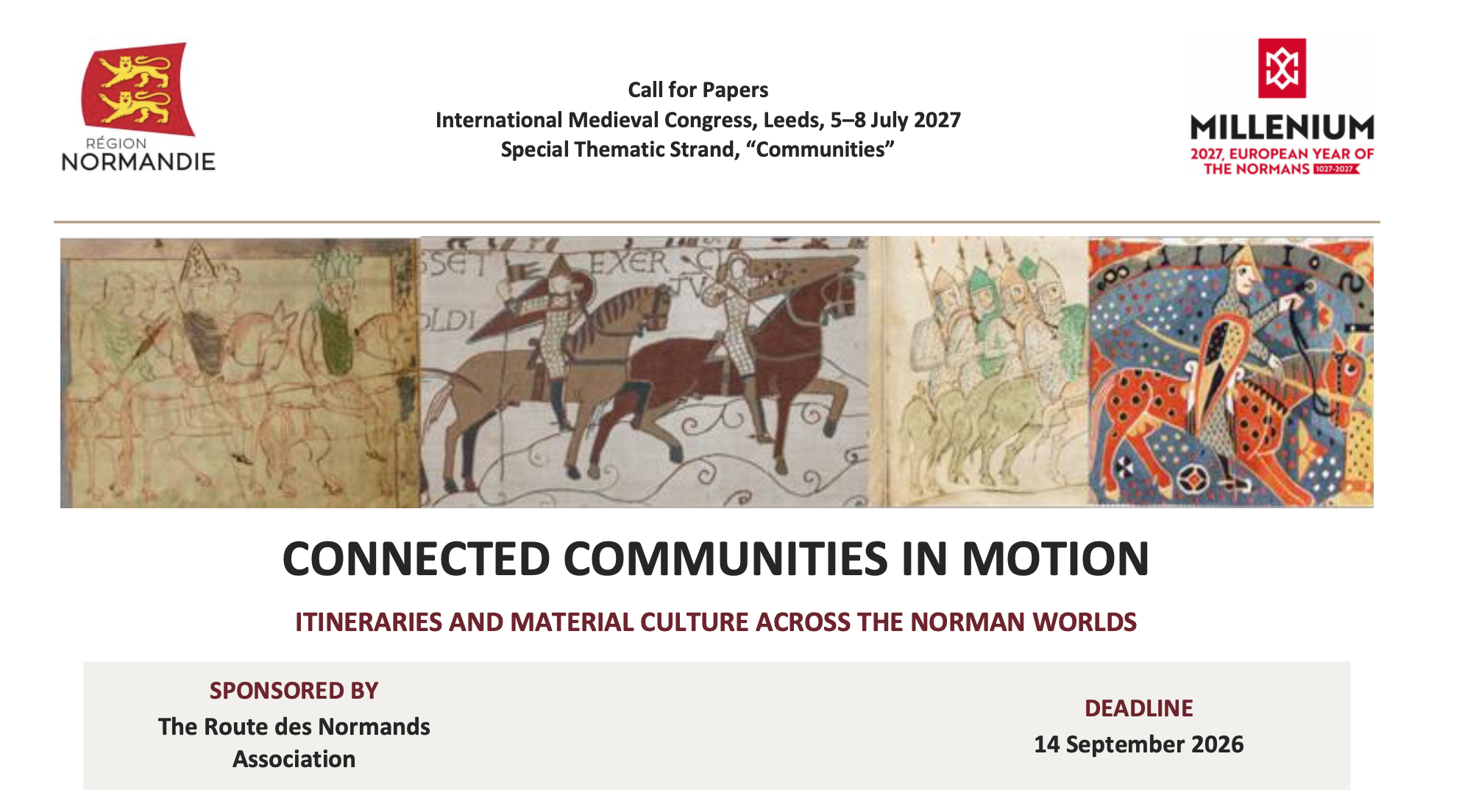
Appel à contribution – Connected Communities in Motion. Itineraries and Material Culture across the Norman World

SPONSORED BY : The Route des Normands
DEADLINE : 14 September 2026

IMC Leeds 2027

The mobility of Norman communities was one of the historical phenomena that most profoundly shaped medieval Europe. The sessions aim to reconstruct its material consequences by examining monuments and objects within a transregional and transnational framework and by identifying networks of patronage, religious devotion, production, and exchange. Through an interdisciplinary approach, they seek to reconsider the interconnected sites, forms of artistic and artisanal production, landscapes, and cultural practices that are essential to a fuller understanding of the establishment and development of Norman communities across Europe, from the Atlantic to the Mediterranean.

The sessions will focus on historically identifiable itineraries and networks, including court itineraries, monastic and episcopal connections, pilgrimage circuits, maritime routes, commercial exchanges, and diplomatic contacts.

They will explore how these connections shaped architectural patronage, artistic production, manuscript culture, liturgical and funerary practices, and the diffusion of transregional cults.

The sessions do not seek to define a homogeneous “Norman style” or to reconstruct a linear diffusion of forms from Normandy. Rather, they will examine how buildings, monumental complexes, manuscripts, liturgical furnishings, tombs, and portable objects were produced within specific local contexts while also responding to the circulation of patrons, ecclesiastical personnel, craftsmen, materials, texts, relics, rites, and technical knowledge.

This approach builds on recent research into the agents and mechanisms of cultural transfer, as well as the political, ritual, and social functions of material culture in the Norman worlds.

In keeping with the IMC theme of “Communities,” the sessions will examine networks of patronage associated with Norman communities and their role in the production, use, and circulation of material culture.

SESSION I – Architecture, Patronage, and Networks of Construction

This session will examine how political authority, ecclesiastical organisation, pilgrimage, and economic exchange shaped the foundation, transformation, and use of buildings and monumental complexes.

Possible topics include
• royal, aristocratic, episcopal, and monastic patronage;
• court itineraries and the geography of architectural commissions;
• the movement of builders, craftsmen, materials, and technical knowledge;
• construction sites and the organisation of labour;
• the relationship between land routes, maritime routes, shrines, settlements, and monumental foundations;
• the adaptation or reuse of Roman, Byzantine, Islamic, Anglo-Saxon, Lombard, and other local structures;
• the impact of political and economic networks on architectural production.

SESSION II – Images, Manuscripts, and Material Exchange

This session will investigate the circulation, adaptation, and local reworking of artistic and technical knowledge in sculpture, painting, manuscript production, monumental decoration, and the decorative arts.

Possible topics include
• architectural sculpture, mural painting, mosaics, pavements, and stained glass;
• illuminated manuscripts, liturgical books, cartularies, chronicles, and Exultet rolls;
• relationships between monumental decoration, manuscript illumination, and portable objects;
• the movement of scribes, illuminators, sculptors, painters, mosaicists, and specialised craftsmen;
• workshops, communities of practice, and the transmission of techniques;
• textiles, ivory carving, metalwork, reliquaries, seals, coins, and liturgical furnishings;
• artistic commissions prompted by diplomacy, dynastic marriage, trade, gift exchange, warfare, or the translation of relics;

• the movement and availability of stone, marble, timber, metals, pigments, parchment, and luxury materials.

SESSION III

Sacred Routes, Liturgy, Cult, and Monumental Memory

This session will consider how the movement of clergy, books, relics, rites, and devotional practices shaped religious buildings and the material organisation of worship, burial, and commemoration.

Possible topics include

• relationships between liturgical practice and the architectural arrangement of churches;
• altars, choirs, crypts, chapels, screens, ambulatories, and processional spaces;
• the circulation of liturgical books, chants, calendars, ceremonial practices, and monastic customs;
• episcopal and monastic networks as channels for the transmission of ritual and architectural practices;
• pilgrimage routes, relic translations, shrines, and transregional saints’ cults;
• the material consequences of devotion to saints such as Michael, Nicholas, Thomas Becket, and Catherine of Alexandria;
• royal, aristocratic, episcopal, and monastic burial practices;
• monumental tombs, mausolea, burial chapels, inscriptions, and funerary imagery;
• dynastic memoria, anniversaries, necrologies, commemorative foundations, and the liturgy of the dead.

The Route des Normands ssociation, founded at the initiative of the Normandy Region, is a French non-profit association governed by the Law of 1 July 1901, formally declared to the French prefectural authorities in mars 2026 and headquartered at the Abbaye-aux-Dames in Caen. Its founding members are the Normandy Region, the British Council, Ireland’s National Monuments Service, Jersey Heritage Trust, and Guernsey Museums. Building on Millennium 2027 – European Year of the Normans, the Association is establishing the historical, scientific, and institutional foundations of the Route des Normands, with a view to its certification as a Cultural Route of the Council of Europe. The initiative also benefits from the support and prospective involvement of regions in southern Italy, whose historical and cultural heritage forms an essential component of the wider Norman world. Its Scientific Committee brings together university professors with recognised expertise in Norman studies and related fields, drawn from participating institutions across France, England, Wales, Ireland, Northern Ireland, Scotland, and Italy.

The sessions will contribute to the historical and scholarly foundations of the Route des Normands as a network of interconnected sites, collections, sacred landscapes, and cultural practices.

Submission of Proposals

Proposals are invited from scholars working on the history, material culture, and religious life of the Norman worlds. Papers may focus on a building, work of art, manuscript, patron, institution, burial site, or cult, provided that the case study is situated within a clearly defined itinerary or network, or linked to a historically plausible mechanism of transmission.

Submissions should include a title, an abstract of no more than 350 words, a short biography of no more than 100 words, institutional affiliation, contact details, and four or five keywords.

Papers will be either 15 or 20 minutes long. Selected proposals will be organised into linked 90-minute sessions and submitted to the IMC Programming Committee.

Please send proposals by 14 September 2026 to:
Giacomo D’Andrea

Session Organiser :
Route des Normands Association, Normandy Region
giacomo.dandrea@normandie.fr

Publié dans Appel à contributions | Commentaires fermés sur Appel à contribution – Connected Communities in Motion. Itineraries and Material Culture across the Norman World

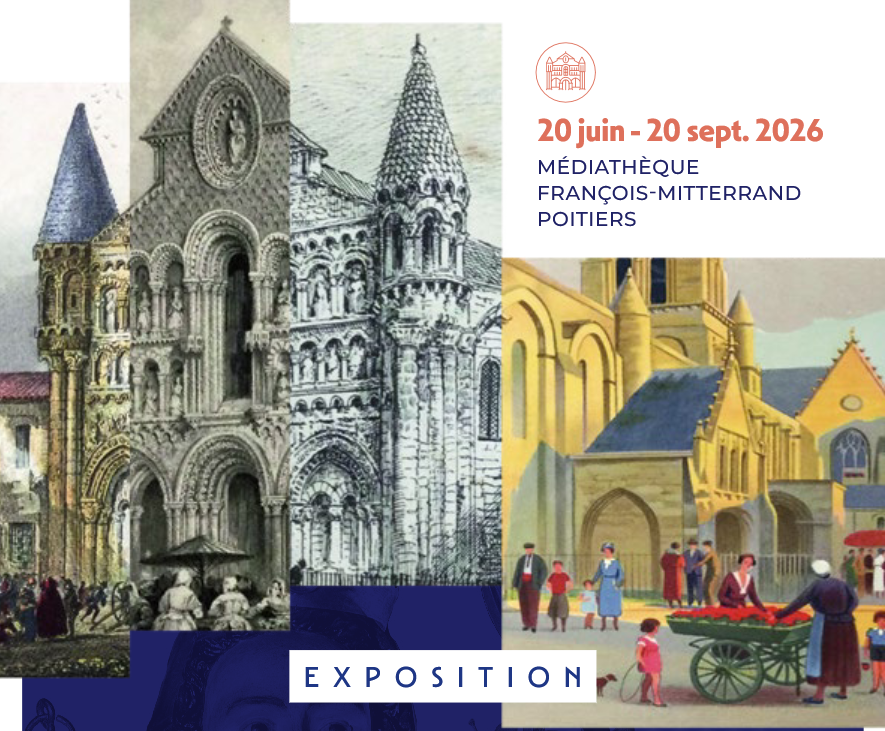
Exposition – Notre-Dame-la-Grande : icône de Poitiers

L’église Notre-Dame-la-Grande apparaît comme l’une des images les plus emblématiques de Poitiers. Avec sa façade sculptée, elle occupe une place centrale dans les représentations de la ville. Pourtant, cette évidence est le résultat d’une histoire longue, construite progressivement, au fil des siècles, à travers les usages de l’édifice, les transformations de la ville et l’évolution du regard porté sur le Moyen Âge.

L’exposition «  Notre-Dame-la-Grande, icône de Poitiers  » revient sur l’importance artistique de ce monument, sur son histoire, sur ses représentations et sur sa place primordiale dans l’histoire de la cité poitevine depuis sa construction à la fin du 11e siècle à aujourd’hui.

Exposition proposée par la Ville de Poitiers en partenariat avec la médiathèque François-Mitterrand, Les Musées de Poitiers, le CESCM et la Société des Antiquaires de l’Ouest (SAO) dans le cadre du chantier de restauration de l’église Notre-Dame-la-Grande. 

Informations pratiques :

20 juin-20 sept. 2026
Médiathèque François-Mitterrand – Poitiers

Entrée libre.

Du 20 au 30 juin, et du 1er au 19 septembre, ouvert le mardi et jeudi (11 h-19 h), le mercredi et vendredi (11 h-18 h) et le samedi (10 h-18 h).
Du 1er juillet au 29 août, ouvert du mardi au vendredi (13 h-18 h) et le samedi (10 h-18 h).

Source : CESCM

Publié dans Exposition | Commentaires fermés sur Exposition – Notre-Dame-la-Grande : icône de Poitiers

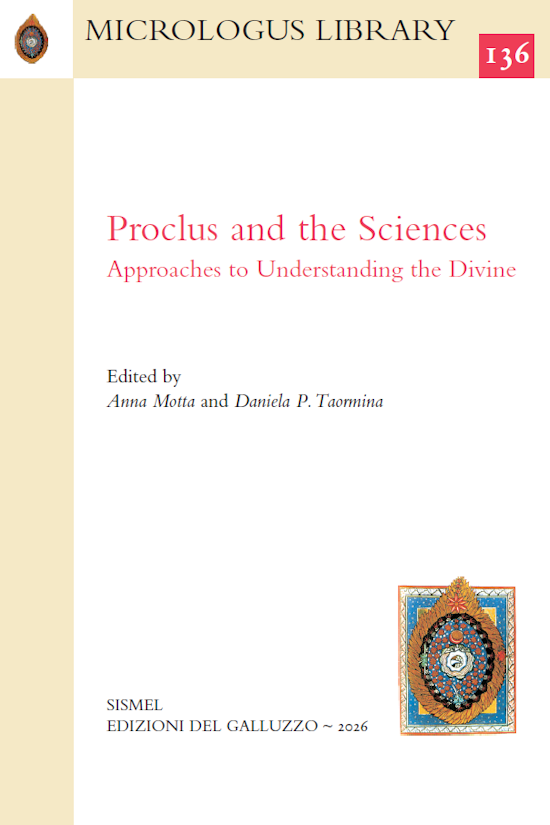
Publication – « Proclus and the Sciences. Approaches to Understanding the Divine », éd. Anna Motta, Daniela P. Taormina

Proclus and the Sciences. Approaches to Understanding the Divine, éd. Anna Motta, Daniela P. Taormina, Florence, SISMEL–ED. del Galluzzo, 2026 ; 1 vol., X–373 p. (Micrologus Library, 136). ISBN : 978-88-9290-508-5. Prix : € 62,00.

Table des matières :

Proclus and the Sciences — A. Motta, D. P. Taormina

I. Mathematics: Branches, Ontological Status and Method

Syrianus and Proclus on Why True Mathematics Cannot Be Empirically Based — Dominic J. O’Meara

The Place of Music in Proclus’ Conception of Mathematical Exegesis — A. Sheppard

Incommensurability in Geometrical Entities in Proclus’ In Eucl. and In Prm. — D. Walter

The Unfolded Syntax of Intellect: Proclus on the Metaphysical Foundations of Elementary Arrangements — Á. J. Campillo Bo

Can the Will Ground Science? — A. Vargas

II. Mathematics: A Bridge to Theology

Proclus on the Usefulness of Mathematics for Theology — C. Steel

La mathématique générale chez Proclus — A. Lernould

Relations That Are Given and Established. Proclus’ Use of Analogical Reasoning in Theology — M. Martijn

L’Arithmos divino nel sistema metafisico di Proclo — M. Cutino

Les structures numériques des ordres divins dans la Théologie Platonicienne de Proclus. De la triade à l’hebdomade et à la dodécade — P. Hoffmann

III. Other Sciences and the Divine

Proclus’ Potamology: The Role of Rivers in Eschatology — G. Van Riel

Proclus’ “Theological” Spherical Cosmic Whole and His Scientific Innovative Astronomy — E. Kutash

IV. A Philological Proclean Appendix

Difformità storico-tradizionali in Proclo, Commento all’Alcibiade I e Commento al Timeo tra il periodo mediobizantino e l’età dei Paleologi: Giorgio Pachimere (Napoli, BN, III.E.17, In Alc.), Giovanni Catrario (Napoli, BN, III.D.28, In Ti.) e lo Upatos ton pilosopon Michele Psello (Patmos Eileton 897) — M. Menchelli

Source : SISMEL

Publié dans Publications | Commentaires fermés sur Publication – « Proclus and the Sciences. Approaches to Understanding the Divine », éd. Anna Motta, Daniela P. Taormina

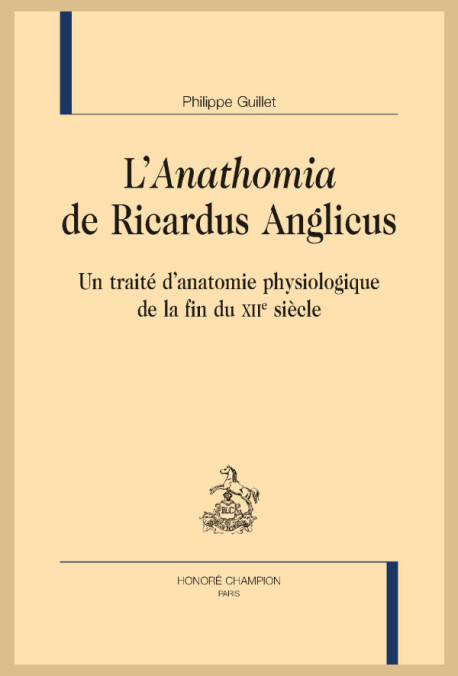
Publication – Philippe Guillet, « L’Anathomia de Ricardus Anglicus. Un traité d’anatomie physiologique de la fin du XIIe siècle »

Les bases médiévales de l’anatomie moderne, définie comme une connaissance approfondie de la structure et de l’organisation du corps humain essentielle à la médecine, émergent en Italie à la fin des XIIIe et XIVe siècles. Les textes médicaux des XIIe et XIIIe siècles s’intéressent précocement à l’anatomie, non pas dans le contexte de la chirurgie, qui n’a pas encore clairement manifesté d’intérêt pour cette discipline, mais plutôt dans une perspective naturaliste plus large, visant à comprendre l’organisation et le fonctionnement des différents membres du corps humain. Un texte notable illustrant cet intérêt est l’Anathomia Ricardi, également connue sous le nom d’Anathomia Ricardi Salernitani. Les historiens allemands de la médecine, qui en ont publié les premiers manuscrits à la fin du XIXe siècle, pensaient qu’il avait été écrit à Salerne.

Il s’agit de la première synthèse intégrant les informations anatomiques et physiologiques détaillées dans le Pantegni de Constantin l’Africain, mais organisée en suivant la classification des membres principaux de Galien dans le Tegni, version médiévale de son Art médical.

Les résultats de notre enquête présentés dans ce livre, révèlent que les copies successives de ce texte, écrit à la fin du XIIe siècle, se divisent en deux traditions distinctes, chacune ayant connu un succès certain. La première tradition, écrite par un médecin du nom de Ricardus anglicus, possiblement à Montpellier, diffuse rapidement dès le début du XIIIe siècle à travers le réseau abbatial, vers le nord et l’est de l’Europe (France, Angleterre, Allemagne, Pologne). La seconde tradition résulte d’une révision significative de ce texte initial, intégrant des éléments issus des œuvres biologiques d’Aristote peu après leur traduction au XIIIe siècle. Elle semble être enseignée à Montpellier, et ses copies gagnent également rapidement les mêmes régions géographiques que la première. Ces traditions furent l’objet d’adaptations en langue vernaculaire au XVe siècle, attestant leur intérêt persistant pendant trois siècles.

Philippe Guillet, médecin et historien des sciences et des techniques est actuellement chercheur associé à l’équipe SAPRAT (Savoirs et pratiques du Moyen Âge à l’époque moderne) de l’EPHE.

Table des matières : ici

Informations pratiques :

Philippe Guillet, L’Anathomia de Ricardus Anglicus. Un traité d’anatomie physiologique de la fin du XIIe siècle, Paris, Honoré Champion, 2026 ; 1 vol., 414 p. (Sciences, technique, 25). ISBN : 978-2-74536-629-0. Prix : € 45,00.

Source : Honoré Champion

Publié dans Publications | Commentaires fermés sur Publication – Philippe Guillet, « L’Anathomia de Ricardus Anglicus. Un traité d’anatomie physiologique de la fin du XIIe siècle »

Offre d’emploi – Lecturer in Medieval History (University of Glasgow)

Deadline : 5th August 2026

This post is full time (35 hours per week) and is open ended.

The History subject in the College of Arts and Humanities is seeking to appoint a Research and Teaching Track lecturer in Medieval History. The postholder will undertake field leading research in European medieval history (c.800 CE to 1500CE), ideally through either a comparative transnational perspective (e.g. Europe’s links with medieval Islam, non-Islamic Africa, and wider Eurasia), or through a set of interdisciplinary lenses that opens medieval history to substantive research collaborations beyond the traditional humanities (e.g. medical humanities, environmental humanities).

The post-holder’s research and teaching interests will complement rather than duplicate those of current staff on opened-ended contracts (these can be viewed on the History staff page). Through both individual and team-taught modules, and in collaboration with colleagues in the History subject areas, they will provide high-quality teaching and administrative service in a range of roles.

In any given year the post-holder can expect to be asked to contribute a mix of the following teaching activities:

  • Seminar teaching and lectures for History 1A (the core pre-Honours Medieval History course for the undergraduate degree in History).
  • A 60-credit fourth-year special subject across the entire academic year
  • 1 to 2 20-credit Honours modules for a class of up to 36 students,
  • Provide UG/PG dissertation supervision
  • PGT teaching (either as part of a team or as an individual), both in their own field of interest and in the skills and methodologies of medieval history scholarship.
  • The post-holder will also be expected to contribute to the ongoing development of cross-discipline Medieval research and teaching collaboration.

A core expectation of the post-holder will be to provide engaging and high-recruiting teaching and UG, PGT and PGR supervision on Medieval History.

The postholder will be expected to pursue their own research as a third of their contracted time.

For informal enquiries, please contact Prof. Andrew Mackillop:

Email Andrew.Mackillop@glasgow.ac.uk

For more about the History subject area at Glasgow, see www.gla.ac.uk/subjects/history

Closing date: 5th August 2026 at 23:45

We believe that we can only reach our full potential through the talents of all. Equality, diversity and inclusion are at the heart of our values. Applications are particularly welcome from across our communities and in particular people from the Black, Asian and Minority Ethnic (BAME) community, and other protected characteristics who are under-represented within the University. Read more on how the University promotes and embeds all aspects of equality and diversity within our community www.gla.ac.uk/myglasgow/humanresources/equalitydiversity.

We endorse the principles of Athena Swan www.gla.ac.uk/myglasgow/humanresources/equalitydiversity/athenaswan and hold bronze, silver and gold awards across the University.

Source : H-Soz-Kult

Publié dans Offre d'emploi | Commentaires fermés sur Offre d’emploi – Lecturer in Medieval History (University of Glasgow)

Podcast – Angélique Ferrand, « Du Zodiaque et des Hommes »

Hérités de l’Antiquité, les signes du zodiaque ont perduré au Moyen Âge au sein du lieu ecclésial, dans le décor monumental du portail, à l’intérieur des calendriers ornant les manuscrits ou bien encore sur les objets du mobilier liturgique. La dimension à la fois spatiale et temporelle du Zodiaque, inhérente à sa tradition scientifique située à la croisée de l’astronomie et de l’astrologie, sous-tend l’agencement de ses images, leur emplacement et le discours idéologique véhiculé.

Lors de cette conférence, Angélique Ferrand propose de nous intéresser à la resémantisation chrétienne du zodiaque dans les décors monumentaux ecclésiaux entre les XIe et XIIIe siècles. Il s’agira d’une part, d’observer comment le zodiaque contribue à l’évocation de la Porta coeli et à la médiation entre ciel et terre en relation avec de grands thèmes iconographiques. D’autre part, certaines occurrences des signes du zodiaque dans des décors des XIIe et XIIIe siècles, en particulier de la Vierge et de la Balance, ont fait l’objet d’une resémantisation plus prononcée comme nous le montrerons.

Source : École nationale des chartes – YouTube

Publié dans Podcast | Commentaires fermés sur Podcast – Angélique Ferrand, « Du Zodiaque et des Hommes »