Appel à contribution – Rituals of Gender Staging and Performance in the Middle Ages

The Network for Medieval Arts & Rituals (NetMAR), an international, interdisciplinary network investigating the intersections between medieval arts and rituals, invites proposals for 20-minute papers that address the role of rituals in the staging and performance of medieval gender roles. The conference, which will include scholars of different career stages, will be held at the premises of the University of Bamberg between the 3rd and 4th of May 2023.
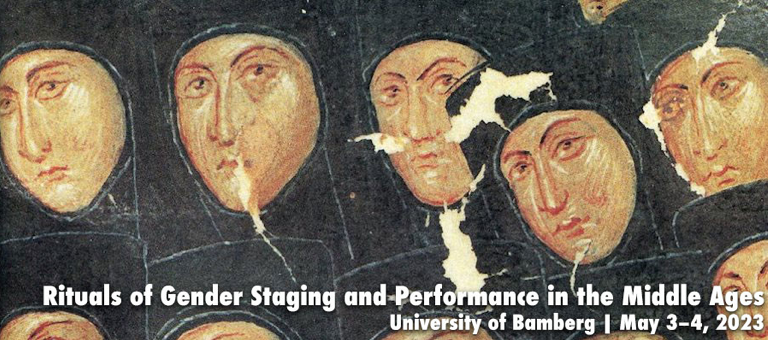
The Middle Ages are generally regarded as an era in which symbolic communication played an important and extensive role in almost all areas of life. Medieval rituals are, as Gerhard Althoff has defined them, “longer sequences of actions whose processes are committed to patterns and create a performative impact; they cause what they show” (Rules and Rituals in Medieval Power Games, 2020: 9). Rituals serve the medieval need for producing religious, legal, power-consolidating, and magical acts in symbolic ways. They can be understood, according to Hannah Vollrath, as forms of multi-sensory communication that addresses the senses and feelings of participants. In short, rituals become perceptible through the senses that render them meaningful and powerful.

Medieval ritual research has so far focused on the role of rituals in the contexts of religion and power relations. It is obvious, however, that in the patriarchally organised and male dominated societies of the Middle Ages, rituals also played a significant role in the staging and performance of gender roles. Sharon T. Strocchia comes to the same conclusion when she observes “that ritual and gender offer valuable new ways to study power and systems of social relations,” while at the same time noting that the interactions of gender and ritual have so far remained “largely unexplored” (Funerals and the Politics of Gender, 1991: 155). Taking this into account, a closer examination of ritual as a possible form of solidification and confirmation of gender roles seems worthwhile.

Speakers of all medievalist disciplines are invited to use various textual and/or visual sources to explore the complicated intersections of sex, body and gender through the lens of medieval ritual. Of interest are topics such as the following:

  • gender-specific initiation rituals
  • ritualistic consolidations of male and female family roles
  • rituals of male- and female-dominated professions
  • male and female power relations
  • gender-specific burial practices
  • the role of women in religious and magical rituals
  • female agency and ritual art
  • ritual and gender transgression in iconography and beyond
  • rituals and pregnancy.

The language of the conference is English. Please send an abstract (max. 300 words) and a brief biographical note to michaela.poelzl@uni-bamberg.de by no later than 15 January 2023. Notifications of acceptance will be sent by February 2023.

NetMAR is funded by the European Union’s Horizon 2020 research and innovation programme under grant agreement No. 951875. Learn more about the network at https://netmar.cy.

Source : Medieval Art Research
Publié dans Appel à contributions | Laisser un commentaire

Appel à contribution – Vivre, prier et mourir dans un espace insulaire et côtier entre le IVe et le XIIe s.

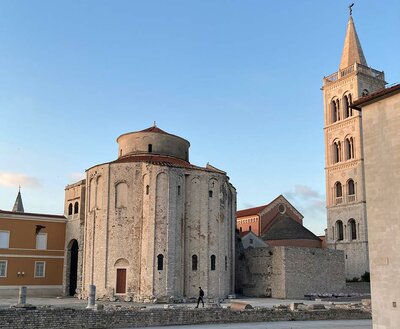
Atelier du 17 au 21 avril 2023 à Zadar, Croatie – envoi des candidatures avant le 31/01/2023

Le programme ANR MONACORALE, en collaboration avec l’École française de Rome, l’Université de Zadar et les UMR Chrono-Environnement, ARTEHIS, HISOMA, Orient et Méditerranée, organise un atelier doctoral à l’université de Zadar (Croatie), du 17 au 21 avril 2023. Cet atelier a pour objectif de rassembler doctorants ou post-doctorants (ayant soutenu leur thèse depuis moins de 5 ans) et chercheurs autour de questions historiques et archéologiques portant sur des thématiques religieuses et funéraires, économiques, environnementales, sur l’occupation du sol et le peuplement, sur la culture matérielle, etc. Ces approches seront spécifiques aux espaces insulaires et côtiers, de la fin de l’Antiquité au Moyen Âge central.

Résolument interdisciplinaire, cette rencontre devra permettre la confrontation et la mise en perspective de données issues de disciplines aussi distinctes que l’étude archivistique, l’archéologie, la géoarchéologie, l’archéologie du paysage, l’histoire de l’art, l’anthropologie funéraire, l’épigraphie, etc. Les sujets abordés pourront accorder une part aux questions historiographiques, mais s’appuieront pour l’essentiel sur des programmes de recherches récents et des recherches doctorales ou post-doctorales en cours. Les interventions des chercheurs porteront avant tout sur l’espace adriatique, mais dans une perspective d’ordre méthodologique et comparative avec d’autres espaces côtiers et insulaires, méditerranéens ou septentrionaux, traités dans le cadre de travaux doctoraux.

L’atelier doctoral se déroulera en deux temps :
1. Six demi-journées seront consacrées à la formation théorique ; elles comprendront des interventions à caractère général présentées par des chercheurs (60 minutes) et la présentation des travaux des doctorants (pendant 20 minutes),
2. Trois demi-journées seront réservées à la visite de monuments et de sites archéologiques religieux de l’Antiquité tardive et du Moyen Âge de Zadar et de sa région.

L’École française propose 12 bourses pour de jeunes chercheurs (doctorants et post-doctorants de la Communauté européenne et d’autres pays) ayant effectué ou effectuant un travail de recherche concernant l’espace adriatique.
Ces bourses couvrent uniquement les frais de séjour en Croatie du lundi 17 avril au samedi 22 avril 2023. Le transport est à la charge des étudiants.

Les candidat-e-s devront envoyer par e-mail, avant le 31 janvier 2023, à l’adresse dirma(at)efrome.it
un dossier constitué de :
– une lettre de motivation
– un bref curriculum vitae précisant les compétences linguistiques et, le cas échéant, une liste de publications
– un résumé du projet (2 pages au max., env. 6000 signes)
– une lettre de recommandation
Les candidat-e-s seront choisi-e-s en considération de leur projet par le comité scientifique. Ils seront prévenus de l’obtention de la bourse avant le 11 mars 2023.

Les candidats retenus pour l’atelier seront tenus d’assister à l’ensemble des séances.

Comité scientifique
Josipa Baraka Perica, Sébastien Bully, Morana Čaušević-Bully, Pascale Chevalier, Stéphane Gioanni, Etleva Nallbani, Vivien Prigent

Contacts
École française de Rome
Vivien Prigent, Directeur des études médiévales
Piazza Farnese, 67 – I – 00186 Roma – Tel. (+39) 06 68 60 15 16 – dirma(at)efrome.it

Source : École française de Rome

Publié dans Appel à contributions | Laisser un commentaire

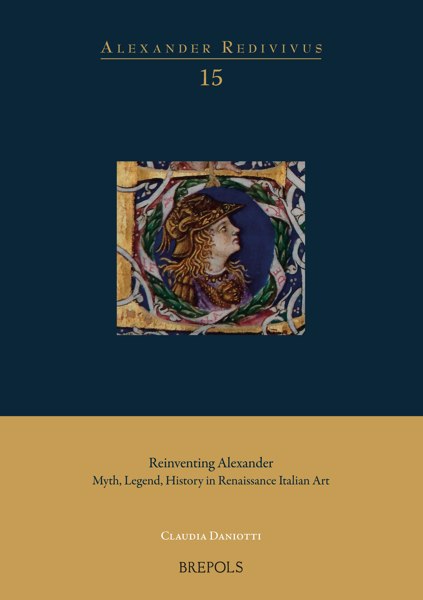
Publication – Claudia Daniotti, « Reinventing Alexander. Myth, Legend, History in Renaissance Italian Art »

In this book Claudia Daniotti provides the first comprehensive study of the representation of Alexander the Great in Renaissance Italian art, exploring a fundamental turning point in the tradition: the transition from the medieval imagery of Alexander as a legendary, fairy-tale hero to the new historically grounded portrait of him as an example of moral virtue and military prowess.

During the Middle Ages, Alexander was turned into a fabled creature and fearless explorer, whose Flight to Heaven and other marvellous adventures were tirelessly recounted and illustrated, enjoying huge popularity. With the humanist recovery of the ancient historical texts and the changing taste and expectations of the wider, wealthier and more diverse public of the courts and cities of the Italian peninsula, the fabulous aura that had surrounded Alexander for centuries evaporated. He was recast as the moral exemplum and valorous military commander spoken of by the newly available ancient historians, and became the protagonist of an unprecedently vast iconographic repertoire established in the course of the sixteenth century.

By discussing a body of artworks from 1160s to 1560s spanning several media (from illuminated manuscripts and frescoes to sculptural reliefs, wedding chests and tapestries) and researching this material in constant dialogue with the literary tradition, this book offers a reassessment of the whole visual tradition of Alexander in Renaissance Italy, making sense of a figurative repertoire often perceived as fragmentary and disparate, and casting new light on an overall still neglected chapter in the tradition of the myth of Alexander.

Claudia Daniotti is an art historian specialising in Italian Renaissance art, with an emphasis on iconography, the classical tradition, and the transmission of visual motifs from antiquity to the present times. She holds a PhD from the Warburg Institute, London, and is currently a Leverhulme Early Career Fellow in the Centre for the Study of the Renaissance at the University of Warwick.

Table des matières :

Acknowledgments
Introduction

Chapter 1. The Legendary Tradition of Alexander in Medieval Art and Literature  
The Medieval Tradition in Italy: An Overview

Episodes from the Legend: The Begetting and Birth of Alexander; The Taming of Bucephalus; The Flight with Griffins; The Submarine Voyage; The Visit to the Trees of the Sun and the Moon

Chapter 2. The Persistence of the Legendary Tradition in Fifteenth-Century Italian Art  
Marvellous Adventures in the East in the Doria Tapestries

The Flight with Griffins in a Curtius Rufus Manuscript

Alexander as King of Swords in the Sola-Busca Tarocchi

A Fifteenth-Century Drawing Depicting the Submarine Voyage

Alexander among the Nine Worthies: the Sala Baronale in the Castle della Manta; the Triads of Castel Roncolo; the Castelnuovo Cycle; the ‘Cavalcavia’ with the Worthies of Palazzo Trinci

Chapter 3. The Humanist Recovery of Ancient Historical Sources and Its Impact on the Reception of Alexander      
The Recovery of the Ancient Greek Sources: Plutarch’s Life of Alexander; Arrian’s Anabasis; Diodorus Siculus’s Bibliotheca Historica

The Revived Interest in the Ancient Latin Sources: Curtius Rufus’s Historiae Alexandri Magni; Justin’s Epitoma Historiarum Philippicarum
Humanist Use of Ancient Sources: Petrarch; Giovanni Boccaccio; Angelo Decembrio’s De politia litteraria; Pier Paolo Vergerio

Chapter 4. The Emergence of a New Renaissance Iconography in the Fifteenth Century  
Alexander on Cassone Panels: The Battle of Issus and the Meeting with the Family of Darius; Two Sienese Panels Based on Plutarch

Alexander and the Cycles of Uomini famosi: An Introduction to the Uomini famosi in Italian Art; Representations of Alexander in Uomini famosi Cycles; Medieval Cycles (The Castel Nuovo Cycle, Naples); Transitional Cycles (The Cycle in the Aula Minor, Palazzo Vecchio, Florence; The Cycle in the Orsini Palace of Monte Giordano, Rome); Humanist Cycles (Alexander in the Sala dei Giganti, Padua; The Cycle in the Corte Ducale, Palazzo dell’Arengo, Milan; The ‘Piccolomini Cycle’ of Famous Men and Women)

Images of Alexander in Fifteenth-Century Manuscripts: Images of Alexander Based on Ancient Numismatic Prototypes (Alexander Wearing the Lion-Skin of Hercules; the Helmeted Alexander; Alexander with the Horns of Zeus Ammon); A Curtius Rufus Manuscript “Illustrated like a Romance Text”
         
Chapter 5. The Development and Consolidation of Renaissance
Iconography in the Sixteenth Century                  
Selected Episodes from the Life of Alexander: The Meeting with the Women of Darius; The Marriage of Alexander and Roxane; Alexander, Apelles and Campaspe; The Taming of Bucephalus; The Birth (and Begetting) of Alexander
Conclusion

Conclusion                      
Appendices
Bibliography
Index of names
List of Illustrations
Table of contents

Informations pratiques :

Claudia Daniotti, Reinventing Alexander. Myth, Legend, History in Renaissance Italian Art, Turnhout, Brepls, 2022 ; 1 vol., 348 p. (Alexander redivivus, 15). ISBN : 978-2-503-59743-0. Prix ;: € 100,00.

Source : Brepols

Publié dans Publications | Laisser un commentaire

Publication – « Rutas de mercado, rutas de arte: Materiales, procedimientos y artistas en la configuración pictórica en el Mediterráneo del siglo XV », éd. Joan Aliaga Morell et Nuria Ramón Marqués

L’activité des peintres et sculpteurs qui ont travaillé au cours des siècles gothiques et de la Renaissance continue de susciter un grand intérêt parmi les spécialistes de l’art occidental. L’une des approches les plus suggestives pour comprendre la gestation et la diffusion de la production artistique est d’aborder le phénomène comme un fait multiforme et complexe du point de vue historico-artistique. La connaissance des matériaux et des procédés techniques utilisés est également enrichissante, ainsi que les liens entre les œuvres et les ateliers, auxquels on accède en suivant le parcours des marchands qui transportaient les pigments, les laques et les teintures et en recherchant la trace de l’itinérant. des artistes qui diffusent leur savoir dans les ports de destination.


Sept auteurs, issus de différentes universités et centres de recherche d’Europe et des États-Unis, spécialistes de l’histoire de l’art médiéval et moderne, présentent dans cet ouvrage leurs dernières contributions, exposées lors de la conférence « Rutas de mercado, rutas de arte: 1.as Jornadas Internacionales. Materiales, procedimientos y artistas en la configuración pictórica en el Mediterráneo del siglo XV», qui a eu lieu à l’Universitat Politècnica de València et au Musée des Beaux-Arts de Valence les 17 et 18 novembre 2021.

Informations pratiques :

Rutas de mercado, rutas de arte: Materiales, procedimientos y artistas en la configuración pictórica en el Mediterráneo del siglo XV, éd. Joan Aliaga Morell et Nuria Ramón Marqués, Valence, Tirant Editorial, 2022 ; 1 vol., 172 p. (Plural). ISBN : 978-8-41937-610-7. Prix : € 16,90.

Source : Tirant Editorial

Publié dans Publications | Laisser un commentaire

Le RMBLF vous souhaite une très belle année 2023 !

Toute l’équipe du Réseau des Médiévistes belges de Langue française vous souhaite une belle et heureuse année 2023 !

En 2022, un peu moins de 1000 annonces ont été publiées, tandis que notre site a été consulté près de 170 000 fois ! Merci beaucoup ! N’oubliez pas que nous pouvons publier vos annonces à caractère scientifique. Pour cela, il suffit de nous contacter à l’adresse suivante : info.rmblf@gmail.com

En 2023 notre équipe s’agrandira de deux nouveaux membres. Timothée Sébert et Sandra Otte, philologues à l’Université catholique de Louvain et à l’Université de Liège, renforceront en effet notre équipe dès le début du mois de janvier. Leur arrivée devrait nous permettre de compenser les départs d’Anh Thy Nguyen et Chloé McCarthy, qui ont souhaité se mettre en retrait. Nous profitons de ce message pour les remercier publiquement pour tout ce qu’elles ont apporté au RMBLF.

Bien cordialement,
L’équipe du RMBLF

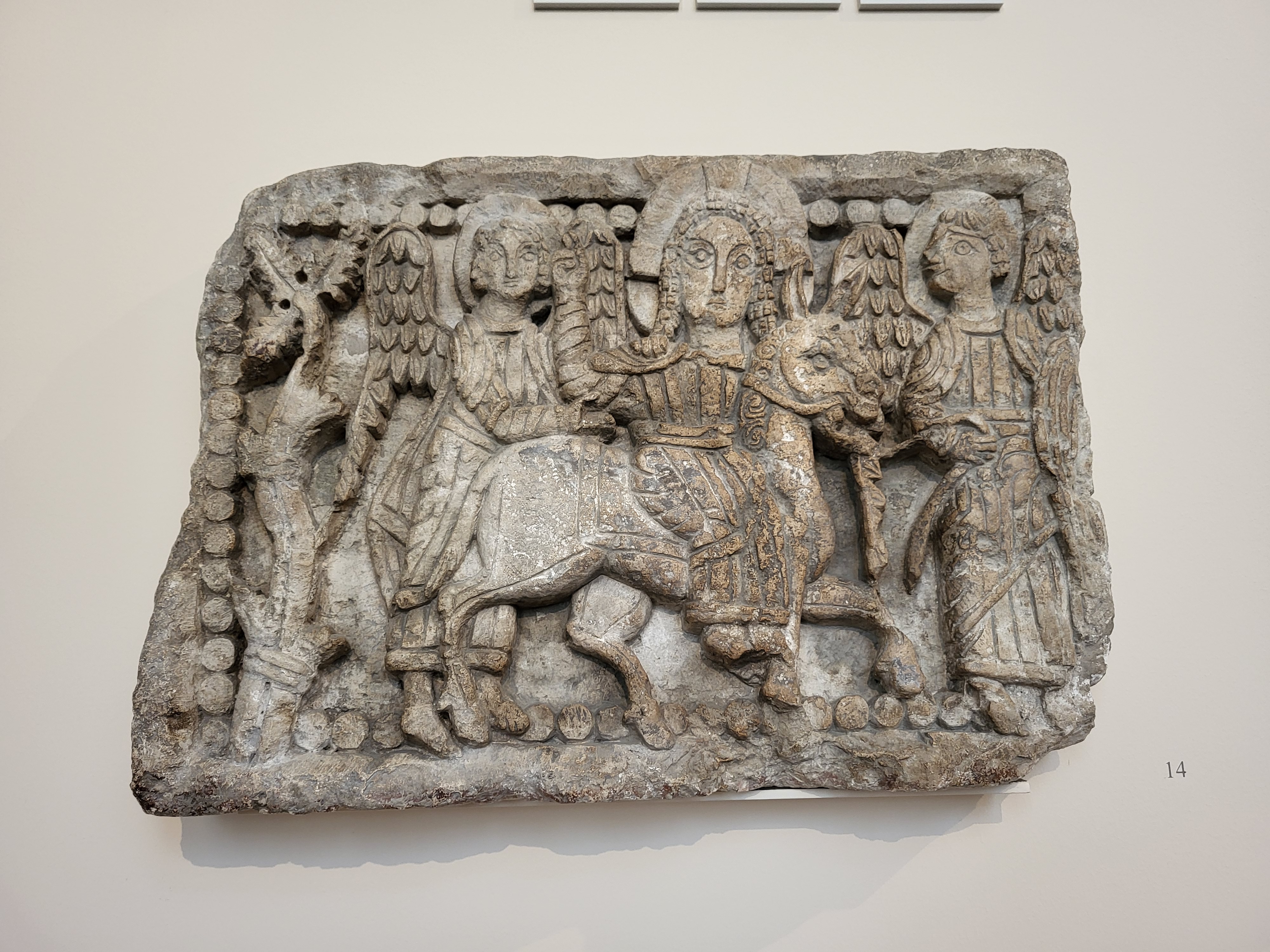
Illustration : Christ sur un cheval et deux anges. Égypte, 6e ou 7e siècle (Berlin, Bode-Museum).

Publié dans Activités du RMBLF | Laisser un commentaire

RMBLF – Les dix annonces les plus consultées (et toujours d’actualité) en 2022

Comme chaque année, nous donnons la liste des dix annonces les plus consultées des douze derniers mois. Une fois n’est pas coutume, c’est un… antiquiste (!) qui se trouve au cœur de l’annonce la plus consultée. C’est en effet le débat animé par Jacques Le Goff autour du Comment on écrit l’histoire de Paul Veyne (décédé le 29 septembre) qui a été le plus consulté.

On retrouvera notamment Paul Veyne, Georges Duby et Emmanuel Le Roy Ladurie sur la photo ci-dessous, qui représente les professeurs (le masculin est de rigueur….) du Collège de France en 1985 (source, avec quelques identifications : ici).

Les annonces :

Podcast – « Comment on écrit l’histoire, de Paul Veyne », débat animé par Jacques Le Goff. Accès : ici

Podcast – « Le temps des cathédrales » de Georges Duby en intégralité. Accès : ici

Base de données – Collecta. Archive numérique de la collection Gaignières (1642-1715). Accès : ici

Publication – « L’archéologie du bâti aujourd’hui et demain », dir. Christian Sapin, Sébastien Bully, Mélinda Bizri et Fabrice Henrion. Accès : ici

Offre d’emploi – Assistant Professor of Medieval History (1,0 FTE) (University of Leiden). Accès : ici

Publication – Laure-Anne Finoulst, « Les sarcophages du Haut Moyen Âge en Gaule du Nord. Production, diffusion, typo-chronologie et interprétations ». Accès : ici

Publication – Chiara Frugoni, « Vivre avec les animaux au Moyen Âge. Histoires fantastiques et féroces ». Accès : ici

Podcast – Un an d’histoire médiévale à « La Fabrique de l’Histoire » (2017-2018). Accès : ici

Publication (open access) – « #révolution de l’écrit. Essor et développement de la culture écrite (XIIe-XVe siècles) », dir. Aurélie Stuckens. Accès : ici

Séminaires-conférences « Pratiques médiévales de l’écrit 2022–2023 » (Université de Namur). Accès : ici

Publié dans Activités du RMBLF | Laisser un commentaire

Publication (en ligne) – L’ordre dominicain dans la péninsule Ibérique : nouvelles perspectives de recherche en histoire de l’art (XIIIe-XVIe siècles)

L’ordre des Frères prêcheurs et la première communauté de moniales à en dépendre ont été fondés au début du XIIIe siècle dans le Midi de la France par deux religieux castillans, l’évêque d’Osma Diego et son chanoine Dominique de Caleruega. Toutefois, force est de constater que la péninsule Ibérique occupe une place encore trop discrète dans une historiographie dominicaine dominée par un tropisme franco-italien. Le présent dossier rassemble des travaux inédits en histoire de l’art qui cherchent à combler cette lacune. Les six articles envisagent les couvents de Frères prêcheurs et les monastères de moniales dominicaines de la péninsule au prisme des problématiques les plus actuelles de la recherche internationale sur les ordres mendiants et sur le monachisme féminin tardo-médiéval. Il s’agit ainsi de contribuer au débat sur le rôle des frères dans la ville, sur le poids des réformes de l’Observance au XVe siècle, sur les liens entre les communautés religieuses et le pouvoir royal, sur les structures de division de l’espace ecclésial, ou encore sur les spécificités de l’art produit par et pour les moniales.

Accès : ici

Table des matières :

Haude Morvan et Eduardo Carrero Santamaría – Introduction

Eduardo Carrero Santamaría – Los frailes en la ciudad. Una aproximación a la predicación como argumento urbanístico

Diana Olivares Martínez – Du couvent au collège : relations, circulations et conflits entre San Pablo et San Gregorio à Valladolid

Diana Lucía Gómez-Chacón – Manly hearts in female bodies. Representing holy Dominican women in Castile in medieval times

Saul António Gomes et Jean-Marie Guillouët– Les Dominicains au Portugal du XIIIe à la fin du XVe siècle. Éléments de synthèse sur leur histoire et leur architecture

Paula Cardoso – Shaping an Observant identity: Narrative and image in the service of reform in the Portuguese Dominican nunneries

Haude Morvan et Mercedes Pérez Vidal – La mémoire du passé. Les couvents dominicains des provinces d’Espagne et d’Aragon à travers les écrits de l’époque moderne

Informations pratiques :

L’ordre dominicain dans la péninsule Ibérique : nouvelles perspectives de recherche en histoire de l’art (XIIIe-XVIe siècles), dans Mélanges de la Casa de Velázquez, t. 52, 2022 , DOI : https://doi.org/10.4000/mcv.16993

Source : Casa de Velázquez

Publié dans Publications | Laisser un commentaire

Offre d’emploi – Lecturer in Art History, Ernest G. Welch School of Art & Design

The Welch School of Art & Design seeks a full-time, benefits-eligible, non-tenure-track Lecturer in the art of the ancient and/or medieval world. Appointment date: August 2023.

This position entails teaching surveys of Western art and upper-level courses that incorporate at least two of the following: ancient Egypt, ancient Greece, ancient Rome, and the European Middle Ages. The successful candidate must value working with diverse student populations and cultural perspectives. The successful candidate will join an established Art History area within the Welch School of Art & Design’s growing faculty. They will play a significant role in the College of the Arts’ contribution to Georgia State University’s strategic goals of highlighting the arts and media as vital to the quality of all major cities, demonstrating that students from all backgrounds can achieve academic and career success at high rates.

Opportunities for growth and support in this position include university-level teaching fellowships and grants through the Center for Excellence in Teaching, Learning and Online Education, leadership in instructional innovation through our active learning classroom program, and successive promotion to the ranks of Senior Lecturer and Principal Senior Lecturer.

Responsibilities include:

  • Teaching four courses per semester
  • service to the area, school, college, university, community and/or profession
  • serving on MA/MFA thesis committees
  • advising undergraduate Art History majors

Necessary qualifications:

  • PhD in Art History by the time of the appointment
  • strong teaching skills
  • excellent oral and written communication skills
  • command of computer-mediated technologies related to the discipline

Salary range: $45,000-50,000

To Apply

Submit a PDF for this job application to wsadrecruiting@gsu.edu either through email or through direct download (such as WeTransfer). Complete applications will include PDF documents in this order:

  • A cover letter including past and/or potential contributions to diversity, equity, and inclusion through teaching and service
  • Curriculum Vitae
  • statement of teaching interest
  • Names, email addresses, telephone numbers, and titles of at least three professional references

Review of applications will begin immediately and continue until the position is filled. To ensure consideration, submit all materials by January 9, 2023. Questions about the position can be directed to the search committee chair at wsadrecruiting@gsu.edu. Should you be recommended for a position, an offer of employment will be conditional on background verification.

For more information, visit here.

Source : Medieval Art Research
Publié dans Offre d'emploi | Laisser un commentaire

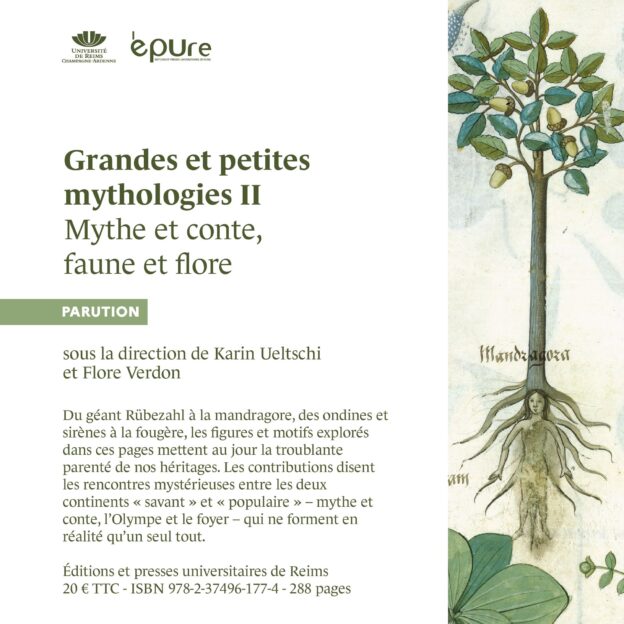
Publication – « Grandes et petites mythologies », t. 2, « Mythe et conte, faune et flore », dir. Karin Ueltschi et Flore Verdon

Voici le second tome des travaux consacrés aux rencontres entre grande et petite mythologie, entre l’univers de l’Olympe et celui des foyers, entre mythe et conte, et à leurs échanges permanents, à leur plasticité, à leur porosité. Quel que soit le sujet traité, il s’agit en effet de mettre en évidence les ponts qui existent entre les deux canaux « savant » et « populaire », ce qui renouvelle l’approche de thématiques parfois déjà amplement traitées. Mieux, au fil des travaux proposés depuis le début de nos investigations (cf. K. Ueltschi, F. Verdon (dir.), Grandes et Petites mythologies 1. Monts et abîmes : des dieux et des hommes, Reims, EPURE, 2020), ce couple des grandes et petites mythologies ne cesse de s’enrichir de variantes problématiques supplémentaires, et de nouvelles créatures emblématiques, à l’instar de Rübezahl qui s’appelle Krakonoš en Tchéquie, et Liczyrzepa en Pologne. S’il semble émerger tout droit du XVIe siècle qui a donné un acte de naissance écrit à tant de figures – pensons à Faust, à Till Eulenspiegel, à Guillaume Tell –, il est en réalité beaucoup plus vieux. Il incarne non seulement la persistance tenace de l’imaginaire mythique, mais aussi son infinie aptitude à la métamorphose, à l’adaptation, et même à la « récupération ». Profondément enraciné dans le terroir et d’anciennes strates linguistiques, foncièrement ambivalent avec sa barbe rousse et son bâton, ses gènes remontent à l’origine même de l’humanité, à son enfance, à sa mémoire première.

De nouvelles dialectiques ont pu être dégagées, mettant sans cesse en évidence la troublante parenté de nos héritages et leur ancrage toujours perceptible notamment par le biais du calendrier. Des rapports à première vue improbables sont mis en évidence, celui entre chocolat et ambroisie ou entre art et science par exemple. Se pose également la question centrale du passage du silence à la parole ; la parole, si on la suppose d’abord antérieure à l’écrit, peut à l’inverse également constituer l’appropriation de l’écrit par l’oral ; c’est donc une passerelle fondamentale entre la grande et la petite mythologie, transcendant le clivage entre la littérature savante et le conte populaire pour que subsiste le mythe. Par ailleurs, des figures sans nom – quel est celui de la statue de Pygmalion ? – se retrouvent sous des identités enfin cernées, Venus, Galatée. C’est d’ailleurs là un sujet majeur en mythologie comparée : comment sortir de la namelessness, si on nous accorde cet anglicisme, comment transformer une figure mythique en personnage littéraire ?

De nouveaux éclairages viennent constamment consolider et multiplier des scénarios pourtant si intimement familiers : simul vetus et novella, simul senex et puella, pourrions-nous dire avec Alain de Lille : d’Apulée à la Fontaine, de Merlin à Ambroise Paré, la vitalité des motifs réside sans aucun doute dans leur capacité à nouer, via l’analogie et l’inépuisable magie de la coincidentia oppositorum, des syncrétismes ; ainsi, la seule évocation du nom d’Iphigénie proclame son immortalité féconde sur les scènes et dans les livres, et interroge infiniment les notions de sacrifice ou d’héroïsme.

Dans l’univers que nous avons choisi d’explorer, le discours universitaire doit se confronter sans cesse à la voix du conteur et du poète, souvent véhicules plus efficaces de transmission d’une mémoire : un Tolkien ou un T.H. White en savent quelque chose ! Et rien ne saurait remplacer l’investigation sur le terrain pour cueillir encore et encore les traditions orales en vue de les explorer et les inscrire dans la mémoire savante : la mythologie reste fondamentalement vivante.

Table des matières :

Introduction 
PARTIE I : PLASTICITÉ ET VARIANCES 
Sophie Conte, “Le sacrifice d’Iphigénie aura-t-il lieu ? Réécriture du mythe à l’époque contemporaine” 
Alain Trouvé, “Le mythe de Pygmalion, d’hier à aujourd’hui”
Miren Lacassagne, “Fortune, la roue et le meunier”
Françoise Gevrey, “La mythologie dans le conte parodique ou licencieux” 
Anna Loba, “Peau d’Âne et ses sœurs”
Thomas Nicklas, “Rübezahl, esprit polyvalent. L’étonnante faculté d’adaptation d’une figure de la petite mythologie d’Europe centrale” 

PARTIE II : MYTHOLOGIES ANIMALES, MYTHOLOGIES VÉGÉTALES

Aurore Noirault, “Entre force et fragilité : le lion comme miroir des héros épiques dans l’Iliade et les Posthomériques” 
Cécile Mauré, “Éphémérité et dégénérescence : l’étude du Narcisse” 
Laurence Hélix, “Des Sirènes et des Ondines”
Myriam White-Le Goff, “La licorne, polyvalence et persistance” 
Anne Berthelot, “Les sorts sans les plantes : magie rituelle dans le monde arthurien ?”
Justine Breton, “Bestiaire populaire et bestiaire savant : la faune dans l’œuvre médiévaliste de T.H. White”
Épilogue 
Anne Marchand, “Traditions et mythes vivants : l’exemple de la fougère” 
Karin Uelteschi, “Du rempotage de mandragores”
Présentation des auteurs et résumés

Informations pratiques :

Grandes et petites mythologies, t. 2, Mythe et conte, faune et flore, éd. Karin Ueltschi et Flore Verdon, Reims, EPURE, 2022 ; 1 vol., 400 p. ISBN : 978-2-37496-177-4. Prix : € 20,00.

Source : LCPDU

Publié dans Le réseau | Laisser un commentaire

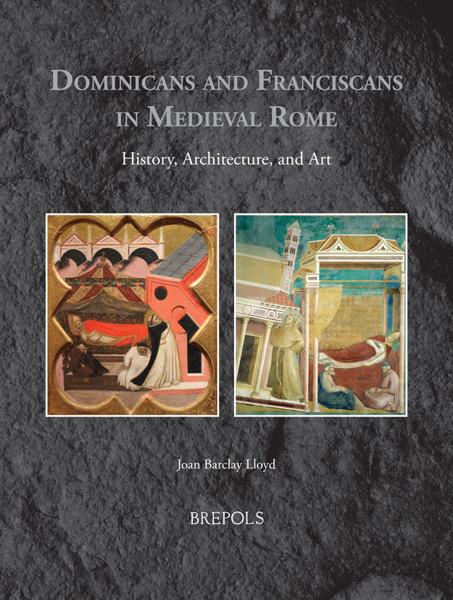
Publication – Joan Barclay Lloyd, « Dominicans and Franciscans in Medieval Rome. History, Architecture, and Art »

When Saint Dominic (c. 1174–1221) came to Rome to seek papal approval of the Order of Preachers, he founded two houses on the periphery of the city — a nunnery at  S. Sisto, in structures rebuilt by Pope Innocent III, and a priory next to the early Christian basilica of S. Sabina. The Dominicans modified and enlarged the existing buildings, according to their needs. Saint Francis of Assisi (c. 1182–1226) also came to consult the Pope, but he did not make any foundations in Rome. In 1229, Pope Gregory IX ordered the Benedictine monks of SS. Cosma e Damiano in Mica Aurea to cede to the Franciscans their hospice of S. Biagio in Trastevere, where Saint Francis had stayed. The friars built the church and friary of S. Francesco a Ripa there. Later, Gregory IX took over the Benedictine monastery itself, where he established the Franciscan nunnery of S. Cosimato in 1234. Moving into the more densely inhabited parts of the city, the Friars Minor built a new friary and church at S. Maria in Aracoeli on the Capitoline Hill from c. 1248–1252 onwards. The Dominicans, in 1266, acquired a convent near the Pantheon, where they constructed the Gothic church of S. Maria sopra Minerva. In 1285, the Colonna family established a Franciscan nunnery at S. Silvestro in Capite.

In the context of the origin and evolution of the two Mendicant Orders, this book traces the history of these thirteenth-century Dominican and Franciscan foundations, focussing on their location in Rome, the history of each site, their architecture, and the medieval works of art connected with them. Popes and cardinals, members of important families, and Franciscan Tertiaries contributed generously to their construction and decoration. The book ends with Saint Catherine of Siena, who lived near S. Maria sopra Minerva, where she was buried.

Table des matières :

List of Illustrations

Preface

Abbreviations

Colour Plates

Introduction

Part I. The First Dominican and Franciscan Foundations in Rome

Chapter 1. The Dominican Nunnery at S. Sisto (now S. Sisto Vecchio), founded c. 1218–1221

Chapter 2. The Dominican Priory at S. Sabina, founded c. 1220–1222

Chapter 3. The Franciscan Church and Friary of S. Francesco a Ripa, founded in 1229

Chapter 4. The Franciscan Nunnery of SS. Cosma e Damiano (S. Cosimato), founded in 1234

Part II. A New Generation of Dominicans and Franciscans and their Foundations in Rome

Chapter 5. The Friars Minor at S. Maria in Aracoeli, founded c. 1248–1252

Chapter 6. The Friars Preachers at S. Maria Sopra Minerva, founded c. 1266–1276

Chapter 7. The Franciscan Nunnery at S. Silvestro in Capite, founded in 1285

Chapter 8. Medieval Dominican Penitents from c. 1286 and Catherine of Siena (1347–1380)

Conclusion

Glossary

Informations pratiques :

Joan Barclay Lloyd, Dominicans and Franciscans in Medieval Rome. History, Architecture, and Art, Turnhout, Brepols, 2022 ; 1 vol., 439 p. (Medieval Monastic Studies , 6). ISBN : 978-2-503-57883-5. Prix : € 110,00.

Source : Brepols

Publié dans Publications | Laisser un commentaire