Offre d’emploi – Boursier-ère de doctorat (H/F/X) en histoire médiévale, pour une durée de quatre ans : Édition critique et recontextualisation historique des Chroniques de Hainaut de Jean Wauquelin

L’Université Saint-Louis – Bruxelles recrute un-e boursier-ère de doctorat (H/F/X) en histoire médiévale, pour une durée de quatre ans.

Contexte et missions :
Dans le cadre du projet de recherche interuniversitaire (PDR) Édition critique et recontextualisation historique des Chroniques de Hainaut de Jean Wauquelin, financé par le F.R.S.-FNRS, le/la doctorant- e sera affecté-e au Centre de recherches en histoire du droit, des institutions et de la société (CRHiDI) de l’USL-B. Sa tâche sera double. Elle ou il mènera une recherche, devant aboutir à la soutenance d’une thèse de doctorat, sur le processus de production et de réception d’une traduction des Chroniques de Hainaut ; il s’agira de préciser la finalité du texte et son insertion dans la société hainuyère et dans les réseaux culturels et politiques liés à la cour de Bourgogne, avec une attention soutenue aux questions d’identités régionales et pré-nationales (titre provisoire : « Le pays ou le prince ? Analyse du projet historiographique et politique des Chroniques de Hainaut de Wauquelin »). Il ou elle communiquera ses résultats par le biais de communications orales et de publications. Conjointement à sa thèse, elle ou il collaborera avec le chercheur postdoctoral chargé de l’édition philologique du texte ; il ou elle contribuera notamment à la réalisation de l’apparat critique de l’édition par l’identification et la contextualisation des noms de lieux et de personnes et des événements mentionnés par le texte. En outre, elle ou il participera au travail scientifique collectif, tant celui du CRHiDI que celui de l’équipe interuniversitaire du projet de recherche (p. ex. organisation de séminaires ou colloques, participation à des séminaires ou colloques, publications collectives, etc.).
Le projet FNRS sur les chroniques de Hainaut est mené sous la coresponsabilité de Tania Van Hemelryck (Groupe de recherche sur le Moyen Français) à l’UCLouvain et d’Eric Bousmar (CRHiDI) à l’USL-B. Ils seront les co-promoteurs de la thèse.

Diplôme et profil :

Le ou la candidat-e possédera :
– un Master 120 en Histoire, obtenu avec au minimum le grade de Distinction (cum laude), ou équivalent, et avec un mémoire réalisé de préférence sur une question d’histoire du Moyen Âge ou de la Renaissance ou d’historiographie,
– une bonne connaissance du latin et du moyen français, ainsi qu’une première expérience de la paléographie.

La ou le candidat-e sera dans les conditions légales pour être engagé-e sur le statut de boursier de doctorat.

En outre, le ou la candidat-e devra faire preuve de :
– capacité à travailler seul-e et en équipe,
– sens de la rigueur ; esprit critique ; capacités d’observation, d’analyse et de synthèse,
– ouverture interdisciplinaire vers l’histoire de la littérature et l’histoire de l’art,
– connaissances linguistiques : maîtrise du français ; la connaissance d’autres langues modernes (anglais, italien, allemand, néerlandais) est un atout.

Entrée en fonction : dès que possible.
Toute information complémentaire peut être obtenue en s’adressant au Prof. E. Bousmar

(eric.bousmar@usaintlouis.be).

Modalités de candidature :

Les candidatures, accompagnées d’une lettre de motivation et d’un curriculum vitae détaillé, sont à adresser par e-mail, aux adresses suivantes : eric.bousmar@usaintlouis.be et crhidi@usaintlouis.be, au plus tard le 31 janvier 2023.

Publié dans Offre d'emploi | Laisser un commentaire

Appel à contribution – Renaissance Architecture and Theory Scholars

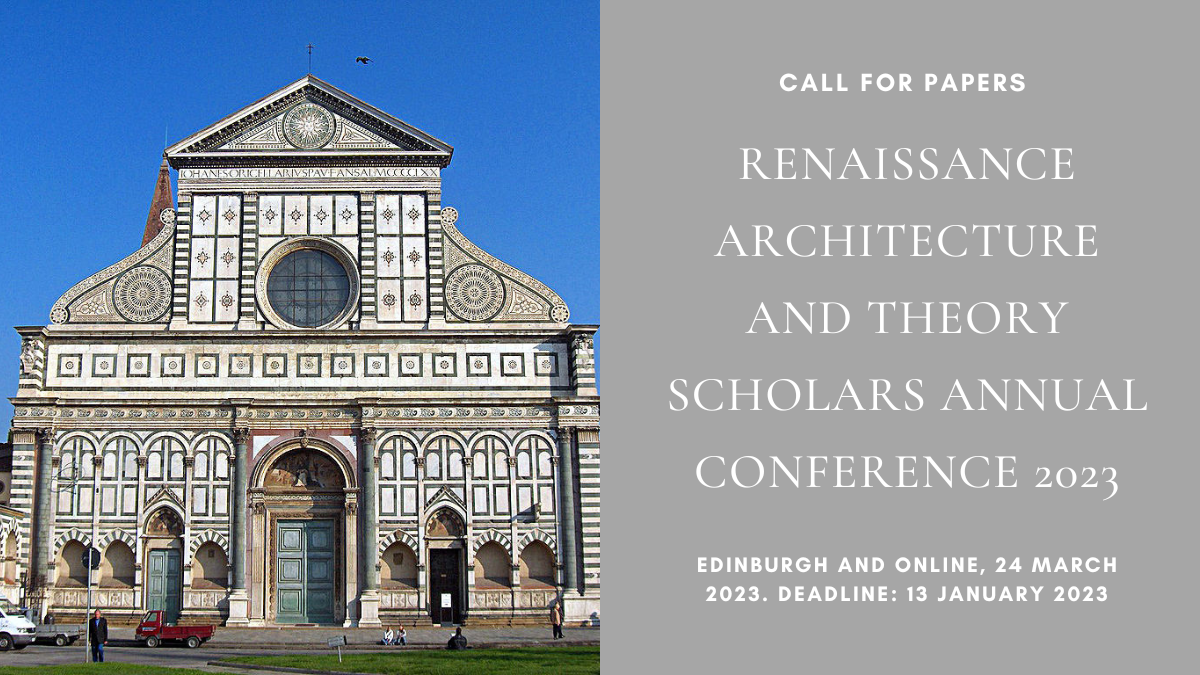
The next conference of the Renaissance Architecture and Theory Scholars (RATS) will take place on Friday, 24 March 2023 from 8:30 to 17:30 UK time at the Edinburgh School of Architecture and Landscape Architecture, in hybrid format. 

The conference co-convenors seek proposals for 20-minute papers on topics in the history of Renaissance architecture and theory, broadly defined. We welcome research on all chronologies of Renaissance architectural culture, including its reception in other periods, as well as all geographies implicated in Renaissance architectural culture. We are open to emerging research as well as work that is nearing publication. We encourage any postgraduate student or early career researcher who would like to present original research to submit a paper proposal.

Because the conference will occur in hybrid format, anyone with an internet connection can present research or participate as an audience member from anywhere in the world. A key goal of the upcoming meeting is to expand accessibility to RATS and widen participation among scholars who may not have previously enjoyed the benefits of the RATS community. To that end, the upcoming meeting will also include time for a group discussion on future plans for RATS.

If you would like to present a paper in the conference, please send a title and an abstract of c. 250 words or less, as well as a brief, c. 150-word bio or CV of no more than 2 pages to RenArchandTheoryScholars@gmail.com by Friday, 13 January 2023 at 12 noon UK time.

Source : Medieval Art Research

Publié dans Appel à contributions | Laisser un commentaire

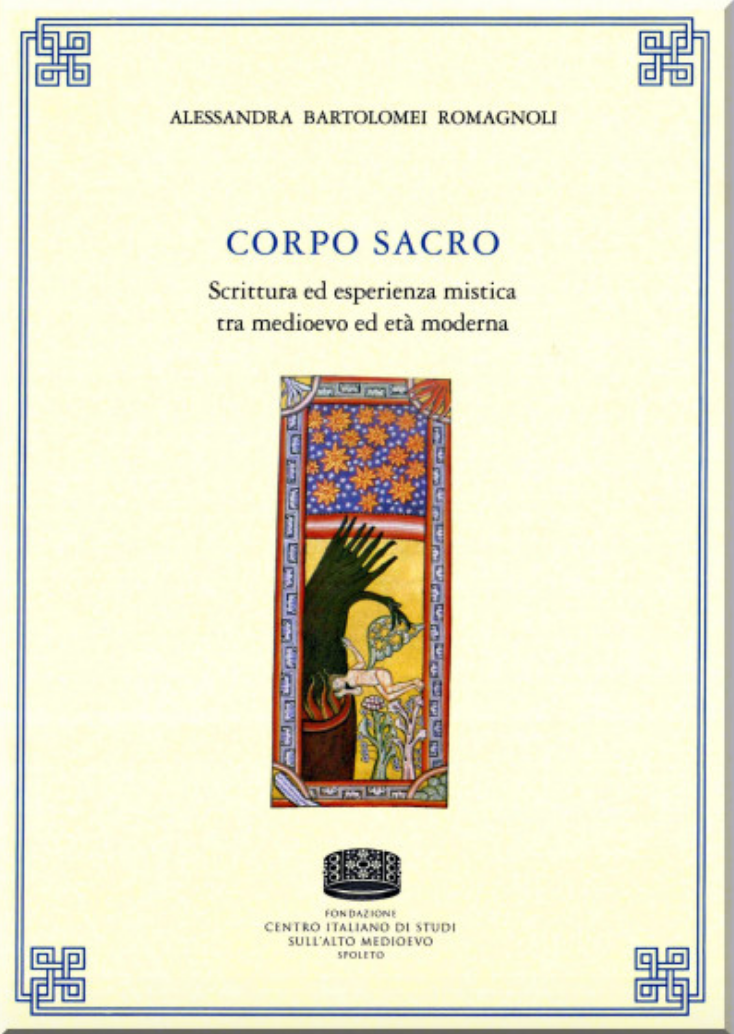
Publication – Alessandra Bartolomei Romagnoli, « Corpo sacro. Scrittura ed esperienza mistica tra medioevo ed età moderna »

A partire dal Duecento si verificano processi culturali di grande rilevanza e mutamenti di carattere epocale nel vissuto religioso del popolo cristiano. Per Giacomo da Vitry, illustre iniziatore del nuovo genere letterario dell’agiografia mistica, si apre una nuova età, quella delle Madri della Chiesa. La centralità assegnata al mistero dell’Incarnazione e alla umanità del Cristo, il culto eucaristico e quello mariano interessano da vicino il mondo femminile per l’attenzione riservata al problema del corpo, ma anche alla sfera delle emozioni e dell’affettività. Nei recinti monastici e nei deserti urbani delle cellane e delle beghine si plasmano pratiche e devozioni destinate a durare nel tempo nella pietà cattolica.  Nella zona neutra delle religiosae mulieres, lì dove si arrestano le responsabilità pastorali e sociali, si libera un nuovo linguaggio per “dire Dio”, quello dell’estasi, del sogno, della visione.  Questo libro cerca di restituire almeno una eco di questi discorsi che vengono da lontano, dai meravigliosi testi e poemi delle Fiandre e del Brabante, della Renania, ma anche dell’Italia delle città.

Table des matières :

Avvertenza – Referenze bibliografiche – Sigle – I. Donne in religione – 1. La vita religiosa femminile negli ultimi secoli del medioevo. Temi e problemi – 2. Santa Chiara di Assisi e la sua Regola: la clausura come spazio dell’alterità – 3. Recluse ed eremite nello specchio delle fonti agiografiche (secoli IV-XV) – 4. La galassia penitenziale (secoli XIII-XV) – 5. L’Osservanza al femminile – 6. Antonia da Firenze e Giovanni da Capestrano. Una storia difficile al tempo delle Osservanze – II. Temi spirituali e mistici – 7. Sulla mistica – 8. Il silenzio, la parola, la scrittura. Una introduzione all’agiografia mistica del Duecento – 9. L’amore, il dolore, il nulla. Mistica e profezia nel tempo delle crisi – 10. Eros e santità. La sessualità nell’agiografia latina medievale (secoli XII-XV) – 11. Eucarestia ed estasi: propaganda clericale e visioni nel Duecento – 12. Il teatro del diavolo – 13. Il profetismo politico femminile al tramonto del medioevo – 14. Il cammino, la terra, la visione. Racconti di pellegrine medievali – III. Viaggi cosmici e cooperazione delle anime 15. La Comunione dei santi: modelli e pratiche di intercessione -16. Le mistiche francescane e il Perdono di Assisi – 17. Una visione dell’inferno nella Roma del Quattrocento – 18. Il concilio di Firenze e l’immaginario del purgatorio in una visione di santa Francesca Romana – IV. Oltre il medioevo – 19. Arcangela Panigarola nella Milano dei Valois – 20. Teresa la Grande – 21. Il culto di Francesca Romana santa della Riforma cattolica – 22. Tommaso da Bergamo e Giovanna della Croce. Una coppia santa nel Seicento italiano – 23. Estasi barocche – Indice dei personaggi e degli autori antichi – Indice degli studiosi.

Informations pratiques :

Alessandra Bartolomei Romagnoli, Corpo sacro. Scrittura ed esperienza mistica tra medioevo ed età moderna, Spolète, Centro italiano di studi sull’alto medioevo, 2022 ; 1 vol., XVI-776 (Uomini e mondi medievali, 74). ISBN : 978-88-6809-370-9. prix : € 70,00

Source : Centro italiano di studi sull’alto medioevo

Publié dans Publications | Laisser un commentaire

Appel à contribution – Easter in Late Antiquity and the Middle Ages

We at Medievalists.net are teaming up with the journal After Constantine and the Orthodox Academy of Crete to host a one-day conference on Easter in Late Antiquity and the Middle Ages.

The conference will take place online through Zoom on April 1, 2023. The conference will examine how Easter was celebrated and viewed from Late Antiquity throughout the medieval period. Every year this would be a high point of Christian life, and medieval people were keenly interested in many aspects of this event.

We are looking for papers on a wide variety of topics, including:

  • The origins of its rituals
  • How different traditions developed throughout the world
  • How it impacted relations with other religious groups
  • How determining the date of Easter spurred learning in various subjects

Candidates are welcome to send their abstracts accompanied by a brief biographical note in English to the journal’s email (afterconstantine@gmail.com) or to Medievalists.net (medievalists.net@gmail.com)

Deadline: December 31, 2022

Source : Medieval Art Research

Publié dans Le réseau | Laisser un commentaire

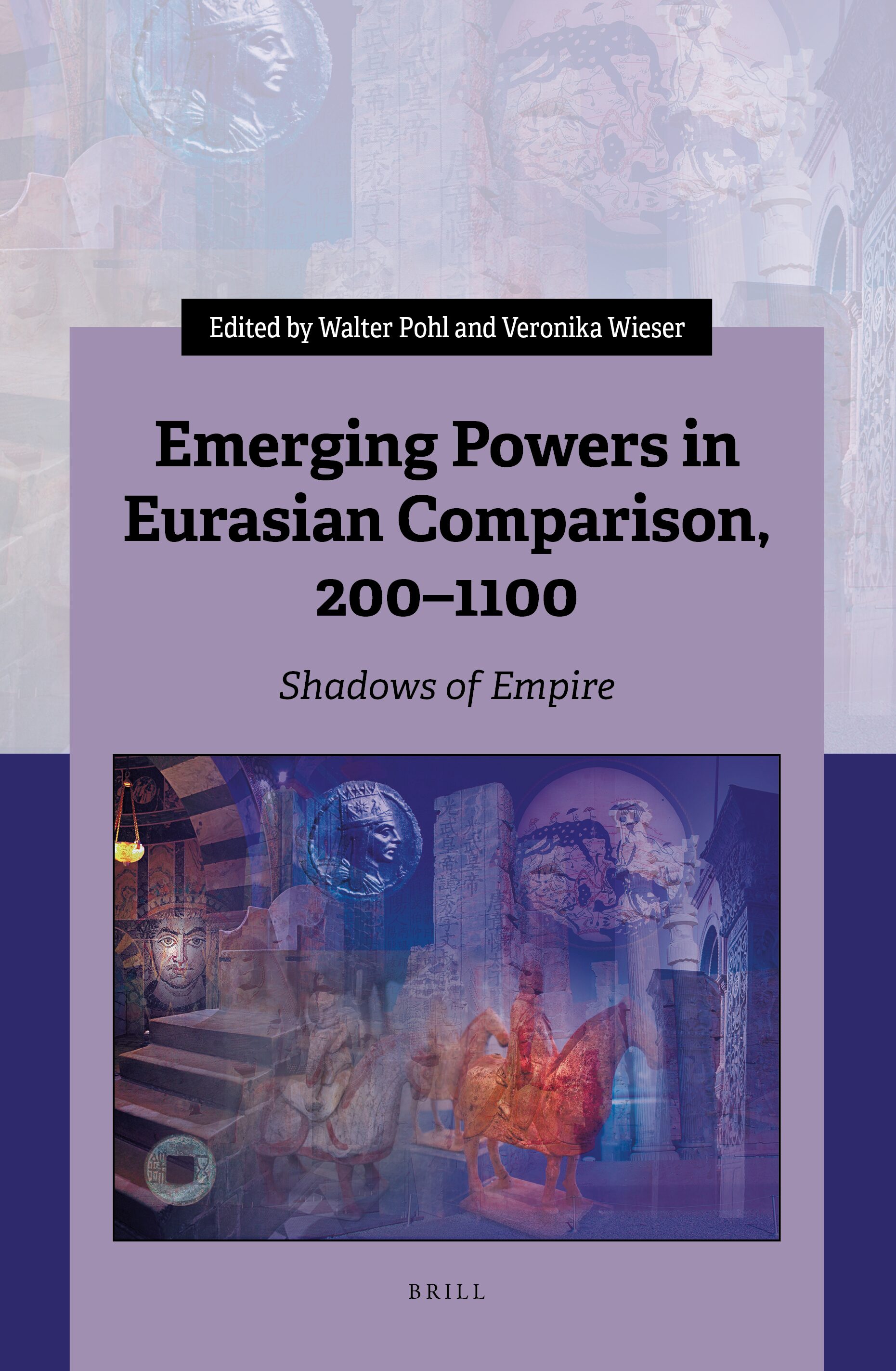
Publication – « Emerging Powers in Eurasian Comparison, 200–1100. Shadows of Empire », éd. Walter Pohl et Veronika Wieser

This book compares the ways in which new powers arose in the shadows of the Roman Empire and its Byzantine and Carolingian successors, of Iran, the Caliphate and China in the first millennium CE. These new powers were often established by external military elites who had served the empire. They remained in an uneasy balance with the remaining empire, could eventually replace it, or be drawn into the imperial sphere again. Some relied on dynastic legitimacy, others on ethnic identification, while most of them sought imperial legitimation. Across Eurasia, their dynamic was similar in many respects; why were the outcomes so different?


Contributors are Alexander Beihammer, Maaike van Berkel, Francesco Borri, Andrew Chittick, Michael R. Drompp, Stefan Esders, Ildar Garipzanov, Jürgen Paul, Walter Pohl, Johannes Preiser-Kapeller, Helmut Reimitz, Jonathan Shepard, Q. Edward Wang, Veronika Wieser, and Ian N. Wood.

Table des matières : ici

Informations pratiques :

Emerging Powers in Eurasian Comparison, 200–1100. Shadows of Empire, éd. Walter Pohl et Veronika Wieser, Leyde–Boston, Brill, 2022 ; 1 vol., 480 p. ISBN : 978-90-04-51856-8. Prix : € 154,00.

Source : Brill

Publié dans Publications | Laisser un commentaire

Colloque – Good Governance in the Late Medieval City (1200-1600)

International Workshop on Good Governance in the Late Medieval City (1200-1600)

Organized by Nele De Raedt (UCLouvain) and David Napolitano (Utrecht University)

Programme :

February 1th, 2023

Utrecht University

Drift 23, Room 0.10

This interdisciplinary workshop is made possible thanks to the financial support of the Dutch Research School of Medieval Studies, the Louvain Research Institute for Landscape, Architecture and the Built Environment (LAB, UCLouvain), the Utrecht University Centre for Medieval Studies (UUCMS), and the Research Alliance CITY (Ghent University and Vrije Universiteit Brussel).

Program

09:45-10:00 Registration

10:00-10:15 Welcome

SESSION 1: SOURCES

10:15-10:35 Minne De Boodt (KU Leuven)

Debating good governance. The added value of a cross-contextual analysis for the study of late medieval political thinking

What did ‘good governance’ mean in the late medieval period? This paper argues for a cross-contextual analysis to answer this question. Although medieval political thought was originally studied from a more theoretical point of view, the research field has gained several diverse perspectives in the last years.  Historians have not only investigated the ideas of various social groups but have also done so by means of increasingly diverse sources. While some researchers have already started to combine different perspectives, most studies still limit themselves to one social group, source type, community, case study or political idea.

To study how fifteenth-century political ideas inspired negotiations on good governance, I study a wide variety of sources ranging from literary works or juridical treatises to privileges, petitions, letters and so on. Taken together my source-corpus spans the period between 1400 and 1520 and originated in social contexts such as the court of the Burgundian Dukes, courtrooms, town halls, and the houses of craft guilds. By means of this broad perspective, I argue that patterns of expectations existed in political thinking about good governance. But patterns were not carved into stone. By additionally zooming in on a local context, this paper makes clear that social groups continuously talked about patterns of expectations to achieve contemporary goals. I assert that the ‘patterns’ and ‘context-bound expressions’ of late medieval political thinking were not only inextricably connected, but also mutually reinforcing. Inspiring ideas remained inspiring because they were adaptable and expected.

10:35-10:55 Frederik Buylaert (Ghent University), Kaat Capelle (Ghent University), Klaas Van Gelder (Universiteit Brussel/State Archives in Brussels)

Comparing “good governance” in town and countryside: the evidence from Flanders, c. 1250-1550

In our contribution, we reflect on the idea of “Good Governance” in the towns of the county of Flanders in the 14th to 16th centuries, paying special attention to the question what – if anything except scale – is distinct about urban governance vis-à-vis rural governance. Empirically speaking, we proceed from a corpus of about fifty village regulations that reveal in granular detail the normative framework of village seigneuries, including regulations on, for example, public order management, waste disposal, the regulation of factor markets, moral policing, demarcating the boundaries between the public and the private sphere, and so on. We aim at a comparative discussion with recent research on urban governance. In light of fierce discussions about “urban agency”, we must chart the similarities and dissimilarities between governance in town and countryside while paying special attention to similar or dissimilar mechanisms for conflict resolution and decision-making. Theoretically speaking, we will draw on the recently developed notion of “Discursive Institutions” to conceptualize our comparative discussion.

10:55-11:15 David Napolitano (Utrecht University)

From mirrors-for-princes, over the podestà literature, to mirrors-for-magistrates: Preliminary explorations of three modern labels for medieval advice literature on rulership

The concept “mirrors-for-princes” has grown into a fixed feature of modern reference works, encyclopaedias, and historical dictionaries, although critical reflections on its existence and delineation as a genre have always accompanied its historiography. A similar discussion has opened up with respect to its lesser-known republican counterpart, the “mirrors-for-magistrates”. Focusing on the podestà literature – the traditional designation for the Italian mirrors-for-magistrates – Enrico Artifoni has, for instance, questioned whether there is such a thing as a podestà literature and whether it merits study as a particular group of texts. In my presentation I will trace the origins of the term “podestà literature”, discuss its use in existing scholarship, and argue that a continued use of the term is warranted and justified for this group of texts. Moreover, I will underline the importance of a label to denominate a group of texts and I will hold that, in order to facilitate comparisons across modern national and linguistic borders, the term “mirrors-for-magistrates” is to be preferred as a general designation.

11:15-12:15 Discussion

* Lunch

SESSION 2: METHODOLOGY

13:30-13:50 Nele De Raedt (UCLouvain)

Mirrors for magistrates on building the city

This presentation will focus on three political advice books, written over the course of the fifteenth century in Florence, Görlitz and Worms, with a specific focus on the ideas they contain on the architectural patronage and design of the late-medieval city; Matteo Palmieri’s Della vita civile (1429), Johann Frauenburg’s Anweisung, wie der Bürgermeister sich in seinem Amacht haltens soll (1476), and Johann von Soest’s Wie men woll eyn statt regiern soll (1495). Such political advice books, addressed to the urban elites, emerged from the thirteenth century onwards across a wide geographical area (from the Italian Peninsula, over the German Lands to the Low Countries). They not only instructed the magistrates on the political duties, related to their office. They also sometimes contained specific ideas on the construction and maintenance of the physical structure of the city. This presentation will discuss three examples in more detail, questioning whether they could be read as architectural theories, as well as whose voices and thoughts on architecture they represent. The presentation fits within a larger project that questions how mirrors-for-magistrates served as vehicles for architectural design theories on the city and its buildings in the late-medieval period.  

13:50-14:10 – Mats Dijkdrent (UCLouvain)

Architectural descriptions as mirrors for good governance in sixteenth-century Antwerp

Buildings that housed city governments in the late medieval period are often well studied. Much less researched, however, are the texts describing these buildings. In my presentation, I will analyze how these administrative strongholds (in particular the new city hall), and other buildings that symbolized the urban community, are described and framed in sources from 16th-century Antwerp. The descriptions of these buildings might appear quite formulaic, in part because they follow the rules of panegyric and ekphrasis. However, the texts also occasionally name values that refer specifically to ideas about good governance. I will show and analyze some examples in which the visual description of the building coincides with political theories and discourses about good governance of the city. In these texts, Magnificentia functions as a connection between the visual while alluding to virtues regarding good governance.

14:10-15:10 Discussion

*Coffee

SESSION 3: IDEALS AND COMPARISON

15:30-15:50 Giacomo Santoro (Scuola Normale Superiore di Pisa)

Magistratus virum ostendit: a perspective on good governance in the Republic of Siena, between pedagogy and government (1428-1456)

In the first half of the fifteenth century, the Republic of Siena went through a phase of profound changes, internal tensions between citizen groups, and external pressure from foreign powers. The institutional architecture of the Republic seemed to make the exacerbation of the struggles between factions inevitable. The dynamics of elections for the city’s magistracies became increasingly fractious.

A number of factors fit into this complex and fractured context. First of all, the novelty of humanist culture, thanks to which classical authors and works (Plato, Aristotle, Cicero in primis) were not only rediscovered, but used in public discourse; the opposition between oligarchic-conservative tendencies and the extensive ambitions of those excluded from city power; the need to build a new order based on the good governance of the past and the recovery of the values of Siena of the past.

One of the most prestigious, influential and active men in those years in those dynamics was Francesco Patrizi (Siena, 1413-Gaeta, 1494). He was a fraternal friend of Enea Silvio Piccolomini, a member of the Grande Academia Senese, a master of rhetoric at the Universitas, a well-known man of letters, a true “organic intellectual” of one of the three regimental mounts, the Monte dei Nove; but also a member or head of numerous ambassadors for the Republic and several times Prior and Chancellor. Patrizi is one of the paradigmatic characters for understanding Italian and European political Humanism. His eclecticism between theory and political praxis is an example of a season of blending theoretical needs, demands for new languages, the search for legitimacy and governmental practices in fifteenth century Italy. He would go on to be the most edited political treatise writer after Machiavelli until the Baroque age with his works: De institutione rei publicae and De Regno et regis institutione.

In the home of the allegorical visual representation of Buon Governo, Patrizi elaborates his own model on how to hold a magistracy and do the good of the city. The epistolary treatise De gerendo magistratu admonitio (1446), whose critical edition I am currently editing, is not just a work of political pedagogy on the virtues needed to govern, but a veritable ideological political manifesto for the communes amicos nostros of the Monte dei Nove.

In my presentation I will show what was meant by good governance in Siena in the first half of the fifteenth century, in political theory and practice, and what dynamics are present and influence each other. My intention is to show how references to good governance in the fourteenth century in the Age of the Nine are a rhetorical device to polarise the political struggle and legitimise public debate, up to the tragic conspiracy of 1456.

15:50-16:10 Vasileios Syros (Jawaharlal Nehru University & The Medici Archive Project) 

Good governance and the city in early modern Italy and India

The purpose of this presentation is to explore the relationship between good governance and the city by looking at early modern Italian and Indian political and economic writings. More specifically, I will rely on the Italian (Giovanni Botero etc.) and Mughal (Abu’l Fazl etc.) traditions to trace affinities between diverse modes of theorizing the dual function of the city both as political and economic unit. My presentation will discuss how parallel patterns of depersonalization of political power translate into urban organization. I will also demonstrate that in both Italian and Mughal discourse, the city is depicted as the locus of economic and commercial activities that lead to the creation of the market as an autonomous sphere. Whereas these ideas are prefigured in Latin Europe and the Arabic world, the commonalities between the Italian and Mughal cases point to a novel shared understanding of how the city as the microcosm of the state operates according to its own rules and is ultimately disentangled from the persona of the sovereign.

16:10-17:00 Discussion

Publié dans Colloque | Laisser un commentaire

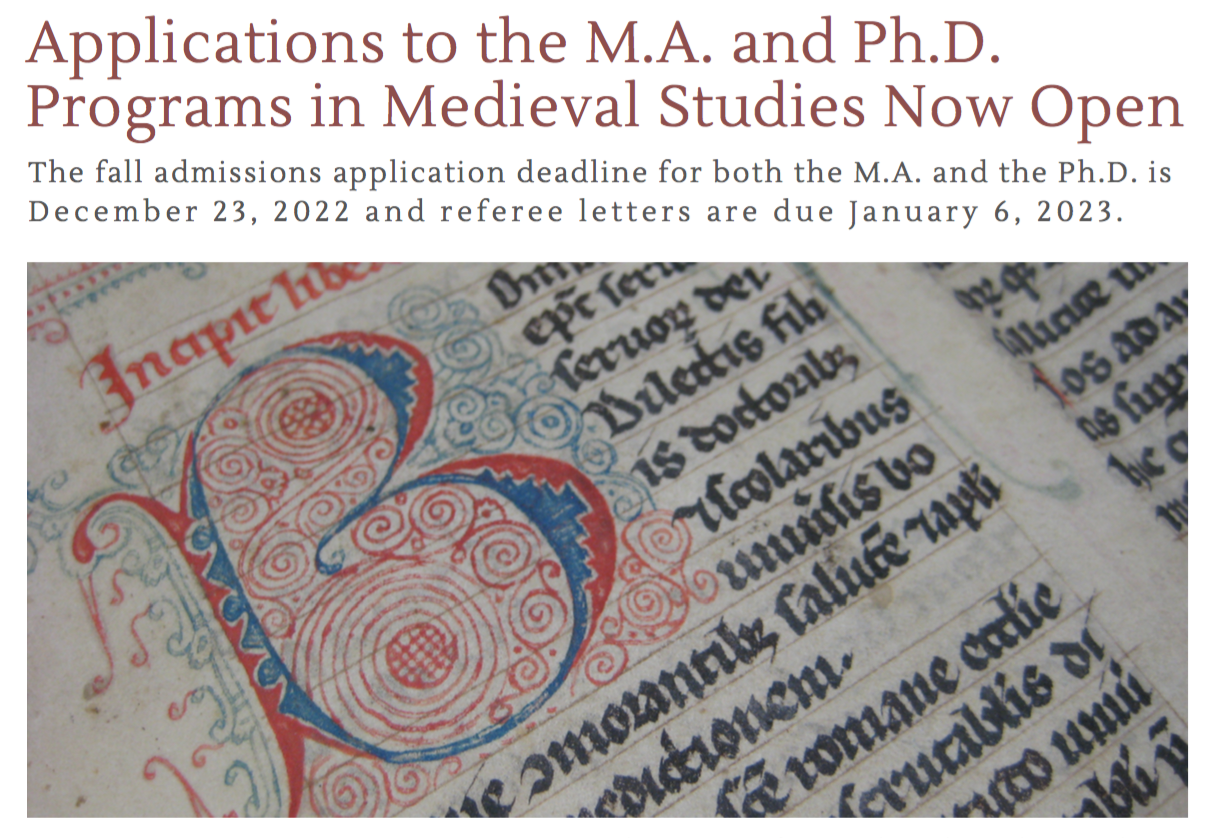
Formation – Centre for Medieval Studies, University of Toronto. Applications to the M.A. and Ph.D. Programs in Medieval Studies Now Open

The fall admissions application deadline for both the M.A. and the Ph.D. is December 23, 2022 and referee letters are due January 6, 2023.

The Centre for Medieval Studies at the University of Toronto accepts applications for 2023-2024.

The Centre for Medieval Studies hosts one of the world’s most renowned interdisciplinary medieval studies programs. Students can enroll in a Master of Arts (M.A.) program, a Doctor of Philosophy (Ph.D.) program, and one of several Collaborative Programs.

Additionally, the Centre offers a Summer Latin Program, expressly conceived to support the preparation of prospective candidates and external students.

The Centre for Medieval Studies

Since its foundation in 1964, the CMS has been internationally renowned for:

the first-rate education offered by the Latin Program,
the incomparable breath of advanced training in languages other than Latin relevant to the study of medieval times and cultures beyond Western Europe,

the comprehensive course offering, which includes Art History, History, Languages and Literatures, Manuscript Studies and Textual Cultures, Philosophy, Religious Studies, Theology, and Musicology, and the unique training in “reading” the materials remaining from the medieval past, thanks to courses in Paleography, Codicology, Diplomatics, Textual Criticism and Digital Humanities, the opportunity to collaborate on globally prominent research projects, such as the Dictionary of Old English and the Records of Early English Drama, several faculty-led research endeavours, and six publication series published by the Pontifical Institute of Mediæval Studies and University of Toronto Press,

the opportunity to acquire a comprehensive professional experience as a Course Instructor, Teaching Assistant, and Tutor in a variety of programs and departments, as well as to receive dedicated training in the Professional Development Course,

the unparalleled library resources of the network of U of T Libraries, which includes the famous Library of the Pontifical Institute of Mediæval Studies and the Fisher Library, the vibrant community constituted by approximately 60 students, an equal number of distinguished faculty, plus visiting professors, and post-doctoral fellows,
the well-established network of international partners,

the wider community of Alumni, both in academic and non-academic careers, as well as the strong Ph.D. placement record in higher education, which includes 80.95% of the 125 Ph.D. students who graduated from CMS between 2000 and 2015 (source: 10K PhDs Project),
the renewed commitment to foster Equity, Diversity, Inclusion and Accessibility in graduate education and academia,
the several services offered by the School of Graduate Studies via the Graduate Centre for Academic Communication, the Centre for Graduate Mentorship and Supervision, and the Centre for Graduate Professional Development,
and the possibility of studying and working in one of the top 20 universities in the world, which is also the second among North American public universities (source: THE2023), and in the very heart of Saint George Campus in one of the world’s most dynamic and diverse cities.

Prospective Applicants

The Centre for Medieval Studies offers a flexible curriculum tailored to students’ interests and backgrounds. Individual attention, small classes, and a dynamic academic environment will prepare students for a promising future in academic research and teaching, as well as in many other fields beyond the academy. Throughout the program, graduate students receive training in the latest methodologies for studying the Middle Ages, professional development courses and mentorship.

The Ph.D. in Medieval Studies is a five-year dissertation-oriented program consisting of three major phases (Coursework and Linguistic training, Special Field, and Writing of the Dissertation) designed to enable all students to achieve a high degree of specialization and a broad understanding of Medieval studies.

The M.A. in Medieval Studies is a one-year program conceived for students who want to explore the field in all its breadth while also strengthening their expertise in Latin. It is especially well-suited for students considering further study in doctoral programs in Medieval Studies or cognate programs, but also for those who want to pursue professional opportunities and careers that require a strong background in the humanities and unique linguistic skills.

All Ph.D. students receive a base funding package for up to five years, including tuition fees and health insurance (UHIP) for international students. The base funding package includes, in varying combinations and amounts, any external scholarship (Commonwealth Scholarship, Fulbright, OGS, SSHRC, etc.), University of Toronto Fellowship funds, Teaching and Research Assistantships, and any other contractual academic work at the University of Toronto and its federated colleges (including course instructorships and sessional appointments). On top of the base funding package, financial resources are available upon application in the form of Teaching and Research Assistantships and Awards. Awards are also available for MA students, and applicants should contact the Centre as soon as possible to get more information. Finally, the Centre offers additional funding for travel and research by subsidizing grants and fellowships for graduate students.

Do you have a question?

Feel free to write to

Professor Elisa Brilli (Director) to know more about the CMS;
Professor James Ginther (Associate Director) for info about the M.A. program and the application process;
Professor Jennifer Purtle (Ph.D. Coordinator) for info about the Ph.D. program; Rhonda Marley (Graduate Administrator) for info about administration.

Publié dans Enseignement | Laisser un commentaire

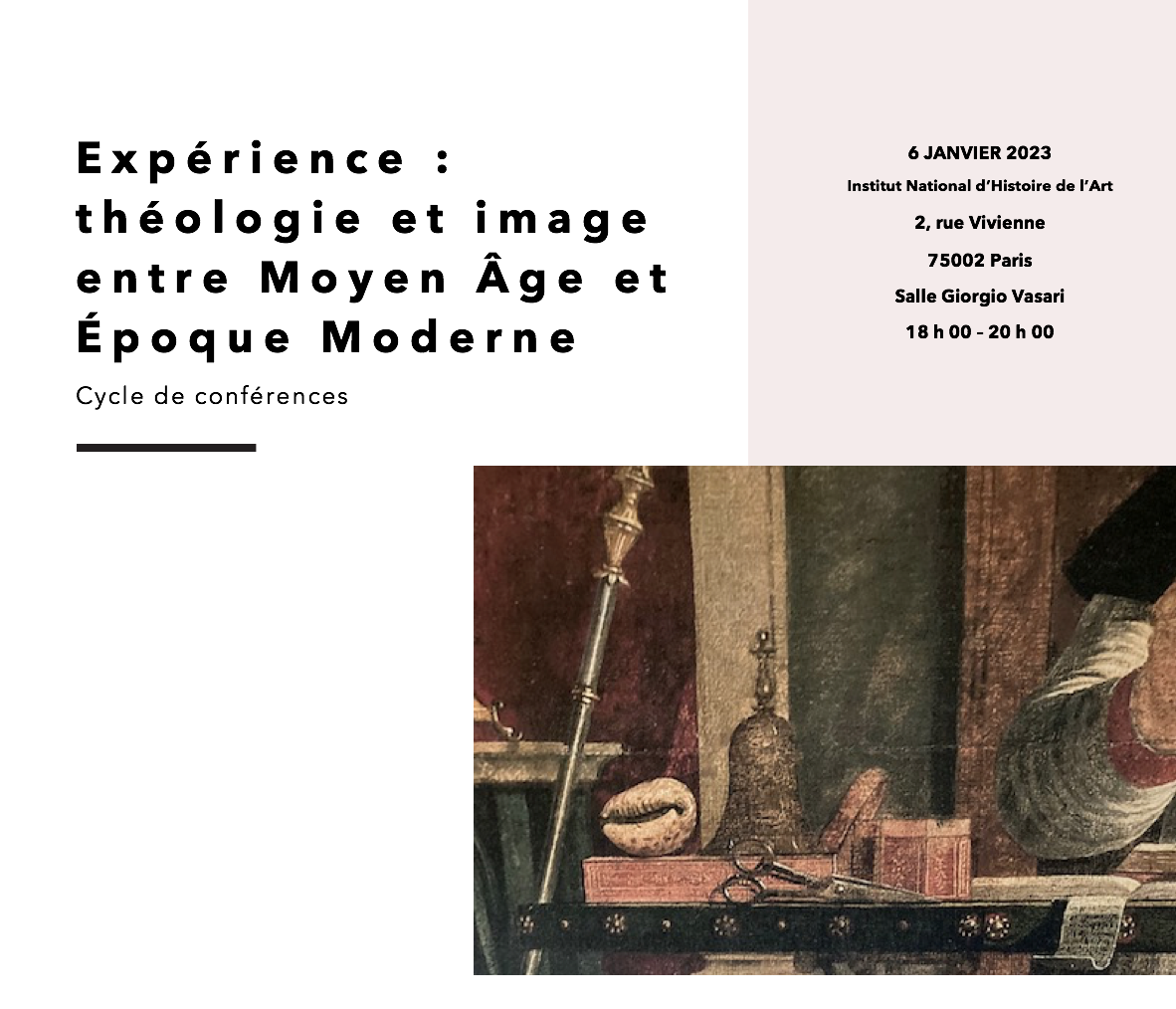
Séminaire – Expérience : théologie et image entre Moyen Âge et Époque Moderne

Afin de tisser des liens entre Histoire de l’art, Théologie et Histoire religieuse, chaque séance de ce cycle de conférences accueillera deux intervenants d’horizons disciplinaires et méthodologiques différents, qui s’exprimeront chacun pendant quarante minutes avant une discussion finale avec l’assemblée. Cette collaboration résulte d’un hiatus méthodologique constaté entre Histoire de l’art médiéval et Histoire de l’art moderne dans l’appréhension des rapports entre l’art et la théorie religieuse.

De fait, en 2005, Jean-Michel Leniaud faisait le constat de « l’absence de dialogue, voire d’autisme savant » entre l’histoire religieuse et l’histoire de l’art religieux. Pourtant, en Histoire de l’art médiéval, malgré des relations parfois conflictuelles entre l’analyse des textes et celle des images, l’invitation de Jeffrey Hamburger à recréditer académiquement la théologie en tant que « mitress of arts » semble avoir été prise ces dernières années avec beaucoup de sérieux. Le dialogue entre Histoire de l’art, Théologie et Histoire religieuse se trouve aujourd’hui bien souvent revendiqué comme le fondement de nombreuses études récentes (Bauer, Hamburger, Bynum, Kessler, Baschet, Palazzo…).

Toutefois, une telle tridisciplinarité semble encore rare chez les historiens de l’art moderne, parmi lesquels certains chercheurs comme Giovanni Careri ou Ralph Dekoninck font figure de pionniers. En 2020, Jean-Pascal Gay observait encore par exemple que « l’histoire de l’activité théologique à l’époque moderne […] demeure un champ marginal tant dans le champ historique dans son ensemble qu’au sein de celui de l’histoire religieuse ». Ce constat vaut particulièrement pour l’historiographie française qu’il compare avec celle de l’Italie et de l’Allemagne, où la « Kircherngeschichte n’a jamais désinvesti l’étude des théologiens modernes. Lorsqu’il plaidait pour une « histoire visuelle du sentiment religieux », Ralph Dekoninck saluait les travaux d’Olivier Boulnois, de Frédéric Cousinié et de Walter Melion, pour leur aptitude à ouvrir « la voie aux historiens de l’art des temps modernes sur de nouvelles manières d’appréhender l’image religieuse conçue et vécue comme expérience ».

Le dernier mot de cette citation sera utilisé comme pivot autour duquel seront axées les conférences et les discussions de ce cycle. Nous considérerons toutefois l’expérience dans son sens le plus large comme la mise en contact de soi avec le réel, confrontation de laquelle résulte le savoir et l’action.

Programme :

6 janvier – Conférences inaugurales

Éric PALAZZO L’expérience de la tension des choses et la « nature morte liturgique »

Frédéric NEF Expérience et expérienciation

21 février 

Vincent DEBIAIS Théologie du silence et expérience dans l’image médiévale

Caroline HEERING Les festivités jésuites au xviie siècle : l’expérience sensible du sacré dans les arts éphémères

28 mars

Ingrid FALQUE Mit bildgebender wise. Images et experience mystique dans l’Exemplar d’Henri Suso

Michel WEEMANS Pièges dans les marges. Images de pièges et images pièges dans les Heures de Catherine de Clève

7 avril

Alain RAUWEL Existe-t-il des « images liturgiques » dans la chrétienté médiévale ? (xie-xiiie siècles)

Émilie CHEDEVILLE Mystagogie et expérience : le décor au prisme de l’effectuation liturgique à l’époque moderne

23 mai

Werner G. JEANROND The Contribution of Theology yo the Understanding of Religious Experience and Expression

Ralph DEKONINCK Artem experiential fecit.Expérience mystique et experience esthétique au premier âge moderne

Informations pratiques :

Institut National d’Histoire de l’Art
2, rue Vivienne, 75002 Paris
Salle Giorgio Vasari
18 h 00 – 20 h 00

Publié dans Séminaire | Laisser un commentaire

Exposition – Bérengère, à la rencontre d’une Reine

Bérengère, à la rencontre d’une Reine, une exposition consacrée à la reine Bérengère fondatrice de l’Abbaye Royale de l’Epau, jusqu’au 13 mars.

Découvrez le parcours exceptionnel d’un personnage historique ancré dans la Sarthe !

Cette exposition, proposée par le Département de la Sarthe, vous invite à plonger dans l’histoire d’un personnage et d’un lieu qui lui est particulièrement attaché. Bérengère de Navarre, reine d’Angleterre, épouse de Richard Cœur de Lion, Dame du Mans est en effet la fondatrice de l’Abbaye Royale de l’Épau en 1230.
Cette femme exceptionnelle au destin de reine voyageuse a inscrit pour de nombreux siècles sa mémoire dans la pierre de l’abbaye.

Bande dessinée et Abbaye Royale de l’Épau, une riche et déjà longue histoire

La création de la bande dessinée autour de la vie de cette souveraine du 12ème siècle, «Bérengère de Navarre du trône d’Angleterre à l’abbaye de l’Épau», nous offre l’opportunité de lui consacrer une exposition temporaire intitulée : « Bérengère, à la rencontre d’une Reine». Les majestueuses voutes de l’église abbatiale, où désormais repose le gisant de la reine, accueilleront du 19 novembre 2022 au 13 mars 2023, une exposition historique à la scénographie immersive consacrée à la fondatrice des lieux et à la construction de l’abbaye. Une partie de la muséographie sera entierement dédiée à la création de cet album.

Une exposition historique

Cette exposition vous fera découvrir l’histoire de la reine Bérengère, la vie au XIIe siècle, le processus de fabrication d’une bande dessinée historique et reviendra sur les différentes étapes traversées par le reine Bérengère lors de la fondation de l’Abbaye Royale de l’Épau. Reine longtemps méconnue voire ignorée, vous découvrirez que la notoriété de Bérengère de Navarre n’a cessé de s’accroître ces dernières année.

Une scénographie immersive

Dans une mise en scène épurée et immersive conçue par Olivier Clausse (Atelier Ohm), le public est invité à approcher au plus près cette reine et partager l’héritage qu’elle a nous légué. Avec un parti-pris artistique assumé, mêlant entre autres dessin et vidéo, la muséographie vous invite à mettre vos pas dans ceux d’un personnage emblématique de notre histoire.

L’autre ambition de cette exposition est de projeter le visiteur au cœur même de son contenu.
Deux cabines de projection proposent des films saisissants au format panoramique et immersif. Le premier est consacré au processus de création de la bande dessinée et le second à l’histoire, riche et pluriséculaire, de l’Abbaye Royale de l’Épau.

Habits de lumière pour une reine

Cette exposition sera également l’occasion de découvrir le gisant de la reine Bérengère, véritable trésor de l’abbaye scupté du 13ème siècle, sublimé par un mapping vidéo signé Yann Nguema allant jusqu’à donner vie à la matière

INFOS PRATIQUES

Du 19 novembre au 2 décembre et du 30 janvier au 13 mars [entrée payante]
Ouvert de 11h00 à 18h00 du mercredi au dimanche
Lundis : réservés aux groupes et aux scolaires hors vacances Zone B
Fermé les mardis.

Du 3 décembre au 15 janvier [entrée payante]
Ouvert de 11h00 à 17h00 du mercredi au dimanche et 7j/7 pendant les vacances scolaires
Lundis : réservés aux groupes et aux scolaires hors vacances Zone B
Fermé les mardis.

Entrée gratuite pendant la période des illuminations de fin d’année du 3 décembre au 15 janvier
de 17h30 à 20h30 du mercredi au dimanche (hors vacances scolaires)
et ouverture 7j/7 pendant les vacances scolaires du 17 décembre au 2 janvier.

FERMETURES EXCEPTIONNELLES
Fermetures les 25 décembre et 1er et 12 janvier
24 et 31 décembre : fermeture à 17h00
Fermeture annuelle du 16 au 29 janvier

TARIFS
Plein 5,50€ | Jeune (10-17 ans) 3,00€ | Réduit 4,00€ / Moins de 10 ans et accompagnateur d’une personne en situation de handicap : Gratuit

Source : Abbaye royale de l’Épau

Publié dans Le réseau | Laisser un commentaire

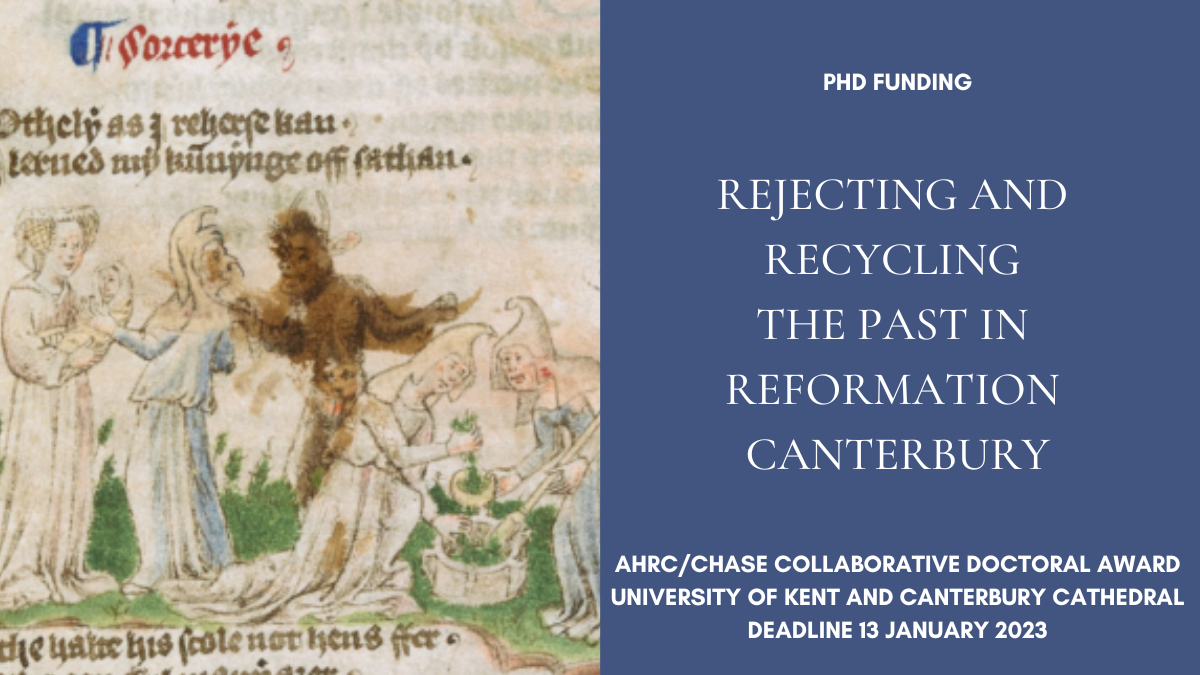
Offre d’emploi – Rejecting and Recycling the Past in Reformation Canterbury

AHRC/CHASE Collaborative Doctoral Award
University of Kent and Canterbury Cathedral
Deadline 13 January 2023

This collaborative doctoral award will allow one student to intervene an emerging new humanities discipline, working at a World Heritage Site. Funded by CHASE, it is a collaboration between the Centre for Medieval and Early Modern Studies at the University of Kent and the Archives and Library at Canterbury Cathedral.

This project takes an historical perspective on two issues of urgent present-day importance: the impulse or imperative to destroy certain cultural artefacts (iconoclasm) and the countervailing need to reuse and recycle. The historical lens is the sixteenth century when the destruction wrought by the Dissolution of the Monasteries was met with a concern to salvage and redeploy what remained. Canterbury Cathedral has many witnesses to this in its Archives and Library: fragments of medieval manuscripts reused in the sixteenth and early seventeenth centuries.‘Fragmentology’ is a developing discipline in its own right, and one which can disrupt existing narratives by introducingnew evidence and fresh eyes. This award will place the successful candidate at the heart of this transformative work.

We encourage applications from a diverse range of candidates. Training in the core skills of palaeography and codicology, as well as in Latin, will be provided as required.

 While a substantial number of fragments in the Cathedral’s collections have been identified, there remain many that have not been. The first task of the student, therefore, will be to explore and excavate the collections for relevant examples. The student will be given full training in identifying, recording and analysing the fragments. The student will be encouraged to consider these fragments as evidence as wider cultures of discarding and salvaging.

We welcome applications from a diverse range of backgrounds. Having gained or be about to gain either a MA or professional experience in a relevant area, particularly one with training in palaeography and languages would be welcome but, if that does not describe you, do not be discouraged: if you are interested, do contact the lead supervisor (see below).

The studentship is subject to UKRI eligibility criteria, and will cover home or EU fees and stipend at UKRI rates for a maximum of four years full-time, or eight years part-time study, subject to institutional regulations.

Applications for this studentship must be made via the University of Kent application form https://www.kent.ac.uk/scholarships

Potential candidates are encouraged to make informal enquiries, contacting the lead supervisor, Dr David Rundle D.G.Rundle@kent.ac.uk

Source : Medieval Art Research

Publié dans Offre d'emploi | Laisser un commentaire