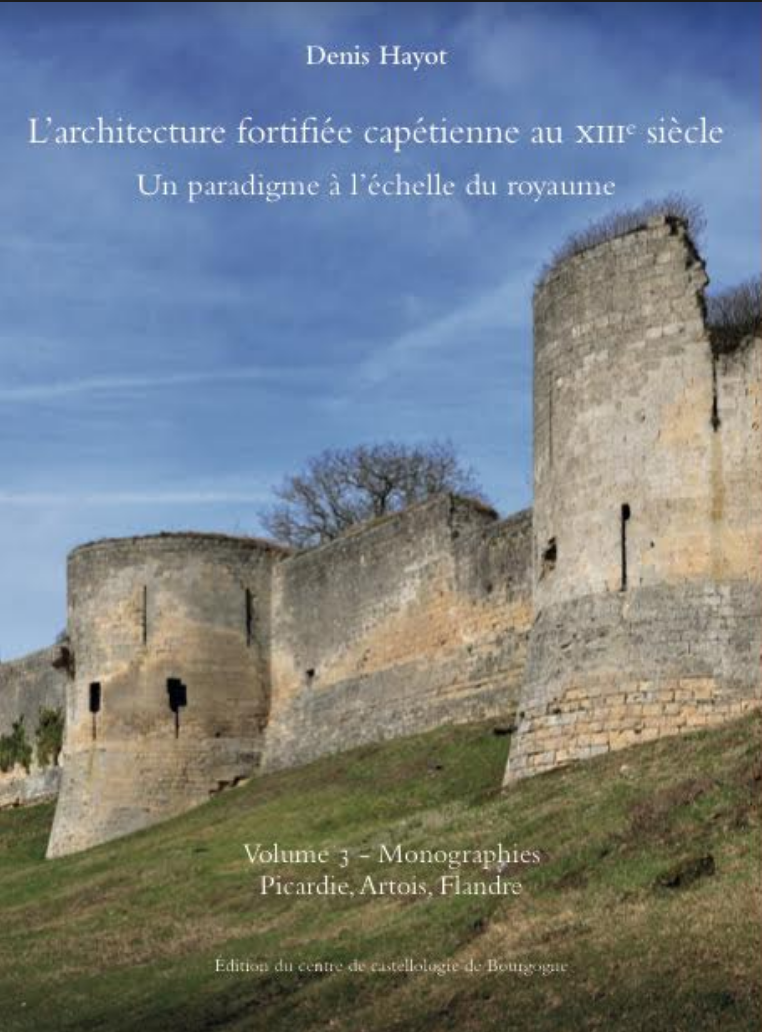
Publication – Denis Hayot, « L’architecture fortifiée capétienne au XIIIe siècle. Un paradigme à l’échelle du royaume », t. 3, « Monographies : Picardie, Artois, Flandre »

Fondée sur l’usage des tours cylindriques à archères, la forteresse idéale du XIIIe siècle ressemble à un « château-fort » de dessin d’enfant : un château carré, crénelé et cantonné de tours rondes. Mais derrière cette apparence si familière se cache un phénomène architectural majeur : apparue à la charnière de l’an 1200, et pratiquée aussi bien par le roi que par les grands princes ou les seigneurs plus modestes, l’architecture fortifiée « capétienne » remporte un immense succès dans l’ensemble du royaume tout au long du XIIIe siècle, au point d’avoir façonné le territoire et notre propre vision du Moyen Âge.

Pour comprendre cette oraison architecturale et dépasser les longs débats de l’historiographie, Denis Hayot a pris le parti d’une recherche globale, embrassant dans une même étude les forteresses royales, princières et seigneuriales à l’échelle du royaume. Cette réflexion le conduit à interroger l’idée reçue d’un hypothétique « modèle royal », à laquelle il faut préférer le constat de l’émergence d’un modèle commun, dans un royaume alors en phase d’uni cation culturelle.

Informations pratiques :

Denis Hayot, L’architecture fortifiée capétienne au XIIIe siècle. Un paradigme à l’échelle du royaume, t. 3, Monographies : Picardie, Artois, Flandre, Dijon, CeCaB, 2022 Prix : € 28,00.

Bon de commande : ici

Publié dans Publications | Laisser un commentaire

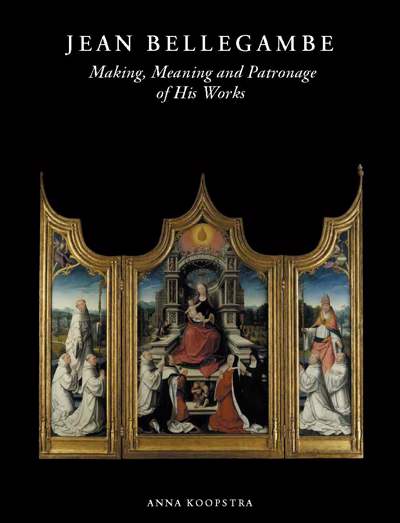
Publication – Anna Koopstra, « Jean Bellegambe (c. 1470-1535/36). Making, Meaning and Patronage of his Works »

Jean Bellegambe (c. 1470- 1535/36), whose career as far as we know spanned the first three decades of the sixteenth century, was a successful painter. His patrons included some of the most high-ranking clerics in the Habsburg-Burgundian Netherlands as well as members of the ruling class of Douai, the town where he lived and worked all his life.

This is the first study to appear since Dehaisnes’ 1890 monograph that is exclusively devoted to the artist. By reassessing primary evidence – archival documents and material evidence from the works of art themselves – it aims to highlight Bellegambe’s artistic achievements. Close scrutiny of his paintings and investigation of the artist’s working methods will show that Bellegambe visualised the concerns of his patrons by closely linking the physical characteristics of his works to their original imagery, function and use.

This volume presents a series of five case studies of his works that were made for a monastic community, two individual clerics, a town hall and a bourgeois layman, thus providing rich evidence of patronage and audiences. The objective here is to examine how Bellegambe met the challenges posed by these commissions, and to gain further insight into the practice of a skilled artist who – rooted in a long line of craftsmanship and artistic tradition and in close collaboration with his colleagues and patrons – produced a body of highly original works.

Anna Koopstra (1980) studied art history at the University of Groningen (MA, 2004) and obtained her doctorate from the Courtauld Institute of Art (PhD, 2016). She has held curatorial positions and research fellowships at the Suermondt-Ludwig Museum (2005-08), The Metropolitan Museum of Art (Slifka interdisciplinary Fellow, 2008-10), The National Gallery (2015-17), and the Courtauld (Associate Caroline Villers Research Fellow, 2016/17). Her research focuses on the technical investigation of paintings, and in particular on the making and meaning of early Netherlandish paintings.

Informations pratiques :

Anna Koopstra, Jean Bellegambe (c. 1470-1535/36). Making, Meaning and Patronage of his Works, Turnhout, Brepols, 2022 ; 1 vol., 160 p. (Me Fecit, 11). ISBN : 978-2-503-57437-0. Prix : € 100,00.

Source : Brepols

Publié dans Publications | Laisser un commentaire

Appel à contribution – The Cusanus Society of UK & Ireland

The Cusanus Society of UK & Ireland will be holding its first annual conference 20-21 June 2023 in St Andrews in conjunction that week with the annual meeting of the European Academy of Religion. We welcome papers and sessions on any aspects of the work and writings of Cusanus, including influences on his writings, his own thought and that of his contemporaries, and his subsequent influence and potential role in constructive theological and philosophical thought today. Proposals for individual papers and sessions are welcome. While we hope to primarily hold in-person sessions, selected virtual sessions may be possible.

Paper proposals (20 minutes) should include:

  • Paper title and 100-word abstract
  • Speaker’s academic affiliation and contact information Session proposals should include:
  • Session title, organizer and 150-word abstract

Information as above for 3 (20 minute) papers. Proposals and inquiries should be sent to: Simon J. G. Burton Simon.Burton@ed.ac.uk or William P. Hyland wph3@st-andrews.ac.uk.

The deadline for proposals is Monday October 31st.

We are delighted that our two plenary speakers will be: Professor John Millbank. Emeritus Professor & Director of the Centre of Theology and Philosophy, University of Nottingham, and Dr Richard Oosterhoff. Senior Lecturer in History, University of Edinburgh.

Publié dans Appel à contributions | Laisser un commentaire

Appel à candidature – Atelier d’initiation à la recherche (Master) – Rome, la péninsule italienne, le monde : enjeux et défis d’une ambition de centralité (XVe-XVIIIe siècles)

Atelier du 23 au 27 janvier 2023 à l’EFR

Envoi des candidatures jusqu’au 17/10/2022 à 12 h

Pour la sixième année consécutive, les membres de l’École française de Rome proposent un atelier d’initiation à la recherche. Il sera consacré à l’ambition romaine de centralité, à la fois politique, religieuse et culturelle, du retour des papes dans l’Urbs en 1420 à la création de l’éphémère République romaine en 1798. Cette thématique sera abordée à travers des conférences, des ateliers pratiques et des visites thématiques. La formation est ouverte aux étudiantes et étudiants de master 1 et master 2 en histoire et en histoire de l’art, qui mènent des recherches en lien avec le sujet de l’atelier.

La Caput mundi met en mouvement des forces qui sont peut-être avant tout centripètes – elle attire à elle des personnes, des biens, des informations (pèlerins, artistes, nouvelles, etc.) – mais aussi centrifuges – elle est un centre duquel partent des flux variés (légats du pape, missions, normes religieuses, etc.). Alors que la métaphore de Rome comme théâtre du monde est un lieu commun, les mécanismes concrets de cette construction ont fait l’objet d’études récentes qui ont contribué à en éclairer d’un jour nouveau les multiples ressorts et qui ouvrent de nouvelles perspectives de recherche. L’atelier abordera, d’une part, la centralité romaine liée à la vocation universelle de la papauté, tout comme à l’action des dirigeants des États pontificaux pour s’imposer face à d’autres puissances de la péninsule italienne et au-delà, qu’il s’agisse de négociations diplomatiques ou du rayonnement artistique. D’autre part, seront évoqués les obstacles (politiques, économiques, religieux) à la volonté centraliste de Rome et les résistances qu’elle suscite à l’échelle locale et globale. L’exception romaine sera ainsi abordée avant tout à travers ses constantes interactions avec d’autres espaces et d’autres modèles (confessionnels, culturels, etc.). Pour explorer ces dimensions, l’atelier cherchera à faire découvrir la diversité et la richesse parfois vertigineuses des archives romaines, mais aussi la matérialisation topographique de la volonté d’être (et/ou d’apparaître comme) un centre du monde.

Cette formation visera les objectifs suivants :

  • Découverte de fonds d’archives, de bibliothèques et de lieux emblématiques de la Rome renaissante et moderne pour appréhender à la fois leur richesse et la nécessité d’adopter des stratégies de recherche pour ne pas se trouver submergé par leur nombre et leur diversité ;
  • Familiarisation avec de récents développements historiographiques et des champs en renouveau, principalement en histoire diplomatique et en histoire de l’Église romaine, en histoire de l’information, en histoire culturelle et en histoire des savoirs ;
  • Réflexion méthodologique autour du choix du sujet de thèse et de la problématisation du projet de recherche.

Admission

Les dossiers de candidature doivent comporter : un CV, un relevé des notes obtenues au cours de l’année universitaire précédente, une lettre de motivation évoquant les projets futurs de l’étudiant et les raisons de son intérêt pour la formation. Les dossiers, sous forme d’un seul document PDF, doivent parvenir avant le 17 octobre 2022 à midi à l’adresse suivante : atelier.master(at)efrome.it. En cas d’absence d’accusé de réception, il est nécessaire de contacter les organisateurs. La sélection effectuée par le comité de coordination de l’EFR sera communiquée au plus tard le 31 octobre 2022. La commission d’évaluation n’attend pas de profil académique particulier ; les dossiers seront évalués avant tout en fonction du bénéfice que les candidats pourront retirer de la formation.

Informations pratiques

Les étudiants seront logés à l’École française de Rome, place Navone, et leurs déjeuners seront pris en charge. En revanche, le déplacement vers Rome et les dîners seront à la charge des participants ou de leur université. En cas d’impossibilité d’assurer ce financement, il sera possible exceptionnellement de demander à l’EFR une aide pour le déplacement, sur présentation d’une attestation de non-prise en charge par l’établissement d’origine.

Un rapport (cinq-six pages) devra être remis aux formatrices et aux formateurs comprenant une réflexion sur une catégorie de sources présentée durant l’atelier, au choix, assortie de quelques exemples de thèmes de recherche en lien avec ces sources. Ce rapport pourra faire l’objet d’une validation en fonction des modalités prévues par les universités de rattachement, par exemple, compter comme un stage.

Contacts

Pour toute question, contacter : Lana Martysheva et Pierre-Bénigne Dufouleur (atelier.master(at)efrome.it).

Source : École française de Rome

Publié dans Appel à contributions | Laisser un commentaire

Séminaire – Utrecht Centre for Medieval Studies Yearly Seminar: Premodern Reading Cultures Between Transforming Materialities

Programme : ici

This year’s UCMS Seminar, on 14 October 2022, will be devoted to the connections between reading cultures and the transforming material features of the medieval book: from scroll to codex, from parchment to paper, from manuscript to print, and recently from printed to digital facsimiles.

Historical developments

The distinctions between material forms and media have crucially shaped scholarly narratives around books and reading cultures in late antiquity, the Middle Ages, and the early modern period. A concept such as ‘the printing revolution’ has supported our understanding of the influence of technological developments on the transmission of texts and knowledge, but may simultaneously be criticised for implying a rigid distinction between print and manuscript culture.

Relations between different developments

This seminar will investigate the relations between technological, textual, and cultural developments, paying particular attention to texts and practices that cross traditional divides. Themes that may be discussed include developments and continuities in the characteristics and functions of paratext, images, and decoration, the transmission of specific texts or genres, and reading techniques.

Material forms

Another crucial issue relates to the co-existence of various material forms. Examples include late-medieval scrolls, handwritten copies of printed texts, printed images in manuscripts, written marginalia in printed books, and the digital copies of physical manuscripts.

About the seminar

By bringing together book historical, art historical, literary, and cultural perspectives on these matters, the seminar aims to provide a multidisciplinary outlook on the influence of transforming materialities on the transmission and use of texts. The presentations at the UCMS Seminar not only focus on research results, but may also discuss ongoing research or broader developments within the field.

The event is mainly intended for RMA students, PhD’s and Early Career Scholars, but all those who are interested, in particular all UCMS members, are welcome to attend.

Informations pratiques :

Start date and time : 14 October 2022 – 11:00
End date and time 14 October 2022 – 17:00
Location Janskerkhof 2-3, room 021
Registration To register, please send an e-mail to ucms@uu.nl
More information Utrecht Centre for Medieval Studies

Source : Utrecht Centre for Medieval Studies

Publié dans Séminaire | Laisser un commentaire

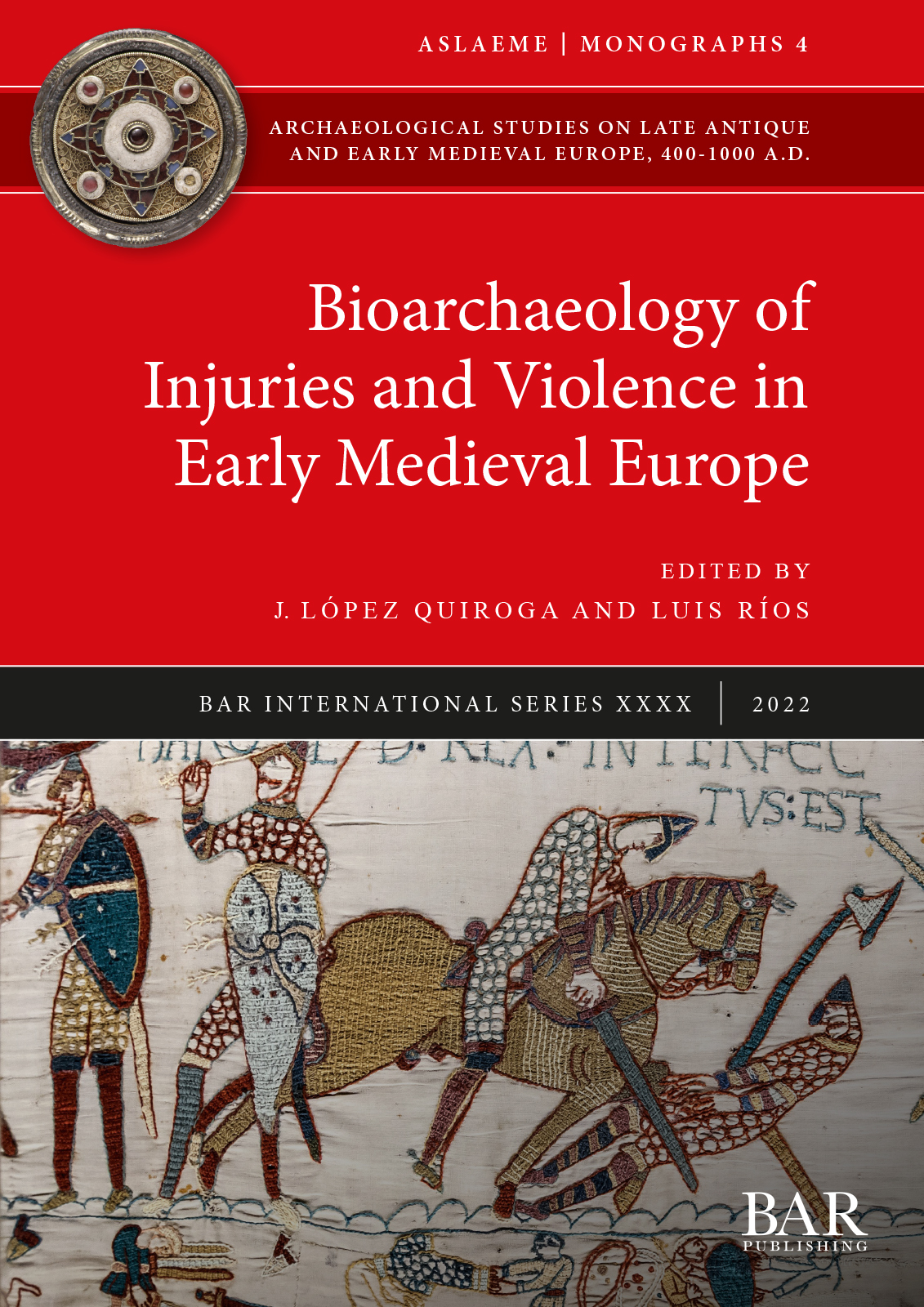
Publication – « Bioarchaeology of Injuries and Violence in Early Medieval Europe », dir. Jorge López Quiroga et Luis Ríos Frutos

Bioarchaeology of Injuries and Violence in Early Medieval Europe presents evidence and documents forms of violence and injuries in skeletal remains. Its contributions address this topic for the first time in a chronologically specific arc (Late Antiquity and Early Middle Ages) and a wide geographical area (Greece, England, Germany, France, Italy and Spain). The diversity of examples of interpersonal violence, collective violence (mass graves), punishments, and ante-mortem and post-mortem injuries provides an important data set concerning the degree and dimension of violence and injuries in post-Roman Europe. Osteoarchaeological and bioarchaeological analysis of human remains, together with exhaustive studies of corpses, from the time of burial to exhumation, makes it possible to identify burials as ‘non-normative’, ‘anomalous’ or ‘deviant’ burials that may be the result of violence, including evidence of punishments and executions.

Jorge López Quiroga is Senior Researcher at the Autonomous University of Madrid. His research focuses on Late Antiquity and the Early Middle Ages in the Iberian Peninsula and in the post-Roman West. He is the editor of Entangled Identities and Otherness in Late Antique and Early Medieval Europe (BAR Publishing, 2017), among others, and co-editor since 2006 of the BAR sub-series Archaeological Studies on Late Antique and Early Medieval Europe (ASLAEME).

Luis Ríos Frutos, Biologist and Anthropologist, is Assistant Professor of Physical Anthropology at the Complutense University of Madrid and Researcher at Sociedad de Ciencias Aranzadi. He has authored numerous publications on human bones spanning from the Neanderthals from El Sidrón, to mass graves from the Spanish Civil War.

Table des matières : ici

Contributors: Kurt W. Alt, Fabrizia Andriani, Fabio Armenise, Agustín Azkárate, Jo Buckberry, Chryssa Bourbou, Mª Paz De Miguel Ibañez, Francisco Etxeberria, I Etxeberria, Véronique Gallien (†), Dawn Hadley, Lourdes Herrasti, Rachel Holgate, Jorge López Quiroga, Alyxandra Mattison, Christian Meyer, Ginevra Anna Panzarino, Patrick Périn, Luis Ríos Frutos, Iban Sánchez-Pinto, Sandro Sublimi Saponetti, Michelle Williams-Ward.

Informations pratiques :

Bioarchaeology of Injuries and Violence in Early Medieval Europe, éd. Jorge López Quiroga, Luis Ríos Frutos, Oxford, BAR Publishing, 2022 ; 1 vol., 250 p. (Archaeological Studies on Late Antiquity and Early Medieval Europe (400-1000 A.D.). Monographs, 4). ISBN : 978-1-40735-993-9. Prix : GBP : 65,00.

Source : BAR Publishing

Publié dans Publications | Laisser un commentaire

Offre d’emploi – « REIGN. Reconstructing the Ghent knowledge center of the Counts & Countesses of Flanders, 11th-18th C. » 1 historicus – wetenschappelijk medewerker (m/v/x)

1 historicus – wetenschappelijk medewerker (m/v/x)

voor het BRAIN-be 2.0-project (2023-2027)

REIGN (Reconstructing the Ghent knowledge center of the Counts & Countesses of Flanders, 11th-18th C.)

Het Algemeen Rijksarchief en Rijksarchief in de Provinciën is een federale wetenschappelijke instelling die deel uitmaakt van de Federale Programmatorische Overheidsdienst (POD) Wetenschapsbeleid. De instelling bestaat uit het Algemeen Rijksarchief te Brussel, 18 vestigingen van het Rijksarchief verspreid over het hele land en het Studie- en Documentatiecentrum Oorlog en Hedendaagse Maatschappij (SOMA) te Brussel.

Het Rijksarchief verwerft en bewaart (na selectie) archieven van minstens 30 jaar oud, afkomstig van onder meer van hoven en rechtbanken, openbare besturen en notarissen, alsook van de private sector en particulieren (bedrijven, politici, verenigingen en genootschappen, invloedrijke families, enz.).

De valorisatie van deze archieven is één van de hoofdopdrachten van de instelling. Het Rijksarchief stelt niet alleen in zijn studiezalen, maar ook on line een uitgebreide onderzoeksomgeving ter beschikking van een ruim en gevarieerd publiek.

BESCHRIJVING VAN DE TE BEGEVEN FUNCTIE

REIGN is een vierjarig project van het BRAIN-be 2.0-programma van de POD Wetenschapsbeleid. Het betreft een bottom-up project ingediend en gecoördineerd door het Rijksarchief Gent.

Als wetenschappelijk personeelslid van het Gentse Rijksarchief beschik je over een welomschreven takenpakket binnen het REIGN-project. Je werkt daarnaast ook nauw samen met de coördinator en de medewerker, onder meer tijdens de oriënteringsfase en op het gebied van valorisatie en publiekswerking. Je staat tevens mee in voor de projectrapportering aan de POD Wetenschapsbeleid en voor de begeleiding van jobstudenten die door het Rijksarchief binnen het project worden aangeworven. Een korte contextualisering, samengevat uit het projectvoorstel, luidt als volgt:

“Few archival collections have such a turbulent history” argued historian and archivist E. Aerts, when writing about the condition of the “chartrier” of the Counts of Flanders in 1996. Although from a slightly different point of view, the sentiment is still shared by many historians and archivists of the medieval and the early modern period. Recently, with the financial support of the Baillet-Latour foundation, the State Archives in Ghent have made great efforts to improve the material condition of the vast collection of political, legislative, administrative, judicial and financial documents of the

Flemish counts. In addition to the restoration of all 4055 “charters”, the digitization lab of the Belgian National Archives provided high-resolution scans of front and back of each document. This large-scale operation is finished – which means that the momentum for scientific exploration and dissemination is now.

However, it does not suffice to simply update the existing but (according to modern standards) inadequate archival descriptions, to accompany the scans in the search engine of the Belgian National Archives. The biggest hurdle to presenting these “charters” in a scientifically sound environment is their current arrangement in four artificially composed series – a situation at odds with 21st-century developments within the field of archival science, in particular the basic principle of presenting records in their contexts. In this case, the quest for that context leads us back to the late days of the Ancien Régime, to the vast archival mass left behind by several institutions of the former County of Flanders at their location in the Volderstraat and the castle of the Counts (“Gravensteen”) in Ghent. What is now known as the “chartrier”, was in 1796 scattered between archives of the Council of Flanders, the highest feudal court in Flanders known as the « Wetachtige Kamer », the financial Chamber of the “Hoofdredeninge”, the exception court of the “Indaginge”, documents about the management of the comital domains and even the archives of the Oudburg castelleny – in short, the core of the historical collection of the State Archives in Ghent and, combined, the written testimony of the governance of the Counts and Countesses of Flanders.

There is a consensus among historians and archivists that Ancien Régime administrations were not as defined as the institutions we know nowadays. The archival history of the comital archives seems to confirm this notion. The compartmentalization of these archives in different archival holdings, as listed above, is mainly an artificial construction – a result of consecutive, often uncoordinated actions of officiaries, historians and archivists from an era when archival science was still in its infancy, an era in which other motives for perusing the archives also applied (such as the search for property titles). These interventions are often not explicitly documented, but this can be remedied provided a correct and well thought-out methodology. By combining dorsal notes found on the ‘”chartrier” during preparation of the restoration (showing several different numbering systems over time), old inventories (for example the Buntinx “fichier” of the Council of Flanders), lists of various artificially created collections such as “Varia”-series and the “Fonds Gent”, preserved reports of 19th-century archival committees, correspondence, general annual activity reports and other documents saved within the own archives of the State Archives in Ghent, a virtual reconstruction of the Ghent knowledge center of the Counts and Countesses of Flanders is within range.

Doing so, this project aims to (i) contribute to the knowledge of the comital administration, broadening the field of view on the governance of the County of Flanders and, consequently, enabling new angles for historical research. For instance, by focusing on the notion of « archival creator », interesting possibilities in the field of gender studies arise. Likewise, REIGN will offer (ii) new insights for the relatively young scientific discipline of archival history, by studying the arrangement of documents by their creator(s), in addition to 19th-century archival methods. All this will be viewed in the light of current developments in archival science, such as the conceptual model of RiC-CM (v0.2). Last but not least, (iii) the heuristic tools generated by this project will enable both the staff of the Federal Scientific Institution and the users of their collections (academic researchers, students, non- academic historians, genealogists, and so on) to navigate comital records more easily and effectively.

Main archival deliverables include an online access point to the “chartrier” worthy of the 21st century, in which the documents are contextualized and presented in relation to their archival creators and in their various arrangements since the 14th century (= date of the first traceable inventory). In addition, a correlation table to the vast archives of the Council of Flanders and adjacent institutions will provide a solution to persistent difficulties with consultation based on old archival references – to be found in all studies until mid 20th century and in important 19th-century source publications (such as the “Recueil des ordonnances des Pays-Bas” or the “Messager des sciences et des arts”, nowadays available online). Finally, an overview of strayed or rather artificially separated records of a seemingly more documentary nature, their origin and current location, will complete the virtual reconstruction of the comital knowledge center.

PLAATS VAN TEWERKSTELLING

Rijksarchief Gent, Bagattenstraat 43, 9000 Gent. PROFIEL

  • Je bent houder van een diploma van master (en eventueel doctor op proefschrift) in de geschiedenis.
  • Een zeer goede kennis van instellingen, archiefvorming en documenttypes uit de middeleeuwen en de vroegmoderne tijd (11de – 18de eeuw) is een conditio sine qua non.
  • Je beschikt over een gedegen paleografische kennis.
  • Goede, passieve kennis van het Latijn en het Frans; en actieve kennis van het Engels is aanwezig.
  • Je hebt een uitstekende kennis van Microsoft Office (Word, Excel en Access).
  • Je kan georganiseerd en zelfstandig werken.
  • Je bent resultaatgericht en je houdt je aan de doelstellingen en termijnen die binnen het project zijn vooropgesteld.
  • Een diploma archivistiek en/of aantoonbare ervaring in de archiefsector vormt een pluspunt.

WERKVOORWAARDEN

Wij bieden:

  • Een voltijds (38 uur per week) contract van bepaalde duur voor 2 jaar, eenmalig verlengbaar met max. 2 jaar.
  • Datum van indiensttreding: 1 februari 2023 (eventueel 1 maart of 1 april 2023).
  • Glijdend uurrooster.
  • Mogelijkheid tot telewerk.
  • Loonschaal:

o SW10 (21.880,00 – 33.895,00 EUR niet-geïndexeerd brutoloon, een netto salaris vanaf ca. 2.210 EUR bij 0 jaar anciënniteit)

o of SW11 (25.880,00 – 41.351,00 EUR niet-geïndexeerd brutoloon, een netto salaris vanaf ca. 2.560 EUR bij 2 jaar anciënniteit). Om toegelaten te worden tot de schaal van SW11, moet je minstens 2 jaar wetenschappelijke ervaring kunnen voorleggen of een andere professionele activiteit die relevant wordt geacht voor deze functie.

Voordelen:

  • Gratis openbaar vervoer voor het woon-werkverkeer en/of fietsvergoeding.
  • oordelige hospitalisatieverzekering.
  • Mogelijkheid tot recuperatie van overuren.
  • Minimum 26 vakantiedagen per jaar.
  • Voordelen en interessante aanbiedingen via de Fedplus en Belspo – kaarten.
  • Bijkomende voordelen, zie: http://www.fedplus.be

SELECTIEPROCEDURE

Om in aanmerking te komen dienen de kandidaten hun dossier (PDF) uiterlijk op 15 oktober 2022 per email te hebben overgemaakt aan recruit@arch.be; in CC Joke.Verfaillie@arch.be (met de referentie: NAAM_VOORNAAM_REIGN).

Het dossier moet worden ingediend in het Nederlands en bevat minstens een motivatiebrief, een kopie van het vereiste diploma en een curriculum vitae met publicatielijst en relevante ervaring. De kandidaten die op basis van hun dossier werden geselecteerd, zullen worden uitgenodigd voor een mondelinge proef. Deze bestaat uit een 60 minuten durend interview met de leden van de jury op 8 november 2022 in het Rijksarchief Gent. Ter voorbereiding van dat interview zullen de uitgenodigde kandidaten de integrale tekst van het projectvoorstel ontvangen, samen met een korte opdracht die in lijn ligt met de projectinhoud. Deze opdracht zal aan bod komen tijdens het interview, samen met o.a. de inhoud van het cv en verschillende deelaspecten van het project. Om te slagen dient de kandidaat 12 op 20 punten te behalen. Het resultaat van de selectie blijft één jaar geldig.

CONTACTEN

Voor bijkomende informatie over het project en de te begeven functie kan je contact opnemen met Joke VERFAILLIE (Joke.Verfaillie@arch.be), coördinator, en/of Annelies SOMERS (Annelies.Somers@arch.be), medewerker van het REIGN-project. Voor bijkomende informatie over de selectieprocedure kan je contact opnemen met Sébastien DUBOIS, operationeel directeur onderzoek (Sebastien.Dubois@arch.be).

Publié dans Offre d'emploi | Laisser un commentaire

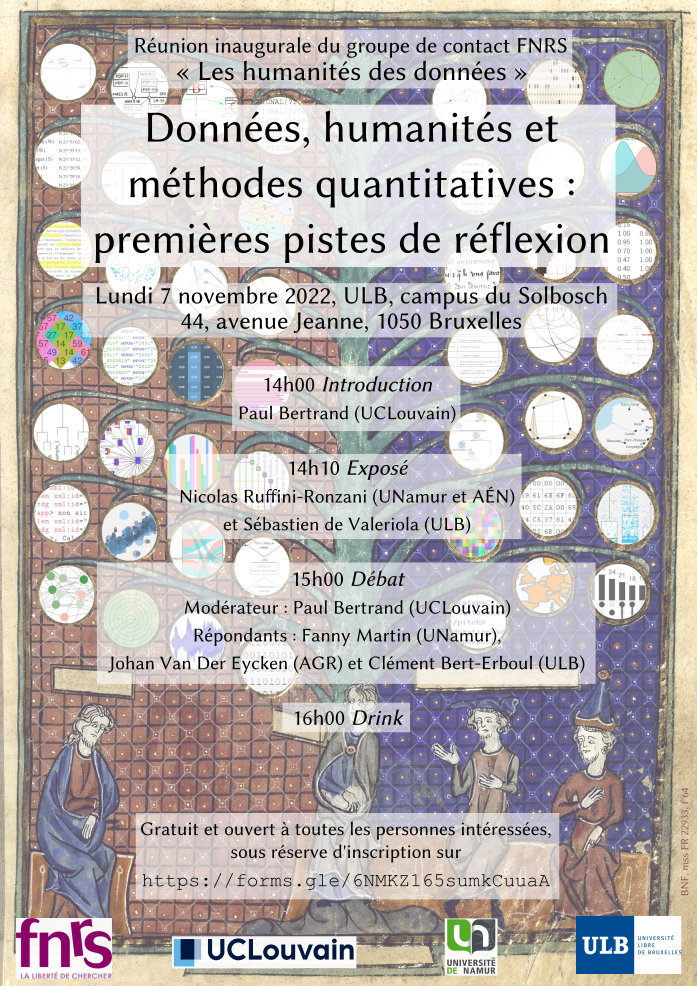
Journée d’étude – Données, humanités et méthodes quantitatives : premières pistes de réflexion

Réunion inaugurale du groupe de contact FNRS « Les humanités des données »

Lundi 7 novembre 2022, ULB, campus du Solbosch
44, avenue Jeanne, 1050 Bruxelles

Programme :

14h00 Introduction – Paul Bertrand (UCLouvain)

14h10 Exposé : Nicolas Ruffini-Ronzani (UNamur et AÉN) et Sébastien de Valeriola (ULB)

15h00 Débat
Modérateur : Paul Bertrand (UCLouvain)
Répondants : Fanny Martin (UNamur), Johan Van Der Eycken (AGR) et Clément Bert-Erboul (ULB)

16h00 Drink

Gratuit et ouvert à toutes les personnes intéressées, sous réserve d’inscription sur https://forms.gle/6NMKZ165sumkCuuaA

Publié dans Colloque | Laisser un commentaire

Publication – Kevin Bovier, « La Renaissance de Tacite. Commenter les Histoires et les Annales au XVIe siècle »

Au XVIe siècle, les humanistes commentèrent pour la première fois les Histoires et les Annales de l’historien romain Tacite. L’objectif de cette étude est de montrer les intérêts et les méthodes de travail de ces commentateurs, ainsi que les stratégies qu’ils développaient pour faciliter l’accès du lectorat au texte antique. Comment les commentaires étaient-ils élaborés ? Pour quel public ? Ces travaux érudits ont-ils permis à Tacite de gagner le statut d’auteur majeur à la fin du XVIe siècle ? En répondant à ces questions et à d’autres encore, l’auteur tente de redéfinir la place de Tacite dans le mouvement humaniste du XVIe siècle et d’offrir de nouvelles perspectives sur la transmission et la réception de ses œuvres à la Renaissance.

Kevin Bovier est docteur en langue et littérature latines de l’Université de Genève. Ses travaux portent sur la réception des auteurs antiques à la Renaissance et sur la littérature néo-latine. Il collabore actuellement au projet Humanistica Helvetica à l’Université de Fribourg.

Informations pratiques :

Kevin Bovier, La Renaissance de Tacite. Commenter les Histoires et les Annales au XVIe siècle, Bâle, Schwabe Verlag, 2022 ; 1 vol., 341 p. (Antiquity after Antiquity, 2). ISBN : 978-3-7965-4606-8. Prix : CHF : 64,00.

Source : Schwabe Verlag

Publié dans Publications | Laisser un commentaire

Colloque – Gender, Work and Service in Late Medieval Europe (1300–1600)

Considering how service was perceived, regulated and practiced in relation to gender, speakers take into account the diversity of late medieval forms of service and focus on a broad spectrum of lifelong or periodic service work. This includes domestic service, service work within workshops, brothels, religious communities and poorhouses or military and diplomatic services provided for cities. The conference brings together scholars from different countries, various disciplines and at all career stages to discuss, e.g., divisions of tasks and responsibilities, degrees of coercion and autonomy as well as the monetary and cultural value attached to different forms of service and groups of servants from a gendered perspective.

Programme :

Thursday, 29 September 2022

09.30–10.00h
Welcome and Introduction
Eva-Maria Cersovsky (University of Cologne) and Julia Exarchos (RWTH Aachen)

10.00–11.00h KEYNOTE
Jeremy Goldberg (University of York): “They Put Them Out, Both Males and Females, to Hard Service and in the Houses of Other People”: English Servanthood in Comparative Perspective
Chair: Karl Ubl (University of Cologne)

11.00–11.30h Coffee Break

SESSION 1: DOMESTIC SERVICE AND WORK IN URBAN AND RURAL CONTEXTS
Chair: Sabine von Heusinger (University of Cologne)

11.30–12.15h: Dorothee Rippmann (UZH Zürich): Gender, Work, and Visibility: The Examples of Agriculture and Textile Production (15th and 16th Centuries)

12.15–13.00h: Eyal Levinson (The Hebrew University of Jerusalem): “If there Is an Elderly Woman in the Home, there Is a Treasure in the Home”: Work, Old Age, and Conceptualizations of Gender Among Medieval Ashkenazi Jews

13.00–14.00h: Lunch Break

14.00–14.45h: Jacqueline Turek (RWTH Aachen): Gender-Specific Aspects of Domestic Service: Work, Wages, and Migration of Male and Female Servants in Late Medieval Southern Germany

SESSION 2: PROSTITUTION AND UNFREE LABOR
Chair: Julia Exarchos (RWTH Aachen)

14.45–15.30h: Jamie Page (Independent Scholar): Sex, Work, and Social Identity: Evidence from Late Medieval Europe

15.30–16.00h: Coffee Break

16.00–16.45h: Michael Hammer (University College of Teacher Education Styria): Prostitution in the Late Medieval “Frauenhaus” – Sex Work between Slavery and Protection?

16.45–17.30h: Angela Zhang (Harvard University): “She Keeps the House”: Enslaved Labor in the Racializing Processes of Late-Medieval Florence

17.45–18.45h KEYNOTE
Judith Bennett (University of Southern California): Poor Women and the Intimate Labor of Sex in Late Medieval England
Chair: Eva-Maria Cersovsky (University of Cologne)

Friday, 30 September 2022

SESSION 3: MILITARY AND DIPLOMATIC SERVICES
Chair: Julia Bruch (University of Cologne)

09.00–09.45h: Edward Loss (I Tatti, Harvard University Research Center): Far from the Exception: Female Couriers and Information Gatherers in Late Medieval Italy

09.45–10.30h: Markus Jansen (University of Cologne): Women of War. Urban Women and Martial Service in the Late Middle Ages

10.30–11.00h: Coffee Break

SESSION 4: SERVING AND WORKING IN RELIGIOUS COMMUNITIES
Chair: Lioba Geis (University of Cologne)

11.00–11.45h: Adrian Kammerer (University of Cologne): Male and Female Tertiaries as Workers at Dominican Convents: A Gendered Approach

11.45–12.30h: Emma Gabe (University of Toronto): Lay Sisters, Social Status, and Labor in Late Medieval Female Monasteries

12.30–13.30h: Lunch Break

SESSION 5: SERVING AND WORKING IN TEXTILE PRODUCTION
Chair: Milan Pajic (Free University of Berlin/ Université Catholique de Louvain)

13.30–14.15h: Marco Tomaszewski (University of Freiburg): Gender, Age, and Status in the Export-Production of Linen. A Multi-Relational Approach (St. Gallen, 15th/16th Century)

14.15–15.00h: Ivana Lemcool (University of Belgrade): Donors or Embroiderers: Late Medieval Serbian Noblewomen and their Votive Textiles

15.00–15.15h: Coffee Break

15.15–16.00h: Meagan Khoury (Stanford University): Silken Sensualities and Wayward Women: High and Low Cultural Labor in Early Modern Bologna

16.00h: Concluding Remarks

Informations pratiques :

29.09.2022 – 30.09.2022

a.r.t.e.s. Graduate School for the Humanities Cologne, Aachener Str. 217, Room 3.A06 (« Skyfall ») – Cologne

Participation is free, to register please send an email to Eva-Maria Cersovsky until 26 September 2022: cersovse@uni-koeln.de.

Organizer Eva-Maria Cersovsky (University of Cologne) / Dr. Julia Exarchos (RWTH Aachen)

Source : H-Soz-Kult

Publié dans Colloque | Laisser un commentaire