Offre d’emploi – 1 doctoraatsonderzoeker (m/v/x) : “A Pragmatic Reality: The Performance and Codification of Collective Agency in the ‘Age of Freedom’ of Urban Communities in the Southern Low Countries and Northern France (late 11th – early 13th Centuries)”

Universiteit Gent – Vakgroep Geschiedenis werft aan:
1 doctoraatsonderzoeker (m/v/x) voor het FWO Senior Onderzoeksproject

“A Pragmatic Reality: The Performance and Codification of Collective Agency in the ‘Age of Freedom’ of Urban Communities in the Southern Low Countries and Northern France (late 11th – early 13th Centuries)”

BESCHRIJVING VAN HET PROJECT EN VAN DE TE BEGEVEN FUNCTIE

Het onderzoek naar de vroege ontwikkeling van stedelijke gemeenschappen in West-Europa is lang bepaald door een politiek-institutionele benadering van de vrijheden, wetten en gewoonten die deze gemeenschappen van hun heren ontvingen in zgn. ‘keures’. Deze eenzijdige benadering heeft geleid tot een gebrekkige kennis over de pragmatische context waarin deze rechten werden onderhandeld en neergeschreven, over de socio-economische omstandigheden die de acties van de betrokken sociale groepen bepaalden en over hoe juridische concepten geënt waren op ideeën rond rechtssystemen.

Dit project stelt een interregionale vergelijkende studie voor van een 150-tal typologisch variërende vrijheidscharters toegekend aan steden en communes in de Zuidelijke Nederlanden en Noord-Frankrijk tijdens de pioniersfase van hun ontwikkeling. De methodologie bestaat uit drie benaderingen die vanuit een antropologisch perspectief verbanden zullen onderzoeken tussen mensen, documenten en contexten:

1) een pragmatisch—documentaire analyse, met als doel de context waarin wetten en vrijheden werden opgetekend te reconstrueren tijdens de experimentele fase van pragmatische geletterdheid en document-gebaseerd bestuur;
2) een politiek—socio-economische analyse, met de intentie de ‘collectiviteit’ van vroegstedelijke gemeenschappen te doorgronden;

3) een rechtshistorische analyse, waarin vrijheidscharters worden beschouwd als de consolidatie van rechtsprincipes in de machtsstrijd tussen heersers en onderdanen.

Het onderzoek wordt deels op zelfstandige basis en deels in samenwerking met de projectleiders gevoerd, en zal leiden tot meerdere (co-)publicaties. Daarnaast wordt de doctoraatsonderzoeker verwacht de onderzoeksresultaten te presenteren tijdens wetenschappelijke bijeenkomsten in binnen- en buitenland.

Het project wordt geleid vanuit de Universiteit Gent (Els De Paermentier en Jan Dumolyn, Vakgroep Geschiedenis en Dirk Heirbaut, Vakgroep Metajuridica, Privaat- en Ondernemingsrecht) in samenwerking met de Vrije Universiteit Brussel (Georges Declercq en Bart Lambert, Vakgroep Geschiedenis). De standplaats van de doctoraatsonderzoeker is de Universiteit Gent (Sint- Pietersnieuwstraat 35, Gent).

FUNCTIEOMSCHRIJVING

Het gaat om een voltijdse onderzoekspositie van vier jaar (één jaar, verlengbaar met drie jaar na een positieve tussentijdse evaluatie) die gefinancierd wordt door het Fonds Wetenschappelijk Onderzoek (FWO) Vlaanderen. De precieze datum van indiensttreding wordt in onderling overleg met de gekozen kandidaat bepaald en zal uiterlijk op 1 oktober 2023 ingaan. De onderzoeker zal de mogelijkheid hebben om deel te nemen aan (inter)nationale wetenschappelijke bijeenkomsten en zal nauwe contacten onderhouden met de collega’s van het Henri Pirenne Instituut voor Middeleeuwse Studies (UGent), de HOST onderzoeksgroep voor Stadsgeschiedenis (VUB) en het Instituut voor Rechtsgeschiedenis (UGent).

PROFIEL

– Je bent houder van een diploma van Master in de Geschiedenis en hebt een uitgesproken interesse in middeleeuwse stadsgeschiedenis, sociaal-politieke en rechtsgeschiedenis.

– Je hebt aantoonbare ervaring in het werken met originele documentaire (administratief- bestuurlijke) middeleeuwse bronnen. Kennis van de hulpwetenschappen diplomatiek en paleografie strekt daarbij tot aanbeveling.

– Je beschikt over voldoende kennis van het Latijn en bent bereid deze tijdens de duurtijd van het project bij te schaven.

– Je kan zowel zelfstandig als in team werken, je werkt nauwkeurig en planmatig en beschikt over een kritische geest.

– Je beschikt over goede mondelinge en schriftelijke communicatievaardigheden in zowel het Nederlands, het Engels als het Frans.

HOE TE SOLLICITEREN

– Solliciteer uiterlijk op vrijdag 31 maart via e-mail naar els.depaermentier@ugent.be met de volgende documenten (aan te leveren in pdf):

• Motivatiebrief
• Curriculum vitae • Masterscriptie

De kandidaten zullen kort na het verstrijken van de deadline op de hoogte worden gebracht van de uitslag van de eerste selectieronde. De interviews voor de tweede selectieronde zullen plaatsvinden in de week van 24-28 april 2023.

Wie meer informatie wenst kan zich wenden tot Els De Paermentier (els.depaermentier@ugent.be).

Source : Vlaamse Werkgroep Mediëvistiek
Publié dans Offre d'emploi | Laisser un commentaire

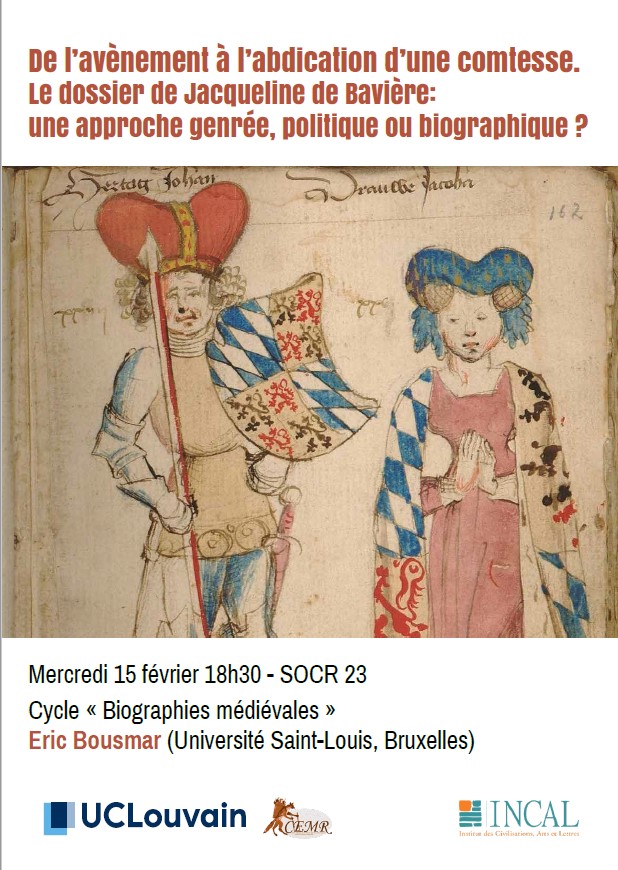
Conférence – Éric Bousmar, « De l’avènement à l’abdication d’une comtesse. Le dossier de Jacqueline de Bavière: une approche genrée, politique ou biographique ? »

Jacqueline Bavière a-t-elle réellement révolutionné les couleurs du jeu d’échecs? Avait-elle réellement un lion rouge et un autre noir comme animaux de compagnie? Autant de questions auxquelles répondra (peut-être) Eric Bousmar lors de la prochaine séance du cycle « Biographies médiévales », intitulée « De l’avènement à l’abdication d’une comtesse. Le dossier de Jacqueline de Bavière:
une approche genrée, politique ou biographique ? ».

Informations pratiques :

Eric Bousmar (Université Saint-Louis – Bruxelles)
Cycle « Biographies médiévales »
UCLouvain (Louvain-la-Neuve) – SOCR 23
15 février, 18h30

Publié dans Colloque | Laisser un commentaire

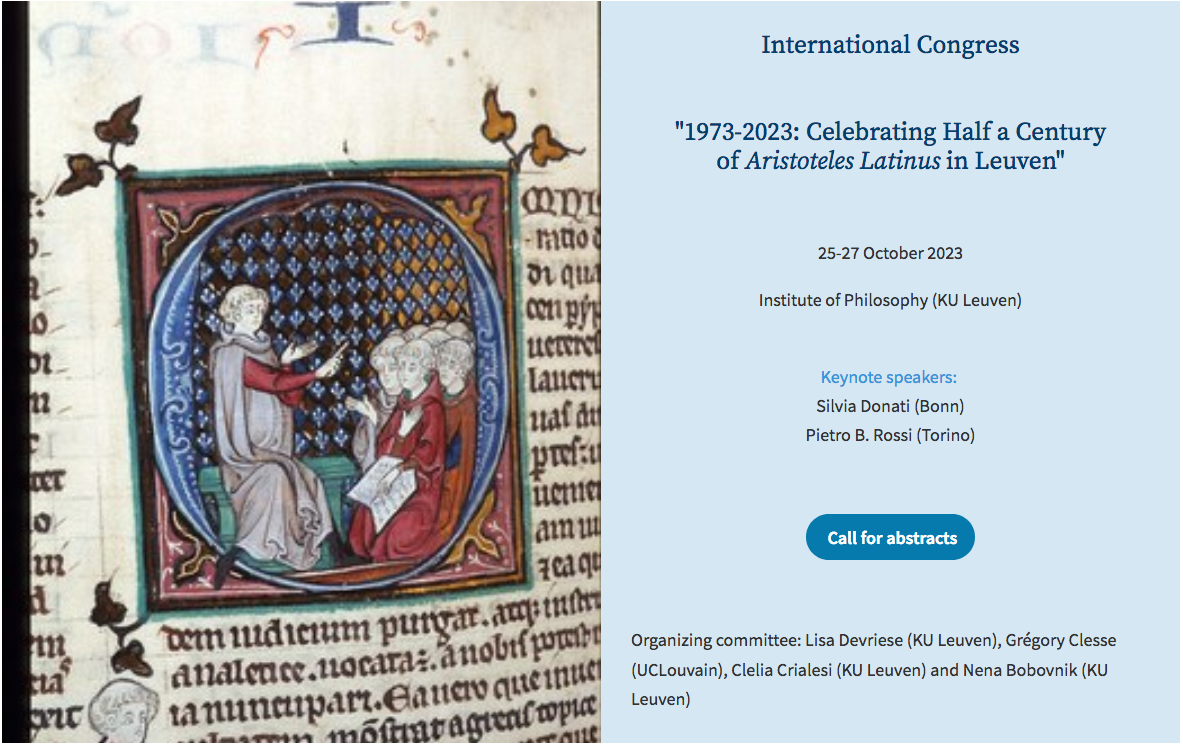
Colloque – 1973-2023: Celebrating Half a Century of Aristoteles Latinus in Leuven

The Aristoteles Latinus project has a long history that goes back nearly a century. The project was founded in 1930 by the Union Académique Internationale (UAI), at a time when several scholars expressed their interest in and recognized the importance of the Latin translations of Aristotle in the Middle Ages. Soon, the founders realized that there was a lot of work ahead of them: first, all preserved manuscripts with Latin Aristotelian texts needed to be inventoried and described, and second, all translations needed to be critically edited. These Latin translations cover a period of roughly 800 years, starting with Boethius’ translations and ending with the so-called Translatio Durandi of the Oeconomica in 1295, but the majority of the translations are from the 12th and 13th century.

When Lorenzo Minio-Paluello left as director of Aristoteles Latinus in 1973, it was decided to move the seat of the project from Oxford to Leuven, where it has been ever since. Over the years, the project has been in the hands of several Leuven scholars, such as Gérard Verbeke, Fernand Bossier, Jozef Brams, Carlos Steel, Pieter De Leemans and Lisa Devriese. Although the project is housed in Leuven, more specifically at the De Wulf-Mansion Centre for Ancient, Medieval and Renaissance Philosophy (Institute of Philosophy, KU Leuven), the editions are prepared by an international team of researchers.

In 2023, it is exactly 50 years that the project will be in Leuven, a milestone that we cannot let go unnoticed. The Congress will celebrate this important occasion by bringing together current editors of Aristoteles Latinus texts, as well as researchers who are closely connected to the project.

Call for Abstracts :

We invite submissions on several topics that are related to Aristoteles Latinus, such as:
–    a study and edition of one of the AL texts
–    a study on the reception history of an AL text
–    a study of a commentary (Latin or translated)
–    a study of one of our sister companies Avicenna Latinus, Averroes Latinus and Aristoteles Semitico-Latinus
–    translations of philosophical treatises in Latin
–    a study of medieval translators or translation techniques
–    challenges and methodology of critical editions, manuscript studies
–    the influence or importance of Aristotle in the Middle Ages
–    Aristotle at the medieval University.

Submissions should contain the title of the presentation, an abstract of no more than 500 words, as well as the author’s name and affiliation. 

Submissions and questions should be sent to: lisa.devriese[at]kuleuven.be.
Submission deadline: 15 March 2023.

Informations pratiques :

25-27 October 2023

Institute of Philosophy (KU Leuven)

Keynote speakers: 
Silvia Donati (Bonn)
Pietro B. Rossi (Torino)

Organizing committee: Lisa Devriese (KU Leuven), Grégory Clesse (UCLouvain), Clelia Crialesi (KU Leuven) and Nena Bobovnik (KU Leuven).

Source : KU Leuven


Publié dans Appel à contributions | Laisser un commentaire

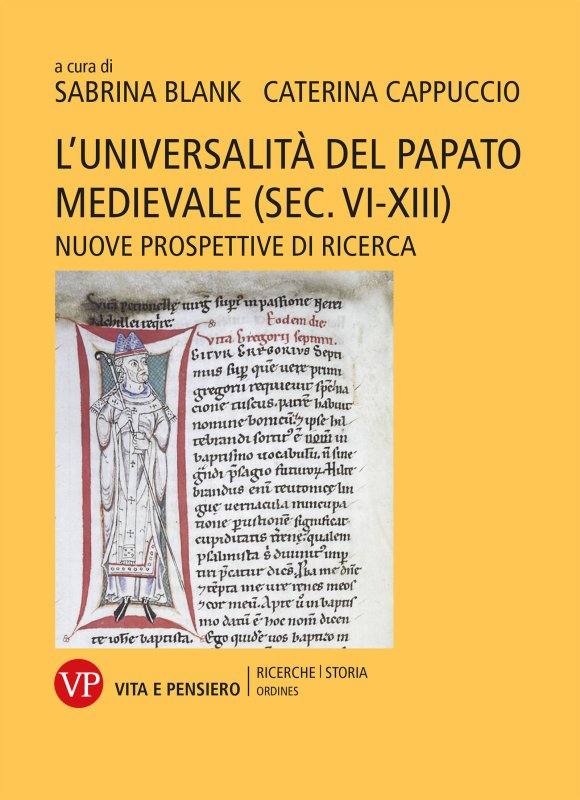
Publication – « L’universalità del papato medievale (sec. VI-XIII). Nuove prospettive di ricerca », dir. Sabrina Blank, Caterina Cappuccio

Il volume presenta i risultati del convegno internazionale tenutosi alla Bergische Universität di Wuppertal nel settembre 2019. I contributi raccolti si confrontano con la seconda affermazione contenuta nel dictatus papae di Gregorio VII (Quod solus Romanus pontifex iure dicatur universalis). L’affermazione dell’universalità del papato, già a più riprese indagata dalla storiografia europea, è qui l’oggetto delle ricerche di giovani studiosi e studiose sia da un punto di vista normativo, come nei casi delle elezioni papali, sia nella riflessione teologica di età altomedievale. Questa pubblicazione si inserisce nella linea delle più recenti e affermate tendenze storiografiche della medievistica e dedica particolare attenzione non solo alle norme alla base dell’universalità del papato, ma anche all’applicazione di tali teorie attraverso l’analisi di alcuni vettori dell’interazione tra il papato e le realtà locali. Lo studio di questi attori dell’interazione costituisce la base imprescindibile per la comprensione del papato medievale nelle sue relazioni con le province ecclesiastiche, con l’intento di verificare e approfondire il rapporto esistente tra norma e prassi.

Sabrina Blank ha conseguito il dottorato di ricerca in Storia medievale presso la Bergische Universität Wuppertal. Le sue ricerche si concentrano sulle elezioni papali e la non giudicabilità del papato dall´età tardo antica al pontificato di Alessandro III. Attualmente è wissenschaftliche Mitarbeiterin presso la RWTH ad Aachen.

Caterina Cappuccio ha conseguito il dottorato di ricerca in Storia medievale presso la Bergische Universität Wuppertal in cotutela di tesi con l’Università Cattolica del Sacro Cuore. Le sue ricerche riguardano la curia romana nel XII e XIII secolo, con particolare attenzione all’istituzione della cappella papale. Attualmente è wissenschaftliche Mitarbeiterin presso la Bergische Universität di Wuppertal.

Informations pratiques :

L’universalità del papato medievale (sec. VI-XIII). Nuove prospettive di ricerca, dir. Sabrina Blank, Caterina Cappuccio, Milan, Vita e Pensiero, 2022 ; 1 vol., 288 p. (Ricerche. Storia – Ordines). ISBN : 978-8-83434-839-0. Prix : € 25,00.

Source : Vita e Pensiero

Publié dans Publications | Laisser un commentaire

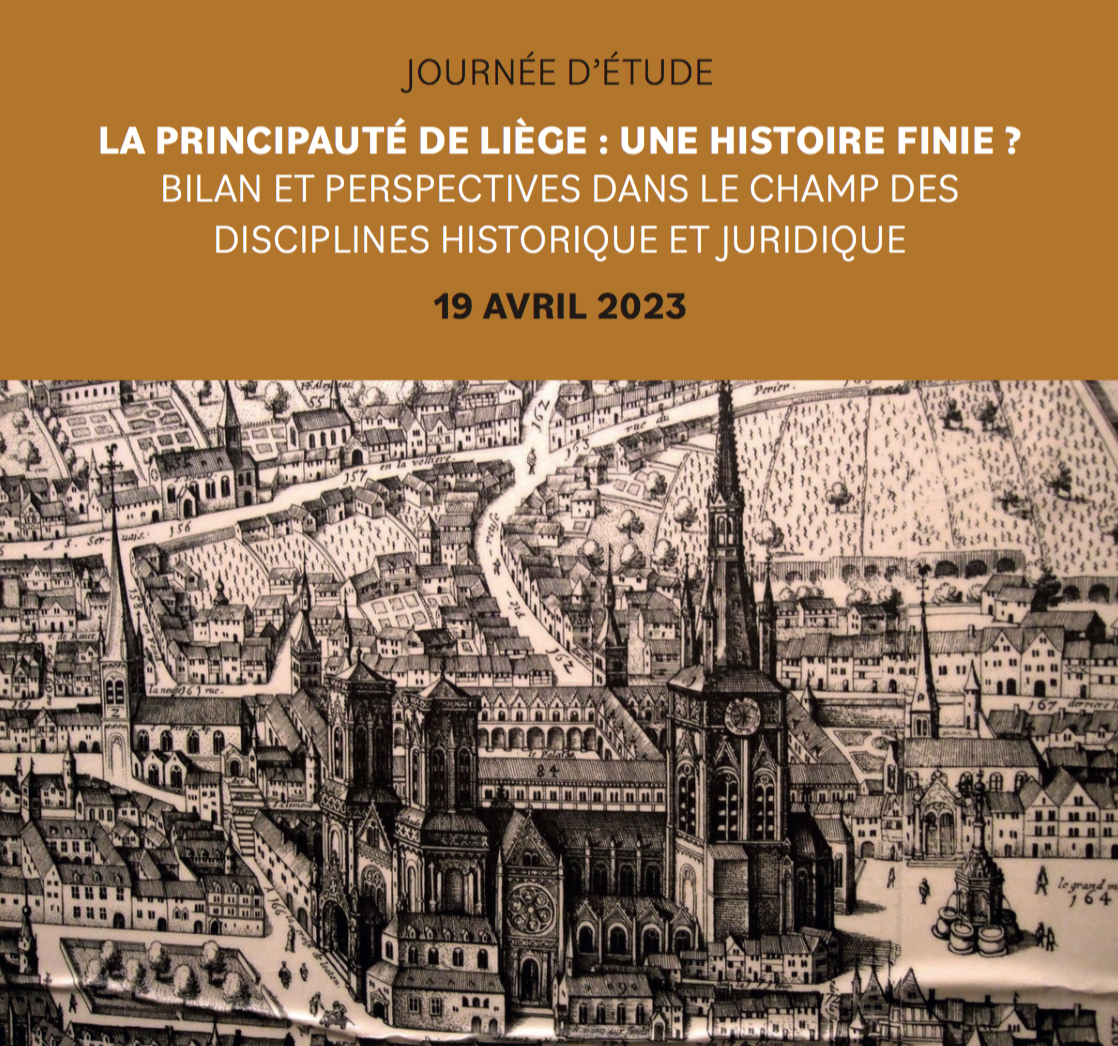
Colloque – La principauté de Liège : une histoire finie ? Bilan et perspectives dans le champ des disciplines historique et juridique

  • 19 AVRIL 2023
  • DE 9H À 16H
    SALLE DU CONSEIL, B31
    PLACE DES ORATEURS, 3 4000 LIÈGE
  • REPAS DE MIDI OFFERT ET VERRE DE L’AMITIÉ À LA FIN DE LA JOURNÉE

Entrée libre | Inscription souhaitée

Jusqu’au 12/04/23 auprès des organisateurs ou via le QR Code

COMITÉ ORGANISATEUR

Marie-Sophie Silan : mssilan@uliege.be Antoine Leclère : Antoine.leclere@uliege.be

Programme :

Accueil au Faculty club (B31) : 8h45

Panel 1 : 9h15-10h45
9h15 : conférence d’ouverture par Vincent Genin dans la salle du Conseil (B31)
10h : conférence par Christophe Masson dans la salle du Conseil (B31)
Pause au Faculty club (B31) : 10h45-11h

Panel 2 : 11h-12h30
11h : conférence par Wim Decock dans la salle du Conseil (B31)
11h45 : conférence par Benoît Lagasse dans la salle du Conseil (B31)
Pause de midi au Faculty club : 12h30-13h30 (petite restauration offerte)

Panel 3 : 13h30-15h
13h30 : conférence par Laetizia Puccio dans la salle du Conseil (B31)
14h15 : conférence par Charlotte Séaux dans la salle du Conseil (B31)
Pause au Faculty club (B31) : 15h-15h15

Panel 4 : 15h15-17h30
15h15 : conférence par Marie-Sophie Silan dans la salle du Conseil (B31) 16h : conférence par Antoine Leclere dans la salle du Conseil (B31)
16h45 : conférence de clôture par Philippe Raxhon dans la salle du Conseil (B31)
Verre de l’amitié au Faculty club à 17h30

Publié dans Colloque | Laisser un commentaire

Prix – Prix d’Histoire médiévale du CLUDEM

En date du 30 juin 2022, l’asbl « Centre luxembourgeois de documentation et d’études médiévales » (CLUDEM) a créé un « Prix d’Histoire médiévale du CLUDEM » dans le but de promouvoir la recherche et sa publication dans le domaine de l’histoire du Moyen Âge et plus spécifiquement en relation avec les études publiées dans la collection du CLUDEM. Le « Prix d’Histoire médiévale du CLUDEM », dont le montant s’élève à 2.000 Euros est attribué à partir de l’année 2023 tous les ans, au mois de septembre.


Appel à candidature

Un appel à candidature est lancé annuellement au 15 janvier de l’année de l’attribution du Prix. La date limite pour l’envoi des candidatures est fixée au 1er mars minuit de la même année. La remise du Prix a lieu à Luxembourg-ville, lors de l’assemblée générale annuelle du CLUDEM.

Éligibilité

Le Prix récompense un travail à caractère scientifique, d’un ou de plusieurs auteurs, en relation avec l’histoire de l’ancienne Lotharingie (IXe-XIIe s.), l’histoire médiévale de la Maison des Luxembourg (XIe-XVe s.) ou l’histoire médiévale portant sur l’espace de l’ancien comté ou duché de Luxembourg (Ve-XVe s.). Il s’agira d’une étude inédite destinée à publication sous forme de livre ou en open access, rédigée en français, allemand ou anglais. Les travaux pris en compte doivent avoir été achevés pendant la période précédant d’au plus deux années la date de l’appel à candidature pour le Prix. Les travaux présentés au jury ne doivent pas provenir d’auteurs présentant des conflits d’intérêts (liens de parenté ; publications ou projets de recherche communs ou liens hiérarchiques dans les cinq années antérieures à l’appel) avec les membres du jury.

Sélection

La sélection des travaux en compétition se fera sur base de l’excellence de leur qualité scientifique, de leur originalité et de leur lisibilité. Le Prix sera attribué sur proposition d’un jury composé de trois membres, dont un(e) enseignant(e)-chercheur(e) de l’Université du Luxembourg et membre du CLUDEM, un second membre du CLUDEM et un professeur en histoire médiévale d’une université externe au Luxembourg. Le jury sera nommé annuellement lors de l’assemblée générale du CLUDEM précédant l’année de l’appel. Le jury sera présidé par l’enseignant(e)-chercheur(e) de l’Université du Luxembourg membre du CLUDEM. La décision de jury se fera par vote à la majorité simple. Le jury a le droit de ne pas attribuer le Prix faute de candidatures répondant aux critères définis ci-dessus. En cas de non-attribution antérieure, le montant des Prix suivants n’est pas sujet à augmentation. Tous les cas non prévus par ce règlement seront tranchés par le jury en accord avec le Conseil d’administration du CLUDEM.

Attribution du Prix

L’étude sélectionnée sera désignée par le Conseil d’administration du CLUDEM au 15 juin de chaque année suite à la décision du jury. Il sera remis lors d’une cérémonie publique à laquelle le/la lauréat/e doit être présente.

Soumission

Les ouvrages présentés au Prix d’histoire médiévale du CLUDEM doivent parvenir au secrétariat du CLUDEM (courriel: contact.cludem@gmail.com ) sous forme d’un fichier pdf, complété par un résumé de l’étude et d’un bref curriculum vitae de l’auteur/e ou des auteur/es. L’envoi sera suivi d’un accusé de réception. Le fichier transmis restera la propriété du CLUDEM ; il sera traité de manière confidentielle.

Les membres du jury

– Marie-Cécile Charles, membre du CLUDEM asbl
– Pierre Monnet, professeur d’histoire à l’École des Hautes Études en Sciences Sociales (EHESS) à Paris et directeur de l’Institut Franco-Allemand de Sciences Historiques et Sociales (IFRA/SHS) à Francfort
– Michel Pauly, professeur ém. de l’Université du Luxembourg, président honoraire du CLUDEM asbl

Tout changement du présent Règlement devra faire l’objet d’une approbation au Conseil d’administration du CLUDEM.

Source : CLUDEM

Publié dans Prix | Laisser un commentaire

Appel à contribution – Noms d’une bête ! L’usage linguistique et culturel des noms d’animaux dans l’Antiquité et le Moyen Age

Le réseau de recherche Zoomathia organise à Montpellier avec le laboratoire Crises et en association avec le réseau Animed du 19 au 21 octobre 2023 un colloque international consacré aux zoonymes.

Ce colloque s’intéresse à plusieurs usages linguistiques et pragmatiques des zoonymes et aux animaux vrais qui les motivent : ceux qui ont plusieurs noms (polyonymie) et ceux qui n’en ont pas, ceux qui partagent leur nom avec d’autres animaux, ceux qui donnent leur nom à des hommes, des lieux, des maladies ou d’autres objets du monde (ou le reçoivent d’eux), ceux qui changent de nom (métonomasie) et de nature dans le temps ou en passant à une autre langue, ceux qui se construisent une existence naturaliste sur la seule base d’un nom (“animaux de papier”)…

Il s’agira d’explorer non seulement la tradition propre à l’Antiquité, mais aussi sa réception au Moyen Âge, et la façon dont se fabriquent alors aussi des nouvelles façons de nommer les animaux. Les langues concernées sont toutes celles des cultures de l’Antiquité classique (grec, latin, langues de l’Égypte, langues ouest-sémitiques). Pour le Moyen Age, on abordera aussi les zoonymes en persan, en arabe, dans les langues slaves et également les langues vernaculaires (français, italien…)… Entre toutes ces langues, les questions de traduction propres à la littérature zoologique sont particulièrement intéressantes à envisager.

Il s’agira donc de « saisir l’animal par ses noms », à travers des questions étymologiques, onomatopéiques, manifestant des phénomènes de dérivation ou de métaphores. On s’efforcera aussi de voir ce que la zoonymie révèle des conceptions du monde, notamment quand à travers les liens entre zoonymes et toponymes (zoonymes épichoriques, toponymes zoophores).  A côté de ces questions et enjeux zoonymiques, on pourra aborder des dossiers relevant de la zoo-onomastique et s’attacher aux « noms propres » donnés à des individus animaux, comme cela peut se faire pour des chevaux, des chiens, des bœufs, aussi bien dans l’Antiquité qu’au Moyen Âge.

Le lexique animal constitue le pivot des connaissances zoologiques et assure la continuité des données du savoir, même si cette tradition est accidentée et semée de malentendus (ou de facéties), comme toutes les transmissions. L’identification des animaux à travers (ou parfois malgré) leur nom, et la correspondance inter-linguistique que l’on peut établir, à travers les traductions, les lexiques bilingues ou les emprunts, constituent une dimension importante de la thématique de ce colloque, mais les aspects zoologiques, référentiels ou de traduction ne sont pas l’unique enjeu de cette rencontre.

Le répertoire zoonymique joue aussi, plus largement (comme le répertoire phytonymique) un rôle crucial et dynamique au cœur de la construction lexico-idéelle des sociétés anciennes. Les zoonymes opèrent des liens entre différentes sphères de la structure socio-culturelle, qui vont bien au-delà du prisme totémique, et construisent des micro-systèmes ou des éléments de discours dont l’efficacité s’appuie sur un constant travail de motivation et de remotivation.

Les approches suggérées sont donc multiples et doivent permettre de faire communiquer des recherche linguistiques, historiques, traductologiques, anthropologiques…  On pourra proposer soit des études de cas, soit des approches plus méthodologiques sur l’onomastique animale et les manipulations humaines auxquelles elle donne lieu.

Les propositions de communication (500 mots maximum) par des chercheurs confirmés ou des jeunes chercheurs, sont à envoyer avant le 15 avril 2023 aux adresses suivantes : arnaud.zucker@univ-cotedazur.fr ou chrchandezon@yahoo.com. Elles pourront être formulées dans les langues traditionnelles du réseau Zoomathia : en français, anglais, allemand, italien ou espagnol. Le comité scientifique communiquera ses réponses le 01 juin 2022.

Comité d’organisation : Christophe Chandezon (Université Paul-Valéry/Montpellier III), Arnaud Zucker (Université Côte d’Azur, Nice)

Comité scientifique : Sébastien Barbara,Christophe Chandezon, Jérémy Clément, Diego De Brasi, Isabelle Draelants, Cristiana Franco,Oliver Hellmann,Stavros Lazaris,Sian Lewis,Philippe Monbrun,Jean Trinquier,Marco Vespa,Arnaud Zucker

Conférencier(e)s invité(e)s : Elisabetta Carpitelli (Université Grenoble Alpes) & autre conférencier à confirmer

Publié dans Appel à contributions | Laisser un commentaire

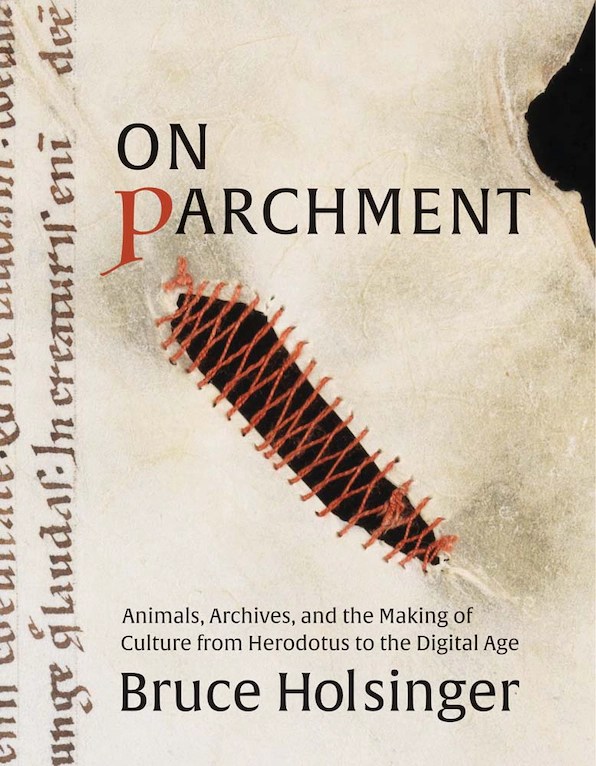
Publication – Bruce Holsinger, « On Parchment. Animals, Archives, and the Making of Culture from Herodotus to the Digital Age »

For centuries, premodern societies recorded and preserved much of their written cultures on parchment: the rendered skins of sheep, cows, goats, camels, deer, gazelles, and other creatures. These remains make up a significant portion of the era’s surviving historical record. In a study spanning three millennia and twenty languages, Bruce Holsinger explores this animal archive as it shaped the inheritance of the Euro-Mediterranean world, from the leather rolls of ancient Egypt to the Acts of Parliament in the United Kingdom.
 
Holsinger discusses the making of parchment past and present, the nature of the medium as a biomolecular record of faunal life and environmental history, the knotty question of “uterine vellum,” and the imaginative role of parchment in the works of St. Augustine, William Shakespeare, and a range of Jewish rabbinic writers of the medieval era. Closely informed by the handicraft of contemporary makers, painters, and sculptors, the book draws on a vast array of sources—codices and scrolls, documents and ephemera, works of craft and art—that speak to the vitality of parchment across epochs and continents. At the center of On Parchment is the vexed relationship of human beings to the myriad slaughtered beasts whose remains make up this vast record: a relationship of dominion and compassion, of brutality and empathy.

Bruce Holsinger is Linden Kent Memorial Professor at the University of Virginia, editor of New Literary History, and an award-winning author. He lives in Charlottesville, VA.

Informations pratiques :

Bruce Holsinger, On Parchment. Animals, Archives, and the Making of Culture from Herodotus to the Digital Age, New Haven, Yale University Press, 2023 ; 1 vol., 448 p. ISBN : 978-0-30026-021-2. prix : € 40,00.

Source : Yale University Press

Publié dans Publications | Laisser un commentaire

Appel à contribution – Armoriaux médiévaux

Dans le cadre d’un cycle de manifestations organisées pour rendre hommage au Docteur Jean-Claude Loutsch et valoriser l’arrivée de sa riche collection d’imprimés et de manuscrits dans les fonds de la Bibliothèque nationale du Luxembourg, les journées d’études organisées en son sein les 4 et 5 décembre 2023 invitent à porter de nouveaux regards sur les armoriaux médiévaux.

En 1994, le colloque de Paris avait, entre autres, largement ouvert la notion d’armorial1. Presque 30 ans après, il s’agira de rouvrir le dossier pour établir un bilan des dernières recherches et proposer de nouvelles perspectives. Cet état des lieux concerne non seulement les récentes éditions d’armoriaux, mais aussi et surtout, la mise en ligne de nombreux documents originaux numérisés par les différentes institutions de conservation. À l’heure du développement des Humanités numériques qui ouvrent des nouvelles voies pour l’analyse des écritures anciennes comme des images, il conviendrait sans doute d’essayer de mieux articuler les résultats des éditions « anciennes » avec les possibilités offertes par les numérisations de sources brutes.

Il faudrait également chercher à (re)définir une méthode de valorisation de l’armorial (rouleau ou codex) dans les perspectives de l’héraldique nouvelle. La confrontation des approches sociales, culturelles et numériques permettra d’analyser le phénomène de la production des armoriaux dans le sens strict du terme, mais aussi leurs caractéristiques, fonctions et finalités en élargissant la définition retenue en 1994.

Les notions d’intermédialité et d’intericonicité seront mises en œuvre pour appréhender la performativité de l’armorial dans la société du Moyen Âge. Dans ce but, les historiens de l’art, les codicologues et les spécialistes de la littérature sont également sollicités aux côtés des héraldistes. L’interaction entre les armoriaux en parchemin ou papier et les collections d’armoiries rassemblées sur d’autres supports doivent être prises en compte. Quel fut notamment l’impact réel des très nombreuses armoiries regroupées dans les armoriaux dans la vie quotidienne des hommes du Moyen Âge ? Quel était finalement le niveau de leurs connaissances, de leurs compétences héraldiques ?

L’espace concerné est celui de l’occident chrétien médiéval, des royaumes de la péninsule ibérique aux confins de la Pologne et de la Hongrie, de la Scandinavie à la Sicile.

L’ouverture diachronique permettra d’interroger et de scruter les armoriaux sous plusieurs angles. La question de leurs auteurs, de leurs sources, de leurs diffusions et de leurs impacts sera prise en compte à partir de leurs premières apparitions (XIIIe siècle) jusqu’au milieu du XVIe siècle. Les journées d’études intègreront également le regard porté par les érudits des siècles suivants (jusqu’au XIXe siècle). Quelle fut la place de ces documents dans leurs bibliothèques ? Pourquoi prirent-ils la peine de les copier et/ou de les compiler ? A quelles fins savantes, généalogiques, politiques ou autres furent-ils utilisés ?

Les propositions d’intervention en français ou en anglais, argumentées (environ 5000 signes espaces compris) et accompagnées d’un bref CV devront parvenir avant le 30 juin 2023 à Jean-Christophe Blanchard (jean-christophe.blanchard@univ-lorraine.fr).

English version :

The workshop organised at the National Library of Luxembourg (Bibliothèque nationale du Luxembourg, BnL) on 4 and 5 December 2023 invite us to take a new look at medieval armorials. They are part of a series of events in tribute of Dr. Jean-Claude Loutsch and to promote the incorporation of his rich collection of printed books and manuscripts in the holdings of the Library. In 1994, the Paris colloquium opened up the concept of the “armorial”2. Almost 30 years later, it is time to revisit the theme in order to assess the latest research and to propose new perspectives. This review concerns not only recent editions of armorials but also and above all the online availability of numerous original documents digitised by various conservation institutions. At a time when digital humanities are opening up new avenues for the analysis of historical texts and images, we must try to better articulate the results of older editions with the possibilities offered by the digitisation of primary sources.

It is also necessary to (re)define a method of valorizing armorials (in the form of both rolls of arms and codices) from the perspective of the ‘new heraldry’. The confrontation of social, cultural and digital approaches will allow us to analyse the production of armorials in the strict sense of the term, but also their characteristics, functions and purposes by broadening the definition adopted in 1994.

The notions of intermediality and intericonicity will be used to understand the performative role that armorials had in medieval society. To this end, art historians, codicologists and specialists in literature are called upon to contribute alongside heraldists. The interaction between armorials in parchment or paper and collections of coats of arms assembled and expressed through other media must be taken into account. What real impact had the numerous coats of arms grouped together in armorials on the daily life of medieval people? What was the level of their heraldic knowledge and skills?

Geographically, the study days focus on the medieval Christian West, from the Iberian kingdoms to the borders of Poland and Hungary, from Scandinavia to Sicily.

Moreover, the adoption of a wide diachronic perspective will make it possible to evaluate and examine the armorials from several angles. The question of their authors, their sources, their distribution and their impact will be considered from the first appearances of the phenomenon in the 13th century to the middle of the 16th century. The study days will also include the viewpoint of the erudite minds of subsequent centuries, up to and including the 19th century. What place did armorials have in these men’s libraries? Why did they take the trouble to copy and/or compile them? For what scholarly, genealogical, political or other purposes were armorials used?

Proposals for papers in French or English (with an abstract of c. 5000 characters, spaces included) and a brief CV, should be sent before 30 June 2023 to Jean-Christophe Blanchard (jean-christophe.blanchard@univ-lorraine.fr).

Publié dans Appel à contributions | Laisser un commentaire

Publication – Benjamin Wheaton, « Venantius Fortunatus and Gallic Christianity. Theology in the Writings of an Italian Émigré in Merovingian Gaul »

A wandering “Orpheus among the barbarians,” a lively flatterer of the powerful and an appreciator of good food and pleasant company: the sixth-century poet Venantius Fortunatus is known to us today for being all these things. Yet in the Middle Ages people knew and loved “Fortunatus the priest:” a man of the Church and a teacher of Christian dogma.

This book for the first time looks at this other side of Fortunatus’ character through the lens of what he wrote when he was bishop of Poitiers at the end of his life: two sermons and a hymn to the Virgin Mary. Here you will encounter something unexpected: Bishop Fortunatus the stern yet skillful preacher of Augustinian grace and Chalcedonian orthodoxy.

Benjamin Wheaton, Ph.D. (2018), University of Toronto, specializes in theology and society in Late Antiquity. He has published articles on Gregory of Tours, Nicetius of Trier and Venantius Fortunatus.

Table des matières :

Contents
Acknowledgments
List of Abbreviations

Introduction
 1 The Religious Writings of Venantius Fortunatus
 2 The Composition of the Final Two Books of the Carmina
 3 The Purpose of the Sermons in the Carmina
 4 Outline of the Book

1 The Expositio Symboli: Religious and Literary Context
 1.0 Introduction to the Expositio symboli
 1.1 The Symbol in Italy and Gaul
 1.2 Symbol Sermons in Italy and Gaul
 1.3 Rufinus and His Summarizers
 1.4 Conclusion

2 The Expositio symboli of Rufinus of Aquileia and the Expositio symboli of Venantius Fortunatus
 2.0 Introduction
 2.1 Venantius Fortunatus and Rufinus of Aquileia Compared
 2.2 The Medieval Reception of the Expositio symboli
 2.3 Conclusion

3 Background to the Expositio orationis dominicae
 3.0 Introduction
 3.1 The Sources of the Expositio orationis dominicae
 3.2 The Content of the Expositio orationis dominicae
 3.3 The Authenticity of the Expositio orationis dominicae
 3.4 Conclusion

4 The Expositio orationis dominicae of Venantius Fortunatus and the Semi-Pelagian Controversy
 4.0 Introduction
 4.1 The Pelagian and Semi-Pelagian Controversies in the Fifth and Sixth Centuries
 4.2 The Semi-Pelagian Controversy in Sixth-Century Gaul
 4.3 The Freedom of the Will in the Expositio orationis dominicae
 4.4 The Augustinianism of Venantius Fortunatus, Compared with Gregory of Tours
 4.5 Conclusion

5 Venantius Fortunatus and the Three Chapters Controversy
 5.0 Introduction
 5.1 The Second Council of Constantinople (553) and the Three Chapters Controversy
 5.2 Venantius Fortunatus and the Three Chapters Schism
 5.3 The Christology of the Carmina
 5.4 The Panegyric Ad Iustinum iuniorem imperatorem et Sophiam Augustos and the Three Chapters Controversy
 5.5 Conclusion

6 Vision of A Chalcedonian Christendom: The In laudem sanctae Mariae of Venantius Fortunatus
 6.0 Introduction
 6.1 The Authenticity of the In laudem sanctae Mariae
 6.2 Content and Structure of the In laudem sanctae Mariae
 6.3 The Sources of the In laudem sanctae Mariae
 6.4 The Vision of the In laudem sanctae Mariae: A United Chalcedonian Christendom
 6.5 Conclusion

Conclusion
Appendix: In laudem sanctae Mariae: Text, Translation and Sources
Bibliography
Index of Biblical Citations
General Index

Informations pratiques :

Benjamin Wheaton, Venantius Fortunatus and Gallic Christianity. Theology in the Writings of an Italian Émigré in Merovingian Gaul, Leyde–Boston, Brill, 2022 ; 1 vol., 300 p. (Brill’s Series on the Early Middle Ages, 29). ISBN : 978-90-04-52194-0. Prix : € 109,00.

Source : Brill

Publié dans Publications | Laisser un commentaire