Offre d’emploi – Temporary Lecturer in Medieval History (0.7 FTE) (Utrecht University)

Job description

The Department of History and Art History seeks to appoint a temporary Lecturer in Medieval History. Members of the Medieval History Section are required to teach Medieval History, both at BA level (in Dutch and English) and at RMA level (in English). They make contributions to the (interdisciplinary) courses of the minor Medieval Studies, and they are also requested to make a contribution to the department’s general BA courses (both in Dutch and in English). Finally, on occasion they may be asked to contribute to teaching in the Dutch Research School in Medieval Studies.

Requirements

The successful candidate will have:

  • experience teaching undergraduate students and a commitment to thesis supervision and internships;
  • a PhD degree or far advanced PhD trajectory in medieval history or a closely related discipline;
  • a clear teaching philosophy (to be included in your letter of motivation, briefly outlining in a teaching philosophy statement your teaching beliefs and practices, and the skills and knowledge you bring to an education team;
  • the ambition and the ability to contribute fully to the academic life of the group and the department.

Utrecht University has a teaching qualification system for university lecturers, and candidates are required to obtain the Basic Teaching Qualification (BKO) within two years if they are not already in possession of one. Candidates are expected to be proficient in both Dutch and English. Candidates must fulfill the conditions set by the IND to work in the Netherlands. 

Conditions of employment

We offer a position (0.7 FTE), as from 1 August 2022 for a period of one year and after a positive evaluation, the appointment will become permanent. The gross salary – depending on previous qualifications and experience  – ranges between €3,821 and €5,230 (scale 11 according to the Collective Labour Agreement Dutch Universities) per month for a full-time employment. Salaries are supplemented with a holiday bonus of 8% and a year-end bonus of 8.3% per year. In addition, Utrecht University offers excellent secondary conditions, including an attractive retirement scheme, (partly paid) parental leave and flexible employment conditions (multiple choice model). For more information: working at Utrecht University.

Employer

A better future for everyone. This ambition motivates our scientists in executing their leading research and inspiring teaching. At Utrecht University, the various disciplines collaborate intensively towards major societal themes. Our focus is on Dynamics of Youth, Institutions for Open Societies, Life Sciences and Sustainability.

The Faculty of Humanities has around 6,000 students and 900 staff members. It comprises four knowledge domains: Philosophy and Religious Studies, History and Art History, Media and Culture Studies, and Languages, Literature and Communication. With its research and education in these fields, the faculty aims to contribute to a better understanding of the Netherlands and Europe in a rapidly changing social and cultural context. The enthusiastic and committed colleagues and the excellent amenities in the historical city center of Utrecht, where the faculty is housed, contribute to an inspiring working environment.

Additional information

For more information about this position, please contact:  Marco Mostert (Professor of Medieval History), via m.mostert@uu.nl.

Source : Academic Transfer
Publié dans Offre d'emploi | Laisser un commentaire

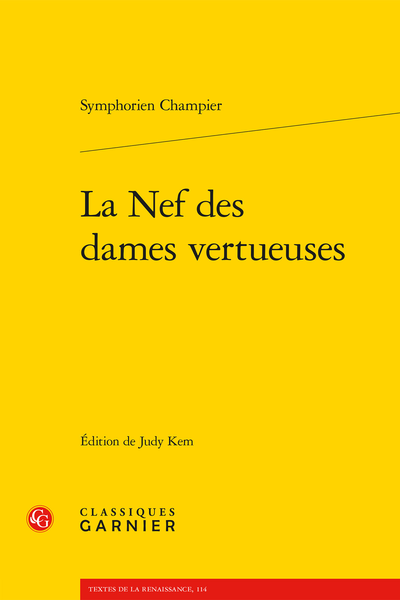
Publication – Symphorien Champier, « La Nef des dames vertueuses », éd. Judy Kem

La Nef des dames vertueuses (1503) de Symphorien Champier, humaniste et médecin lyonnais, est une « apologie féministe », qui consiste en quatre livres : un recueil de biographies de femmes célèbres, un traité sur le mariage, une étude sur les prophéties des sibylles et un essai sur l’amour platonique.

Table des matières : ici

Informations pratiques :

Symphorien Champier, La Nef des dames vertueuses, éd. Judy Kem, nouv. éd., Paris, Classiques Garnier, 2022 (Textes de la Renaissance, n° 114). 307 p. ISBN : 978-2-406-12827-4. Prix : 35 euros.

Source : Classiques Garnier

Publié dans Publications | Laisser un commentaire

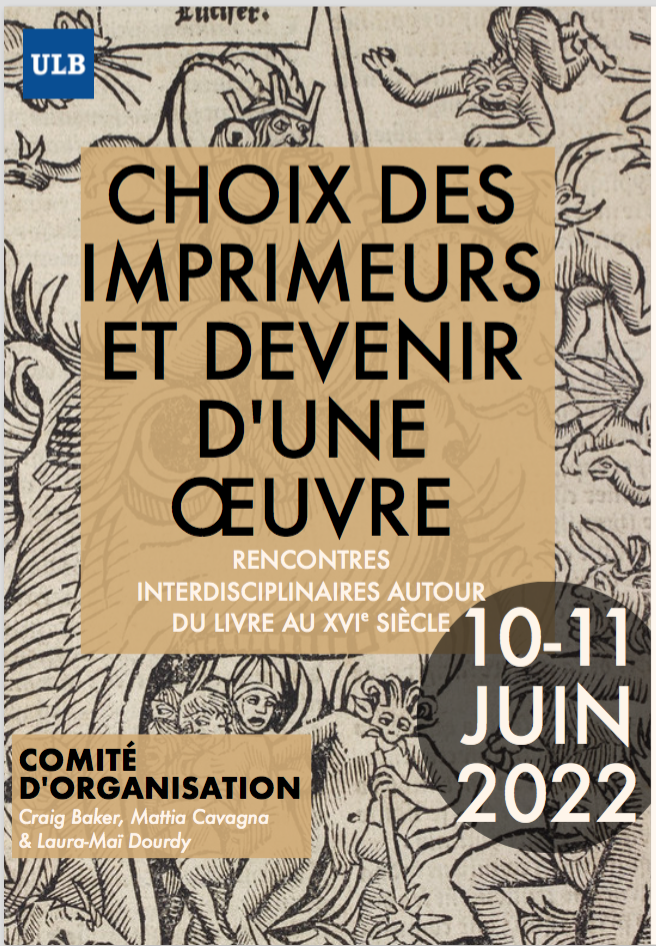
Colloque – Choix des imprimeurs et devenir d’une œuvre. Rencontres interdisciplinaires autour du livre au XVIe siècle

Le colloque « Choix des imprimeurs et devenir d’une œuvre » se veut l’occasion d’étudier la réception des récits médiévaux et le renouveau générique au XVIe siècle. Il réunira des experts de différents champs, qui focaliseront leur réflexion sur le genre littéraire, en empruntant les méthodes de l’histoire du livre et de la bibliographie matérielle, et en les faisant dialoguer avec celles d’autres disciplines, telles que la littérature, la philologie et la linguistique. Les participants analyseront la fortune des œuvres dans l’Europe du XVIe siècle en essayant de déterminer le rôle des passeurs de textes impliqués dans la production et dans le commerce du livre. Les analyses de plusieurs traditions imprimées permettront de révéler différentes habitudes et stratégies éditoriales. Les catalogues, inventaires d’ateliers et autres documents d’archives liés aux libraires et imprimeurs seront explorés afin d’identifier les genres les plus répandus, les succès de librairie et leur devenir tout au long du XVIe siècle. Les choix concernant les pages de titre, les tables des matières, la mise en page, l’emploi de bois, de certains signes typographiques ou encore de formes linguistiques plus ou moins archaïsantes seront également interrogés car ils constituent autant de phénomènes qui permettent de cerner les conventions, les innovations et les évolutions génériques à la fin du Moyen Âge. 

Programme :

Vendredi 10 juin

Salle H2111
(Bâtiment H – Solbosch) 9h45 Accueil des participants

10h15 Introduction par Laura-Maï Dourdy (Université Libre de Bruxelles)

SÉANCE 1 : LE REMANIEMENT DES ŒUVRES AU XVIe SIÈCLE

MARIA COLOMBO TIMELLI (Università degli Studi di Milano) Titre et genre : quel sort pour le Dialogus creaturarum / Dialogue des creatures ?

FANNY MAILLET (Universität Zürich)
Du livre de choses au propriétaire revisité : observations sur le passage à l’imprimé du De proprietatibus rerum en français

MARCO VENEZIALE (Universität Zürich)
Poèmes de cour en variation controlée : la poésie marotique imprimée par Pierre Attaingnant

Lunch

SÉANCE 2 : IMPRIMER LES ROMANS DE CHEVALERIE

FRANCESCO MONTORSI (Université Lumière-Lyon 2) Editio princeps chez le Prince ? Le cas du Giglan

LAURA-MAÏ DOURDY (Université Libre de Bruxelles) Réception des romans de chevalerie au XVIe siècle : matérialité et langue d’un genre littéraire

Pause

SÉANCE 3 : L’ÉVOLUTION MATÉRIELLE AU XVIe SIÈCLE

15h30 JORAN PROOT (Cultura Fonds Library)
A Theory about Typographical Evolution in the Early Modern Period

16h00 SUSAN BADDELEY (Université Paris-Saclay)
The First Printed Works for Teaching French in England

16h30 URSULA RAUTENBERG (Friedrich-Alexander-Universität) Some Basic Features Concerning the Transition of Vernacular Narrative Texts from Manuscript to Printed Book

DOUBLE-TEST

SAMEDI 11 JUIN

Bibliothèque du CIERL

9h30 Accueil des participants

SÉANCE 4 : LA LANGUE DES IMPRIMÉS

ANJA VOESTE (Justus-Liebig-Universität Gießen) Linguistic Features as part of the Dispositif?

MARKO NEUMANN (Justus-Liebig-Universität Gießen)
Tables of Contents in the Spotlight. Linguistic Interventions in Early Book Printing

Pause

SÉANCE 5 : DANS L’ATELIER D’UN IMPRIMEUR

11h30 GABRIELLA PARUSSA (Sorbonne Université) Le rôle des libraires et imprimeurs dans la diffusion et réception des mystères médiévaux au XVIe siècle : l’exemple de Jean Saint Denis et de Julien Hubert

12h00 Conclusions

Publié dans Colloque | Laisser un commentaire

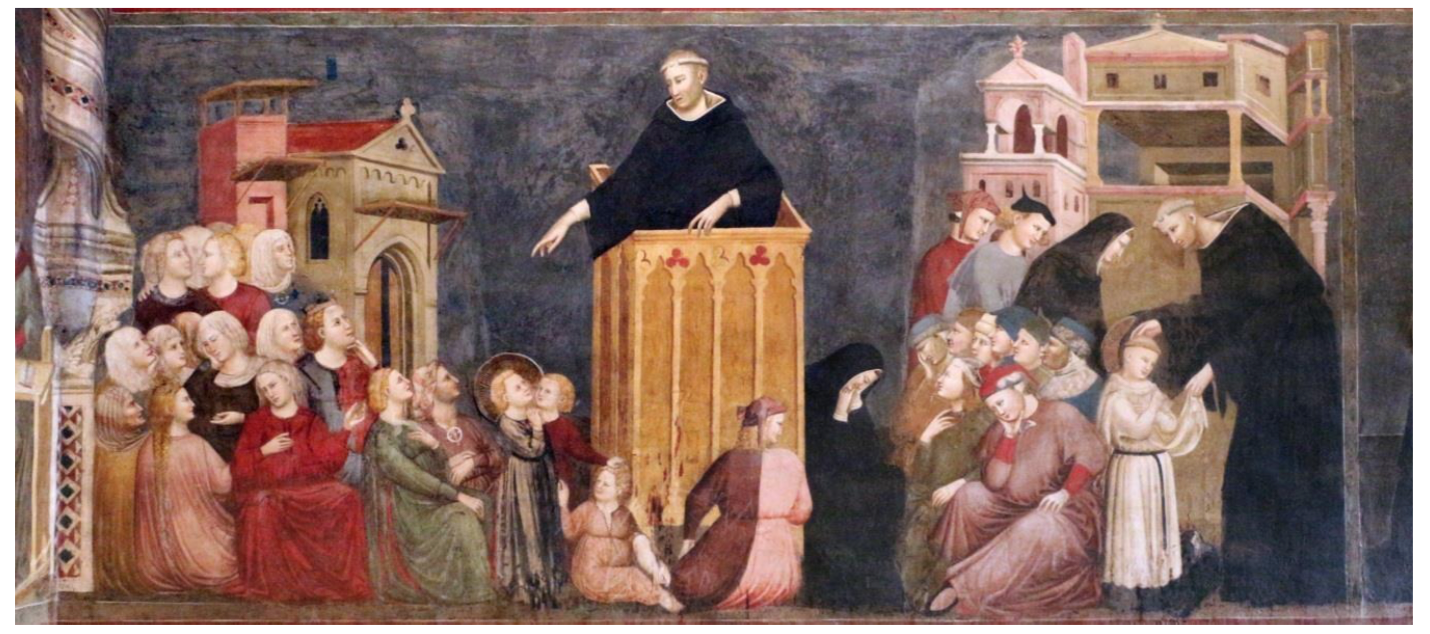
Appel à contribution – The Other who listens: Holiness and Preaching to Minorities and Excluded in the Late Middle Ages and Early Modernity

November 3-4, 2022
IV o COLLOQUIUM ON HAGIOGRAPHY

It is the purpose of this IVth Colloquium on Hagiography, convened by the Augustinian Library in Buenos Aires, to be able to reflect on the research in the hagiographic field referring to Saints, Blesseds and venerable ones who have given their testimony of holiness in the midst of the Blessed of the Gospel (Cf. Mt V, 3-12).

Discourses on poverty, minorities and the exclusion of these for various reasons related to religion, gender, ethnic origin, health and life decisions, are highly cultivated nowadays. Following a path of scientific production that began a couple of decades ago, studies related to the social field, cultures, practices of writing and reading, ways of preaching, the practice of power and the hagiographic models, continue to enjoy a vitality from different disciplines, which contribute to the debate and generate the challenge of also providing a living contribution and an analysis of what is happening to us in the present as a society from the academic field.

For this, we invite researchers with work in progress who want to share their contributions from their disciplinary or confessional approaches, within the time frame of the call (From Early Christianity to the 18th century), with special emphasis on those witnesses of the Christian faith. who have been in contact with Judaizing minorities, Moors, excluded for reasons of origin, ethnicity or race, slaves, poor, migrants, etc. Likewise, the modern period includes the possibility of also analyzing the relationship between preaching and holiness with the original cultures of the New World as it was called at that time. In turn, the approach used may include any of the three main aspects of the act of preaching: the preacher as the transmitter of the message, the sermon as an instrumental, documentary and textual reflection of that act, and the audience as the objective, receiver and interpreter of the message. speech. The event will be in Hybrid and/or Virtual format according to the development of the health situation that affects us all.

The rules for presenting papers are similar to those of the publication Bibliotheca Augustiniana ISSN 2469 – 0341, where those that pass peer review will be edited once presented at the Colloquium.

The Abstract submission date is open until Friday, June 24, and the delivery of the final paper on Friday, October 7, 2022.

This allows us to have Abstracts and Final Papers peer reviewed prior to the event. It is suggested to send the abstract in the following way: Title of the work, Author and Academic membership, a text of no more than 250 words and at least four keywords.

The date of the event, as is tradition, will be in the Spring of the Southern Cone, at the beginning of November 2022, on November 3 and 4.

We would like to count on your collaboration, participation and assistance. The dynamics of the Colloquium is following the Liturgical Hours of the day, with a Conference of Terce, one of Median Hour and one of Vespers. The Discussion Tables of the Presentations have 20 minutes of oral presentation per work and about ten minutes of general consultations at the end of each Table, composed of no more than three exhibitors.

We believe that revitalizing hagiographic studies is a good way to generate memory and values in the society that contains us and is a contribution to all of the Humanities.

Our contact email for the Colloquium is:
bibcisao@gmail.com bibliothecaugustiniana@gmail.com & biblioteca@sanagustin.org

Publié dans Appel à contributions | Laisser un commentaire

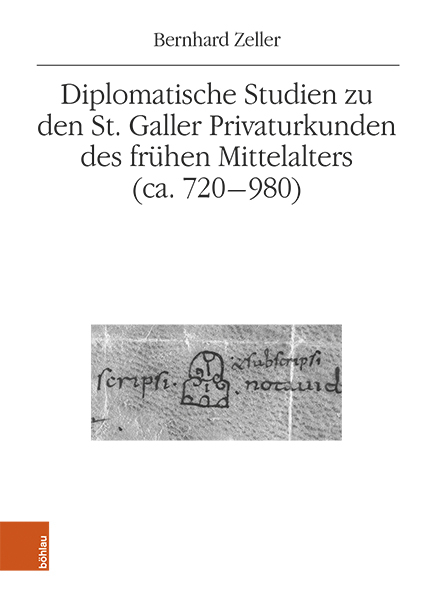
Publication – Bernhard Zeller, « Diplomatische Studien zu den St. Galler Privaturkunden des frühen Mittelalters (ca. 720-980) »

Bis zum heutigen Tag werden im Stiftsarchiv St. Gallen weit über 800 Urkunden aus der Zeit vor dem Jahr 1000 aufbewahrt. Es ist ein außergewöhnlicher Bestand von Originaldokumenten, der im vorliegenden Buch erstmals einer systematischen diplomatischen Untersuchung unterzogen wird. In den ersten drei Abschnitten des Buches werden grundlegende Aspekte des Urkundenwesens im frühmittelalterlichen Alemannien behandelt sowie ausführlich die äußeren und inneren Merkmale der St. Galler Dokumente (also Schreib- und Beschreibstoffe, Schriftformen, graphische Symbole, Urkundenformen und -formeln) untersucht. Auf dieser formal-diplomatischen Grundanalyse beruhen die folgenden Abschnitte, in denen zuerst die Entwicklung des klösterlichen (St. Galler) Urkundenwesens verfolgt und dann den Spuren von nichtklösterlicher-lokaler Schreibtätigkeit nachgegangen wird. Auf diese Weise werden schrittweise die Koordinaten einer historischen „Urkundenlandschaft“ Alemannien abgesteckt.

Bernhard Zeller hat an der Universität Wien Geschichte und Germanistik studiert, ist Mitglied des Instituts für Österreichische Geschichtsforschung und hat sich 2018 für Mittelalterliche Geschichte und Historische Hilfswissenschaften habilitiert.

Informations pratiques :

Bernhard Zeller, Diplomatische Studien zu den St. Galler Privaturkunden des frühen Mittelalters (ca. 720-980), Göttingen, Vandehoeck und Ruprecht, 2022 (Mitteilungen des Instituts für Österreichische Geschichtsforschung. Ergänzungsbände, 66). 632 Seiten, gebunden ISBN: 978-3-205-21487-8 Böhlau Verlag Wien, 1. Auflage, 2022. Prix : 95 euros.

Source : Vandehoeck und Ruprecht

Publié dans Publications | Laisser un commentaire

Offre d’emploi – Departmental Lecturer in History of Art (University of Oxford)

Closes: 1st June 2022

This is an exciting opportunity to join our thriving History of Art community and gain valuable teaching and administrative experience at the undergraduate and graduate levels. Although this is primarily a teaching and administrative role, you will also engage in advanced study and conduct independent research and play an active role in the interdisciplinary Christ Church academic community. The post is intended to fill a gap in our teaching coverage while Professor Geraldine Johnson is on leave.  This is a joint appointment in association with Christ Church.

You will be responsible for overseeing the organisation of History of Art teaching at Christ Church (including undergraduate admissions) and will have academic/pastoral responsibility for undergraduate art historians at Christ Church. The key teaching requirement will be to cover core History of Art departmental courses, including BA courses on theory and methodology. You will also be asked to contribute lectures and guest classes in other departmental courses and to participate in relevant tutorial teaching and supervision.

You will contribute to an academic community that places the highest value on rigorous inquiry and encourages a range of perspectives, experiences, and ideas to inform and stimulate intellectual challenge, engagement, and exchange.

Whilst in post, you will be assigned a mentor, a senior member of the Department or the History Faculty. In addition, the History Faculty provides support for early career and other researchers, including assistance in the preparation and submission of grant and fellowship applications through the Faculty Research Director and Research Development Officer.

The post is fixed term for one year and is tenable from 1st October 2022.

About you

You will have research and teaching interests in the history of art, broadly defined, and will be able to teach courses on the theories and methodologies of art history.  We are particularly interested in candidates who can bring innovation to the way art history is conceived and practiced.

You will be able to inspire and enthuse students and draw on your own research to inform and augment your teaching.

You will have a completed doctorate in a relevant field, or evidence that a doctorate is close to completion.

Applications are particularly welcome from women, from disabled people and from people of Black, Asian and minority ethnic backgrounds, as these groups are currently under-represented in academic posts in Oxford.

Application Process

For an informal discussion about this role, please contact Professor Geoffrey Batchen at geoffrey.batchen@history.ox.ac.uk.

You will be required to complete a supporting statement, setting out how you meet the selection criteria, curriculum vitae and the names and contact details of two referees as part of your online application.

The deadline for applications is 12.00 noon on Wednesday 1st June 2022.

Only applications submitted online and received before noon 1st June 2022 can be considered

Source : Jobs.ac.uk

Publié dans Offre d'emploi | Laisser un commentaire

Colloque – Avant l’État. Droit international et pluralisme politico-juridique en Europe, XIIe-XVIIe siècle

Alors que l’État national souverain a longtemps été considéré comme l’acteur exclusif des relations internationales, ce projet a l’ambition de nouer un dialogue entre historiens et historiens du droit pour s’interroger sur le droit international conçu comme le cadre multi-normatif qui régit les relations entre une grande variété d’acteurs. Cette notion nous paraît mieux s’adapter aux traits spécifiques de la constellation politique médiévale et pré-moderne, qui était caractérisée par l’entrelacement de différentes juridictions, fondées sur des liens de dépendance personnelle et sur des relations de sujétion territoriale, par la coexistence d’une pluralité de centres de pouvoir au statut variable et par la répartition de l’autorité politique à différents niveaux. Les thèmes abordés dans les deux rencontres (la première à Rome le 20 septembre 2021 et la deuxième à Lille et Courtrai les 18-19 mai 2022) incluent la guerre, les représailles, la diplomatie, les relations féodales, le droit de la mer, le commerce ou encore les relations avec les juifs et les « infidèles », notre ambition générale étant de faire porter la réflexion sur trois questions transversales : celle des acteurs du droit international ; celle des sources du droit international, qui ne constituait pas à l’époque prémoderne une branche autonome de la science juridique ; celle enfin de la gestion des conflits, en particulier à travers la négociation, la médiation et l’arbitrage.

Programme : ici

Informations pratiques :

18-19 mai 2022, 9h-18h, Courtrai et Lille

Colloque Avant l’État. Droit international et pluralisme politico-juridique en Europe, XIIe-XVIIe siècle

Org. Pierre Savy (EFR), Dante Fedele (CNRS-CHJ) et Randall Lesaffer (KU Leuven)

Partenaires : CNRS-CHJ et KU Leuven

Axe 4 – Territoires, communautés, citoyenneté

Source : École française de Rome

Publié dans Colloque | Laisser un commentaire

Offre d’emploi – Wissenschaftlicher Mitarbeiter (m/w/d) Abteilung Handschriften und Historische Drucke

Bei der Stiftung Preußischer Kulturbesitz ist in der Abteilung Handschriften und Historische Drucke der Staatsbibliothek zu Berlin – Preußischer Kulturbesitz zum nächstmöglichen Zeitpunkt die Stelle

wissenschaftliche/r Mitarbeiter*in (m/w/d)
Entgeltgruppe E 14 TVöD / Besoldungsgruppe A 14 BBesO
Kennziffer: SBB-IIIA-3-2022

unbefristet zu besetzen. Die Staatsbibliothek zu Berlin ist eine Kultur- und Wissenschaftseinrichtung der Stiftung Preußischer Kulturbesitz und eine der größten und leistungsfähigsten Bibliotheken Europas. Wir sprechen 81 Sprachen, entwickeln Wissensressourcen von Weltrang und wollen mit modernsten Techno­logien internationalen Austausch und freien Informationszugang fördern. 1661 gegründet, setzen wir konsequent auf digitale Souveränität und die aktive Mitwirkung unserer Nutzenden. Die Abteilung Handschriften und Historische Drucke umfasst rund 65 Mitarbeitende. Sie garantiert die internationale Verfügbarkeit und Sichtbarkeit weltweit einzigartiger Sonder­samm­lungen (Handschriften, Inkunabeln, Nachlässe, Autographen, Verlagsarchive) und trägt Ver­ant­wortung für den umfassenden historischen Druckschriftenbestand der Bibliothek.


Aufgabengebiet:

  • Erhöhung der Sichtbarkeit der Bestände des Referats « Abendländische Handschriften »
    • Wissenschaftliche Erschließung von mittelalterlichen und neuzeitlichen Buchhandschriften in unterschiedlicher Tiefe im zentralen fachlichen elektronischen Nachweis
    • Betreuung dieser Erschließung durch Dritte
    • Erarbeitung und Weiterentwicklung von Konzepten für die langfristige Erschließung der Bestände des Referats
    • Anbahnung von Kooperationen
  • Übernahme der Rolle des Product-Owners fachlicher IT-Anwendungen des Referats
    • Betreuung der (Weiter-)Entwicklung fachspezifischer IT-Anwendungen und IT-Verfahren des Referats (Handschriftenportal)
    • Bedarfs- und Anforderungsanalyse im Austausch mit den relevanten Communities
    • Anforderungsmanagement gegenüber IT-Entwicklern
    • Erarbeitung und Entwicklung von Konzepten zur Nutzung von Daten zu Beständen des Referats
  • Kundenservice
    • Bearbeitung von komplexen Nutzer- und Digitalisierungsanfragen
    • Aufsicht im Handschriftenlesesaal (ggfs. auch samstags), Übernahme von Schulungen, Vorträgen und Führungen

Anforderungen:

  • abgeschlossenes wissenschaftliches Hochschulstudium in einem historisch orientierten geisteswissenschaftlichen Fach
  • umfassende wissenschaftliche Kenntnisse der Kultur-, Buch- und Schriftgeschichte des Mittelalters und der Frühen Neuzeit
  • sehr gute IT-Kenntnisse sowie gute Kenntnisse der für das Fachgebiet relevanten Standards und Verfahren
  • Kenntnisse des agilen Anforderungsmanagements; Kenntnisse von TEI-XML
  • mehrjährige relevante erfolgreiche Berufserfahrung in der Katalogisierung von mittel­alter­lichen und frühneuzeitlichen Handschriften
  • gute Kenntnisse der mittelalterlichen Buchmalerei
  • Überblick über die Nutzungspraxis von Erschließungsinformationen
  • Übersicht über die aktuelle handschriftenbezogene Forschung in den unterschiedlichen historischen Disziplinen

Erwünscht:

  • Promotion und wissenschaftliche Veröffentlichungen
  • sehr gute Kenntnisse des Englischen und einer weiteren Fremdsprache
  • Teamfähigkeit

Wir bieten:

  • einen interessanten und anspruchsvollen Arbeitsplatz in der historischen Mitte Berlins
  • flexible Arbeitszeiten
  • 30 Tage Erholungsurlaub
  • ein attraktives Angebot für Fort- und Weiterbildung
  • Betriebliche Altersvorsorge über die Versorgungsanstalt des Bundes und der Länder (nur Tarifbeschäftigte)
  • einen Zuschuss zu Angeboten der Gesundheitsförderung
  • einen Zuschuss zum VBB-Firmenticket von derzeit 40 € monatlich

Die Stiftung Preußischer Kulturbesitz begrüßt Bewerbungen von Menschen aller Nationalitäten. Als interdisziplinäre Kultur- und Forschungseinrichtung bietet sie familienfreundliche Arbeits­be­dingungen und gewährleistet die Gleichstellung von Frauen und Männern nach dem Bundes­gleichstellungsgesetz. Schwerbehinderte Menschen werden bei gleicher Eignung besonders be­rück­sichtigt. Die Übernahme in ein Beamten*innenverhältnis kann erfolgen, wenn die laufbahnrechtlichen Voraussetzungen gegeben sind. Eine Besetzung mit Teilzeitbeschäftigten ist grundsätzlich möglich. Bitte richten Sie Ihr Anschreiben an den Generaldirektor der Staatsbibliothek zu Berlin, Dr. Achim Bonte. Ihre aussagekräftigen Bewerbungsunterlagen senden Sie bitte per E-Mail (möglichst in einem einzelnen PDF-Dokument bis zu 7 MB) unter Angabe der Kennziffer SBB-IIIA-3-2022 bis zum 18. Mai 2022 an: Stiftung Preußischer Kulturbesitz, Personalabteilung, Sachgebiet I 2 e
Von-der-Heydt-Str. 16-18, 10785 Berlin
E-Mail: bewerbungsmanagement@hv.spk-berlin.de
Bei einer Bewerbung in Papierform fügen Sie bitte nur Kopien bei, da wir die Unterlagen nicht zurücksenden können, es sei denn, Sie fügen einen frankierten Rückumschlag bei. Ihre Daten werden im Rahmen des Bewerbungsverfahrens gespeichert und verarbeitet. Genaue Informationen erhalten Sie hier:
https://www.preussischer-kulturbesitz.de/karriere/datenschutz.html Beamtinnen und Beamte legen bitte eine aktuelle (nicht älter als zwölf Monate) dienstliche Beurteilung vor. Ansprechpartner für Fragen zum Aufgabengebiet:
Herr Dr. Robert Giel (Tel.: 030 – 266 43 5050 oder robert.giel@sbb.spk-berlin.de
Ansprechpartnerin für Fragen zum Bewerbungsverfahren:
Frau Carmen Fischer (Tel.: 030 – 266 41 1760)

Source : Academics.de

Publié dans Offre d'emploi | Laisser un commentaire

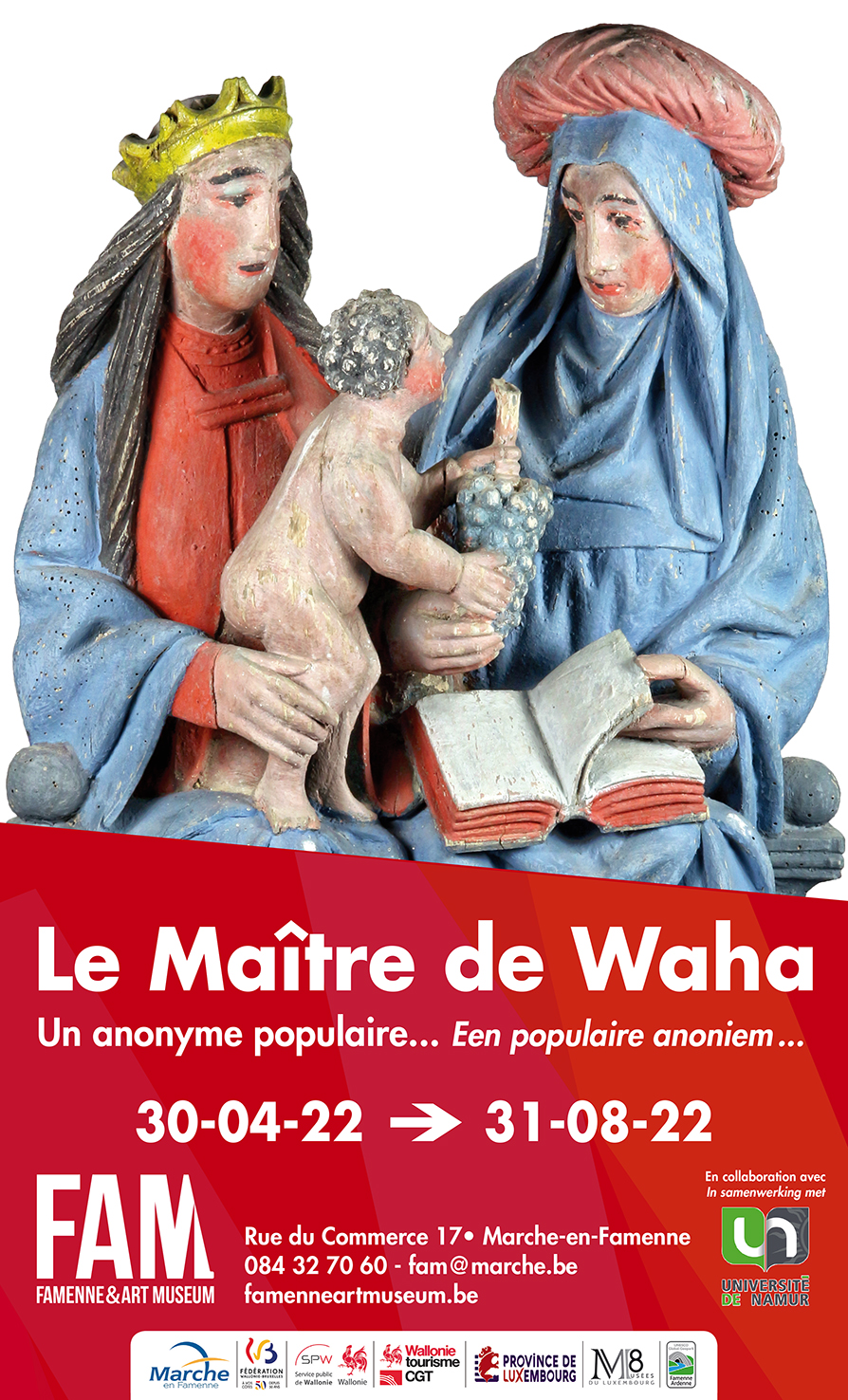
Exposition – Le Maître de Waha. Un anonyme populaire

Le mystère entourant le Maître de Waha est sur le point d’être percé…

Si ce sculpteur du XVIe siècle demeure anonyme, son travail est de mieux en mieux connu.

Alors que diverses œuvres ont émergé ces dernières années sur le marché de l’art, d’autres ont été identifiées dans les chapelles et églises de la région. Les modèles qui l’ont inspiré ont également pu être retrouvés.

Et tout cela est exceptionnellement rassemblé lors de l’exposition événement au FAM !

Découvrez à cette occasion l’influence considérable que ces œuvres de la fin du Moyen Âge ont eu sur les peintres et graveurs wallons des années 1920-1930’ !

Informations pratiques :

Le Famenne & Art Museum, Marche-en-Famenne
30 avril-31 août 2022

Source : Famenne & Art Museum

Publié dans Exposition | Laisser un commentaire

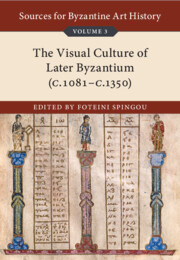
Publication – « Sources for Byzantine Art History ». Volume 3. « The Visual Culture of Later Byzantium (1081–c.1350) », dir. Foteini Spingou

In this book the beauty and meaning of Byzantine art and its aesthetics are for the first time made accessible through the original sources. More than 150 medieval texts are translated from nine medieval languages into English, with commentaries from over seventy leading scholars. These include theories of art, discussions of patronage and understandings of iconography, practical recipes for artistic supplies, expressions of devotion, and descriptions of cities. The volume reveals the cultural plurality and the interconnectivity of medieval Europe and the Mediterranean from the late eleventh to the early fourteenth centuries. The first part uncovers salient aspects of Byzantine artistic production and its aesthetic reception, while the second puts a spotlight on particular ways of expressing admiration and of interpreting of the visual.

Table des matières :

Part I. Art, Aesthetics and Literature:
1. Notions of the image in later Byzantium Ch. Barber, D. Jenkins, N. Leidholm, D. Angelov, M. Hinterberger, Th. A. Carlson
2. Artists and patrons F. Spingou, I. Drpić, Th. Tsampouras, A.-M. Talbot, Al. Alexakis, A. M. Talbot, A. W. Carr
3. Eikon and iconography in later Byzantium F. Spingou, N. Zagklas, A. W. Carr, M. Duluş, Em. Bourbouhakis, M. Mavroudi, N. Zagklas, A. Walker, M. Jeffreys, E. Jeffreys
4. Materials F. Spingou, E. Cullhed, M. Bazzani, with a note on the author in collaboration with A. Rhoby, S. Steiner, E. Bourbouhakis, M. Grünbart
5. Seeing spaces: responses to built environment F. Spingou, E. Rizos, A. Novikoff, G. P. Majeska, Th. A. Carlson, C. Palombo, L. Mordechai, Sc. Ashley, R. Romanchuk, B. Hostetler, M. W. Herrington, Chr. Timm, S. Simmons, Gr. Dinkova-Bruun, M. Grünbart, E. Jeffreys, A. Walker, M. Mulchahey, D. Manolova and P. Magdalino
6. Art and devotion F. Spingou, A. Riehle, A.-M. Talbot, I. Toth, A. W. Carr, L. Andriollo, J. Featherstone, R. Ceulemans, Br. Hostetler
7. Memory and art F. Spingou, M. Hinterberger, Fl. Leonte, A. M. Talbot, E. Jeffreys, A. Rhoby, J. Lansdowne
8. Beauty F. Spingou, I. Polemis, Al. Alexakis, D. Angelov, M. Duluş, M. Bazzani
D. Penna, V. Marinis, E. Jeffreys, K. Stewart, P. Van Deun, M. Jeffreys, M. Mavroudi, A. Riehle, Chr. Maranci
Part II. Literature, Art and Aesthetics:
9. Counting down: inventories M. Parani, L. Bender, A. M. Talbot, F. Spingou
10. Describing, experiencing, narrating: the use of ekphrasis (ca. 1081–1330s) I. Nilsson, E. Cullhed, B. van den Berg, Ch. Messis, K. Chryssogelos, M. Tomadaki, Prz. Marciniak, Μ. Duluș
11. Speaking: Ethopoiiae E. Jeffreys, K. Warcaba, M. Jeffreys, L. Andriollo, N. Zagklas
12. Instructing and dedicating: epigrams on works of art F. Spingou, N. Zagklas, L. Andriollo, N. Zagklas, L. Safran, E. Jeffreys, M. Jeffreys, A. Rhoby, A. W. Carr, A.-M. Talbot
13. Reading: book epigrams Kr. Demoen, R. Ricceri, R. Meesters, M. Tomadaki, A. W. Carr
14. Marking: later Byzantine epigraphic culture I. Toth, P. Van Deun, S. Kalopissi-Verti, J. Johns, L. Safran, L. Mahoney, A. W. Carr, I. Špadijer, E. Gedevanishvili
15. Lamenting: tomb epigrams and epitaphs F. Spingou, I. Taxidis, A. Rhoby.

Informations pratiques :

Sources for Byzantine Art History. Volume 3. The Visual Culture of Later Byzantium (1081–c.1350), dir. Foteini Spingou, Cambridge, Cambridge University Press, 2022. ISBN : 9781108483056. Prix : GBP 200.

Source : Cambridge University Press

Publié dans Publications | Laisser un commentaire