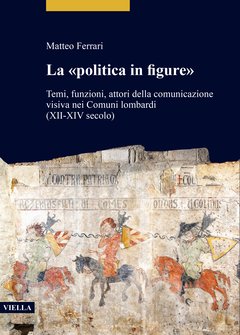
Nel corso del Duecento, i palazzi pubblici di molte città dell’area padana si popolano d’immagini, scolpite e soprattutto dipinte. Antecedenti meno noti dei grandi manifesti politici che ornano i palazzi comunali toscani nel corso del Trecento, queste figurazioni, varie per soggetto e funzione, hanno a lungo rappresentato una sfida interpretativa per il ricercatore, a causa della loro singolarità formale e iconografica.
Attraverso un’analisi delle attestazioni materiali e un recupero della memoria delle tante perdute, questo libro si propone d’identificare le tradizioni di immagini che percorrono le città lombarde in età comunale, di ricostruirne il significato e di leggerne gli sviluppi alla luce dei cambiamenti istituzionali e sociali che caratterizzano la regione tra l’eclissi dei governi consolari e l’affermazione della signoria viscontea.
Matteo Ferrari, dottore in Storia dell’arte medievale presso la Scuola Normale Superiore di Pisa, ha svolto incarichi di ricerca presso istituzioni universitarie italiane ed europee. È autore di numerosi saggi sull’uso dell’immagine da parte dei Comuni italiani e sulle forme e le funzioni dell’araldica nel tardo Medioevo europeo, con particolare riferimento all’Italia settentrionale e alla Francia.
Matteo Ferrari, La «politica in figure». Temi, funzioni, attori della comunicazione visiva nei Comuni lombardi (XII-XIV secolo), Roma, Viella, 2022 (Studi lombardi, 10). pp. 340 + 90 tav. col., 17×24 cm, bross. ISBN: 9788833138794. prix : 58 euros.
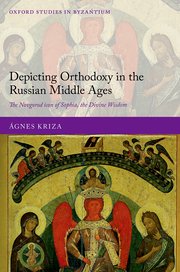
The image of Divine Wisdom, traditionally associated with the Sophia Cathedral in Novgorod, is an innovation of the fifteenth century. The icon represents the winged, royal, red-faced Sophia flanked by the Mother of God and John the Baptist. Although the image has a contemporaneous commentary, and although it exercised a profound influence on Russian cultural history, its meaning, together with the dating and localisation of the first appearance of the iconography, has remained an art-historical conundrum. By exploring the message, roots, function, and historical context of the creation of the first, most emblematic and enigmatic Russian allegorical iconography, Depicting Orthodoxy in the Russian Middle Ages deciphers the meaning of this icon. In contrast to previous interpretations, Kriza argues that the winged Sophia is the personification of the Orthodox Church. The Novgorod Wisdom icon represents the Church of Hagia Sophia, that is, Orthodoxy, as it was perceived in fifteenth-century Rus. Depicting Orthodoxy asserts that the icon, together with its commentary, was a visual-textual response to the Union of Florence between the Catholic and Orthodox Churches, signed in 1439 but rejected by the Russians in 1441. This interpretation is based on detailed interdisciplinary research, drawing on philology, art history, theology, and history. Kriza’s study challenges some key assumptions concerning the relevance of Church Schism of 1054, the polemics between the Greeks and the Latins about the bread of Eucharist, and the role of the Union of Florence in the history of Russian art. In particular, by studying both well- and lesser-known works of art alongside overlooked textual evidence, this volume investigates how the Christian Church and its true faith were defined and visualized in Rus and Byzantium throughout the centuries.
Ágnes Kriza’s research interests include medieval Russian, Byzantine, and post-Byzantine art, literature, and theology, with a focus on the interface between text and image. She holds a PhD from the University of Cambridge, and is the author of a monograph on the reception of Byzantine iconophile literature in Rus. She is a former Alexander von Humboldt post-doctoral fellow at the University of Cologne, exploring the significance of anti-Latin visual polemics in medieval Russian art.
Table des matières :
Introduction PART I. WORD 1:The Icon and its Commentary 2:The Winged Bride: Quotations in the Sophia Commentary 3:Medieval Russian Sophiology: The Context of the Sophia Commentary in the Manuscripts PART II. IMAGE 4:Representations of Wisdom in Rus 5:The Novgorod Sophia as a Deesis 6:Sophia in the Womb of the Virgin PART III. IDENTITY 7:Slavonic Sophia Churches and the Schism of 1054 8:Leaven and Byzantine Marian iconography 9:Depicting Orthodoxy in Rus PART IV. HISTORY 10:Sophia, the Divine Wisdom and the Union of Florence 11:Evfimii II, Archbishop of Novgorod 12:The Hagia Sophia in Rome Conclusions Appendices: Critical Edition of the Sophia Commentary with English Translation Table 1: The ‘Sophiological Block’ Table 2: The ‘Sophiological Synthesis’ Catalogue: The Iconography of the Novgorod Sophia in the Fifteenth and Sixteenth Centuries
Informations pratiques :
Ágnes Kriza, Depicting Orthodoxy in the Russian Middle Ages. The Novgorod Icon of Sophia, the Divine Wisdom, Oxford, Oxford University Press, 2022 (Oxford Studies in Byzantium). 384 Pages | 105 colour figures 234x156mm ISBN: 9780198854302. Prix : GBP : 90,00.
À quoi correspond le dit, forme littéraire de langue française dont la vie s’étend du XIIIe au XVe siècle ? Ce volume pose un regard diachronique sur les manifestations de ce qui se nomme dit à travers les siècles, en repensant les frontières qu’on trace souvent entre Moyen Âge central et tardif.
Le Dit du berceau au tombeau (XIIIe-XVe siècle), dir. Isabelle Delage-Béland et Anne Salamon, Classiques Garnier, 2022 (Civilisation médiévale, n° 47 ; Rencontres, n° 542). 178 p. ISBN : 978-2-406-12894-6. Prix : 16 euros.
Online-Kolloquium des Seminars für Deutsche Philologie der Georg-August-Universität Göttingen im SoSe 22
Liturgie und Volkssprache im Mittelalter: Rezeption, Gebrauch, Überlieferung
Die Veranstaltungsreihe des Seminars für Deutsche Philologie der Georg-August-Universität Göttingen in Verbindung mit der Schriftenreihe ‘Liturgie und Volkssprache’ (De Gruyter) findet im Sommersemester 2022 jeweils dienstags 18-20 Uhr c.t. statt. Interessent:innen sind herzlich eingeladen. Bitte wenden Sie sich für den Zoom-Link spätestens am Vortag der jeweiligen Veranstaltung an Pavlina Kulagina: pavlina.kulagina@uni-goettingen.de.Programm
28.06. Lena Vosding (Oxford): So wirt die küsterin nit irr. Regieanweisungen für die Liturgie im Nürnberger ‘Notel der Küsterin’
05.07. Christian Schmidt (Hamburg): Von der Tagzeitenliturgie zum Stundenschlag. Georg Philipp Harsdörffers Uhrenmeditationen in literatur- und frömmigkeitsgeschichtlicher Perspektive
12.07. Nikolaus Henkel (Hamburg): Latein und Volkssprache. Sebastian Brants Arbeit an liturgischen Texten.
Au sein de la riche production enluminée du Maître de Coëtivy, l’un des plus grands peintres de la France royale dans la seconde moitié du XVᵉ siècle, le texte philosophique de Boèce occupe une place tout à fait singulière ; on en conserve en effet pas moins de cinq exemplaires, dont deux, hélas, n’existent plus qu’à l’état de fragments (Los Angeles, Londres) et un troisième a irrémédiablement été endommagé par une inondation (Lisbonne). Mais les luxueux exemplaires de Paris et de New York permettent d’appréhender dans son intégralité le programme iconographique conçu pour cet ouvrage particulièrement apprécié à la fin du Moyen Âge. Loin de revêtir les aspects d’une production en série, même si les partis pris de composition demeurent identiques d’un volume à l’autre, aucun exemplaire n’est la copie conforme du précédent, et leur examen comparé permet de cerner les pratiques en cours dans un atelier de peintre enlumineur. Et de tenter, même si la datation des cinq volumes se situe dans une fourchette chronologique relativement étroite (entre 1460 et 1470), de préciser leur ordre d’exécution.
Nicolas Oget soutiendra prochainement sa thèse de doctorat sur Le Maître de Coëtivy, la peinture à Paris au temps de Colin d’Amiens (vers 1450-1500). Il a déjà signé plusieurs articles sur le sujet, notamment « Quelle identité pour l’artiste médiéval ? Le cas du Maître de Coëtivy » (https://124revue.hypotheses.org/2398), « La vie et la carrière de Colin d’Amiens : un état de la question », dans les Documents d’histoire parisienne (2018), et récemment « Les vitraux de Saint-Séverin : un écrin pour la peinture à Paris dans la seconde moitié du XVᵉ siècle » dans la Revue de l’Art (2021). Il est également l’auteur d’un numéro de la revue Art de l’enluminure (2019) consacré au manuscrit des Héroïdes de Louise de Savoie, enluminé par Robinet Testard (Paris, BnF, ms, Fr. 875). Parallèlement à ses travaux de recherche, il est professeur documentaliste dans un lycée des Hauts-de-Seine.
Informations pratiques :
La prochaine réunion des Ymagiers aura lieu le lundi 13 juin 2022, à 17 h 30, à l’Ecole du Louvre, amphithéâtre Michel-Ange (Palais du Louvre, Place du Carrousel, Porte Jaujard, 75001 Paris). Elle pourra aussi être suivie à distance*. Nous aurons le plaisir d’écouter :
Merci de vous inscrire auprès de Claudia.Rabel@cnrs-orleans.fr au plus tard le vendredi 10 juin 2022, et de préciser si vous souhaitez assister à la conférence à distance (communication du lien de connexion).
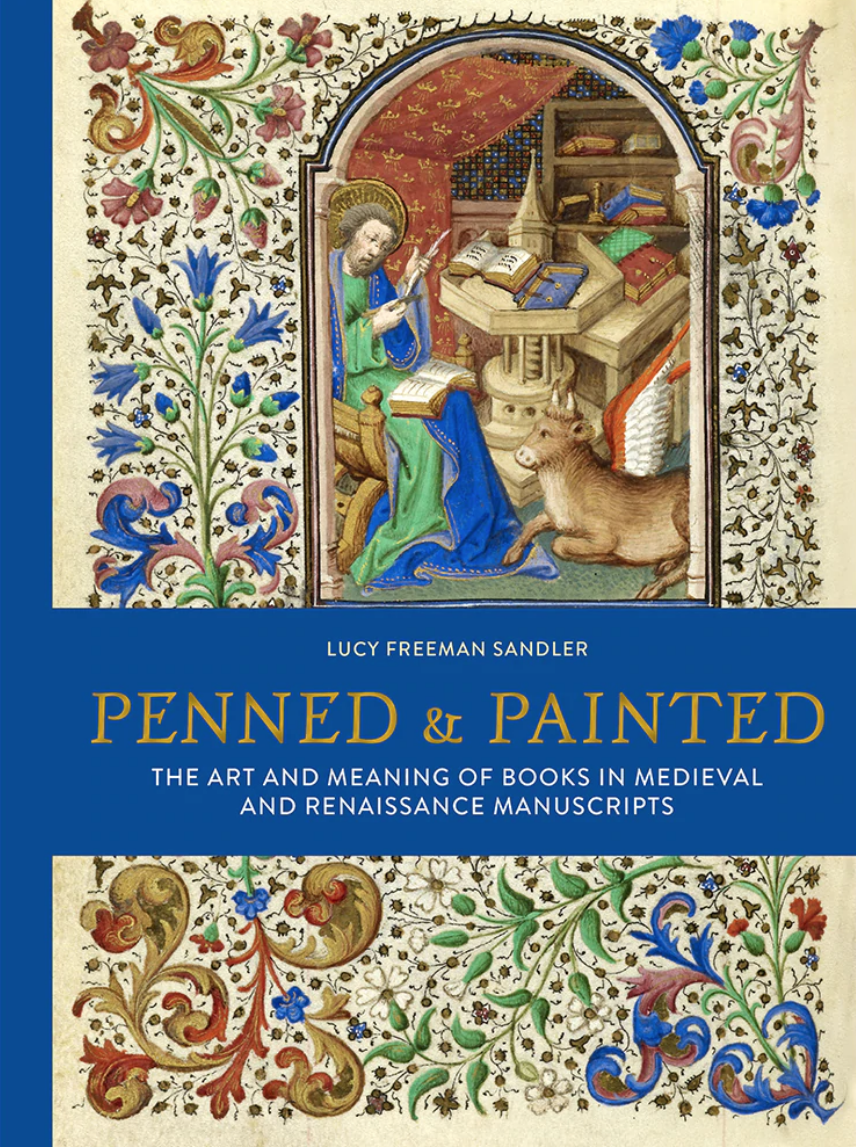
Penned & Painted is a beautifully produced, large format book in which one of the most celebrated historians of medieval art surveys one of the world’s great collections and asks ‘what is a medieval book?’.
The idea of the book was central throughout the western European and the eastern Mediterranean world in the Middle Ages and the Renaissance. From the beginning, the word for ‘book’— sefer in Hebrew, biblia in Greek, and liber in Latin — was identified with sacred writings — the Holy Scriptures of Jews and Christians, who were known as ‘people of the book’.
The centrality of the book to medieval thought is reflected materially in the countless images of books that appear in the manuscripts of the era, be they in the most treasured, highly decorated, sacred texts or in devotional and secular works as well. In Penned & Painted, Lucy Freeman Sandler, one of one of the world’s most respected authorities on medieval art, takes us on a personal but highly insightful exploration of some of the British Library’s most precious manuscript holdings and describes the many uses and meanings of these ‘books in books’.
Through the fascinating face-to-face discovery of 60 manuscripts, she investigates the various types and forms of books as depicted in the era. How were they produced and what did they look like? What do they tell us of the lives and skills of the scribes and illuminators? What did these books record and signify? How were they displayed, consumed and how did some of these objects of supreme beauty even come to be wantonly destroyed? Penned & Painted is presented in full-colour throughout and includes a high number of images specially photographed for this volume.
Informations pratiques :
Lucy Freeman Sandler, Penned and Painted: The Art & Meaning of Books in Medieval and Renaissance Manuscripts, Londres, British Library Publishing, 2022. 176 p. Prix : GBP 22,50.
Représenter la vie des patriarches, du Christ ou des saints participe de la définition même de l’art chrétien et entretient des liens étroits avec les textes sacrés. Mais figurer les histoires du christianisme revient-il à imiter la narration textuelle et à produire, pour les yeux, un objet d’une nature comparable aux textes eux-mêmes ? L’objet du travail collectif présenté dans cet ouvrage consiste à interroger les procédés permettant de traduire, de transposer, de transmettre une histoire par des moyens qui ne sont pas ceux de l’écrit mais de la représentation figurée. Cette enquête, fondée sur une approche chronologique et géographique large, entend porter un nouveau regard sur la conception et le rôle des images au cours du Moyen Âge, à travers quelques moments cruciaux et certaines œuvres exemplaires. Par ailleurs, le fait que les cultures visuelles chrétiennes d’Orient et d’Occident soient en grande partie fondées sur la mise en images de récits bibliques et hagiographiques communs engage à la mise en regard des approches, posant la question des relations d’influence et d’émulation entre ces deux aires. L’étude de la narration à travers ses diverses manifestations visuelles, tant en Occident qu’à Byzance, montre la puissance des images à « dire des histoires » pour forger et partager une conscience collective fondée sur les mythes fondateurs de la civilisation médiévale.
Table des matières :
Sulamith Brodbeck, Anne-Orange Poilpré et Ioanna Rapti
Les enjeux narratifs de l’image médiévale. Bilan historiographique et approches actuelles
1. Formats et structure du récit : construire le cycle, montrer l’histoire
Héléna Rochard
Le cycle de l’Enfance du Christ en Égypte byzantine : structure et enjeux de la narration picturale
Anne-Orange Poilpré
Représentations carolingiennes et ottoniennes de la vie du Christ : approches extensive et sélective
Charis Messis
Le Massacre des Innocents à Byzance : entre homilétique, ekphrasis et iconographie
Nicolas Varaine
Peindre la vie des saintes : structures et rhétorique de l’hagiographie picturale dans le décor des églises de la période paléologue
Serena Romano
L’histoire de saint Jean dans l’église Sant’Agostino à Rimini. La narration et ses modèles dans le sillage de Giotto
2. Usages et fonctions de l’image narrative
Henry Maguire
The Story in Images: Visual and Literary Approaches in Early Byzantine Portrayals of the Life of Joseph
Ivan Foletti
Quand l’histoire devient prétexte : les cycles narratifs à Milan et Rome au Ve siècle
Bertrand Billot
Le cycle christologique de Saint-Apollinaire-le-Neuf de Ravenne : narrativité et fonction
Liz James
Narrative and the Wall Mosaic – Telling a Story of Filling the Wall?
Barbara Franzé
Narration par l’image et réforme grégorienne : les décors de Saint-Nicolas de Tavant
Licia Buttà, Maud Pérez-Simon
Une scène emblématique convertie en séquence narrative. Raconter le Jugement de Salomon sur une solive du Palais Chiaramonte (Sicile, fin du XIVe siècle)
3. Espace et temps de la narration
Mary B. Cunningham
The Portrayal of Joachim and Anna in Byzantine Texts and Images: An Intersection of Historical and Liturgical Time
Ioanna Rapti
Adam et Ève à Aght’amar : une épopée humaine
Marcello Angheben
Le cycle vétérotestamentaire de Saint-Savin et la liturgie de la Septuagésime
Judith Soria
La Passion du Christ dans les églises tardobyzantines : temps et récit du jugement de Pilate
Maria Alessia Rossi
Christ’s Miracles in the Palaiologan Period: Narratives of Salvation in Text and Image
Informations pratiques :
Histoires chrétiennes en images : espace, temps et structure de la narration Byzance et Moyen Âgeoccidental, éd. Sulamith Brodbeck, Anne-Orange Poilpré, Ioanna Rapti, Paris, Éditions de la Sorbonne, 2022 (Byzantina Sorbonensia). 335 p. ISBN : 979-10-351-0805-2. Prix : 35 euros.
Fixed Term: The post is available from 1 September 2022 and funded for 12 months in the first instance.
UCL History is recruiting for the post of Associate Lecturer (Teaching) to teach the following MA level module:
Medieval Manuscripts and Documents
Medieval Manuscripts and Documents introduces UCL MA students in medieval studies to palaeography, codicology and diplomatic.
In addition to this, the successful candidate will supervise a number of students in the Manuscripts and Documents add-on course ‘Medieval Manuscripts and Documents: Skills and Sources’. This course requires students to make a catalogue entry for an assigned manuscript from the British Library. The tutor should provide supervision to these students, in the form of additional meetings in the British Library in Term 1 (4-5 hours to cover supervision and assessment).
Additionally, the successful candidate will:
Act as Personal Tutor to an allocation of students.
Carry out administrative responsibilities within the department, as directed by the Head of Department.
The post is available from 1 September 2022 and funded for 12 months in the first instance.
Applicants must have; previous experience of teaching undergraduate and/or graduate students in this period and specialism in the UK; previous experience of small group teaching; a commitment to high-quality teaching, fostering a positive learning environment. Applicants must have demonstrable ability to teach paleography, including late medieval manuscripts.
If you have any queries regarding the vacancy or the application process, please contact the Departmental Manager, Claire Morley (email claire.morley@ucl.ac.uk), (tel. +44 (0)20 7679 1341).
Latest time for the submission of applications: 23:59.
UCL Taking Action for Equality
We will consider applications to work on a part-time, flexible and job share basis wherever possible.
Our department is working towards an Athena SWAN award. We are committed to advancing gender equality within our department.
Summer School CUNY Hunter College, New York July 11-15 2022
Programme :
11th July
Introduction 10:00 AM → Ivan FOLETTI, Cynthia HAHN, Kristen RACANIELLO, Cécile VOYER
SESSION I / Chair → Ivan FOLETTI 10:20 AM → Kirk AMBROSE The Tautological Inscriptions of the Conques Tympanum
11:00 AM → Kristen RACANIELLO The “Iron Man”: Islamic Materiality and Arabic Inscriptions in the Shrine of Sainte-Foy
SESSION II / Chair → Cécile VOYER 2:00 PM → Éric SPARHUBERT Sainte-Foy of Conques and Beyond: Making the Holy Body Visible and Promotional Strategies in Romanesque Architecture 2:40 PM→ Martin F. LEŠÁK Landscape, Liturgy, and Sainte-Foy: Rituals in and Around Medieval Conques 3:40 PM → Sabina ROSENBERGOVÁ Conques’ Monastic Landscape: From Geological Reality to Hagiographic Imagination 4:20 PM → Michele Luigi VESCOVI Conques: Monastic Network, Artistic Practices
12th July
CONQUES AND ITS NETWORKS SESSION III / Chair → Cynthia HAHN 10:00 AM → Vincent DEBIAIS Portals as Epigraphic Pages: Describing the Path of Light in Conques and Beyond 10:40 AM → Zuzana FRANTOVÁ The Virgin of Beaulieu: The Engagement of Silver and Vermeil in the Liturgical Drama 11:20 AM → Bissera PENTCHEVA Audiovision: Image and Chant at Sainte-Foy in Conques
SESSION IV / Chair → Herbert KESSLER 2:00 PM → Lei HUANG Memory Between Tradition and Modernity: Odolric’s Historicism and Bégon’s Promotion of Image in Romanesque Conques 2:40 PM → Adrien PALLADINO The Myth of Byzantium on the Way to Conques 3:40 PM → Janet MARQUARDT Rouergue Roman: Zodiaque’s Conque
13th July
SACRED ARCHITECTURE AND MEMORY 9 AM → Poitiers Day Vincent DEBIAIS, Marjolaine MASSÉ, Angelica PICARIELLO, Éric SPARHUBERT, Cécile VOYER Elina GERSTMAN, Mapping the Tympanum 3 PM → Organization of 2023 Conference
14th July
LANDSCAPE, CARTOGRAPHY, AND PRE-MODERN NETWORKS 9AM → Hertziana Day Adrian BREMENKAMP, Tanja MICHALSKY, Elisabetta SCIROCCO, Sabina ROSENGOVÁ, Tanja MICHALSKY, Antonino TRANCHINA 3PM → Final Book Structure and Brainstorming
15th July
ACTIVATING SPACES AND OBJECTS 9 AM → Brno Day Philippe CORDEZ, Jana ČERNOCKÁ, Klára DOLEŽALOVÁ, Karolina FOLETTI, Zuzana FRANTOVÁ, Katarína KRAVČÍKOVÁ, Martin F. LEŠÁK, Adrien PALLADINO, Kristen RACANIELLO, Pavla TICH
This workshop is organized as a part of the project Conques in the Global World. Transferring Knowledge: From Material to Immaterial Heritage (H2020_MSCA-RISE 101007770).
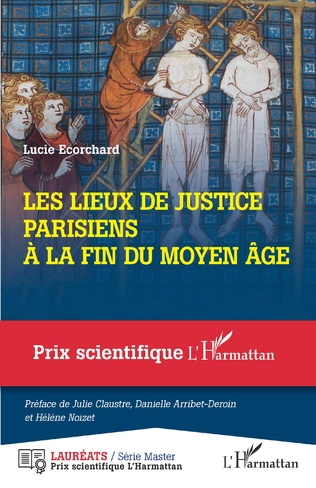
Violent, cruel, barbare… C’est encore ainsi que le Moyen Âge est décrit et imaginé. En étudiant les lieux et les structures grâce auxquels les nombreux seigneurs parisiens rendaient la justice, cet ouvrage remet en cause l’image traditionnelle de la justice médiévale. Recensant l’ensemble de ces lieux de l’espace public dans la capitale et ses faubourgs, du XIIe à la fin du XVe siècles, l’étude offre une représentation globale des pratiques pénales parisiennes. Au croisement d’une histoire matérielle et politique, ce travail inédit manifeste les politiques territoriales des seigneurs de la capitale en cette fin du Moyen Âge et montre que ces structures judiciaires étaient multifonctionnelles. Bien plus que de simples supports des exécutions, ces objets portent en eux des usages politiques, territoriaux et symboliques.
Cet ouvrage est lauréat du Prix scientifique L’Harmattan.
Préface de Julie Claustre, Danielle Arribet-Deroin et Hélène Noizet
Formée en histoire et histoire de l’Art et archéologie à l’Université de Paris 1, Lucie Ecorchard a poursuivi ses études en master d’histoire et anthropologie des sociétés médiévales. Actuellement, elle travaille au musée national Eugène Delacroix.
Informations pratiques :
Lucie Ecorchard, Les lieux de justice parisiens à la fin du Moyen Âge, Paris, L’Harmattan, 2022. 302 p. ISBN : 978-2-343-24636-9. Prix : 31 euros.
Avec le soutien du FNRS, du CRHiDI (UCLouvain – Saint-Louis, Bruxelles), d'INCAL (UCLouvain), de PraME (UNamur), de sociAMM (ULB) et de Transitions (ULiège)








 L'Agenda des Médiévistes
Vous devez être connecté pour poster un commentaire.