Séminaire – Utrecht Centre for Medieval Studies Yearly Seminar: Premodern Reading Cultures Between Transforming Materialities

Programme : ici

This year’s UCMS Seminar, on 14 October 2022, will be devoted to the connections between reading cultures and the transforming material features of the medieval book: from scroll to codex, from parchment to paper, from manuscript to print, and recently from printed to digital facsimiles.

Historical developments

The distinctions between material forms and media have crucially shaped scholarly narratives around books and reading cultures in late antiquity, the Middle Ages, and the early modern period. A concept such as ‘the printing revolution’ has supported our understanding of the influence of technological developments on the transmission of texts and knowledge, but may simultaneously be criticised for implying a rigid distinction between print and manuscript culture.

Relations between different developments

This seminar will investigate the relations between technological, textual, and cultural developments, paying particular attention to texts and practices that cross traditional divides. Themes that may be discussed include developments and continuities in the characteristics and functions of paratext, images, and decoration, the transmission of specific texts or genres, and reading techniques.

Material forms

Another crucial issue relates to the co-existence of various material forms. Examples include late-medieval scrolls, handwritten copies of printed texts, printed images in manuscripts, written marginalia in printed books, and the digital copies of physical manuscripts.

About the seminar

By bringing together book historical, art historical, literary, and cultural perspectives on these matters, the seminar aims to provide a multidisciplinary outlook on the influence of transforming materialities on the transmission and use of texts. The presentations at the UCMS Seminar not only focus on research results, but may also discuss ongoing research or broader developments within the field.

The event is mainly intended for RMA students, PhD’s and Early Career Scholars, but all those who are interested, in particular all UCMS members, are welcome to attend.

Informations pratiques :

Start date and time : 14 October 2022 – 11:00
End date and time 14 October 2022 – 17:00
Location Janskerkhof 2-3, room 021
Registration To register, please send an e-mail to ucms@uu.nl
More information Utrecht Centre for Medieval Studies

Source : Utrecht Centre for Medieval Studies

Publié dans Séminaire | Laisser un commentaire

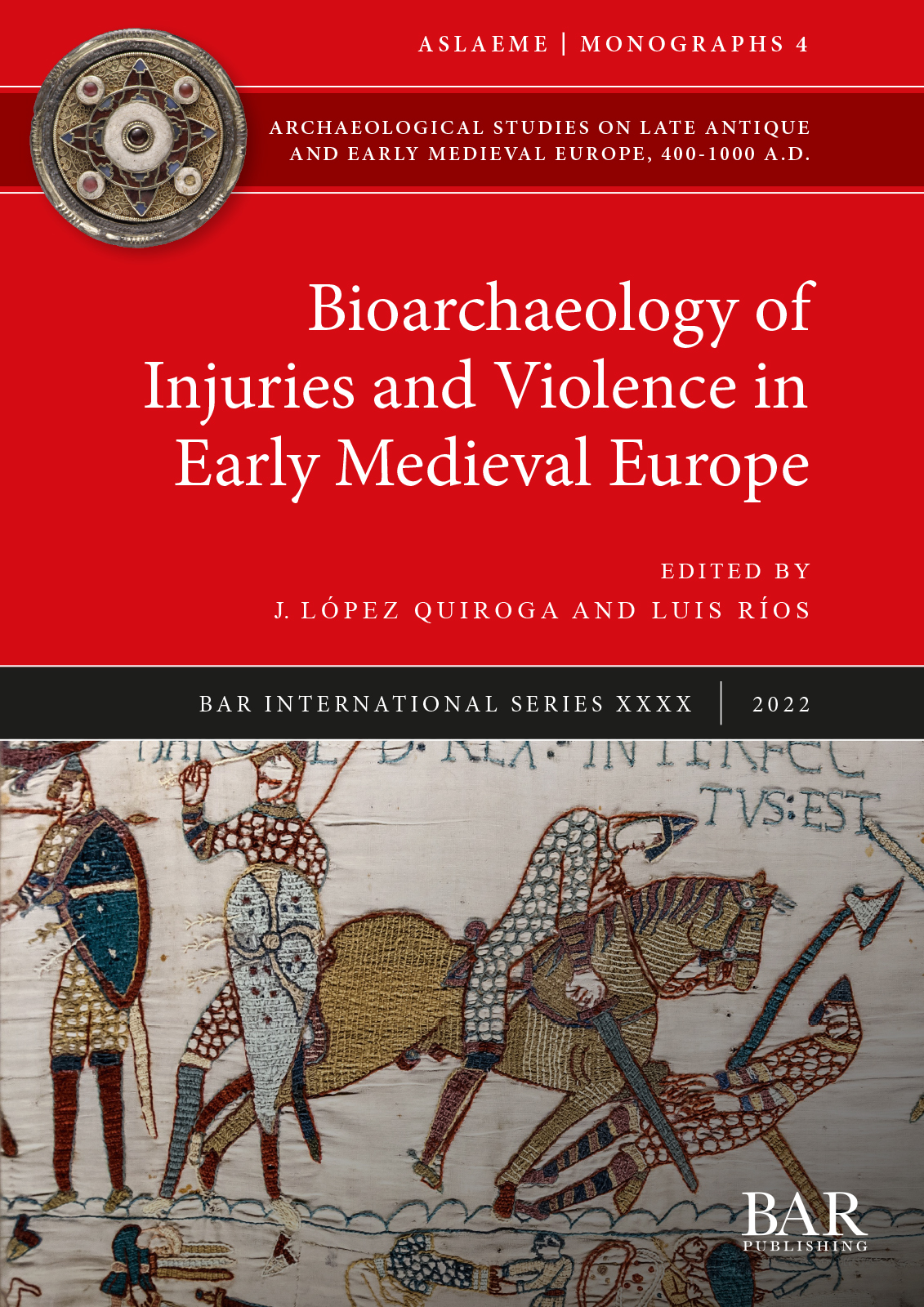
Publication – « Bioarchaeology of Injuries and Violence in Early Medieval Europe », dir. Jorge López Quiroga et Luis Ríos Frutos

Bioarchaeology of Injuries and Violence in Early Medieval Europe presents evidence and documents forms of violence and injuries in skeletal remains. Its contributions address this topic for the first time in a chronologically specific arc (Late Antiquity and Early Middle Ages) and a wide geographical area (Greece, England, Germany, France, Italy and Spain). The diversity of examples of interpersonal violence, collective violence (mass graves), punishments, and ante-mortem and post-mortem injuries provides an important data set concerning the degree and dimension of violence and injuries in post-Roman Europe. Osteoarchaeological and bioarchaeological analysis of human remains, together with exhaustive studies of corpses, from the time of burial to exhumation, makes it possible to identify burials as ‘non-normative’, ‘anomalous’ or ‘deviant’ burials that may be the result of violence, including evidence of punishments and executions.

Jorge López Quiroga is Senior Researcher at the Autonomous University of Madrid. His research focuses on Late Antiquity and the Early Middle Ages in the Iberian Peninsula and in the post-Roman West. He is the editor of Entangled Identities and Otherness in Late Antique and Early Medieval Europe (BAR Publishing, 2017), among others, and co-editor since 2006 of the BAR sub-series Archaeological Studies on Late Antique and Early Medieval Europe (ASLAEME).

Luis Ríos Frutos, Biologist and Anthropologist, is Assistant Professor of Physical Anthropology at the Complutense University of Madrid and Researcher at Sociedad de Ciencias Aranzadi. He has authored numerous publications on human bones spanning from the Neanderthals from El Sidrón, to mass graves from the Spanish Civil War.

Table des matières : ici

Contributors: Kurt W. Alt, Fabrizia Andriani, Fabio Armenise, Agustín Azkárate, Jo Buckberry, Chryssa Bourbou, Mª Paz De Miguel Ibañez, Francisco Etxeberria, I Etxeberria, Véronique Gallien (†), Dawn Hadley, Lourdes Herrasti, Rachel Holgate, Jorge López Quiroga, Alyxandra Mattison, Christian Meyer, Ginevra Anna Panzarino, Patrick Périn, Luis Ríos Frutos, Iban Sánchez-Pinto, Sandro Sublimi Saponetti, Michelle Williams-Ward.

Informations pratiques :

Bioarchaeology of Injuries and Violence in Early Medieval Europe, éd. Jorge López Quiroga, Luis Ríos Frutos, Oxford, BAR Publishing, 2022 ; 1 vol., 250 p. (Archaeological Studies on Late Antiquity and Early Medieval Europe (400-1000 A.D.). Monographs, 4). ISBN : 978-1-40735-993-9. Prix : GBP : 65,00.

Source : BAR Publishing

Publié dans Publications | Laisser un commentaire

Offre d’emploi – « REIGN. Reconstructing the Ghent knowledge center of the Counts & Countesses of Flanders, 11th-18th C. » 1 historicus – wetenschappelijk medewerker (m/v/x)

1 historicus – wetenschappelijk medewerker (m/v/x)

voor het BRAIN-be 2.0-project (2023-2027)

REIGN (Reconstructing the Ghent knowledge center of the Counts & Countesses of Flanders, 11th-18th C.)

Het Algemeen Rijksarchief en Rijksarchief in de Provinciën is een federale wetenschappelijke instelling die deel uitmaakt van de Federale Programmatorische Overheidsdienst (POD) Wetenschapsbeleid. De instelling bestaat uit het Algemeen Rijksarchief te Brussel, 18 vestigingen van het Rijksarchief verspreid over het hele land en het Studie- en Documentatiecentrum Oorlog en Hedendaagse Maatschappij (SOMA) te Brussel.

Het Rijksarchief verwerft en bewaart (na selectie) archieven van minstens 30 jaar oud, afkomstig van onder meer van hoven en rechtbanken, openbare besturen en notarissen, alsook van de private sector en particulieren (bedrijven, politici, verenigingen en genootschappen, invloedrijke families, enz.).

De valorisatie van deze archieven is één van de hoofdopdrachten van de instelling. Het Rijksarchief stelt niet alleen in zijn studiezalen, maar ook on line een uitgebreide onderzoeksomgeving ter beschikking van een ruim en gevarieerd publiek.

BESCHRIJVING VAN DE TE BEGEVEN FUNCTIE

REIGN is een vierjarig project van het BRAIN-be 2.0-programma van de POD Wetenschapsbeleid. Het betreft een bottom-up project ingediend en gecoördineerd door het Rijksarchief Gent.

Als wetenschappelijk personeelslid van het Gentse Rijksarchief beschik je over een welomschreven takenpakket binnen het REIGN-project. Je werkt daarnaast ook nauw samen met de coördinator en de medewerker, onder meer tijdens de oriënteringsfase en op het gebied van valorisatie en publiekswerking. Je staat tevens mee in voor de projectrapportering aan de POD Wetenschapsbeleid en voor de begeleiding van jobstudenten die door het Rijksarchief binnen het project worden aangeworven. Een korte contextualisering, samengevat uit het projectvoorstel, luidt als volgt:

“Few archival collections have such a turbulent history” argued historian and archivist E. Aerts, when writing about the condition of the “chartrier” of the Counts of Flanders in 1996. Although from a slightly different point of view, the sentiment is still shared by many historians and archivists of the medieval and the early modern period. Recently, with the financial support of the Baillet-Latour foundation, the State Archives in Ghent have made great efforts to improve the material condition of the vast collection of political, legislative, administrative, judicial and financial documents of the

Flemish counts. In addition to the restoration of all 4055 “charters”, the digitization lab of the Belgian National Archives provided high-resolution scans of front and back of each document. This large-scale operation is finished – which means that the momentum for scientific exploration and dissemination is now.

However, it does not suffice to simply update the existing but (according to modern standards) inadequate archival descriptions, to accompany the scans in the search engine of the Belgian National Archives. The biggest hurdle to presenting these “charters” in a scientifically sound environment is their current arrangement in four artificially composed series – a situation at odds with 21st-century developments within the field of archival science, in particular the basic principle of presenting records in their contexts. In this case, the quest for that context leads us back to the late days of the Ancien Régime, to the vast archival mass left behind by several institutions of the former County of Flanders at their location in the Volderstraat and the castle of the Counts (“Gravensteen”) in Ghent. What is now known as the “chartrier”, was in 1796 scattered between archives of the Council of Flanders, the highest feudal court in Flanders known as the « Wetachtige Kamer », the financial Chamber of the “Hoofdredeninge”, the exception court of the “Indaginge”, documents about the management of the comital domains and even the archives of the Oudburg castelleny – in short, the core of the historical collection of the State Archives in Ghent and, combined, the written testimony of the governance of the Counts and Countesses of Flanders.

There is a consensus among historians and archivists that Ancien Régime administrations were not as defined as the institutions we know nowadays. The archival history of the comital archives seems to confirm this notion. The compartmentalization of these archives in different archival holdings, as listed above, is mainly an artificial construction – a result of consecutive, often uncoordinated actions of officiaries, historians and archivists from an era when archival science was still in its infancy, an era in which other motives for perusing the archives also applied (such as the search for property titles). These interventions are often not explicitly documented, but this can be remedied provided a correct and well thought-out methodology. By combining dorsal notes found on the ‘”chartrier” during preparation of the restoration (showing several different numbering systems over time), old inventories (for example the Buntinx “fichier” of the Council of Flanders), lists of various artificially created collections such as “Varia”-series and the “Fonds Gent”, preserved reports of 19th-century archival committees, correspondence, general annual activity reports and other documents saved within the own archives of the State Archives in Ghent, a virtual reconstruction of the Ghent knowledge center of the Counts and Countesses of Flanders is within range.

Doing so, this project aims to (i) contribute to the knowledge of the comital administration, broadening the field of view on the governance of the County of Flanders and, consequently, enabling new angles for historical research. For instance, by focusing on the notion of « archival creator », interesting possibilities in the field of gender studies arise. Likewise, REIGN will offer (ii) new insights for the relatively young scientific discipline of archival history, by studying the arrangement of documents by their creator(s), in addition to 19th-century archival methods. All this will be viewed in the light of current developments in archival science, such as the conceptual model of RiC-CM (v0.2). Last but not least, (iii) the heuristic tools generated by this project will enable both the staff of the Federal Scientific Institution and the users of their collections (academic researchers, students, non- academic historians, genealogists, and so on) to navigate comital records more easily and effectively.

Main archival deliverables include an online access point to the “chartrier” worthy of the 21st century, in which the documents are contextualized and presented in relation to their archival creators and in their various arrangements since the 14th century (= date of the first traceable inventory). In addition, a correlation table to the vast archives of the Council of Flanders and adjacent institutions will provide a solution to persistent difficulties with consultation based on old archival references – to be found in all studies until mid 20th century and in important 19th-century source publications (such as the “Recueil des ordonnances des Pays-Bas” or the “Messager des sciences et des arts”, nowadays available online). Finally, an overview of strayed or rather artificially separated records of a seemingly more documentary nature, their origin and current location, will complete the virtual reconstruction of the comital knowledge center.

PLAATS VAN TEWERKSTELLING

Rijksarchief Gent, Bagattenstraat 43, 9000 Gent. PROFIEL

  • Je bent houder van een diploma van master (en eventueel doctor op proefschrift) in de geschiedenis.
  • Een zeer goede kennis van instellingen, archiefvorming en documenttypes uit de middeleeuwen en de vroegmoderne tijd (11de – 18de eeuw) is een conditio sine qua non.
  • Je beschikt over een gedegen paleografische kennis.
  • Goede, passieve kennis van het Latijn en het Frans; en actieve kennis van het Engels is aanwezig.
  • Je hebt een uitstekende kennis van Microsoft Office (Word, Excel en Access).
  • Je kan georganiseerd en zelfstandig werken.
  • Je bent resultaatgericht en je houdt je aan de doelstellingen en termijnen die binnen het project zijn vooropgesteld.
  • Een diploma archivistiek en/of aantoonbare ervaring in de archiefsector vormt een pluspunt.

WERKVOORWAARDEN

Wij bieden:

  • Een voltijds (38 uur per week) contract van bepaalde duur voor 2 jaar, eenmalig verlengbaar met max. 2 jaar.
  • Datum van indiensttreding: 1 februari 2023 (eventueel 1 maart of 1 april 2023).
  • Glijdend uurrooster.
  • Mogelijkheid tot telewerk.
  • Loonschaal:

o SW10 (21.880,00 – 33.895,00 EUR niet-geïndexeerd brutoloon, een netto salaris vanaf ca. 2.210 EUR bij 0 jaar anciënniteit)

o of SW11 (25.880,00 – 41.351,00 EUR niet-geïndexeerd brutoloon, een netto salaris vanaf ca. 2.560 EUR bij 2 jaar anciënniteit). Om toegelaten te worden tot de schaal van SW11, moet je minstens 2 jaar wetenschappelijke ervaring kunnen voorleggen of een andere professionele activiteit die relevant wordt geacht voor deze functie.

Voordelen:

  • Gratis openbaar vervoer voor het woon-werkverkeer en/of fietsvergoeding.
  • oordelige hospitalisatieverzekering.
  • Mogelijkheid tot recuperatie van overuren.
  • Minimum 26 vakantiedagen per jaar.
  • Voordelen en interessante aanbiedingen via de Fedplus en Belspo – kaarten.
  • Bijkomende voordelen, zie: http://www.fedplus.be

SELECTIEPROCEDURE

Om in aanmerking te komen dienen de kandidaten hun dossier (PDF) uiterlijk op 15 oktober 2022 per email te hebben overgemaakt aan recruit@arch.be; in CC Joke.Verfaillie@arch.be (met de referentie: NAAM_VOORNAAM_REIGN).

Het dossier moet worden ingediend in het Nederlands en bevat minstens een motivatiebrief, een kopie van het vereiste diploma en een curriculum vitae met publicatielijst en relevante ervaring. De kandidaten die op basis van hun dossier werden geselecteerd, zullen worden uitgenodigd voor een mondelinge proef. Deze bestaat uit een 60 minuten durend interview met de leden van de jury op 8 november 2022 in het Rijksarchief Gent. Ter voorbereiding van dat interview zullen de uitgenodigde kandidaten de integrale tekst van het projectvoorstel ontvangen, samen met een korte opdracht die in lijn ligt met de projectinhoud. Deze opdracht zal aan bod komen tijdens het interview, samen met o.a. de inhoud van het cv en verschillende deelaspecten van het project. Om te slagen dient de kandidaat 12 op 20 punten te behalen. Het resultaat van de selectie blijft één jaar geldig.

CONTACTEN

Voor bijkomende informatie over het project en de te begeven functie kan je contact opnemen met Joke VERFAILLIE (Joke.Verfaillie@arch.be), coördinator, en/of Annelies SOMERS (Annelies.Somers@arch.be), medewerker van het REIGN-project. Voor bijkomende informatie over de selectieprocedure kan je contact opnemen met Sébastien DUBOIS, operationeel directeur onderzoek (Sebastien.Dubois@arch.be).

Publié dans Offre d'emploi | Laisser un commentaire

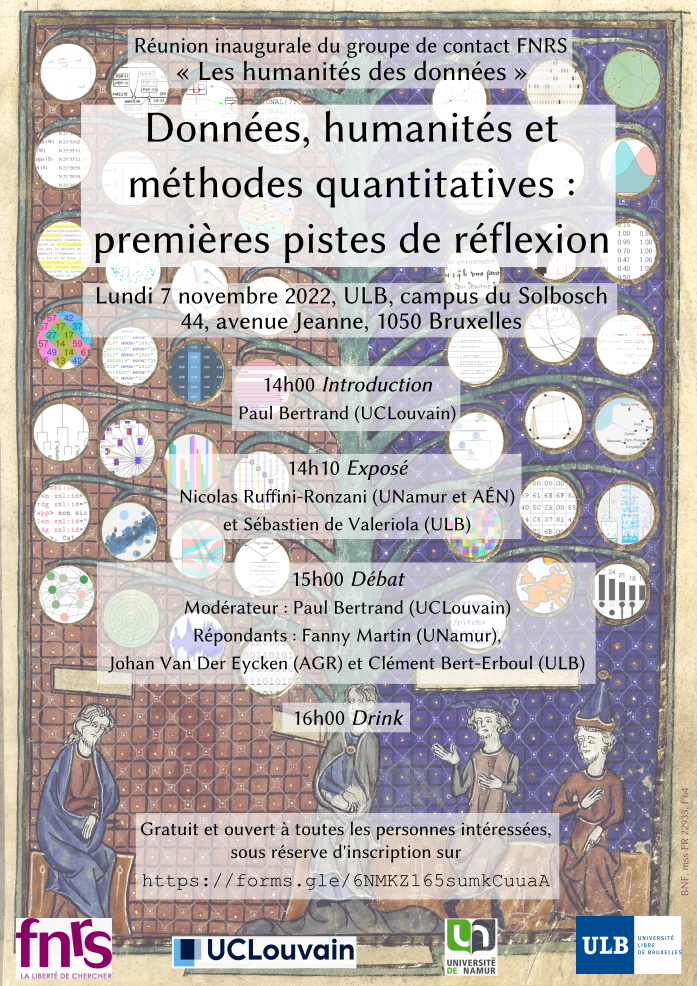
Journée d’étude – Données, humanités et méthodes quantitatives : premières pistes de réflexion

Réunion inaugurale du groupe de contact FNRS « Les humanités des données »

Lundi 7 novembre 2022, ULB, campus du Solbosch
44, avenue Jeanne, 1050 Bruxelles

Programme :

14h00 Introduction – Paul Bertrand (UCLouvain)

14h10 Exposé : Nicolas Ruffini-Ronzani (UNamur et AÉN) et Sébastien de Valeriola (ULB)

15h00 Débat
Modérateur : Paul Bertrand (UCLouvain)
Répondants : Fanny Martin (UNamur), Johan Van Der Eycken (AGR) et Clément Bert-Erboul (ULB)

16h00 Drink

Gratuit et ouvert à toutes les personnes intéressées, sous réserve d’inscription sur https://forms.gle/6NMKZ165sumkCuuaA

Publié dans Colloque | Laisser un commentaire

Publication – Kevin Bovier, « La Renaissance de Tacite. Commenter les Histoires et les Annales au XVIe siècle »

Au XVIe siècle, les humanistes commentèrent pour la première fois les Histoires et les Annales de l’historien romain Tacite. L’objectif de cette étude est de montrer les intérêts et les méthodes de travail de ces commentateurs, ainsi que les stratégies qu’ils développaient pour faciliter l’accès du lectorat au texte antique. Comment les commentaires étaient-ils élaborés ? Pour quel public ? Ces travaux érudits ont-ils permis à Tacite de gagner le statut d’auteur majeur à la fin du XVIe siècle ? En répondant à ces questions et à d’autres encore, l’auteur tente de redéfinir la place de Tacite dans le mouvement humaniste du XVIe siècle et d’offrir de nouvelles perspectives sur la transmission et la réception de ses œuvres à la Renaissance.

Kevin Bovier est docteur en langue et littérature latines de l’Université de Genève. Ses travaux portent sur la réception des auteurs antiques à la Renaissance et sur la littérature néo-latine. Il collabore actuellement au projet Humanistica Helvetica à l’Université de Fribourg.

Informations pratiques :

Kevin Bovier, La Renaissance de Tacite. Commenter les Histoires et les Annales au XVIe siècle, Bâle, Schwabe Verlag, 2022 ; 1 vol., 341 p. (Antiquity after Antiquity, 2). ISBN : 978-3-7965-4606-8. Prix : CHF : 64,00.

Source : Schwabe Verlag

Publié dans Publications | Laisser un commentaire

Colloque – Gender, Work and Service in Late Medieval Europe (1300–1600)

Considering how service was perceived, regulated and practiced in relation to gender, speakers take into account the diversity of late medieval forms of service and focus on a broad spectrum of lifelong or periodic service work. This includes domestic service, service work within workshops, brothels, religious communities and poorhouses or military and diplomatic services provided for cities. The conference brings together scholars from different countries, various disciplines and at all career stages to discuss, e.g., divisions of tasks and responsibilities, degrees of coercion and autonomy as well as the monetary and cultural value attached to different forms of service and groups of servants from a gendered perspective.

Programme :

Thursday, 29 September 2022

09.30–10.00h
Welcome and Introduction
Eva-Maria Cersovsky (University of Cologne) and Julia Exarchos (RWTH Aachen)

10.00–11.00h KEYNOTE
Jeremy Goldberg (University of York): “They Put Them Out, Both Males and Females, to Hard Service and in the Houses of Other People”: English Servanthood in Comparative Perspective
Chair: Karl Ubl (University of Cologne)

11.00–11.30h Coffee Break

SESSION 1: DOMESTIC SERVICE AND WORK IN URBAN AND RURAL CONTEXTS
Chair: Sabine von Heusinger (University of Cologne)

11.30–12.15h: Dorothee Rippmann (UZH Zürich): Gender, Work, and Visibility: The Examples of Agriculture and Textile Production (15th and 16th Centuries)

12.15–13.00h: Eyal Levinson (The Hebrew University of Jerusalem): “If there Is an Elderly Woman in the Home, there Is a Treasure in the Home”: Work, Old Age, and Conceptualizations of Gender Among Medieval Ashkenazi Jews

13.00–14.00h: Lunch Break

14.00–14.45h: Jacqueline Turek (RWTH Aachen): Gender-Specific Aspects of Domestic Service: Work, Wages, and Migration of Male and Female Servants in Late Medieval Southern Germany

SESSION 2: PROSTITUTION AND UNFREE LABOR
Chair: Julia Exarchos (RWTH Aachen)

14.45–15.30h: Jamie Page (Independent Scholar): Sex, Work, and Social Identity: Evidence from Late Medieval Europe

15.30–16.00h: Coffee Break

16.00–16.45h: Michael Hammer (University College of Teacher Education Styria): Prostitution in the Late Medieval “Frauenhaus” – Sex Work between Slavery and Protection?

16.45–17.30h: Angela Zhang (Harvard University): “She Keeps the House”: Enslaved Labor in the Racializing Processes of Late-Medieval Florence

17.45–18.45h KEYNOTE
Judith Bennett (University of Southern California): Poor Women and the Intimate Labor of Sex in Late Medieval England
Chair: Eva-Maria Cersovsky (University of Cologne)

Friday, 30 September 2022

SESSION 3: MILITARY AND DIPLOMATIC SERVICES
Chair: Julia Bruch (University of Cologne)

09.00–09.45h: Edward Loss (I Tatti, Harvard University Research Center): Far from the Exception: Female Couriers and Information Gatherers in Late Medieval Italy

09.45–10.30h: Markus Jansen (University of Cologne): Women of War. Urban Women and Martial Service in the Late Middle Ages

10.30–11.00h: Coffee Break

SESSION 4: SERVING AND WORKING IN RELIGIOUS COMMUNITIES
Chair: Lioba Geis (University of Cologne)

11.00–11.45h: Adrian Kammerer (University of Cologne): Male and Female Tertiaries as Workers at Dominican Convents: A Gendered Approach

11.45–12.30h: Emma Gabe (University of Toronto): Lay Sisters, Social Status, and Labor in Late Medieval Female Monasteries

12.30–13.30h: Lunch Break

SESSION 5: SERVING AND WORKING IN TEXTILE PRODUCTION
Chair: Milan Pajic (Free University of Berlin/ Université Catholique de Louvain)

13.30–14.15h: Marco Tomaszewski (University of Freiburg): Gender, Age, and Status in the Export-Production of Linen. A Multi-Relational Approach (St. Gallen, 15th/16th Century)

14.15–15.00h: Ivana Lemcool (University of Belgrade): Donors or Embroiderers: Late Medieval Serbian Noblewomen and their Votive Textiles

15.00–15.15h: Coffee Break

15.15–16.00h: Meagan Khoury (Stanford University): Silken Sensualities and Wayward Women: High and Low Cultural Labor in Early Modern Bologna

16.00h: Concluding Remarks

Informations pratiques :

29.09.2022 – 30.09.2022

a.r.t.e.s. Graduate School for the Humanities Cologne, Aachener Str. 217, Room 3.A06 (« Skyfall ») – Cologne

Participation is free, to register please send an email to Eva-Maria Cersovsky until 26 September 2022: cersovse@uni-koeln.de.

Organizer Eva-Maria Cersovsky (University of Cologne) / Dr. Julia Exarchos (RWTH Aachen)

Source : H-Soz-Kult

Publié dans Colloque | Laisser un commentaire

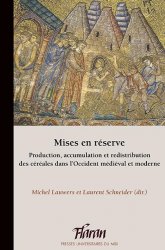
Publication – « Production, accumulation et redistribution des céréales dans l’Occident médiéval et moderne », dir. Michel Lauwers et Laurent Schneider

Dépôt saisonnier des fruits de la récolte, lié au cycle annuel de la consommation, ou formes de stockage plus durable, offrant la perspective d’un usage différé des produits de la terre : les dispositifs de mise en réserve des céréales, qui constituaient la base de l’alimentation dans les sociétés occidentales du passé ainsi qu’un important levier de mobilisation et de circulation des richesses, représentent une dimension essentielle des économies anciennes.

Les contributions d’historiens et d’archéologues, spécialistes des époques médiévale et moderne, qui sont réunies dans cet ouvrage, s’attachent à l’ensemble du processus de production, d’accumulation et de redistribution des grains dans lequel s’inscrivaient les pratiques de stockage. Il y est tout à la fois question des techniques de conservation des céréales et des structures de dépôt, silos, granges, greniers ou entrepôts, des politiques et des réseaux d’approvisionnement, ainsi que des institutions sociales liées à la mise en réserve des fruits du labeur humain. Cet ouvrage propose ainsi un premier panorama des problématiques et des connaissances relatives au stockage des céréales dans l’Occident médiéval et moderne.

Table des matières : ici

Informations pratiques :

Production, accumulation et redistribution des céréales dans l’Occident médiéval et moderne. 40es Journées internationales d’histoire de Flaran, 12-13 octobre 2018, dir. Michel Lauwers et Laurent Schneider, Toulouse, Presses universitaires du Midi, 2022 ; 1 vol., 336 p. ISBN : 978-2-8107-0790-4. Prix : € 26,00.

Source : Presses universitaires du Midi

Publié dans Publications | Laisser un commentaire

Appel à projet – Fonds Jean-Jacques Comhaire – Appel à projets 2022 – Soutien aux projets

Jusqu’au 17 11 2022 – Patrimoine et culture

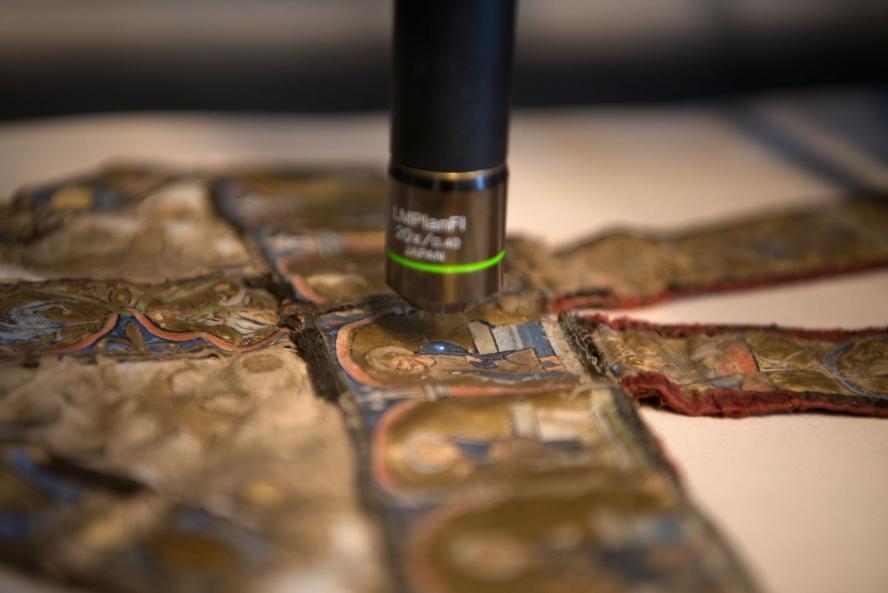
Soutien à la recherche en archéométrie, en utilisant des méthodes et des techniques scientifiques naturelles pour des études en archéologie et histoire (de l’art).

De quoi s’agit-il ?

L’appel à projets du Fonds Jean-Jacques Comhaire s’adresse aux chercheurs, aux universités et aux propriétaires/gestionnaires de témoins majeurs de notre passé. Il soutient l’utilisation de l’archéométrie dans les domaines de l’archéologie, de l’histoire de l’art et de l’architecture. L’étude aboutira à une publication (papier ou digitale) et/ou à un traitement de restauration.

Créé au sein de la Fondation Roi Baudouin en 2012, le Fonds Jean-Jacques Comhaire a pour but de « favoriser et de faciliter le recours aux méthodes d’investigation et de contrôle propres aux sciences exactes (physique, chimie, (micro)biologie, etc.) ou à l’informatique dans le but de mieux faire connaître le patrimoine, soit les recherches de nature archéométrique au sens large ».

L’étude des matériaux (support, pigment, etc.) d’éléments architecturaux, d’œuvres ou d’objets archéologiques permet grâce à une approche partant des sciences exactes, de renouveler et d’élargir le questionnement à propos d’un élément de notre patrimoine. Les sciences exactes et les sciences humaines apportent chacune leur spécificité pour mieux comprendre les témoins de notre passé.

Pour qui ?

L’appel s’adresse aux chercheurs, aux universités et aux propriétaires/gestionnaires de témoins majeurs de notre passé.

Comment introduire un dossier ?

  1. Assurez-vous que vous rentrez dans les conditions de cet appel à projets. Voir les critères de sélection
  2. Connectez-vous à votre compte via https://candidate.kbs-frb.be, ou créez-en un, si c’est la première fois.
  3. Complétez le dossier en ligne (en plusieurs fois, si vous le souhaitez).
  4. Envoyez votre dossier une fois celui-ci entièrement complété.
  5. Vous recevez une confirmation par mail, ainsi que votre dossier de candidature en pdf.

Source : Bibliothèque royale de Belgique

Publié dans Appel à projet | Laisser un commentaire

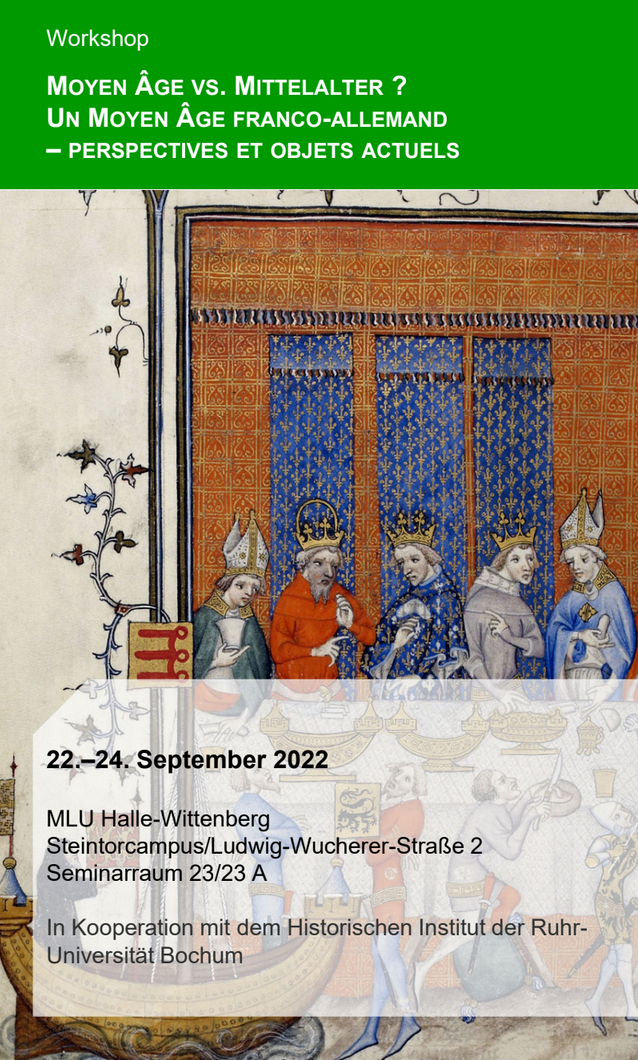
Colloque – Moyen Âge versus Mittelalter ? Un Moyen Âge franco-allemand

Notre atelier souhaite promouvoir la création d’un réseau entre médiévistes francophones et germanophones, stimuler l’échange entre jeunes chercheuses et chercheurs dans le domaine de l’histoire médiévale et initier de nouvelles coopérations.

Programme :

Jeudi 22 septembre 2022

  • 14:00-14.30 Georg Jostkleigrewe/Klaus Oschema: Accueil et introduction
  • 14.30-15:45 Anne Greule (Iéna): Prediger der Transformation. Alain von Lille und die Pariser Schulen in der zweiten Hälfte des 12. Jahrhunderts
  • 15:45-17:00 Maria-Elena Kammerlander (Paris): La fille du roy. Zur gesellschaftlichen Bedeutung der Universität in Paris

17:00-17:30  Pause

  • 17:30-18:45 Olivia Mayer (Klagenfurt): Gescheiterte Magieanklage. Familienstreit um die Grafschaft Artois

Vendredi 23 septembre 2022

  • 9:00-9:30 Philippe Depreux (Hambourg): Das Frühmittelalter im Spannungsfeld zwischen europäischer Identität und nationalen Traditionen
  • 9:30-10:45 Matthias Rozein (Liège), L’histoire des papes en français ? Médiévistique francophone et recher-ches sur les papes du haut Moyen Âge

10:45-11:15 Pause

  • 11:15-12:30 Sebastian Gensicke (Paris): Ein Netzwerk in Aktion? Die gemeinsamen Urkundenausstellungen der Bischöfe Samson von Reims, Joscelin von Soissons und Bartholomäus von Laon

12:30-14:00 Pause

  • 14:00-15:15 Amélie Sagasser (Paris): Judenprivilegien im Reich vs. Privilèges des juifs au Royaume de France (11. bis 13. Jahrhundert)

15:15-15:45 Pause

  • 15:45-17:00 Yannick Pouivet (Trêves): Häretische Netzwerke Okzitaniens um 1300. Das „katharische“ Beher-bergungssystem im Spiegel der Inquisition des Bernard Gui, Geoffroy d’Ablis und Jacques Fournier
  • 17:00-18:15 Philipp Stenzig (Düsseldorf): Unedierte Quellen zum Ende des Großen Abendländischen Schismas in den Ländern des Grafen von Armagnac

Samedi, 24 septembre 2022

  • 09:00-10:15 Katharina Schüppel (Bamberg), Mittelalterliche Madonnenskulpturen mit metallenen Oberflächen. Französische und deutsche Perspektiven auf einen geteilten Gegenstand

10:15-10:45 Pause

10:45-12:00

  • Hanna Schäfer (Trêves): Malaria in Regnum und Imperium? Ein Forschungsprojekt zu Verbreitung, Behandlung und Vorbeugung von Wechselfiebererkrankungen im mittelalterlichen West- und Südeuropa

Discussion/conclusion

Informations pratiques :

Seminarraum 23/23 A – Ludwig-Wucherer-Straße 2
Halle, Allemagne (06108)

22-24 septembre

Source : Calenda

Publié dans Colloque | Laisser un commentaire

Offre d’emploi – Assistant Professor, Early Global South Comparatist

Position overview

Position title: Assistant Professor

Application Window

Open date: September 8, 2022

Next review date: Wednesday, Nov 30, 2022 at 11:59pm (Pacific Time)
Apply by this date to ensure full consideration by the committee.

Final date: Wednesday, Nov 30, 2022 at 11:59pm (Pacific Time)
Applications will continue to be accepted until this date, but those received after the review date will only be considered if the position has not yet been filled.

Position description

The Department of Comparative Literature at the University of California, Los Angeles has been authorized to make an appointment to a full-time position at the rank of Assistant Professor (tenure-track), effective July 1, 2023. The Department seeks an Early Global South comparatist for the position. The ideal candidate will work in the early periods (ca. 1000 – 1600 C.E.) in a non-European field, in any of the following areas: Middle East, Asia, Africa, or the Americas. This includes indigenous thought in the precolonial/early colonial period. While the non-European field specialty should be primary, comparative work on non-European-to-European connections will be considered. Applicants should have a PhD in Comparative Literature or a related field in hand by the time of appointment (July 1, 2023). The candidate will show broad and sophisticated theoretical competence. We seek the potential for exceptional research, excellence in teaching (lower division to graduate), and value candidates whose experience in teaching, research, or community service has prepared them to contribute to our commitment to diversity and excellence. Women and underrepresented minorities are encouraged to apply.

Applicants should submit the materials listed below by November 30, 2022:

  • Letter of application
  • Current curriculum vitae
  • Evidence of teaching effectiveness
  • Sample course descriptions
  • Writing sample, no longer than 30 pages
  • Diversity statement
  • Three letters of recommendation
  • Authorization to Release Information Form

These materials must be submitted online: https://recruit.apo.ucla.edu/JPF07817.

All inquiries about the application process may be directed to Laura Enneian at: lenneian@humnet.ucla.edu. Please cite the reference number for this search in all correspondence: JPF07817.

UCLA offers an excellent package of benefits, including domestic partner benefits; it also has a number of programs to assist faculty in career development and the balance of work and family obligations.

The University of California is committed to creating and maintaining a community dedicated to the advancement, application, and transmission of knowledge and creative endeavors through academic excellence, where all individuals who participate in University programs and activities can work and learn together in a safe and secure environment, free of violence, harassment, bullying and other demeaning behavior, discrimination, exploitation, or intimidation. With this commitment as well as a commitment to addressing all forms of academic misconduct, UCLA conducts targeted employment reference checks for finalists to whom departments or other hiring units would like to extend formal offers of appointment into Academic Senate faculty positions. The targeted employment reference checks involve contacting the finalists’ current and prior places of employment to ask whether there have been substantiated findings of misconduct that would violate the University’s Faculty Code of Conduct. To implement this process, UCLA requires all applicants for Academic Senate faculty positions to complete, sign, and upload the form entitled “Authorization to Release Information” into RECRUIT as part of their application. If the applicant does not include the signed authorization to release information with the application materials, the application will be considered incomplete. As with any incomplete application, the application will not receive further consideration. Although all applicants for faculty recruitments must complete the entire application, only finalists (i.e. those to whom the department or other hiring unit would like to extend a formal offer) considered for Academic Senate faculty positions will be subject to targeted employment reference checks.

Qualifications

Basic qualifications(required at time of application)

Applicants should have a PhD in Comparative Literature or a related field in hand by the time of appointment (July 1, 2023).

Application Requirements

Document requirements

  • Cover Letter – Letter of application
  • Curriculum Vitae – Your most recently updated C.V.
  • Evidence of teaching effectiveness – This can include teaching evaluations, peer teaching observations, etc.
  • Sample Course Descriptions
  • Writing sample – No longer than 30 pages
  • Statement on Contributions to Equity, Diversity, and Inclusion – An EDI Statement describes a faculty candidate’s past, present, and future (planned) contributions to equity, diversity, and inclusion. To learn more about how UCLA thinks about contributions to equity, diversity, and inclusion, please review our Sample Guidance for Candidates and related EDI Statement FAQ document.
  • Reference check authorization release form – Complete and upload the reference check authorization release form

Reference requirements

  • 3 letters of reference required

Three letters of recommendation must be submitted at time of application.

Apply link:https://recruit.apo.ucla.edu/JPF07817

Help contact: lenneian@humnet.ucla.edu

Campus Information

As a condition of employment, you will be required to comply with the University of California SARS-CoV-2 (COVID-19) Vaccination Program Policy. All Covered Individuals under the policy must provide proof of Full Vaccination or, if applicable, submit a request for Exception (based on Medical Exemption, Disability, and/or Religious Objection) or Deferral (based on pregnancy) no later than the applicable deadline. New University of California employees must (a) provide proof of receiving at least one dose of a COVID-19 Vaccine no later than 14 calendar days after their first date of employment and provide proof of Full Vaccination no later than eight weeks after their first date of employment; or (b) if applicable, submit a request for Exception or Deferral no later than 14 calendar days after their first date of employment. (Capitalized terms in this paragraph are defined in the policy.) Federal, state, or local public health directives may impose additional requirements.

The University of California is an Equal Opportunity/Affirmative Action Employer. All qualified applicants will receive consideration for employment without regard to race, color, religion, sex, sexual orientation, gender identity, national origin, disability, age or protected veteran status. For the complete University of California nondiscrimination and affirmative action policy, see: UC Nondiscrimination & Affirmative Action Policy.

Job location

Los Angeles, CA

Source : UCLA

Publié dans Offre d'emploi | Laisser un commentaire