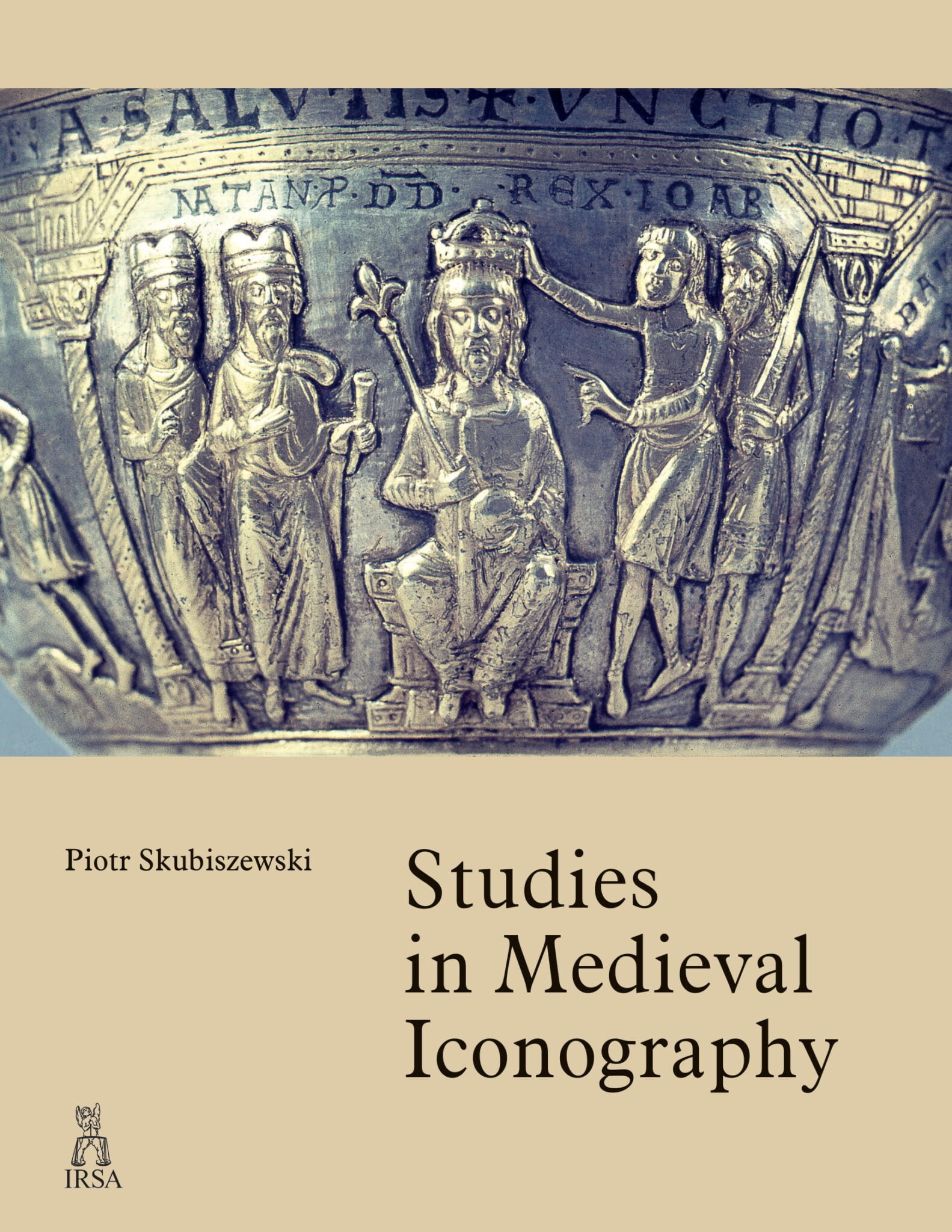
The present volume brings together a collection of fourteen articles, written in French, German and English, originally published between 1962 and 2011, devoted to different ways in which ecclesiastical teaching shaped the art of medieval Latin Europe, a theme that has preoccupied the author for his entire scholarly career. His main area of interest have been works of art (in particular liturgical vessels and manuscripts) with unique iconographies unprecedented in the history of art.
Since their initial publication, various issues addressed in the papers have benefitted from new art historical research. The author has attempted to provide a selection from the now vast, pertinent literature in the updated references to individual papers included in the present volume.
The papers having been revamped, the book now boasts an entirely new set of over 500 illustrations, mostly in colour, which additionally boost the – already classic – scholarship of Piotr Skubiszewski.
Piotr Skubiszewski (born in 1931) studied art history at the University of Poznań where he was awarded a doctorate in 1958. He was a lecturer at the University of Poznań from 1953 to 1963, professor at Warsaw University from 1967 to 2001 and at Poitiers University from 1981 to 1999, visiting professor at Uppsala University in 1967 and at Kansas University in 1975. He has also lectured at a number of European, American and Canadian universities and in Israel. He is the author of some 270 articles and books mostly on late Gothic sculpture, early medieval art in Latin Europe, early medieval and Romanesque minor arts and illuminated manuscripts, medieval iconography and methodology of art history. He is a member of the Polish Academy of Sciences and of a number of other European academic societies.
Table des matières :
Preface
Introduction
Über die „Grenzen“ in der Frühmittelalterforschung. Der „Becher“ von Włocławek
L’intellectuel et l’artiste face à l’oeuvre à l’époque romane
Maiestas Domini et liturgie
La place de la Descente aux Enfers dans les cycles christologiques du Moyen Âge
Ecclesia, Christianitas, Regnum et Sacerdotium dans l’art des Xe et XIe siècles. Idées et structures des images
Le trumeau et le linteau de Moissac :un cas de symbolisme médiéval
Une Annonciation à deux anges à Issoire
La Croix et les griffons. À propos d’un tympan roman de Wiślica
Deux consoles chartraines : Le maître d’oeuvre et son « patron » devant le Jugement Dernier
Un manuscrit peint de la Vita Radegundis conservé à Poitiers. Les idées hagiographiques de Venance Fortunat et la spiritualité monastique du XIe siècle
Une Vita sancti Martini illustrée de Tours. Tours, Bibliothèque Municipale, ms. 1018
Die Bildprogramme der romanischen Kelche und Patenen
The Iconography of a Romanesque Chalice from Trzemeszno
La patène de Kalisz. Contribution à l’étude du symbolisme typologique dans l’iconographie
Informations pratiques :
Piotr Skubiszewski, Studies in Medieval Iconography. Collected Essays 1962–2011, Cracovie, RISA, 2021. 221 × 286 mm, laminated hardback 768 pages, 516 illus. including 321 colour illus. ISBN 978-83-89831-41-5.
Si l’histoire des grandes abbayes cisterciennes est bien connue, il n’en va pas de même pour des abbayes de moindre dimension, comme celles qui se sont implantées dans le diocèse de Verdun : Lachalade, Châtillon-en-Woëvre et Lisle (par la suite transférée du Verdunois au Barrois). Mais tel était le cas de bien d’autres monastères cisterciens que l’histoire des grandes abbayes de l’ordre (Cîteaux, Morimond, Clairvaux, Trois-Fontaines etc.) a souvent éclipsé. L’étude de ces petites abbayes permet ainsi d’apporter une contribution à l’histoire locale, révélant des chartes jusqu’alors inédites, complétant ipso facto des corpus d’actes épiscopaux, comtaux etc., permettant aussi de mieux appréhender des lignages locaux et de nombreux aspects de la vie régionale.
Arrière-petite-fille de Morimond, abbaye modeste, au sud de la forêt d’Argonne, aux confins de la Champagne et de la Lorraine, en même temps que des diocèses de Verdun, Toul et Châlons, Lisle-en-Barrois s’est développée dans une relative tranquillité. Bien insérée dans son environnement immédiat, elle n’avait comme possessions lointaines que des maisons à Verdun et Metz, pour à la fois y écouler ses productions et servir d’étape sur la route du sel.
Au terme d’un patient travail, cet ouvrage vient éclairer l’histoire originelle de l’abbaye et livre un recueil de chartes inédites, couvrant les abbatiats jusque 1226, concourant ainsi à la connaissance générale du Moyen Âge et à celle des cisterciens en Lorraine.
Docteur en histoire médiévale, Jean-Pol Evrard a centré ses recherches sur Verdun et son diocèse au Moyen âge, et en particulier ses aspects diplomatiques. Contributeur aux projets « Originaux 2 » (actes lorrains entre 1121 et 1220) et « Charcis » (chartes cisterciennes du XIIe siècle), il poursuit entre autres les dossiers des actes des évêque de Verdun (en le conduisant jusque 1224, dans le cadre du programme Actépi), et du cartulaire de l’abbaye Saint-Paul.
L’abbaye de Lisle-en-Barrois : ses origines et son histoire (1143-1226) Naissance et développement d’une abbaye (1143-1226) Le transfert de site Les abbés de Lisle-en-Barrois Le temps des conflits Les lignages locaux Un regard sur les actes Conclusion
Les actes pour l’abbaye de Lisle-en-Barrois (de 1143 à 1226)
Annexes Répertoire biographique Répertoire tomographique Index rerum Liste des actes pour Lisle-en-Barrois Liste des actes pour Lisle-en-Barrois non inclus dans le Cartulaire Table des graphiques et des cartes Talbe des illustrations
Informations pratiques :
L’abbaye deLisle-en-Barrois. Origines, histoire et chartes (1143-1226), éd. Jean-Pol Évrard, Turnhout, Brepols, 2022 (Atelier de recherche sur les textes médiévaux, 30). 398 p., 28 b/w ill., 4 b/w tables, 156 x 234 mm, 2021 ISBN: 978-2-503-59380-7. Prix : 95 euros.
Entre réel et imaginaire : les animaux dans l’histoire, l’art et la littérature à l’époque bourguignonne (XIVe-XVIe siècles), dans Publications du Centre Européen d’Etudes Bourguignonnes 61 (2021). 369 p., 150 x 230 mm. ISBN: 978-2-8399-3385-8. Prix : 72 euros.
Table des matières :
François Duceppe-Lamarre, Une cohabitation ordonné avec l’animal sauvage sous Philippe le Hardi ? Le cas de la résidence ducale d’Hesdin entre 1399 et 1404
Victorien Leman, Maîtriser la Création. Animaux et discours politique dans les résidences des ducs de Bourgogne à la fin du Moyen Âge
Alain Marchandisse et Bertrand Schnerb, Belle et ses amis. Le lévrier à la cour de Bourgogne sous Philippe le Bon
Julien Sohier, Les chiens en milieu urbain, dans « l’espace belge », entre le xiiie et le xvie siècle
Paul Delsalle, Le cheval, un acteur de l’économie du comté de Bourgogne et de la cité impériale de Besançon au xvie siècle
Gabriel Redon, La présence de l’aigle impériale dans les sources littéraires italiennes du xive siècle
Jean-Christophe Blanchard, Réalité animale et fantasmes princiers. L’exemple de la cour ducale lorraine (1473-1559)
Anne Dubois, De suppôt de Satan à gardien du foyer domestique : l’iconographie du chat dans les Pays-Bas bourguignons
Valérie Toureille, Duels dérisoires. Chevaliers et escargots dans les marginalia. Enjeux d’interprétation (1250-1350)
Audrey Ségard, Quand les prisonniers invitent les animaux à venir leur tenir compagnie ! Les graffiti animaliers sur les murs des prisons de la fin du Moyen Âge (xive-xvie siècles)
Dominique Delgrange, Décor héraldique pour la clôture du palais de « la Salle de Lille » (1525). Une figure héraldique : le lion ou le griffon tenant une bannière aux armes
Christophe Bosteels, Le thème animalier dans la tapisserie d’Enghien du xvie siècle
Louis-Donat Casterman, Le dragon d’Adrien de Croÿ, une devise en écho à une victoire militaire sur les Turcs (1532) ?
Danielle Quéruel, De la table à la scène : les oiseaux dans les entremets bourguignons
Youssef Ngadi, Les animaux dans le récit de voyage de Bertrandon de la Broquière
Maria Colombo Timelli, Animaux réels, animaux imaginaires dans le Dialogue des creatures (fin xve siècle) : entre nomenclature et iconographie
Henri Simonneau, L’utilisation de la figure animale dans la propagande bourguignonne au xve siècle
Pierre Couhault, La Faune des songes des animaux dans la poésie de Nicaise Ladam
Claire Sicard, Ce que la bête nous dit de l’homme. L’exemple des figures équines dans Le Secret d’Amours de Michel d’Amboise (1542) et Le Tuteur d’Amour de Gilles d’Aurigny (1546)
Pierre-Henry Bas, Le cheval et l’animal dans les livres de combat germaniques et italiens (xive-xvie siècles). Entre réel et symbolique
Alain Servantie, La découverte des animaux d’Amérique
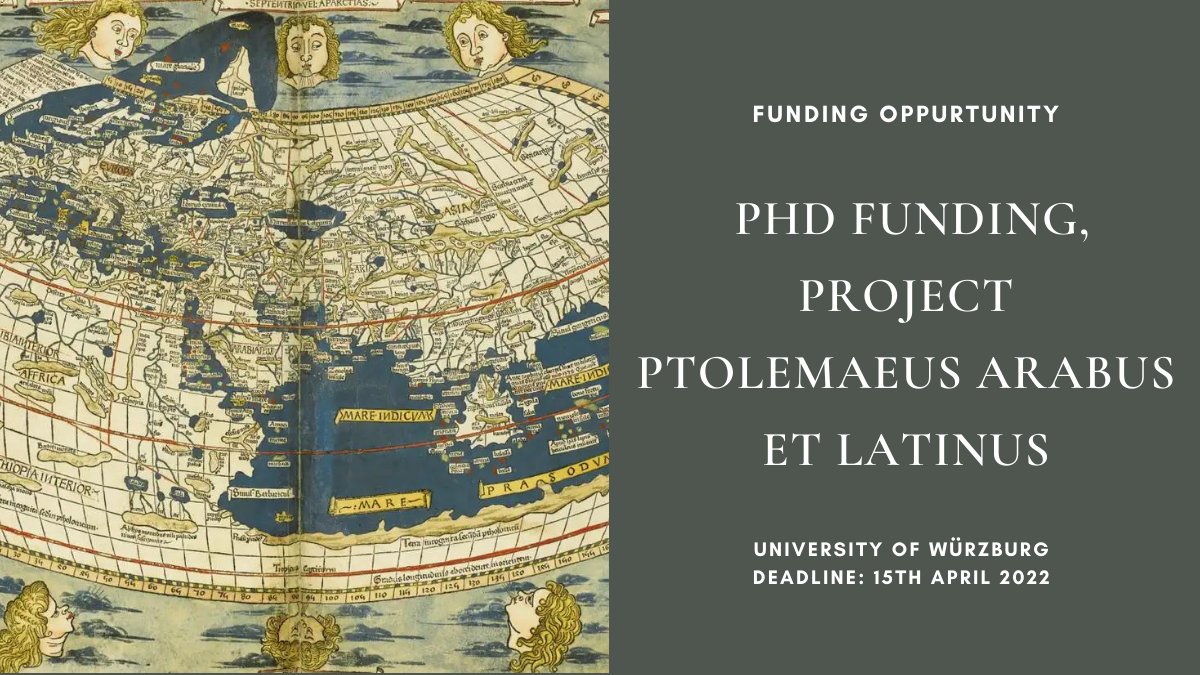
One three-year PhD student position for a Latinist, an Arabist, or a historian of medieval or early modern science
The Project Ptolemaeus Arabus et Latinus (PAL) is dedicated to the edition and study of the Arabic and Latin versions of Ptolemy’s astronomical and astrological texts and related material. These include works by Ptolemy or attributed to him, commentaries thereupon and other works that are of immediate relevance to understanding Ptolemy’s heritage in the Middle Ages and the early modern period up to 1700 A.D.
The Project is hosted by the Bavarian Academy of Sciences and Humanities in Munich for a period of 25 years from 2013 to 2037. It is supervised by Prof. Dr. Dag Nikolaus Hasse (University of Würzburg) and carried out by five scholars, namely two research leaders, Dr. David Juste and Dr. Benno van Dalen, two post-doctoral researchers and one doctoral student.
We welcome applications for the doctoral student position: – One 3-year position expected to commence on 1 October 2022 or as soon as possible thereafter. – The monthly allowance is € 2648 (German pay scale 65% TV-L E13), liable to deductions for tax, social security benefits and retirement provisions. – The contract will be with the University of Würzburg and Professor Hasse will normally serve as the main supervisor or as a co-supervisor. There is also provision for the student to spend a period of time at our partner institute, the Warburg Institute (University of London), under the supervision of Professor Charles Burnett. The doctoral student is otherwise expected to work in Munich, together with the research team, or in Würzburg. Proposals for collaboration with other institutions and professors are welcome, and the main supervisor may be from a different university.
– Qualifications and skills: applicants must hold a Master or an equivalent degree in an area relevant to the Project, have an excellent knowledge of Latin and/or Arabic and a good command of English (the primary language of publication of the Project). Applicants should also have research interests in line with PAL objectives, in particular in the history of medieval or early modern science, in the making of critical editions of Arabic or Latin texts, and/or in handling manuscripts. The doctoral dissertation can be written in English (preferred) or German. – The doctoral student will be able to spend most of his/her working time on his/her dissertation, whose topic will be in line with PAL objectives and will normally include the edition of an Arabic or Latin text (or both). The contract carries with it no teaching or administrative duties, but the doctoral student is expected to devote part of his/her time to other aspects of the Project.
– The doctoral student will be given the opportunity to publish his/her doctoral dissertation in the PAL book series (Brepols) and, where relevant, on the PAL web interface, and he/she should agree to publish his/her dissertation in priority through those media. All contributions by the doctoral student will be published under his/her own name and authorship will be duly acknowledged in every collaborative output, including online publications. – Applications should be sent in English or German to Prof. Dr. Dag Nikolaus Hasse by email (applications@ptolemaeus.badw.de) no later than 15 April 2022. Applications should include a complete CV (with a list of publications where applicable); an outline (1-3 pages) of the proposed research project; and two letters of recommendation by academic referees. The letters of recommendation must be sent directly by the referees,either by email or by post (Prof. Dr. Dag Nikolaus Hasse, Institut für Philosophie, Julius- Maximilians-Universität Würzburg, Residenz – Südflügel, 97070 Würzburg, Germany).
Receipt of all applications will be acknowledged. The outcome of all applications will be notified by email as soon as a decision is made. Short-listed applicants will be invited to an on-campus or online interview.
Information on the Project, including the Project Outline, can be found on our website (http://ptolemaeus.badw.de).
For further enquiries and consultation on possible projects, please contact Dag Nikolaus Hasse, David Juste or Benno van Dalen at info@ptolemaeus.badw.de.
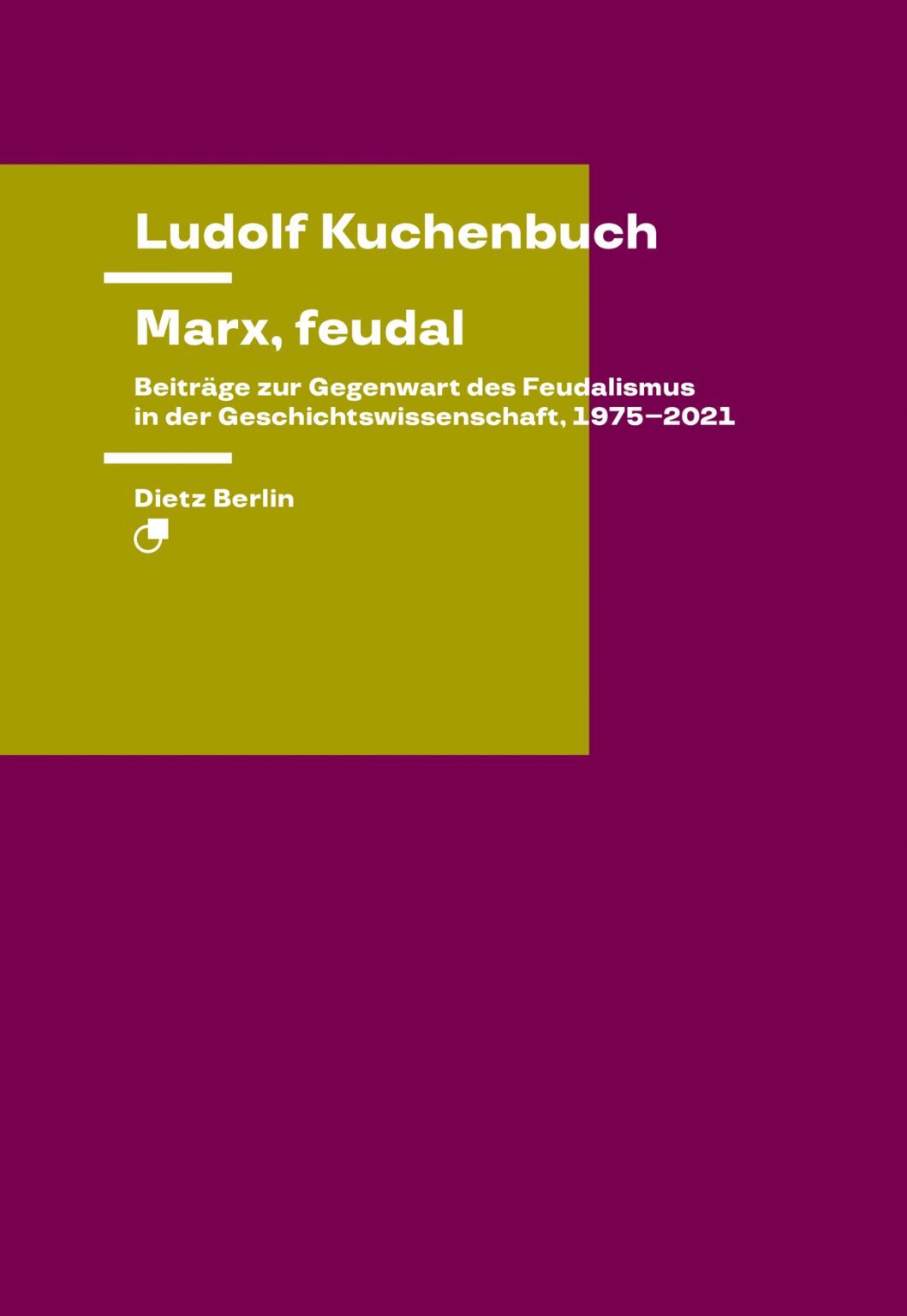
Kaum ein Historiker kennt sich mit Marx’ Theorie und dem Feudalismus gleichermaßen aus wie Ludolf Kuchenbuch. Er setzt Marx’ Forschungsmaximen mittels kritischer Quellenforschung um, reflektiert Begrifflichkeiten, sucht methodisch neue Wege.
Das vorliegende Buch macht einen kleinen, aber alles andere als unwesentlichen Teil der Arbeiten von Ludolf Kuchenbuch zugänglich – Arbeiten, die seine Forschung zu Marx und zum Feudalismus miteinander verbinden.
Der Sammelband soll ein Gespräch eröffnen, ein Gespräch zwischen an Marx Interessierten, für die »Mediävistik« ein Fremdwort ist und denjenigen, die mit dem »Feudalismus« als eurozentrischem Epochensignum eher fremdeln.
Ludolf Kuchenbuch war bis zu seiner Habilitation wissenschaftlicher Assistent an der TU Berlin, ging 1984 als Konservator an das Bayerische Nationalmuseum in München und nahm 1985 einen Ruf als Professor für Ältere Geschichte an die Fernuniversität Hagen an, wo er bis zu seiner Emeritierung 2004 tätig war. Alain Guerreau, der ein Geleitwort beigetragen hat, war Forschungsdirektor am CNRS, dem Nationalen Zentrum für wissenschaftliche Forschung in Paris und ist seit 2011 korrespondierendes Mitglieder der Zentraldirektion der Monumenta Germaniae Historica (MGH) in München.
Table des matières :
Inhalt
Geleitwort von Alain Guerreau Vorwort von Ingo Stützle
Die Kompilation »Marx, feudal« von Ludolf Kuchenbuch
A Historiografie – Einflussfelder und Verlaufslinien
Vom ideologischen Gegensatz zum konzeptionellen Kaleidoskop: Die Feudalismus-Diskussionen, ausgehend von Deutschland, von den 1950er Jahren bis zur Wende 1989 (2007/2009)
»Es ist an uns, es zu sagen!« Feudalismus-Forschungen seit der Mitte der 1980er-Jahre bis heute im Überblick (2012/2021)
Zur Entwicklung des Feudalismuskonzepts im Werk von Karl Marx (1983/2012)
Marc Bloch und Karl Marx? Annäherungen an eine fragliche Beziehung (1999)
Marxens Werkentwicklung und die Mittelalterforschung (1997)
B Theoriearbeit – Konstrukte und Entwürfe
Zur Struktur und Dynamik der »feudalen« Produktionsweise im vorindustriellen Europa (mit Bernd Michael) (1977)
Bäuerliche Ökonomie und feudale Produktionsweise. Ein Beitrag zur »Welt-System«-Debatte aus mediävistischer Sicht (1982)
Zur Periodisierung des europäischen Feudalismus. Überlegungen und Fragen (mit Bernd Michael) (1978)
Alteuropäischer Feudalismus als soziales System – ein Schema (1984)
Feudalismus. Versuch über die Gebrauchsstrategien eines wissenspolitischen Reizworts (2002)
C Forschung heute – Hypothesen und Exempel
Das Epochenprofil des christlich-feudalen Okzidents (2004)
Das Huhn und der Feudalismus (2003)
»An die Erdscholle gewachsen«? Die Metamorphose der Knechtschaft im nördlichen Elsass vom 8. zum 10. Jahrhundert (2021)
Denar-Druck im Okzident 700 bis 1050. Ein Beitrag zur historischen Anthropologie des Geldes (2019)
Anhang
Informations pratiques :
Ludolf Kuchenbuch, Marx, feudal. Beiträge zur Gegenwart des Feudalismus in der Geschichts-wissenschaft, 1975-2021, Berlin, Dietz, 2022. 439 p. ISBN: 978-3-320-02390-4. Prix : 29,90 euros.
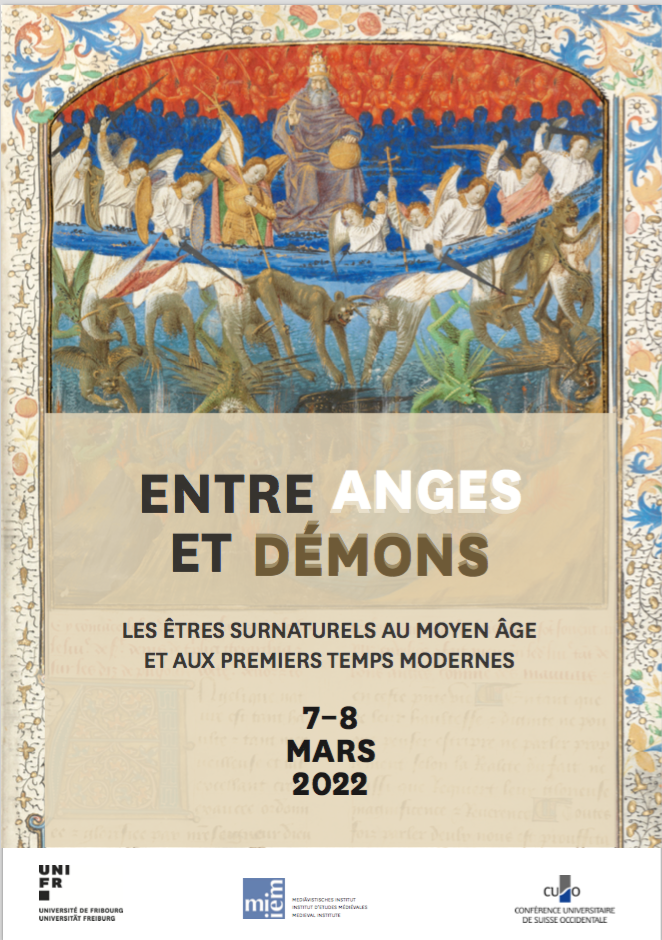
Les traditionnelles journées d’étude organisées par les jeunes chercheurs médiévistes de l’Université de Genève, adopteront une formule bilingue et seront consacrées aux êtres spirituels (anges, démons et esprits) qui occupent une place prépondérante dans l’art et la culture de l’Europe médiévale. De jeunes chercheuses et jeunes chercheurs issus de disciplines médiévales aborderont ces figures sous différentes perspectives dans seize contributions.
Programme :
Lundi 7 mars
9h00 Accueil des participant·e·s
9h15 Introduction par le comité d’organisation
Session 1 : Substances
Présidée par la prof. Tiziana Suarez-Nani (Université de Fribourg)
9h30 Alexander Eniline (Université Genève) Anges de la Bible et Intelligences séparées des philosophes : incompatibilité, convergence ou superposition ?
10h15 Valentin Braekman (Université de Fribourg) Suárez et l’obstination des démons
11h00 Pause-café
11h15 Clarisse Reynard (Université de Genève) De l’homme à l’ange. Perspectives croisées : la connaissance intellectuelle vue par Thomas d’Aquin et Grégoire de Rimini
12h00 Angèle Tence (Université Paris 1 Panthéon-Sorbonne) Quand l’ange devient diable. Formes visuelles et enjeux de la métamorphose des anges rebelles lors de leur chute en enfer (XVe – XVIe siècle)
12h45 Déjeuner
Session 2 : Au-Delà du Christianisme
Présidée par la prof. Yasmina Foehr-Janssens (Université de Genève)
14h15 Samia Touati (EPHE, Paris) Du rire et des pleurs des anges et des démons en islam selon les hadîths
15h00 Anna Lidor-Osprian (Historisches Seminar der Ruprecht-Karls-Universität, Heidelberg) Todesangst und „gezähmter Tod“– Der Engel des Todes in hebräischen Quellen im mittelalterlichen Aschkenas
15h45 Pause-café
16h00 Julieta Gonzàlez-Springer (Université de Wrocław, Pologne) La représentation des anges et du diable dans les textes de la Psalmodia Christiana de Fray Bernardino de Sahagún et ses liens avec la mythologie nahua. Textes pour être chantés
16h45 Luis Schäfer (LMU, München) Systematische Verteufelungen? Höllische Gegenspieler*innen in Heinrichs von Neustadt Apollonius von Tyrland
18h15–19h45 Conférence de la prof. Elisabeth Pinto- Mathieu (Université d’Angers) Ruses diaboliques et anges salvateurs dans la Vie des Pères (XIIIe siècle)
Mardi 8 mars
Session 3 : Procès et magie
Présidée par la prof. Laurence Terrier Aliferis (Université de Neuchâtel)
9h00 Michel-Lucien Belliart (Université de Lille) L’ennemi hagiographique numéro un : le diable dans les Vies de saints anglo-saxons (Xe – XIIe siècles)
9h45 Ignazio Alessi (Université de Fribourg) Anges et Démons dans les « procès simulés » médiévaux
10h30 Pause-café
10h45 Laura Glöckler (Université de Fribourg) Hexenprozesse als Sinnbild frühneuzeitlicher Vorstellungswelten
11h30 Hélène Colleu (POLEN-Cesfima / Université d’Orléans) Entre supplication et injonction : la magie destinative dans un manuscrit du XVe siècle
12h15 Déjeuner
Session 4 : Entités et humanité
Présidée par la prof. Marion Uhlig (Université de Fribourg)
13h30 Delphine Rabier (Université de Tours) Anges et démons dans la peinture des anciens Pays-Bas (XVe siècle)
14h15 Barbara Müller (Université de Zürich) Du Sage Clerc volant sur une pierre ou comment dresser votre démon
15h00 Pause-café
15h15 Pia Schüler (Universität Potsdam) Nicht von materien, forme bann. Engel und Dämonen zwischen theologischer Gelehrsamkeit und dichterischer Formung in der Spruchdichtung Heinrichs von Mügeln
16h00 Nolwenn Kerbastard (Centre d’histoire des sociétés médiévales et modernes, Paris) Anges et démons dans les réécritures hagiographiques en français (XIIIe – XVe siècles)
16h45 Conclusion du colloque
Informations pratiques :
COMITÉ D’ORGANISATION / ORGANISATIONSKOMITEE
David Moos (Université de Fribourg) (coordination) Pauline Quarroz (Université de Fribourg) (coordination) Aurélie Blanc (Université de Fribourg) Valentin Braekman (Université de Fribourg) Nina Fahr (Université de Fribourg) Adeline Favre (Université de Fribourg) Clara Künzler (Université de Fribourg) Sandy Maillard (Université de Neuchâtel) Lauria Sager (Université de Fribourg)
COMITÉ SCIENTIFIQUE / WISSENSCHAFTLICHES KOMITEE
Prof. Nicolas Bock (Université de Lausanne) Laura Acosta (Université de Lausanne et Université de Neuchâtel) Aminöel Meylan (Université de Genève) Mirko Pinieri (Université de Genève) Olivier Silberstein (Université de Neuchâtel)
LIEU / ORT : en présentiel à l’Université de Fribourg, Av. de l’Europe 20, 1700 Fribourg Lundi 7 mars, journée : MIS 03 3027 Lundi 7 mars, conférence du soir : MIS 03 3115 Mardi 8 mars, matin : MIS 03 3016 Mardi 8 mars, après-midi : MIS 03 3027
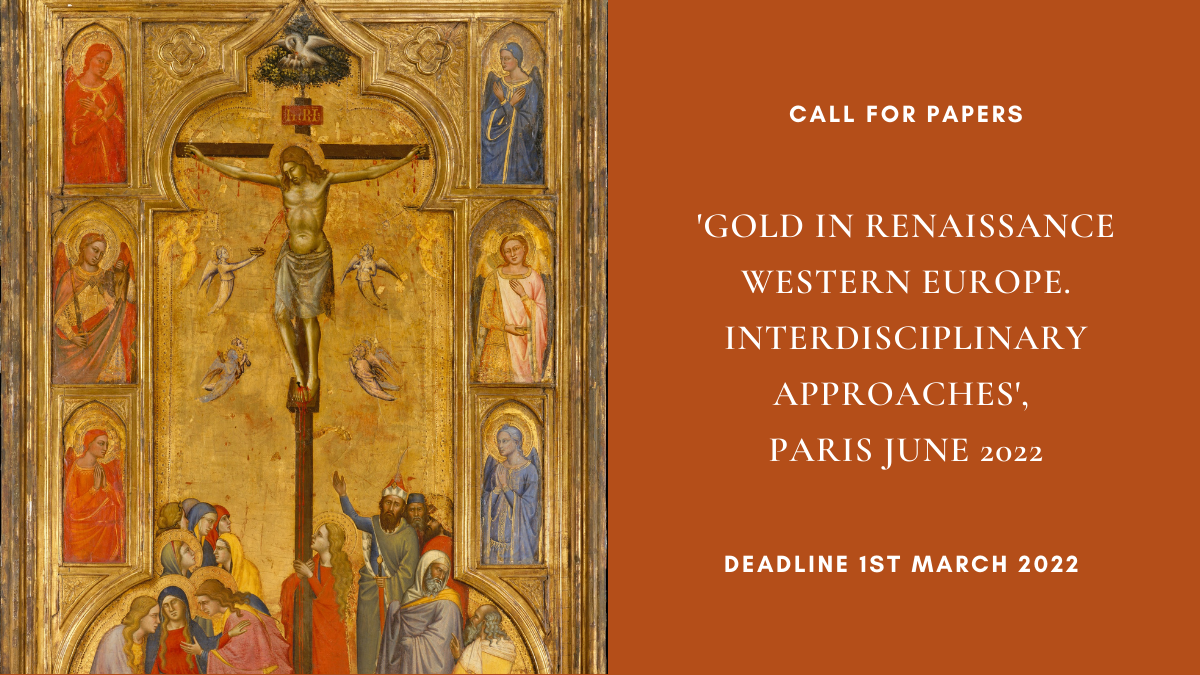
In his influential book on painting and visual culture in fifteenth-century Italy (Painting and Experience in Fifteenth-Century Italy, 1972), Michael Baxandall described the abandonment of gold in painting practices as a sensitive phenomenon both in contracts between painters and patrons, and in the writings of some authoritative art theorists. He linked this attitude to a more general movement on a European scale, consisting of the decline of some practices of display, for example the fashion for clothes embellished with precious materials such as gold. He also suggested a correlation between with the shortage of gold in fifteenth-century Europe or the growing interest in the painter’s maestria at the expense of the preciousness of the materials. Although gold backgrounds gradually disappeared from Western European painting – mainly during the fifteenth century – and art theorists condemned the use of this material, gold was not completely abandoned in practice, as shown by certain artworks produced by painters as innovative as Rembrandt and Vermeer in the middle of the seventeenth century. Nevertheless, the question of the subsequent use of gold has not been a major focus of early modern art historians, who have instead sought to refine Baxandall’s vision by examining the disappearance of gold backgrounds in the fifteenth century in the two main artistic areas of the time : the Low Countries and the Italian Peninsula.
Fifty years after Baxandall’s work, this symposium aims to investigate, in an interdisciplinary way, the place of gold in Western European societies during the Renaissance. As a material, gold has played an important role in the cultural and economic history of Europe and the world, in the history of science, and also in the historiography of the ‘material turn’ in art, as shown by several transchronological syntheses published in recent years [Venable 2011; Zorach & Phillips 2016]. Museums have not been left out of this renewed interest in the various uses and meanings of gold: one need only think of the exhibition that the Mucem organised in 2018 [Bouiller 2018], or the numerous physico-chemical analyses carried out on ancient artworks in research laboratories in France (e.g. C2RMF) and abroad, particularly in London (at the National Gallery). On the basis of these recent achievements, we will focus on a limited area (Western Europe), albeit one connected to the rest of the world, and a given time (especially the period from 1450 to 1520).
The aim of the conference is therefore to explore: -The economic history of gold and what the heritage science can say about it. Which deposits of the metal were exploited at that time? What is the current state of knowledge of monetary history in Western Europe at the end of the fifteenth century ? How can we characterise the origin of the gold in a work of art? -The social history of gold. Can we speak of a symbolism linked to this material at that time? What are the myths associated with it (the alchemical quest, Eldorado, etc.)? What place does gold have in sumptuary legislation? -The taste for gold (e.g. in treasures, domestic interiors, sacred spaces, etc.) and the position of civic and ecclesiastical authorities with regard to this precious metal. -Learned and practical knowledge : metallurgy, alchemical practices, humanist thinking. -The craftsmen who worked with gold (e.g. goldsmiths, gold beaters, gilders) and their regulations. -Its artistic uses (goldsmithing, sculpture, illumination, engraving, tapestry, painting, etc.). -The techniques for using this material as they can be reconstituted today by the physical and chemical sciences, as well as the techniques for restoring the gilding of a few artworks from this period, including the Isenheim Altarpiece (around 1515), which is currently undergoing restoration in Colmar (Musée Unterlinden).
We are inviting papers in all relevant disciplines.
Organising Committee – Prof. Christine ANDRAUD (Professor of Physics (Optics), CRC/CNRS/MNHN) – Dr. Valentina HRISTOVA (Post-doctoral Fellow in Early Modern Art History, Fondation des Sciences du Patrimoine and HAR, University Paris Nanterre) – Dr. Anne-Solenn LE HO (Research Engineer in Physical Chemistry, C2RMF/CNRS) – Dr. Romain THOMAS (Lecturer in Early Modern Art History, HAR, University Paris Nanterre)
Les chaires de professeur.e junior constituent une nouvelle voie de recrutement pour vous permettre d’accéder à un emploi de la fonction publique dans le corps des Professeurs d’Université. Après une période de pré-titularisation de 3 à 6 ans et à l’issue d’une évaluation, vous avez ainsi vocation à être titularisé.e à Université Côte d’Azur en tant que Professeur.e des Universités après avis d’une commission de titularisation.
L’obtention d’une chaire en Intelligence Artificielle (IA) appliquée aux champs de l’Archéologie et de l’Histoire permettra de consolider le positionnement national et international du site Université Côte d’Azur en Archéologie, Histoire et Histoire des images, dans un domaine interdisciplinaire en pleine expansion, très concurrentiel, à forte valeur heuristique et sans équivalent à l’échelle nationale.
Le projet dessine pour Université Côte d’Azur un cadre général et fédérateur, ambitieux et structurant, dont l’objectif est d’encourager et de potentialiser les recherches interdisciplinaires émergentes menées à Université Côte d’Azur, combinant IA et sciences mathématiques autour des données archéologiques et historiques, et d’en susciter de nouvelles en rapport avec les domaines d’expertise traditionnelle des unités du périmètre d’Université Côte d’Azur. La diversité des besoins et des visées des chercheurs déjà engagés sur cette voie au sein du site est un premier défi qui met au cœur de sa genèse le désir de construire une dynamique commune croisant des enjeux transdisciplinaires entre les sciences informatiques (en particulier l’IA), les sciences mathématiques, et mobilisant des jeux de données, des méthodologies et des questions de recherche impliquant des données archéologiques et historiques relevant des sciences physiques et chimiques, des sciences de la vie, des sciences de la terre ainsi que des sciences humaines et sociales. Le ou la Professeur.e Junior pourra bénéficier de collaborations avec plusieurs unités d’Université Côte d’Azur : I3S ; LJAD ; LEAT ; CEMEF ; LOV ; IPMC ; le centre Inria Méditerranée. Il sera par ailleurs adossé à l’institut 3IA.
Établissement/organisme porteur :
Nom du chef d’établissement/d’organisme : Jeanick BRISSWALTER Site concerné : Université Côte d’Azur Région académique : Région Sud Provence Côte d’Azur
Établissements/organismes partenaires : CNRS (INEE, INS2I, INSMI, INSIS, INSB), Inria Nom du projet : IA, Archéologie & Histoire ID GALAXIE : 91 Mots-clés : Archéologie, Histoire, Intelligence Artificielle, Mathématiques appliquées Durée visée : 4 ans
Date de prise de fonction : 1er septembre 2022 Thématique scientifique : Intelligence artificielle, Archéologie & Histoire
Section (s) CNU/CoNRS/CSS correspondante (s) : CoNRS sections 31, 32, 51, 52 ; CNU sections 20, 21, 26, 27
Intégration du projet de chaire dans la stratégie du laboratoire d’accueil
Une véritable ambition holistique se dessine pour l’archéologie et l’histoire dans l’essor de méthodologies renouvelées pour la caractérisation des objets, le traitement de données quantitatives autorisant un profond renouvellement conceptuel. Pour le CEPAM, le projet répond à un enjeu de maintien d’une recherche de haut niveau en Archéologie et Histoire par le développement de méthodologies innovantes. Il répond à un enjeu de positionnement thématique à l’échelle nationale et internationale dans un contexte de forte compétitivité. Le CEPAM entend ainsi asseoir sa spécificité interdisciplinaire en affichant une thématique en plein essor et à forte valeur heuristique, rendant le laboratoire plus attractif pour les chercheurs et plus robuste pour porter des projets internationaux. Par ce positionnement à l’interface de plusieurs champs disciplinaires, le CEPAM renforcera ses collaborations existantes, en étendra le spectre et participera à la structuration d’une recherche interdisciplinaire entre les partenaires académiques à l’échelle d’Université Côte d’Azur. Pour les laboratoires partenaires du projet, il s’agira d’afficher de nouvelles thématiques et collaborations interdisciplinaires au sein d’Université Côte d’Azur, et d’élargir le périmètre du 3IA vers des domaines où le potentiel est en plein essor.
Profil scientifique
En lien avec les thématiques traditionnelles du CEPAM, l’objectif de cette chaire est d’élever le potentiel interprétatif des données archéologiques et historiques et de favoriser l’émergence de nouveaux questionnements par une démarche méthodologique renouvelée
déployant des méthodologies IA. Il s’agira notamment de permettre un changement d’échelle (du qualitatif au quantitatif), d’améliorer la résolution des identifications des objets archéologiques (culture matérielle, archives biologiques) et historiques (textes, images), des pratiques et des systèmes, à différentes échelles spatio-temporelles, depuis la Préhistoire jusqu’au Moyen-Age.
Les questions de recherche pourront relever du champ de la Préhistoire, de la bioarchéologie (archives botaniques, fauniques, biomoléculaires), des paléoenvironnements, de l’Histoire des images, de l’Histoire ou de la philologie.
Les méthodologies envisagées sont diversifiées: réseaux de neurones, géométrie algorithmique, annotation sémantique, data mining, SMA.
Compétences attendues :
Maitrise des méthodologies IA et/ou Mathématiques appliqués
Avoir une expérience dans le domaine de l’Archéologie ou de l’Histoire
Dynamisme, Autonomie / Capacité à diriger des programmes de recherche
Capacité à diffuser les résultats auprès de la communauté scientifique et du grand public
Profil d’enseignement Un enjeu fort du projet porte sur le développement de la formation, depuis la licence jusqu’au doctorat, donnant davantage de lisibilité à Université Côte d’Azur dans les domaines de l’Archéologie, de l’Histoire, pour lesquels ses compétences sont déjà reconnues mais qu’il convient de déployer afin de se singulariser par le biais d’enseignements en IA transdisciplinaires. Le ou la professeur.e Junior dispensera des enseignements au sein des portails de Licence Sciences de l’Homme et de la Société, Sciences et Technologie, Sciences de la Vie et des écoles universitaires de recherche ODYSSEE, DS4H, SPECTRUM.
Compétences attendues :
Capacité à dispenser des enseignements interdisciplinaires
Capacités à encadrer des étudiants (master, doctorat, post-doctorat) relevant de champs disciplinaires variés
Capacité à organiser des séminaires
Diffusion scientifique Les résultats des recherches devront faire l’objet de publications dans des revues à forte audience de communications en colloques internationaux et auprès du grand public.
Science ouverte Plusieurs structures opérationnelles viendront en appui pour le stockage et l’accessibilité des données. Les données primaires et BDD générées seront hébergées par le CEPAM, la Maison de la Modélisation, de la Simulation et de leurs Interactions (MSI) d’UCA, et HumaNum INSHS. Elles seront accessibles en ligne via les interfaces des plateformes BBEES (UMS INEE), OMERO (UCA) et HumaNum. Toutes les publications et communications seront déposées dans HAL.
Science et société
Participation à la fête annuelle de la Science et aux journées annuelles de l’archéologie : stand de présentation avec jeux virtuels issus des développements IA ; mise en ligne régulière de vidéos de vulgarisation via la page YouTube du CEPAM ; communications grand public dans le cadre des associations de diffusion de la culture scientifique.
Indicateurs de suivi du déploiement du projet et méthodologie de leur suivi
Un comité de suivi du projet composé de 3 personnalités extérieures à Université Côte d’Azur membres d’Université Côte d’Azur sera mis en place. Il examinera 3 fois par an : La capacité à dynamiser la thématique au sein du CEPAM
La capacité à établir un réseau de collaboration à l’échelle d’Université Côte d’Azur, à l’échelle nationale et internationale
La mise en place de formations à destination des étudiants depuis la licence jusqu’au master
La qualité des publications L’encadrement de stagiaires de master, de thèses, post-docs La réponse à des Appels à projets (notamment Europe) Les actions de diffusion de la culture scientifique L’accessibilité des données dans une démarche de science ouverte
Montant du financement associé
La personne recrutée aura à sa disposition un financement de l’Agence Nationale de la Recherche (ANR) d’un montant de 200 000 €, dont au moins 120 000 € en ressources humaines (contrat doctoral ou post-doctoral). Elle bénéficiera également d’un environnement financier supplémentaire alloué par le CNRS.
Modalités de candidatures
Aucune condition d’âge, ni de nationalité n’est imposée pour candidater.
Peuvent postuler : les titulaires d’un doctorat ou diplôme équivalent ou les candidates et candidats justifiant de titres et travaux scientifiques jugés équivalents. Ne peuvent pas postuler les titulaires du site Université Côte d’Azur.
Les profils juniors présentant un potentiel d’encadrement et d’animation de la recherche ou justifiant d’au moins 6 années d’expérience de la recherche sont encouragées.
Description du processus de recrutement
La recevabilité administrative des dossiers sera effectuée par les services de la DRH et seuls les dossiers des candidats et candidates éligibles seront transmis à la commission de sélection. Cette commission sera en charge d’étudier les dossiers et d’établir la liste des candidats et candidates retenu.e.s pour une audition.
Chaque candidature retenue sera auditionnée par la commission de sélection.
L’audition sera organisée sur une temporalité d’une heure, dont 30 minutes de présentation du candidat ou de la candidate sur son parcours scientifique, pédagogique et ses motivations, ainsi que sur ses projets de recherche et d’enseignement, et 30 minutes d’échanges avec le jury.
À l’issue des auditions, la commission se prononce en fonction des mérites des candidats et candidates, en prenant notamment en compte la qualité et l’originalité des projets de recherche et d’enseignement présentés, leur motivation, leur vision prospective et leur capacité d’encadrement scientifique et pédagogique.
Mise en situation professionnelle
La capacité du/de la candidat.e à dispenser des enseignements à destination d’un public de non spécialistes sera évaluée dans le cadre d’un cours d’introduction de niveau master (10 minutes).
Localisation du poste
Structure : CEPAM (Unité Mixte de Recherche UMR7264 Université Côte d’Azur – CNRS) Campus : Saint Jean d’Angely Adresse : 24 avenue des Diables Bleus, 06300 Nice
Postdoctoral researcher Laura Cayrol-Bernardo organizes this spring a digital seminar series on « Gender and Ageing in Premodern Europe ». The first lecture will be held on February 17.
Link to Zoom will be sent to registered e-mail a day in advance.
Programme :
17 February Ninon Dubourg (Université de Liège) Religious Experiences of Older Women during the Late Middle Ages – How elderly women were involved in Christian practices and conventual life.
31 March Professor Jón Viðar Sigurðsson (University of Oslo) «Old Age and Ageing in Medieval Iceland»
28 April Dr. Lynn A. Botelho (Indiana University of Pennsylvania) «Medically Male: Old Women in Early Modern Medicine»
26 May Camille Brouzes (Université Grenoble Alpes) «Obscene Old Age: Senescence and Sexuality in Late Medieval French Poetry»
16 June Mireia Comas-Via (Universitat de Barcelona) «Waiting for the End: The Old Age of Sança Ximenis de Foix (c.1397-1474)»
Avec le soutien du FNRS, du CRHiDI (UCLouvain – Saint-Louis, Bruxelles), d'INCAL (UCLouvain), de PraME (UNamur), de sociAMM (ULB) et de Transitions (ULiège)








Vous devez être connecté pour poster un commentaire.