16/07/2021 Colloque international Organisateurs: Luciana Furbetta (Univ. Trieste) e Fabio Romanini (Univ. Ferrara)
Centrée sur la question débattue de la fin du latin parlé et de l’essor des langues romanes, la rencontre entend engager un dialogue entre les domaines linguistiques et littéraires, philologiques et historiques à partir des pistes de recherches proposées par la nouvelle édition avec traduction italienne, révision du texte et nouveaux chapitres du volume de Michel Banniard : Viva voce. Communication écrite et communication orale du IVe au IXe siècle en Occident latin. Il s’agira de réfléchir en particulier sur les « frontières » entre latin et langues romanes, la métamorphose de la langue écrite/orale dans un cadre chronologique assez fluide à saisir comme les IVe-IXe siècles, les contextes de communication, l’analyse de l’intercompréhension et leur relevance dans la genèse culturelle de l’Europe.
Partenaires : École française de Rome ; Laboratoire de théologie catholique et de sciences religieuses UR 4377, Université de Strasbourg (Équipe de recherche sur le christianisme ancien et médiéval) ; Association Textes pour l’histoire de l’Antiquité tardive ; Dipartimento di Studi Umanistici – Università degli studi di Trieste.
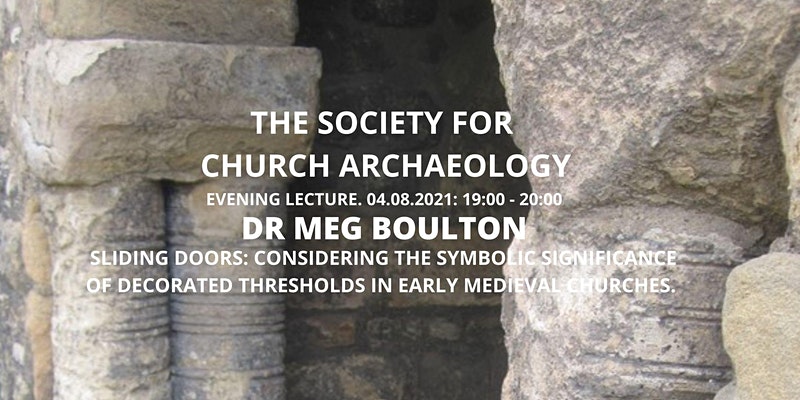
The Society for Church Archaeology is delighted to welcome Dr Meg Boulton who will deliver an online lecture on the topic of ‘Sliding Doors: Considering the symbolic significance of decorated thresholds in Early Medieval Churches’.
Dr Meg Boulton studied Fine Art as an Undergraduate, and completed her doctorate in Art History in 2013. Since then she has taught at various Institutions, including the Department of Continuing Education at Oxford, the University of Leeds and the V & A. Research interests include: Sculpture, space, theories of viewing and reader reception/s. She has special interests in theory and in a transhistorical practice of the History of Art.
The lecture will be hosted through Zoom and will take place on Wednesday 4th August 2021 from 19:00 to 20:00.
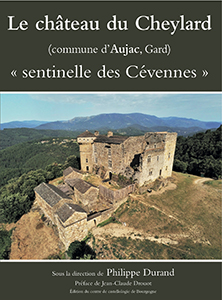
Sur son éperon culminant à 600 m d’altitude, le château du Cheylard domine et contrôle depuis 1211 la vallée de la Cèze. Sous l’impulsion de ses propriétaires passionnés, Marlène et Gilbert Léautier, les vestiges des XIIIe-XVIIe siècles ont été patiemment restaurés, sans rien perdre de leur authenticité.
Philippe Durand a réuni une vaste équipe pluridisciplinaire, regroupant des chercheurs venus d’horizons plus ou moins lointains, pour étudier les pierres et les hommes. Ce livre, fruit d’une aventure humaine, éclaire l’histoire des Cévennes et apporte un nouveau fleuron à la connaissance castellologique.
Informations pratiques :
Le château du Cheylard (commune d’Aujac, Gard), « sentinelle des Cévennes », sous la direction de Philippe Durand, Dijon, CECAB, 2021. 484 p. – 790 illustrations !- 29 €. ISBN : 979-10-95034-19-3.
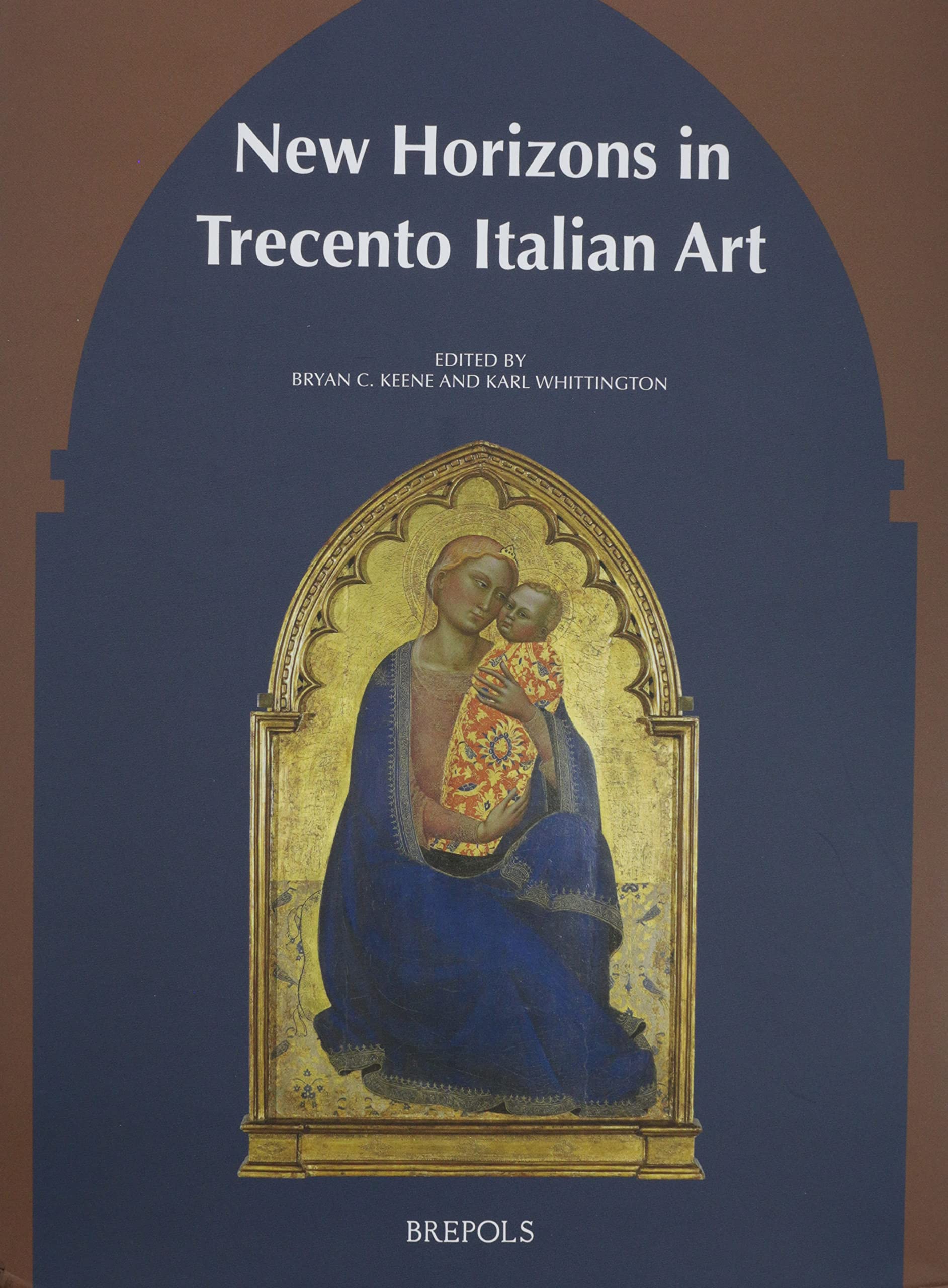
The fourteenth century in Italy, the age of Giotto, Dante, and Boccaccio, widely known as the trecento, was a pivotal moment in art history and in European culture. The studies in this volume present new approaches to art in this important but often neglected period of the late Middle Ages and early Renaissance. Scholars at various stages in their careers discuss a wide range of topics including architecture, cultural exchange, materiality, politics, patronage, and devotion, contributing to a new understanding of how art was made and experienced in this nodal century. These papers were originally presented at the Andrew Ladis Trecento Conference held at the Museum of Fine Arts in Houston in November of 2018.
Bryan C. Keene is associate curator of manuscripts at The J. Paul Getty Museum, and editor of Toward a Global Middle Ages: Encountering the World through Illuminated Manuscripts (Getty Publications, 2019) and contributing author to Florence at the Dawn of the Renaissance: Painting and Illumination, 1300-1350 (Getty Publications, 2013). Karl Whittington is associate professor of history of art at The Ohio State University, and the author of Body Worlds: Opicinus de Canistris and the Medieval Cartographic Imagination, published by the Pontifical Institute in Toronto in 2014.
Table des matières :
Some Reflections — Judith Steinhoff
Introduction — Bryan C. Keene and Karl Whittington
I. Matter and Material
Stone, Paint, Flesh: Fictive Porphyry Exteriors in a Group of Multipart Panel Paintings from Angevin Naples — Sarah K. Kozlowski
The Altar as Stage: Visual and Material Conditions of the Dramatized Nativity — Patricia Simons
Jacopo, Niccolò, and Paintings in Books for Santa Maria degli Angeli — George R. Bent
II. Narrative and Response
Painted Wood Caskets for Saints in Trecento Venice — Ana Munk
The Reliquary of the Column of the Flagellation: A Case for Narrative Reliquaries — Claire Jensen
Fragmented Narrative in the Chapter House of San Francesco in Pistoia — Laura Leeker
Seeing and Sensing Compassion: Giotto’s Naturalism in the Arena Chapel and Pietro d’Abano’s Theory of Sympathetic Response — Theresa Flanigan
III. Prototypes: Local and Global
Locating the Duomo of Milan in the European Trecento — Erik Gustafson
The Ilkhanid-Italian Relationship during the Trecento: Medieval Persian Prototypes for Brunelleschi’s Dome in Florence — Lorenzo Vigotti
IV. Art and Identity
A Tribute to Dante: The Giottesque Portrait in the Palazzo del Podestà in Florence — Sonia Chiodo
Visual Representation of Women’s Legal Duties in Medieval Siena — Elena Brizio
V. Time and Knowledge
Towards a New Reading of the Fifteenth-Century Astrological Cycle at the Palazzo della Ragione in Padua — Anna Majeski
Giotto and Time — Luca Palozzi
Diagramming Triumph in Trecento Painting: Augustine and Thomas from Page to Wall — Karl Whittington
VI. Local Sanctities
Art of an Emblematic King: Robert I of Naples as King of Jerusalem in the Fourteenth Century — Cathleen A. Fleck
The Lignum Crucis and the Veneration of the Cross in the contado of Siena: Unmasking Some Neglected Images in the Cathedral of Massa Marittima — Sandra Cardarelli
The Bodies and Blood of Christ and the Virgin at Santa Maria Novella, Florence — Amber McAlister
VII. The Trecento in the Present
Rising from the Rubble of World War II: The High Altarpiece of Impruneta — Cathleen Hoeniger
Engaging with the Trecento — Caroline Campbell
Afterword — William Underwood Eiland
Informations pratiques :
New Horizons in Trecento Italian Art, éd. Bryan C. Keene et Karl Whittington, Turnhout, Brepols, 2021 (Trecento Forum, 2). 320 p., 200 colour ill., 216 x 280 mm, 2020 ISBN: 978-2-503-58618-2. Prix : 115 euros.
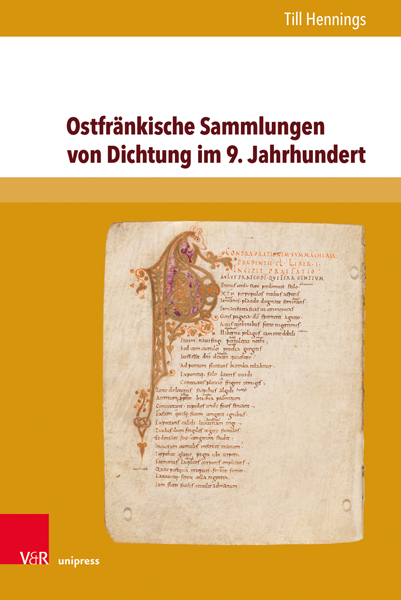
Till Hennings untersucht anhand der überlieferten Handschriften die Sammlung von Dichtung im Ostfrankenreich des 9. Jahrhunderts. Dabei werden die Verbindungen zwischen Institutionen und Personen im kulturellen Netzwerk der karolingischen renovatio offengelegt. Für zahlreiche Handschriften wird erstmals eine kodikologische Untersuchung nach modernen Gesichtspunkten vorgenommen. Diese Analyse der Nutzung der Handschriften ergibt eine Neusituierung der Dichtung bezüglich ihrer Multifunktionalität innerhalb der vielfältigen institutionell-pragmatischen Kontexte. Insbesondere das Verhältnis von Schule und Dichtung wird konkretisiert und gezeigt, dass Dichtung nicht nur Schullektüre und Handschriften mit Dichtung nicht nur Schulbücher waren. Die strukturelle Ordnung des Bandes nach Skriptorien ist ferner ein Beitrag zur Bildungsgeschichte der einzelnen Schreiborte.
The topic of this volume is the Collection of Poetry in 9th century East Francia on the basis of the surviving manuscripts. It gives a fresh look on the connections between institutions and persons in the network of the Carolingian ‘renovatio’. Many manuscripts have been analysed here according to modern codicological standards for the first time. The analysis of the use of the manuscripts has resulted in a new appraisal of poetry in the institutional and pragmatic contexts of the time. The topic of the educational use of poetry has been greatly expanded in this context. The arrangent of the study in terms of single scriptoria has also presents a educational history of these institutions.
Dr. Till Hennings ist Mediävist mit den Schwerpunkten Kodikologie und Diplomatik. Er ist wissenschaftlicher Mitarbeiter am Exzellenzcluster »Understanding Written Artefacts« der Universität Hamburg.
Informations pratiques :
Till Hennings, Ostfränkische Sammlungenvon Dichtung im 9. Jahrhundert, Göttingen, Vandenhoeck und Ruprecht, 2021 (Nova Mediaevalia, 19). 439 p. ISBN: 978-3-8471-1231-0. Prix : 60 euros.
La Vita de saint Didier, évêque de Cahors au VIIe siècle, rédigée peut-être à la fin de ce siècle et remaniée par la suite avec adjonction d’une série de miracles post mortem, est connue par deux manuscrits principaux, le ms. lat. 17002 de la Bibliothèque nationale de France qui date du début du XIe siècle et le ms. 136 de la Bibliothèque royale de Copenhague, du XIVe ou XVe siècle. Nous en présentons ici, après celles de René Poupardin en 1900 et de Bruno Krusch en 1902, une nouvelle édition critique. Cette nouvelle édition est accompagnée de sa première traduction française qui permettra au plus grand nombre d’accéder à un texte qui se démarque de la plupart des vies des saints évêques du haut Moyen Âge par son enracinement historique exceptionnel.
Issu de la plus haute aristocratie de la Gaule méridionale, Didier est formé au Palais des rois mérovingiens. Protégé des rois Clotaire II et Dagobert Ier dont il est le trésorier, son accession à l’évêché de Cahors est un parfait exemple du fonctionnement des institutions politico-religieuses du royaume mérovingien. Installé à Cahors dans des circonstances difficiles, Didier n’est pas seulement un évêque modèle par sa piété, la valeur de son enseignement, son attachement au culte divin et son amour des pauvres. Il est aussi un aristocrate, un grand propriétaire terrien, gestionnaire d’immenses biens qui sont soigneusement énumérés dans la Vita et dont il fait don à son Eglise.
Cette richesse sert sa vocation particulière, celle d’un grand bâtisseur qui a transformé et enrichi, dans la tradition romaine, les monuments civils et religieux de sa ville de Cahors. La description de ces travaux, unique en son genre, est un des plus précieux apports de ce texte.Une Vita d’un style vivant qui s’adresse aussi bien aux hagiographes et aux historiens qu’aux linguistes et aux archéologues.
Cet ouvrage est issu d’un atelier de traduction de textes médiévaux du Centre d’études supérieures de Civilisation médiévale de Poitiers. L’introduction, l’édition et la reprise de la traduction ont été mises en œuvre par Elisabeth Carpentier, Georges Pon et Keith Bate.
Elisabeth Carpentier, professeure honoraire, et Georges Pon, maître de conférences honoraire d’histoire médiévale à l’Université de Poitiers, collaborent depuis plusieurs années pour éditer et traduire des sources narratives et hagiographiques médiévales.
Keith Bate, spécialiste de l’édition des textes médiolatins, a enseigné le latin l’université de Reading et fut associé aux universités de Poitiers et de Rennes.
Table des matières :
Avant-propos de Cécile Treffort, professeure à l’Université de Poitiers
Introduction
I. Le texte manuscrit 1. Les manuscrits 2. Corrections, lacunes, additions 3. Capitulation
II. L’auteur, ses méthodes et la date de rédaction du texte 1. Date de rédaction et langue de la Vita 2. La date de rédaction des Miracula 3. L’auteur, ses sources, ses methodes
III. La Vita sancti Desiderii 1. La formation d’un saint au Palais 2. L’accession de Didier à l’épiscopat 3. La construction de la cite chrétienne 4. La mort de Didier et la naissance de son culte
IV. L’intérêt historique de la Vita sancti Desiderii 1. L’état, la cité et l’évêque 2. L’évêque et la société 3. La richesse d’un grand propriétaire 4. L’évêque et la vie religieuse dans le diocèse de Cahors 5. La « fièvre bâtisseuse » de Didier
Conclusion
V. Principes d’édition Édition, traduction et notes
Informations pratiques :
La vie de saint Didier, évêque de Cahors (630-655). Introduction, édition, traduction et notes, éd. et trad. Élisabeth Carpentier, Georges Pon et Keith Bate, Turnhout, Brepols, 2021 (Hagiologia, 16). 280 p., 4 colour ill., 156 x 234 mm. ISBN: 978-2-503-59145-2. Prix : 85 euros.
Date et lieu: 18- 22 Octobre 2021, Université de Gand Organisateur: H. Pirenne Institute for Medieval Studies (Ghent) with Center for Medieval Studies (Fordham), Centre for Medieval Literature (Odense and York) and Centre for Medieval Studies (York)
The move in Medieval Studies away from nationalising and Eurocentric paradigms toward the ‘Global Middle Ages’ raises pressing and fascinating intellectual questions about scales of knowledge. How do we negotiate these scales as we move between the micro and the macro? What are the appropriate macro scales, geographical and chronological, for studying the period defined for ‘Europe’ as ‘The Middle Ages’? These same questions of scale were also challenging a millennium ago, especially in the years around 1100, in the wake of the 1st Crusade, which transformed Latin Europe’s relationship with the Afro-Eurasian space.
Taking the 12th-century Liber Floridus, a manuscript created at a specific time and place, as its touchstone, this Autumn School will address the challenge of scales of knowledge in times of rapid geopolitical change. The Liber Floridus is an intensely richly illustrated encyclopedia, produced by Lambert, a canon in the Flemish city of St Omer, working in the early decades of the twelfth century.
This Autumn School is organized for PhD- and MA-students in Medieval Studies. It will be organized in a blended way, allowing distance participation for both tutors and students and for the whole programme to move online if necessary.
Venue: Ghent University Library, Rozier 9, 9000 GHENT, BELGIUM (for all Ph.D. students)
Center for Medieval Studies (Fordham University), 441 E. Fordham Rd., FMH 405B, Bronx, NY 10458, U.S.A. (only for Ph.D. students affiliated with Fordham University)
This Autumn School is organized for PhD- and MA-students in Medieval Studies. It will be organized in a blended way, allowing distance participation for both tutors and students and for the whole programme to move online if necessary. Instructions for registration.
The time schedule is given in CET (Brussels, Paris, Madrid). Morning sessions will be live and pre-recorded; afternoon sessions will be live and streamed, allowing interaction between students online and on campus. For information about practicalities and timetable at Fordham please contact medievals@fordham.edu and todonnell12@fordham.edu.
At Ghent, lunches and coffee breaks are provided by the organizers. Dinners are not included. There is an extra charge for attending the conference dinner.
Participants will be invited to prepare the sessions. Online material will be made available in due time.
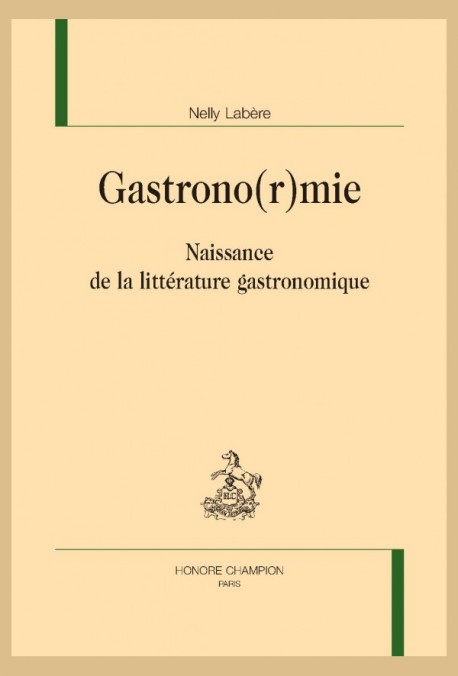
Cet essai est une hypothèse. Celle de la naissance d’une gastrono(r)mie. Elle part d’un constat : à partir du XIIIe siècle, les livres de cuisine et les livres de fiction « explosent » (B. Laurioux). À l’inverse, les fictions se passionnent pour l’alimentation. Il s’agit dans cet essai de comprendre comment, par la littérarisation des livres de cuisine et par la technique culinaire des textes de fiction, se constitue progressivement un nouveau genre : la littérature gastronomique. Personnage, destinataire et prescriptrice, la femme est au centre de son dispositif textuel. C’est elle qui fournit l’argumentaire descriptif, normatif ou satirique de cette nouvelle littérature de bouche qui interroge, par la chair, la chère. Entre ordre et désordre, gula et luxuria, elle offre aux auteurs une nouvelle voix pour explorer les possibles textuels et définir l’essence de cette littérature gastronomique : le goût des mets et des mots.
Nelly Labère est maître de conférences habilitée à diriger des recherches à l’Université Bordeaux Montaigne et membre de l’Institut Universitaire de France. Ses travaux portent sur les formes du discours au Moyen Âge. Elle est l’auteur, aux éditions Honoré Champion, de Défricher le jeune plant. Étude du genre de la nouvelle au Moyen Âge (2006) et a dirigé le collectif Obscène Moyen Âge ? (2015).
Nelly Labère, Gatrono(r)mie. Naissance de la littérature gastronomique, Paris, Honoré Champion, 2021 (Bibliothèque du XVe siècle, 88). 392 p., 15 x 22 cm. ISBN : 9782745355379. Prix : 48 euros.
The format of the conference will be much as it is in person. There will be substantial papers lasting 40-45 minutes with a significant question time allotted to each paper. After each question time, the session will remain open for delegates to stay and talk informally with one another before the next session starts. The zoom meeting will run continuously for the whole of each day. There will also be a poster session and any postgraduate students who wish to give a poster should email the address below. In order to book your place, please register via the email address: battlewebsite@gmail.com You will then be sent the details of the zoom meeting which we would be most grateful if you would not circulate. Only those applying via the conference email will receive a zoom link, and the use of an existing invitation by another person won’t be permitted. But do encourage those who you know will be interested to contact me directly for the zoom link. When you join the zoom meeting, you will need to be joining us with the recognisable name by which you booked your place, otherwise you won’t be admitted to the session. If you do not yet have a zoom account, please join by following this link: https://zoom.us/freesignup/ This year there will be no charge for joining the Battle conference. The Allen Brown Committee, which has oversight of the conference, has made the decision that the Allen Brown Memorial Trust will cover the cost of the zoom account and the administrative burden of organising and putting on the conference. We hope that by offering the conference free of charge, the Anglo-Norman community across the world will feel able to join with us in celebrating the wealth of talent that we have lined up for this year’s conference. The Trust is an educational charity with the objective of supporting the study of the Anglo-Norman past, broadly defined. If you felt that you wished to support our endeavours with a financial contribution, please contact me. If you wish to give a sum which will ensure that a lecture is given annually in your name, then please do talk to me about it. You may wish to note that the 2022 conference will take place (pandemic allowing) in Bonn between 21 and 26 July. More details will follow soon.
Programme :
Friday 23 July
1.30 Welcome and opening remarks by the conference director.
1.40 The Allen Brown Memorial Lecture Professor Lindy Grant, ‘”Avalterre’ and “Affinitas Lotharingorum”: Mapping cultural production, cultural connection and political fragmentation in the ‘Grand Est’ in the High Middle Ages’ Chair: Prof. Liesbeth van Houts
2.30 Formal question time
3.00 Informal discussion time. Delegates are invited to remain to talk informally with one another before the next session starts.
3.30 Prof. Chelsea Shields-Más, ‘The sheriffs of Edward the Confessor’ Chair: Dr Chris Lewis
4.15 Formal discussion time
4.45 Informal discussion time. Delegates are invited to remain to talk informally with one another before the next session starts.
5.15 Poster Session. As in previous years, we plan to hold a poster session. This year, we will open a number of rooms, in each one will be the person offering their poster. You’ll have 15 minutes to look at the poster and then the session will be opened up to questions. Each session will last 30 minutes, so you should be able to get to three sessions in total.
As usual, the winner of the poster session will be offered a prize. The winner will be chosen by a committee of the Trustees led by the Trust’s chair, Prof. Grant.
Saturday 24 July
1.30 The Des Seal Memorial Lecture Dr Kathleen Thompson, ‘The Perspective from Ponthieu: Count Guy and his Norman neighbour’ Chair: The conference director
2.15 Formal question time
2.45 Informal discussion time. Delegates are invited to remain to talk informally with one another before the next session starts.
3.15 Prof Heather Tanner, ‘The Early Angevin Kings and the northern French Nobles’ Chair: Prof. Lindy Grant
4.00 Formal question time
4.30 Informal discussion time. Delegates are invited to remain to talk informally with one another before the next session starts.
5.00 Dr Leonie Hicks and Dr Michael Bintley, ‘Landscapes of concealment in the Brut narratives: Geoffrey of Monmouth, Wace and Layamon’. Chair: Dr Mark Hagger
5.45 Formal question time
6.15 Informal discussion time. Delegates are invited to remain to talk informally with one another before the next session starts.
Sunday 25 July
1.30 The Marjorie Chibnall Memorial Lecture Dr Amy Devenney, ‘Demons and Incidents of Possession in the Miracles of Norman Italy’ Chair: Prof Lindy Grant, Chair of the Allen Brown Memorial Trust.
2.15 Formal question time
2.45 Informal discussion time. Delegates are invited to remain to talk informally with one another before the next session starts.
3.15 PD Dr Christoph T. Maier, Crusaders and Jews: the York Massacre of 1190 Revisited’ Chair: the conference director
4.00 Formal question time
4.30 Informal discussion time. Delegates are invited to remain to talk informally with one another before the next session starts.
5.00 Dr Anaïs Waag, ‘Rulership, Authority, and Power in the Middle Ages: the Case of the Queen Regnant’ Chair: Prof. Heather Tanner
5.45 Formal question time
6.15 Informal discussion time. Delegates are invited to remain to talk informally with one another before the next session starts.
Monday 26 July
1.30 The Christine Mahany Memorial Lecture Prof Rob. Liddiard, ‘Wild, Wild Horses: Equine Landscapes of the 11th and 12th centuries’ Chair: Dr Leonie Hicks
2.15 Formal question time
2.45 Informal discussion time. Delegates are invited to remain to talk informally with one another before the next session starts.
3.15 Prof. Alan Cooper, ‘Poverty in London in the 1190s: Some Possibilities’. Chair: The conference director
4.00 Formal question time
4.30 Informal discussion time. Delegates are invited to remain to talk informally with one another.
En amont de la journée « Des chiffres et des lettres au Moyen Âge », prévue le 7 octobre 2021 dans le cadre de l’Atelier interdisciplinaire de master du CESCM (sous la responsabilité de P.-M. Joris), Joëlle Ducos proposera une conférence préparatoire qui permettra de présenter les principales orientations de la recherche et les questionnements auxquels cette dernière est confrontée. Si la journée d’octobre se veut l’occasion de montrer comment la pratique des nombres et des chiffres s’effectue entre le XIIe et le XVe siècles, aussi bien dans l’art de compter, dans l’écriture des chiffres au gré des manuscrits savants ou vernaculaires, que dans la littérature et ses jeux sur le nombre, la conférence préparatoire de janvier abordera un premier ensemble de questions : comment le Moyen Âge utilisait-il les chiffres et les nombres ? En mathématiques ainsi que dans d’autres domaines y compris la littérature. Qui étaient les mathématiciens du Moyen Âge ? Peut-on parler de culture(s) mathématique(s) ? Quelles représentations et quels usages le Moyen Âge avait-il des chiffres ? De premières indications bibliographiques seront données et les questions du public seront les bienvenues.
Dans le cadre des journées « Histoire des sciences et des techniques au Moyen Âge ». Organisées à l’Espace Mendès France avec le Centre d’études supérieures de civilisation médiévales (CESCM) – CNRS (UMR 7302), université de Poitiers.
Avec le soutien du FNRS, du CRHiDI (UCLouvain – Saint-Louis, Bruxelles), d'INCAL (UCLouvain), de PraME (UNamur), de sociAMM (ULB) et de Transitions (ULiège)








Vous devez être connecté pour poster un commentaire.