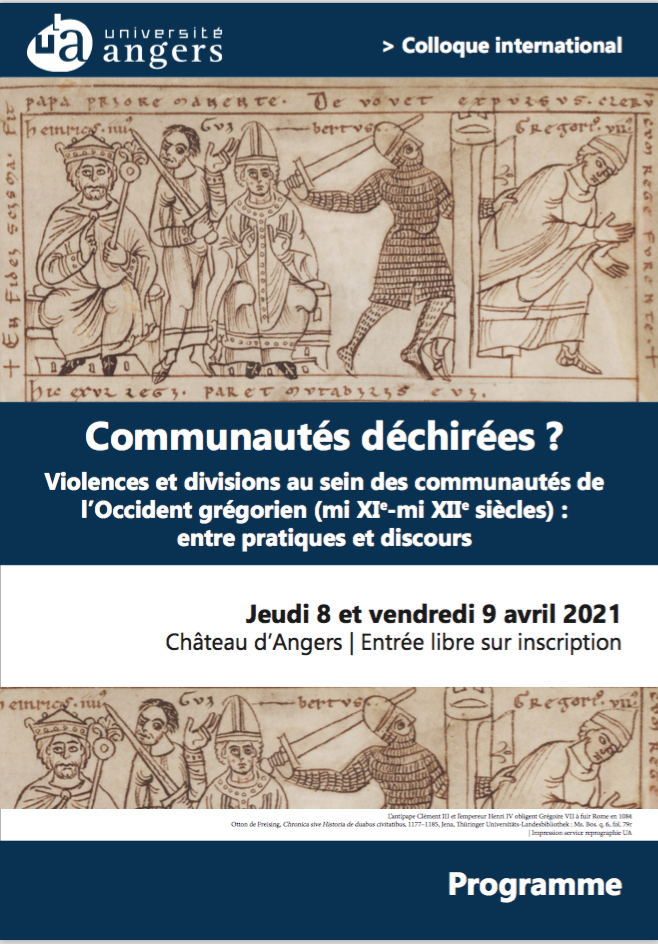
Jeudi 8 et vendredi 9 avril 2021 Château d’Angers | Entrée libre sur inscription
Du milieu du XIe siècle au milieu du XIIe siècle, la « réforme grégorienne » eut de très nombreuses répercussions sociales, culturelles et politiques, à tel point que l’on considère désormais cette période comme un point de rupture entre deux Moyen Âge. Cette rupture est néanmoins appréhendée différemment par les différentes historiographies nationales et l’objectif de cette rencontre est justement d’interroger la violence de ce conflit en s’intéressant à ses conséquences concrètes sur les communautés de l’Occident médiéval. Qu’il s’agisse des communautés ecclésiastiques (curiales, monastiques, canoniales), laïques (urbaines, rurales, guildes) ou encore intellectuelles (textuelles, scripturaires), ce colloque international sera l’occasion de se demander comment celles-ci ont pu être divisées, renforcées ou recomposées par le conflit grégorien.
Colloque organisé par les UMR TEMOS et LAMOP avec le soutien de l’Université d’Angers > Inscriptions : tristan.martine@univ-angers.fr
Programme :
Jeudi 8 avril
13:30 | Accueil des participants : Tristan Martine (Angers) 13:40 | Ouverture du colloque : Thomas Deswarte (Angers) 13:50 | Patrick Henriet (EPHE) – Introduction
Session 1 Oppositions et redéfinitions entre communautés ecclésiastiques
Présidence : Thomas Deswarte (Angers)
14:15 | Laurent Jégou (Paris 1) – Église ordonnée ou Église déchirée ? Une cartographie de l’action conciliaire au concile de Reims (1049) 14:40 | Jean-Hervé Foulon (Aix-en-Provence) – L’abbaye de Marmoutier et la réforme pontificale : tensions ou renforcement d’une identité communautaire (1050-1150) ? 15:05 | Hannes Engl (Aix-la-Chapelle) – Négociations et reconfigurations du pouvoir : les communautés religieuses en Lorraine face à la « réforme grégorienne » (XIe-XIIe siècle) 15:30-16:00 | Discussion Pause
Session 2 Communautés textuelles et mémoire scripturaire
Présidence : Carole Avignon (Angers)
16:30 | Florian Hartmann (Aix-la-Chapelle) – The construction of group identities in eleventh century letter-writings 16:55 | Chantal Senséby (Orléans) – Les évêques de la province ecclésiastique de Tours face aux écrits pontificaux : réaction commune ou attitude divergente ? Analyse comparée de leurs productions 17:20 | Cédric Jeanneau (Brest) – La réforme grégorienne : une mémoire au cœur des écrits des communautés ecclésiastiques de l’Ouest de la France 17:45-18:15 | Discussion
Vendredi 9 avril
Session 3 Entre couture et découture : des communautés en recomposition
Présidence : Geneviève Bührer-Thierry (Paris 1)
09:00 | Niall Ó Súilleabháin (Dublin) – Patrons, Proprietors or Plunderers? Aristocratic Control of Churches in the Loire Valley during the Age of Reform, c. 1050 – c. 1150 09:25 | Emmanuel Grélois (Rennes) – Chevaliers, moines et évêques en Auvergne vers 1100 : l’église de Saint-Sandoux et la seigneurie du Crest au prisme de deux actes témoins des enjeux locaux de la réforme 09:50 | Thomas Kohl (Tübingen) – Dividing and creating communities in 11th c. Germany 10:15-10:45 | Discussion Pause
Session 4 Des communautés urbaines déchirées ?
Présidence : Annick Peters-Custot (Nantes)
11:05 | Isabelle Rosé (Rennes) – Milan en loques ? Une communauté urbaine déchirée par les hérésies nicolaïte, simoniaque et néophyte à l’époque de la Pataria 11:30 | Paolo Tomei (Pise) – Des communautés déchirées en Toscane grégorienne : le cas de Lucques 11:50-12:10 | Discussion Déjeuner
Session 5 Des chanoines au cœur des conflits grégoriens
Présidence : Didier Panfili (Paris 1)
14:00 | Amancio Isla (Tarragone) – L’évêque de Saint-Jacques-de-Compostelle et les chanoines : un con it grégorien ? 14:25 | Guy Jarousseau (UCO-Angers) – Chanoines et moines à l’épreuve des divisions, le cas d’Angers (1082-1118) 14:50 | Charles de Miramon (IHD-Paris II) – La régularisation des chapitres cathédraux : 1050-1150. Une réforme avortée
Location: Groningen – Netherlands Salary: €3,746 to €5,826 £3,391.63 to £5,274.86 converted salary* gross per month Hours: Full Time Contract Type: Fixed-Term/Contract Placed On: 7th January 2021 Closes: 14th February 2021 Job Ref: 220433
The History Department is embarking on an ambitious programme of renewal in terms of staff and content. We are looking for new staff members to add new competencies and innovative approaches to the practice of history both in research and teaching, against the background of recent historiographical and interdisciplinary developments. The Department is a welcoming place for staff and students with diverse backgrounds and orientations. It considers this diversity as a key requirement for its cosmopolitan learning environment and for a balanced and diversified notion of doing history.
We offer you a position with 60% of your time for teaching (including administration) and 40% research.
The assistant professorship is one of seven positions that are advertised by the Department of History.
The Chair Group Medieval History is looking for an enthusiastic and cooperative colleague with an excellent research track record to complete its multifaceted team. Considering recent developments within the interdisciplinary field of Medieval Studies, we are searching for an all-round medievalist with in-depth expertise in a non-European region, preferably the Middle-East or/and Africa in the Central and/or Later Middle Ages. She/he deploys comparative, cross-cultural, global and/ or trans-regional approaches. We particularly welcome candidates with expertise in one or more of the following fields: History of Knowledge, History of Science, Intellectual History, History of Religion, Material Studies, Digital Humanities.
you will make an active contribution to the teaching of the Chair Group Medieval History within the BA and MA programmes in History, the Research MA programmes and other programmes in which the Chair Group takes part
you will develop new specialisations within the history programme and across programmes
you will be expected to develop a promising research line and write applications to capture national or international grants
you will present (intermediate) research results at and organise national and international panels, workshops or conferences
you will participate actively in administrative and organisational activities.
Qualifications
you have a PhD in History (or a closely related discipline)
you have ideally one year of postdoctoral experience in a teaching and/or research position
you have an excellent publication record for the stage of your career, including at least one monograph (under review) and peer reviewed articles
you have a demonstrable capacity and willingness to operate beyond narrow disciplinary boundaries within and beyond the field of History, in teaching and in research
you bring a strong cooperative attitude and willingness to engage in collaborative research and teaching duties
you have teaching experience and relevant teaching qualifications (such as BKO-Basiskwalificatie Onderwijs, Basic Education qualification), or willingness to obtain one in the first two years of your appointment
you have a capacity and willingness to undertake organisational duties
you bring enthusiasm for communicating academic research to non-academic audiences
your international experience and outlook will be considered an advantage
you have the ability to communicate and teach in English (CEFR C1 level for reading, listening, writing, speaking)
knowledge of Dutch or willingness to learn it within a reasonable period of time (within two years) may be one of the conditions for tenure (CEFR B2 for reading and listening, and CEFR B1 for writing and speaking).
Organisation
The Faculty of Arts is built on a long-standing tradition of four centuries. Our mission is to be a top-ranking faculty with both an excellent education and world-quality research, with a strong international orientation, firmly rooted in the North of the Netherlands. We build and share knowledge benefits to society. We work at a modern, broad and international institution, educating over 5.000 Dutch and international students to become forward-looking, articulate and independent academics. We are a hardworking and diverse team of 700 staff members.
History is a large and dynamic department with a strong regional anchor and an international outlook. It accommodates and facilitates international state-of-the-art research in several major historiographical and interdisciplinary fields. We introduce our students to the diversity and complexity of human experience in the past and in present societies around the globe through the study of civilisations, regions, nations, communities, and individuals across all historical periods. We organise our teaching and research around a variety of thematic, geographical and theoretical approaches including, among others, network theories, connected history, reading history, medical humanities, material culture studies, postcolonial perspectives, and digital humanities.
Conditions of employment
We offer you in accordance with the Collective Labour Agreement for Dutch Universities:
a salary, depending on qualifications and work experience, with a minimum of € 3,746 (salary scale 11) to a maximum of € 5,826 (scale 12) gross per month for a full-time position
a holiday allowance of 8% gross annual income, an 8.3% year-end bonus and participation in a pension scheme for employees. Favourable tax agreements may apply to non-Dutch applicants. We offer 232 holiday hours per calendar year for full-time employment
an appointment initially on a temporary basis for five years with the possibility of becoming a permanent appointment following a positive performance review. When meeting the criteria, the assessment for a permanent appointment is possible from the second year onwards.
The Faculty is considering only those applicants who are ready to move to Groningen and live in the near environment of Groningen within a period of two years.
We comply with the conditions of employment of the Collective Labour Agreement for Dutch Universities (cao NU). For more detailed information about working conditions and working for the University of Groningen, please check: https://www.rug.nl/about-us/work-with-us/
The appointee will ideally commence 1 August 2021.
Application
You can fill in the form and upload 4 PDF files (all in English):
a letter of motivation
a CV with a list of three self-selected “best papers”; the complete list of publications and the names and contact details of two referees who may be approached by the selection committee
a brief description of scientific interests and plans; a statement about teaching goals and experience (maximum two pages in total). You can upload this under “ extra document” on the website
an appropriate writing sample, you can upload this document also.
Only complete applications submitted by the deadline will be taken into consideration.
You may apply for this position until 14 February 11:59 pm / before 15 February 2021 Dutch local time by means of the application form (click on « Apply » below on the advertisement on the university website).
The selection interviews will take place over March and April 2021.
We are an equal opportunity employer and value diversity at our University. We are committed to building a diverse faculty so you are encouraged to apply. Our selection procedure follows the guidelines of the Recruitment code (NVP), http://nvp-plaza.nl/download/?id=7714 and European Commission’s European Code of Conduct for recruitment of researchers, https://euraxess.ec.europa.eu/jobs/charter/code
Job reference: HUM-016115 Location: John Rylands Library, Deansgate, Manchester Closing date (DD/MM/YYYY): 25/01/2021 Salary: £32,816 to £40,322 per annum, pro rata (according to relevant experience) Employment type: Fixed Term Faculty/Organisation: Humanities School/ Directorate: University of Manchester Library Research & Learning Services Hours per week: 0.9 Fte Contract Duration: Available from 1 March 2021 until 30 June 2022
Applications are invited for the post of Research Associate in Hebrew Manuscripts, to produce an online catalogue, compliant with current cataloguing and metadata standards and to promote The University of Manchester Library’s Hebrew collection. The post is part-time and fixed term from 1 March 2021 to 30 June 2022.
The Library’s Hebrew collection is internationally renowned and is one of the top four collections in the UK, ranking alongside Oxford, Cambridge and the British Library. The manuscript collection of c.600 codices, scrolls and other texts in Hebrew script is highly diverse, covering all aspects of Jewish diaspora in Europe and the Middle East.
You should hold a Ph.D. in Jewish studies or a related area, ideally dealing with Jewish book culture, possess an excellent command of Hebrew and have extensive experience of cataloguing manuscripts in Hebrew script. Knowledge of other languages written in Hebrew (e.g. Judaeo-Arabic) will be a distinct advantage. In addition, applicants should be highly motivated and enthusiastic, have excellent interpersonal and organisational skills, and be able to work independently to meet strict deadlines.
As an equal opportunities employer we welcome applicants from all sections of the community regardless of age, sex, gender (or gender identity), ethnicity, disability, sexual orientation and transgender status. All appointments will be made on merit.
Une charge à temps plein, indivisible, dans le domaine de la Papyrologie grecque et latine rattachée au Département des Sciences de l’Antiquité. Cette charge comprend des activités d’enseignement, de recherche et des services à la communauté.
La personne retenue, qui sera appelée à assumer la direction scientifique et opérationnelle du CEntre de DOcumentation de PApyrologie Littéraire (CEDOPAL), aura démontré sa capacité à gérer et à développer des projets de recherche collective.
Activités d’enseignement :
– LCLA0063-1 – Introduction à la papyrologie (30 h)
– LCLA0044-1 – Papyrologie littéraire (30 h)
– LCLA0062-1 – Papyrologie documentaire (30 h)
– LCLA0069-1 – Histoire des littératures grecque et latine (partim littérature grecque, 30h)
– LCLA0070-1 – Langue grecque II (cours en co-titulariat, 30h)
Activités de recherche :
– Recherches et publications dans un domaine afférent à la charge.
– Direction scientifique et opérationnelle du CEntre de DOcumentation de PApyrologie Littéraire (CEDOPAL).
– Affiliation à une U.R. (unité de recherche). Un cahier des charges plus précis sera élaboré en concertation avec la personne recrutée et le Président (ou la Présidente) de l’U.R. choisie. Activités de service à la Communauté : Outre la participation aux activités légalement obligatoires (Conseil de Faculté, Conseil de Département, …), il est attendu de la personne recrutée qu’elle participe activement à la vie et à la gestion de la filière et du Département. Qualifications requises / Profil :
Être titulaire d’un doctorat
Faire état d’un dossier de recherches dans le domaine de la papyrologie grecque et latine
Être capable de gérer et de développer des projets de recherche collective
Avoir des compétences en matière de papyrologie littéraire est un atout
Procédure de sélection :
Les personnes candidates seront amenées à donner une leçon publique sur un sujet défini au préalable par la Commission d’attribution. Cette leçon sera suivie d’un entretien en français.
Candidatures :
Les candidat·e·s sont prié·e·s de faire parvenir leur dossier de candidature, par voie électronique à l’adresse: Postesacademiques@uliege.be avec copie à Francoise.Hartkopf@uliege.be pour le 10 février 2021 au plus tard.
Documents requis :
Une requête assortie d’un curriculum vitae complet ;
Un rapport sur les activités de recherche antérieures et en cours, ainsi qu’un projet de recherche, en ce compris l’insertion envisagée au sein de l’Université de Liège ;
Un dossier d’enseignement comprenant un rapport sur les éventuelles activités d’enseignement antérieures et un projet d’enseignement ;
Un exemplaire des publications. Conditions d’engagement : Les charges sont attribuées soit pour une durée déterminée de quatre ans pouvant aboutir à la nomination définitive de l’intéressé·e, soit d’emblée à titre définitif. Dans le cas d’une nomination pour un terme de quatre ans, une évaluation de l’intéressé·e sera réalisée à l’issue de la troisième année.
Si l’évaluation est négative, l’intéressé·e achève son terme de quatre ans sans pouvoir être prolongé·e.
Si l’évaluation est positive, l’intéressé·e est nommé·e à titre définitif. Notre politique institutionnelle est basée sur la diversité et l’égalité des chances. Nous sélectionnons les candidats en fonction de leurs qualités quels que soient leur âge, leur orientation sexuelle, leur origine, leurs convictions, leur handicap ou nationalité. Renseignements : Tout renseignement complémentaire peut être obtenu auprès de la Faculté de Philosophie et Lettres, Mme Françoise Hartkopf – tél. : +32 4 366 54 54 – Francoise.Hartkopf@uliege.be Rémunération : Les barèmes et leurs modalités d’application sont disponibles auprès de l’administration des ressources humaines de l’Université : Mme Ludivine DEPAS – tél. : +32 4 366 52 04 – Ludivine.Depas@uliege.be
The Department of Art History and Archaeology at Washington University in St. Louis (https://arthistory.wustl.edu/), and the Saint Louis Art Museum (www.slam.org) seek a specialist in late medieval European art for a joint teaching-curatorial two-year position beginning on or slightly after July 1, 2021 and ending not later than June 30, 2023. It is expected that within the two-year period, the fellow will spend two semesters at Washington University, teaching two courses in each of those semesters. The fellow will spend the remaining twelve-months working full-time at the Saint Louis Art Museum as an Andrew W. Mellon Foundation Fellow, based in the department of European Art to 1800. At the museum, the fellow will carry out research and other curatorial duties including docent training and gallery talks. It is thus envisioned that the candidate will spend a year in total at each institution over the two-year period.
Courses at Washington University in St. Louis, a leading research institution, will be offered to a combination of beginning and advanced undergraduates, and perhaps graduate students, in art history and related fields. Courses are welcome in any area of late medieval European art, with concentrations on Italy, France, Germany, or Spain especially welcome. An interest in addressing global considerations of trade, exploration, transnational travel and pilgrimages, and other forms of cross-cultural contact and exchange are very welcome. Please include a few topics for proposed courses in the letter of application. Some teaching experience as either Instructor of Record or as a teaching assistant is highly desirable, but not required.
At the Saint Louis Art Museum, among other duties, the fellow will catalogue and interpret a collection of approximately sixty objects, primarily from Italy, France, and Germany and one Spanish panel. Objects range from polychrome stone or wood sculpture to panel paintings, manuscripts, and metalwork. The fellow will work with the curator of European art to 1800 to evaluate the existing display of medieval art in the museum, and then research and evaluate potential replacements or additions to the pieces that are currently on view. The goal is to place the medieval collection in dialogue with other contemporary cultures represented in the museum’s encyclopedic collection through new exhibition and/or interpretation strategies in order to situate the pieces more fully within a global context.
Partial funding for the fellow comes from an endowment granted by the Andrew W. Mellon Foundation.
The candidate must have reading facility in at least 2 of the following languages: French, German, Italian, Spanish, Latin.
The candidate should have no more than three years of postdoctoral teaching or curatorial experience in the field at the start of the appointment.
Annual salary will be $53,000 in the first year; also included are moving expenses, benefits, and research and travel funds.
Initial interviews will be conducted by Zoom or similar virtual platform. Finalists may be brought to St. Louis and/or might have more extensive virtual interviews. Review of applications begins on February 15, 2021 and will continue until the search is closed.
To apply, please go to https://dossier.interfolio.com/apply/82213 and create a profile on Interfolio. Required materials that may be uploaded to Interfolio include a letter of interest, current CV, and a writing sample. The required three confidential letters of recommendation and any writing samples too large to be uploaded should be sent by mail to:
Prof. Elizabeth Childs Chair, Department of Art History and Archaeology Washington University, Kemper 210, Campus Box 1189 One Brookings Drive St. Louis, MO 63130-4899
or e-mailed to artarch@wustl.edu (Please do not email Prof. Childs directly).
Washington University in St. Louis’ mission is to discover and disseminate knowledge, and protect the freedom of inquiry through research, teaching and learning. Washington University creates an environment to encourage and support an ethos of wide-ranging exploration. Washington University’s faculty and staff strive to enhance the lives and livelihoods of students, the people of the greater St. Louis community, the country and the world.
Each year Washington University publishes a Safety and Security brochure that details what to do and whom to contact in an emergency. This report also publishes the federally required annual security and fire safety reports, containing campus crime and fire statistics as well as key university policies and procedures. You may access the Safety and Security brochure at https://police.wustl.edu/clery-reports-logs/.
The Saint Louis Art Museum collects, presents, interprets, and conserves works of art of the highest quality across time and cultures; educates, inspires discovery, and elevates the human spirit; preserves a legacy of artistic achievement for the people of St. Louis and the world; and engages, includes, and represents the full diversity of the St. Louis community supporting it.
Séminaire de recherche organisé par l’IHA (Rolf Große) en coopération avec l’EPHE (Laurent Morelle)
Christian Neumann (IHA Rome), Vieillesse et pouvoir au Moyen Âge (XIIIe–début XVIe siècle)
Présidence: Didier Lett (université Paris Diderot)
L’IHA et l’École pratique des hautes études organisent en commun un séminaire d’histoire médiévale où des doctorantes et doctorants en thèse bien avancée, mais aussi de jeunes postdocs viennent présenter leurs recherches en voie d’achèvement ou un dossier de leur thèse. La prestation, toujours en langue française, dure environ 50 minutes. Le séminaire a lieu tous les deux mois, un mardi matin de 10h à 12h.
Part-time Academic Position in Digital Humanities (80%)
The KU Leuven Arts Faculty offers an 80% tenure-track position in Digital Humanities with a focus on computational methodologies, data analysis and data visualisation in the field of cultural-historical studies. Research in the Arts Faculty covers a wide range of disciplines that are clustered in six Research Units: History; Archaeology, Art history and Musicology; Literary Studies; Linguistics; Translation Studies; East-Asian and Arabic Studies. Researchers in the Faculty have developed and implemented digital methodologies and technologies in their domains for a considerable time and are engaged in interdisciplinary collaborations both within KU Leuven, which boasts a strong comprehensive profile, as with various institutions and projects outside the university. To consolidate and strengthen these efforts and reinforce the Faculty’s digital humanities profile we are seeking an outstanding candidate with an active research agenda and technical background in the application of computational methodologies, coding, data analysis, data visualisation, and network analysis in one of the cultural-historical domains of the Faculty. Depending on your scholarly background and main discipline you will become a member of the Research Group in which your own research has most impact and your interests and expertise can best be utilised and nurtured. Yet we also foster the ambition to strengthen digital research on a cross-disciplinary collaborative basis, which implies streamlining the adoption of common and transferable digital methodologies and technologies, both in research and degree education. Your research will focus on computational methodology as a research area in its own right but reach out to colleagues from different disciplines within the Faculty. You will also further collaboration with other departments and research groups university-wide (with, for example, the HCI Research Group or Leuven AI). You will be expected to teach at the BA, MA and PhD level (see below), and give public visibility to the added value of computational approaches in the cultural-historical fields. The appointment is expected to start on 01.10.2021.
Duties
Research
We are looking for a researcher whose main interest is the development of transferable digital technologies and computational methods in the large field of cultural-historical studies. Candidates need to be well-versed in programming languages, data structures and visualisation techniques applied to the humanities. In particular, acquaintance with some of the following or similar methods is an added value:
• data visualisation • linked data • network analysis • distant reading, stylometry, digital text analysis • topic modelling • human computer interaction
You will monitor and facilitate the transformational impact of data driven research and digital approaches in existing practices in the humanities for acquisition, transformation, analysis, presentation and dissemination of research data. You will develop an excellent research programme in your field but also act as a point of contact with partners in other research groups in the Arts Faculty, exchange and sustain the interoperability of research data in the Arts and Humanities. You support and further expand national and international research collaborations of your research group, achieve scientific output that adheres to the highest international standard. You are able to acquire competitive funding from local, national and international funding sources and establish a solid presence in Digital Humanities networks such as Dariah and Europeana.
Education
Education
The teaching responsibilities contain the following elements. On BA level you will coordinate the faculty-wide BA courses ‘Data Science for the Humanities’ (‘L-Dataverwerking’) and ‘Information Strategies’ (‘L-Informatievaardigheden’).
In collaboration with the Faculty of Science, the Arts Faculty offers an international MA in Digital Humanities. As a member of the Programme Advisory Committee with colleagues from both Faculties you will be one of the driving forces to expand this MA programme and attract students with the right profile and building a network of apprenticeship opportunities. You will conduct the course ‘Introduction to Digital Humanities’ and teach another subject in line with your own research specialism.
You will provide specialized training (linked to your expertise) to PhD students in their doctoral programme.
You will develop your teaching approach in keeping with KU Leuven’s vision on activating and researched-based education, and make use of the possibilities for educational professionalization offered by the faculty and the university.
Service
You are prepared to provide scientific and societal services and take on administrative and management duties. You play an active part in profiling the Arts Faculty towards new students and the wider professional field by participating in open days and networking events. As a senior researcher you will coach junior researchers and supervise (inter)national PhD students.
Profile
You have a PhD in one of the disciplines of the Faculty of Arts with a proven track record in Digital Humanities methods and applications or a PhD in Computer science with a proven track record in Humanities research. Your research shows a strong focus on computational methodologies, data analysis and data visualisation in cultural-historical studies.
You have a strong research profile. The quality of your research is proven by publications in leading international journals and conferences in your scholarship. International experience is an important advantage.
You have qualities related to academic education and are able to take on a range of educational tasks. You possess organisational skills and have a cooperative attitude. You are willing to collaborate with researchers from different cultural-historical disciplines in the Faculty.
Proficiency in English is required. The official language used at KU Leuven is Dutch. If you do not speak Dutch (or do not speak it well) at the start of employment, KU Leuven will provide language training to enable you to take part in meetings. Before teaching courses in Dutch or English, you will be given the opportunity to learn Dutch, respectively English, to the required standard.
Offer
We offer an 80% employment in an intellectually challenging environment. KU Leuven is a research-intensive, comprehensive internationally oriented university that carries out both fundamental and applied scientific research. It has been hailed “Top European innovation university of the year” in the Reuters ranking and offers research disciplines and education in Biomedical, Science and Engineering as well as Humanities and Social Sciences. It is highly focused on interdisciplinary and multidisciplinary research and strives for international excellence. The university actively works together with research partners in Belgium and abroad and provides its students with an academic education that is based on high-quality scientific research. The university has very advanced ICT and Media services and a strong centre for statistics and data science.
You will work in Leuven, a historic, dynamic and lively city located in the heart of Belgium, within 20 minutes from Brussels, the capital of the European Union, and less than two hours from Paris, London and Amsterdam. As a junior researcher you will be appointed as tenure-track assistant professor (tenure track docent) for a period of 5 years, starting October 1, 2021. After this period and a positive evaluation, you obtain a tenured position as associate professor (hoofddocent).
KU Leuven is well set to welcome foreign professors and their family and provides practical support with regard to immigration & administration, housing, childcare, learning Dutch, and partner career coaching.
To facilitate scientific onboarding and accelerate research in the first phase a starting grant of 100.000 euro is offered to new professors without substantial other funding, appointed for at least 50%.
KU Leuven places great importance on research integrity and ethical conduct and will therefore ask you to sign an integrity statement upon appointment.
KU Leuven seeks to foster an environment where all talents can flourish, regardless of gender, age, cultural background, nationality or impairments. If you have any questions relating to accessibility or support, please contact us at diversiteit.HR@kuleuven.be.
Organisé par Aude Mairey, Directrice de recherche (LaMop – CNRS/Paris 1).
Depuis quelques décennies, le médiévalisme, que l’on peut définir à la suite de Louise d’Arcens comme « la réception, l’interprétation ou la recréation du Moyen Âge européen dans les cultures post-médiévales », est devenue une discipline à part entière, d’abord dans les pays anglophones puis dans l’ensemble de l’Europe occidentale (pour ne s’en tenir qu’à elle). Le champ est vaste : de Victor Hugo à J.R.R. Tolkien, de la recréation d’une architecture néo-gothique aux jeux vidéos populaires, de l’anneau de Jeanne d’Arc à la reconstitution de batailles médiévales, les usages contemporains du Moyen Âge sont nombreux – littéraires, cinématographiques, ludiques, mais aussi politique… Pourtant, alors que nos collègues littéraires ont été les premiers à s’emparer de ce champ au sein du monde universitaire, cela n’a pas été le cas (ou à peine) pour les historiens. Ce séminaire se propose donc d’envisager, en complémentarité avec les autres disciplines, tant l’histoire du médiévalisme que la diversité de ses usages actuels.
Il portera cette année sur les rapports entre le médiévalisme et l’Orient.
Les séances sont ouvertes à tous et se tiendront si possible le vendredi de 14h à 16h en salle Perroy, à la Sorbonne. Une tenue par Zoom est de toute façon prévue. Si vous souhaitez y assister, inscrivez-vous à l’adresse suivante : aude.mairey@univ-paris1.fr.
Programme :
5 février 2021 Annliese Nef (Université Paris 1) « Des usages contrastés du passé islamique de l’Europe »
12 mars 2021 Florian Besson (agrégé et docteur en histoire) « “À l’est, tout était différent”. L’Orient de Game of Thrones, monde d’altérités »
26 mars 2021 William Blanc (EHESS) « Comme un samouraï. Figure du guerrier dans le cinéma et les manga japonais de l’Après-Guerre ».
9 avril 2021 Yohan Chanoir (EHESS) « Un Moyen Âge plastique ? Le médiévalisme des cinémas chinois »
14 mai 2021 Catherine Richarte (INRAP) « Médiévalisme, modernité des usages et renouvellement des connaissances sur le Moyen Âge. Quelques allégations revues à travers le prisme de l’archéologie ».
28 mai 2021 Benoît Grévin (EHESS) « Un médiévalisme très oriental : les Hongrois et la pensée de l’origine asiatique ».
Conveners: Cristina Dondi (Lincoln College, Oxford) and Alexandra Franklin (Bodleian Centre for the Study of the Book)
Due to limited space (even online), registrations for the live events will be honoured in the order received.
Presentations will be recorded if the speaker has granted permission, and in that case will be available a few weeks after the date of the seminar.
Programme :
Friday, January 22 Matthew Payne (Keeper of the Muniments, Westminster Abbey) ‘Follow the Money: Wynkyn de Worde, Jacques Ferrebouc and the Bardi’
Friday, January 29: Special session at 5:00pm GMT Goostly Psalmes in Oxford and New Haven Henrike Lähnemann (Faculty of Medieval and Modern Languages, University of Oxford) ‘Translating, Singing, Printing the Reformation. The Queen’s College Sammelband with Myles Coverdale’s Goostly Psalmes’ With a showing of The Queen’s College copy and the Bodleian and Beinecke fragments Kathryn James (Beinecke Library, Yale University); Matthew Shaw (The Queen’s College, Oxford); Sarah Wheale (Bodleian Libraries, Oxford)
Friday, February 5 Francesco Guidi-Bruscoli (University of Florence) ‘The Borromei’s trade unveiled: digging for information in fifteenth-century account-books’
February 12 – No seminar
Friday, February 19 Alessandro Bianchi (Bodleian Libraries, Oxford) ‘Hidden in plain sight. Printed books from the Japanese Mission Press in the Bodleian Collections’
Friday, February 26 Kanupriya Dhingra (SOAS, University of London) ‘Streets and Serendipity: “Locating” Daryaganj Sunday Patri Kitab Bazar’
Friday, March 5 Benjamin Wardhaugh (University of Oxford) ‘Hunting for readers in sixteenth-century editions of the works of Euclid’
Friday, March 12 William Stoneman (Cambridge, MA) ‘Buying Incunabula at Gimbel Brothers Department Store: A Curious Chapter in the History of American Book Collecting’
Avec le soutien du FNRS, du CRHiDI (UCLouvain – Saint-Louis, Bruxelles), d'INCAL (UCLouvain), de PraME (UNamur), de sociAMM (ULB) et de Transitions (ULiège)










Vous devez être connecté pour poster un commentaire.