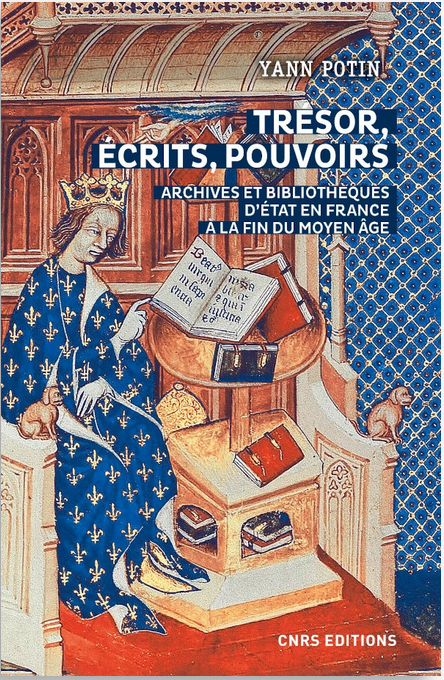
Publication – Yann Potin, « Trésor, écrits, pouvoirs. Archives et bibliothèques d’État en France à la fin du Moyen Âge »

Les pouvoirs de l’écrit dans la société médiévale ne reposent pas seulement sur la capacité des institutions à le produire ou à le diffuser. Le cas particulier du royaume de France et de son État en gestation à la fin du Moyen Âge manifeste un rapport singulier à la conservation des supports et des valeurs de l’écrit dans des espaces réservés et situés au cœur des Palais et qui forment autant de « trésors ». La localisation de ces dépôts structure l’espace et la dynamique de centralisation du pouvoir capétien et assure indirectement, par leur inscription dans les espaces urbains, une présence et un pouvoir de l’écrit bien plus large : la visibilité indirecte des trésors d’écritures. Ces « trésors » de titres, de chartes, de manuscrits informent la « sapience » d’un souverain qui pose ainsi les fondements d’une « science de l’État ».

Cet ouvrage rassemble un certain nombre d’études singulières sur le Trésor des chartes entre le XIIIe et le XVIe siècle, et la librairie royale, dite « de Charles V », entre son installation au Louvre en 1368 et sa dispersion au début du XVe siècle. Ces travaux sont précédés de textes généraux sur la question du statut de la fonction politique et symbolique de la thésaurisation royale.

Yann Potin travaille aux Archives nationales (département Éducation, Culture et Affaires sociales).


Informations pratiques :

Yann Potin, Trésor, écrits, pouvoirs. Archives et bibliothèques d’État en France à la fin du Moyen Âge, Paris, CNRS Éditions, 2020. 272 p., 15 x 23 cm. ISBN : 9782271132390. Prix : 25 euros.

Source : CNRS Éditions

Publié dans Publications | Laisser un commentaire

Séminaire en ligne – ‘Somewhere beyond the sea…’. Belgo-British Research Encounters in Medieval Urban History

The COVID-19 pandemic has shaken our world and academia is no stranger to its effects. Our sector thrives on international contacts and exchange, and has grown accustomed to much travel in pursuit of research and collaborations. Medieval urban history is a particularly ‘mobile’ research field, with its scholars visiting scattered archives, tracing ancient city networks and attending conferences all over the world. Many plans and events have recently been cancelled, many collaborations made more difficult. Prominent among these, the longstanding contacts between British and Belgian medievalists, and more specifically between Queen Mary University and Ghent University, have consequently been postponed.

Yet fascinating new research in medieval urban history continues to emerge even during the crisis. Alongside the many disruptions, we have become sued to work with sustainable digital conferencing. Hence we are able to meet again!

Sharing ideas with colleagues at welcoming, peer-to-peer conferences is especially important for early career scholars. These events offer them the opportunity to meet new people, learn about new research, receive input of various kinds, and sharpen their presentation skills. Medievalists at Queen Mary University London and Ghent University are now able to offer PhD-students and postdoctoral scholars the opportunity to do exactly that. Therefore, leading researchers in medieval urban history from both institutions have organised ‘Somewhere beyond the sea. Belgo-British Research Encounters’, a digital series that will focus on the latest (PhD) research in medieval urban history.

If you wish to know more about the institute or subscribe to our newsletter, email the coordinator: Stefan.Meysman@UGent.be .

Programme :

Friday 25 September (16.00 CET)
Rowan Dorin (Stanford University)
‘Preachers, Crowds , and the Problem of Pentecost in the Late Middle Ages’

Friday 9 October (16.00 CET)
Charlotte Berry (Bath Spa University)
‘Community, policing and marginality in the suburbs of late medieval London’

Friday 23 October (16.00 CET)
Lisa Demets (Ghent University)
‘Multilingual Literary Dynamics of Medieval Flanders: The Production and Reception of Manuscripts in Late Medieval Flemish Towns (1200 – 1500)’

Friday 6 November (16.00 CET)
Milan Pajic (Queen’s University Belfast)
‘The Boundaries of Loyalty and Belonging: Foreign Artisans in English Army during the Campaigns Between 1356 and 1406’

Source : UGent – Henri Pirenne Institute

Publié dans Séminaire | Laisser un commentaire

Publication – « The Materiality of Horse », dir. Miriam A. Bibby and Brian G. Scott

Inspired by our age-old fascination with equids, Materiality of the Horse brings the latest academic research in equine history to a wider readership. Themes examined within the book by specialist contributors include explorations of material culture relating to horses and what this discloses about the horse-human relationship; fresh observations on significant medieval horse-related texts from Europe and the Islamic world; and revealing insights into the effect of the introduction of horses into indigenous cultures in South America. Thought-provoking and original, Materiality of the Horse is the second volume in Trivent Publishing’s innovative “Rewriting Equestrian History” series.


Table des matières :

Introduction
CHAPTER 1. Pony Breeding in the New Forest: A Continuation of Medieval Practice – Gail Brownrigg
CHAPTER 2. Practical Advice on Equine Care from Jordanus Rufus, c. 1250 CE – Jennifer Jobst
CHAPTER 3. A Tapuya “Equestrian Nation”? Horses and Native Peoples in the Backlands of Colonial Brazil – Felipe Vander Velden
CHAPTER 4. Counting Your Blessings in Froissart’s “Debate of the Horse and the Greyhound” – Anastasija Ropa
CHAPTER 5. Equids in Late Byzantine Hagiographies: A Comparison with the Middle Byzantine Period – Alexia-Foteini Stamouli
CHAPTER 6. Alexander’s Arabian: Noble Steed or Fantastic Beast? – Miriam A. Bibby
CHAPTER 7. Hishām ibn al-Kalbi’s Kitāb al-Khayl: A Premodern Arabic Pedigree for the Horse? – Hylke Hettema
CHAPTER 8. Equestrian Military Equipment of the Eastern Roman Armies in the Sixth and Seventh Centuries – Mattia Caprioli
CHAPTER 9. Horse Burials among the Lombards and Avars: Some Differences and Similarities between the Germanic and Nomadic Rituals – Annamaria Fedele
CHAPTER 10. The Irish “Deer” Series of Cheek-Pieces – Brian G. Scott

MIRIAM A. BIBBY is an archaeologist and historian specialising in the history of the horse, particularly the horse in northern England and Scotland. She is currently engaged in specialist research at the University of Glasgow into the history and influence of the Galloway horse. Miriam was formerly a tutor, year convenor and course developer for the University of Manchester’s networked learning course in Egyptology. While at Manchester, she gained her M.Phil. on the topic of the horse in ancient Egypt and in 2000 she founded Ancient Egypt magazine. She has presented at numerous conferences and her work has been published in many journals and magazines. Miriam has also worked as a museum curator and in heritage management.

BRIAN G. SCOTT is the former Keeper of Conservation at the Ulster Museum, Belfast. He has written extensively on early metallurgy, with special emphasis on iron and steel, and is also a specialist on Irish Later Bronze Age equitation, as well as on early artillery, having published the definitive studies of the late-sixteenth and seventeenth centuries cannon in the City of Derry~Londonderry and on the mortar campaign during the 1689 Siege.

Informations pratiques :

The Materiality of Horse, dir. Miriam A. Bibby and Brian G. Scott, Trivent 2020. €39.00. ISBN 978-615-81353-9-9. Paperback, in colour, pp. 297.

Source : Trivent

Publié dans Publications | Laisser un commentaire

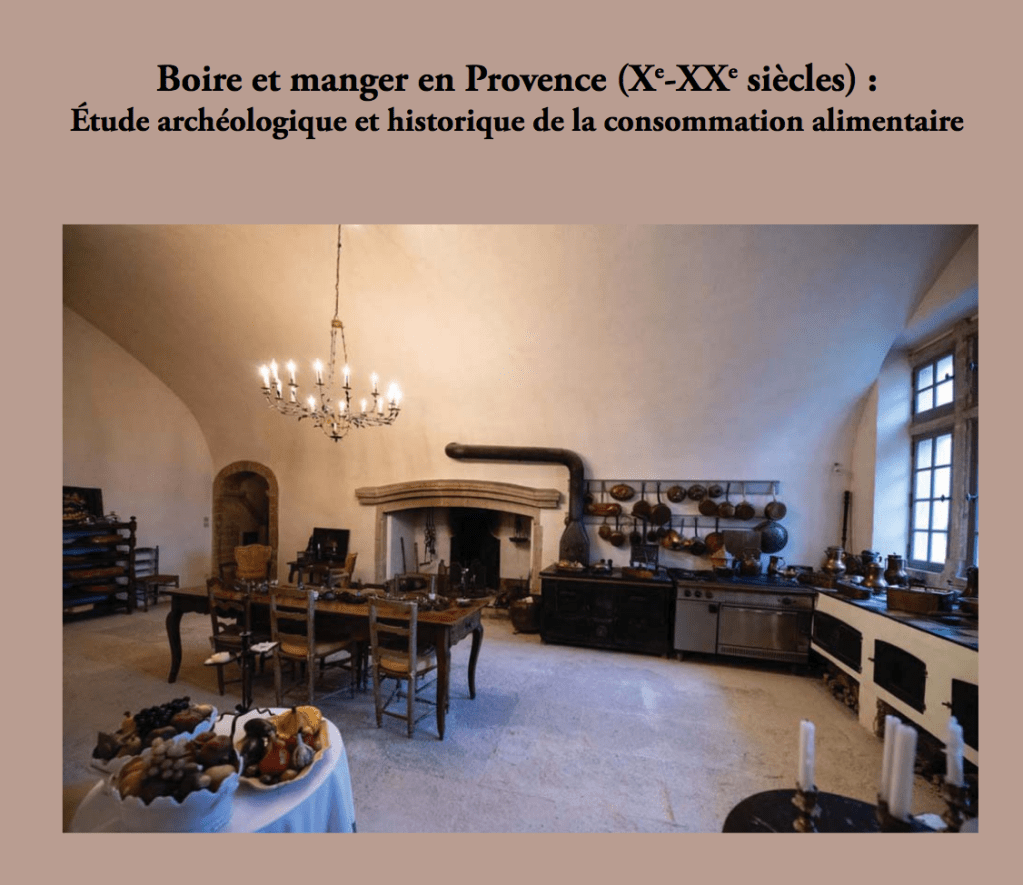
Colloque – Boire et manger en Provence (Xe-XXe siècle). Études archéologique et historique de la consommation alimentaire

Ce colloque propose de valoriser la culture alimentaire provençale et sa construction entre le Moyen Âge et l’Époque contemporaine. Par un regard interdisciplinaire sur les artisans, les produits consommés, les ustensiles de préparation et de table, à la confluence des sources écrites et matérielles, ces deux journées se donnent pour objectif d’appréhender les comportements alimentaires et les habitudes de consommation. Les différentes interventions montreront comment l’art de la table a évolué, s’est structuré, tout en documentant la composition des repas et la façon dont le vaisselier et les ustensiles nécessaires au repas et à leur élaboration s’intègrent dans les manières de table. Chaque communication sera également le moyen d’entrevoir et d’étudier la dimension sociale du partage des repas, son évolution et parfois même sa ritualisation.

Programme :

Mardi 6 Octobre 2020

  • 8H45 – 9H00 : Accueil des participants
  • 9H00 – 9H15 : Introduction
  • 9H15 – 9H45 : Anne Cloarec-Quillon La production de vaisselle en céramique en pays d’Apt du Xe au XIIIe siècles,l’apport des découvertes récentes à Gargas
  • 9H45 – 10H15 : Nicolas Attia Premiers jalons d’une étude des pâtes grises fines médiévales du site des places Verdun et Prêcheurs à Aix-en-Provence (13)

10H15 – 10H30 : Pause

  • 10H30 – 11H00 : Florence Parent La vaisselle de terre dans les cuisines et à la table des marseillais(XIIe-XIVe siècles)
  • 11H00 – 11H30 : Catherine Richarté L’« orientalisation » de la table médiévale, vers un nouveau paradigme.Échanges et transferts de savoir-faire dans la Provence des Xe-XIVe siècles
  • 11H30 – 12H00 : Olivier Thuaudet Le couteau : formes et fonctions (XIe-XVe siècles).Que nous apprend la documentation archéologique provençale ?

12H15 – 14H00 : Repas

  • 14H00 – 14H15 : Introduction
  • 14H15 – 14H45 : Diane Unsain Alimentation et Société, La viande en Provence médiévale
  • 14H45 – 15H15 : Leïa Mion Approche isotopique de l’alimentation du début du Moyen Âge
  • 15H15 – 15H45 : Tatiana André De la nasse au filet. Étude archeoichtyologique de la partie sommitaledu château d’Hyères du IXe au XVIIe siècle
  • 15H45 – 16H00 : Conclusion de la journée

Mercredi 7 Octobre 2020

  • 9H00 – 9H15 : Introduction
  • 9H15 – 9H45 : Aline Lacombe Aperçu du faciès céramique à Aix-en-Provence entre le XVIe et le XVIIe siècle
  • 9H45 – 10H15 : Henri Amouric et Lucy Vallauri Pots à raisins et pots à fraises, conservation/commercialisation, XVIIIe-XXe siècles
  • 10H15 – 10H45 : Véronique Abel Archéologie d’un condiment : le sucre. Archéologie d’un condiment : la moutarde

10H45 – 11H00 : Pause

  • 11H00 – 11H30 : Guergana Guionova De la cuisine à la table : aspects de la standardisation du vaisselier en Provence du XVIIe au XXe siècles
  • 11H30 – 12H00 : Marie-Astrid Chazottes Couteaux, fourchettes ; orfèvres et couteliers : 1ère approche de la production des ustensiles de table à Marseille au XVIIIe siècle
  • 12H00 – 12H30 : Sandrine Krikorian : Les plats dits « à la provençale » dans la gastronomie française du XVIIIe siècle

12H30 – 14H00 : Repas

  • 14H00-14H15 : Introduction
  • 14H15 – 14H45 : Estelle Herscher et Marie-Christine Bailly – Maître Entre dépendance et autosuffisance : se nourrir en haute montagneaux XIIe-XIVe siècles – Archéologie, anthropologie, archéobotanique,archéozoologie et sources écrites
  • 14H45 – 15H15 : Mireille Jacotin : Préparer et boire du café en Provence (milieu XVIIe-fin XVIIIe siècles) :emprunts et créations de nouveaux objets du quotidien
  • 15H15 – 15H30 : Pause
  • 15H30 – 16H00 : Bernard Romagnan : Café, thé, chocolat en Provence orientale (XVIIe-XVIIIe siècles)
  • 16H00 – 16H30 : Tony Volpe : Café, thé, chocolat et sucre, nouvelles consommations à Grasse au XVIIIe siècle
  • 16H30 – 17H00 : Conclusion du colloque

Informations pratiques :

Le colloque se tiendra les 6 et 7 octobre 2020 à Aix-en-Provence, à la Maison Méditerranéenne des Sciences de l’Homme (5 Rue du Château de l’Horloge), en salle Georges Duby.

Organisé par Marie-Astrid Chazottes, ce colloque est soutenu par le LA3M.

Source : Calenda

Publié dans Colloque | Laisser un commentaire

Publication – « Beasts, Humans, and Transhumans in the Middle Ages and the Renaissance », éd. J. Eugene Clay

From shape-shifting Merlin to the homunculi of Paracelsus, the nine fascinating essays of this collection explore the contested boundaries between human and non-human animals, between the body and the spirit, and between the demonic and the divine. Drawing on recent work in animal studies, posthumanism, and transhumanism, these innovative articles show how contemporary debates about the nature and future of humanity have deep roots in the myths, literature, philosophy, and art of the Middle Ages and the Renaissance. The authors of these essays demonstrate how classical stories of monsters and metamorphoses offered philosophers, artists, and poets a rich source for reflection on marriage, resurrection, and the passions of love. The ambiguous and shifting distinctions between human, animal, demon, and angel have long been contentious. Beasts can elevate humanity: for Renaissance courtiers, horsemanship defined nobility. But animals are also associated with the demonic, and medieval illuminators portrayed Satan with bestial features. Divided into three sections that examine metamorphoses, human-animal relations, and the demonic and monstrous, this volume raises intriguing questions about the ways humans have understood their kinship with animals, nature, and the supernatural.

J. Eugene Clay is an associate professor of religious studies at Arizona State University, where he writes and lectures about religious movements in Eurasia and the encounters of the world religions. His work has appeared in Church History, Russian History/Histoire russe, and the Cahiers du monde russe. He has received grants and awards from the Social Science Research Council, the National Endowment for the Humanities, and the International Research and Exchanges Board.

Table des matières :

Introduction — J. EUGENE CLAY

Part I Metamorphoses

Animal/Merlin/Demon — ROBERT S. STURGES
Metamorphosis and Metempsychosis in Thomas Bradwardine’s De causa Dei — EDIT ANNA LUKACS
The Birds of Love: Doves, Pigeons and Owls in Nicolas Brizard’s Metamorphoses Amoris (1556) — JOHN NASSICHUK

Part II Beasts and Humans

Beastly Boars and Human Hunters in MS Bodley 764 — SUSAN ANDERSON
Horsemanship and Libros de Jineta in Habsburg Spain — KATHRYN RENTON

Part III Beyond Humanity: Demons and Monsters

« If You Go Down to the Woods Today »: William Rufus and the Noonday Demon — DAVID SCOTT-MACNAB
Behold thy Beast of Hoof and Horn: Representations of the Devil in Illuminations of the Temptation of Christ, 1150–1400 —AMANDA E. DOWNEY
A Monstrous Marriage: Grotesque Ornament in Late Renaissance ‘Cassoni’ — RACHEL L. CHANTOS
The Monsters of Paracelsus — THOMAS WILLARD
Notes on Contributors

Informations pratiques :

Beasts, Humans, and Transhumans in the Middle Ages and the Renaissance, éd. J. Eugene Clay, Turnhout, Brpeols, 2020 (Arizona Studies in the Middle Ages and the Renaissance, 45). XXIV+168 p., 3 b/w ill. + 4 colour ill., 156 x 234 mm. ISBN: 978-2-503-59063-9. prix : 70 euros.

Soirce : Brepols

Publié dans Publications | Laisser un commentaire

Séminaire – Le papier et le parchemin. Séminaire 2020-2021 « Matérialités » du Laboratoire DYPAC

Matérialités 2020-2021
Séminaire du laboratoire DYPAC
Avec le soutien de la Fondation des Sciences du Patrimoine

Le papier et le parchemin : La technique du pliage: Les « bat books » au Moyen Âge
 

5 octobre 2020, 10h – 12h
Bâtiment Vauban, salle 524


Intervenants :
Alexandre Tur (chargé de collections au département des manuscrits de la Bibliothèque nationale de France), « Grand à l’intérieur e‌t petit à l’extérieur : les livres plicatifs ou bat books à la fin du Moyen Âge »

Marine Valla (doctorante DYPAC), « L’homme veineux dans les almanachs plicatifs médicaux anglais des XIVe et XVe siècles »

Source : DYPAC – UVSQ

Publié dans Séminaire | Laisser un commentaire

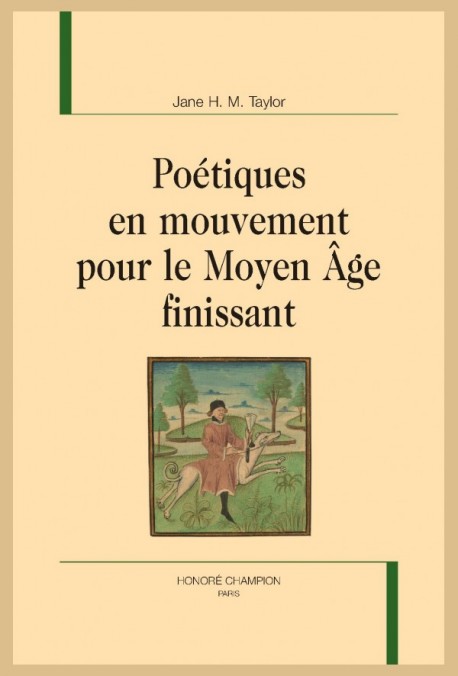
Publication – Jane H. M. Taylor, « Poétiques en mouvement pour le Moyen Âge finissant »

La collection d’articles qu’a réunie Jane H. M. Taylor témoigne de la dynamique des recherches en littérature médiévale tardive depuis un demi-siècle, et de la remise en valeur d’une littérature longtemps parente pauvre des études universitaires, grâce à des démarches critiques diverses : le structuralisme des années 1970 pour étudier le Perceforest, alors quasiment inconnu ; une approche anthropologique pour le Roman de Mélusine ; la réception pour Jehan de Saintré à travers les miniatures, et celle des œuvres de Boccace à travers leur traduction ; la sociologie d’un Pierre Bourdieu ou d’un Michel de Certeau pour éclairer la poésie lyrique. Jane H. M. Taylor a tenu à faire connaître ainsi non seulement les « grands » – les Villon, les Charles d’Orléans – mais aussi les ouvrages alors presque inconnus : Le Chevalier des Dames, Le Jardin de Plaisance. L’ouvrage retrace un parcours placé sous le signe de l’exploration et de l’innovation.

Professeur émérite de l’Université de Durham, et ayant autrefois enseigné à Manchester et à Oxford, Jane H. M. Taylor a consacré ses recherches à la littérature du Moyen Âge tardif. Elle s’est penchée sur les immenses romans en prose (avec notamment une édition pionnière du début du Perceforest, Genève, 1979) ; sur la poésie lyrique, avec, entre autres, des livres sur François Villon (The Poetry of François Villon, Cambridge, 2001), et sur les anthologies lyriques (The Making of Poetry, Turnhout, 2007) ; sur les romans arthuriens de la Renaissance (RewritingArthurian Romance in Renaissance France, Cambridge, 2014).

Table des matières : ici

Informations pratiques :

Jane H. M. Taylor, Poétiques en mouvement pour le Moyen Âge finissant, Paris, Honoré Champion, 2020 (Essais sur le Moyen Âge, 76). 406 p. ISBN : 9782745353405. Prix : 60 euros.

Source : Honoré Champion

Publié dans Publications | Laisser un commentaire

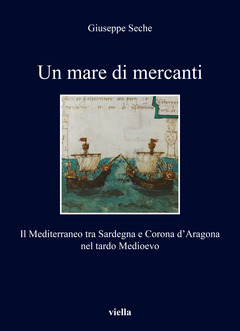
Publication – Giuseppe Seche,  » Un mare di mercanti. Il Mediterraneo tra Sardegna e Corona d’Aragona nel tardo Medioevo »

Mercanti e navigatori cagliaritani, Antoni, Arnau, Julià e Nicolau Dessì portarono avanti i propri affari nelle principali città del Mediterraneo catalano-aragonese, collaborando con colleghi iberici e italiani. Partendo dalle loro vicende, il libro analizza la costruzione delle reti sociali, i problemi della navigazione, la gestione delle transazioni e traccia i profili di piccoli e medi uomini d’affari, la cui attività permise la connessione tra i mercati regionali e il commercio internazionale, favorendo iniziative imprenditoriali locali e lo sviluppo di distretti produttivi specializzati.

Lo studio si basa su una fonte nuova ed eccezionale, costituita da centinaia di lettere commerciali e carte familiari che, oltre a dimostrare le abilità scrittorie di artigiani, donne e operatori economici, consentono di gettare nuova luce su quel grande mare di mercanti che fu il Mediterraneo quattrocentesco.

Giuseppe Seche è assegnista di ricerca presso l’Università di Cagliari e docente a contratto di Storia medievale presso l’Università di Sassari. I suoi interessi di studio si focalizzano sulla storia culturale, economica e sociale del Mediterraneo tardomedievale. Tra le sue ultime pubblicazioni, Libro e società in Sardegna tra Medioevo e prima Età moderna (Firenze, Olschki, 2018).

Table des matières :

Introduzione

1. Fonti e produzione scritta nella Sardegna tardomedievale
2. La società mercantile: uomini d’affari e reti commerciali
3. Merci, trasporti e produzioni
4. Il circuito commerciale

Conclusione

Appendici
Bibliografia
Indice dei nomi di persona
Indice dei nomi di luogo

Informations pratiques :

Giuseppe Seche, Un mare di mercanti. Il Mediterraneo tra Sardegna e Corona d’Aragona nel tardo Medioevo, I Libri di Viella, 2020. pp. 308, 15×21 cm, bross. ISBN: 9788833134505. Prix : 35 euros.

Source : Viella

Publié dans Publications | Laisser un commentaire

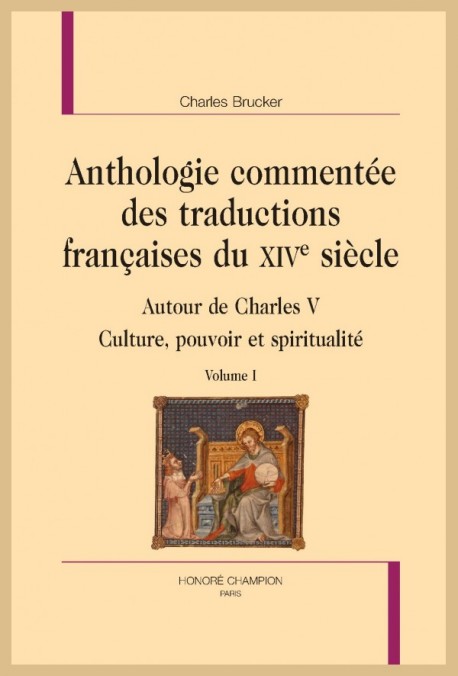
Publication – « Anthologie commentée des traductions françaises du XIVe siècle », vol. 1 : « Autour de Charles V. Culture, pouvoir et spiritualité », éd. Charles Brucker

Ce recueil de traductions françaises du XIVe siècle est destiné à montrer, dans les limites d’une période précise, celle qui s’étend des derniers Capétiens aux premiers Valois, la diversité des pratiques de traduction en moyen français et à mettre en valeur ses conséquences sur le mode d’expression de ceux qui traduisaient les auteurs latins, antiques ou médiévaux. Ces traductions sont presque toutes commanditées par un prince, une princesse ou un roi, si bien que des liens plus ou moins étroits se tissent entre le dédicataire et le « translateur » ; dans ces conditions, ce genre littéraire reflète nécessairement une certaine conception du pouvoir que se fait le traducteur, et le pouvoir politique participe au renouveau de l’humanisme du XIVe siècle en France. Enfin, à cette époque, la conception de la royauté est liée à la spiritualité, dont l’expression revêt des formes diverses : Charles V est le « sage roi dévot ».

Charles Brucker est professeur émérite à l’Université de Lorraine (Lettres, Nancy). Sa spécialité porte sur l’histoire du vocabulaire français et sur l’édition de textes inédits du moyen français, notamment de traductions du latin classique et médiéval. Il a enseigné l’histoire de la langue française, la linguistique comparée des langues romanes ainsi que la langue et la littérature françaises du Moyen Âge.

Table des matières : ici

Informations pratiques :

Anthologie commentée des traductions françaises du XIVe siècle, vol. 1 : Autour de Charles V. Culture, pouvoir et spiritualité, éd. Charles Brucker, Paris, Honoré Champion, 2020. (Linguistique, traduction et terminologie, 2). 976 p. ISBN : 9782745353368. Prix : 98 euros.

Source : Honoré Champion

Publié dans Publications | Laisser un commentaire

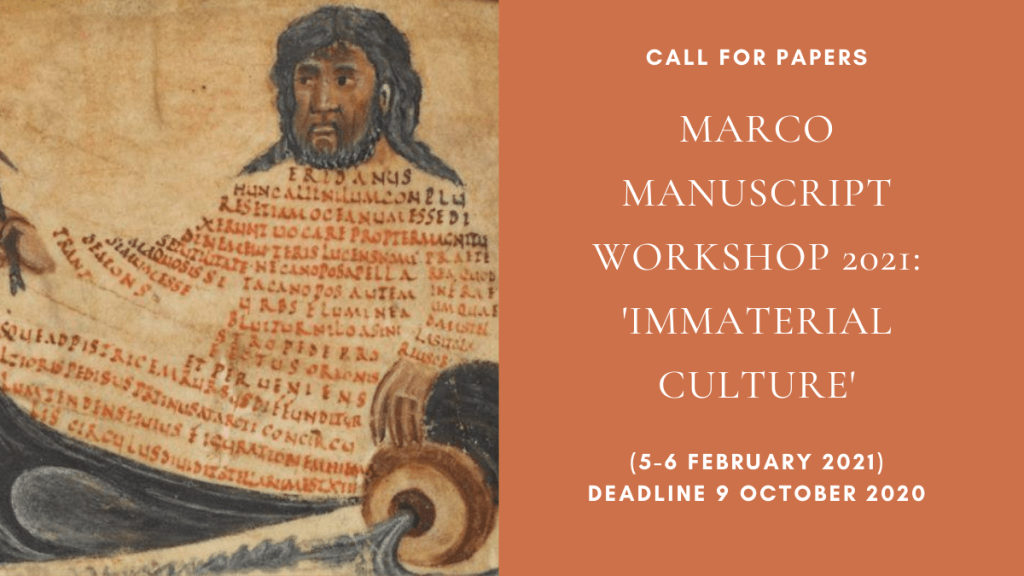
Appel à contribution – Marco Manuscript Workshop 2021: ‘Immaterial Culture’

Remotely from the Marco Institute for Medieval and Renaissance Studies, the University of Tennessee, Knoxville

Presenters will receive a $500 honorarium for their participation. The sixteenth annual Marco Manuscript Workshop will take place Friday, February 5, and Saturday, February 6, 2021. Sessions will meet virtually via an online platform.

The workshop is led by Professors Maura K. Lafferty (Classics) and Roy M. Liuzza (English), and is hosted by the Marco Institute for Medieval and Renaissance Studies at the University of Tennessee, Knoxville.

This year’s workshop will consider some of the recent challenges that researchers have faced with the suspension of travel, the closing of libraries and universities, and the quarantine restrictions that have kept so many of us in our homes.

How can our field, which has always emphasized the importance of physical place and tactile artifacts, work successfully in isolation and at a distance? What does it mean for us when our work takes place in an incorporeal world of light and numbers rather than ink and flesh, in matrices of data rather than dusty rooms?

We propose to explore the advantages and disadvantages of this “immaterial culture,” and to think about how our work is shaped by access or lack of access to manuscripts, texts, catalogues, and objects. We would like to hear about experiences working remotely, discoveries made using virtual archives or catalogues, or advice on how to study manuscripts without visiting archives or how to teach codicology without a library. We welcome stories of scholars who have been productive in constrained circumstances.

We would also like to learn from the experience of those for whom archives have been inaccessible for other reasons – scholars who are homebound, visually impaired, or otherwise physically challenged, or those whose access to libraries and collections has been restricted or denied. How have these constraints shaped your work? What can these experiences tell us about our discipline? We welcome presentations on any aspect of this topic, broadly imagined.The workshop is open to scholars and graduate students in any field who are engaged in textual editing, manuscript studies, or epigraphy.

This year’s workshop will be virtual, but we hope to retain as much of the format and the flavor of our in-person meetings as possible. Individual 75-minute sessions will be devoted to each project; participants will be asked to introduce their text and its context, discuss their approach to working with their material, and exchange ideas and information with other participants.

We will prepare an online repository where presenters can place abstracts, presentations, or supporting material for access by all attendees. As in previous years, the workshop is intended to be more like a class than a conference; participants are encouraged to share new discoveries and unfinished work, to discuss both their successes and frustrations, to offer practical advice and theoretical insights, and to work together towards developing better professional skills for textual and codicological work.

We particularly invite the presentation of works in progress, unusual problems, practical difficulties, and new or experimental models for studying or representing manuscript texts.The deadline for applications is October 9, 2020.

Applicants are asked to submit a current CV and a two-page abstract of their project to Roy M. Liuzza, preferably via email to rliuzza@utk.edu.

The workshop is also open at no cost to scholars and students who do not wish to present their own work but are interested in sharing a lively weekend of discussion and ideas about manuscript studies. In order to keep the virtual sessions manageable, preregistration will be required and spaces will be limited.

Further details will be available later in the year; please contact the Marco Institute at marco@utk.edu for more information.

Source : Medieval Art Research

Publié dans Appel à contributions | Laisser un commentaire