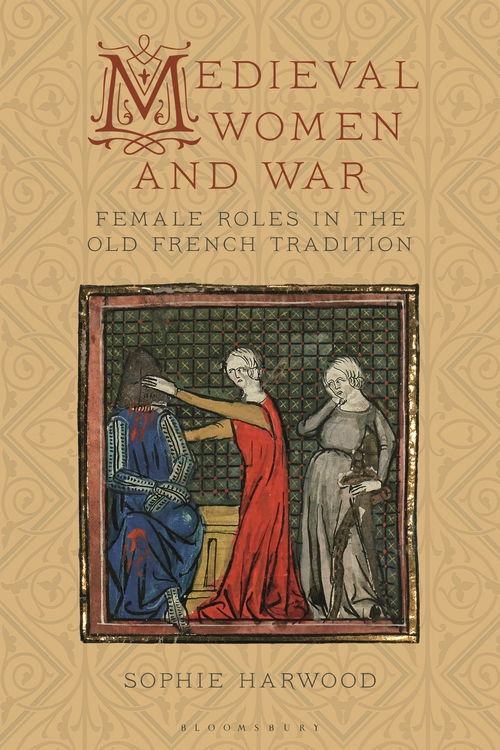
For the first time, Sophie Harwood uses the Old French tradition as a lens through which to examine women and warfare from the 12th to the 14th centuries. The result is a skilled analysis of gender roles in the medieval era, and a heightened awareness of how important literary texts are to our understanding of the historical period in which they circulated.
Medieval Women and War examines both the text and illustrations of over 30 Old French manuscripts to highlight the ways in many of the texts differ from their traditionally assumed (usually classical) sources. Structured around five pivotal female types – women cited as causes for violence, women as victims of violence, women as ancillaries to warriors, women as warriors themselves, and women as political influences – this important book unpicks gendered boundaries to shed new light on the social, political and military structures of warfare as well as adding nuance to current debates on womanhood in the middle ages.
Table des matières :
List of Figures List of Tables Acknowledgements Notes on the Text List of Abbreviations and Sigils
Introduction Reading Texts through the Manuscript Tradition, 1150 – 1400 Women as Reasons for War Women as Victims of War Women as Ancillaries in War Women as Warriors in War Women as Diplomats in War Conclusion
Appendix 1. Catalogue of Manuscripts Appendix 2. Manuscript Illustrations of Women Bibliography Index
Informations pratiques :
Sophie Harwood, Medieval Women and War Female Roles in the Old French Tradition, Bloomsbury, 2020. 234 x 156 mm. 232 p., 30 ill. ISBN : 9781788315197. Prix : 76,5 £.
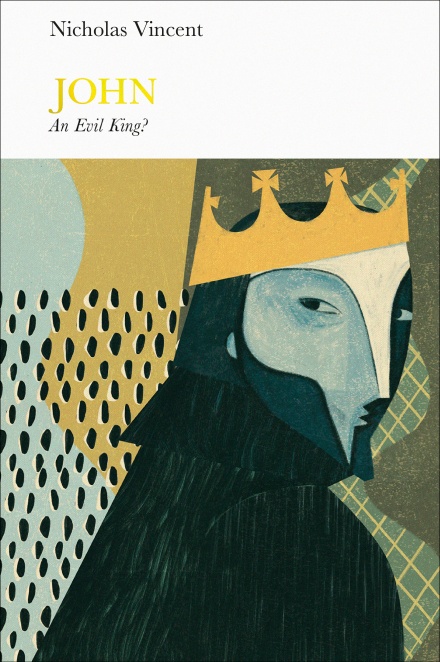
King John ruled England for seventeen and a half years, yet his entire reign is usually reduced to one image: of the villainous monarch outmanoeuvred by rebellious barons into agreeing to Magna Carta at Runnymede in 1215. Ever since, John has come to be seen as an archetypal tyrant. But how evil was he?
In this perceptive short account, Nicholas Vincent unpicks John’s life through his deeds and his personality. The youngest of four brothers, overlooked and given a distinctly unroyal name, John seemed doomed to failure. As king, he was reputedly cruel and treacherous, pursuing his own interests at the expense of his country, losing the continental empire bequeathed to him by his father Henry and his brother Richard and eventually plunging England into civil war. Only his lordship of Ireland showed some success. Yet, as this fascinating biography asks, were his crimes necessarily greater than those of his ancestors – or was he judged more harshly because, ultimately, he failed as a warlord?
Informations pratiques :
Nicholas Vincent, John. An Evil King?, Penguin Books, Londres, 2020. 144 p. ISBN : 9780141977690. Prix : 14,99 £.
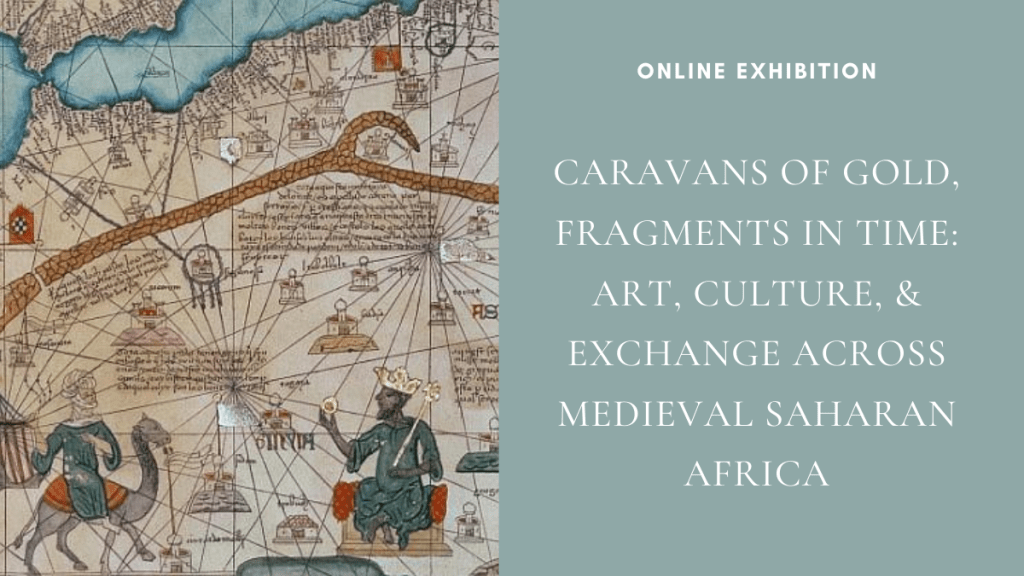
Travel along routes crossing the Sahara Desert to a time when West African gold fueled expansive trade and drove the movement of people, culture, and religious beliefs. Caravans of Gold is the first major exhibition addressing the scope of Saharan trade and the shared history of West Africa, the Middle East, North Africa, and Europe from the eighth to sixteenth centuries. Weaving stories about interconnected histories, the exhibition showcases the objects and ideas that connected at the crossroads of the medieval Sahara and celebrates West Africa’s historic and underrecognized global significance.
La réflexion sur ce qui sépare l’état de paix et l’état de guerre conditionne l’histoire de la diplomatie dans la mesure même où, dans l’histoire politique de l’Ancien Régime, la gestion efficace et immédiate des conflits armés – ouverts, programmés ou potentiels – constitue une exigence majeure du bon gouvernement des communautés. À côté du fracas des armes, avant ou après lui mais aussi pendant, se développent continument des pratiques de communication et d’échange dont le but premier est de dessiner le cadre possible des relations correctes entre communautés, quels que soient les forces, les jeux d’échelle, les territoires de référence et les horizons en présence. Ces pratiques sont particulièrement polymorphes et flexibles et, avant même de faire l’objet de traités et de donner un contenu au nouveau métier d’ambassadeur – à compter du XVIIe siècle surtout –, elles se construisent à tâtons selon des tempos, des coutumes, des discours, des écritures et des hiérarchies évolutifs. Ainsi est posée une autre façon de faire de la politique. Ainsi émerge, au fil de l’histoire que l’on peut en faire, un pan crucial de la régulation du système des États.
zq<
Table des matières :
Jean-Louis FOURNEL Avant-propos. Entre la paix et la guerre, le travail de l’ambassade Remerciements
I PRATIQUES ET USAGES
Stéphane PEQUIGNOT Les « journaux d’ambassade » en Occident à la fin du Moyen Âge Óscar VILLARROEL GONZÁLEZ L’ambassadeur et sa charge en Castille au XVe siècle : renouvellement ou consolidation ? Bruno FIGLIUOLO La vita quotidiana dell’ambasciatore residente Joël BLANCHARD Héritages, glissements, créations : la diplomatie de Louis XI Hélène SOLDINI Les sous-ambassadeurs de la République florentine. Francesco Nasi au service de la délégation à Rome (automne 1529) Fiona LEJOSNE « Negotiare, servire, et tener secrete le cose negotiate, et scritte ». Le memoriale de Giovanni Carlo Scaramelli (1550-1608), secrétaire d’ambassade vénitien Francesco SENATORE Diplomazia dentro e fuori : le ambascerie della città di Capua (1504-1559) Juan Carlos D’AMICO « L’art de la diplomatie » : un métier à risque pendant les guerres d’Italie Bertrand HAAN Jeu diplomatique et lien amical au XVIe siècle Jean-Luc NARDONE L’étoffe des ambassadeurs : de l’art des présents diplomatiques à l’occasion du mariage (raté) entre le prince de Galles et l’Infante d’Espagne (1623) Fabrice MICALLEF Quel conseiller est l’ambassadeur ? Théories et réalités d’une pratique politique à la fin du XVIe siècle (France, Italie) Françoise JIMÉNEZ La justice royale face au corps diplomatique à Madrid au milieu du XVIIe siècle
II ÉCRITURES, LANGAGES ET PENSÉE POLITIQUE
Isabella LAZZARINI Discours diplomatique, discours politique. La création d’un langage nouveau dans les correspondances diplomatiques italiennes au XVe siècle Filippo DE VIVO Discorsi, cerimoniali, esposizioni : oralità e registrazione delle udienze diplomatiche in Italia tra Quattro e Seicento Elena BONORA Lettres chiffrées, langages métaphoriques et information politique dans l’Italie de Charles Quint Luca D’ONGHIA Note linguistiche e testuali sulle relazioni degli ambasciatori veneti (sec. XVI) Romain DESCENDRE « Fra e’ signori la fanno solo observare l’armi ». Diplomazia e politica estera in Machiavelli Raffaele RUGGIERO Baldassarre Castiglione a Londra, Blois e Madrid Dante FEDELE La « reconnaissance » dans le processus de constitution de l’État. Pour une revue critique du rapport entre diplomatie et souveraineté à la fin du Moyen Âge et au début de l’époque moderne Paolo CARTA et Dorota GREGOROWICZ Nunziature e politica nel ’500. L’istituto e i suoi aspetti critici
INDEX DES NOMS CITÉS
Informations pratiques :
Ambassades et ambassadeurs en Europe (XVe-XVIIe siècles) : pratiques, écritures, savoirs, éd. Jean-Louis Forunel, Matteo Residori, Genève, Droz, 2020 (Cahiers d’Humanisme et Renaissance). ISBN : 978-2-600-06040-0. Prix : 49 euros.
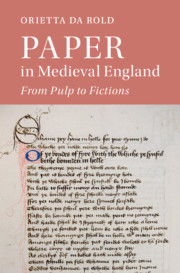
Orietta Da Rold provides a detailed analysis of the coming of paper to medieval England, and its influence on the literary and non-literary culture of the period. Looking beyond book production, Da Rold maps out the uses of paper and explains the success of this technology in medieval culture, considering how people interacted with it and how it affected their lives. Offering a nuanced understanding of how affordance influenced societal choices, Paper in Medieval England draws on a multilingual array of sources to investigate how paper circulated, was written upon, and was deployed by people across medieval society, from kings to merchants, to bishops, to clerks and to poets, contributing to an understanding of how medieval paper changed communication and shaped modernity.
Dr Orietta Da Rold is Lecturer in Literature and Material Text, 1100 to 1500 at the University of Cambridge. She is the Co-Director (with Elaine Treharne) of the successful AHRC-funded project and e-book, English Manuscripts 1060 to 1220 and is currently editing the Cambridge Companion to British Manuscripts with Elaine Treharne.
Table des matières :
Paper and culture in medieval England: an introduction 1. Paper stories 2. The economics of paper 3. Writing on paper 4. The character of paper and its use in medieval books 5. Paper in the medieval literary imagination 6. Epilogue: the age of paper.
Informations pratiques :
Orietta Da Rold, Paper in Medieval England. From Pulp to Fictions, Cambridge, Cambridge University Press, 2020. ISBN : 9781108840576. Prix : 75 £.
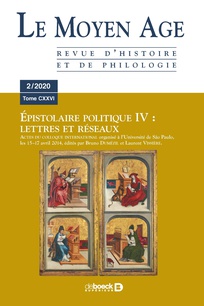
Épistolaire politique IV : lettres et réseaux, dir. Laurent Vissière et Bruno Dumézil, Le Moyen Âge, t. 127, 2020/2. 236 p.
Table des matières :
Laurent Vissière, Bruno Dumézil – Lettres et réseaux au Moyen Âge. Épistolaire politique IV
Adrien Bayard – Réseaux et lieux de pouvoir au très haut Moyen Âge. Les lettres face à l’archéologie Martin Gravel – Les lettres des autres : correspondances et réseaux en filigrane des grandes collections carolingiennes Michaël Cousin – Un réseau épistolaire dans la tourmente des intrigues politiques : Gerbert d’Aurillac et ses correspondants au cœur de la lutte pour le pouvoir entre Ottoniens, Carolingiens et Capétiens (984–989) Micol Long – « Il est jeune, honnête, instruit, accueille-le » : pour une analyse d’ensemble des lettres de recommandation du XIIe siècle Annick Peters-Custot – Stratégies épistolaires et réforme grégorienne : le cas de l’Italie méridionale normande Armand Jamme – « Networking » d’un espace chrétien ? Représentativité et réseaux de la correspondance pontificale aux XIIIe et XIVe siècles Cécile Becchia – Les échanges épistolaires professionnels et privés d’un procureur de Dijon au XVe siècle
La Tempérance, une des quatre vertus premières des Stoïciens devenues ensuite les vertus cardinales, est étudiée ici dans les divers sens qu’elle prend de la fin du Moyen Âge au début de l’âge classique. Le volume, qui comprend une abondante anthologie, suit le modèle de celui qui a porté sur la vertu de Prudence.
La Vertu de tempérance entre Moyen Âge et âge classique, éd. Giuliano Ferretti, François Roudaut et Jean-Pierre Dupouy, Paris, Classiques Garnier, 2020 (Rencontres, n° 433). 917 pages. ISBN : 978-2-406-09664-1. Prix : 83 euros.
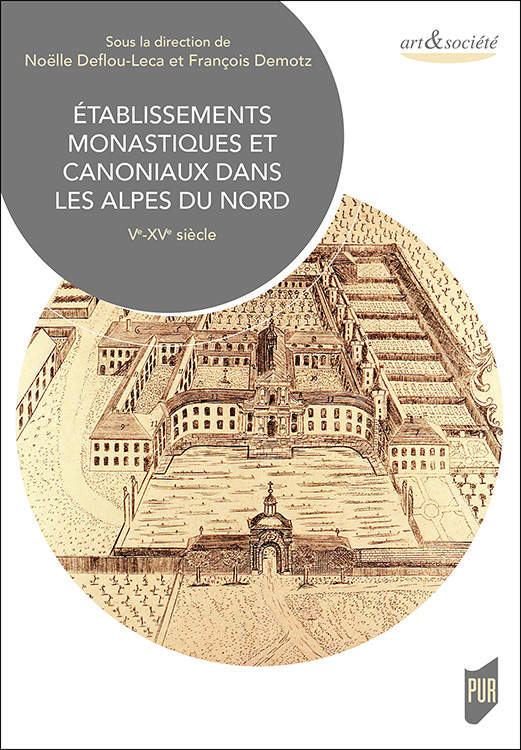
Les Alpes du nord représentent un paradoxe dans le monachisme médiéval. Elles constituent un lieu privilégié de son développement depuis ses débuts en Gaule, avec des exemples illustres et fondateurs comme à Saint-Maurice d’Agaune dès le VIe siècle. Il faut cependant attendre près de six siècles, pour assister à une nouvelle installation d’importance avec celle de la Chartreuse de saint Bruno (1084).
Établissements monastiques et canoniaux dans les Alpes du nord, Ve-XVe siècle, dir. Noëlle Deflou-Leca et François Demotz, Rennes, Presses universitaires de Rennes, 2020 (Art & Société). 17 x 24 cm, 352 p. ISBN : 978-2-7535-7933-0. Prix : 28 euros.
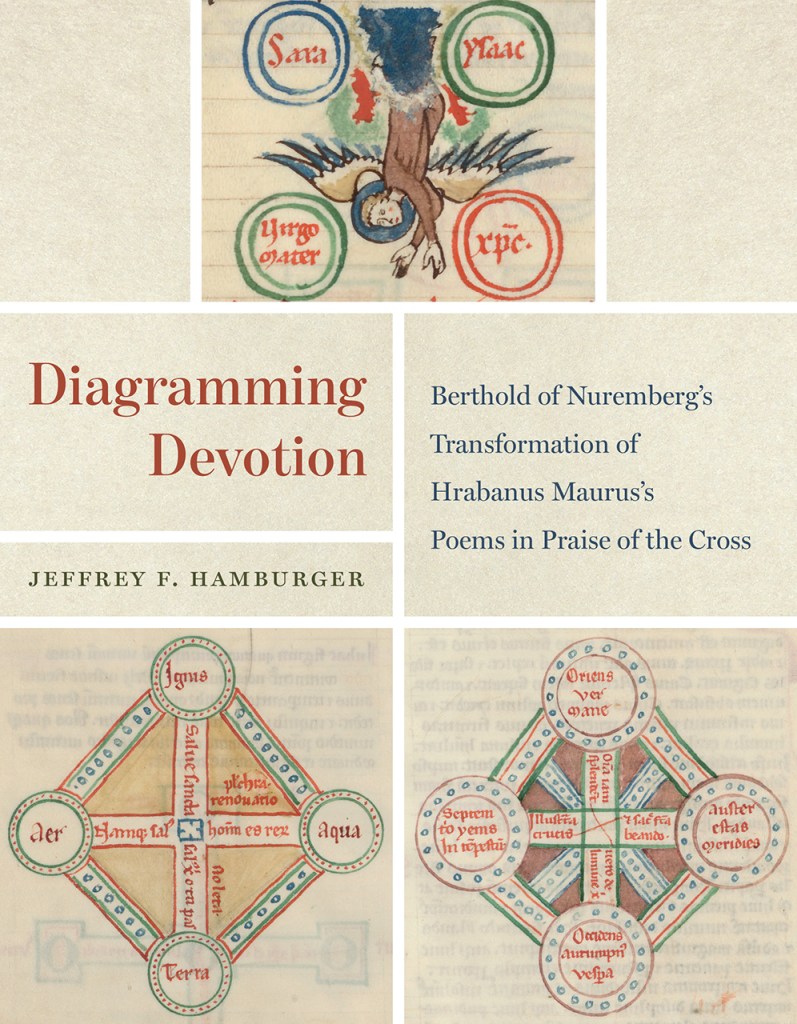
During the European Middle Ages, diagrams provided a critical tool of analysis in cosmological and theological debates. In addition to drawing relationships among diverse areas of human knowledge and experience, diagrams themselves generated such knowledge in the first place. In Diagramming Devotion, Jeffrey F. Hamburger examines two monumental works that are diagrammatic to their core: a famous set of picture poems of unrivaled complexity by the Carolingian monk Hrabanus Maurus, devoted to the praise of the cross, and a virtually unknown commentary on Hrabanus’s work composed almost five hundred years later by the Dominican friar Berthold of Nuremberg. Berthold’s profusely illustrated elaboration of Hrabnus translated his predecessor’s poems into a series of almost one hundred diagrams. By examining Berthold of Nuremberg’s transformation of a Carolingian classic, Hamburger brings modern and medieval visual culture into dialogue, traces important changes in medieval visual culture, and introduces new ways of thinking about diagrams as an enduring visual and conceptual model.
Informations pratiques :
Jeffrey F. Hamburger, Diagramming Devotion: Berthold of Nuremberg’s Transformation of Hrabanus Maurus’s Poems in Praise of the Cross, Chicago, The University of Chicago Press, 2020. 384 pages | 220 color plates, 1 halftone | 8 1/2 x 11. ISBN: 9780226642819. Prix : 65 $.
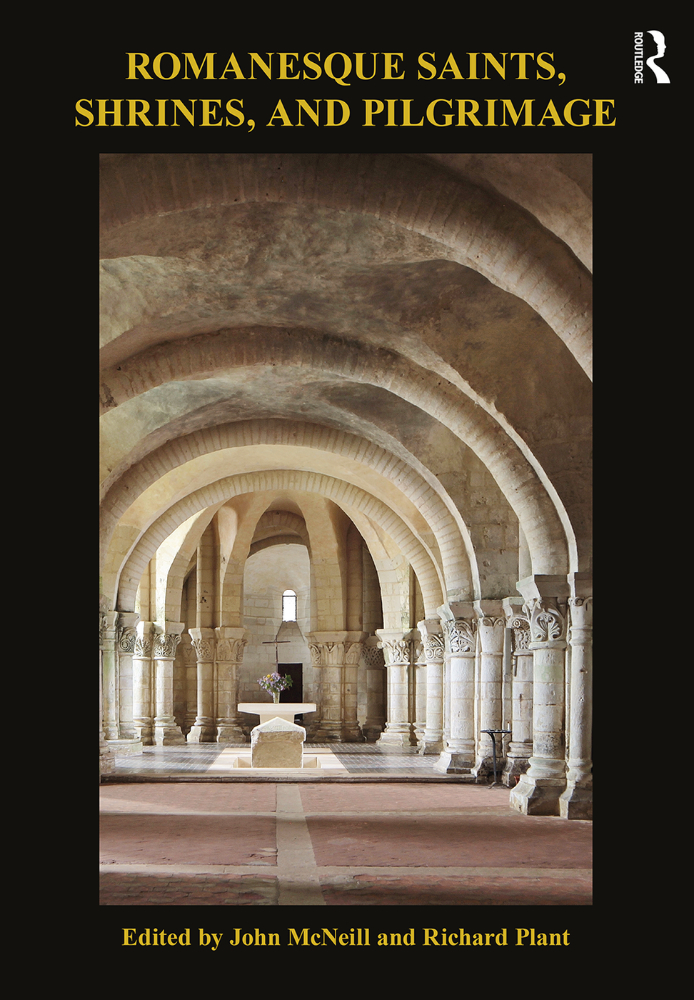
The 23 chapters in this volume explore the material culture of sanctity in Latin Europe and the Mediterranean between c. 1000 and c. 1220, with a focus on the ways in which saints and relics were enshrined, celebrated, and displayed.
Reliquary cults were particularly important during the Romanesque period, both as a means of affirming or promoting identity and as a conduit for the divine. This book covers the geography of sainthood, the development of spaces for reliquary display, the distribution of saints across cities, the use of reliquaries to draw attention to the attributes, and the virtues or miracle-working character of particular saints. Individual essays range from case studies on Verona, Hildesheim, Trondheim and Limoges, the mausoleum of Lazarus at Autun, and the patronage of Mathilda of Canossa, to reflections on local pilgrimage, the deployment of saints as physical protectors, the use of imagery where possession of a saint was disputed, island sanctuaries, and the role of Templars and Hospitallers in the promotion of relics from the Holy Land.
The book will serve historians and archaeologists studying the Romanesque period, and all those interested in material culture and religious practice in Latin Europe and the Mediterranean c.1000–c.1220.
Romanesque Saints, Shrines, and Pilgrimage, éd. John McNeill, Richard Plant, Routledge, 2020. 308 Pages – 23 Color & 306 B/W Illustrations. ISBN 9780367202071. Prix : 23,99 £.
Avec le soutien du FNRS, du CRHiDI (UCLouvain – Saint-Louis, Bruxelles), d'INCAL (UCLouvain), de PraME (UNamur), de sociAMM (ULB) et de Transitions (ULiège)







Vous devez être connecté pour poster un commentaire.