Publication – Agostino Paravicini Bagliani, « Le monde symbolique de la papauté. Corps, gestes, images d’Innocent III à Boniface VIII »

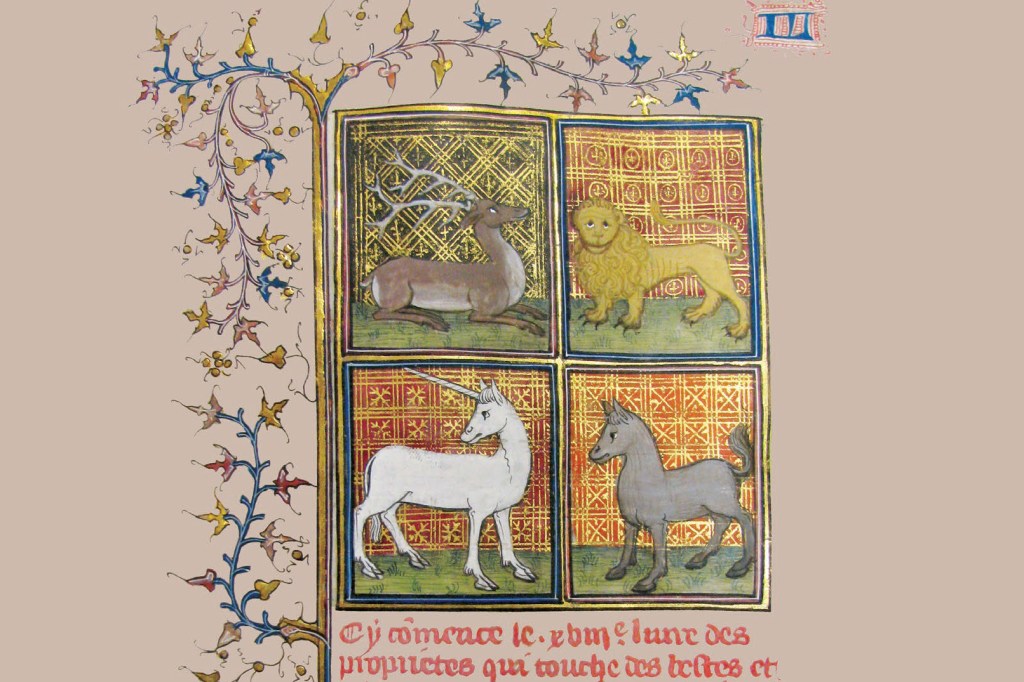
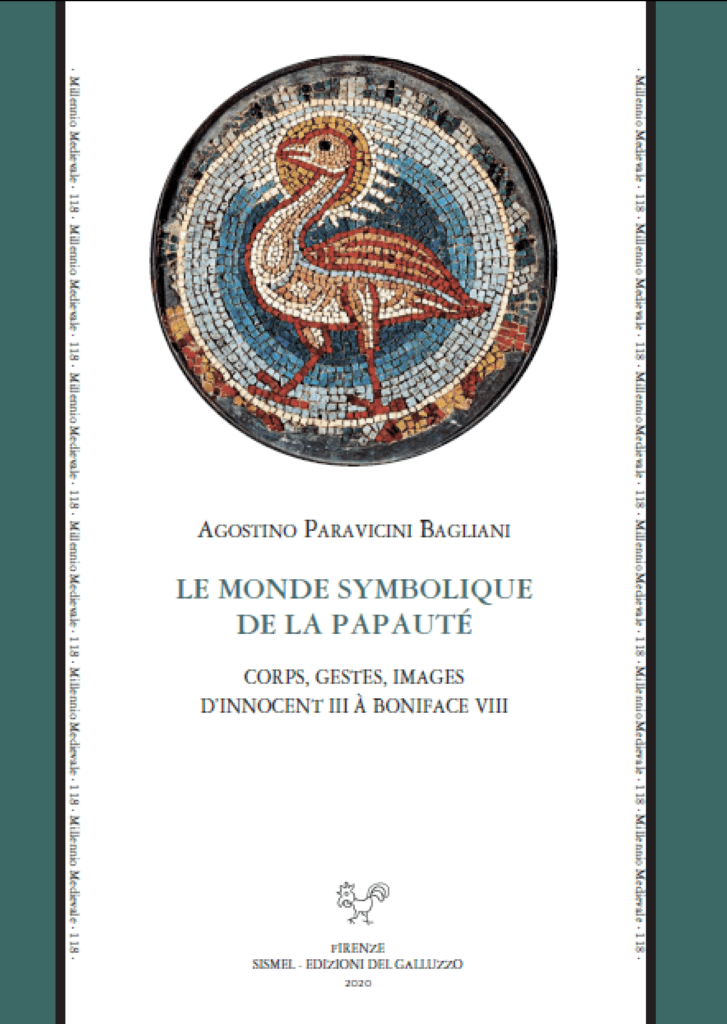
Entre Innocent III (1198-1216) et Boniface VIII (1294-1303) métaphores, titres, objets, rites, figures animales et savoir médical donnent vie à une opération d’auto- représentation qui n’a pas d’égal dans l’histoire de la papauté. Corps, gestes et images créent un monde symbolique ayant au centre la personne même du pape – physique et institutionnelle. Ce volume réunit vingt essais en langue française. Certains sont inédits et ceux qui avaient déjà publiés ont été mis à jour.
Tables des matières :

I. CORPS: Le Corps du pape, vingt ans après

Le prestige de la médecine et des médecins à la cour pontificale, d’Innocent III à Boniface VIII – Quelle prolongation de la vie dans les traités adressés aux pontifes romains (XIIIe-XVIe siècles)? – Tommaso Rangoni (1493-1577) et la prolongévité des papes.

II. GESTES ET RITES:

La Garcineida et le cérémonial de la cour pontificale – Les festins des papes – Cérémonial et auto-représentation (XIe-XIIIe siècles) – Le rite pontifical de l’Eucharistie – Les baisers liturgiques entre papes et cardinaux (XIIIe- XVe siècles) – Boniface VIII et le Jubilé de 1300: quelles cérémonies publiques? – Boniface VIII, violence du verbe et émotivité – Le pape est-il peut-il tomber dans l’erreur? A propos du rituel de canonisation au Moyen Âge? – Rituels et pratiques funéraires à la Curie romaine. – Hiérarchies et prestige curial (XIIIe-XVe siècles) – Le pape peut-il s’habiller en vert?

III. IMAGES:

Grégoire VII et l’excommunication. À propos des figures des apôtres Pierre et Paul sur les bulles pontificales – Le pape, inter deum et hominem constitutus. Autour d’une métaphore de Geoffroy de vin sauf et d’Innocent III – Le cheval blanc du pape. Symbolique et auto-représentation (XIIe-XIIIe siècles) – Autour de la tiare aux plumes de paon – Robert d’Uzès et la symbolique pontificale. La tiare «haute une coudée» (cubitus) – Avignon, une autre Rome? – Animaux et figures identitaires du pape (XIIIe-XVIIe siècles).

Informations pratiques :

Agostino Paravicini Bagliani, Le monde symbolique de la papauté. Corps, gestes, images d’Innocent III à Boniface VIII, Florence, SISMEL, 2020 (Millennio Medievale, 118). XXIII-350, € 76,00. ISBN : 978-88-8450-975-8.

Source : SISMEL
Publié dans Publications | Laisser un commentaire

Colloque – Networks of Manuscripts, Networks of Texts

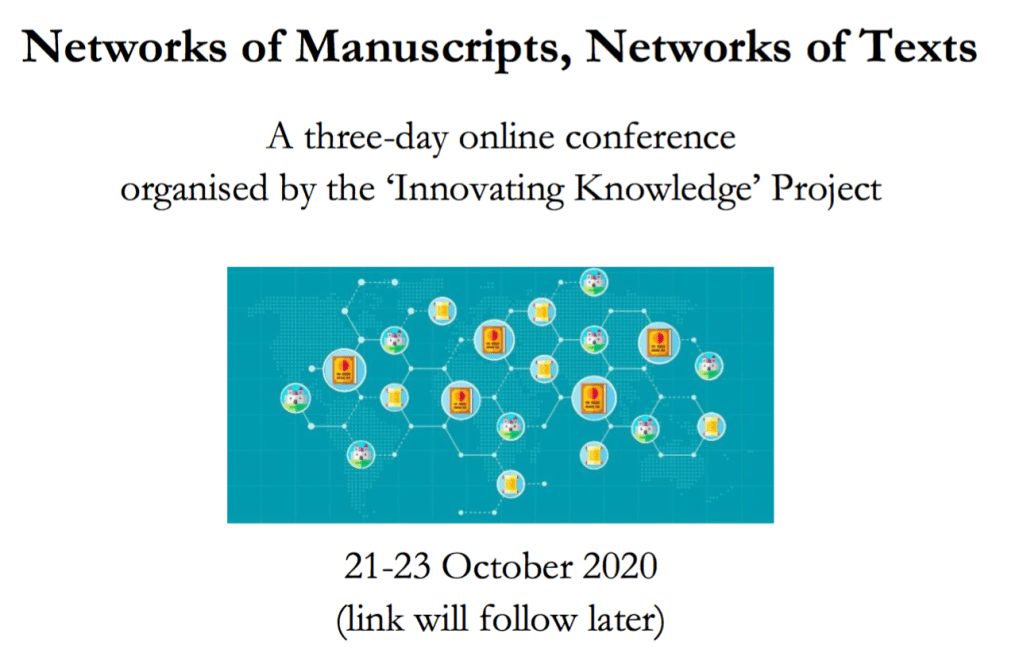
A three-day online conference organised by the ‘Innovating Knowledge’ Project
21-23 October 2020 (link will follow later).

Programme :

Wednesday, 21 october

13.15 – 13.30 Welcome

Network Analysis as a Method for the Study of Manuscripts

13.30 – 14.10 14.20 – 15.00 15.10 – 15.50

16.00 – 17.00

Gustavo Fernández Riva (University of Heidelberg): Networks of Shared Manuscript Transmission for Medieval European Vernacular Languages. Evaluating the Data and the Method
Andreas Kuczera (Akadmie für Wissenschaften und Literatur, Mainz)/Martin Fechner (Berlin-Brandenburg Academy of Sciences and Humanities): Aristoteles multimodal – with ediarum to the graph
Evina Steinová (Huygens ING): Travelling Annotations: Network Analysis as a Tool to Study Glossing Networks in Carolingian Europe

Mix and Match session for speakers

Thursday, 22 October

Networks of People

Session introduction
Catherine Emerson (NUI Galway): Textual and personal networks: The Chronique Abrégée in fifteenth-century Paris
Katharina Kaska (Austrian State Library): Scribal and textual networks – collaboration and exchange in manuscripts and scriptoria
Katarzyna Anna Kapitan (University of Iceland): A saga in a network and a network of a saga

Networks of Influence

Dominique Stutzman (IRHT Paris)/Louis Chevalier (IRHT Paris): Books of hours as text compilations in the Low countries
Shari Boodts (Radboud University Nijmegen)/Iris Denis (Radboud University Nijmegen): A sermon by any other name? The pseudo-Augustinian S. App. 121 and its medieval textual network
Richard Matthew Pollard (University of Montreal): What do the Church Fathers, Scientific Fathers, and Military Fathers have in common?

Round Table for conference participants

Keynote: Matteo Valleriani (Max Planck Institute for the History of Science/Technische Universität Berlin/Tel Aviv University): Early Modern University Textbooks: How to Gain Hegemony

Friday, 23 October

Networks of Reuse and Repurposing

Ina Serif (University of Basel): From Networks of Texts to Networks of Genres? On the Classification ofTexts in Compilations with a View towards Manuscript Transmission
Sara Steffen (University of Basel): Audible Networks: Connecting Texts through Music in 16th-Century Swiss Broadsheet Ballads
Jialong Liu (Leiden University): Text Reuse in the Medieval Chinese Public Inscriptions (618-907)

Networks of Knowledge Transfer

Session introduction : Immo Warntjes (Trinity College Dublin): Computistical objects and intellectual networks in the Carolingian age
Agata Paluch (Freie Universität Berlin): Patterns ofKnowledge Circulation in Early Modern East-Central Europe: Tracing Jewish Kabbalistic Textual Units in Multiple- Text Manuscripts
Elizabeth Archibald (Pittsburgh University): Medieval Library Catalogues and Intellectual Networks

Round Table for conference participants Conference wrap-up

For more information, please contact Evina Steinová (evina.steinova@gmail.com or evina.steinova@huygens.knaw.nl)

Publié dans Colloque | Laisser un commentaire

Publication en ligne – « Appréhender les catégories zoologiques dans les sociétés du passé », éd. Brémont A., Boudes Y., Thuault S. & Ben Saad M.

Accès : ici

Ce volume thématique fait suite au colloque « Appréhender les catégories zoologiques dans les sociétés du passé », tenu en mars 2019 à Paris et qui a réuni une cinquantaine d’historiens, philosophes et scientifiques autour d’un questionnement épistémologique sur les sources et les méthodes permettant d’appréhender les catégorisations des animaux dans les sociétés anciennes.

La richesse de ce colloque, et du volume en résultant, tient tout d’abord à la variété des sociétés évoquées, préhistoriques, antiques ou médiévales mais aussi européennes, asiatiques ou africaines. Elle tient également à une démarche comparatiste permettant de confronter les problèmes méthodologiques communs et d’explorer la diversité des sources qu’elles soient lexicales, iconographiques ou archéologiques.

Table des matières :

Baudouin Van den Abeele – Classifier et inventorier le monde animal : les choix des encyclopédies médiévales latines (VIIe-XIIIe siècles)
Kaouthar Lamouhi Chebbi & Mehrnaz Katouzian-Safadi – La classification des animaux sauvages chez un naturaliste et médecin du Xe siècle Aḥmad Ibn Abī al-Ašʿaṯ
Aurélia Borvon et Charles Viaut – Des bestes médiévales aux espèces linnéennes : autour de la classification de quelques espèces en contexte castral au Moyen Âge
Riccardo Andreozzi – Categorizing reptiles in Ancient Egypt: an overview of methods
Vérène Chalendar – De quelques principes de classement de la faune par les savants mésopotamiens du premier millénaire av. J.-C.
Rafael Afonso Gonçalves – Nommer les animaux des Indes : quelques considérations sur la faune décrite dans les récits de voyage entre la fin du XIIIe et le début du XVIe siècle
Anne Levillain – D’Homère à Aristote : le porc et le sanglier, figures domestique et épique
Axelle Brémont – Appréhender les catégories zoologiques en anthropologie historique : enjeux méthodologiques et épistémologiques

Informations pratiques :

BRÉMONT A., BOUDES Y., THUAULT S. & BEN SAAD M. (eds) 2020. — Appréhender les catégories zoologiques dans les sociétés du passé/Appréhender les catégories zoologiques dans les sociétés du passé. Anthropozoologica, vol. 55, fasc. 2.

Source : Muséum national d’Histoire Naturelle

Publié dans Publications | Laisser un commentaire

Publication – « Anglo-Norman Studies XLII. Proceedings of the Battle Conference 2019 », dir. Stephen D. Church

The wide-ranging articles collected here represent the cutting edge of recent Anglo-Norman scholarship. There is a particular focus on historical sources for the eleventh and twelfth centuries, and especially on the key texts which are used by historians in understanding the past. There are articles on Eadmer’s Historia Novorum, Dudo of Saint-Quentin’s Historia Normannorum, the historical profession at Durham, and the use of charters to understand the role of women in the Norman march of Wales. Other contributions examine canon law in late twelfth-century England, and Angevin rule in Normandy in the time of Henry fitz Empress. The Old English world is also represented in the volume: there is a fresh investigation into Harold Godwineson’s posthumous reputation, and a new interpretation of the reign of Aethelred the Unready.

S.D. CHURCH is Professor of Medieval History at the University of East Anglia. Contributors: Emma Cavell, Catherine Cubitt, John Gillingham, Mark Hagger, Fraser McNair, Charles C. Rozier, Nicholas Ruffini-Ronzani, Danica Summerlin, Ann Williams.

Table des matières :

Reassessing the Reign of King Æthelred the Unready – Katy Cubitt
The Art of Memory: The Posthumous Reputation of King Harold II Godwineson – Ann Williams
Women, Memory and the Genesis of a Priory in Norman Monmouth – Emma Cavell
The Sins of a Historian: Eadmer of Canterbury, Historia Novorum in Anglia. Books I-IV – John B Gillingham
Angevin Rule in the West of Normandy, 1154-1186: The View from Mont-Saint-Michel – Mark Hagger
‘A girly man like you can’t rule us real men any longer’: Sex, Violence and Masculinity in Dudo of Saint-Quentin’s Historia Normannorum – Fraser McNair
Compiling Chronicles in Anglo-Norman Durham, c/. 1100-1130 – Charles C. Rozier
The Counts of Louvain and the Anglo-Norman World, c. 1100-c. 1215 – Nicolas Ruffini-Ronzani
England, Normandy, and the Ecclesiastical ‘New Law’ in the Later Twelfth-Century – Danica Summerlin

Informations pratiques :

Anglo-Norman Studies XLII Proceedings of the Battle Conference 2019, dir. Stephen D. Church, Boydell & Brewer, 2020. 185 pages, 23.4×15.6 cm. 1 black and white, 5 line illustrations. ISBN : 9781783275328. Prix : 50£.

Source : Boydell & Brewer

Publié dans Publications | Laisser un commentaire

Podcast – Sergi Sancho Fibla, « Écrire la paraliturgie:Le Libro de devociones y oficios de Santo Domingo el Real »

Écrire la paraliturgie: Le Libro de devociones y oficios de Santo Domingo el Real (Madrid, XVe siècle), intervention au webinaire H37 Histoire et Cultures Graphiques, le 14 mai 2020.

Source : YouTube — H 37

Publié dans Podcast | Laisser un commentaire

Podcast – Desi Marangon, « Venice and Byzantium. Comparing alphabets and identities through the lens of epigraphical sources »

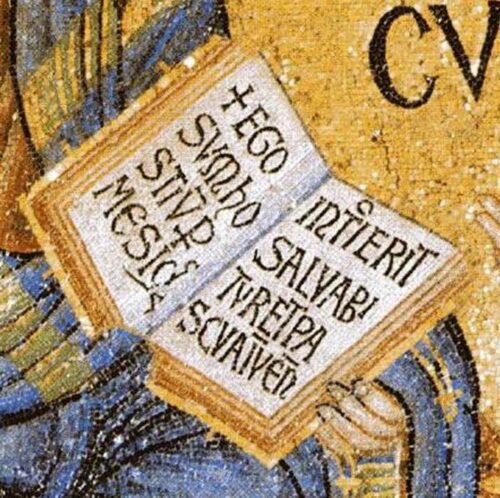
Desi Marangon (docteure, Université de Padoue), Venice and Byzantium. Comparing alphabets and identities through the lens of epigraphical sources

Accès : ici

Source : YouTube – H37

Publié dans Podcast | Laisser un commentaire

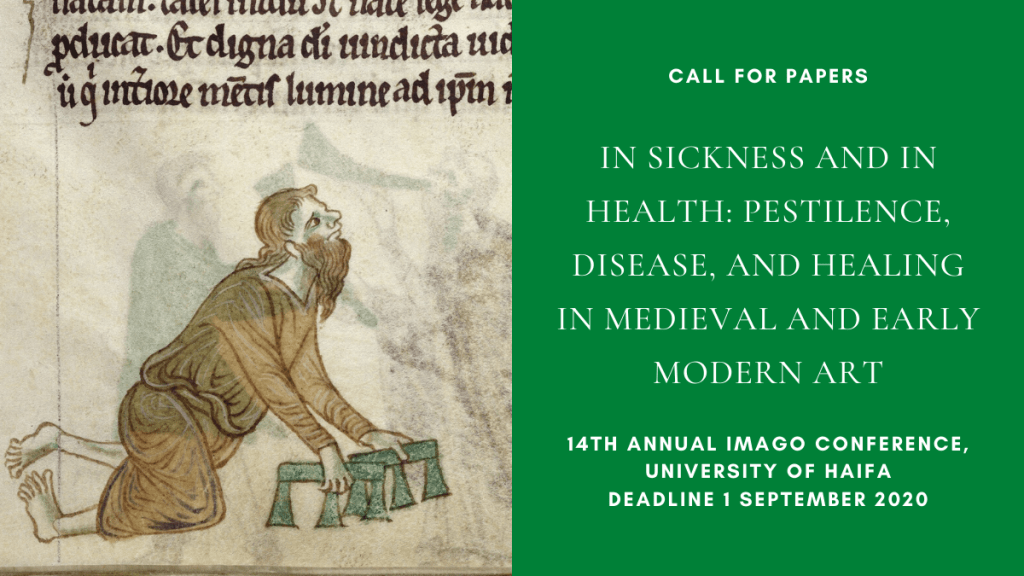
Appel à contribution – In Sickness and in Health: Pestilence, Disease, and Healing in Medieval and Early Modern Art

14th Annual Imago Conference, University of Haifa

In light of the global turmoil caused by the COVID-19 epidemic, the 14th AnnuaI Imago conference will examine the cultural and artistic impact of epidemics, diseases and healing in the art of the Middle Ages and the Early Modern Period. We hope this examination will not only shed new light on the artistic, social, and political mechanisms of both of these periods, but will also produce fresh insights into cultural and artistic responses to the current global health crisis.

Disease is an inevitable part of the human experience. Whether in times of acute crisis, the most familiar of which is the Black Death of the mid-14th century, or as a constant threat at all other times, diseases evoked varied responses, from theological formulations to the transmission of medicinal knowledge; and, not least, to artistic depictions.

We invite papers from broad and diverse points of view: case studies of iconographies dealing with disease or healings, studies of the artistic responses to specific epidemics, and comparative studies between East and West, the Christian and the Islamic worlds, etc. Interdisciplinary studies and those engaging with the production, reception, and interpretation of art concerned with disease and healing are of particular interest.

Suggest topics may include, but are not limited to:

  • Artistic expressions of medicinal practices
  • Visual components in medical manuscripts
  • Artistic responses to the Black Death and other epidemics
  • Physical and spiritual health – Medieval and Early Modern expressions
  • Diseases and otherness – xenophobic, racist, and anti-Semitic polemical visual expressions
  • Disease and healing between East and West – artistic expressions
  • Disease – theological and moral conceptions
  • Gendered aspects of disease and healing

Abstracts of no more than 250 words should be sent to Dr. Gil Fishhof (gfishhof@staff.haifa.ac.il) no later than September 1st 2020.

Source : Medieval Art Research

Publié dans Appel à contributions | Laisser un commentaire

Podcast – Fabio Coden, « Épigraphes et dynamiques historico-artistiques dans la région vénitienne (XI-XIIe siècles) : Johannes Vidorensis et son fils Arpo, évêque de Feltre, entre achats de reliques et fondations de sanctuaire »

Fabio Coden (professeur Université de Vérone), Épigraphes et dynamiques historico-artistiques dans la région vénitienne (XI-XIIe siècles) : Johannes Vidorensis et son fils Arpo, évêque de Feltre, entre achats de reliques et fondations de sanctuaires

Accès : ici

Source : EPIMED

Publié dans Podcast | Laisser un commentaire

Podcast – Jan van Eyck and Manuscript Illumination, with Lieve de Kesel and Dominique Vanwijnsberghe

Accès : ici

The most gifted Flemish court painter is the subject of today’s podcast. Was van Eyck a manuscript illuminator as well as a painter? The answer rests within the Turin-Milan Hours. Host Sandra Hindman sits down with two leading scholars working on van Eyck; Dominique Vanwijnsberghe and Lieve de Kesel.

Source : Les Enluminues

Publié dans Podcast | Laisser un commentaire

Appel à contribution – Diagrams in Science, Science in Diagrams, 1300–1700

Online conference « Diagrams in Science, Science in Diagrams: 1300–1700 »
June 14–18, 2021 (online)

In modern scientific publications, readers will often encounter diagrams providing a visual account of some complex concept or theory. This visual tool, the diagram, has a long, yet ill-understood history in premodern science. While some fields of knowledge, e.g. geometry and astronomy, have used diagrams from its very start, other disciplines of medieval and early modern science (such as medicine and alchemy) adopted this tool of presentation and reasoning at a later stage. This conference seeks to address and compare the development and use of diagrams in all strands of premodern scientific knowledge between approx. 1300 and 1700. This time period is chosen specifically to be able to study the material and medial side of diagrams, and to understand whether and how the introduction of the printing press to the Western World impacted the production, use, and availability of diagrams. Print was restricting the options, since for example, colour was harder to produce, diagrams were not always printed directly next to the related text, and the preparation of woodblocks and copper plates requested other skills than drawing them. At the same time diagrams (like texts, and other visual tools) became wider spread through print. Did this have an impact on the use of diagrams in the various scientific “disciplines” of premodern science? How strongly was diagrammatic thinking part of scientific practice on paper? We believe that we need to study the history of the diagram as part of the “scientific toolbox”, against the backdrop of broader scientific, technological and social developments, to understand more about the use, function, and epistemic value of images in premodern science in general. 

This conference aims at doing so by tracing the emergences and the disruptions of traditions of diagrams in all fields of scientific theory and practice, e.g. (but not restricted to) geometry, astronomy, medicine, philosophy, alchemy, law, theology, and music.

We ask contributors to focus on a limited set of diagrams of one tradition or field and to address, among others, questions such as the following:

1. Do the diagrams under investigation come from a precise tradition or do they form the foundation of such a tradition?
2. What is the scientific/disciplinary context of the diagrams under investigation and how do they relate to it?
3. What is the aim of the diagrams under investigation (illustration, explanation, demonstration, etc.)?
4. How does the medium carrying diagrams under investigation impact their form and role (print, manuscript)?
5. What are the most intriguing visual/graphical features to be found in the diagrams under investigation?
6. How do the diagrams under investigation interact with the text and which vocabulary is used to refer to the diagrams?
7. What justifies the diagrams under investigation to be labelled as ‘diagrams’ (and not ‘tables’, ‘maps’, etc.) and what is a reasonable demarcation line here?
8. How do the diagrams under investigation relate to scientific practices (experiments, taking measures, etc.)?

The conference will take place on June 14–18, 2021, entirely online, in two 90-minute sessions per day. Presentations will be based on pre-circulated papers, which will then be prepared for publication. To participate as a speaker, please send the following documents to sander@biblhertz.it by September 15, 2020:

• a title
• a 300-word abstract
• a short CV, including full name, affiliation and email address

Confirmed speakers:
Kathleen Crowther, University of Oklahoma
Christoph Lüthy, Radboud University Nijmegen
Benjamin Wardhaugh, University of Oxford

Conference organized by the Max Planck Research Group Visualizing Science in Media Revolutions:
Sietske Fransen, Bibliotheca Hertziana – Max Planck Institute for Art History
Christoph Sander, Bibliotheca Hertziana – Max Planck Institute for Art History

Source : Max Planck Institute

Publié dans Le réseau | Laisser un commentaire