Offre d’emploi – University of St. Andrews, Art History Lecturer in Art History (Pre-1750)

Lecturer in Art History (Pre-1750)
Ref: AC2042AC

University of St Andrews
School of Art History, Salary: £39,324 – £48,327 per annum, Start Date: As soon as possible
university-of-st-andrews-art-history

Details
We wish to appoint a Lecturer (Pre 1750) within the School of Art History. You will be a scholar with a growing international research reputation in art or architectural history or a related field and a commitment to delivering high quality teaching within the field of art history (broadly defined). The successful candidate will be expected to have a range of interests, to be active in research publication that strengthens or complements those in the School and to be capable of teaching the subject to undergraduate and taught postgraduate students from a wide range of backgrounds.

Candidates should hold a PhD in a cognate discipline. Excellent teaching skills and an interest in promoting knowledge exchange are essential. You should also have some familiarity with grant seeking processes in relation to research councils and other sources.

We encourage applicants to consult the Further Particulars and apply online at http://www.vacancies.st-andrews.ac.uk/welcome.aspx

However, if you are unable to do this, please call +44 (0)1334 462571 for a paper application form.

Informal enquiries can be directed to the Head of the School of Art History, Dr Julian Luxford – jml5@st-andrews.ac.uk

Closing Date: 24 April 2017

The University of St Andrews is committed to promoting equality of opportunity for all, which is further demonstrated through its working on the Gender and Race Equality Charters and being awarded the Athena SWAN award for women in science, HR Excellence in Research Award and the LGBT Charter; http://www.st-andrews.ac.uk/hr/edi/diversityawards

The University of St Andrews is a charity registered in Scotland (No SC013532)

Source : Medieval Art Research
Publié dans Offre d'emploi | Laisser un commentaire

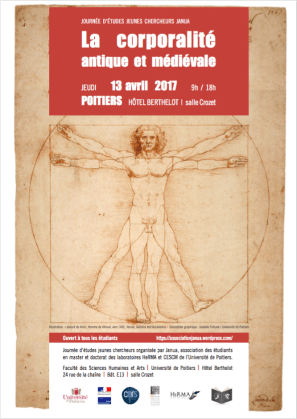
Journée d’étude – La corporalité antique et médiévale

Journée d’études jeunes chercheurs organisée par Janua, association des étudiants en master et doctorat des laboratoires HeRMA et CESCM de l’Université de Poitiers.

Jeudi 13 avril 2017
Faculté des Sciences Humaines et Arts | Université de Poitiers | Hôtel Berthelot 24 rue de la chaîne | Bât. E13 | salle Crozet

Ouvert à tous les étudiants
https://associationjanua.wordpress.com/

Corporalité antique et médiévale

Programme :

9h Accueil des participants
9h15 Introduction de la journée par les représentants des laboratoires CESCM et HeRMA

Séance I – Le corps spirituel : au carrefour du discours philosophique et religieux
Modératrice : Pauline Maouchi, Université de Poitiers

9h30 Maël Goarzin, Université de Lausanne – Le corps du philosophe dans les biographies néoplatoniciennes : représentations du corps et exercices spirituels
10h15 François Wallerich, Université Paris Ouest-Nanterre – Penser la présence de Dieu dans les corps. l’eucharistie et ses analogies dans un fragment pastoral inédit du XIIIe siècle
11h15 Joanna Augustyn, Université de Varsovie – Condamnées à être un corps ? les saintes travesties dans l’hagiographie française médiévale
12h Fatma Touj, Université de Tunis – L’inhumation en décubitus latéral, survivance et identité ethnique : étude comparative entre les trois nécropoles puniques, Cap Zbib (Bizerte), El Mansoura (Cap Bon) et El Hkayma (Sahel)

Séance II – Corps politique, corps social : approches croisées
Modératrice : Sarah Skaghammar, Université de Poitiers

14h15 Caroline Husquin, Université Bretagne-Sud – Les deux corps du prince : corporalités impériales et traitement littéraire à travers l’exemple d’Hadrien
15h Charlotte Pichot, Université de Poitiers – Le corps (féminin) est-il un miroir de l’honneur ? Quelques pistes de ré exion autour des sources judiciaires du bas Moyen Âge
16h Thierry Gregor, Université de Poitiers – la posture du corps dans le chantier médiéval
16h45 Sophie Hulot, Université Bordeaux Montaigne – Ne nudarent corpora : le corps du soldat romain exposé à la violence de guerre (de la deuxième guerre punique aux Flaviens)
17h30 Conclusions de la journée et présentation des Annales de Janua

Source : Janua

Publié dans Colloque | Laisser un commentaire

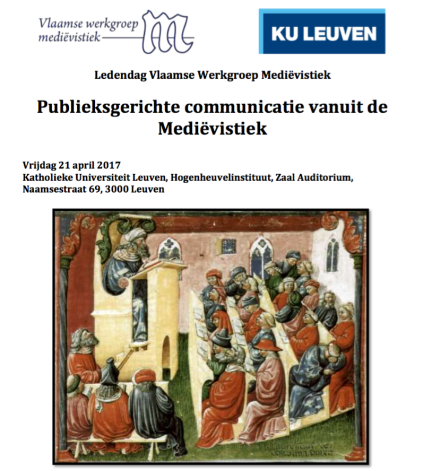
Journée d’étude – Publieksgerichte communicatie vanuit de Mediëvistiek

Vrijdag 21 april 2017
Katholieke Universiteit Leuven, Hogenheuvelinstituut, Zaal Auditorium, Naamsestraat 69, 3000 Leuven

Onderzoekers hebben vandaag, meer dan ooit, de mogelijkheid om rechtstreeks te communiceren met een breed en geïnteresseerd publiek. Omgekeerd wordt outreach ook steeds meer een vereiste en graadmeter voor succesvolle onderzoeksprojecten. Op haar tweejaarlijkse Ledendag wil de Vlaamse Werkgroep Mediëvistiek dit thema dan ook graag belichten: hoe vertaal je als academisch onderzoeker je resultaten best naar een breder publiek? Hoe bereik je dat publiek? Welke kanalen, strategieën en hulpmiddelen bestaan er? Kan je de niet-academische wereld ook laten participeren in je onderzoek?

Ledendag VWM

Programma :

10u00: verwelkoming en inleiding door Paul Trio (KUL)
10u10-12u10: getuigenissen van wetenschapscommunicatie

Jonas Roelens (historicus, Ugent) – Korte zinnen, sexy prentjes. Historisch
onderzoek en de commerciële uitgeverij
Véronique Lambert (historicus, zaakvoerder Verbo Vero) – Schrijven om gelezen
te worden. De moeilijke vertaalslag van historisch onderzoek naar een breed
publiek
Bart Robberechts (archeoloog-diensthoofd Dienst Archeoloog Stad Mechelen):
titel te bevestigen
Samuel Mareel (neerlandicus, curator in het Museum Hof van Busleyden in
Mechelen en Ugent) – Een historisch letterkundige in tentoonstellingsland 12u10-13u30: lunch

13u30-15u30: voorstel en bespreking van projecten tot wetenschapscommunicatie door onderzoekers van Vlaamse Universiteiten
15u30-16u00: koffiepauze

16u00-17u00: panelgesprek over de uitdagingen van wetenschapscommunicatie gemodereerd door Peter Stabel (UA)
Karl Drabbe (Uitgever bij Uitgeverij Vrijdag)
Jan-Frederik Abbeloos (Journalist bij De Standaard)
Ilse Frederickx (redacteur wetenschapsnieuws, KUL)

17u00: receptie

Praktisch
Deelname is gratis voor VWM-leden. Niet VWM-leden betalen 15 euro bij aankomst. Aanmelden is verplicht vóór 14 april 2017 via pieterjan.deckers@vub.ac.be of lies.vervaet@ugent.be.

Publié dans Colloque | Laisser un commentaire

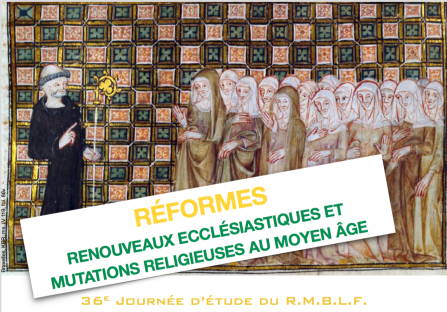
Journée du RMBLF – Réforme(s). Renouveaux ecclésiastiques et mutations religieuses au Moyen Âge

36e journée d’étude du RMBLF
Maison d’Érasme (Anderlecht), le vendredi 28 avril 2017
Informations et inscription (souhaitée) : info.rmblf@gmail.com

Bruxelles – Maison d’Érasme
Rue du Chapitre, 31- 1070 Bruxelles (Métro Ligne 5, dir. Érasme, à 5 min.
de l’arrêt Saint-Guidon)BRUXELLES – Maison d’Érasme
Rue du Chapitre, 31- 1070 Bruxelles (Métro Ligne 5, dir. Érasme, à 5 min.
de l’arrêt Saint-Guidon)

RMBLF - Réformes

Argumentaire :

L’année 2017 marque le 500e anniversaire de la publication des 95 thèses de Martin Luther. Le fait est bien connu, cette retentissante condamnation du commerce des indulgences contribua à l’émergence des Églises dites « protestantes » ou « évangéliques ». Elle stimula aussi, par contrecoup, une profonde réforme de l’Église romaine, de ses institutions et de sa doctrine lors du Concile de Trente. À l’occasion de cet anniversaire, la 36e journée d’étude du RMBLF souhaite poser un regard rétrospectif sur ce tournant de l’histoire de la Chrétienté occidentale et, partant, s’interroger sur la notion de « réforme » en contexte ecclésiastique.

En s’inscrivant dans une perspective d’histoire des idées, des spiritualités et des écrits, la présente rencontre vise à mettre en exergue la richesse des travaux menés par de jeunes médiévistes belges – francophones et néerlandophones – sur les réformes religieuses des Xe-XIIe siècles et de la fin du Moyen Âge.

Programme :

9h00-12h15
Séance du matin présidée par Nicolas Ruffini-Ronzani

Johan Belaen (UGent) – La collaboration régionale des abbés bénédictins au temps des ordres religieux naissants : l’exemple de la province ecclésiastique de Reims (XIIe siècle)
Jérôme Verdoot (ULB / Oxford) – La réforme grégorienne à Bury St Edmunds au XIIIe siècle
Arthur Panier (ULB / Paris I) – L’individu et la communauté : la réforme chez les célestins
Elisabeth Terlinden (UNamur) – L’abbaye de Saint-Jacques de Liège et la Réforme de l’Obser- vance (XVe siècle)

Conclusions intermédiaires par Steven Vanderputten (UGent)

13h30-17h00
Séance de l’après-midi présidée par Xavier Hermand

Ingrid Falque (UNamur) – Entre volonté réformatrice et valorisation personnelle : le Registre de Gilles li Muisis (KBR, ms IV 119)
Gaylen Vankan (ULg) – L’art au service du clerc. Nouveaux regards sur l’abbé Guillaume de Bruxelles et le Triptyque de l’Annonciation de Jean Bellegambe
Margherita Romengo (UCL) – Marguerite de Navarre et la publication de ses écrits religieux au XVIe siècle : prises de risque et stratégies de contournement
Conclusions générales et conférence plénière par Jean-Marie Le Gall (Paris I)

La journée se clôturera par un concert de l’ensemble ‘Les Alchimistes’ (Koninklijk Conservatorium Brussel). Répertoire de musique du XVIe siècle de l’école franco-flamande

Publié dans Activités du RMBLF, Colloque | Laisser un commentaire

Publication – « Acquérir, prélever, contrôler: Les ressources en compétition (400-1100) », éd. Vito Loré, Geneviève Bührer – Thierry, Régine Le Jan

Les ressources matérielles sont un élément de première importance de la compétition au Haut Moyen Âge, en étant l’arrière-plan, souvent le moyen, parfois l’enjeu de la compétition elle-même. D’une part, la compétition conduit ou souvent impose de mobiliser des ressources, d’autre part, ses formes sont affectées par la disponibilité ou la rareté des ressources. Elles sont donc un point d’observation privilégié pour comprendre les systèmes de valeurs et les règles, souvent implicites, qui président alors aux actions des élites. Ce volume est le résultat du troisième colloque organisé à Rome par le groupe international de recherches sur la compétition dans les sociétés médiévales (400-1000). En croisant des perspectives qui tiennent de l’anthropologie et de certaines lignes de l’histoire économique, ce livre prend en considération les formes du rapport entre compétition et ressources dans une grande variété de milieux sociaux et institutionnels de l’Europe occidentale du haut Moyen Âge, de la famille aux élites politiques et religieuses, aux sociétés rurales, aux communautés artisanes et marchandes.

dIS-9782503569598-1

Table des matières :

Vito Loré – Introduzione. Risorse materiali e competizione politica nell’alto Medioevo
Cristina La Rocca e Ignazio Tantillo – Corredi, corpi e reliquie nelle Variae di Cassiodoro. La competizione tra re e vescovi per le risorse del sottosuolo
Tiziana Lazzari – La competizione tra grandi possessoreslongobardi e il regno : le leggi di Liutprando e il patrimonio delle donne nel secolo VIII
Giuseppe Albertoni – Ad terminos Sclauorum. Élites e competizione per le risorse in «piccoli mondi» alpini : la regione tra Isarco, Drava e Sava (secoli VIII-XI)
Matthias Hardt – The Importance of the Slave Trade for the Slavic Princes of the Early and High Middle Ages
Adrien Bayard – Accumuler, consommer et exhiber les ressources. Les lieux de pouvoir dans l’Auvergne des IXe et Xe siècles
Lucie Malbos – Les ressources en compétition dans des territoires scandinaves disputés (première moitié du XIe siècle) : le roi Óláfr Haraldsson et l’«arme économique»
Jean François Boyer – Compétitions autour de l’aurum pagense dans les royaumes mérovingiens
Giacomo Vignodelli – La competizione per i beni fiscali: Ugo di Arles e le aristocrazie del regno italico (926-945)
Giovanna Bianchi e Simone M. Collavini – Risorse e competizione per le risorse nella Toscana dell’XI secolo
Alessio Fiore – Les châteaux et la compétition pour le contrôle des ressources économiques (Italie du Centre et du Nord, 900-c. 1120)
Horst Lößlein – Les ressources en compétition: les conflits concernant Saint-Vaast et Saint-Servais de Maastricht entre les grands et Charles III « le Simple »
Marco Stoffella – La competizione per le risorse ecclesiastiche nella Toscana altomedievale (750-1050)
Émilie Kurdziel – Au prisme des faux. Clergé, compétition pour les ressources et falsification en Italie du Nord et du Centre (XIe-XIIe siècles)
Thomas Kohl – Competing Narratives, Churches and Monasteries in Eleventh-Century Anjou
Christopher Loveluck – The Dynamics of Portable Wealth, Social Status and Competition in the Ports, Coastal Zones and River Corridors of Northwest Europe, c. AD 650-1100
Alessia Rovelli – Il ruolo della moneta nella competizione altomedievale
Laurent Feller – Conclusion

Résumés en anglais des articles
Index des noms de personnes et de lieux

Informations pratiques :
Vito Loré, Geneviève Bührer – Thierry, Régine Le Jan (éd.), Acquérir, prélever, contrôler: Les ressources en compétition (400-1100), Turnhout, Brepols, 2017 (Haut Moyen Âge, 25). 366 p., 1 b/w ill., 3 b/w tables, 156 x 234 mm, 2017
ISBN: 978-2-503-56959-8. Prix : 75 euros.

Source : Brepols

Publié dans Publications | Laisser un commentaire

Publication – « The Capetian Century, 1214 to 1314 », éd. W. C. Jordan, J. R. Phillips

The volume provides a fresh look at the Capetian century (1214-1314) as a period that changed the cultural and political fabric and laid the foundation for the modernisation of the medieval West.

This volume provides a fresh look at the Capetian century (1214-1314), a period that changed the cultural and political fabric and laid the foundation for the modernisation of the medieval West.

The period from the birth of Louis IX to the death of Philip the Fair is remarkable for a series of developments and accomplishments associated with the Capetian kings of France. Innovations in architecture, manuscript illumination, and music all helped shape the cultural fabric of French and European life. Administrative historians emphasize the development of political institutions that have been said to lay foundations of the modern State. ‘Moral reform’, partly in support of the crusading movement, led to various changes in policies toward Jews, prostitutes, heretics, and many other social groups.

This volume brings together essays presented at the Capetian Century Conference held at Princeton University, commemorating two seminal anniversaries bracketing the ‘Capetian Century’ — the Battle of Bouvines (1214), and the death of Philip the Fair (1314).

dIS-9782503567181-1

Table des matières :

List of illustrations

Introduction — William Chester Jordan

Royal Patronage and Expressions of Kingship

The Capetian Monarchy and the University of Paris, 1200-1314 — William J. Courtenay
Saint Louis and Cîteaux Revisited: Cistercian Commemoration and Devotion during the Capetian Century, 1214-1314 — Anne E. Lester
King/Confessor/Inquisitor: A Capetian-Dominican Convergence — Sean L. Field
Kingship and Crusade in the First Four Moralized Bibles — M. C. Gaposchkin

Power and Its Representation

French nobility and the military requirements of the king (ca. 1260 – ca. 1314) — Xavier Hélary
The Managerial Revolution of the Thirteenth Century — Hagar Barak
The Ambiguity of Representation. Semiotic Roots of Political Consent in Capetian France — Brigitte Miriam Bedos-Rezak

Philip the Fair and his Ministers

Philip the Fair and His Ministers: Guillaume de Nogaret and Enguerran de Marigny — Elizabeth R. Brown
The Pioneer of Royal Theocracy. Guillaume de Nogaret and the conflicts between Philip the Fair and the Papacy — Julien Théry-Astruc
Robert Fawtier’s Philip the Fair — Elisabeth Lalou

Crusaders and Crusading Orders

Travels, Troubles, and Trials: The Montaigu Family between Capetian France and Lusignan Cyprus — Jochen Burgtorf
An Upstart without Prospects? The Familial Context of Renaud of Châtillon and its Implications — Paul F. Crawford
What became of the Templars after the trial of 1307-14? — Helen J. Nicholson

Index

Informations pratiques :
The Capetian Century, 1214 to 1314, éd. W. C. Jordan, J. R. Phillips, Turnhout,Brepols, 2017 (Cultural Encounters in Late Antiquity and the Middle Ages, 22). XVI+362 p., 28 b/w ill. + 5 colour ill. + 1 Map, 156 x 234 mm. ISBN: 978-2-503-56718-1. Prix : 100 euros.

Source : Brepols

Publié dans Publications | Laisser un commentaire

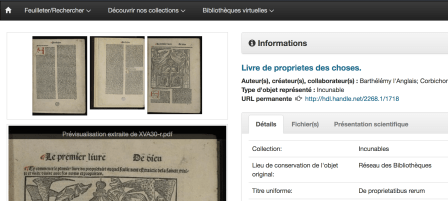
Web – Arm@rium Universitatis Leodiensis. La bibliothèque numérique du Moyen Âge et de la première Modernité de l’Université de Liège

L’Unité de recherches (UR) Transitions est heureuse de vous annoncer la mise en ligne de l’Arm@rium Universitatis Leodiensis, un nouvel outil numérique qui vise à accompagner la diffusion, en Open Access, des collections patrimoniales et artistiques de l’Université de Liège par son portail de Dépôt d’Objets Numérisés (DONum http://donum.ulg.ac.be). L’UR Transitions profite ainsi d’une nouvelle fonctionnalité créée par le Réseau des Bibliothèques de l’Université de Liège pour son portail DONum : cette nouvelle fonctionnalité permet désormais d’associer aux objets numérisés de l’Université de Liège un contenu scientifique de grande rigueur, accessible gratuitement.

Armarium

Les étagères virtuelles de la nouvelle bibliothèque Arm@rium offriront la possibilité de consulter une sélection de témoins de la culture écrite, imprimée et graphique de la période couverte par les recherches menées au sein de l’UR Transitions, celle du Moyen Âge à la première Modernité. Avec l’Arm@rium Universitatis Leodiensis, l’UR Transitions se propose d’apporter sa contribution aux nombreux défis que la « grande conversion numérique » a imposés depuis plusieurs décennies à la conservation et à la diffusion du patrimoine ancien, dont le principal est sans conteste l’accès à un savoir de qualité.

Les premières publications peuvent être consultées sur le site de l’Arm@rium Universitatis Leodiensis (http://web.philo.ulg.ac.be/transitions/armarium/). Prévue avec une périodicité bimestrielle, les prochaines publications seront annoncées dans notre newsletter.

  • Coordination scientifique: Renaud Adam
  • Coordination numérique: Stéphanie Simon, responsable de la cellule numérisation du réseau des bibliothèques de l’ULg.

Source : Arm@rium

Publié dans Web | Laisser un commentaire

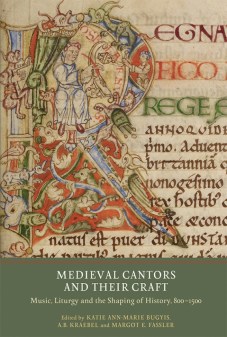
Publication – « Medieval Cantors and their Craft Music, Liturgy and the Shaping of History, 800-1500 », edited by Katie Ann-Marie Bugyis, A.B. Kraebel, Margot E. Fassler

Cantors made unparalleled contributions to the way time was understood and history was remembered in the medieval Latin West. The men and women who held this office in cathedrals and monasteries were responsible for calculating the date of Easter and the feasts dependent on it, for formulating liturgical celebrations season by season, managing the library and preparing manuscripts and other sources necessary to sustain the liturgical framework of time, and promoting the cults of saints. Crucially, their duties also often included committing the past to writing, from simple annals and chronicles to more fulsome histories, necrologies, and cartularies, thereby ensuring that towns, churches, families, and individuals could be commemorated for generations to come.

This volume seeks to address the fundamental question of how the range of cantors’ activities can help us to understand the many different ways in which the past was written and, in the liturgy, celebrated across the Middle Ages. Its essays are studies of constructions, both of the building blocks of time and of the people who made and performed them, in acts of ritual remembrance and in written records; cantors, as this book makes clear, shaped the communal experience of the past in the Middle Ages.

Katie Ann-Marie Bugyis is Assistant Professor of Religious Studies at St. Martin’s University; Margot Fassler is Kenough-Hesburgh Professor of Music History and Liturgy at the University of Notre Dame and Robert Tangeman Professor Emerita of Music History at Yale University; A. B. Kraebel is Assistant Professor of English at Trinity University.

9781903153673

Table des matières :

Historia: Some Lexicographical Considerations – David Ganz
Liturgy and History in the Early Middle Ages – Rosamond McKitterick
Notker Bibliothecarius – Susan K Rankin
Singing History: Chant in Ekkehard IV’s Casus sancti Galli – Lori Kruckenberg
Adémar de Chabannes (989-1034) as Musicologist – James Grier
Cantor or Canonicus? In Search of Musicians and Liturgists in Eleventh-Century Constance – Henry Parkes
Shaping the Historical Dunstan: Many Lives and a Musical Office – Margot Fassler
Female Monastic Cantors and Sacristans in Central Medieval England: Four Sketches – K.A. Bugyis
Cantor, Sacrist or Prior? The Provision of Books in Anglo-Norman England – Tessa Webber
Symeon of Durham as Cantor and Historian at Durham Cathedral Priory, c. 1090-1129 – Charlie Rozier
Reshaping History in the Cult of Æbbe of Coldingham – Lauren L. Whitnah
William of Malmesbury as a Cantor-Historian – Paul A. Hayward
Lex orandi, lex scribendi? The Role of Historiography in the Liturgical Life of William of Malmesbury – Sigbjorn Olsen Sonnesyn
Of the Making of Little Books: The Minor Works of William of Newburgh – A.B. Kraebel
The Cantors of the Holy Sepulchre and their Contribution to Crusade History and Frankish Identity – Cara Aspesi
Shaping Liturgy, Shaping History: A Cantor-Historian from Twelfth-Century Peterhausen – Alison I. Beach
The Roman Liturgical Tradition According to a Twelfth-Century Roman Cantor – Peter Jeffery
A Life in Hours: Goswin of Bossut’s Office for Arnulf of Villers – Anna De Bakker
Writing History to Make History: Johannes Meyer’s Chronicles of Reform – Claire Jones

Informations pratiques :
Medieval Cantors and their Craft Music, Liturgy and the Shaping of History, 800-1500, edited by Katie Ann-Marie Bugyis, A.B. Kraebel, Margot E. Fassler, Boydell&Brewer, 2017 (Writing History in the Middle Ages). 21 black and white, 3 line illustrations. 391 pages, 23.4×15.6 cm. ISBN: 9781903153673. Prix : 60£.

Source : Boydell&Brewer

Publié dans Publications | Laisser un commentaire

Appel à contribution – Concealment and Revelation in the Art of the Middle Ages

Nicosia, 22-24 September 2017
CFP Deadline: 30 April 2017

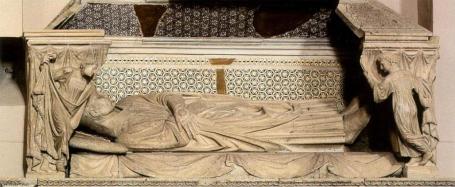
‘To reveal art and conceal the artist is art’s aim’ – thus Oscar Wilde in his aphoristic Preface to The Picture of Dorian Gray (1891). In the western intellectual tradition, art has repeatedly been conceived and understood as existing at the intersection of the antithetical notions of concealment and revelation – from the old unattributed adage that ‘it is true art to conceal art’ (ars est celare artem) to Robert Rauschenberg’s lapidary statement about the ability of a work of art to reveal something beyond itself (‘A light bulb in the dark cannot show itself without showing you something else too’, scribbled in pencil on the photo collage entitled Random Order, c. 1963). Veiled or unveiled, obscured or illuminated, opaque or transparent, works of art are often invested with meaning(s) and function(s) at the liminal moment of transition from the one state to the next; after all, to resort again to Wilde’s witty prose, ‘the commonest thing is delightful, if one only hides it’.

arnolfo-di-cambio-tomb-of-cardinal-de-braye-detail-11

Recent scholarship on medieval art has brought such considerations to the fore, by tackling issues of screening, veiling / unveiling, temporal and performative transformations, the permeability of barriers and the movement of objects in space, among others. The visibility of sacred relics and their reliquaries, the metal revetments and textile curtains of miracle-working icons, the folding wings of northern European altarpieces, the parting womb of the Vierges ouvrantes or Schreinmadonnen and the porosity of choir screens East and West have all received fairly extensive treatment in monographic studies and specialist articles. Nevertheless, the juxtaposition of these individual phenomena within a broader framework, encompassing both the religious and secular sphere, as well as several different religious traditions, has only seldom been attempted.

The present conference aspires to explore the role of the concept and the act of concealment and revelation in the arts of the Latin West, Byzantium, Islam and Judaism in the course of the Middle Ages (defined chronologically as c. 500-c. 1500). Subjects to be broached include, but are not limited to, the use of curtains or veils in screening objects or spaces; the function of permeable screens (in a variety of materials and media) in structuring accessibility, whether physical, visual, aural or spiritual; the performative aspect of concealing and revealing in all its civic and private manifestations, and the issues of emotional manipulation thereby raised; the role of gesture and spatial motion in the performance of concealment and revelation; the hierarchy of sacred and secular space as the outcome of its compartmentalisation; and the representation of these practices in the pictorial arts.

The conference is planned as a three-day event, to take place at the Archaeological Research Unit of the University of Cyprus, Nicosia, in 22-24 September 2017. Due to budgetary constraints, the speakers’ travel and accommodation expenses cannot be covered, but every effort will be made to secure conference rates at hotels near the conference venue. There is no registration fee for participation or attendance.

Prospective speakers are invited to submit electronically a title and a 300-word abstract (in either English or Greek) for consideration by 30 April 2017. Please send all materials and address all queries to the conference convenors, Michalis Olympios (olympios.michalis@ucy.ac.cy) and Maria Parani (mparani@ucy.ac.cy).

Source : Medieval Art Research
Publié dans Appel à contributions | Laisser un commentaire

Colloque – Patrimoines en mouvement : entre préservation et dévotion

Bruxelles, 27-28 avril 2017
Programme : ici

IRPA -KIK

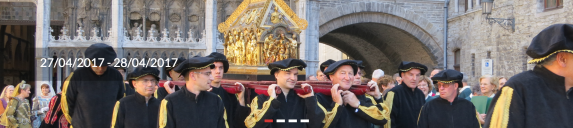
Ce n’est que dans les dernières années du XXe siècle que, sous l’impulsion de l’UNESCO, le patrimoine immatériel a été reconnu comme une fraction essentielle du patrimoine culturel de l’humanité. Les traditions orales, les savoir-faire, les pratiques sociales, les rituels et les événements festifs sont aujourd’hui reconnus comme des composantes fondamentales de la diversité culturelle. À ce titre, l’autorité publique doit veiller à en assurer la préservation pour les générations futures. Diverses manifestations reconnues du patrimoine culturel immatériel impliquent d’autres enjeux patrimoniaux. C’est le cas de certaines pratiques rituelles et festives centrées sur des objets faisant figure d’écrins véhiculant des valeurs mémorielles ou religieuses. Souvent, les processions en tous genres, religieuses ou non, assurent des déplacements d’objets mobiliers qui peuvent être eux-mêmes de haute valeur patrimoniale et qui sont à leur tour l’expression de la communauté qui les a engendrés. On songe par exemple aux antiques statues ou reliquaires en tous genres qui sortent périodiquement dans des conditions parfois susceptibles de mettre leur conservation en péril. Il y a donc un conflit de valeurs entre les manifestations relevant du patrimoine immatériel et les objets précieux qui les soutiennent. On reconnaîtra aussi un conflit de valeurs pour un même objet, qui peut être reconnu d’un côté comme objet de dévotion et de l’autre comme objet patrimonial. À l’occasion des quinze ans du décret de la Fédération Wallonie-Bruxelles (FWB) relatif aux biens culturels mobiliers et au patrimoine oral et immatériel, la Direction du Patrimoine culturel de la FWB et l’Institut royal du Patrimoine artistique (IRPA) se sont associés pour mener une réflexion sur la manière de concilier les valeurs opposées présidant à la préservation tant des manifestations immatérielles que du patrimoine mobilier qui en constitue le ressort matériel. Il s’agira moins de se focaliser sur de multiples études de cas que de dégager des mécanismes susceptibles d’assurer de façon harmonieuse la pérennisation tant des pièces processionnées que des manifestations qu’elles rehaussent. L’objectif est d’aboutir à des solutions concrètes permettant d’améliorer l’analyse des risques et les conditions de déplacement, de sécurité et de manipulation de biens processionnés.

Informations pratiques :

27-28 avril 2017

Ce colloque se tiendra dans l’auditorium de l’Institut royal du Patrimoine artistique (1, parc du Cinquantenaire B-1000 Bruxelles) les jeudi 27 et vendredi 28 avril 2017.

Les actes seront publiés par la FWB.

Comité organisateur :
Marjolijn Debulpaep (IRPA-KIK)
Mallorie Duplouy (FWB)
Géraldine Jaffré (FWB)
Pierre-Yves Kairis (IRPA-KIK)
Caroline Marchant (FWB)
Emmanuelle Mercier (IRPA-KIK)
Ieva Mikutavičiūté (FWB)
Nathalie Nyst (FWB)
Fanny Van Cleven (IRPA-KIK)
Claude Vandewattyne (FWB)

Source : IRPA – KIK

Publié dans Colloque | Laisser un commentaire