Appel à contribution – Reuse Reconsidered

Reuse Reconsidered
September 15-17, 2017
Brown University, Providence RI

Spolia. Appropriation. Palimpsests. Afterlives…These terms, and others, have been employed by scholars across disciplines to describe the reuse of architecture and material culture. This conference aims to advance current scholarship by exploring some of these terms and unpacking the phenomenon throughout history and across cultures. From the Mexica reuse of Olmec relics to the fascist appropriation of historic styles in building projects—to name two examples—societies have given new meanings to objects, architectonic fragments, buildings, and styles by repurposing them for new contexts.

The field of reuse studies has grown rapidly in the last three decades. In the United States, this is a more recent conversation, particularly as a result of 2006’s “The Mirror of Spolia: Premodern Practice and Postmodern Theory” colloquium at the Clark Art Institute. The colloquium, and subsequent edited volume Reuse Value, covered a wide range of fields and time periods. In the years since, other academic forums have taken a more focused approach, such as Wesleyan University’s “Monuments as Palimpsests” symposium and a College Art Association session on reuse in the ancient world.

While acknowledging the importance of these more focused conversations, this conference aims to broaden the conversation once again. It seeks to unite scholars, from graduate students to senior faculty members, that study a variety of time periods, cultures, and types of reuse. This cross-disciplinary conference will explore the complex and multivalent motivations behind the reuse of cultural heritage. It will also seek to expand how we understand the phenomenon of cultural identity in relationship to the appropriation, memorialization, and reimaging of the past.

We imagine that papers could address questions including, but not limited to:

  • How do cultures (re)employ objects, buildings, or styles from the past as part of the definition of themselves in their present?
  • What is the role of the architect/patron in the act of reuse?
  • How does the cultural biography of the reused object or building inform its use in new contexts?
  • Why do certain things (buildings, styles, time periods) get called upon for a new use while others do not?
  • Why and how are specific buildings or cities reimagined in new contexts?
  • How is the history of museums and antiquarianism connected to the motivations behind reuse?

Abstracts (up to 300 words) and a CV should be sent to: Reuse.Reconsidered@gmail.com by April 14, 2017. Applicants will be notified by mid-May. Papers should be approximately 20 minutes. Any questions should be addressed Lia Dykstra at Reuse.Reconsidered@gmail.com.

Source : The Medieval Academy Blog
Publié dans Appel à contributions | Laisser un commentaire

Appel à candidature – Mondes méditerranéens et Italie méridionale au Moyen Âge

L’Atelier doctoral Mondes méditerranéens et Italie méridionale au Moyen Âge, organisé par l’Università degli Studi di Salerno (Dipartimenti di Scienze del patrimonio culturale e di Scienze umane, filosofiche e della formazione), l’Università della Basilicata (Dipartimento di Scienze Umane), le Laboratoire de médiévistique occidentale de Paris (LaMOP) et l’École française de Rome, a pour but de fournir une formation spécialisée dans le domaine de l’histoire, de la civilisation et de la culture de l’Italie méridionale et de son environnement méditerranéen au Moyen Âge.

csm_Image_AD_Salerno_2017_73c627e596

Dans cet esprit, l’Atelier réunit des enseignants spécialisés et de jeunes chercheurs pour offrir une occasion de réflexion, de discussion, d’approfondissement méthodologique et de mise au point historiographique concernant les différentes sources historiques et les conditions convenables de leur utilisation.

Le Séminaire de cette année s’attachera particulièrement au thème des cultures et der rapports culturels dans l’Italie méridionale médiévale, qui abrite des populations se rattachant à des aires culturelles différentes. Comme les années précédentes, le thème sera abordé sous l’angle de la lecture et de l’analyse des sources.

Candidatures :

veuillez trouver l’appel à candidatures ici ;
le délai de dépôt des candidatures est fixé au 2 mai 2017.

Bando di concorso :

  • si prega di trovare qua il bando di concorso;
  • la scadenza per le domande di iscrizioni è fissata al 2 maggio 2017.
Publié dans Appel à contributions | Laisser un commentaire

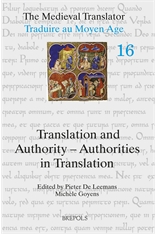
Publication – « Translation and Authority – Authorities in Translation », P. De Leemans, M. Goyens (eds.)

The question about the relation between medieval translation practices and authority is a complex and multifaceted one. Depending on one’s decision to focus on the authority of the source-text or of the translated text itself, on the author of the original text, on the translator, or on the user of the translation, it falls apart in several topics to be tackled, such as, just to name a few: To what extent does the authority of the text to be translated affect translational choices? How do translators impose authority on their text? By lending their name to a translation, do they contribute to its authoritative status?

After two introductory essays that set the scene for the volume, addressing the above questions from the perspective of translations of authoritative texts into Dutch and French, the focus of the volume shifts to the translators themselves as authorities. A next section deals with the choices of texts to be translated, and the impact these choices have on the translation method. A third part is dedicated to papers that examine the role of the users of the translations.

The selection of papers in the present volume gives a good indication of the issues mentioned above, embedded in a field of tension between translations made from a learned language to a vernacular language, translations from one vernacular to another, or even from a vernacular to the Latin language.

Pieter De Leemans is Professor at the De Wulf-Mansion Centre for Ancient, Medieval, and Renaissance Philosophy of the University of Leuven, and academic secretary of the Aristoteles Latinus.

Michèle Goyens is Professor of French diachronic linguistics at the University of Leuven. Her research is focused on medieval translations and the development of the scientific vocabulary in the vernacular.

dis-9782503566764-1

Table des matières :

Acknowledgements

Pieter De Leemans – Michèle Goyens – Translation and Authority – Authorities in Translation. Introduction

Paul Wackers – Authority in Middle Dutch
Joëlle Ducos – Que traduire en français ? Traductions uniques et traductions multiples
Charles Burnett – The Translator as an Authority
Michelle Bolduc – The Form of Authority in Medieval Translation: Brunetto Latini’s Translations of Cicero
Graziella Pastore – Langue de l’’aucteur’ et langue du ‘translateur’ ? Réflexions sur la langue de Nicolas de Gonesse
Ian Johnson – Authority and the Translation of Boethian Selves: John Walton, James I, and Thomas Usk
Marcela K. Perett – The Un-Authoritative Translation: Ælfric’s Book of Genesis, and the Need for External Authority
Sharon Rhodes – Translating the Context in the Orrmulum
Juliette Dor – John of Trevisa légitimise la traduction en langue anglaise (vers 1387)
Ildiko Van Tricht – L’autorité et le développement d’une terminologie médicale aux XIVe et XVe siècles
Moreno Campetella – Les traductions de l’Opus Agriculturae de Rutilius Aemilianus Palladius aux XIVe – XVe siècles et la création de néologismes
Christine Gadrat-Ouerfelli – Les traductions latines du livre de Marco Polo et l’autorité du texte
An Smets – The Middle English Translation of the ‘De Falconibus’ by Albertus Magnus in The Kerdeston Cynegetical Manuscripts
Anne Mouron – ‘Help thin Godric in Francrice: an Old French Life of St Godric’
Stefania Vignali – À propos de la première traduction de l’Enfer de Dante: un modèle poétique?
Naoë Kukita Yoshikawa – Mechtild of Hackeborn as Spiritual Authority: the Middle English Translation of the Liber Specialis Gratiae
Tamás Karáth – The Re-Invention of Authority in the Fifteenth-Century Translations of Richard Rolle’s Emendatio Vitae
Marthe Mensah – Claude Schwerzig – Walter Hilton translateur d’auctoritates
Courtney Rydel – Interpretive Etymologies in Translations of the Golden Legend
Stefka E. Eriksen – Translating Christian Symbolism into Old Norse Mythology in Thirteenth-Century Norway
Igor Filippov – Vulgate Versus Vetus Latina: The Choices of Caesarius of Arles
Andrea Colli – Augustine’s De Genesi Ad Litteram as a Commentary on the De Anima. A Significant Case of Comparison between Authority and Translations in the 13th Century
Stefania d’Agata d’Ottavi – Chauntecleer’s Small Latin and the Meaning of Confusio in the Nun’s Priest’s Tale
Alastair Minnis – Aggressive Chaucer: of Dolls, Drink and Dante

Index

Informations pratiques :
Pieter De Leemans et Michèle Goyens (eds.), Translation and Authority – Authorities in Translation, Turnhout, Brepols, 2017 (The Medieval translator, 16). 391 p., 7 b/w ill., 156 x 234 mm. ISBN: 978-2-503-56676-4. Prix : 85 euros.

Source : Brepols

Publié dans Publications | Laisser un commentaire

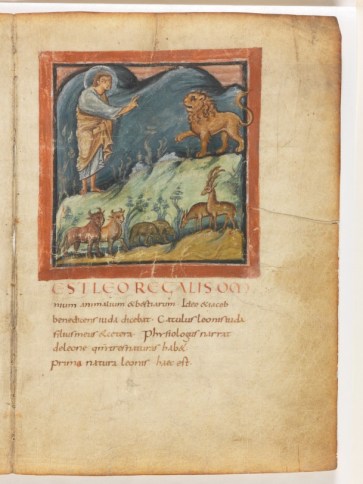
Journée d’étude – La réception du Physiologus dans les encyclopédies médiévales / The Reception of the Physiologus in Mediaeval Encyclopaedias

Demi-journée d’études sur l’utilisation du Physiologus dans les encyclopédies médiévales, organisée le 14 juin 2017 à l’Institut de recherche et d’histoire des textes, dans le cadre du projet SourcEncyMe et du Groupe de recherche international Zoomathia.

À l’occasion du colloque international “The Physiologus between East and West. Diffusion and transmission of an Early Christian Text on Nature” (15-17 juin 2017, org. A. Dorofeeva, S. Lazaris, C. Macé, A. Zucker).

Org. Isabelle Draelants

default

Programme :

9h30 – 12h30 :

Introduction – Accueil

Isabelle Draelants : Les progrès du corpus SourcEncyMe (Sources des encyclopédies médiévales – corpus annoté)
Emmanuelle Kuhry : le Physiologus dans les Recueils de propriétés et chez l’Experimentator (c. 1230-40)
Mattia Cipriani : le Physiologus chez Thomas de Cantimpré et chez l’Experimentator (c. 1240-50)
Isabelle Draelants : le Physiologus dans le Speculum naturale et le Speculum doctrinale de Vincent de Beauvais (c. 1250)
Elisa Lonati : Barthélemy l’Anglais connaît-il le Physiologus ? Etat des lieux
Beatrice Amelotti : Le Physiologus et les sources zoologiques dans la Summa de exemplis et similitudinibus rerum de Giovanni da San Geminiano (avant 1317)

Après-midi :

Bilan et prospective du Groupe de recherche international (GDRI) Zoomathia, Transmission culturelle des savoirs zoologiques (Antiquité-Moyen Âge) : discours et techniques

Source : Atelier Vincent de Beauvais

Publié dans Colloque | Laisser un commentaire

Colloque – Bishops’ Identities, Careers and Networks

Bishops were powerful individuals who had considerable spiritual, economic and political power. To be a bishop was to be a leader who might crown kings or foment rebellion. So who became bishops? What were their family backgrounds, educational attainment, social networks? What was the impact of international Church events such as the Great Schism or the Council of Basle on the types of bishop appointed in individual dioceses? This conference brings together scholars studying medieval bishops and their networks from across Europe, including Spain, Italy, Portugal, France, Poland, the British Isles and Scandinavia.

The aim of this two-day conference, funded by an AHRC Early Career Research Grant, is to stimulate discussion on how individuals achieved a bishopric in Europe, including Scandinavia and the British Isles. An edited volume is the planned outcome for the conference.

Keynote speakers include Professor Steinar Imsen (NTNU), Professor Sverrir Jaboksson (University of Iceland), Professor Kirsi Salonen (University of Turku) and Dr Katherine Harvey (Birkbeck)

Bishops

Programme :

9.00 – 10.00 – FIRST KEYNOTE LECTURE – Steinar Imsen, Norwegian University of Science and Technology – The Nidaros Church and the insular parts of its province
10.00-10.30 COFFEE

10.30-12.00 SESSION A ‘Tenth and Eleventh Century Networks’

Fraser McNair – Ottonians in Miniature?: A Post-Carolingian Reichskirchentendenz in France, c.950-990
Sally Vaughn – Herluin’s Dream: Lanfranc of Canterbury and Anselm of Bec’s Creation of a Bec Network of Ecclesiastical Rulers Spread Over Normandy, France, and England
Andrew Smith – Pope Leo IX (1049-1054): Bishop of Rome or Pope for Europe

10.30-12.00 SESSION B ‘Episcopal Networks in Central Europe’

Jacek Maciejewski – Premeditation and Determination on the Way to Episcopacy in Medieval Poland (12th-14th C)
Mišo Petrović – The Episcopal Authority and Power of the Archbishops of Split during the ecclesiastical and political instability in the Kingdom of Hungary-Croatia (c.1378-c.1420)
Alexandra Laliberté De Gagné – Greek Bishops (metropolitan) in Roumelia in the 16th-17th centuries: between Latins and Orthodox
12.00-1.00 LUNCH

1.00-2.00 SECOND KEYNOTE LECTURE – Sverrir Jakobsson, University of Iceland – An Enjoyable Profession? Icelandic Bishops in a Time of Troubles
2.00 – 2.30 COFFEE

2.30-4.00 SESSION C Familial and Royal Connections in Portugal and Italy

Herminia Vasconcelos Vilar – How to become a bishop in medieval Portugal? Kings, popes and family ties in the 14th century
Stefano G. Magni – Bishops, Nepotism and Social Mobility in Italy in the 13th and 14th century
Fabrizio Pagnoni – Guelphs, jurists, curiales: the appointment of bishops in Northern Italy in the first half of the fourteenth century

2.30-4.00 SESSION D Portraits of Individual Bishops

Hester Ross – Portrait of a Scottish Renaissance man: Bishop Elphinstone of Aberdeen
Bridget Riley – A Prudent Archbishop: Richard FitzRalph, Archbishop of Armagh (1300-1360)
Sarah Thomas – John Donkan: A Manx Bishop caught between England and Scotland

EVENING – INFORMAL DINNER AND WHISKY RECEPTION

SATURDAY 27TH MAY

9.00 – 10.00 – THIRD KEYNOTE LECTURE – Katherine Harvey, Birkbeck, University of London – The Perfect Prelate, or How to Become a Bishop in Medieval England
10.00-10.30 COFFEE

10.30-12.00 – SESSION E Eleventh and Twelfth Century Networks

Ryan Kemp – Bishops, kings, and their careers in twelfth-century England and the Empire
Ian Styler – From Isolation to Domination: Who Created the bishopric of Ely, and how they did it.
Wojciech Sawicki – Appointment of Bohemian bishops as presented by Cosmas of Prague and his followers

10.30-12.00 – SESSION F Spanish and Italian Bishops of the Fourteenth and Fifteenth Centuries

Fernando Gutiérrez Baños – Pedro Pérez de Monroy (1310-24): a new bishop for a new era in Salamanca
Susana Guijarro – Power, Culture and Ecclesiastical Reform in Late Medieval Castile: The Bishop of Burgos Luis de Acuña (1456-1495)
Alessandro Di Bari – Relations between Venice and Alexander of Masovia, Bishop of Trento
12.0 – 1.00 – LUNCH

1.00 – 2.00 – FOURTH KEYNOTE LECTURE – Kirsi Salonen, University of Turku – Between Uppsala and Rome: Swedish bishops’ contacts with the papal curia
2.00 – 2.30 COFFEE

2.30-4.00 SESSION G Northern and Southern Networks

Michael Gelting and Mia Munster-Swendsen – Magister, Abbot, Bishop: the Life of Bishop Gunner of Viborg (d.1251)
Jacopo Paganelli – «Pro se et amicis de domo de Scolaribus». Alberto Scolari bishop of Volterra and the Ghibelline network in Tuscany (1261-1269).
Michael Frost – Between Rome, Avignon and Nidaros: Bishops of Kirkjubøur during the Western Schism

2.30-4.00 SESSION H From Meaux to York

Aída Portilla González – Social networks and academic education of Castilian cathedral clergy in the late Middle Ages
Claudia Minett – Yorkist Chancellors – Pre-Episcopal Careers and Networks 1461-1483
Christine Barralis – The bishops of Meaux (France, Champagne), 1195-1510 : from chapter’s men to king’s men

Informations pratiques :

Standard registration costs £40, students and senior delegates £15

Please register here: http://www.store.abdn.ac.uk/product-catalogue/events/college-of-arts-and-social-sciences/social-sciences/a-prosopographical-study-of-bishops-careers-in-northern-europe-twoday-conference

Deadline

Please register by 12 April 2017.

Queries

Please direct any queries to Sarah Thomas and Michael Frost: bishopscareersnetworks@gmail.com.

Publié dans Colloque | Laisser un commentaire

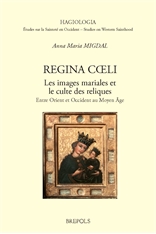
Publication – Anna M. Migdal, « Regina Cœli. Les images mariales et le culte des reliques. Entre Orient et Occident au Moyen Âge »

Les images-reliquaires, dont la singularité attire notre attention, se définissent par la complexité de leur composition tant au point de vue artistique qu’au point de vue religieux. Il s’agit ici des peintures sur panneau de bois (plus rarement, sur verre églomisé), ayant fonction de porte-reliques, et décorées dans certains cas de pierres précieuses ou semi-précieuses. Le modèle de tableau-reliquaire : panneau unique, diptyque et triptyque comprenant le portrait de la Vierge à l’Enfant enchâssé dans une large bordure incrustée de reliques, se répandit particulièrement dans la péninsule italienne, et par la suite en Europe centrale. Cependant, les reliquaires polonais, connus sur le territoire de la Petite-Pologne durant le XVe siècle jusqu’au début du siècle suivant, ne sont mentionnés que de manière sporadique dans l’histoire de l’art. Ils sont apparus dans quelques articles, mais sans avoir fait l’objet d’aucune analyse spécifique quant à leur contenu iconographique, leur similarité formelle, ainsi qu’à l’égard de leur usage dévotionnel. C’est pourquoi, nous souhaitons les joindre aux créations semblables répandues dans l’art entre Orient et Occident au Moyen Âge. Dans la même optique, il serait également intéressant de s’interroger sur la continuité de tels objets au-delà de l’époque médiévale.

dIS-9782503568584-1

Historien de l’art, ancienne boursière de l’École française et de l’Académie de France à Rome, Anna M. Migdal est spécialisée dans l’étude des arts plastiques et de l’iconographie du Ve au XVIe siècle. Le doctorat soutenu à l’Université Lumière Lyon II – Maison de l’Orient et de la Méditerranée, a suivi les études à l’Institut d’histoire de l’art de l’Université Jagellon.

Informations pratiques :
Anna M. Migdal, Regina Cœli. Les images mariales et le culte des reliques. Entre Orient et Occident au Moyen Âge, Turnhout, Brepols, 2017 (Hagiologia, 12). Approx. 438 p., 110 b/w ill. + 26 colour ill., 156 x 234 mm. ISBN: 978-2-503-56858-4. Prix : 95 euros.

Source : Brepols

Publié dans Publications | Laisser un commentaire

Appel à contribution – Livres de maîtres, livres d’étudiants : le manuscrit universitaire au Moyen Âge

Pecia. Le livre et l’écrit (Brepols Publishers) – Volume 21/2018 –
Livres de maîtres, livres d’étudiants : le manuscrit universitaire au Moyen Âge (Commande, fabrication, décoration, utilisation, circulation, etc)

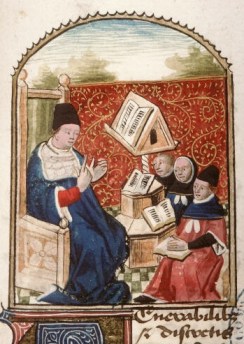
amiens_366_Bohic_enseignant

Amiens, BM, 366. Henri Bohic enseignant.

La soumission devra comprendre un résumé de la proposition (titre et descriptif d’un maximum de 300 mots) et un bref curriculum vitae.

Submissions should include a summary of the proposal (title and abstract, maximum 300 words) and a brief curriculum vitae.

Après soumission de votre résumé, vous recevrez un courriel de confirmation.
On completion of your submission you will receive a confirmation by email.

La date limite de soumission du résumé est le 31 mai 2017.
The deadline for abstract submission is 31 mai 2017.

Contact :
Jean-Luc Deuffic
jldeuffic@gmail.com

Source : Pecia

Publié dans Appel à contributions | Laisser un commentaire

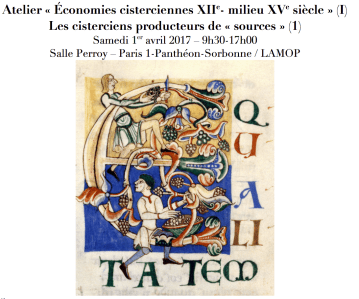
Journée d’étude – Économies cisterciennes XIIe- milieu XVe siècle » – (I) Les cisterciens producteurs de « sources »

Atelier « Économies cisterciennes XIIe- milieu XVe siècle » (I)
Les cisterciens producteurs de « sources » (1)
Samedi 1er avril 2017 – 9h30-17h00
Salle Perroy – Paris 1-Panthéon-Sorbonne / LAMOP

LAOMOP Cictsrcien

Programme :

Accueil
Didier Panfili – Introduction
Alexis Grélois – L’économie dans les sources normatives cisterciennes.
Discussions

Coraline Rey – Économies cisterciennes. La documentation bourguignonne.
Discussions
Thomas Poiraud – Les abbayes cisterciennes masculines du Rouergue, panorama des sources disponibles et perspectives.
Discussions
Pause déjeuner

Nathalie Verpeaux – La production documentaire dans la Flandre méridionale : les cartulaires comme outils de gestion.
Discussions
Vincent Corriol – Quelles sources pour l’économie cistercienne ? Le diocèse de Besançon et ses marges, XIIe-XIVe siècle.
Discussions

Laurent Feller – Conclusions
Table ronde

Source : LAMOP

Publié dans Colloque | Laisser un commentaire

Appel à contribution – The Jewish family in Europe and the Mediterranean from the Middle Ages to our days

Thematic volume of the Annales de démographie historique (2018/2), edited by Luca Andreoni, Michaël Gasperoni and Cyril Grange

The history of the family is at the center of a considerable historiographical renewal that has marked Jewish studies during the last decades. The medievalists were the first to widely study small groups and Jewish family networks in order to better understand the settlement and diffusion of the Jewish population in a territory or their relations with the majoritarian society. Being particularly heterogeneous, the Jewish diaspora is traditionally divided into several groups and factions dependent on ritual practices, geographic provenances and affiliations or legal traditions, more or less influenced by the local contexts the different Jewish populations were settled in. These differences clearly had an impact on the matrimonial practices and family structures of Jews in Europe and the Mediterranean : Whilst the Ashkenazi Jewish tend less to marry among very close relatives, Sephardic families are known for their pronounced intrafamilial endogamy and a certain tolerance towards polygamy (Goiten 1978 ; Stow 1987 ; Katz 1992 ; Bonazzoli 1998 ; Oliel-Grausz 2000; Galasso 2002 ; Hidiroglou 2003 ; Gasperoni 2013). Thus, the rules of incest prohibition of the Jewish populations differ strongly from those of the Christian ones, being particularly strict and cognatic. On the contrary, they come rather close to the ones of the populations in the Mediterranean basin who practice the so-called « arabic » marriage, that is to say such favoring unions between close relatives, in particular agnatic ones (Barry 2008 ; Delille 2013).

In fact, the matrilinear transmission of Jewishness and the consequential asymmetry of Jewish incest prohibitions (Di Segni 1989) tend to attune the Jewish kinship system to the one shaping societies that widely contract unions between agnatic relatives – a practice based on a more or less strict prohibition of relations between uterine parents as the letter were considered the actual « relatives » in the sense of a common identity (Barry 1998; 2000; 2008). The marriage between cousins, between uncle and niece, the levirate marriage – which constitutes one of the rare matrimonial prescriptions in Judaism – and the sororate marriage are frequent practices that shape dynamics of social reproduction as well as the transmission and redistribution of the patrimony within the families. Therefore, it is not surprising that these mechanisms of transmission have attracted the attention of researchers, who have stressed the importance of the dowry and female contributions in the Jewish societies of the past (Allegra 1993 ; 1996 ; 1997 ; Luzzati et Galasso 2007 ; Francesconi 2009 ; Frank 2009 ; Gasperoni 2013 ; 2015).

Recent studies have shown the variety of demographic configurations in Jewish societies, especially influenced by the respective economic, social and cultural surroundings, even in a context of spatial and social segregation (Allegra 2009). Is the notable diversity of family structures and matrimonial practices known in particular for Italy (so-called « Italian » Jews, Sephardim and Levantines, Ashkenazim, Marranos) common to all geographic areas? Can we observe such a diversity in other spaces of the Ashkenazi settlement or in the Ottoman Empire? How can we measure and analyze social mobility within communities starting from demographic behavior? Did the emancipation and full integration of the Jews in the European societies have an impact on marriage practices and the family structures?

Comparative, diachronic, interdisciplinary and quantitative perspectives are welcome: we do not intend to limit the volume to case studies, but to analyze the Jewish family on a larger scale and in its diversity by combining the existing rich historiography on the subject with efforts towards synthesis and original pieces of research opening new prospects of research.

Conditions of submission and evaluation

Proposals of 5000 characters maximum with a short CV are to be submitted to michael.gasperoni@cnrs.fr and luca.andreoni20@gmail.com no later than September 1st 2017. A response will be given on septembre 15, 2017.

The full articles must be submitted to the scientific committee before February 1st 2018 and will be submitted to double blind peer review. The scientific committee will receive the final versions before September 30 2018 (for a publication of the volume in the beginning of 2019).

Articles may be written in French or English and contain a summary (around 15 lines). They must not exceed 75 000 characters, tables and figures included.

Scientific coordinators

Luca Andreoni, has been a post-doctoral researcher (assegnista di ricerca) at the Università Politecnica delle Marche, Department of economic and social scientes (Ancona, Italy), and has been visiting researcher in France on several occasions. His works focus on the rural history of Europe and the economic and social history of the Jewish in the Mediterranean.

Michael Gasperoni, chargé de recherches at the CNRS, UMR 8596, Centre Roland Mousnier, is working on the history of social segregation and the family in early modern Italy. He has published several works on the Jewish and Christian kinship system, matrimonial practices and demographic, legal, economic and social aspects of the Jewish ghettos in Italy. He is a member of the research group « Traitement Informatique de la Parenté » (TIP).

Cyril Grange, directeur de recherches at the CNRS, UMR 8596, Centre Roland Mousnier. His works focus on the social history of French elites in the 19th and 20th centuries. In 1996, he published Les gens du Bottin Mondain, Y être c’est en être (Paris, Fayard) and Une élite parisienne, les familles de la bourgeoisie juive 1870-1939 at the Editions du CNRS in 2016. He is a member of the research group « Traitement Informatique de la Parenté » (TIP) author of the the Puck software (Program for the Use and Computation of Kinship Data).

The Annales de démographie historique

Founded in 1964 by the Société de Démographie Historique, the Annales de démographie historique, are outstanding as the only French journal in its domain and publish international pieces of research in French and English on the history, or rather the histories, of populations and the family with contributions paying special attention to their methodology and categories of analysis, approaches open to social history, the history of medicine, anthropological and economic history. The Annales de démographie historique are published with support of the INSHS (CNRS).

For guidelines for authors and the style sheet of the Annales de démographie historique see: http://www.societededemographiehistorique.fr/proposer-un-article.html

Source : Academia.edu

Publié dans Appel à contributions, Le réseau | Laisser un commentaire

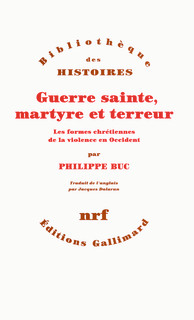
Publication – Philippe Buc, « Guerre sainte, martyre et terreur. Les formes chrétiennes de la violence en Occident »

Philippe Buc examine dans ce livre comment la théologie chrétienne a façonné des siècles de conflits, depuis la première guerre judéo-romaine (66) jusqu’à l’invasion de l’Irak (2003), en passant par la première croisade (1096) ou la Révolution française. Même dans les sociétés sécularisées ou explicitement non chrétiennes, comme l’Union soviétique stalinienne, les formes qu’ont prises de nombreux séismes politiques (guerres civiles, purges, déportations, terrorisme, etc.) sont selon lui en grande partie explicables par le christianisme et les très anciens concepts religieux qui influencent la façon dont la violence est perçue et perpétrée.

product_9782070178193_195x320

Ce que veut comprendre Philippe Buc c’est non seulement la logique par laquelle une personne saine d’esprit est amenée à tuer ou mourir pour un principe, mais aussi les raisonnements qui légitiment l’imposition de la liberté par la contrainte ou le pardon des atrocités de la guerre. Analysant l’idéologie américaine contemporaine de la guerre, qui place la violence sous l’empire d’idées abstraites, comme la liberté ou la paix mondiale, il met au jour son profond enracinement dans l’Écriture sainte.

Fruit de quinze années de recherches d’une ampleur peu commune, Guerre sainte, martyre et terreur montre combien les pieux idéaux de sacrifice, de pureté et de rédemption n’ont cessé de donner sens à la violence, depuis les premiers siècles chrétiens jusqu’aux temps inquiets que nous vivons.

Feuilleter les premières pages du livre : ici

Informations pratiques :
Philippe Buc, Guerre sainte, martyre et terreur. Les formes chrétiennes de la violence en Occident, Paris, Gallimard, 2017 (Bibliothèque des histoires). 560 pages, 140 x 225 mm. Prix : 36 euros (24,99 au format PDF).

Source : Gallimard

Publié dans Publications | Laisser un commentaire