Formation – Écrire, lire, archiver : une histoire de l’écrit au Moyen Âge

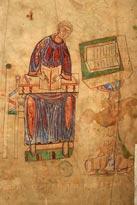
L’écrit est omniprésent dans la société contemporaine et, à ce titre, il nous semble parfaitement familier. Pourtant, son usage ne va pas de soi, comme se sont attachés à le montrer nombre d’anthropologues : pour s’imposer, l’écrit ne nécessite pas seulement des compétences techniques de lecture et d’écriture de la part de ses utilisateurs, il doit aussi apparaître aux yeux de tous – y compris de ceux qui ne le maîtrisent pas – comme une technologie de communication efficiente et crédible. En Occident, c’est précisément au cours du Moyen Âge que sont nées les conditions matérielles et mentales qui ont permis à l’écrit de s’imposer : entre le XIIe et le XIVe siècle, l’écrit, dont l’usage était jusqu’alors réservé à une élite essentiellement cléricale, se répand massivement, pour atteindre, à des degrés divers, toutes les couches de la société. Dans le même temps, ses fonctions se diversifient, fondant de nouvelles pratiques culturelles et sociales. C’est donc à une découverte des racines médiévales de notre rapport à l’écrit que convie la présente formation.

ecrit

Programme :
L’écrit médiéval, concepts et outils
L’écrit, outil d’une élite (VIᵉ-XIIᵉ s.)
La « révolution de l’écrit » (XIIᵉ-XIVᵉ s.)
Histoire d’archives, histoire de bibliothèques

Informations pratiques :
Du jeudi 23 juin 2016 au vendredi 24 juin 2016
Lieu : École nationale des chartes, au 65, rue de Richelieu, Paris 2ᵉ

Tarif public : 420 euros
Tarif privé : 840 euros
S’inscrire : ici

Nos formations sont accessibles dans le cadre des plans de formation CPF et bénéficient de différents dispositifs de financement.

Contact
École nationale des chartes
service de la formation continue
65, rue de Richelieu – 75002 Paris

et

19, rue de la Sorbonne – 75005 Paris
T. +33 (0)1 55 42 21 53
formation.continue_at_enc-sorbonne.fr

Équipe pédagogique :

Olivier Canteaut – Maître de conférences à l’École nationale des chartes

Archiviste paléographe et agrégé d’histoire (2000), Olivier Canteaut a consacré son doctorat à l’étude des mécanismes décisionnels à la cour royale française au début du XIVe siècle et à l’analyse, notamment par le recours à la prosopographie, des élites qui y œuvrent. Dans la lignée de ces recherches, ses travaux s’orientent aujourd’hui dans deux directions. D’une part, il s’attache à étudier les pratiques de gestion de l’écrit développées par les administrations de la fin du Moyen Âge, confrontant notamment les modalités de production et d’utilisation de l’écrit qui prévalent usages dans l’appareil d’État capétien avec celles développées par son homologue anglais ou par la Curie pontificale. D’autre part, il s’intéresse aux structures institutionnelles de la monarchie française et aux groupes humains qui les sous-tendent ; il concentre en particulier son attention sur le Conseil du roi et sur les hommes qui le peuplent.

Enfin, il s’intéresse au développement des humanités numériques. Dans ce cadre, il participe notamment aux réflexions menées par le Centre Jean-Mabillon sur l’édition électronique et se penche sur l’application d’outils et méthodes informatiques pour le traitement des corpus d’actes diplomatiques.

Il est membre du GDR Diplomatique et du GDR Capétiens et du comité exécutif du labex HASTEC.

Source : École nationale des chartes

Publié dans Enseignement | Laisser un commentaire

Offre d’emploi – Stipendiary College Lecturership in Medieval History (University of Oxford)

Location: Oxford
Salary: £12,885 to £14,491 per annum , pro rata
Hours: Part Time
Contract Type: Contract / Temporary
Placed on: 18th March 2016
Closes: 25th April 2016

102

Applications are invited for a Stipendiary College Lecturership in Medieval History at University College, tenable for six months from 1 October 2016 to 31 March 2017. The appointment is to fulfil teaching needs arising from sabbatical leave by Dr Catherine Holmes, who holds a Tutorial Fellowship at University College in association with an Associate Professorship in History, and is non-renewable. Applications are invited from those with active research interests in any field of British or European medieval history between 500 and 1500.

The appointee will be required to provide six hours of tutorial teaching per week for the college during the eight weeks of full term, averaged over two academic terms, and to participate in the annual undergraduate admissions process, pastoral care of students and the administration of the subject in the college, including marking college examinations.

Candidates should have a PhD in History or be able to demonstrate that they are within six months of submitting a doctoral thesis for examination, as well as a record of successful teaching within the field of appointment.

The stipend of the post will be in the range of £12,885-£14,491 per annum, pro rata for six months, plus a number of college benefits. The further particulars and the application form can be viewed at and downloaded from http://www.univ.ox.ac.uk, or are available from the Academic Services Manager: recruitment@univ.ox.ac.uk). The closing date for applications and the last date for receipt of references direct from referees is Monday 25 April 2016.

Please note that this post would not entitle the successful applicant to apply for a Tier 2 UK Visa, and thus any applicant should ensure that they have the legal right to work in the UK for the period of the lecturership.

University College is an Equal Opportunities Employer. Applications are particularly welcome from women and black and minority ethnic candidates, who are under-represented in academic posts in Oxford.

Source : Jobs.ac.uk

Publié dans Le réseau | Laisser un commentaire

Publication – « La dame de cœur ». Patronage et mécénat religieux des femmes de pouvoir dans l’Europe des XIVe-XVIIe siècles

Entre dévotions privées et mémoire dynastique, la question du mécénat et du patronage religieux des femmes de pouvoir permet d’aborder l’histoire de leur spiritualité, mais s’inscrit aussi dans une histoire plus politique du pouvoir, et de son partage entre les sexes. Majoritairement écartées de la Couronne et du pouvoir réel au bas Moyen Âge, les reines se sont-elles distinguées par un investissement plus grand dans le domaine du sacré ? Dans l’association délibérée d’un couple, le monarque incarnait-il davantage l’auctoritas et son épouse la caritas ? Loin de l’histoire engagée du genre, il faut concevoir le pouvoir en termes de complémentarité. Il est néanmoins nécessaire de s’interroger sur la (ou les) spécificités du patronage féminin ; en d’autres termes, existe-t-il des domaines spécifiquement féminins d’appropriation ou d’incarnation du sacré ? C’est sous cet angle d’analyse, à la confluence du politique et du religieux, qu’est abordé l’ensemble des reines-consorts des royaumes européens (France, Italie, Espagne, Pays-Bas) dont les parcours sont examinés sur un temps long, du XIVe au XVIIe siècle, dans une perspective comparatiste.

1459243917

Toutes les formes d’interventions religieuses sont ici évoquées par les meilleurs spécialistes internationaux de l’histoire politique et artistique du Moyen Âge et de l’époque moderne : fondations d’églises, de couvents et d’hôpitaux, legs pieux et charitables, patronages et collections d’ouvrages religieux, mais aussi commandes architecturales ou artistiques.

Murielle Gaude-Ferragu est maître de conférences à l’université Paris 13-Sorbonne Paris Cité. Elle a consacré ses recherches au pouvoir et à ses représentations à la fin du Moyen Âge, tant d’un point de vue cérémoniel (D’or et de cendres. La mort et les funérailles des princes dans le royaume de France au bas Moyen Âge, Presses universitaires du Septentrion, 2005), qu’à travers l’histoire du genre (La reine de France. Le pouvoir au féminin (XIVe-XVe siècle), Tallandier, 2014).

Cécile Vincent-Cassy est maître de conférences à l’université Paris 13-Sorbonne Paris Cité. Spécialiste de l’histoire religieuse et de la culture visuelle dans la Monarchie hispanique de la première modernité, elle est l’auteur de Les saintes vierges et martyres dans l’Espagne du XVIIe siècle. Culte et image, Casa de Velázquez, 2011, et a coédité La Cour céleste. La commémoration collective des saints au Moyen Âge et à l’époque moderne, Brepols, 2015.

Table des matières : ici

Informations pratiques :
Murielle Gaude-Ferragu et Cécile Vincent-Cassy (dir.), « La dame de cœur ». Patronage et mécénat religieux des femmes de pouvoir dans l’Europe des XIVe-XVIIe siècles, Rennes, Presses Universitaires de Rennes, 2016 (Histoire). 15,5 x 24 cm, 322 p. . ISBN : 978-2-7535-4870-1. Prix : 22,00 €.

Source : Presses Universitaires de Rennes

Publié dans Publications | Laisser un commentaire

Offre d’emploi – Lecturer in Medieval Latin (University of Edinburgh)

Vacancy Ref: : 035966
Closing Date : 06-May-2016
Contact Person : Professor Niels Gaul
Contact Email : N.Gaul@ed.ac.uk

Edinburgh

Applications are invited from scholars of the highest calibre with research interests and teaching experience in Medieval Latin (ca.AD 500-1500). The successful candidate is expected to contribute to teaching and supervision at undergraduate and postgraduate levels, including potentially the MSc programmes in Classics, Medieval History, and Late Antique, Islamic and Byzantine Studies, and to take a lead in the teaching of Medieval Latin to postgraduates in various fields across the University of Edinburgh’s College of Humanities and Social Science. The ability to teach Latin Palaeography will be advantageous. The post-holder will actively engage in research of high quality that will make a substantive contribution to the School’s profile, and will be open to interdisciplinary collaboration.

This is a full-time, open-ended, post with a salary of £38,896 – £46,414

Closing date: 5pm (GMT) on Friday 6th May 2016

1. Job Details

Job title: Lecturer in Medieval Latin
School/Support Department: School of History, Classics and Archaeology
Unit: Classics
Line manager: Head of Classics

Classics at Edinburgh

Undergraduate applications to courses and degrees in Classics are buoyant and applications and enrolments are high. There is a very strong and growing postgraduate presence, both in taught courses and in research degrees. All staff are active researchers with interests covering a great many areas of classical studies. Full information about the subject area is detailed below, and can be found on our website at: http://www.ed.ac.uk/history-classics-archaeology/classics

Medieval studies at Edinburgh

Medieval Studies at Edinburgh is taught across many of the Schools that make up the College of Humanities and Social Science, and the Centre for Medieval and Renaissance studies brings together around seventy staff, including about a dozen Medieval and Renaissance historians within the History Subject Area of the School of History, Classics, and Archaeology. Further information can be found on our website at:
http://www.ed.ac.uk/history-classics-archaeology/centre-medieval-renaissance

Main Responsibilities

Teaching

The post-holder will be required to deliver and assess courses at all levels of the School’s teaching provision, and to carry out administrative tasks associated with the delivery and assessment of teaching. S/he will be expected to lecture and conduct tutorials in appropriate sub-honours undergraduate courses and to teach honours courses in medieval and classical Latin and, ideally, Latin Palaeography. S/he will act as dissertation supervisor to a small number of students in the fourth year of the curriculum, and will be required to provide pastoral advice and guidance, especially to undergraduate students. S/he will also contribute to the teaching and supervision of postgraduate students in his/her area of expertise.

Research

The post-holder will be expected to engage in personal research of high quality and to play an active role in obtaining external funding and starting individual or joint research projects/networks. S/he is expected to contribute to the research culture of the School of History, Classics & Archaeology, including active participation in its Research Seminar series, and invited to develop interdisciplinary research initiatives across the School and the University of Edinburgh. S/he is expected to furnish evidence of outstanding achievement as a researcher, in the form of publications, commensurate with his/her career stage.

Administration

All members of the School of History, Classics and Archaeology are required to contribute to the administration of their Subject Area, at the direction of the Head of Subject Area, and may also expect to become involved in the administration of the School, under the direction of the Head of School. The successful candidate will be asked from the start of the appointment to contribute fully to the administration and assessment that arise from teaching, and increasingly to the administration of both Subject Area and School. He or she will be directly responsible to the Head of School and the Head of Classics (who has been delegated line management responsibility by the Head of School).

Knowledge, Skills and Experience Needed for the Job

Qualifications/Training

Essential

• A PhD on a topic involving Medieval Latin, or a PhD in a related field combined with substantial research in Medieval Latin.
• Good first degree (first/2.1) in Classics, Medieval Studies, or a cognate subject.

Experience

Essential

• Teaching experience at undergraduate level in Latin and/or Medieval Studies.
• Evidence of ability to produce original research publications of recognised international excellence in the field of Medieval Latin, commensurate with career stage.

Desirable

• Experience of large-group lecturing and small-group tutorial teaching at pre-honours level.
• Experience of teaching classes at honours level.
• Teaching experience at postgraduate level.
• Teaching experience in other relevant subjects (e.g. classical Latin, medieval history, Latin palaeography).
• Experience in course design and evaluation.
• Experience of research supervision.
• Strong record of research publication.
• Strong record in applications for research funding.
• Experience of communicating research findings to the wider public.
• Relevant IT skills and experience including skills for online teaching
• Relevant administrative experience.

Personal Attributes

Essential

• Excellent presentation and communication skills.
• Commitment to quality and innovation in teaching.
• Versatility in approach to teaching.
• Commitment to scholarship and research.
• Capacity for originality and innovation in scholarship.
• Excellent interpersonal skills.
• Ability to work as part of a team.
• Capacity to enthuse and motivate.

Desirable

• Capacity for leadership in teaching and research.

Application Procedure

All applicants should apply online by clicking the apply link at the bottom of this page and submitting an up to date CV, including a list of publications, and completing the 2000 character supporting statement in the application. The application process is quick and easy to follow, and you will receive email confirmation of safe receipt of your application. The online system allows you to submit a CV and other attachments.

The closing date is 5pm (GMT) on Friday 6th May 2016.

Eligibility to Work

In accordance with the Immigration, Asylum and Nationality Act 2006 the University of Edinburgh, as an employer, has a legal responsibility to prevent illegal working and therefore must check that all employees are entitled to work in the United Kingdom (UK).

To do so, the University of Edinburgh requires to see original documents evidencing right to work in the UK before commencement of employment and this is normally carried out at interview. Details will be provided in any letter of invitation to interview.

For further information on eligibility to work please visit our eligibility to work website

If you are not currently eligible to work in the UK, the University has the authority to issue a Certificate of Sponsorship (CoS) to successful candidates who meet the eligibility criteria. The CoS enables candidates to apply for a Tier 2 (general visa) in accordance with current UK Visas and Immigration rules.

For applicants interested in sponsorship information is available on our Working in the UK website

However, if you have previously been sponsored by an employer within the UK but your leave has expired or lapsed and you are no longer in the UK, according to Home Office Visa Immigration rules you cannot apply for sponsorship under any category of Tier 2 for a period of 12 months after the date your visa expired and/or you left the UK.

If you are an academic in the field of sciences; humanities; engineering; medicine; digital technology; or the arts and come from outside the EEA, it may be possible for you to apply for a Tier 1 (Exceptional Talent) visa.

The Tier 1 (Exceptional Talent) visa route offers a greater flexibility in your employment compared to other UK immigration routes, meaning you can, for example, move organisation, location and/or job role. By contrast with, a Tier 2 visa where you are ‘tied to a UK sponsor’. Tier 1 provides greater flexibility in undertaking additional engagements, such as collaborations and is intended as a route to settlement. Allowed absences from the UK are up to 180 days per year without losing the eligibility to qualify for settlement, with no restriction on the reason for absence (unlike Tier 2, where any absences from the UK must be for a purpose consistent with the person’s employment or economic activity, including paid annual leave, or for serious or compelling personal reasons).

You would initially need to apply to be endorsed as an internationally recognised leader or emerging leader in your particular field by a designated competent body (Arts Council England, British Academy, Royal Academy of Engineering, Royal Society, Tech City UK).

Tier1 (Exceptional and Exceptional Promise) Endorsement Criteria

Once successfully endorsed, you are able to apply for a Tier 1 (Exceptional Talent) visa. More information on this entry route is available at UKVI Website.

Conditions of Employment

Pension Scheme

This role is grade UE08 and therefore the post holder is automatically included in membership of the Universities Superannuation Scheme (USS), subject to the USS membership criteria, unless they indicate that they choose not to join the Scheme.

For further information please visit our Pensions website.

Salary

The role is grade UE08 and attracts an annual salary of £38,896 – £46,414 for 35 hours each week. Salary is paid monthly by direct transfer to your Bank or Building Society account, normally on the 28th of the month. Salaries for part-time staff are calculated on the full-time scales, pro-rata to the Standard Working Week.

The University reserves the right to vary the candidate information or make no appointment at all. Neither in part, nor in whole does this information form part of any contract between the University and any individual.

Source : University of Edinburgh

Publié dans Offre d'emploi | Laisser un commentaire

Journée d’étude – La chevalerie en représentation

19 avril 2016
Deutsches Historisches Institut Paris
Institut historique allemand, 8 rue du Parc-Royal, 75003 Paris, http://www.dhi-paris.fr

Organisation : Guillaume Bureaux (IHA)
Renseignements et inscription: event@dhi-paris.fr

DHIP IHA

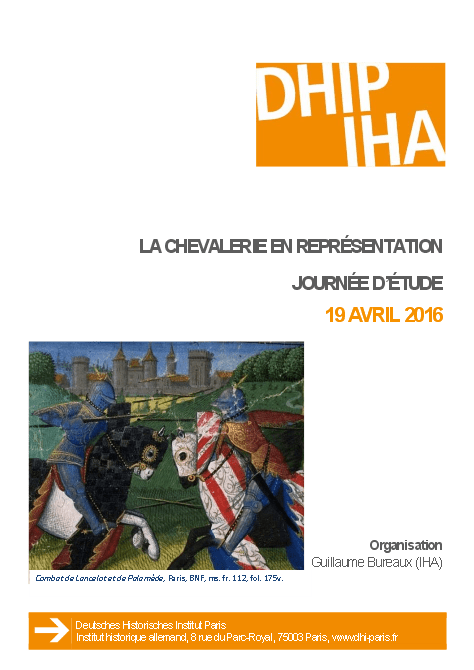
L’image galvaudée d’un Moyen Âge noir, emprunt de malheurs en tout genre, encore persistante de nos jours, tend à montrer une certaine immobilité, aussi bien intellectuelle, sociale et économique que politique et culturelle. À en croire cette représentation, nombre de pratiques dites »moyenâgeuses« renvoient inévitablement à cette période pensée comme rude et austère. C’est cependant oublier le goût des hommes et des femmes du Moyen Âge pour les festivités, les réjouissances et les moments d’union avec tel ou tel souverain, telle ou telle ville.

S’il est vrai que la plupart des fêtes sont l’apanage de l’élite sociale qu’incarne la noblesse, la bourgeoisie et voire même les ecclésiastiques; elles constituent des témoignages précieux pour la connaissance de cette époque et de son organisation. Tournois, joutes et pas d’armes, bien que nobiliaires ou haut-bourgeois, sont des événements réunissant un ensemble de personnes représentatif de la société médiévale.

D’après Roger Caillois, les jeux, notamment agonaux, sont des moments à part, »hors du temps« quotidien. Ils incarnent une réponse formidable à un besoin ludique dont l’ensemble des catégories sociales se nourrit et dans laquelle elles puisent leurs forces pour dépasser une réalité souvent difficile.

Programme :

9h00 : Guillaume Bureaux (IHA/univ. Rouen), Accueil et Introduction

Session I Présidence: Jacques Paviot (univ. Créteil)

9h15 Audrey Pennel (univ. de Bourgogne), Des hourds aux lices: la place des »dames« dans les enluminures des tournois et pas d’armes aux XIVe et XVe siècles
9h45 Commentaire

10h00 Guillaume Bureaux (IHA/univ. Rouen), La théâtralisation du pouvoir au
sein des pas d’armes angevins et bourguignon
10h30 Commentaire et discussion
11h00 Pause

Session II Présidence: Torsten Hiltmann (univ. Münster)

11h15 Jayne Wackett (univ. Canterbury), Capturing Kingliness: English
Kingship in the »Age of Chivalry«
11h45 Commentaire

12h00 Claudia Wittig (univ. York), Erfolg am Hof, Legitimation in der Welt – Verhaltensregeln und Rittertugenden als Grundlage der Legitimation des hochmittelalterlichen Adels in Frankreich und Deutschland
12h30 Commentaire et discussion
13h00 Pause déjeuner

Session III Présidence: Vanina Kopp (IHA)

14h15 Luis Miguel Duarte (univ. de Porto), Des sauvages ces allemands! Le Mariage de l’empereur Frédéric III avec Leonor du Portugal (Italie, 1452)
vu par un gentilhomme de Lisbonne
14h45 Commentaire

15h Torsten Hiltmann (univ. Münster), Das spätmittelalterliche Turnier als »Unbekannte«. Vergleichende Beobachtungen zu agonalen Innovationen und sozialen Differenzierungen
15h30 Commentaire et discussion
16h00 Pause

Session IV Présidence: Jayne Wackett (Canterbury)

16h15 Gion Wallmeyer (univ. Göttingen), With Pen and Sword – Knights as
Crusading-Expert at the Latin Courts of the 13th and 14th Century
16h45 Commentaire

17h00 Alexandra Ilina (univ. Paris 3/Bucarest), Remarques sur l’iconographie
du chevalier sarrasin dans les manuscrits du Tristan en prose
17h30 Commentaire et discussion

18h00 Guillaume Bureaux (IHA/univ. Rouen), Conclusion

Source : DHIP-IHA

Publié dans Colloque | Laisser un commentaire

Colloque – The Making of a Female Memory : Texts, Images, Rituals

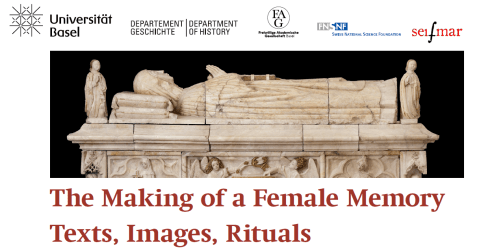
Die diesjährige Jahrestagung der Société d’Études Interdisciplinaires sur les Femmes au Moyen Âge et à la Renaissance (SEIFMAR) findet vom 20. bis 21. Mai 2016 am Departement Geschichte der Universität Basel statt. Im Zentrum der zweitägigen Konferenz stehen Fragen nach den verschiedenen Arten weiblicher Identitäts- und Erinnerungskonstruktion in Europa und den Amerikas. Ausgehend von Kontinuitäten, die sich sowohl über Epochengrenze zwischen Mittelalter und der Frühen Neuzeit als auch transatlantisch konstatieren lassen, bringt die Tagung Forschende aus Europa und Nord- sowie Lateinamerika zusammen. Chronologisch reicht die Bandbreite vom 10. bis ins späte 17. Jahrhundert und auch disziplinär decken die Vortragenden aus den Bereichen Geschichte, Kunstgeschichte und Literaturwissenschaft eine große Bandbreite ab.

Female Memory

Programme :

Friday, May 20th 2016

1.00- 1.15 pm

Introduction: Dr. Annalena Müller (Basel)

1.15- 4.30 pm
I. Death and Commemoration
Chair: Caroline Schärli, MA (Basel)

Dr. Mads Heilskov (Aarhus University) – From Gown to Chasuble: The Donation and Transformation of Gendered Objects in Late Medieval Denmark
Dr. Miguel García Fernández, MA (Santiago de Compostela) – The Memory of noblewomen in Northwest Spain during the Late Middle Ages: Chronicles, Documents and Tombs
Coffee Break

Dr. Sonsoles García (University College London) – Women as Memory Keepers in the Kingdoms of Asturias and León (10th-13th c.)
Dr. Patricia Stoop (Antwerp/ Utrecht) – Dutch Collections of Sermons as Tools for Commemoration of the Death (c. 1450–1650)
Discussion & Break

5.00 pm Keynote: Prof. Dr. Alison Beach (Ohio State) – Monastic Necrologies and the Politics of Female Memory in the Central Middle Ages

ca. 7 pm Conference Dinner

Saturday, May 21st 2016

09.30 – 10.00 am Coffee and Tea

10.00-12.00
II. Creation of Origin Narratives
Chair: Prof. Dr. Claudia Opitz-Belakhal

Jirki Thibaut, MA (Ghent) – Remembering Female Monastic Origins in Tenth-Century Metz
Dr. Kirsty A. Day (Leeds) – Rethinking the Origins of the Franciscan Nuns in Wrocław
Prof. Doris Bieñko (Instituto Nacional de Antropología e Historia) – Our Mothers’ Writings. The Seventeenth-Century Mexican Nuns’ Manuscripts and their Cultural Background

ca. 12.30 Lunch

2.00 – 5.00 pm

III Material Culture and Memory
Chair: Dr. Mercedes Pérez Vidal (Padua)

Dr. Stefanie Seeberg (Cologne/ Städel Museum) – Commemorative Function of Art in the Female Monastery of Altenberg under Gertrud of Thüringen (1227-1297)
Dr. Anja Rathmann-Lutz (Basel) – Books of Hours as Melting Pots of Devotion, Memory and Wishes in 14th-Century France
Discussion

Closing Remarks by Laura Cayrol Bernardo, MA (EHESS)

Informations pratiques :
Ort : Basel
Veranstaltungsort : Departement Geschichte
Veranstalter : Société d’Études Interdisciplinaires sur les Femmes au Moyen Âge et à la Renaissance (SEIFMAR)
Datum : 20.05.2016 – 21.05.2016
Bewerbungsschluss : 01.05.2016

Source : H-Soz-Kult

Publié dans Colloque | Laisser un commentaire

Exposition virtuelle – Bruegel. Unseen Masterpieces. When art meets technology

Bruegel. Unseen Masterpieces When art meets technology
Installation temporaire
16.03.2016 > 16.03.2020

googlebruegel_300x300_v2_4_medium@2x.jpg

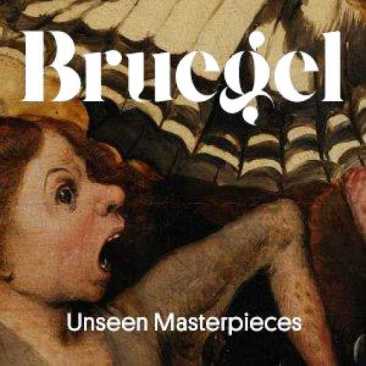
Bruegel. Unseen Masterpieces dévoile au public les secrets cachés des œuvres de Pieter Bruegel l’Ancien († Bruxelles, 1569). Si le peintre et ses tableaux sont mondialement connus, chacune de ses compositions renferme encore une multitude de personnages insolites ou familiers, d’histoires dans l’Histoire qui sont autant de chefs-d’œuvre à révéler.

À travers une large palette d’expériences accessibles en ligne et in situ, cette initiative inédite propose à chacun de s’immerger dans les tableaux de Bruegel, en accédant aux détails infimes de chaque peinture ainsi qu’aux connaissances des experts. Plongeant dans l’univers du peintre, le spectateur découvre ces détails insoupçonnés qui sont la plus belle expression du génie du maître flamand. Les Musées royaux des Beaux-Arts de Belgique ont initié cet événement avec l’Institut Culturel de Google, dans la perspective du 450ème anniversaire de la mort de Bruegel, en 2019. Ce projet innovant rassemble de prestigieux musées internationaux, pour la plupart européens, autour de la figure de Bruegel. Il est la concrétisation d’une profonde réflexion sur les changements en cours dans le domaine de la muséologie, à l’ère du digital.

Les expositions virtuelles Bruegel. Unseen Masterpieces sont à découvrir sur les stations interactives des Musées royaux des Beaux-Arts de Belgique, sur leur application mobile et sur la plateforme de l’Institut Culturel de Google.

Les Musées royaux des Beaux-Arts de Belgique remercient l’Institut Culturel de Google de s’être associé à eux dans le développement de ce projet extraordinaire. Les MRBAB expriment également leur gratitude envers Engie, grâce à qui le projet-pilote de la Breugel Box a pu voir le jour.

Source : Musées royaux des Beaux-Arts de Belgique

Publié dans Exposition, Web | Laisser un commentaire

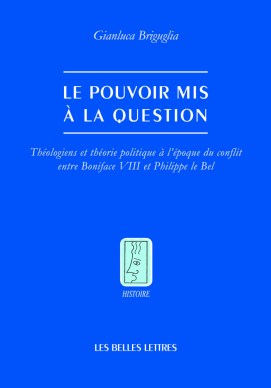
Publication – Gianluca Briguglia, « Le pouvoir mis à la question. Théologiens et théorie politique à l’époque du conflit entre Boniface VIII et Philippe le Bel »

À partir d’une étude des principales questions disputées dans les innombrables traités – politiques et théologiques – qui ont fleuri à l’époque de la querelle entre le pape Boniface VIII et le roi Philippe le Bel, Gianluca Briguglia interroge le rapport entre théologie et théorie politique et relève l’émergence, au sein de ces débats, des catégories fondatrices de la pensée politique moderne.

S’appuyant sur les textes de Godefroid de Fontaine, de Jacques de Viterbe, de Jean de Paris et de Gilles de Rome, l’auteur s’emploie à cerner les enjeux théoriques et pratiques des thèmes débattus par ces éminents théologiens.

Le champ d’investigation s’ouvre sur des thèmes plus proprement philosophiques et à caractère social et politique : la notion de signe, de contrat, de pacte, de propriété, de sociabilité humaine. Finalement, les théologiens en viennent à questionner les fondements du pouvoir.

Cette plongée au cœur des questions disputées offre au lecteur la possibilité d’accéder à des textes majeurs du Moyen Âge, non traduits en français, et d’appréhender la complexité des liens entre théologie, philosophie et politique.

22510100219150L

Table des matières :

Introduction
1. Signes, instruments, pouvoirs
2. Rois, papes et intellectuels

I. Inquirere veritatem. Les prologues politiques de Jean de Paris, Gilles de Rome et Jacques de Viterbe
Notitia veritatis. Connaître la vérité
« Je crois que la recherche de la vérité n’est pas critiquable, puisque l’ignorance est dangereuse et que, dans certains cas, nous n’avons aucune certitude » : Jacques de Viterbe, Gilles de Rome, Jean de Paris et la recherche de la vérité.

II. Corpus. Corps du Christ et théorie politique
Quelques implications philosophiques du débat sur l’eucharistie. Corps, matière, substance
La Determinatio de Jean de Paris
Gilles de Rome et Jean de Paris face au corps du Christ. Sacrement et théorie politique

III. L’institution du pouvoir
Les deux natures du Christ et le pouvoir de Pierre et de son successeur. Jacques de Viterbe et Jean Quidort de Paris
« Nutus est signum voluntatis. » Le problème de la fondation

IV. Générer et régénérer le pouvoir. La causalité politique chez Gilles de Rome
« Communicacio ». Le naturalisme politique comme agir communicationnel
Adam. Le péché originel
Générativité
Le baptême et le pacte
Le pape et le pouvoir constituant

Conclusions. Les théologiens et la politique
Notes
Index des noms
Bibliographie

Informations pratiques :
Gianluca Briguglia, Le pouvoir mis à la question. Théologiens et théorie politique à l’époque du conflit entre Boniface VIII et Philippe le Bel, Paris, Les Belles Lettres, 2016 (Histoire). 15 x 21 x 1,1 cm, 228 pages. ISBN :978-2-251-38132-9. Prix : 25,90 euros. Traduit de l’italien par Marilène Raiola.

Source : Les Belles Lettres

Publié dans Publications | Laisser un commentaire

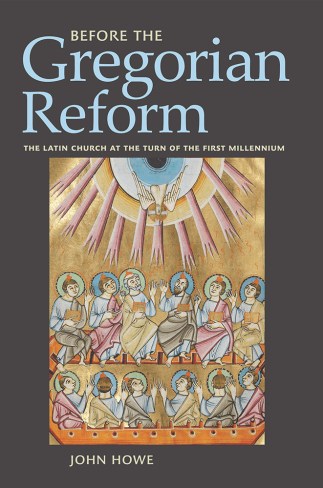
Publication – John Howe, « Before the Gregorian Reform. The Latin Church at the Turn of the First Millennium »

Historians typically single out the hundred-year period from about 1050 to 1150 as the pivotal moment in the history of the Latin Church, for it was then that the Gregorian Reform movement established the ecclesiastical structure that would ensure Rome’s dominance throughout the Middle Ages and beyond. In Before the Gregorian Reform, John Howe challenges this familiar narrative by examining earlier, « pre-Gregorian » reform efforts within the Church. He finds that they were more extensive and widespread than previously thought and that they actually established a foundation for the subsequent Gregorian Reform movement.

80140100552420L

The low point in the history of Christendom came in the late ninth and early tenth centuries—a period when much of Europe was overwhelmed by barbarian raids and widespread civil disorder, which left the Church in a state of disarray. As Howe shows, however, the destruction gave rise to creativity. Aristocrats and churchmen rebuilt churches and constructed new ones, competing against each other so that church building, like castle building, acquired its own momentum. Patrons strove to improve ecclesiastical furnishings, liturgy, and spirituality. Schools were constructed to staff the new churches. Moreover, Howe shows that these reform efforts paralleled broader economic, social, and cultural trends in Western Europe including the revival of long-distance trade, the rise of technology, and the emergence of feudal lordship. The result was that by the mid-eleventh century a wealthy, unified, better-organized, better-educated, more spiritually sensitive Latin Church was assuming a leading place in the broader Christian world.

Before the Gregorian Reform challenges us to rethink the history of the Church and its place in the broader narrative of European history. Compellingly written and generously illustrated, it is a book for all medievalists as well as general readers interested in the Middle Ages and Church history.

Table des matières :

Introduction: A Pre-Gregorian Reform?
1. « Wolves Devouring the Lambs of Christ »
2. “Enter Confidently into the War of the Lord God”
3. “A White Mantle of Churches”
4. “To Rouse Devotion in a Carnal People”
5. “Following in the Footsteps of the Saints”
6. “When My Soul Longs for the Divine Vision”
7. “Learning Is Part of Holiness”
8. “The Body Is Not a Single Part”
9. “One Shepherd Presides over All Generally”
Epilogue: A Pope Captured, A Church Triumphant

Informations pratiques :
John Howe, Before the Gregorian Reform. The Latin Church at the Turn of the First Millennium, Ithaca, Cornell University Press, 2016. 368 p., 45 ill., 44 halftones, black & white. 1 table. ISBN : 978-0-8014-5289-5. Prix : 45$.

Source : Cornell University Press

Publié dans Publications | Laisser un commentaire

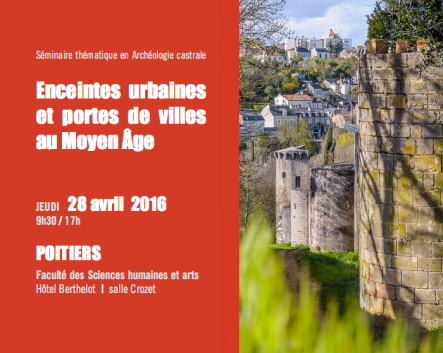
Journée d’étude – Enceintes urbaines et portes de villes au Moyen Âge

Journée de séminaire thématique en Archéologie castrale, organisée dans le cadre du Master 2 Civilisation Histoire Patrimoine Sources, spécialité Civilisation antique et médiévale, de l’Université de Poitiers, sous la coordination de Nicolas Prouteau (CESCM, Université de Poitiers) et Jocelyn Martineau (Service régional de l’archéologie Pays de la Loire).

Capture d’écran 2016-04-09 à 22.33.43

Programme :

9h30 – Jocelyn Martineau (Service régional de l’archéologie Pays de la Loire), Introduction
10h – Christian Corvisier (Historien de l’architecture) et Judicaël de la Soudière (Architecte du patrimoine), Coucy / Porte de Laon : renouvellement de la connaissance et projets futurs de réhabilitation
11h – Vincent Acheré et Thomas Lecroère (Service archéologique de la Ville de Chartres), Une barbacane de la fin du Moyen Âge à Chartres
11h45 – Jean-Yves Hunot (Archéologue, Conservation Départementale du Patrimoine de Maine-et-Loire), L’enceinte urbaine d’Angers, nouveaux apports sur sa mise place au XIIIe siècle

14h – Hugo Meunier (CAPRA, Le Mans) et Stéphane Augry (Inrap), Les fortifications urbaines du Mans : première approche (IXe-XVIe s.)
14h45 – Amélie Deron (Master I en Archéologie médiévale, Université de Poitiers), Le front sud de l’enceinte de Poitiers, de la tour à l’Oiseau à la tour de Vouneuil
15h30 – Jean Yasmine (Architecte), L’enceinte et les portes de la ville mamelouke de Baalbek (Liban)
16h15 – Nicolas Prouteau (CESCM, MCF Université de Poitiers), Décor, protection spirituelle et mise en scène du pouvoir dans les enceintes urbaines du Proche-Orient des Croisades

Informations pratiques :
Jeudi 28 avril 2016
CESCM, salle Crozet – Bât. E13, Faculté des Sciences humaines et arts, hôtel Berthelot, – 24 rue de la chaîne
Poitiers, France (86)

Entrée libre. Ouvert à tous.

Publié dans Colloque | Laisser un commentaire