Offre d’emploi – Full-time position as Research Professor in the rank of assistant professor (tenure track), funded by the Special Research Fund (BOF) in the field of Rural History of pre-Industrial Europe

  • Last application date: Mar 30, 2016 23:59
  • Department: LW03 – Department of History
  • Contract:Statutary
  • Occupancy rate: 100%
  • Vacancy Type:Autonomous academic staff

UGent

Full-time position as Research Professor in the rank of assistant professor (tenure track), funded by the Special Research Fund (BOF) in the Faculty of Arts & Philosophy.

The Faculty of Arts & Philosophy of Ghent University (Belgium) announces a vacancy for a fulltime professorial post in the rank of assistant professor (tenure track), starting October 1, 2016 at the earliest.

The appointment is in the field of ‘Rural History of pre-industrial Europe’.

An appointment in the rank of lecturer is a tenure track position for a period of five years, at the end of which a tenure decision will be taken, following an evaluation by the university of the personalised objectives agreed upon at the time of the appointment.

The new academic staff member will be granted the privilege of focusing primarily on research for a period of 5 years, with a teaching assignment limited to a maximum average of 8 ECTS per semester over a period of 3 years. Stipulated working time assigned to research, teaching and service may be changed by the university after this period.

At Ghent University, career advancement in the rank of lecturer and associate professor is subject to periodic assessment on the basis of agreed personalised objectives.

Candidate’s profile:

  • candidates are required to hold a PhD with a doctoral thesis in the field of history, or an equivalent thereof;
  • candidates should have at least two years of postdoctoral research experience on October 1, 2016;
  • candidates are required to have excellent research experience in the indicated research field, substantiated with the doctoral thesis and recent outstanding publications in national and international peer-reviewed scientific journals and books;
  • candidates should possess the necessary didactic skills to develop students’ academic competence;
  • experience in conducting research and/or supervising doctoral theses is considered an asset;
  • positively evaluated experience with provided and/or organised academic education is considered an asset;
  • professionalization of education is considered an asset;
  • candidates should have experience in international mobility through participation in research programs at research institutions other than the university where the highest degree was attained.

The application must be accompanied by the following documents:

  • an outline (max. 1,500 words) of the candidate’s view on research, education and scientific services in relation to this vacancy;
  • the required transcripts (copies of the qualifications);
  • a portfolio containing additional information on the candidate’s own teaching competences.

The selection is carried out in two stages:

  • candidates will be shortlisted on the basis of their CV, publications and outline. All shortlisted candidates will be invited for a trial lesson and an interview;
  • based on the collated information, a decision will be made as to if and how each candidate will be ranked.

A full-time position in the rank of assistant professor is a temporary Tenure Track appointment of five years, after which a tenure decision will be made, based on an overall evaluation. A positive evaluation will lead to a permanent appointment in the rank of associate professor.

Exceptionally, candidates employed as professorial staff or an equivalent thereof at another university or research institute can immediately be appointed in the rank of assistant professor, without prejudice to the possibility of a temporary appointment as provided by article 91 of the university decree.

Candidates are required to attend the compulsory basic teacher training.

In support of the language of instruction, Ghent University provides non-mandatory Dutch and English language courses for non-native speaking professorial staff.

For further information about this vacancy, applicants are welcome to contact prof. Eric Vanhaute () or tel +32 (0)9 331 02 82.

How to apply 

Applications must be sent no later than March 30, 2016 by e-mail to

recruitmentzap@ugent.be, using the application form for BOF-ZAP positions. The submission includes copies of the applicant’s diplomas and a research plan for a period of five years (in English, minimum 3 pages, maximum 5 pages; add a one-page summary in English). All documents are submitted together in one attachment. Please indicate clearly the name of the vacant position, department and reference number BC20160219 rural history. Candidates will receive an e-mail confirming receipt of the application.

The BOF-ZAP application form is available through the following link:

http://www.ugent.be/nl/vacatures/zap/sollicitatieformulieren-zap/sollboftt.docx/view.

Source : Universiteit Gent

Publié dans News | Laisser un commentaire

Offre d’emploi – One postdoc position (1 + 3 years) within the ERC Starting Grant Project “STATE – Lordship and the Rise of the State in Western Europe, 1300-1600”

Deadline: 15 May 2016
Ghent University (Belgium) – Department of History

Job Description

The postdoctoral researcher will participate in an ERC-funded research project that pursues a new interpretation of state formation in Western Europe between 1300 and 1600. This period is considered as the key phase in the genesis of the modern state, as various polities now centralized fiscal and military resources under their command. While there is debate whether this was primarily a top-down process carried out by princes, or a bottom-up process carried out by popular representation, scholars tend to agree that state building was essentially a process of centralization. This assumption must be questioned, as recent studies have raised awkward questions that cannot be answered by the current paradigm.

The research hypothesis is that the emerging states of Western Europe could only acquire sufficient support among established elites if they also decentralized much of their legal authority through a process in which princes created or endorsed a growing number of privately owned seigneuries as “states-within-states” for the benefit of elites who in turn contributed to state building. This project will study the interplay between states and seigneurial elites in five regions – two in the Low Countries, two in France, and one in England – to test whether fiscal and military centralization was facilitated by a progressively confederal organization of government. Together, the case studies cover four key variables that shaped the relations between princes and power elites in different combinations all over Europe. It concerns different trajectories in 1) state formation, 2) urbanization, 3) the socio-economic organization of rural society, and 4) ideological dissent. The comparisons between the case studies are aimed at the development of an analytical framework to chart and to explain path-dependency in Europe.

The postdoctoral researcher, starting 1 September 2016, will explore secular lordship in the French provinces of Normandy and Languedoc. Depending on personal preference, a focus on either the fourteenth or sixteenth century is possible. The heuristic aim is to develop a snapshot survey of seigneuries and their owners of a part of each province, using sources preserved in the Archives nationales/Bibliothèque nationale in Paris, as well as in regional archives (travel expenses are borne by the ERC-project). The interpretative aim is to use these case studies to engage with current theories on state formation and elite formation in Late Medieval and Early Modern Europe.

You will be based at Ghent University in the Department of History and the Pirenne Institute for Medieval ,Studies and be part of the research team led by prof.dr. Frederik Buylaert (currently Vrije Universiteit Brussel; Ghent University as of September 2016). The team will consist of two postdoctoral fellows and two doctoral students. Close collaboration is expected with dr. Justine Firnhaber-Baker (University of St Andrews), who will co-supervise the French case studies of the project.

Ghent University was founded in 1817 and counts approximately 40,000 students and 9,000 staff. It is consistently listed in the top 100 of the universities of Europe (see http://www.ugent.be/en).

Qualifications

The successful candidate preferably has:
– A Ph.D. in Medieval or Early Modern History or a manuscript submitted to the Ph.D. committee.
– Demonstrated experience with archival work, preferably on French or French-language history.
– Demonstrated experience with qualitative and quantitative research methods, including an active interest in comparative history.
– Demonstrated capacity for creative and independent research.
– The ability and willingness to work as a member of an international research team, including contributions to a shared database as well as joint publications.
– Demonstrated experience in publishing at high academic standards.

Offer

We offer a postdoc-position of 1 FTE, beginning 1 September 2016. Initially, there is a one-year contract. After a positive evaluation, this contract can be extended with three more years (a total of three to four years maximum). The starting salary approximates 3,896 euros gross on a full-time basis, in concordance with the requirements of the Flemish Government.

Ghent University offers a pension scheme, a holiday allowance and end-of-year bonus. For more information, see http://www.ugent.be/en/work.

How to apply

Applications are to be sent as a pdf-file by email to prof.dr. Frederik Buylaert (email: frederik.buylaert@ugent.be). Applications must include the following elements:
– Motivation letter.
– Curriculum Vitae, including a survey of 1) language skills (active and passive); 2) experience with archival work; and 3) PC-skills.
– A pdf-copy of the doctoral dissertation.
– A writing sample (e.g. an article or book chapter), preferably in English unless the submitted doctoral dissertation is written in English).
– Certified copies of relevant diplomas.
– Contact details of two referees (name, institutional affiliation and email address) or two letters of reference.

In the second stage of the application procedure, the selected candidates will be provided with the full project description and be asked to submit a research proposal of max. 1,500 words that will be discussed during an interview.

Application Deadline: 15 May 2016

Additional information
Are you interested? For more information, please contact the project leader prof. dr. Frederik Buylaert (email: frederik.buylaert@ugent.be)

Publié dans Offre d'emploi | Laisser un commentaire

Exposition – Moissac et l’enluminure romane

Exposition au cloître de Moissac du 2 avril au 2 octobre 2016

Moissac mérite son surnom de « cité de l’art roman ». Au XIe siècle, quand les chapiteaux du cloître et le portail monumental de l’abbaye Saint-Pierre se paraient de leur décor sculpté, les moines travaillaient à enrichir le trésor de l’abbaye : sa bibliothèque. Grâce aux reproductions de décors des manuscrits copiés par les moines vous pourrez explorer l’art de l’enluminure, autre facette d’expression de l’art roman à Moissac, mais cette fois-ci… en couleurs !

L’exposition « Moissac et l’enluminure romane » a été réalisée à partir du fonds documentaire du Centre d’art roman Marcel Durliat, recensant plus de 3000 reproductions d’enluminures romanes de Moissac et du Sud de la France dont les originaux sont pour la plupart conservés à la Bibliothèque nationale de France.

Moissac

Autour de l’exposition :
Une visite guidée thématique « Enluminures et sculptures » aura lieu quotidiennement au cloître à 14h30 sauf les mardis en juillet et en août.

Un enlumineur, Chantal Boursiac, y réalisera des œuvres et partagera son savoir-faire avec le public du 25 juillet au 7 août, le mardi, jeudi, vendredi, samedi et dimanche de 13 à 17h.

Le service du Patrimoine initiera les enfants de 6 à 12 ans à l’enluminure romane, tous les vendredis à 14h30 du 8 juillet au 26 août 2016 sur inscription au 05 63 05 08 01.

Source : Moissac.fr

Publié dans Exposition | Laisser un commentaire

Appel à contribution – Beyond Borders: Mutual Imaginings of Europe and the Middle East (800-1700)

Barnard College’s 25th Biannual Medieval and Renaissance Studies Conference
Saturday, December 3, 2016

Recent scholarship is challenging the stark border between Europe and the Middle East during the long period between 800-1700. Rather than thinking of these areas in isolation, scholars are revealing the depth of their mutual influence. Trade, war, migration, and scholarly exchange connected Europe and the Middle East in ways both cooperative and adversarial. The distant world was not only an object of aggression, but also, inextricably, of fantasy and longing. Jewish, Muslim, and Christian thinkers looked to each other to understand their own cultural histories and to imagine their futures. Bringing together art historians, literary scholars, historians, scholars of the history of science, and scholars of religious thought, this interdisciplinary conference will explore the real and imaginary cultural interchanges between Europe and the Middle East during their formative periods. The conference will feature plenary lectures by Professors Nancy Bisaha of Vassar College, and Nabil Matar of the University of Minnesota.

This conference is being organized by Professors Rachel Eisendrath, Najam Haider, and Laurie Postlewate of Barnard College.

Please send an abstract (with title) of approximately 200 words and CV to lpostlew@barnard.edu. Presentations should be 20 minutes. Deadline: April 10, 2016.

Source : The Medieval Academy blog

Publié dans Appel à contributions | Un commentaire

Publication – Francine Michaud, « Earning Dignity: Labour Conditions and Relations during the Century of the Black Death in Marseille »

‘Earning Dignity: Labour Conditions and Relations during the Century of the Black Death’ sheds a direct light on the changing labour market and working relations of medieval Marseille before and after the Black Death. The author’s close analysis of hundreds of notarized contracts and legal suits provides an unparalleled comprehensive study of the prime actors in work relations – masters and employees; men, women, and children- integral to the Massilian port economy through its most turbulent period of pestilence, warfare, and tense labour relations after 1348. By establishing the longer trends of pre-plague conditions, the author reveals the predicaments masters found themselves in the new labour shortages after the Black Death, the intensified use of money in work relations, and the broader place of unskilled workers (not least among them, women) in urban, household, agricultural, and maritime trades. The study ends as the calamitous century drew to a close, when changing relations, long-term debt, and demanded dignity of labourers undoubtedly created the basis for longer term trends in work relations in the century to follow.

dIS-9782503565521-1

Francine Michaud specializes in medieval Provence, with a special emphasis on Marseille’s notarial and judicial series, before and after the Black Death. Her publications include a book (published by the Pontifical Institute of Mediaeval Studies) and numerous articles (in « Revue historique », « Le Moyen Âge », etc.) on family inheritance strategies, the changing forms of training and labour conditions affecting men, women and children, family relations and patrimonial devolution, testamentary practice, and expressions of lay piety.

Table des matières :

Chapter 1: The acquisition of a trade, ‘God willing’: training in changing times (Apprenticing: arts’ requirements and recruits’ profile; Learning and living conditions; parental-master’s relations)

Chapter 2: Craftsmen and Their Masters (Professional paths; origins of craftmen; changing labour relations)

Chapter 3: Women, Work, and the Arts (Issue of female, contractual work; apprenticeship -conventional and non-conventional streams-; transformation toward domesticity)

Chapter 4: The Opportunities and Vicissitude of Servanthood (Toward a definition and historical development in Marseille after 1348; conditions of employment; power relations betwen masters and servants, and their evolution)

Chapter 5: Authority and Dependancy: Master’s Right, Servants’ Plight (Litigants and litigations; post-plague developments: building tensions around wages, employment, and dignity).

Informations pratiques :
Francine Michaud, Earning Dignity: Labour Conditions and Relations during the Century of the Black Death in Marseille, Turnhout, Brepols,2016 (Studies in European Urban History, 38). XIV+236 p., 3 b/w ill., 41 b/w tables, 178 x 254 mm. ISBN: 978-2-503-56552-1. Prix : 85 euros.

Source : Brepols

Publié dans Publications | Laisser un commentaire

Publication – Jean-René Trochet, « De l’Empire à la tribu. États, villes, montagnes en Albanie du Nord (VIe‐XVe siècle) »

Du VIe au XVe siècle, la Dalmatie méridionale et l’Albanie du Nord présentent une situation géo-historique unique en Europe. Ces contrées voient s’affronter le christianisme romain et le christianisme byzantin, et cette situation religieuse se double d’une situation politique souvent conflictuelle : un empire continental et maritime (Empire romain d’Orient), des principautés territoriales slaves et albanaises continentales, un empire maritime (Venise), et enfin l’Empire Ottoman qui conquiert ou soumet presque toute ces contrées à partir de la fin du XIVe siècle. En outre, à côté de villes côtières et intérieures, des sociétés de montagne font leur apparition dans les sources dès le début du XIIe siècle, et y prennent une place grandissante au cours des trois siècles suivants. Enfin, une situation linguistique particulière ajoute à l’originalité de cet espace : à côté des langues albanaise et slave, longtemps essentiellement non urbaines, une langue latine est parlée dans certaines villes et, suivant les époques, dans leurs environs plus ou moins proches.

En diversifiant son approche par des comparaisons dans l’espace et dans le temps, l’ouvrage tente de montrer les conditions et les limites de l’intervention des grandes formations politiques dans des territoires périphériques, et présente une réflexion d’ensemble sur les relations entre pouvoirs et sociétés locales dans l’Europe préindustrielle. Dans ce contexte, il s’interroge aussi sur l’origine du phénomène tribal en Albanie du Nord, qui a subsisté jusqu’au XXe siècle.

capture_decran_2015-12-18_a_16.40.05

Table des matières :

Première partie : montagnes, tribus, pouvoirs

Chapitre I. Les Albanais du XIe au XIVe siècle : Un peuple introuvable ?
Chapitre II. Les principautés en archipel (XIVe-XVe siècles)
Chapitre III. Les tribus dans les Alpes albanaises (XIVe-XXe siècle)
Chapitre IV. Territoires et société dans le Pulati

Deuxième partie : villes, pays, pouvoirs

Chapitre V. De l’Empire byzantin aux principautés territoriales (IXe-XVe siècle)
Chapitre VI. Romains et Latins (IXe-XVe siècle)
Chapitre VII. Les villes de l’Albanie du Nord et de la Dalmatie méridionale aux XIVe-XVe siècles : pouvoirs et territoires
Chapitre VIII. Les villes et leur environnement au haut Moyen Âge (VIe-IXe siècle)

Conclusion

Tableau de concordance des noms
Cartes
Généalogies
Bibliographie
Index géographique
Index des noms de personnes
Index des notions

Informations pratiques :
Jean-René Trochet, De l’Empire à la tribu. États, villes, montagnes en Albanie du Nord (VIe‐XVe siècle), Paris, Publications de l’université Paris-Sorbonne, 2016. ISBN : 979-­10-­231‐0511‐7. Format : 16 x 24 cm. Nombre de pages : 328. Prix : 22 euros.

Source : PUPS

Publié dans Publications | Laisser un commentaire

Colloque – Neue Forschungen zu hagiographischen Fragen

Neue Projekte und Dissertationen zu hagiographischen Fragen stehen im Mittelpunkt des Arbeitskreistreffens 2016. Daneben gibt es Gelegenheit, sich über Neuigkeiten auszutauschen und die Vorhaben der kommenden Jahre zu planen.

Die diesjährige Tagung bietet Nachwuchswissenschaftlern und etablierten Forschern eine Plattform zum Austausch und zur Diskussion ihrer wissenschaftlichen Vorhaben. Forscher und Interessierte an hagiographischen Fragen sind eingeladen an der Tagung teilzunehmen.

Programme :

Donnerstag, 14. April 2016

18:00 Uhr : Abendessen
19:00 Uhr : Kennenlernen und gesellige Runde in der Denkbar

Freitag, 15. April 2016

8:30 Uhr : Christoph Birkner, Göttingen – Hagiographie und Figurenanalyse. Ein methodischer Versuch anhand der monastischen Heiligenviten Kyrills von Skythopolis (525-558)
9:30 Uhr : Stavroula Constantinou, Nikosia – Hagiographical Mockery.
Satire in Byzantine Hagiography
10:30 Uhr : Kaffee/Tee

11:00 Uhr : Dr. Diarmuid Ó Riain, Wien – « Ein ungewöhnlicher Sammeleifer » und monastisches Zusammenwirken. Überlegungen zur Entstehung und Überlieferung des Magnum Legendarium Austriacum
12:00 Uhr : Anne Hofmann, Stockholm – Female Pilgrims in the Scandinavian Middle Ages. A Lost Tradition
13:00 Uhr : Mittagessen

14:30 Uhr : Hélène Caillaud, Limoges – Hagiography as a weapon
15:30 Uhr : Kaffee/Tee

16:00 Uhr : Daniela Hoffmann, Mannheim – Hagiographie und ordensinterne Kontroversen. Überlegungen zu zwei grandmontensischen Heiligenviten des
12. Jahrhunderts
17:00 Uhr : Jeremy Winandy, Freiburg – Der Abt als Held. Abtsviten im Kontext der Reformen um 1000
18:00 Uhr : Abendessen

19:00 Uhr : Austausch und Planungen des Arbeitskreises danach gesellige Runde in der Denkbar

Samstag, 16. April 2016

8:30 Uhr : Stephan Bruhn, Kiel – « Höfische » Heilige? Beobachtungen zu Formen, Funktionen und Kontexten « höfischen » Verhaltens in den Viten monastischer Reformer des spätangelsächsischen England
9:30 Uhr : Andreas Rentz, München – Inszenierte Heiligkeit. Soziale Funktion und symbolische Kommunikation von Heiligen im hohen Mittelalter
10:30 Uhr : Kaffee/Tee

11:00 Uhr : Pia Bockius, Berlin – Von heiligen Orten und heiligem Willen. Reliquien und die Entstehung einer Landschaft des Heiligen bei Gregor von Tours
12:00 Uhr : Dr. Janneke Raaijmakers, Utrecht – Mind over Matter. Debates about relics as sacred objects (350-1150)
13:00 Uhr : Mittagessen, danach Ende der Tagung

Informations pratiques :
Stuttgart-Hohenheim
Akademie der Diözese Rottenburg-Stuttgart Arbeitskreis für hagiographische

14.04.2016 – 16.04.2016

Tagungsleitung :

Claudia Alraum, M.A., Universität Erlangen-Nürnberg
Dr. Miriam Czock, Universität Duisburg-Essen
Prof. Dr. Klaus Herbers, Universität Erlangen-Nürnberg
Dr. Uta Kleine, Fernuniversität Hagen
Dr. Petra Kurz, Akademie der Diözese Rottenburg-Stuttgart
Prof. Dr. Felicitas Schmieder, Fernuniversität Hagen

Zur Teilnahme :

Tagungskosten
– inkl. Verpflegung und Übernachtung im EZ 137,00 EUR
– inkl. Verpflegung und Übernachtung im DZ 127,00 EUR
– ohne Übernachtung/Frühstück 75,00 EUR
Ermäßigt
– inkl. Verpflegung und Übernachtung im DZ 98,00 EUR
– ohne Übernachtung/Frühstück 50,00 EUR

Anmeldung und Rückfragen

Akademie der Diözese Rottenburg-Stuttgart
– Geschäftsstelle –
Assistenz: Kerstin Hopfensitz M.A.
Im Schellenkönig 61, 70184 Stuttgart
Tel: +49 711 1640-752 ; Fax: +49 711 1640-852
E-Mail: geschichte@akademie-rs.de

Die Anmeldung zur Tagung erbitten wir schriftlich (Anmeldekarte, Fax, E-Mail) spätestens bis zum 30.03.2016. Sie erhalten eine Anmeldebestätigung. Bitte kommen Sie nicht unangemeldet zur Tagung! Bei Rücktritt von der Anmeldung vom 06.-13.04.2016 (Eingangsdatum) stellen wir Ihnen den Tagungsbeitrag in Rechnung, danach bzw. bei Fernbleiben die Gesamtkosten. Ersatz durch eine andere Person befreit von den Stornogebühren.

Tagungshaus und Anreise

Akademie der Diözese Rottenburg-Stuttgart
– Tagungszentrum Hohenheim –
Paracelcusstraße 91, 70599 Stuttgart
Tel: +49 711 451034-600; Fax: : +49 711 451034-898

Das Tagungszentrum liegt in der Nähe der Universität Hohenheim. Ab Stuttgart Hauptbahnhof (U5, U6, U12) bis Möhringen, von dort mit der U3 bis Plieningen. Bei Anreise mit der S-Bahn (S1, S2, S3) bis Vaihingen, dann Stadtbahn (U3) bis Plieningen. Von der Endstation sind es noch 300 Meter zur Paracelsusstraße (zunächst weiter in Fahrtrichtung, im Kreuzungsbereich / Kreisverkehr die Hauptstraße überqueren, dann sofort rechts).

AutofahrerInnen, die über die Autobahn A 8 aus Richtung Ulm oder Karlsruhe anreisen: Ausfahrt 53a « Flughafen/Messe » in Richtung Plieningen. Hauptstraße durch Plieningen bis zur Abzweigung « Universität Hohenheim ». Am Kreisverkehr bei der Gaststätte « Wirtshaus Garbe » scharf rechts in die Paracelsusstraße.

Vom Flughafen Stuttgart zum Tagungszentrum benötigen Sie ca. 15 Minuten (Taxi/Buslinie 79).

Source : Akademie der Diözese Rottenburg-Stuttgart

Publié dans Colloque | Laisser un commentaire

Colloque – Écrire à l’ombre des cathédrales (espace anglo-normand et France de l’Ouest, XIe-XIIIe siècle)

L’objectif de ce colloque est de comprendre et d’étudier les pratiques de l’écrit documentaire des évêques, des chapitres cathédraux et des cours épiscopales (officialités) dans le monde anglo-normand et la France de l’Ouest entre le XIe et le XIIIe siècle.

On s’interrogera sur les processus d’élaboration des chartes épiscopales et capitulaires. Que peut-on savoir de l’existence et de l’organisation des chancelleries épiscopales et/ou cathédrales? Comment, avec quels instruments, quels modèles travaillent les scribes des institutions cathédrales? Ces scribes et ces chancelleries ne travaillent-ils que pour ces institutions? À quelles influences culturelles sont-ils réceptifs? Que peut-on savoir des césures dans la production diplomatique épiscopale et cathédrale, et des partenariats documentaires qui peuvent être noués avec d’autres institutions? La gestion par les institutions cathédrales des documents écrits qu’elles produisent et qu’elles reçoivent est un autre aspect important du sujet. Quels documents conserve-t-on à l’ombre des cathédrales et avec quelle stratégie de conservation? Les cartulaires cathédraux et les registres épiscopaux seront sollicités: de quelle manière et avec quels objectifs sont-ils élaborés?

Interventions :

– Olivier Guyotjeannin – Introduction

– Richard Allen : Écrire à l’ombre des cathédrales de la Basse-Normandie: la production diplomatique des évêques de Bayeux et de Coutances (XIe-XIIIe siècles)
– Francisco Jose Alvarez-Lopez, Julia Crick & Loïs Lane – Le manuscrit Exon Domesday (Exeter, Bibliothèque cathédrale, MS. 3500): services épiscopaux et ressources d’écriture dans le sud-ouest de l’Angleterre, v. 1086-1137 [Exon Domesday (Exeter, Cathedral Library, MS. 3500): episcopal agency and scribal resources in South-West England, C. 1086-1137]
– Julia Barrow – « Confirmé par le doyen et le chapitre »: fabriquer et conserver les archives dans le diocèse d’Hereford au XIIIe siècle [« Confirmed by the dean and chapter »: making and keeping records in the diocese of Hereford in the thirteenth century]
– Richard Barton – Production documentaire et pouvoir épiscopal au Mans sous l’épiscopat de Guillaume de Passavent (1145-1186)
– Elma Brenner – L’obituaire perdu de l’hôpital de la Madeleine de Rouen: pratiques de l’écrit et stratégies de mémoire à l’ombre de la cathédrale
– Isabelle Bretthauer – L’activité des officialités aux XIIIe et XIVe siècles au prisme des formulaires
– Ghislain Brunel – L’écrit des évêques et du chapitre cathédral de Soissons. Chartes, scribes, destinataires et commanditaires: une enquête comparative (vers 1150-vers 1220)
– Grégory Combalbert – Activités et pratiques de la chancellerie épiscopale d’Évreux (v. 1140- v. 1220)
– Emmanuel Grélois – Pratiques de l’écrit chez les évêques et dans le chapitre cathédral de Clermont au XIIIe siècle
– Cyprien Henry – Les actes de juridiction gracieuse chez les évêques bretons: naissance et premier essor d’une activité diplomatique « nouvelle » au XIIe siècle
– Philippa Hoskin – Outil pastoral ou développement de la bureaucratie? Les rôles et archives des évêques de Lincoln dans la première moitié du XIIIe siècle [Pastoral tool or bureaucratic development? The rolls and archives of the bishops of Lincoln in the first half of the thirteenth century]
– Philippe Jacquet – Valider l’écrit, apposer le sceau, quelles sont les interactions?
– Guy Jarousseau – Pratiques et expressions documentaires d’une chancellerie épiscopale: le cas de l’Église d’Angers sous l’épiscopat d’Eusèbe Brunon (1047-1081)
– Thierry Kouamé – Gestion et production de l’écrit par les écolâtres cathédraux dans les provinces ecclésiastiques de Reims, Rouen et Tours (XIe-XIIIe siècle)
– Eveline Leclercq – Wérinbold III: scribe entre le chapitre cathédral et la chancellerie épiscopale
– Laurent Morelle – Les actes des évêques d’Amiens jusqu’en 1169: héritages, césures, partenariats dans la production de l’écrit diplomatique épiscopal
– Thomas Roche – Écrit, mémoire et archives: autour du premier cartulaire du chapitre cathédral d’Évreux (AD de l’Eure, G 122)
– Chantal Senséby – Les actes épiscopaux angevins du premier XIIe siècle. Critères d’authenticité et monopole de la chancellerie épiscopale
– Caroline Simonet – L’excommunication des Frères mineurs de Rouen (1285): des chartes multi-scellées au service de la politique de l’archevêque
– Francesca Tinti – La production de cartulaires dans les cathédrales monastiques anglo-normandes de Worcester et Canterbury [The production of cartularies at the Anglo-Norman monastic cathedrals of Worcester and Canterbury]
– Benoît-Michel Tock – La diplomatique des évêques de Thérouanne Milon Ier et Milon II, 1130-1169
– Lucie Tryoen – Le chapitre de Notre-Dame de Paris et ses établissements dépendants: entre complémentarité et autonomie des pratiques d’écriture

– Véronique Gazeau – Conclusion

Résumés des communications : ici

Informations pratiques :
Du mercredi 8 juin (19h) au dimanche 12 juin (18h) 2016
Centre Culturel International de Cerisy-la-Salle

Direction: Grégory Combalbert, Chantal Senséby

Avec le soutien
de l’Université d’Orléans,
de l’Université de Caen Normandie
(Centre Michel de Boüard – CRAHAM et Office Universitaire d’Études Normandes – OUEN),
de l’Institut Universitaire de France
et de la Ville de Caen

Source : Centre culturel international de Cerisy

Publié dans Colloque | Laisser un commentaire

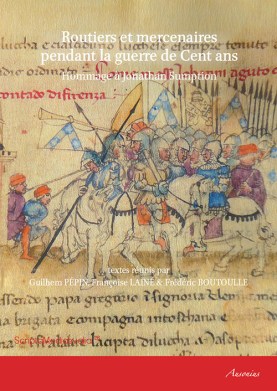
Publication – Routiers et mercenaires pendant la guerre de Cent ans

Les routiers et mercenaires de la guerre de Cent Ans (1337-1453) ont longtemps été mal vus par les historiens à cause de leur rôle ambigu lors de cette guerre. Oscillant entre emploi par les pouvoirs princiers et une autonomie quasi-totale, leur place au sein du conflit franco-anglais pose toutefois de nombreuses questions que les actes de ce colloque tentent de résoudre. Les contributions de ce volume écrites par des spécialistes de l’histoire de la guerre médiévale permettent de se faire une meilleure idée du complexe phénomène routier qui a eu sans doute une place plus importance que celle qui lui fut reconnu par l’historiographie jusqu’à une période récente.

For a long time Routiers and mercenaries of the Hundred Years War (1337-1453) have been seen in a bad light by historians because of their ambiguous role during this war. Wavering between employment by princely powers and an almost complete autonomy, their place within the Anglo-French conflict raises some questions the proceedings of this conference attempt to resolve. The papers of this volume written by specialists of medieval warfare give us a better idea of the complex routier phenomenon which probably had a more important role that has been previously accepted until recently.

978-2-35613-149-2

Table des matières :

Frédéric Boutoulle et Guilhem Pépin, Avant-propos
Jean-Philippe Genet, Introduction

Guilhem Pépin, Les routiers gascons, basques, agenais et périgourdins du parti anglais : motivations, origines et la perception de leur présence (v. 1360-v. 1440).
Armand Jamme, Routiers et distinction sociale : Bernard de La Sale, l’Angleterre et le pape
Justine Firnhaber-Baker, Soldiers, Villagers, and Politics: Military Violence and the Jacquerie of 1358
Nicolas Savy, Les procédés tactiques des compagnies anglo-gasconnes entre Garonne et Loire (1350-1400)
Pierre Prétou, Les voisins contre la route : réactions et imprécations communautaires en Gascogne face aux bandes armées pendant la guerre de Cent ans
Philippe Contamine, Un “Marmouset” contre les Compagnies : Jean de Blaisy (vers 1340-1396)
Loïc Cazaux, Antoine de Chabannes, capitaine d’Écorcheurs et officier royal : fidélités politiques et pratiques militaires au XVe siècle
Valérie Toureille, Robert de Sarrebrück un routier au service de Charles VII
Michael Jones, Une petite guerre dans un pays lointain : les carrières mercenaires des soldats bretons au service de Robert, duc de Bar, 1372-1373
Germain Butaud, Les mercenaires et les routiers actifs durant la guerre civile de Provence (1383 – 1388)
Kelly DeVries, Routier Perrinet Gressart: Joan of Arc’s Penultimate Enemy
Françoise Lainé, Gens d’armes “savoyards” guerroyant en Gascogne en 1338-1341 : des alliés du roi de France
Christophe Masson, Compagnies d’aventure et armées françaises. Le cas des campagnes de Gênes et de Naples à l’époque du Grand Schisme d’Occident
Bertrand Schnerb, Compagnons aventureux et mercenaires dans les armées des ducs de Bourgogne au début du XVe siècle
Werner Paravicini, Mercenaires au Voyage de Prusse
Anne Curry, Foreign Soldiers in English Pay: Identity and Unity in the Armies of the English Crown, 1415-1450

Françoise Lainé, Conclusion

Informations pratiques :
Pépin Guilhem, Françoise Lainé et Frédéric Boutoulle (éd.), Routiers et mercenaires pendant la guerre de Cent ans, Bordeaux, Ausonius, 2016 (Scripta Mediaevalia, 28). 358 p. 25 €.

Bulletin de commande : ici

Source : Ausonius

Publié dans Le réseau | Laisser un commentaire

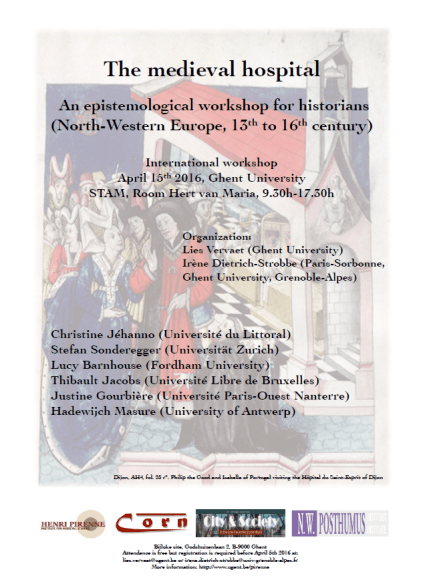
Journée d’étude – The medieval hospital, an epistemological workshop for historians (North-Western Europe, 13th to 16th century)

Research on medieval hospitals, usually written in monographs, was traditionally embedded in national historiography. Recently and thanks to various international conferences, this approach has changed. Historians are increasingly studying these institutions from an international-comparative perspective, or focus on particular issues on a larger geographical scale, for example the way in which hospitals were integrated in urban space.

This workshop has two objectives. Firstly, we aim to offer young scholars the opportunity to take part in the recent trend of comparative research, going beyond the traditional national framework. Secondly, it will be important to demonstrate the various ways in which sources of medieval hospitals can be applied by historians: How can the study of source material deriving from medieval hospitals lead to concrete answers to larger research questions, or at least to some valuable new contributions and reflections?

The importance of hospitals for the poor relief evidently has to be considered, but the proposed research field is much larger. For instance, the significance of hospitals for the development of the urban craft guilds could be focused on, or their role in the power struggles between different urban groups, or their significance as important players on the land and lease market in the city and on the countryside.

The medieval Hospital

Programme :

09.30 Welcome by Marc Boone (Professor, Dean of the Faculty of Arts and Philosophy, Ghent University)

09.45 Introduction of the participants

10.00 Introduction by Irène Dietrich-Strobbe (PhD Student, Université Paris-Sorbonne – Ghent University – Université Grenoble-Alpes) et Lies Vervaet (PhD, Postdoctoral Fellow of FWO Flanders, Ghent University).

10.15 Panel 1: Medieval hospitals, which kind of laboratories ?
Chair : Els De Paermentier (Professor, Ghent University)

10.15 Justine Gourbière (PhD, Université Paris Ouest Nanterre La Défense): Les établissements de soins à Paris entre 1122 et 1505: implantation et architecture.
Lucy Barnhouse (PhD Student, Fordham University): Medieval Hospital History as a History of Religious Institutions.
11.15 Discussion
11.30 Coffee

11.45 Hadewijch Masure (PhD Student, Research Fellow FWO-Flanders, University of Antwerp): Hospitals in the diverse field of poor relief (Low Countries, 13th-16th century).
12.15 Discussion
12.45 Lunch

14.00 Panel 2 : Medieval hospitals, which kind of experiences?
Chair : Erik Thoen (Professor, Head of the Department of History, Ghent University)

14.00 Irène Dietrich-Strobbe (PhD Student, Université Paris-Sorbonne – Ghent University – Université Grenoble-Alpes): « Pour procés esquiver et amour nouri avec ceulx dudit hospital » : l’hôpital Comtesse et la gestion des conflits à Lille à la fin du Moyen Âge.

Lies Vervaet (PhD, Postdoctoral Fellow of FWO Flanders, Ghent University): The food provisioning of a major urban charitable institution: the Saint John’s hospital of Bruges (14th-16th century).
15.00 Discussion
15.45 Coffee

16.00 Thibault Jacobs (PhD Student, Research fellow of F.R.S-FNRS, Université Libre de Bruxelles ): Nouvelles élites économiques et investissement hospitalier dans les villes brabançonnes médiévales.
16.30 Discussion

17.00 Conclusions by Christine Jéhanno (Maître de Conférence, Université du Littoral) and Stefan Sonderegger (Professor, Universität Zurich).
19.00 Diner

Informations pratiques :
15-04-2016, from 09:30 to 17:00
STAM (City Museum), Bijlokesite, Godshuizenlaan 2, 9000 Gent
Contact Name : Lies Vervaet
Contact Email : lies.vervaet@ugent.be

Source : UGent – Henri Pirenne Institute for Medieval studies

Publié dans Colloque | Laisser un commentaire