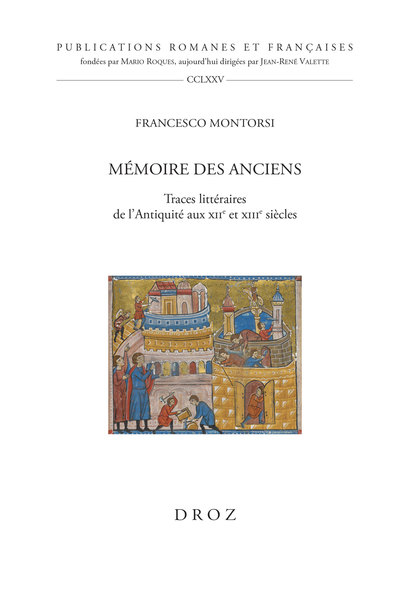
Publication – Francesco Montorsi, « Mémoire des Anciens Traces littéraires de l’Antiquité aux XIIe et XIIIe siècles »

Cet essai aborde la question de savoir comment un passé, celui des XIIe et XIIIe siècles, a représenté, transmis, utilisé, vécu un autre passé, celui des mondes grec et latin. Il vise alors à identifier et interpréter les traces littéraires de la mémoire de l’Antiquité dans un corpus de textes vernaculaires (romans antiques, chroniques, traductions de classiques).

À l’aide d’explorations convergentes, portant sur différents aspects du savoir historique (des pratiques religieuses au théâtre, du conflit militaire aux rites funéraires, des jeux à l’art statuaire), nous découvrons dans ces textes un souvenir de l’Antiquité qui, pour être par moment lacunaire, se révèle à la fois riche et mouvant. Un souvenir tantôt déformé par les rêves, les peurs et les ambitions mondains de toute une époque, tantôt empreint d’un étonnant détachement et d’un véritable élan érudit.

Table des matières : ici

Informations pratiques :

Francesco Montorsi, Mémoire des Anciens Traces littéraires de l’Antiquité aux XIIe et XIIIe siècles, Genève, Droz, 2022 (Publications Romanes et Françaises, 275). 376 p. ISBN : 978-2-600-06362-3. Prix : 35 euros.

Source : Droz

Publié dans Publications | Laisser un commentaire

Appel à contribution – Artificial Light in Medieval Churches between Byzantium and the West

Artificial Light in Medieval Churches between Byzantium and the West
Online workshop | Tufts University & Accademia di architettura di Mendrisio | 9-10 February 2023

Organizers:
Alice Isabella Sullivan, PhD, Tufts University
Vladimir Ivanovici, PhD, University of Vienna | Accademia di architettura di Mendrisio

Throughout the Middle Ages, artificial illumination was used to draw attention to and enhance the symbolism of certain areas, objects, and persons inside Christian sacred spaces. The strategies usually found in Latin and Byzantine churches have been analyzed in recent decades. However, the cultures that developed at the crossroads of the Latin, Greek, and Slavic spheres, particularly in regions of the Balkan Peninsula and the Carpathian Mountains, have received less scholarly attention. The uses of artificial light in churches were likely shaped by aspects such as inherited practices, the imitation of other societies, as well as by local climatic, economic, and theological parameters.

Following a similar workshop that focused on natural light, which showed how uses of sunlight reveal patterns of knowledge transfer and cultural interaction between Byzantium, the West, and the Slavic world throughout the Middle Ages, this workshop invites papers on the economy of artificial light in medieval churches across Eastern Europe, from the Balkans to the Baltic Sea. Whether innovative or inspired by the more established traditions on the margins of the Mediterranean, local customs are to be examined in order to understand how artificial light was used in ecclesiastical spaces, and how it brought together the architecture, decoration, objects, and rituals.

Following the workshop, select papers will be revised and published in a volume that will complement the edited collection that resulted from the workshop on natural light, which is currently in print with Brill.

Proposals for 20-min. papers in English should include the following: an abstract (300 words max.) and a brief CV (2 pages max.). Proposals should be emailed to the organizers of the workshop at alice.sullivan[at]tufts.edu and vladimir.ivanovici[at]usi.ch by 1 September 2022. Please include in the email subject line “Artificial Light Proposal.

Source : The Medieval Academy Blog

Publié dans Appel à contributions | Laisser un commentaire

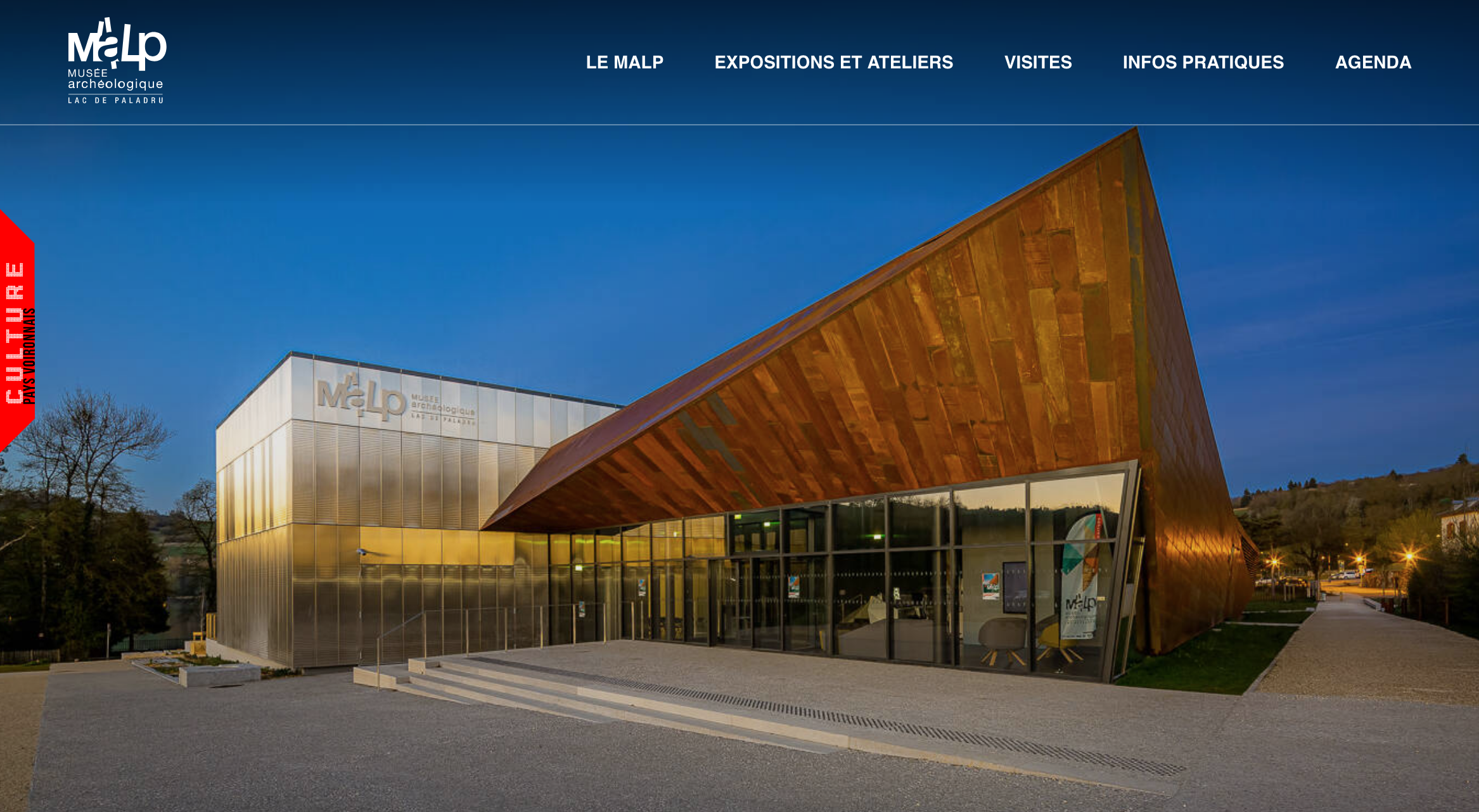
Exposition – Ouverture du MALP – Musée archéologique du lac de Paladru

Musée archéologique du lac de Paladru, pour un voyage temporel captivant vers le Néolithique et l’an Mil. À travers les vestiges exceptionnels découverts sous les eaux du lac, partez à la rencontre des hommes qui vécurent là il y a si longtemps.

Exposition permanente :

L’espace central du musée est dédié à l’exposition permanente. Le sol en pente douce imite la descente vers le lac. Comme les archéologues, vous voici en immersion au plus près de 600 objets exceptionnels trouvés sous les eaux. Le lac lui-même vous accueille, prêtant sa voix au film de présentation du site et de l’exposition.

De part et d’autre du chemin central, le Néolithique et l’an Mil se répondent de façon thématique : habitat, alimentation, artisanat et savoir-faire, vie domestique, chasse, armes, etc. Laissez libre cours à votre curiosité, pour découvrir les deux époques selon votre inspiration.

Sur les passerelles latérales légèrement en surplomb, évoquant les berges du lac, découvrez l’aventure des fouilles subaquatiques et les étonnantes techniques de conservation des objets.

Enfin, derrière la baie vitrée du belvédère-terrasse, prenez le temps de vous asseoir sur l’un des deux bancs dédiés à l’écoute des légendes du lac.

Exposition temporaire :

« Ce que nous murmurent les murs. Archéologie du bâti et des constructions »

Des pierres dressées et des premières constructions du Néolithique aux constructions modernes, comment les sociétés humaines ont-elles répondu au besoin primordial de s’abriter ?
Découvrez l’histoire du bâti au fil des panneaux de cette « archéocapsule », exposition proposée par l’Inrap, Institut national de recherches archéologiques préventives. Avec, en regard, les photos du chantier de construction du MALP et la découverte de ses partis pris architecturaux.

Informations pratiques :

Le MALP
51 rue du musée, 38850 Les Villages du lac de Paladru.
Tél. : 04 56 26 16 16
musee.archeologique (@) paysvoironnais.com

Avril à octobre
Du mardi au dimanche : 10h00 à 12h30 et de 14h00 à 18h00

Novembre à mars
Samedi et dimanche : 10h00 à 12h30 et de 14h00 à 17h00
Pendant les vacances scolaires de la Zone A du mardi au dimanche de 10h00 à 12h30 et de 14h00 à 17h00

Pour les groupes :
Le musée est ouvert toute l’année du mardi au dimanche de 10h00 à 12h30 et de 14h00 à 17h00.

Fermetures annuelles : 1er  janvier, 1er  mai et 25 décembre

Source : MALP

Publié dans Exposition | Laisser un commentaire

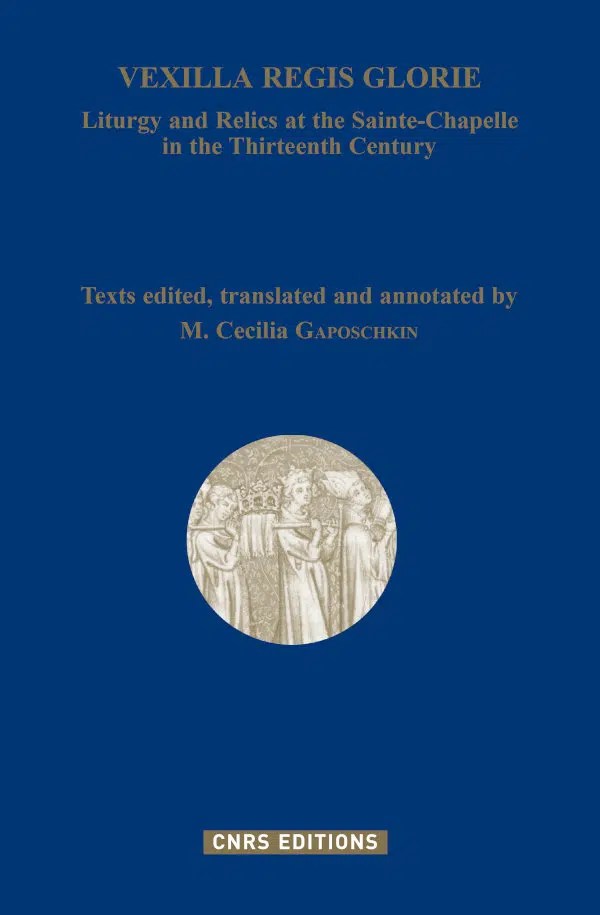
Publication – M. Cecilia Gaposchkin,  » Vexilla Regis Glorie. Liturgy and Relics at the Sainte-Chapelle in the Thirteenth Century »

Between 1239 and 1242 Louis IX acquired the relic of the Crown of Thorns and a series of Passion relics, including the True Cross and the Holy Lance, for which he had the Sainte-Chapelle built at the royal palace in the center of Paris. Liturgical feasts were established to celebrate the Crown of Thorns (on August 11) and the Reception of the Relics (on September 30). This volume presents interpretations, editions, and English translations of the earliest liturgical offices and masses written for use at the Sainte Chapelle after its consecration in 1248. These texts testify to the early history of the chapel, and to royal devotion and religious ideology more broadly. They demonstrate the place that Christ’s Kingship and Passion held in thirteenth-century culture, and also the place that relics held at the Capetian court and in the construction of Capetian kingship.

Informations pratiques :

M. Cecilia Gaposchkin, Vexilla Regis Glorie. Liturgy and Relics at the Sainte-Chapelle in the Thirteenth Century, Paris, CNRS Éditions, 2022 (Sources d’histoire médiévale). 352 p., ISBN : 9782271143327. Prix : 65 euros.

Source : CNRS Éditions

Publié dans Publications | Laisser un commentaire

Appel à contribution – Neglected Voices in Premodern Sciences, from Persia to Iceland(Routledge, “Global Perspectives on the History of Natural Philosophy”)

Most of the studies about Pre-modern European sciences have been dedicated to the role played by a relatively small number of primary characters (Avicenna, Albert the Great, Roger Bacon, Nicole Oresme, Nicholas of Cusa, to name but a few) who had a significant impact on knowledge, culture and modi pensandi of the Latin West throughout and beyond the Middle Ages. However, this presentation has led to two closely related consequences. The first consequence is that while the works of the “main” authors tend to be thoroughly studied and thus their ideas continuously observed and reinforced, those of other, less known characters, have received little, if any, attention, or have simply been forgotten, primarily when they evolved on the fringe of the mainstream. The second consequence is that Pre-modern and Medieval science is often perceived as a monolith, one composed, and shaped, only by a few inspired authors.

In response to this observation, this book aims to shed light on these neglected voices in Pre-modern sciences and to give a voice even to those ‘underrated’ actors (authors, scribes, compilers, copyists, readers, users…) who nevertheless have somehow contributed to the formation of Medieval science. Within this perspective, the volume addresses these issues from the point of view of both ideas and practices, which are particularly delicate to interrogate when dealing mainly with textual material. For this purpose, several axes (not exhaustive) have been defined:

1) Authors against the tide: This section is particularly interested in authors who, in various ways, went against the major scientific tendencies of their time and developed their science as “free electrons” by contrast to their contemporaries. Several cases are to be considered: (1) authors whose scientific involvement goes against the traditional ways of thinking by exploring original and even daring theories and practices in opposition to what was in vogue at their time; (2) authors who evolved outside the main intellectual centers and networks of the time. This can be due either to their geographical situation on the periphery of the traditional radiating places in the development of sciences or because they did not belong to any organization, institutional group or religious order promoting the diffusion and assimilation of knowledge.

2) Actors in the “physical” margins: This point focuses on those who added scientific contents into the “broader margins” of a Late Medieval work, i.e. in the actual margins, at the beginning or end of a manuscript or of a codicological unit. The contributions can analyze the authors’ identities, if they can be reconstructed, as well as the new contents which were added (ideas, sources, relationships with the main texts, reasons for which they were inserted, circulation…). Moreover, the texts considered can be both paratextual additions (comments, glosses, scholia…) or actual “guest texts”.

3) Unknown actors: This point questions the role of discrete authors, almost invisible and unknown, in the development and diffusion of Medieval knowledge. It aims to bring to

light unpreserved authors who are known only through other posterior works. Within this perspective, one could consider both characters who left no written traces and authors whose works have been lost and are only known by later quotes. Papers focusing on figures evolving in an “oral culture” (for instance in the pre-Islamic context), who provided a basis for further scientific developments, will be particularly welcome. Similarly, the scientific contribution of teachers, whose ideas and practices were kept through the writings of their students, deserves to be taken into account. Finally, papers highlighting the role of oral witnesses, practitioners and merchants, who might contribute to the transmission of knowledge by bringing empirical data taken from their daily practice, will be highly appreciated.

4) Authors between traditions: Another line of research will be dedicated to the study of the dissemination and use of scientific knowledge in areas outside the scientific field (art, literature…). In the first case, this volume is interested as much in the depictions of the figure of the experimenter or the scholar as in the artistic exploitation of the scientific disciplines. In the second case, a particular attention will also be paid to the integration of scientific knowledge into the literary domain. The sciences, as well as some scientific figures, become motifs and themes with specific narrative functions. Conversely, one might also consider the way in which scientific discourse is fed and expressed through a literary medium.

5) Authors on the fringes of historiography: Finally, this book also wants to give a voice to authors who received less attention despite their actual importance and significant contribution to premodern sciences. In particular, the historiographical readings and the appreciation of an author’s significance have been oriented, among other criteria, by their impact on European thought. Nevertheless, this attitude tends to exclude certain important characters from our usual research horizons. This is notably the case of authors who were not translated into Latin during the Middle Ages and who hardly reached European Latin scholars at that time. From this point of view, this book gives the opportunity to reassess the original contribution of such authorities and even to reevaluate their possible influence on later works in more indirect ways, outside the scope of the translations.

Abstracts (250/300 words) should be sent to:
Meyssa Ben Saad (mbs.bsaad@gmail.com), Mattia Cipriani (mattia.cipriani80@gmail.com), Grégory Clesse (gregory.clesse@uclouvain.be), or Florence Ninitte (Florence.Ninitte@univ-nantes.fr).

Contributions will be written in English.
Abstracts submission deadline: on the 30th of September 2022.

Submission deadline for the completed articles: on the 30th of April 2023.

Publié dans Appel à contributions | Laisser un commentaire

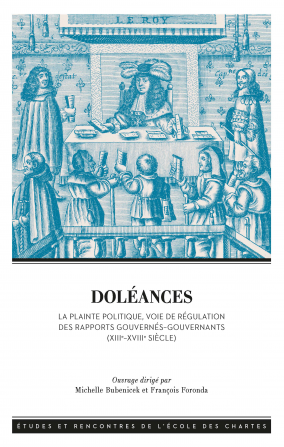
Publication – « Doléances. La plainte politique, voie de régulation des rapports gouvernés-gouvernants (XIIIe-XVIIIe siècle) », dir. Michelle Bubenicek et François Foronda

Entre la révolution du gouvernement, au XIIIe siècle, et la révolution de la citoyenneté, au xviiie siècle, la doléance, ou la plainte politique, a fonctionné telle une voie de régulation du rapport entre gouvernés et gouvernants. Si l’histoire d’autres formes de demandes est bien connue, la requête par exemple, celle de la doléance restait à entreprendre. Cet ouvrage en propose les premiers jalons, sur la base d’une enquête documentaire de dimension européenne visant à déterminer l’identité propre de la doléance. Émerge ainsi toute la complexité des supposées origines des « cahiers de doléances », dont la mémoire a été avivée, en France, par le récent Grand débat national et les « cahiers des mairies ». À travers des contributions d’historiens spécialistes du politique et du social ainsi que de juristes historiens du droit, l’ouvrage met délibérément l’accent sur les sources qui permettent d’exprimer et donc de connaître la doléance, qu’il s’agisse de suppliques, de requêtes, de mémoires, de billets manuscrits, de cahiers synthétiques, de placets ou de recueils imprimés. Une attention particulière est également apportée à l’économie interne de ces supports, et notamment à la langue et au vocabulaire employés. Ces approches croisées permettent ainsi d’appréhender la doléance comme un objet historique à part entière.

Professeur des universités, directrice de l’École nationale des chartes – PSL, Michelle Bubenicek s’intéresse à la place des femmes dans la sphère politique médiévale, ainsi qu’aux modalités d’implantation et de réception des pouvoirs.

Maître de conférences HDR à l’université Paris 1 Panthéon-Sorbonne, François Foronda travaille sur la production sociale d’un pouvoir d’État à la fin du Moyen Âge, à partir d’un champ d’observation castillan confronté à l’horizon européen.

Informations pratiques :

Doléances. La plainte politique, voie de régulation des rapports gouvernés-gouvernants (XIIIe-XVIIIe siècle), dir. Michelle Bubenicek et François Foronda, Paris, École nationale des chartes, 2022 (Études et documents de l’École des chartes). 288 p. ISBN : 978-2-35723-166-5. Prix : 34 euros.

Source : École nationale des chartes

Publié dans Le réseau | Laisser un commentaire

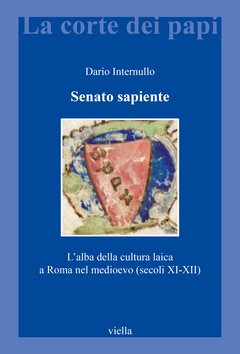
Publication – Dario Internullo,  » Senato sapiente. L’alba della cultura laica a Roma nel medioevo (secoli XI-XII) »

La Roma del XII secolo profuma di novità. Dopo esser stati a lungo governati dai papi, i romani danno vita a una struttura politica inedita, laica e inclusiva dal punto di vista sociale. È la nascita del comune, chiamato con il nome altisonante di «Senato» e associato al «popolo» di Roma attraverso il recupero dell’antica sigla S.P.Q.R.: Senatus PopulusQue Romanus.

Gli storici si sono confrontati a lungo con questa vicenda ma, privilegiandone gli aspetti sociali, hanno finora lasciato sullo sfondo i fondamenti intellettuali del nuovo sistema politico, ricco di tradizioni e riferimenti colti.

Ribaltando la prospettiva e allargando lo sguardo ai secoli XI e XII, il libro pone quel problema al centro del discorso, portando alla luce i testi, i contesti, i personaggi dotti e le dinamiche che hanno reso possibile quel cambiamento.

Table des matières : ici

Dario Internullo è ricercatore in Storia medievale presso l’Università degli Studi Roma Tre. È autore di Ai margini dei giganti. La vita intellettuale dei romani nel Trecento, Viella, 2016.

Informations pratiques :

Dario Internullo, Senato sapiente. L’alba della cultura laica a Roma nel medioevo (secoli XI-XII), Roma, Viella, 2022 (La corte dei papi, 33). 408 p. ISBN : 9788833138381. Prix : 38 euros.

Source : Viella

Publié dans Publications | Laisser un commentaire

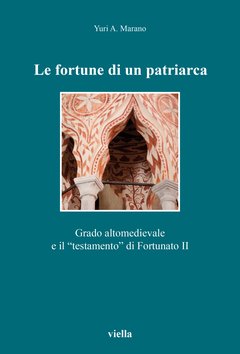
Publication – Yuri A. Marano, « Le fortune di un patriarca Grado altomedievale e il “testamento” di Fortunato II »

Lo scorcio dell’VIII e gli inizi del IX secolo segnarono nell’alto Adriatico una fase di intenso confronto politico e diplomatico tra Franchi e Bizantini, gli uni impegnati nel tentativo di imporre la loro supremazia sull’area istriano-dalmata e pannonica, gli altri decisi alla tenace difesa dei propri interessi nella regione. È sullo sfondo di questi avvenimenti che il patriarca Fortunato di Grado intraprese una politica di spregiudicate alleanze che avrebbe dovuto garantire la salvaguardia degli interessi della sua Chiesa, schierandosi con l’una o con l’altra parte ogniqualvolta il mutamento degli scenari “internazionali” mettesse a repentaglio il perseguimento di tale obiettivo. Il “testamento” di Fortunato, di cui si presentano qui una traduzione e un commento, costituisce una fonte di eccezionale interesse e fascino per la ricostruzione della parabola politica e umana di questo personaggio e di un capitolo di cruciale importanza nella storia dell’Adriatico altomedievale.

Yuri A. Marano collabora con la cattedra di Archeologia Medievale dell’Università Ca’ Foscari di Venezia. I suoi principali interessi scientifici vertono sull’evoluzione dell’urbanesimo, delle pratiche funerarie e delle produzioni nell’Adriatico e nel Mediterraneo tra la tarda Antichità e l’alto Medioevo.

Table des matières : ici

Informations pratiques :

Yuri A. Marano, Le fortune di un patriarca Grado altomedievale e il “testamento” di Fortunato II, Roma, Viella, 2022 (Altomedioevo, 10). 244 p. ISBN : 9788833138978. Prix : 28 euros.

Source : Viella

Publié dans Publications | Laisser un commentaire

Offre d’emploi – Departmental Lecturer in Medieval History (University of Oxford)

Closes: 18th July 2022

This is an exciting opportunity to join the thriving Medieval History community in the Faculty, and to gain teaching experience at the undergraduate and graduate levels. Although this is primarily a teaching role, you will also conduct independent research, assist in the running of the History School at Wadham College and play an active part in the interdisciplinary College community. The post is intended to cover teaching and administrative duties whilst Dr Matthew Kempshall is on leave. 

You will have research and teaching interests in Medieval History. You will be able to inspire and enthuse students and draw on your own research to inform and augment your teaching.

This is a full-time, fixed term post and is tenable from 1st October 2022 until 30th September 2023 (limited by external funding).

About you

You will hold a completed doctorate in a relevant field, or evidence that a doctorate is close to completion.  You will possess sufficient depth and breadth of knowledge, alongside research and teaching interests, in Medieval History which will enable you to develop course materials and research proposals.  You will have a publication record commensurate with career stage, and familiarity with the existing literature and research in the field of Medieval History.

You will be able to inspire and enthuse students and draw on your own research to inform and augment your teaching.

Application Process 

For an informal discussion about this role, please contact Dr Matthew Kempshall at matthew.kempshall@wadham.ox.ac.uk; all practical and procedural queries should be sent to our recruitments team: recruitments@history.ox.ac.uk. All enquiries will be treated in strict confidence; they will not form part of the selection decision.

We expect to hold interviews on Monday 8th August 2022; overseas candidates will be offered Microsoft Teams interviews.

You will be required to complete a supporting statement, setting out how you meet the selection criteria, curriculum vitae and the names and contact details of two referees as part of your online application.

The deadline for applications is 12.00 noon on Monday 18th July 2022.

Only applications submitted via our e-recruitment system and received before noon Monday 18th July 2022 can be considered.

Committed to equality and valuing diversity

Publié dans Offre d'emploi | Laisser un commentaire

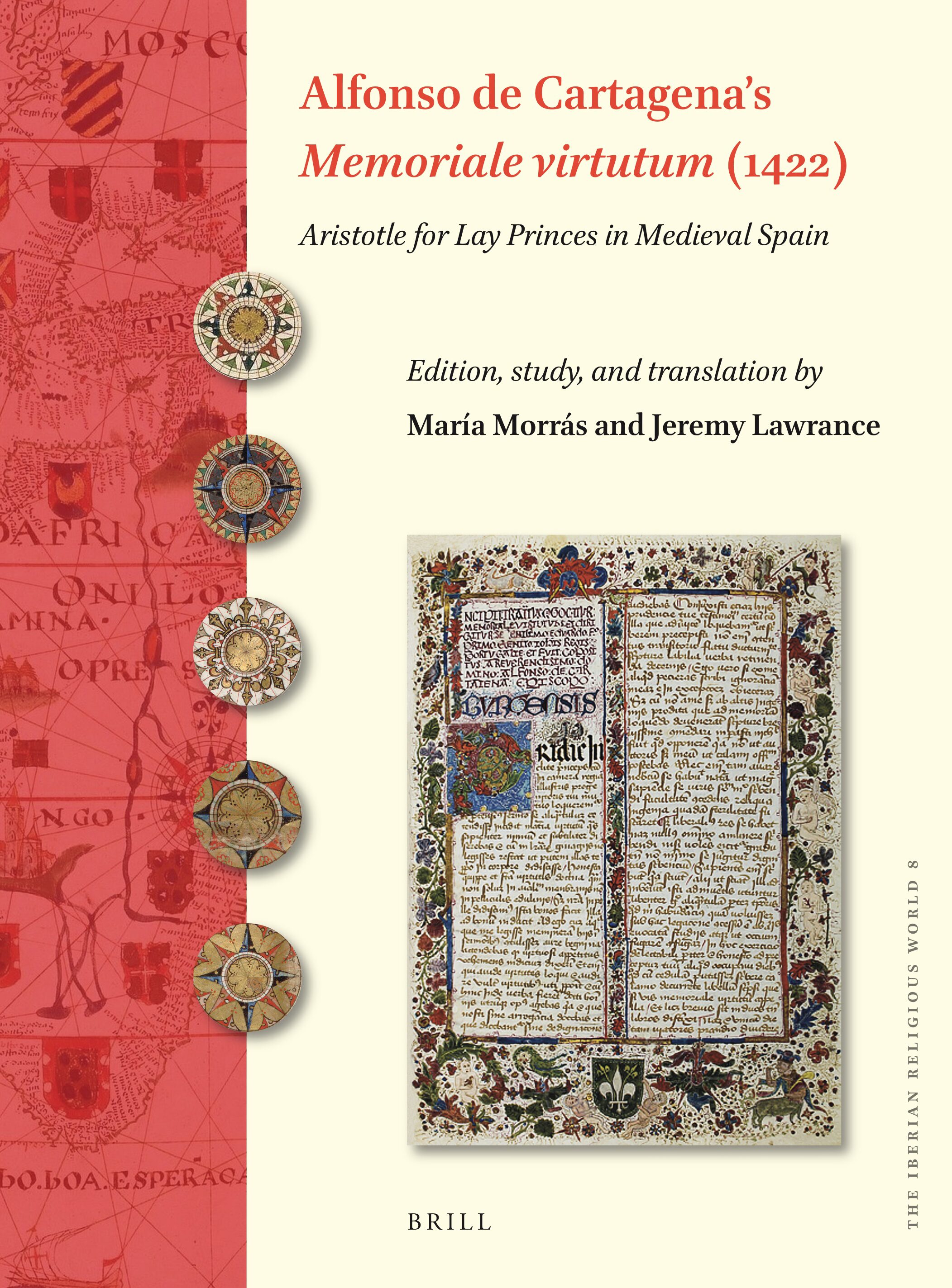
Publication – « Alfonso de Cartagena’s ‘Memoriale virtutum’ (1422). Aristotle for Lay Princes in Medieval Spain », dir. María Morrás et Jeremy Lawrance

In Alfonso de Cartagena’s ‘Memoriale virtutum’ (1422) María Morrás and Jeremy Lawrance offer a new edition from the manuscripts of a compilation of Aristotle’s Nicomachean Ethics addressed by the major Castilian intellectual of the day, bishop Alfonso de Cartagena, to the heir to the throne of Portugal, crown prince Duarte.

The work was a speculum principis, an education for the future king in the virtues suitable to a statesman; Cartagena’s choice of Aristotle was thus a significant index of the advent of new Renaissance ideas. This edition shows how the “memorial” throws light on the ideological transformation of society those ideas would bring, setting new ethical guidelines for the ruling class at the crossroads between medieval feudalism and Renaissance absolutism.

María Morrás Ph.D. (1990, Berkeley), professor in Humanities at Universitat Pompeu Fabra, Barcelona and Special Lecturer at Oxford, studies medieval and Renaissance Spanish literature, particularly the cultural impact of humanism. She has edited Cartagena’s Ciceronian translations, Libros de Tulio (Alcalá, 1996).

Jeremy Lawrance, DPhil (1983, Oxford), former Professor of Spanish at the Universities of Manchester and Nottingham, studies the history of ideas. He has edited and translated Latin works by Cartagena (Bellaterra, 1979), Vitoria (Cambridge, 1991), and Palencia (Madrid, 1998–99).

Table des matières : ici

Informations pratiques :

Alfonso de Cartagena’s ‘Memoriale virtutum’ (1422). Aristotle for Lay Princes in Medieval Spain, dir. María Morrás et Jeremy Lawrance, Leiden–Boston, Brill, 2022 (The Iberian Religious World, Volume: 8). ISBN : 978-90-04-41115-9. Prix: 128 euros.

Source : Brill

Publié dans Publications | Laisser un commentaire