Conférence – Sven Sochon (Sorbonne-Université), « Le travers de Conflans, source de pouvoir de l’évêque de Paris et de ses vassaux au XIIIe siècle ».

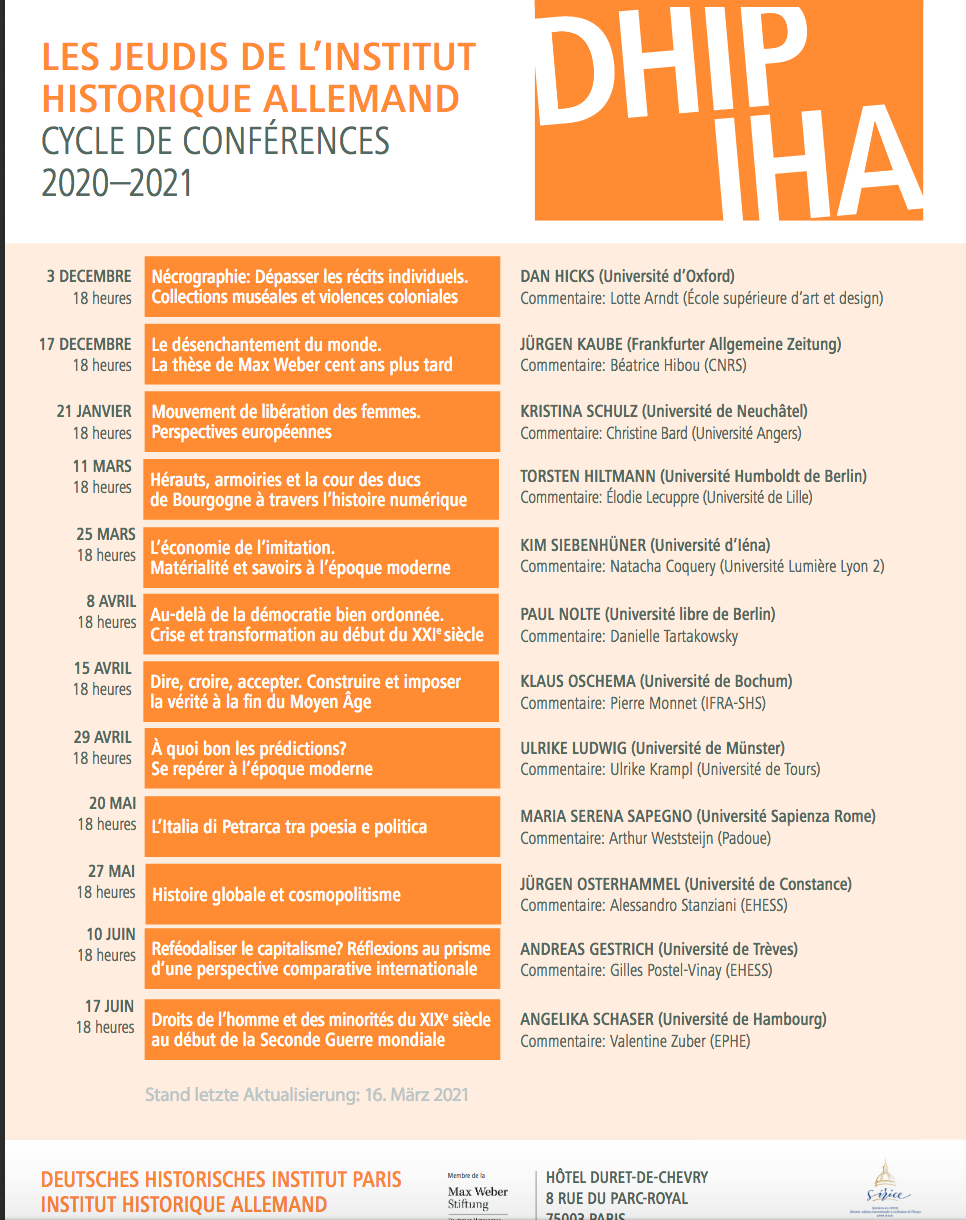
« Séminaire d’histoire médiévale » organisé par l’École Pratique des Hautes Études – PSL (EPHE – PSL) et l’Institut historique allemand (IHA).

Le séminaire d’histoire médiévale organisé par l’ École Pratique des Hautes Études – PSL et l’Institut historique allemand se poursuit avec, le mercredi 14 octobre 2020, de 10h00 à 12h00,

Sven Sochon (Sorbonne-Université) : « Le travers de Conflans, source de pouvoir de l’évêque de Paris et de ses vassaux au XIIIe siècle ».

La discussion qui suivra sera animée par Boris Bove (Université Paris 8).

Le séminaire aura lieu à l’IHA (8 rue du Parc-Royal, 75003 Paris), de façon hybride très probablement (« distanciel et présentiel » : les modalités seront précisées ultérieurement).

En raison de la situation sanitaire, les personnes désireuses d’assister au séminaire se feront connaître auprès de Rolf Große : rgrosse@dhi-paris.fr (message adressé en copie à Laurent Morelle : Laurent.Morelle@ephe.psl.eu).

Source : EPHE

Publié dans Colloque | Laisser un commentaire

Publication – Caroline Walker Bynum, « Dissimilar Similitudes: Devotional Objects in Late Medieval Europe »

Between the twelfth and the sixteenth centuries, European Christians used in worship a plethora of objects, not only prayer books, statues, and paintings but also pieces of natural materials, such as stones and earth, considered to carry holiness, dolls representing Jesus and Mary, and even bits of consecrated bread and wine thought to be miraculously preserved flesh and blood. Theologians and ordinary worshippers alike explained, utilized, justified, and warned against some of these objects, which could carry with them both anti-Semitic charges and the glorious promise of heaven. Their proliferation and the reaction against them form a crucial background to the European-wide movements we know today as “reformations” (both Protestant and Catholic).

In a set of independent but inter-related essays, Caroline Bynum considers some examples of such holy things, among them beds for the baby Jesus, the headdresses of medieval nuns, and the footprints of Christ carried home from the Holy Land by pilgrims in patterns cut to their shape or their measurement in lengths of string. Building on and going beyond her well-received work on the history of materiality, Bynum makes two arguments, one substantive, the other methodological. First, she demonstrates that the objects themselves communicate a paradox of dissimilar similitude—that is, that in their very details they both image the glory of heaven and make clear that that heaven is beyond any representation in earthly things. Second, she uses the theme of likeness and unlikeness to interrogate current practices of comparative history. Suggesting that contemporary students of religion, art, and culture should avoid comparing things that merely “look alike,” she proposes that humanists turn instead to comparing across cultures the disparate and perhaps visually dissimilar objects in which worshippers as well as theorists locate the “other” that gives their religion enduring power.

Caroline Walker Bynum is Professor emerita of Medieval European History at the Institute for Advanced Study, and University Professor emerita at Columbia University in the City of New York. She studies the religious ideas and practices of the European Middle Ages from late antiquity to the sixteenth century. In the 1980s, she worked on women’s spirituality in Europe; in the 1990s, she turned to the history of the body. Her recent work, Wonderful Blood (2007) and Christian Materiality (2011), locates the upsurge of new forms of art and devotion in the fourteenth and fifteenth centuries against the background of changes in natural philosophy and theology and reinterprets the nature of Christianity on the eve of the reformations of the sixteenth century. Her essays “In Praise of Fragments” (in Fragmentation and Redemption), “Why All the Fuss About the Body?” (in Critical Inquiry and reprinted in The Resurrection of the Body, expanded edition, 2017), and “Wonder” (in Metamorphosis and Identity) are widely cited as discussions of historical method. Bynum has taught at Harvard, the University of Washington in Seattle, and Columbia University. She was a MacArthur Fellow from 1986 to 1991 and has won the Ralph Waldo Emerson Prize of Phi Beta Kappa, the Jacques Barzun Prize of the American Philosophical Society, the Gründler Prize in Medieval Studies, and the Haskins Medal of the Medieval Academy of America. She has won three undergraduate teaching awards, one from the University of Washington and two from Columbia University. She is a past president of the Medieval Academy of America and the American Historical Association, a member of the American Academy of Arts and Sciences, the American Philosophical Society, and the Orden Pour le Mérite für Wissenschaften und Künste of the Federal Republic of Germany, and a Fellow of the Medieval Academy of America and the British Academy.

Informations pratiques :

Caroline Walker Bynum, Dissimilar Similitudes: Devotional Objects in Late Medieval Europe, Princeton, Princeton University Press, 2020. 352 p., ISBN : 9781942130376. Prix : 28 £.

Source : Princeton University Press

Publié dans Publications | Laisser un commentaire

Publication – « Villon hier et à jamais. Deux décennies de recherches sur François Villon. Articles choisis », éd. Jacqueline Cerquiglini-Toulet

Ce volume donne à entendre la voix de grands médiévistes autour de la figure de François Villon. Il est le témoignage de trois colloques organisés de 1989 à 2006 par Jean Dufournet, Michael Freeman et Jean Dérens, grands spécialistes du poète. Les articles retenus, corrigés et mis à jour éclairent la découverte de son oeuvre et l’histoire de sa publication, mettent en lumière sa silhouette contrastée, dégagent des thèmes (notamment celui, paradoxal et nostalgique, de la chevalerie) et des formes (celle de la ballade en particulier). Sont aussi étudiés ses rapports avec le théâtre et avec la musique. Par ces approches croisées, Villon y apparaît dans toute la richesse d’une œuvre inépuisable. Réflexion sur la poésie, hier et à jamais.

Jacqueline Cerquiglini-Toulet, professeure émérite de littérature française du Moyen Âge à Sorbonne Université, s’intéresse particulièrement à la poétique de cette période et à des auteurs tels Guillaume de Machaut, Christine de Pizan et Villon. Elle a édité et traduit les Œuvres complètes de François Villon dans la « Bibliothèque de la Pléiade » (2014) et a donné en 2020 une nouvelle version enrichie de cette édition en « Folio classique ».

Table des matières : ici

Informations pratiques :

Villon hier et à jamais. Deux décennies de recherches sur François Villon. Articles choisis, éd. Jacqueline Cerquiglini-Toulet, Paris, Honoré Champion, 2020 (Colloques, congrès et conférences, Moyen Âge, 28). 218 p. ISBN : 9782745354846. Prix : 29 euros.

Source : Honoré Champion

Publié dans Publications | Laisser un commentaire

Publication – Keith Busby, « The French Works of Jofroi de Waterford. A Critical Edition »

At the beginning of the fourteenth century, Jofroi, a brother of the Dominican house of St Saviour’s in Waterford, Ireland, translated into French and adapted from the Latin three texts: the De excidio Troiae of the so-called ‘Dares Phrygius’, the Breviarium historiae romanae of Eutropius, and Pseudo-Aristotelian Secretum secretorum. While the first two, La gerre de Troi and Le regne des Romains are generally close translations, Le secré de secrés is much modified by omissions and interpolations of exempla and scientific material. In his enterprise, Jofroi was aided and abetted by his scribe, the Walloon merchant and custos, Servais Copale. This book is the first critical edition of Jofroi’s œuvre. The texts are accompanied by a general introduction, individual introductions to each of the three texts, extensive notes, a substantial glossary, and an index of proper names. Jofroi and Servais collaborated in Waterford, not Paris, as has long been assumed, and these texts are therefore witness to the importance of French as a literary language in southeastern Ireland.

Keith Busby is Douglas Kelly Professor of Medieval French Emeritus at the University of Wisconsin-Madison and Fellow of the Medieval Academy of America.

Table des matières :

General Introduction

La gerre de Troi
Introduction
Edition
Textual and Explanatory Notes

Le regne des Romains
Introduction
Edition
Textual and Explanatory Notes

Le secré des secrés
Introduction
Edition
Textual and Explanatory

Notes
Glossary
Index of Proper Names

Informations pratiques :

Keith Busby, The French Works of Jofroi de Waterford. A Critical Edition, Turnhout, Brepols (Textes vernaculaires du Moyen Âge, 25). 494 p., 3 b/w ill., 156 x 234 mm. ISBN: 978-2-503-58294-8. Prix : 90 euros.

Source : Brepols

Publié dans Publications | Laisser un commentaire

Appel à contribution – Animal and Portraiture in the Renaissance, Musée de la Chasse et de la Nature

Musée de la Chasse et de la Nature, Paris and Musée National de la Renaissance, Ecouen, May 17 – 18, 2021

International conference organized by Cécile Beuzelin (Lecturer in History of Modern Art, Montpellier 3 University) and Armelle Fémelat (doctor in Art History, CESR Tours), in collaboration with the National Renaissance Museum of Écouen and the Hunting and Nature Museum, Paris.

In his treaty on the dignity of man (De hominis dignitate, ca 1486), Pico della Mirandola describes man as an animal without rank, eternally suspended between earth and sky, oscillating between the celestial and the terrestrial, divinity and animality. In accordance with this lack of fixed rank, man also lacks definite form: finding his place is also a question of finding his form; he must model himself as best he can somewhere between the divine and the bestial. This vision of humanity invites us to question the way early modern men and women perceived animals, the place the latter occupied in daily life, and, importantly, the link between animals and portraiture at this time. By considering the use of animals as models and the hierarchical relationship between people and animals during the Renaissance, this conference aims to explore a vital, but largely overlooked aspect of portraiture in fifteenth- and sixteenth-century Europe.

At the heart of this line of inquiry is the humanist conception of the order and hierarchy of living beings and the question of mankind’s place within this. Early modern thinkers essentially evaluated their place in the great natural scheme of things with respect to animals. The study of humans and the study of animals went hand in hand, and these intertwined studies were directly related to the development of the art of portraiture.

Individuated images of animals started to appear precisely at the moment when European portraiture entered its greatest period of development. Clearly, in the 15th and 16th centuries, Europeans felt the need to define themselves in relation to animals, even as they sought to distinguish themselves from them and construct an autonomous image of themselves. This seems to be particularly true in the case of artists, as many paintings, sculptures, drawings and literary texts suggest. Self-portraits with animals and self-portraits as animals are particularly interesting in this regard.

The richness of the relationship between animals and portraiture necessitates a multidisciplinary approach, involving art historians, historians, historians of science, scholars of literature, musicologists, sociologists, philosophers, ethologists and veterinarians. By bringing together these different forms of specialisation, we hope to carry out the following objectives:

  • Determine the criteria that will make it possible to define the notion of animal portraiture during the Renaissance (anatomical study, degrees of individuation, autonomous portraits, animal imprints).
  • Consider how the hierarchical relationship between people and animals, attested by numerous philosophical and literary texts from the 15th and 16th centuries, is reflected in animal portraits and in images associating animals and humans. Certain painted, literary and musical portraits explicitly question this hierarchical relationship, sometimes going so far as to inverse it. Notable examples of this include double portraits where one of the sitters is an animal and texts like Leon Battista Alberti’s literary portrait De Canis.
  • Study the use of animals as models for humans. The quest to understand the animal world in the early modern period involved symbolism, metaphor, the concepts of vice and virtue and advanced physiognomic observation. Heraldry and moralisation, as well as physiognomic theories – in full swing during the Renaissance – undoubtedly shaped the way both animals and people were perceived and depicted. The imitation of animals in, for example, musical portraits or representations of people dressed up  as animals, is also central to this question.
  • Further understanding of representations of animals based on imagination rather than observation. A certain number of early-modern depictions of animals may be considered as products of the collective imagination. In the most rigorous encyclopaedic works on animals, observable animals coexist with exotic animals, such as elephants and rhinoceroses, that were known about but not seen by the vast majority of Europeans, as well as fantastic creatures, such as unicorns or hydras, that, although inexistent, were similarly “familiar to the minds” of men at the time. An eloquent example of the role of imagination in the depiction of animals is provided by Albrecht Dürer’s famous engraving of a rhinoceros which was based almost entirely on written descriptions.   

Proposals may address, but are not limited to the following areas of inquiry:

  • The link between scientific study and individual portraits
  • Animal imprints and portraits
  • Animals as models: from medieval examples to physiognomic theories
  • Emblematic animals and portraits
  • Resemblance and dissemblance: portraits of people with animals
  • Self-portrait as animals : visual arts, literature, music…
  • Animal and funeral portraits: mortuary effigies, epitaphs, spoils, trophies, taxidermy
  • Exotic animals and fantastic creatures: portraits of imaginary animals

Scientific committee:

  • Cécile Beuzelin (University of Montpellier 3)
  • Sarah Cockram (University of Edinburgh)
  • Armelle Fémelat (CESR, University of Tours)
  • Aurélie Gerbier (National Renaissance Museum)
  • Christine Germain-Donnat (Museum of Hunting and Nature)
  • Matteo Gianeselli (National Renaissance Museum)

Presentation of the event:

  • The conference “Animal and Portraiture in the Renaissance” will be international and multidisciplinary. It will open new perspectives by exploring a subject at the cross-section of the humanities and life science.
  • It will give rise to a scientific publication. Speakers will be invited to submit a text of 35,000 characters, in French or English.
  • The time allotted to each speaker will be precisely 30 minutes. Talks can be given in French or in English.

Application procedures

  • Proposals should address one or more of the lines of inquiry described above.
  • A synopsis of approximately 4,500 characters or 700 words, in French or English, accompanied by a curriculum vitae, should be sent to animaletportraitalarenaissance@gmail.com
  • The deadline for application is 30 October 2020.
  • All proposals will be considered by the scientific committee and responses sent by email in December 2020.

Source : Medieval Art Research

Publié dans Appel à contributions | Laisser un commentaire

Publication – Yann Potin, « Trésor, écrits, pouvoirs. Archives et bibliothèques d’État en France à la fin du Moyen Âge »

Les pouvoirs de l’écrit dans la société médiévale ne reposent pas seulement sur la capacité des institutions à le produire ou à le diffuser. Le cas particulier du royaume de France et de son État en gestation à la fin du Moyen Âge manifeste un rapport singulier à la conservation des supports et des valeurs de l’écrit dans des espaces réservés et situés au cœur des Palais et qui forment autant de « trésors ». La localisation de ces dépôts structure l’espace et la dynamique de centralisation du pouvoir capétien et assure indirectement, par leur inscription dans les espaces urbains, une présence et un pouvoir de l’écrit bien plus large : la visibilité indirecte des trésors d’écritures. Ces « trésors » de titres, de chartes, de manuscrits informent la « sapience » d’un souverain qui pose ainsi les fondements d’une « science de l’État ».

Cet ouvrage rassemble un certain nombre d’études singulières sur le Trésor des chartes entre le XIIIe et le XVIe siècle, et la librairie royale, dite « de Charles V », entre son installation au Louvre en 1368 et sa dispersion au début du XVe siècle. Ces travaux sont précédés de textes généraux sur la question du statut de la fonction politique et symbolique de la thésaurisation royale.

Yann Potin travaille aux Archives nationales (département Éducation, Culture et Affaires sociales).


Informations pratiques :

Yann Potin, Trésor, écrits, pouvoirs. Archives et bibliothèques d’État en France à la fin du Moyen Âge, Paris, CNRS Éditions, 2020. 272 p., 15 x 23 cm. ISBN : 9782271132390. Prix : 25 euros.

Source : CNRS Éditions

Publié dans Publications | Laisser un commentaire

Séminaire en ligne – ‘Somewhere beyond the sea…’. Belgo-British Research Encounters in Medieval Urban History

The COVID-19 pandemic has shaken our world and academia is no stranger to its effects. Our sector thrives on international contacts and exchange, and has grown accustomed to much travel in pursuit of research and collaborations. Medieval urban history is a particularly ‘mobile’ research field, with its scholars visiting scattered archives, tracing ancient city networks and attending conferences all over the world. Many plans and events have recently been cancelled, many collaborations made more difficult. Prominent among these, the longstanding contacts between British and Belgian medievalists, and more specifically between Queen Mary University and Ghent University, have consequently been postponed.

Yet fascinating new research in medieval urban history continues to emerge even during the crisis. Alongside the many disruptions, we have become sued to work with sustainable digital conferencing. Hence we are able to meet again!

Sharing ideas with colleagues at welcoming, peer-to-peer conferences is especially important for early career scholars. These events offer them the opportunity to meet new people, learn about new research, receive input of various kinds, and sharpen their presentation skills. Medievalists at Queen Mary University London and Ghent University are now able to offer PhD-students and postdoctoral scholars the opportunity to do exactly that. Therefore, leading researchers in medieval urban history from both institutions have organised ‘Somewhere beyond the sea. Belgo-British Research Encounters’, a digital series that will focus on the latest (PhD) research in medieval urban history.

If you wish to know more about the institute or subscribe to our newsletter, email the coordinator: Stefan.Meysman@UGent.be .

Programme :

Friday 25 September (16.00 CET)
Rowan Dorin (Stanford University)
‘Preachers, Crowds , and the Problem of Pentecost in the Late Middle Ages’

Friday 9 October (16.00 CET)
Charlotte Berry (Bath Spa University)
‘Community, policing and marginality in the suburbs of late medieval London’

Friday 23 October (16.00 CET)
Lisa Demets (Ghent University)
‘Multilingual Literary Dynamics of Medieval Flanders: The Production and Reception of Manuscripts in Late Medieval Flemish Towns (1200 – 1500)’

Friday 6 November (16.00 CET)
Milan Pajic (Queen’s University Belfast)
‘The Boundaries of Loyalty and Belonging: Foreign Artisans in English Army during the Campaigns Between 1356 and 1406’

Source : UGent – Henri Pirenne Institute

Publié dans Séminaire | Laisser un commentaire

Publication – « The Materiality of Horse », dir. Miriam A. Bibby and Brian G. Scott

Inspired by our age-old fascination with equids, Materiality of the Horse brings the latest academic research in equine history to a wider readership. Themes examined within the book by specialist contributors include explorations of material culture relating to horses and what this discloses about the horse-human relationship; fresh observations on significant medieval horse-related texts from Europe and the Islamic world; and revealing insights into the effect of the introduction of horses into indigenous cultures in South America. Thought-provoking and original, Materiality of the Horse is the second volume in Trivent Publishing’s innovative “Rewriting Equestrian History” series.


Table des matières :

Introduction
CHAPTER 1. Pony Breeding in the New Forest: A Continuation of Medieval Practice – Gail Brownrigg
CHAPTER 2. Practical Advice on Equine Care from Jordanus Rufus, c. 1250 CE – Jennifer Jobst
CHAPTER 3. A Tapuya “Equestrian Nation”? Horses and Native Peoples in the Backlands of Colonial Brazil – Felipe Vander Velden
CHAPTER 4. Counting Your Blessings in Froissart’s “Debate of the Horse and the Greyhound” – Anastasija Ropa
CHAPTER 5. Equids in Late Byzantine Hagiographies: A Comparison with the Middle Byzantine Period – Alexia-Foteini Stamouli
CHAPTER 6. Alexander’s Arabian: Noble Steed or Fantastic Beast? – Miriam A. Bibby
CHAPTER 7. Hishām ibn al-Kalbi’s Kitāb al-Khayl: A Premodern Arabic Pedigree for the Horse? – Hylke Hettema
CHAPTER 8. Equestrian Military Equipment of the Eastern Roman Armies in the Sixth and Seventh Centuries – Mattia Caprioli
CHAPTER 9. Horse Burials among the Lombards and Avars: Some Differences and Similarities between the Germanic and Nomadic Rituals – Annamaria Fedele
CHAPTER 10. The Irish “Deer” Series of Cheek-Pieces – Brian G. Scott

MIRIAM A. BIBBY is an archaeologist and historian specialising in the history of the horse, particularly the horse in northern England and Scotland. She is currently engaged in specialist research at the University of Glasgow into the history and influence of the Galloway horse. Miriam was formerly a tutor, year convenor and course developer for the University of Manchester’s networked learning course in Egyptology. While at Manchester, she gained her M.Phil. on the topic of the horse in ancient Egypt and in 2000 she founded Ancient Egypt magazine. She has presented at numerous conferences and her work has been published in many journals and magazines. Miriam has also worked as a museum curator and in heritage management.

BRIAN G. SCOTT is the former Keeper of Conservation at the Ulster Museum, Belfast. He has written extensively on early metallurgy, with special emphasis on iron and steel, and is also a specialist on Irish Later Bronze Age equitation, as well as on early artillery, having published the definitive studies of the late-sixteenth and seventeenth centuries cannon in the City of Derry~Londonderry and on the mortar campaign during the 1689 Siege.

Informations pratiques :

The Materiality of Horse, dir. Miriam A. Bibby and Brian G. Scott, Trivent 2020. €39.00. ISBN 978-615-81353-9-9. Paperback, in colour, pp. 297.

Source : Trivent

Publié dans Publications | Laisser un commentaire

Colloque – Boire et manger en Provence (Xe-XXe siècle). Études archéologique et historique de la consommation alimentaire

Ce colloque propose de valoriser la culture alimentaire provençale et sa construction entre le Moyen Âge et l’Époque contemporaine. Par un regard interdisciplinaire sur les artisans, les produits consommés, les ustensiles de préparation et de table, à la confluence des sources écrites et matérielles, ces deux journées se donnent pour objectif d’appréhender les comportements alimentaires et les habitudes de consommation. Les différentes interventions montreront comment l’art de la table a évolué, s’est structuré, tout en documentant la composition des repas et la façon dont le vaisselier et les ustensiles nécessaires au repas et à leur élaboration s’intègrent dans les manières de table. Chaque communication sera également le moyen d’entrevoir et d’étudier la dimension sociale du partage des repas, son évolution et parfois même sa ritualisation.

Programme :

Mardi 6 Octobre 2020

  • 8H45 – 9H00 : Accueil des participants
  • 9H00 – 9H15 : Introduction
  • 9H15 – 9H45 : Anne Cloarec-Quillon La production de vaisselle en céramique en pays d’Apt du Xe au XIIIe siècles,l’apport des découvertes récentes à Gargas
  • 9H45 – 10H15 : Nicolas Attia Premiers jalons d’une étude des pâtes grises fines médiévales du site des places Verdun et Prêcheurs à Aix-en-Provence (13)

10H15 – 10H30 : Pause

  • 10H30 – 11H00 : Florence Parent La vaisselle de terre dans les cuisines et à la table des marseillais(XIIe-XIVe siècles)
  • 11H00 – 11H30 : Catherine Richarté L’« orientalisation » de la table médiévale, vers un nouveau paradigme.Échanges et transferts de savoir-faire dans la Provence des Xe-XIVe siècles
  • 11H30 – 12H00 : Olivier Thuaudet Le couteau : formes et fonctions (XIe-XVe siècles).Que nous apprend la documentation archéologique provençale ?

12H15 – 14H00 : Repas

  • 14H00 – 14H15 : Introduction
  • 14H15 – 14H45 : Diane Unsain Alimentation et Société, La viande en Provence médiévale
  • 14H45 – 15H15 : Leïa Mion Approche isotopique de l’alimentation du début du Moyen Âge
  • 15H15 – 15H45 : Tatiana André De la nasse au filet. Étude archeoichtyologique de la partie sommitaledu château d’Hyères du IXe au XVIIe siècle
  • 15H45 – 16H00 : Conclusion de la journée

Mercredi 7 Octobre 2020

  • 9H00 – 9H15 : Introduction
  • 9H15 – 9H45 : Aline Lacombe Aperçu du faciès céramique à Aix-en-Provence entre le XVIe et le XVIIe siècle
  • 9H45 – 10H15 : Henri Amouric et Lucy Vallauri Pots à raisins et pots à fraises, conservation/commercialisation, XVIIIe-XXe siècles
  • 10H15 – 10H45 : Véronique Abel Archéologie d’un condiment : le sucre. Archéologie d’un condiment : la moutarde

10H45 – 11H00 : Pause

  • 11H00 – 11H30 : Guergana Guionova De la cuisine à la table : aspects de la standardisation du vaisselier en Provence du XVIIe au XXe siècles
  • 11H30 – 12H00 : Marie-Astrid Chazottes Couteaux, fourchettes ; orfèvres et couteliers : 1ère approche de la production des ustensiles de table à Marseille au XVIIIe siècle
  • 12H00 – 12H30 : Sandrine Krikorian : Les plats dits « à la provençale » dans la gastronomie française du XVIIIe siècle

12H30 – 14H00 : Repas

  • 14H00-14H15 : Introduction
  • 14H15 – 14H45 : Estelle Herscher et Marie-Christine Bailly – Maître Entre dépendance et autosuffisance : se nourrir en haute montagneaux XIIe-XIVe siècles – Archéologie, anthropologie, archéobotanique,archéozoologie et sources écrites
  • 14H45 – 15H15 : Mireille Jacotin : Préparer et boire du café en Provence (milieu XVIIe-fin XVIIIe siècles) :emprunts et créations de nouveaux objets du quotidien
  • 15H15 – 15H30 : Pause
  • 15H30 – 16H00 : Bernard Romagnan : Café, thé, chocolat en Provence orientale (XVIIe-XVIIIe siècles)
  • 16H00 – 16H30 : Tony Volpe : Café, thé, chocolat et sucre, nouvelles consommations à Grasse au XVIIIe siècle
  • 16H30 – 17H00 : Conclusion du colloque

Informations pratiques :

Le colloque se tiendra les 6 et 7 octobre 2020 à Aix-en-Provence, à la Maison Méditerranéenne des Sciences de l’Homme (5 Rue du Château de l’Horloge), en salle Georges Duby.

Organisé par Marie-Astrid Chazottes, ce colloque est soutenu par le LA3M.

Source : Calenda

Publié dans Colloque | Laisser un commentaire

Publication – « Beasts, Humans, and Transhumans in the Middle Ages and the Renaissance », éd. J. Eugene Clay

From shape-shifting Merlin to the homunculi of Paracelsus, the nine fascinating essays of this collection explore the contested boundaries between human and non-human animals, between the body and the spirit, and between the demonic and the divine. Drawing on recent work in animal studies, posthumanism, and transhumanism, these innovative articles show how contemporary debates about the nature and future of humanity have deep roots in the myths, literature, philosophy, and art of the Middle Ages and the Renaissance. The authors of these essays demonstrate how classical stories of monsters and metamorphoses offered philosophers, artists, and poets a rich source for reflection on marriage, resurrection, and the passions of love. The ambiguous and shifting distinctions between human, animal, demon, and angel have long been contentious. Beasts can elevate humanity: for Renaissance courtiers, horsemanship defined nobility. But animals are also associated with the demonic, and medieval illuminators portrayed Satan with bestial features. Divided into three sections that examine metamorphoses, human-animal relations, and the demonic and monstrous, this volume raises intriguing questions about the ways humans have understood their kinship with animals, nature, and the supernatural.

J. Eugene Clay is an associate professor of religious studies at Arizona State University, where he writes and lectures about religious movements in Eurasia and the encounters of the world religions. His work has appeared in Church History, Russian History/Histoire russe, and the Cahiers du monde russe. He has received grants and awards from the Social Science Research Council, the National Endowment for the Humanities, and the International Research and Exchanges Board.

Table des matières :

Introduction — J. EUGENE CLAY

Part I Metamorphoses

Animal/Merlin/Demon — ROBERT S. STURGES
Metamorphosis and Metempsychosis in Thomas Bradwardine’s De causa Dei — EDIT ANNA LUKACS
The Birds of Love: Doves, Pigeons and Owls in Nicolas Brizard’s Metamorphoses Amoris (1556) — JOHN NASSICHUK

Part II Beasts and Humans

Beastly Boars and Human Hunters in MS Bodley 764 — SUSAN ANDERSON
Horsemanship and Libros de Jineta in Habsburg Spain — KATHRYN RENTON

Part III Beyond Humanity: Demons and Monsters

« If You Go Down to the Woods Today »: William Rufus and the Noonday Demon — DAVID SCOTT-MACNAB
Behold thy Beast of Hoof and Horn: Representations of the Devil in Illuminations of the Temptation of Christ, 1150–1400 —AMANDA E. DOWNEY
A Monstrous Marriage: Grotesque Ornament in Late Renaissance ‘Cassoni’ — RACHEL L. CHANTOS
The Monsters of Paracelsus — THOMAS WILLARD
Notes on Contributors

Informations pratiques :

Beasts, Humans, and Transhumans in the Middle Ages and the Renaissance, éd. J. Eugene Clay, Turnhout, Brpeols, 2020 (Arizona Studies in the Middle Ages and the Renaissance, 45). XXIV+168 p., 3 b/w ill. + 4 colour ill., 156 x 234 mm. ISBN: 978-2-503-59063-9. prix : 70 euros.

Soirce : Brepols

Publié dans Publications | Laisser un commentaire