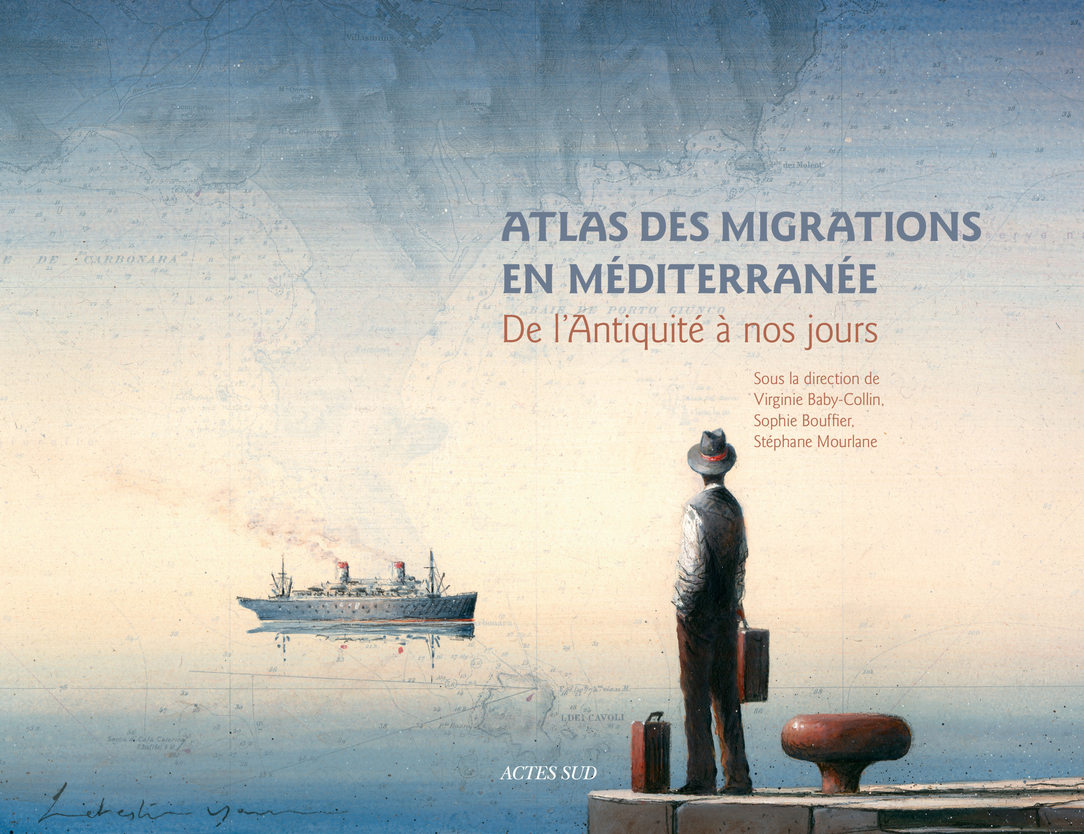
L’Atlas des migrations en Méditerranée de l’Antiquité à nos jours est un ouvrage sans équivalent, qui balaye plus de trois mille ans d’histoire. Au travers de deux cents cartes, des illustrations, des extraits de sources historiques et des textes de synthèse rédigés par des spécialistes, historiens et géographes, l’atlas montre comment les migrations ont façonné les sociétés et les cultures méditerranéennes sur la longue durée. S’adressant à un large public, il propose sur une base scientifique pluridisciplinaire solide, à la fois une mise au point utile et des pistes de réflexion sur une question toujours en débat.
Informations pratiques :
Atlas des migrations en Méditerranée. De l’Antiquité à nos jours, par Virginie Baby-Collin, Stéphane Mourlane et Sophie Bouffier, Paris, Actes Sud, 2021. 288 p., 25.50 x 19.60 cm. ISBN : 978-2-330-14501-9. Prix : 35 euros.
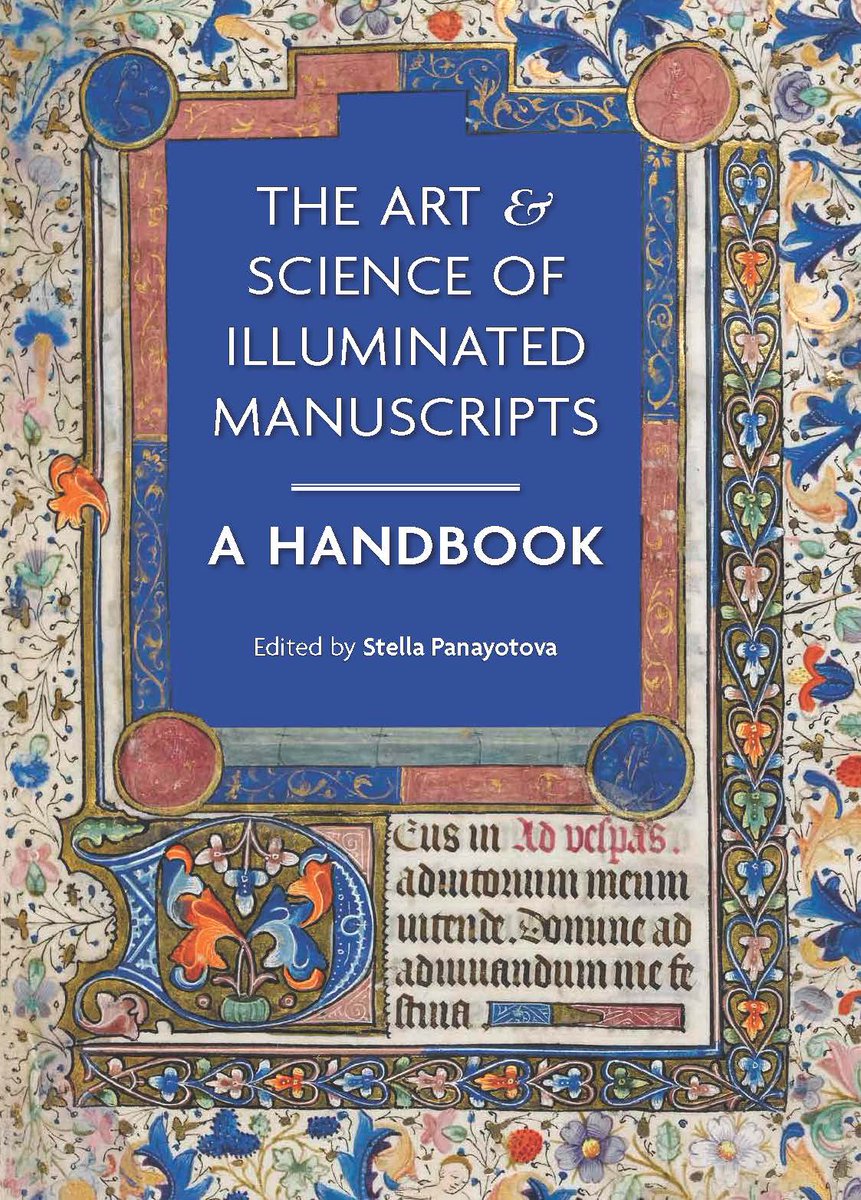
The results achieved by the research of the pioneering MINIARE research project based at the Fitzwilliam Museum in Cambridge led to the ground-breaking and acclaimed 2016 exhibition « COLOUR: The Art and Science of Illuminated Manuscripts. » This was followed by an international Conference, in which art historians, paper and book conservators, and cultural heritage scientists were brought together to share new recent research not only on manuscripts but also on painting in other media. The Conference proceedings were published in the first two volumes of the HMMIMA series (2017-2018). The present publication includes 6 Essays by way of introducing and explaining the major topics being investigated, including the range of inks, pigments and paint binders used by illuminators; parchment-making; pigment recipes; and model books. The many analytical instruments and techniques that are used to investigate manuscripts are also discussed. Then follow 58 Case Studies of manuscripts from as early as the year 700 up to c.1600. All these are fully illustrated in colour and in great detail, and should act as examples to inform scholars in libraries, museums and other cultural institutions of the benefits of adding scientific tools to the range of methods used to investigate manuscripts.
Programme :
Preface and Acknowledgements Contributors Analytical teams
Essay 1. Introduction: The Integrated Analyses of Illuminated Manuscripts – Stella Panayotova Essay 2. Pigment Recipes and Model Books. Mechanisms for Knowledge Transmission and the Training of Manuscript Illuminators — Nancy K. Turner and Doris Oltrogge Essay 3. Science of the Book. Analytical Methods for the Study of Illuminated Manuscripts – Paola Ricciardi and Catherine Schmidt Patterson Essay 4. From Pelt to Painted Page. Western Medieval Manuscript Parchments – Edward Cheese Essay 5. Painting Materials and Techniques in Byzantine and Slavonic Illuminated Manuscripts, c.800 – Elina Dobrynina Essay 6. Painting Materials and Techniques in Western Illuminated Manuscripts c.600 – Stella Panayotova
Case Studies 58 highly detailed case studies of manuscripts from as early as the year 700 up to c.1600.
All these are fully illustrated in colour and provide stimulating examples to guide conservation departments in collections, museums and other laboratories in applying scientific investigation into works of art.
Index of Works of Art Cited Bibliography
Informations pratiques :
Stella Panayotova, The Art & Science of Illuminated Manuscripts: A Handbook, Turnhout, Brepols, 2020. 528 p., 830 colour ill., 190 x 255 mm, 2020 (Manuscripts in the Making, 3). ISBN: 978-1-912554-59-1. Prix : 30 euros.
Le Moyen Âge ne cesse d’être recréé, réimaginé, réinventé, dans des romans, des séries, des fêtes estivales ou des discours politiques. Pour désigner ces réappropriations, les chercheurs ont forgé le terme de « médiévalisme ». Ce colloque international, organisé en virtuel, se propose d’analyser les médiévalismes contemporains et les rapports contrastés que les médiévistes peuvent entretenir avec eux.
Programme :
Lundi 29 mars
16h30-16h45 : Mot d’accueil de Martin Aurell (Univ. Poitiers) et remerciements
16h45-17h : Introduction de Martin Aurell : histoires du médiévalisme, médiévalismes historiques
17h-17h40 : Conférence de Tommaso di Carpegna Falconieri (Univ. Urbino Carlo Bo), « Médiévistique et médiévalisme : un château aux destins croisés » 17h40-17h55 : Questions et discussions 17h55-18h05 : Pause et posters
18h05-18h25 : Marion Bertholet (Univ. Aix-Marseille), « Le Moyen Âge italien des Lumières à Sismondi : un anti-médiévalisme ? » 18h25-18h45 : Joanna Pavleski-Malingre (Univ. Rennes 2), « Étudier les fortunes politiques de Mélusine du Moyen Âge à nos jours : intérêts et enjeux d’un médiévalisme au long cours » 8h45-19h : Questions et discussions
Mardi 30 mars
16h30-16h45 : Mot d’accueil et remerciements
16h45-17h :Introduction de Justine Breton : des Moyen Âges partout
17h-17h20 : Romain Vincent (Univ. Paris 13), « Du ludique au pédagogique : Médiévisme et jeu vidéo : jouer au Moyen Âge à l’école » 17h20-17h40 : Martin Bostal (Univ. Paris Sorbonne Nord), « La reconstitution historique du Moyen Âge : un « loisir sérieux » entre médiévalisme et recherche d’identité ». 17h40-17h55 : Pause et posters
15h00 : Assemblée générale de l’association « Modernités Médiévales » 16h30-16h45 : Mot d’accueil et remerciements
16h45-17h :Introduction de Florian Besson : bilan et perspectives 17h-17h20 : Alain Corbellari (Univ. Lausanne), « L’éternel retour du Moyen Âge. Pour une histoire longue du médiévalisme » 17h20-17h40 : Vincent Ferré (Univ. Paris Est-Créteil), « Médiévalisme(s) : divisions disciplinaires, culturelles, linguistiques depuis 1979 » 17h40-17h55 : Pause et posters
17h55-18h15 : Georges Bertin (CNAM des Pays de la Loire), « Médiévalisme et implication » 18h15-18h45 : Questions et discussions
Jeudi 1er avril
16h30-16h45 : Mot d’accueil et remerciements
16h45-17h :Introduction de Justine Breton : le Moyen Âge en mots 17h-17h20 : Anne Besson (Univ. Artois), « Fantasy médiévale et médiévistique : une relation à sens unique ? » 17h20-17h40 : Isabelle Olivier (Univ. Artois), « Le Moyen Âge et la littérature de jeunesse font-ils bon ménage ? Des tensions (fécondes ?) entre didactisme et divertissement » 17h40-17h55 : Pause et posters
17h55-18h15 : Tristan Martine (Univ. Angers), « Des bulles médiévales en cases : les enjeux du médiévalisme en bande dessinée » 18h15-18h45 : Questions et discussions
Vendredi 2 avril
16h30-16h45 : Mot d’accueil et remerciements
16h45-17h :Introduction de Lucie Malbos: un médiévalisme bien vivant
17h-17h45 : Table ronde « Le médiéviste face aux non-médiévistes : tensions et attentions » Paul Sturtevant (Smithsonian Institution) Florian Besson Cécile Voyer (Univ. Poitiers) Chloé Maillet (École Supérieure d’Art et de Design, Angers)
17h45-18h15 : Questions et discussions 18h15-18h25 : Pause et posters
La revue I quaderni del m.ae.s. – Journal of m.ae.s. lance un appel à contributions scientifiques en vue de la publication de son dix-neuvième numéro, prévue pour le 30 novembre 2021. La revue, fondée en 1998, est hébergée sur la plateforme AlmaDL Journals de l’Université de Bologne, le système digital de publication de revues évaluées par des pairs. Elle s’appuie ainsi sur un système de doubles relectures anonymes, dit peer-review, et sur une politique d’Open Access, qui contribue à la diffusion du débat et des connaissances scientifiques.
La revue se focalise sur l’étude de la période médiévale (Ve-XVIe siècles). Elle a un caractère interdisciplinaire et accepte des contributions qui utilisent une variété d’approches méthodologiques (par ex. histoire, histoire de l’art, études littéraires et philologiques, anthropologie historique, études de genre, humanités numériques etc.). Consciente de l’importance pour le débat scientifique de transcender les frontières nationales, la revue accepte des contributions en italien, anglais, français ou espagnol.
Pour le prochain numéro, le comité éditorial et scientifique s’intéresse particulièrement aux propositions concernant l’histoire des femmes dans les environnements urbains. Ces contributions seront publiées dans une section spéciale du numéro, consacrée à “La cité des femmes au Moyen Age”. Nous soulignons cependant le caractère généraliste de la revue, qui accepte donc des contributions sur d’autres thèmes.
La date limite de soumission des contributions scientifiques (articles ou critiques de livres) est fixée au 30 juin 2021.
Concernant les modalités de soumission des propositions et des exigences de style et de mise en page, veuillez respecter les consignes éditoriales publiées sur la page web de la revue : https://maes.unibo.it/about/submissions.
Les propositions qui ne respectent pas ces consignes ne seront pas considérées par le comité éditorial.
Call for Papers (ENG)
The journal « I quaderni del m.ae.s. – Journal of m.ae.s. » is opening a call for scientific contributions in view of the publication of its 19th issue, scheduled for 30 November 2021.
The journal, founded in 1998, is hosted by the AlmaDL Journals service, the digital publication system for peer-reviewed journals of the University of Bologna. It therefore guarantees the utilisation of a double blind peer-review system and of an Open Access policy, which contributes to the dissemination of scientific debate and knowledge.
The main focus of the journal is the period ca. 400-1500 a. D. It is an interdisciplinary publication accepting contributions from a variety of methodological approaches (including, but not limited to history, art history, literary studies, anthropology, philology, gender studies, etc.). Conscious of the importance of a scholarly debate that transcends national boundaries, the journal accepts contributions in Italian, English, French and Spanish.
For the upcoming issue, the Editorial Board and the Scientific Committee are particularly interested in articles that pay special attention to the history of women in the urban environment. Articles that fall into this category will be published in a special section devoted to the « City of Women in the Middle Ages« . However, we would like to stress that the journal has a fully generalist scope and therefore also welcomes contributions on other topics.
We invite you to send your scientific contributions (articles or book reviews) by 30 July 2021.
The Saxo Institute, Faculty of Humanities, Copenhagen University (UCPH), Denmark, invites applicants for a tenure-track assistant professorship in Archaeology to be filled by the 1st of September 2021 or as soon as possible thereafter.
We are looking for an outstanding junior researcher with an innovative mind-set and intellectual curiosity to strengthen and complement the research profile of Archaeology at the Saxo Institute. Our research group comprises the fields of Classical, Nordic, and contemporary archaeology, and its research focuses on visual culture, landscape, technology and production, archaeo-metallurgy, textile studies, and archaeological theory and epistemology in the humanities. Methodologically, fieldwork, excavations, surveys, experimental archaeology, and museum studies form an integral part of our research. We aim to attract an international top-talent to our ambitious and collaborative environment.
The Saxo Institute is dedicated to the study of human societies past and present, with degree programs ranging from History to Ethnology, Archeology, Classical Languages and Migration Studies. With some 1400 students and a staff of 100 employees, the Institute offers a variety of research and library facilities, servicing a vibrant community of tenured scholars, graduate students, visiting researchers and externally funded projects. The institute also hosts a range of leading research centres and externally funded research projects.
For more information on this job opening, please visit University of Copenhagen’s website.
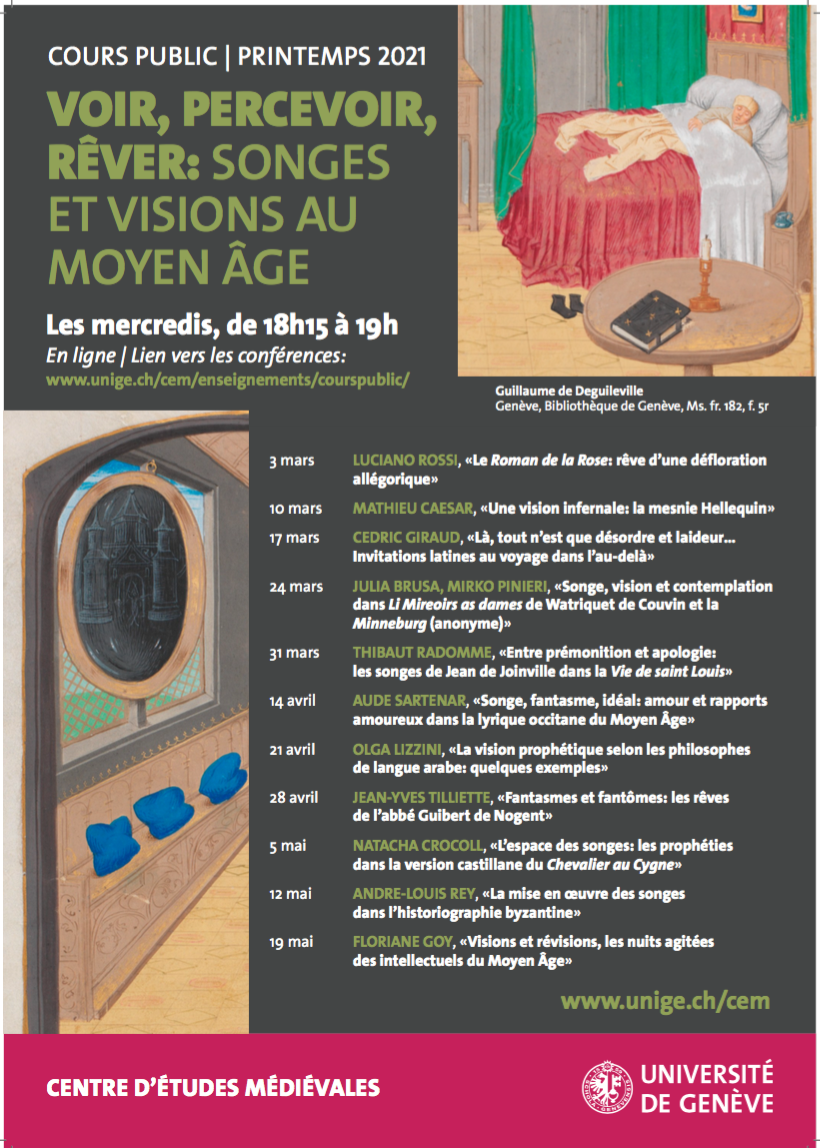
Ce cycle thématique de conférences réunit les contributions de divers intervenants rattachés au Centre d’Études Médiévales de Genève : historiens, historiens de l’art, archéologues, philosophes, théologiens, spécialistes des langues et littératures médiévales. Cette année, les conférenciers se pencheront sur les expériences de conscience qui sortent de l’état de veille ordinaire: qu’il s’agisse de rêves ou songes intervenant pendant le sommeil ou de visions perçues par un personnage éveillé, diverses catégories de perceptions, affectées de valeurs diverses, se rencontrent dans la littérature, la documentation historique, l’analyse philosophique et les arts, tout au long du Moyen Âge.
Programme :
3 mars LUCIANO ROSSI «Le Roman de la Rose: rêve d’une défloration allégorique»
10 mars MATHIEU CAESAR «Une vision infernale: la mesnie Hellequin»
17 mars CEDRIC GIRAUD «Là, tout n’est que désordre et laideur… Invitations latines au voyage dans l’au-delà»
24 mars JULIA BRUSA, MIRKO PINIERI «Songe, vision et contemplation dans Li Mireoirs as dames de Watriquet de Couvin et la Minneburg (anonyme)»
31 mars THIBAUT RADOMME «Entre prémonition et apologie: les songes de Jean de Joinville dans la Vie de saint Louis»
14 avril AUDE SARTENAR Songe, fantasme, idéal: amour et rapports amoureux dans la lyrique occitane du Moyen Âge
21 avril OLGA LIZZINI «La vision prophétique selon les philosophes de langue arabe: quelques exemples»
28 avril JEAN-YVES TILLIETTE «Fantasmes et fantômes: les rêves de l’abbé Guibert de Nogent»
5 mai NATACHA CROCOLL «L’espace des songes: les prophéties dans la version castillane du Chevalier au Cygne»
12 mai ANDRE-LOUIS REY «La mise en œuvre des songes dans l’historiographie byzantine»
19 mai FLORIANE GOY «Visions et révisions, les nuits agitées des intellectuels du Moyen Âge»
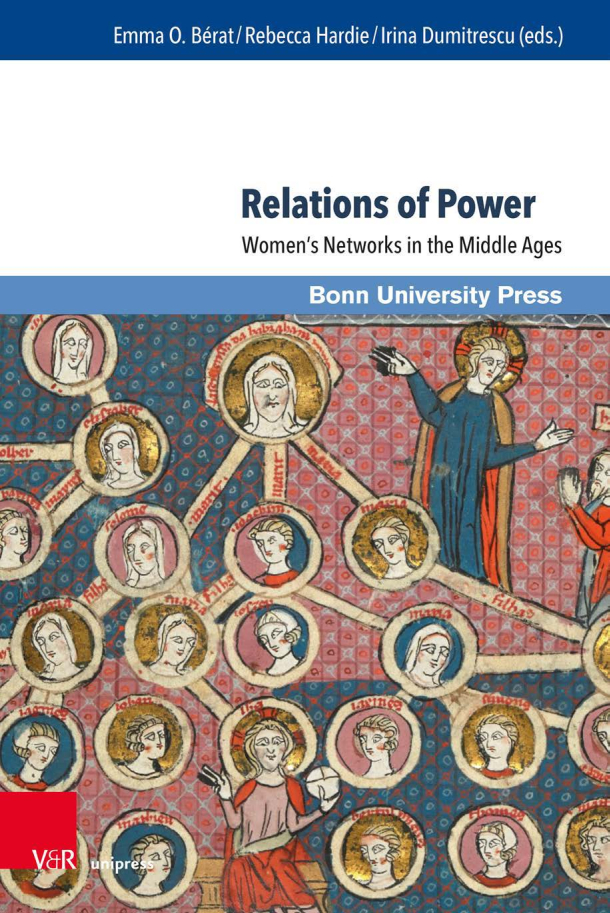
Women’s networks – their relations with other women, men, objects and place – were a source of power in various European and neighbouring regions throughout the Middle Ages. This interdisciplinary volume considers how women’s networks, and particularly women’s direct and indirect relationships to other women, constituted and shaped power from roughly 300 to 1700 AD. The essays in this collection juxtapose scholarship from the fields of archaeology, art history, literature, history and religious studies, drawing on a wide variety of source types. The volume’s aim is to highlight not only the importance of networks in understanding medieval women’s power but also the different ways these networks are represented in medieval sources and can be approached today. This volume reveals how women’s networks were widespread and instrumental in shaping political, familial and spiritual legacies.
Table des matières :
Emma O. Bérat/Rebecca Hardie – Introduction
Julia Hillner/Máirín MacCarron – Female Networks and Exiled Bishops between Late Antiquity and the Early Middle Ages: The Cases of LiberiusofRome and Wilfrid of York Lucy K. Pick – Networking Power and Gender at Court: An Eleventh-Century Diploma and ‘Las Meninas’ Jitske Jasperse – With This Ring: Forming Plantagenet Family Ties Abigail S. Armstrong – English Royal Family Ties: EdwardIand his Breton Nieces Mercedes Pérez Vidal – Female Aristocratic Networks: Books, Liturgy and Reform in Castilian Nunneries Stephanie Hollis – Dynastic Visions: Founder Abbesses of Wilton and Barking and their Eleventh-Century Successors Alyssa Gabbay – Mothers, Liver-Eaters and Matrilineal Descent:Hind bint‘Utba, Mu‘a ̄wiya and Nasab(Filiation) in Early Islam Karen Dempsey – Herstory: Exploringthe Material Life of Gundrada de Warenne
Informations pratiques :
Relations of Power. Women’s Networks in the Middle Ages, dir. Emma O. Bérat, Rebecca Hardie, Irina Dumitrescu, Vandenhoeck & Ruprecht, 2021 (Studien zu Macht und Herrschaft, 5). 199 p. ISBN 978-3-8471-1242-6. Prix : 45 euros.
La seconde moitié du XIIIe siècle est une période charnière dans l’histoire de la culture écrite de l’Occident latin. Dans le comté de Flandre, sous Marguerite de Constantinople (1244-1278) et Gui de Dampierre (1278-1305), c’est le temps où la prédominance de la charte cède le pas à l’essor des pratiques administratives au sens large. Aurélie Stuckens a publié dans notre série Studies in Belgian History une monographie sur cette évolution.
Le développement de la principauté flamande s’inscrit dans une évolution qui touche, à quelques décennies d’intervalle, la plupart des administrations royales, princières et seigneuriales de l’Europe occidentale. L’originalité de la Flandre réside néanmoins dans sa précocité à mettre au point certains outils administratifs (registres, formulaires, mentions de commandement des actes, etc.), au soin porté à la conservation de l’écrit au sens large – notamment aux documents préparatoires – et à l’émergence progressive de premières fonctions bureaucratiques intimement liées au déploiement de ces pratiques documentaires. Parmi ces fonctions se distinguent particulièrement celles de receveur général des finances, de maître et receveur des « terres nouvelles » du comte et de « chancelier de facto ».
Ces agents princiers et leurs subalternes sont les acteurs talentueux d’un XIIIe siècle qui les a vus façonner l’administration du comté de Flandre, pôle culturel, économique et politique majeur de l’Europe du Nord-Ouest au Moyen Âge.
Informations pratiques :
Aurélie Stuckens, Les hommes de l’écrit : Agents princiers, pratiques documentaires et développement administratif dans le comté de Flandre (1244-1305), Bruxelles, Archives générales du Royaume, 2021 (Studies in Belgian History vol. 9), Archives générales du Royaume, Bruxelles, 2020. 17 x 24 cm, 454 p. ISBN : 978-9463911450. Prix : 29,95 euros.
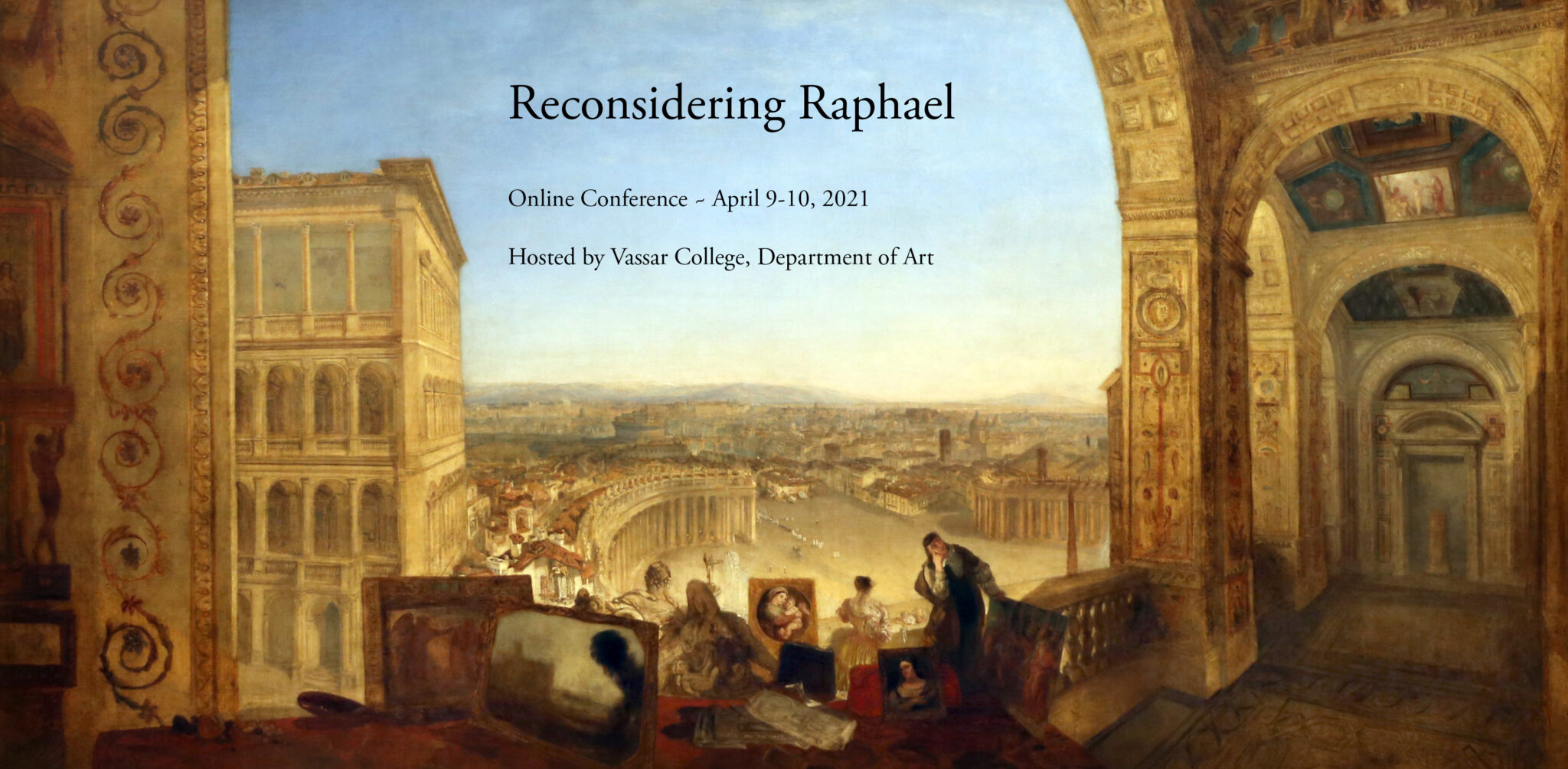
April 6, 2020 marked the quincentenary of the death of Raffaello Sanzio (1483-1520), one of the most brilliant and consequential artists in the western tradition. Praised during his lifetime as “Prince of Painters” (pictorum princeps), a description rendered indelible by Giorgio Vasari, this characterization long served to obscure Raphael’s artistic achievements in other modes. He was in reality an impresario in many media: revered in his own day as Rome’s chief architect, Raphael was also an urbanist and a designer of landscape, as well as of sculpture, silver, prints, and tapestries. A series of international conferences and exhibitions held in 1983-84, the quincentenary of the artist’s birth, was a watershed in Raphael studies, and in the intervening years, building on those events and publications, new understandings of Raphael have begun to take form, not only as a designer in an array of media, but also in terms of his collaboration with other artists, patrons, advisors, and literati. This conference dedicated to Raphael brings together established and emerging scholars to take stock of what has been accomplished in the past 37 years, to assess current approaches to his astonishingly innovative, diverse, and influential body of work, to present new research, and to chart directions for further study. Expanding upon well-established lines of inquiry, the program reflects new approaches to the quintessential old master.
Programme :
Friday, April 9, 2021
I. Introduction / Raphael at Work 9:30-11:15 EDT
Welcome: William Hoynes, Dean of the Faculty and Professor of Sociology, Vassar College Chair: Yvonne Elet, Associate Professor, Vassar College
Chair: Linda Wolk-Simon, Visiting Professor, Institute of Fine Arts, New York University / Independent Curator
Canonization and its Consequences – Sir Nicholas Penny, Visiting Professor, The China Academy of Art, Hangzhou / Director, National Gallery of Art, London (2008-15).
Tracy E. Cooper, Professor, Temple University Yvonne Elet, Associate Professor, Vassar College Marcia B. Hall, Laura Carnell Professor of Renaissance Art, Temple University Sheryl E. Reiss, Newberry Library Scholar-in-Residence / University of Chicago, Graham School Linda Wolk-Simon, Visiting Professor, Institute of Fine Arts, New York University / Independent Curator
Produced by Yvonne Elet, assisted by Vassar Computing & Information Services and Alumnae/i Affairs
Sponsored by the Agnes Rindge Claflin Fund, Vassar College Department of Art
With special thanks to:
Baynard Bailey, Susan Brkich, Cammy Brothers, Brian Chickery, Blake De Maria, Brandon Deichler, Wes Dixon, Heather Graham, Christopher Kirbabas, Amy Laughlin, Sophia Quach McCabe, Caleb Mitchell, Andrea Monteleone, Nancy Myers, Naomi Pucarelli, Susan Quade, Thomas Sinistore, Steve Taylor, and Bronwen Wilson
Vers 1360, la carrière de Nicole Oresme connut un tournant capital, largement ignoré jusqu’à présent : après plus de vingt-cinq ans en Faculté des arts, il se fit théologien.
Se munissant d’un doctorat de théologie, il accomplit les étapes successives du cursus. Il faut s’en surprendre : la cohérence de son parcours de philosophe de la nature aurait pu le conduire aux mêmes choix que Jean Buridan qui s’était lui-même refusé l’accès aux Facultés supérieures et était demeuré à la Faculté des arts de Paris.
Ce tournant se manifeste dans un manuscrit, unique le Vat. Lat. 986, épais dossier issu, d’une circonstance universitaire précise, la résompte d’Oresme. Une introduction détaillée en donne la composition. Dans ce manuscrit, Alain Boureau pense avoir découvert le texte de dix longues questions sur les Sentences, inédites et même inconnues, dont la transcription et la traduction constituent les deux premiers tomes de cette série.
Alain Boureau est directeur d’études à l’EHESS, spécialiste d’histoire de la scolastique médiévale. Parmi ses ouvrages récents : En somme… Pour un usage analytique de la scolastique médiévale (2011), L’Errance des normes (2016) et une édition critique et bilingue des Questions disputées (six volumes parus aux Belles-Lettres depuis 2011) et des Quodlibets (trois volumes depuis 2015) de Richard de Mediavilla. Aux Belles Lettres, il dirige également avec Michel Desgranges la collection « Histoire » et avec Ruedi Imbach la « Bibliothèque scolastique ».
Table des matières :
TOME 1
QUESTIONS SUR LES SENTENCES DE PIERRE LOMBARD
Sommaire de l’introduction générale Introduction générale Annexes
Introduction à la Question I I. Le fidèle catholique doit-il concéder ce principe théologique : Dieu peut faire tout ce qui peut être fait, sans que cela n’implique une contradiction ?
Introduction à la Question II II. Sur la première distinction du premier livre, je demande s’il faut user ou jouir de toute chose et ne le faire ensemble pour rien.
Introduction à la Question III III. En second lieu, sur la même distinction première, je demande si l’utilisation ou la jouissance constituent une représentation ou bien une connaissance de leur objet.
TOME II
QUESTIONS SUR LES SENTENCES DE PIERRE LOMBARD
Introduction à la Question IV IV. À partir de la saisie qu’a de Dieu la créature en ce monde, peut-on conclure avec évidence qu’existe dans l’univers un principe infini ?
Introduction à la Question V V. À propos des distinctions où le Maître traite de l’immuabilité de Dieu, de sa simplicité et de sa généralité, par quoi il se trouve partout, je demande si, du fait que Dieu est partout, à la manière dont il est, et pas autrement, on peut conclure de façon suffisante que Dieu est simple et immuable.
Introduction à la Question VI VI . À propos de la distinction 17, je demande si un homme d’ici-bas peut être admis sans grâce à la vie éternelle.
Introduction à la Question VII VII . À propos de la distinction 33 et des suivantes, où le Maître traite de la prédestination, je demande si la contingence des choses est compatible ou peut l’être avec la prescience de Dieu et avec sa science certaine.
Introduction à la Question VIII VIII . On demande si l’action de la volonté divine est compatible avec la contingence dans notre volonté.
Introduction à la Question IX IX. À partir du sujet du quatrième livre des Sentences, je pose cette question : le pèlerin de la vie d’ici-bas est-il tenu de rendre des grâces à Dieu tout-puissant de façon égale pour tous ses bienfaits ?
Introduction à la Question X X. À propos du troisième livre des Sentences, je demande si, en raison de la bienheureuse union de la nature humaine au Verbe, il faut véridiquement accorder que Dieu s’est fait nouvellement homme.
Index des sources explicites Bibliographie
Informations pratiques :
Nicole Oresme, Écrits métaphysiques et théologiques. La résompte de 1362 (Tome I & II), éd. Alain Boureau, Paris, Les Belles Lettres, 2021 (Bibliothèque scolastique, 17). CXXX + 848 p., 12.6 x 19.3 cm. ISBN : 9782251451626. Prix : 95 euros.
Avec le soutien du FNRS, du CRHiDI (UCLouvain – Saint-Louis, Bruxelles), d'INCAL (UCLouvain), de PraME (UNamur), de sociAMM (ULB) et de Transitions (ULiège)







Vous devez être connecté pour poster un commentaire.