Publication – Sébastien Cazalas, « Jean Juvénal des Ursins, prélat engagé (1388-1473). Étude des épîtres politiques »

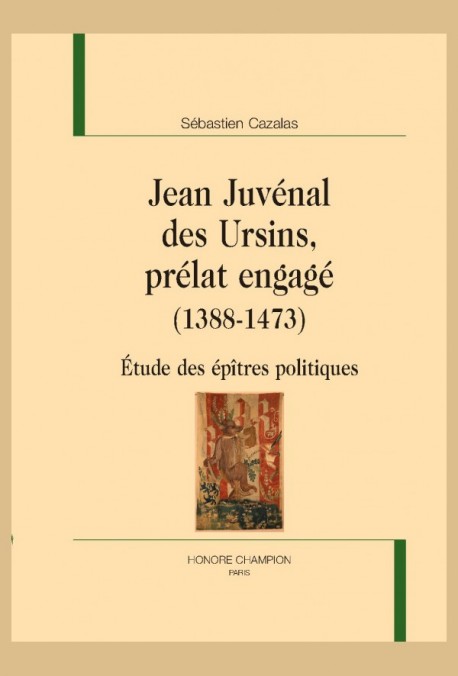
Spectateur meurtri par les drames de la fin de la guerre de Cent Ans et l’état de déréliction morale du royaume, Jean Juvénal des Ursins (1388-1473) entreprend un long dialogue avec le roi de France. Ses épîtres politiques constituent une tentative d’avertir Charles VII, puis Louis XI, des carences et des erreurs de leur gouvernement. Au-delà du commentaire de l’actualité, c’est un puissant engagement moral qui s’affirme, enraciné dans une conception chrétienne et humaniste des devoirs du prince. Afin de convaincre celui-ci de la nécessité d’une reformation du royaume, le propos s’organise pour gagner en force de persuasion. Les discours de l’évêque accueillent une grande variété de traditions littéraires (épopée, motif courtois, apologue animalier, prophétie, étymologie, généalogie et plaidoyer, etc.). Le souci d’une mise en scène de soi est particulièrement remarquable : l’évêque, inséparable de sa famille, se nimbe de l’ethos du prophète et travaille à l’affirmation d’une nouvelle noblesse, les gens de robe, maîtres d’oeuvre d’une monarchie restaurée par les pouvoirs de l’ymaginacion.

Sébastien Cazalas, docteur ès Lettres, est professeur agrégé à l’Université de Nantes.

Table des matières : ici

Informations pratiques :

Sébastien Cazalas, Jean Juvénal des Ursins, prélat engagé (1388-1473). Étude des épîtres politiques, Paris, Honoré, Champion, 2020 (Bibliothèque du XVe siècle, 85). 730 p., 15 x 22 cm. ISBN : 9782745354099. Prix : 85 euros.

Source : Honoré Champion

Publié dans Publications | Laisser un commentaire

Publication – « Modus Vivendi. Religious Reform and the Laity in Late Medieval Europe », dir. Miri Rubin

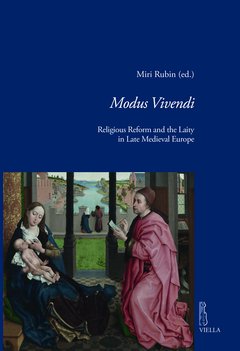
Modus Vivendi is a collection of essays by scholars who seek to discover lay men and women within the projects of reform and renewal in later medieval Europe. Religious life was never without change, yet religious orders, preachers, and institutions of learning proclaimed their desire to make religious life more sincere. In doing so, they occasionally developed a mission to lay people alongside professional religious. Such encounters with the laity – through the writing of theology in the vernacular, in the delivery of charismatic preaching, in the operation of inquisition into heresy, in the composition of new liturgies, and through networks of patronage – created modes of living religion – modus vivendi – of creativity as well as discipline. They contributed to religious life beyond the routine provisions of parish life, and often included women in novel ways.

Table des matières :

Miri Rubin, Modus Vivendi: An Introduction

Stephen Mossman, Hatred of University Lecturers and the Inspired Word in the Fourteenth Century: Ruusbroec – Tauler – Merswin
Marika Räsänen, The Cult of St Thomas Aquinas, Reform and the Laity in Late Medieval Italy
Reima Välimäki, Bona docere et mala dedocere. Inquisition of Heresy and Communication with the Lay Population
Mathilde van Dijk, Inventing Secular Devotion: Dirc of Herxen, and Dionysius the Carthusian on the Life of Married People
Antonín Kalous, Mendicants and the Reform of Religious Life in Late Medieval Bohemia and Moravia
Cécile Caby, Santa Giustina of Padua in Santa Fiora of Arezzo: Reform between Literary Invention and Social Demand in a Fifteenth-Century Tuscan Abbey
Meri Heinonen, The Books of the Laity and the Observant Dominican Reform in Nuremberg at the Turn of the Fifteenth Century

Index
Notes on Contributors

Informations pratiques :

Modus Vivendi. Religious Reform and the Laity in Late Medieval Europe, dir. Miri Rubin, Rome, Viella, 2020. pp. 152, 15,5×23 cm, hardback. ISBN: 9788833137063. Prix : 39 euros.

Source : Viella

Publié dans Publications | Laisser un commentaire

Publication (en ligne) – « De la clôture à la fortification des monastères », dir. Sébastien Bully et Christian Sapin

Hors-série n° 12 | 2020
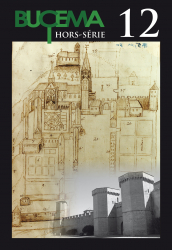
De la clôture à la fortification des monastères. Actes des 5èmes journées d’études monastiques, Auxerre, 1-2 septembre 2016

Accès : ici

Table des matières :

Christian Sapin – Introduction : les premiers monastères, entre clôtures et fortifications

Ronan Pérennec et Annie Bardel – Barrières, clôtures et murailles à Landévennec : juxtaposition et évolution
Jacques Bujard – Clôtures et fortifications monastiques en Suisse
Frédéric Chantinne – Fortification et fonctions militaires des abbayes et chapitres dans l’Entre-Sambre-et-Meuse aux IXe-XIe siècles
Isabelle Cochelin – Regards monastiques sur la double clôture de Cluny (XIe siècle)
Eleonora Destefanis – Limites et enjeux spatiaux dans les monastères du haut Moyen Âge italien
Fabrice Henrion – La Charité-sur-Loire, la ville, le prieuré et son enclos : un aperçu des connaissances et un état des lieux
Jacques Le Maho et Gilles Deshayes – Limites et clôtures à Jumièges (VIIe-XIIe s.)
Christian Sapin – De la clôture à la fortification des abbayes en Bourgogne avant le XIIIe siècle
Jean-Michel Picard – Septum monasterii : clôtures et monastères en Irlande médiévale (VIe-IXe siècles)
François Blary –  La question des clos symboliques et fortifiés des établissements cisterciens (XIIIe-XVe s.)
Luc Bourgeois – Claustrum versus castrum : réalités et ambiguïtés des enclos monastiques

Source : BUCEMA

Publié dans Le réseau | Laisser un commentaire

Conférence – Robert Gramsch-Stehfest, « Networks of political and clerical actors in the Middle Ages: new insights in medieval history with the help of digital methods” »

Considered the current situation related to the spread of Covid-19, for 2020 the seminars will take the form of a webinar, hosted on the VUB LifeSize platform (as it appears to be more stable than Teams). If the sanitary situation allows it, the series will take the form of a standard presential seminar in 2021. 

The seminars will take place during lunch time, from 12:00 to 13:30.

15/12 – Robert Gramsch-Stehfest (University of Jena): “Networks of political and clerical actors in the Middle Ages: new insights in medieval history with the help of digital methods”

Source : DigiResearch – VUB

Publié dans Colloque | Laisser un commentaire

Publication (en ligne) – « Rethinking Scholastic Communities & Ideologies of Translation, II » (Medieval Worlds, 12, 2020)

medieval worlds
Volume 12. 2020
ISSN Online: 2412-3196
ISBN-13 Online: 978-3-7001-8852-0

Table des matières :

Preliminaries

Pascale Hugon – Birgit Kellner – Rethinking Scholastic Communities in Medieval Eurasia: Introduction

Constant J. Mews – Rethinking Scholastic Communities in Latin Europe: Competition and Theological Method in the Twelfth Century
José Ignacio Cabezón – Rethinking Buddhist Scholastic Communities Through a Socio-Historical Lens
Cathy Cantwell – Myang ral Nyi ma ’od zer (1124-1192): Authority and Authorship in the Coalescing of the rNying ma Tantric Tradition
Bénédicte Sère – Between disputatio and Polemics: Dialectics as Production of Knowledge in the Middle Ages
Jonathan Samuels – The Tibetan Institutionalisation of Disputation: Understanding a Medieval Monastic Practice
Réka Forrai – Hostili praedo ditetur lingua latina: Conceptual Narratives of Translation in the Latin Middle Ages
Jan Odstrčilík – Multilingual Medieval Sermons: Sources, Theories and Methods
Herbert Schendl – Multilingual Texts as a Reflection of Code-Switching in Medieval England: Sermons and Beyond
Nicole Bériou – Orality in its Written Traces: Bilingual reportationes of Sermons in France (Thirteenth Century)
Carlo Delcorno – Bilingualism in Medieval Italian Preaching: The Case of Angelo da Porta Sole (d. 1334)
Lidia Negoi – Bilingual Strategies in Fourteenth-Century Latin Sermons from Catalonia
Tom ter Horst – Typology and Spectrum of Latin-Irish and Latin-English Codeswitches in Medieval Sermon Literature
Roy Flechner – Review Article: How Far is Global?

Source : Medieval Worlds

Publié dans Publications | Laisser un commentaire

Appel à contribution – Perspective – Habiter n°2021 – 2

English version below

Pour son prochain numéro, la revue Perspective souhaite poser la question de ce que c’est qu’habiter: habiter un espace, un territoire, sa maison ou son corps, qu’il s’agisse de confins extrêmes ou des frontières de l’intime ; habiter sa vie, sa (ses) société(s), son temps, pour ce qu’habiter, c’est aussi être au monde, être présent à autrui, se confronter à un étant donné. À l’heure où, partout sur la planète, des populations entières sont assignées à domicile, la revue invite à revenir sur les imaginaires plastiques de l’habiter: «occuper habituellement un lieu», comme le suggère le dictionnaire, où se glisse l’idée de l’habitude, des cadres, de la répétition et de la régularité, mais encore «occuper quelqu’un», l’habiter, l’animer, l’émouvoir.

Habiter n’est, en effet, pas uniquement une question spatiale. L’âme d’un lieu en rend compte, qui ouvre la question poétique de l’être habité: hanter, être hanté, posséder un lieu ou un être, être possédé par lui, comme l’on possède des idées, des valeurs et des croyances qui, à leur tour, nous habitent. Le temps et l’invisible, ici, s’immiscent dans les matérialités: habiter parle de ce que l’on construit – maçonneries, toits, maisons, frontières – mais aussi de ce dont on hérite, des présences immatérielles, des représentations intimes et des espaces mentaux – de ce qui nous tient, nous retient et nous relie. Habiter articule in fine l’individuel et le collectif, les partages et les frontières, les mouvements et les clôtures, les lieux et les non-lieux, et pose la question des communs, du monde que nous avons, précisément, en partage : de l’écologie, donc, au sens propre du terme, qui renvoie, en tant que science de l’habitat (oikos, la «maison»), à la manière dont s’entrelacent les formes multiples de nos existences et de nos voisinages.

Ainsi la revue Perspective souhaite-t-elle consacrer son prochain numéro aux manières dont les artistes, les historiens de l’art, ainsi que leurs collègues des disciplines voisines, s’emparent de ces questions et témoignent des multiples manières d’habiter et d’être habité. Ce thème appelle une diversité d’approches, thématiques autant que disciplinaires. Elles seront les bienvenues, pourvu que les propositions répondent aux lignes éditoriales de la revue. Les regards portés vers l’histoire de l’architecture, de l’urbanisme, du paysagisme et des arts visuels ne sauraient exclure des explorations liées à la muséologie, à l’ethnologie, à l’anthropologie, aux visual studies et aux humanités numériques, ainsi que vers les champs des arts décoratifs et du design, de la mode, des arts de la scène ou du cinéma

Contribuer

Prière de faire parvenir vos propositions (un résumé de 2000 à 3000 signes, avec un titre provisoire, une courte bibliographie sur le sujet, et une biographie de quelques lignes) à l’adresse de la rédaction (revueperspective@inha.fr) avant le 10 janvier 2021. Perspective prenant en charge les traductions, les projets seront examinés par le comité de rédaction du numéro quelle que soit la langue. Les auteurs des propositions retenues seront informés de la décision du comité au mois de février 2021, tandis que les articles seront à remettre pour le 15 juin 2021. Les articles soumis, d’une longueur finale de 25000 ou 45000 signes selon le projet envisagé, seront définitivement acceptés à l’issue d’un processus anonyme d’évaluation par les pairs.

Inhabiting n°2021 – 2

For its coming issue, the journal Perspective asks the question of what it means to inhabit : to inhabit a space, a territory, one’s home or one’s body, whether we are dealing with far away frontiers, or the outlines of intimacy; to inhabit one’s life, one’s society/ies, one’s epoch, in what inhabiting means in terms of being present in one’s world, for and with one another, to face circumstances as they stand. In a time when, across the globe, entire populations are confined to their homes, Perspective issues an invitation to revisit the visual and imaginary plasticity of inhabiting: “to occupy a place of settled residence or habitat,” so states the dictionary, suggesting habit, repetition, regularity; but also occupying persons, inhabiting them, animating them, moving them.

Inhabiting is not only a question of space. When we speak of “the spirit of a place”, it opens the poetic question of being inhabited: to haunt, to be haunted, to possess a place or a being, to be possessed, as one may possess an idea, values or beliefs which, in turn, inhabit us. Thus, both time and intangibility find their way into the material world: inhabiting refers to what is built (masonry, roofs, buildings, frontiers), but it also refers to what we inherit, immaterial presences, intimate representations and mental spaces – finally, it refers to what holds us up, holds us back, or holds us together. In fine, inhabiting articulates the individual and the collective, what is shared and what is separated, what is movement and what is closure, places and non-places, and brings forth the question of the Commons: in our world, what do we share? This inevitably brings us to the question of ecology, in its original meaning; the science of the habitat (oikos, the “home”), to how our multiple forms of existence and coexistence interweave.

In this manner, Perspective endeavours to dedicate its coming issue to the ways in which artists, art historians, and their colleagues from various neighbouring disciplines, take on these interrogations and bring forth the multiple ways in which one can inhabit or be inhabited. This subject calls for a wide variety of approaches, both in terms of thematic and fields of study. All proposals will be studied as long as submissions remain in line with the journal’s editorial policy. Investigations into the fields of history of architecture, urbanism, landscaping, visual arts, but also museology, ethnology, anthropology, visual studies, and digital humanities, as well as decorative arts, design, fashion, performing arts and cinema shall all be welcome.

Call for papers

Bibliography on the subject, and a biography of a few lines) to the editorial office (revue-perspective@inha. fr) before January 10, 2021. As Perspective will manage translations, projects will be examined by the issue’s editorial board regardless of language. The authors of selected proposals will be informed of the committee’s decision in February 2021, and articles must be submitted by June 15, 2021. Submitted articles, with a final length of 25,000 or 45,000 characters depending on the project, will be definitively accepted after the anonymous peerreview process. 

Source : INHA

Publié dans Le réseau | Laisser un commentaire

Séminaire – Project NOTAE Lectures. Around a Research Project and Beyond

Location: Sapienza University of Rome, Piazzale Aldo Moro 5, Rome, CU003 (Faculty of “Lettere e Filosofia”),  Third Floor, Department of “Storia Religioni Arte Spettacolo“, Room “Aula nuova Buonaiuti”.

It is possible to participate remotely. For registration: antonella.ghignoli@uniroma1.it

Programme :

Friday, January 22, 2021 – 3:00 pm
Davide Domenici (Alma Mater Studiorum Università di Bologna)
L’esperienza di ricerca di un antropologo: testi, immagini e glosse alfabetiche nel mondo mesoamericano, tra epoca preispanica e prima età coloniale

Friday, February 5, 2021 – 3:00 pm
Silvia Ferrara (Alma Mater Studiorum Università di Bologna, ERC project INSCRIBE)
Da icona a linea. Evoluzione dei primi segni tra natura e cultura

Friday, February 19, 2021 – 3:00 pm
Maria Chiara Scappaticcio (Università degli Studi di Napoli Federico II, ERC project PLATINUM)
Il nuovo Corpus of Latin Texts on Papyrus (CLTP)

Friday, March 5, 2021 – 3:00 pm
Yasmine Amory (Ghent University, ERC project EVWRIT)
Più di un’arte, più di un’intuizione. Una proposta tipologica per l’analisi paleografica dei papiri documentari greci

Friday, March 26, 2021 – 3:00 pm
Agostino Soldati (Sapienza Università di Roma, ERC project PAThs)
Alcune peculiarità grafiche dei colofoni copti: tipi di staurogrammi, compendi e crittografie

Friday, April 9, 2021 – 3:00 pm
Sophie Kovarik (Universität Wien)
Notaries in Late Antiquity (4th-8th century). The Middle Egyptian Evidence

Friday, April 30, 2021 – 3:00 pm
Arianna D’Ottone Rambach (Sapienza Università di Roma)
I simboli religiosi nella cultura arabo-islamica

Friday, May 7, 2021 – 3:00 pm
Johannes Preiser-Kapeller (Österreichische Akademie der Wissenschaften Wien)
Elephants, Oranges and Pathogens. The Global Entanglement of Long Late Antiquity through the Mobility of Non-human Actors, 200-900 AD

Friday, May 28, 2021 – 3:00 pm
Martin Hellmann (Dietrich Bonhoeffer Gymnasium Wertheim)
Marking with Shorthand in Earlier Latin Manuscripts

Friday, June 18, 2021 – 3:00 pm
Tessa Canella (Sapienza Università di Roma)
Segni, sogni e visioni celesti nella letteratura di età costantiniana

Friday, October 1, 2021 – 3:00 pm
Alessia Rovelli (Università degli Studi della Tuscia)
Tipi e legende monetali: alcuni aspetti del linguaggio simbolico del potere tra tardoantico e alto medioevo

Source : Notae

Publié dans Séminaire | Laisser un commentaire

Publication – « Passionarium Hispanicum. Saeculum X et Saeculum XI », éd. Valeriano Yarza Urquiola.

Estudio y edición crítica de los relatos hagiográficos, de autor anónimo, de mártires cristianos de diferentes países agrupados en la colección llamada Pasionario Hispánico, formada en la Hispania de los siglos X y XI en los monasterios, principalmente, de Cardeña y Silos.

El Passionarium Hispanicum es una colección de relatos hagiográficos de mártires cristianos de diferentes países, localizados, básicamente, en época de las persecuciones del Imperio Romano. Los relatos tenían función litúrgica, es decir, su lectura en maitines, oficio nocturno o misa. La lectura se hacía siguiendo el orden cronológico de la festividad de cada mártir de la colección a lo largo del año. Las narraciones, esto es, las Pasiones de los mártires incluidas en la colección, fueron escritas, casi siempre por autores anónimos, desde el s. IV al XI, siendo recogidas y agrupadas en España en códices de los siglos X y XI y en algunos del s. XIII. En los manuscritos hispanos del s. X se recogen 63 Pasiones de mártires. En la de los siglos XI-XIII, 65. En los relatos se contraponen la ética cristiana, representada por los mártires, víctimas sometidas a horribles tormentos solamente por su condición de cristianos, y la pagana, personificada en el poder político, esto es, emperadores, gobernadores, etc. Los protagonistas de los relatos, los mártires, son de toda edad y condición, varones y mujeres, adultos y niños, pudientes y humildes, y pertenecen, como hemos dicho, a diversos países, poniéndose de manifiesto la universalidad de la Iglesia católica.

Valeriano Yarza Urquiola es autor de varios artículos de temática diversa y de libros sobre la literatura latina de época patrística y medieval (ss. IV-XVI), que contienen básicamente el estudio y la edición crítica de textos latinos de autores como Potamio de Lisboa, Ildefonso de Toledo, Isidoro de Sevilla, Julián de Toledo y Elio Antonio de Nebrija.

Informations pratiques :

Passionarium Hispanicum. Saeculum X et Saeculum XI. Cura et studio Valeriano Yarza Urquiola, Turnhout, Brepols, 2020 (Corpus Christianorum, Series Latina, 171 et 171 A). 1005 p., 155 x 245 mm, 2020. ISBN: 978-2-503-58876-6. Prix : 540€ (vol. 1) + 305€ (vol. 2).

Source : Brepols

Publié dans Publications | Laisser un commentaire

Appel à contribution – St. Augustine’s ‘De Civitate Dei’ Political Doctrine, Textual Transmission and Early Medieval Reception

On 27-29 January 2022, the research units Literary Studies: Latin Literature and History of Church and Theology of KU Leuven will organize, in the framework of the C1-project «Magnum opus et arduum»: Towards a History of the Reception of Augustine’s «De civitate Dei», the international conference:

Saint Augustine’s De civitate Dei
Political Doctrine, Textual Transmission and Early Medieval Reception
Leuven/Brussels, 27-29 January 2022

This conference aims to bring together scholars who have recently made important contributions to the study of Augustine’s De civitate Dei and its reception from the philosophical, historical, philological and theological points of view. The following survey offers some possible topics, but does not intend to exclude alternative issues. Preference will be given, however, to source-based contributions that focus on Late Antiquity and the Early Middle Ages.

(1) Political doctrine in Augustine’s De civitate Dei and its legacy

The socio-political ideas expressed by Augustine in De civitate Dei have already been extensively researched. Nonetheless, Augustine’s theory can only be properly understood if situated within the contexts of both his œuvre and his own praxis as a bishop. The place of De civitate Dei in the development of Augustine’s thought, as well as its relationship with his activity as a local political leader, should be more closely examined. Moreover, De civitate Dei exerted a crucial influence on the development of political and moral theology from Late Antiquity to the Early Modern era and beyond, which deserves to be better explored. Examples of questions that can inspire conference papers are: how did the historical context exert an influence on the ideas expressed in De civitate Dei? How is a specific concept treated in De civitate Dei compared to his other works, and those of other Church Fathers? How has Augustine’s political doctrine as conveyed by De civitate Dei and other works been reshaped by medieval readers? How did this work inspire the behavior and actions of late antique and early medieval politicians?

(2) Late antique and early medieval transmission and reception of De civitate Dei

Though Augustine’s De civitate Dei had a massive influence on Western thinking and culture, we are currently very far from understanding the path of its transmission and dissemination in the Middle Ages, as we still rely on an almost century-old edition which takes into account a limited number of manuscripts. The impact of Augustine’s magnum opus is not only reflected in the wide reception of its content, but also in the large number of extant copies and the numerous quotations in anthologies and other works composed from Late Antiquity onwards. Speakers may propose the study of a manuscript or a group of manuscripts from the textual, paratextual and/or codicological points of view, as well as a survey and an evaluation of literal and non-literal quotations in late antique and early medieval literature (e.g. florilegia, biblical commentaries, visions of the afterlife, theological, philosophical, historical and encyclopedic works).

On 27-29 January 2022, the research units Literary Studies: Latin Literature and History of Church and Theology of KU Leuven will organize, in the framework of the C1-project «Magnum opus et arduum»: Towards a History of the Reception of Augustine’s «De civitate Dei», the international conference:

Saint Augustine’s De civitate Dei
Political Doctrine, Textual Transmission and Early Medieval Reception
Leuven/Brussels, 27-29 January 2022

This conference aims to bring together scholars who have recently made important contributions to the study of Augustine’s De civitate Dei and its reception from the philosophical, historical, philological and theological points of view. The following survey offers some possible topics, but does not intend to exclude alternative issues. Preference will be given, however, to source-based contributions that focus on Late Antiquity and the Early Middle Ages.

(1) Political doctrine in Augustine’s De civitate Dei and its legacy

The socio-political ideas expressed by Augustine in De civitate Dei have already been extensively researched. Nonetheless, Augustine’s theory can only be properly understood if situated within the contexts of both his œuvre and his own praxis as a bishop. The place of De civitate Dei in the development of Augustine’s thought, as well as its relationship with his activity as a local political leader, should be more closely examined. Moreover, De civitate Dei exerted a crucial influence on the development of political and moral theology from Late Antiquity to the Early Modern era and beyond, which deserves to be better explored. Examples of questions that can inspire conference papers are: how did the historical context exert an influence on the ideas expressed in De civitate Dei? How is a specific concept treated in De civitate Dei compared to his other works, and those of other Church Fathers? How has Augustine’s political doctrine as conveyed by De civitate Dei and other works been reshaped by medieval readers? How did this work inspire the behavior and actions of late antique and early medieval politicians?

(2) Late antique and early medieval transmission and reception of De civitate Dei

Though Augustine’s De civitate Dei had a massive influence on Western thinking and culture, we are currently very far from understanding the path of its transmission and dissemination in the Middle Ages, as we still rely on an almost century-old edition which takes into account a limited number of manuscripts. The impact of Augustine’s magnum opus is not only reflected in the wide reception of its content, but also in the large number of extant copies and the numerous quotations in anthologies and other works composed from Late Antiquity onwards. Speakers may propose the study of a manuscript or a group of manuscripts from the textual, paratextual and/or codicological points of view, as well as a survey and an evaluation of literal and non-literal quotations in late antique and early medieval literature (e.g. florilegia, biblical commentaries, visions of the afterlife, theological, philosophical, historical and encyclopedic works).

Committed speakers include: Anne-Isabelle Bouton-Touboulic (Université de Lille), Emanuela Colombi (Università degli Studi di Udine), Jérémy Delmulle (IRHT – Paris), Volker Henning Drecoll (Universität Tübingen), Jacques Elfassi (Université de Lorraine), Jesse Keskiaho (University of Helsinki), Jerôme Lagouanère (Université Paul Valéry – Montpellier), Karla Pollmann (University of Bristol).

If you would like to deliver a lecture during this conference, please send the provisional title, abstract (max. 500 words) and a concise CV (max. 500 words) to Marina Giani (marina.giani@kuleuven.be) before 31 March 2021. Young researchers and early career scholars are especially encouraged to apply.

The colloquium will take place at the University of Leuven. A guided visit will be conducted to the Bibliothèque Royale in Brussels, where some of the most famous manuscripts and printed editions of Augustine’s De civitate Dei will be displayed. We are committed to host an on campus conference: nonetheless, if travelling abroad will not yet be safe by then, we are prepared to either switch online or to host a blended meeting.

Acceptance of your paper will be communicated by 30 April 2021. All participants are kindly invited to announce the definitive title of their lecture and a short abstract before 30 June 2021. Lectures should be approx. 30 minutes long, followed by a general discussion of 10 minutes. The organizing committee has the intention of publishing the conference papers as quickly as possible in the international series Augustinus. Werk und Wirkung, directed by Volker Henning Drecoll and Johannes Brachtendorf. More practical information will follow when abstracts have been accepted.

If you have any questions, do not hesitate to contact us. Yours sincerely,
Gert Partoens, Anthony Dupont, Marina Giani

Publié dans Appel à contributions | Laisser un commentaire

Appel à contribution – Rituel et image : textiles et révélation du sacré / Ritual and Image: Textiles and the Revelation of the Sacred

English version below

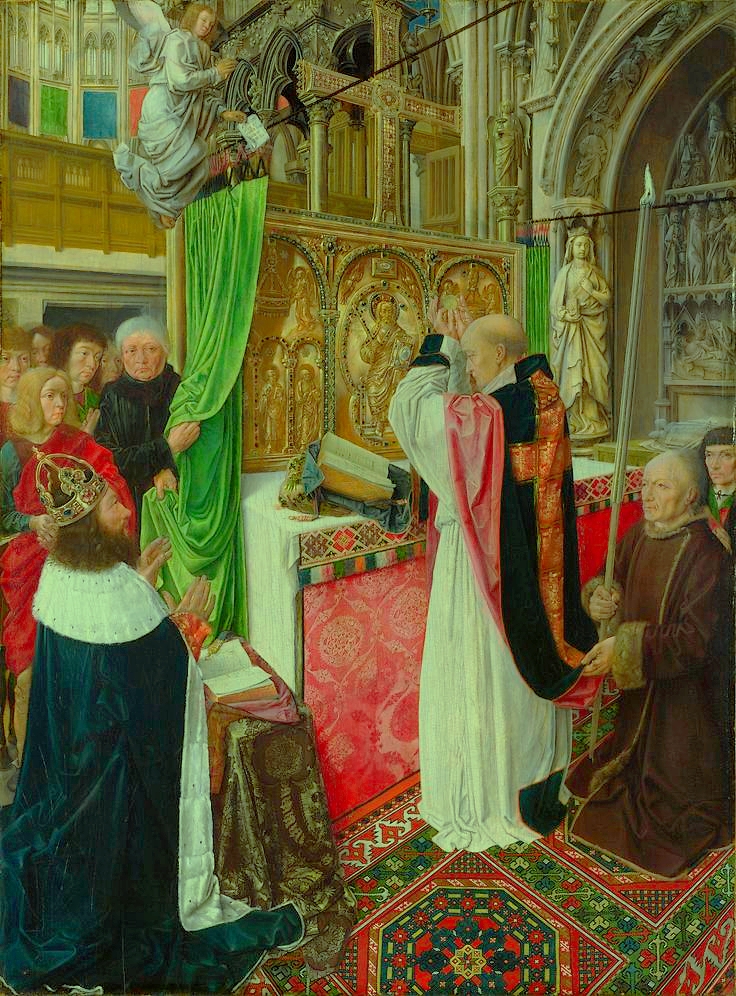
Qu’ils participent des agencements plastiques de l’image ou qu’ils soient déployés autour de l’autel, les textiles, en alliant mobilité et fluidité, jouent un rôle de première importance dans la révélation du sacré. Depuis le milieu du XIIIe siècle, l’exaltation de la Présence Réelle et l’essor des images dévotionnelles alimentent un intense « désir de voir ». L’image elle-même, puissant instrument de médiation entre le visible et l’invisible, est souvent comparée à un voile, dans la mesure où elle est capable de suggérer la présence ou l’absence de ce qui est représenté.

Vêtements, les textiles parent et transforment les corps. Parements, ils deviennent supports de l’adoration. Voiles, ils matérialisent la séparation entre l’humain et le divin. Rideaux soulevés, ils sont les auxiliaires d’une théophanie visuelle. Ces journées d’études entendent interroger la participation des textiles – réels ou fictifs, matériels, représentés ou feints – dans la manifestation du sacré, compris dans une acceptation large au-delà de la sphère strictement religieuse. La diversité de leurs formes, la pluralité de leurs fonctions et leur potentiel métaphorique seront au cœur de la réflexion.

Comment voit-on les textiles dans un cadre liturgique ou dévotionnel ? Quels sont leurs rôles dans l’appréhension du sacré et dans sa révélation, qu’elle soit figurée ou sacramentelle ? Si l’Europe occidentale du Moyen Âge et de l’Époque moderne constitue le cadre privilégié de cette enquête, des exemples issus d’autres aires culturelles et/ou d’autres périodes pourront enrichir la réflexion, qui s’articulera autour des thématiques suivantes :

Orner. Les textiles participent du decorum de l’église : ils revêtent le célébrant, ornent l’autel et parent les murs de l’église. De même dans l’iconographie, ils honorent et glorifient les figures avec lesquelles ils entrent en contact. Mêlant brillance des matières, éclat des filés métalliques et techniques parfois prestigieuses, l’aspect précieux de certaines étoffes ; souvent accentué sous le pinceau du peintre ; enrichit l’espace ecclésial ou pictural.

Sacraliser. Barrières ou points de rencontre, les étoffes structurent l’espace, aussi bien ecclésial que pictural. Déployées autour d’une figure sainte ou des sacralia, elles en soulignent la splendeur et achèvent de les dégager de la sphère séculière. Ces textiles peuvent profiter de la sacralité des objets avec lesquels ils sont en contact et devenir à la fois agents et objets du sacré.

Révéler, dévoiler, exhiber. Tantôt les textiles dissimulent les corps, les objets et les lieux, tantôt ils en révèlent la présence. Que ce soit dans l’image dévotionnelle ou autour de l’autel, ils impliquent le regardeur physiquement, émotionnellement et spirituellement. Au-delà d’une certaine « théâtralité », le voile désigne par excellence l’ignorance et le secret. Dévoiler, soulever ou déchirer le voile relève alors d’une véritable démarche herméneutique.  

Incarner. Depuis l’Antiquité, les textiles sont les métaphores privilégiées de la chair : chair humaine qui occulte et signifie l’aveuglement, mais aussi chair divine incarnée, salvatrice, consacrée lors de l’Eucharistie. Des analogies complexes sont tissées entre la vêture, l’acte de prendre un vêtement et l’incarnation, l’acte de prendre chair.

Concepts : sacré ; rituel ; performance ; gestes ; mouvement ; espace ; dévoilement ; révélation ; visualité ; matérialité ; decorum ; ornement.

Modalités de soumission
L’appel s’adresse en priorité aux historien(ne)s de l’art, spécialistes de l’iconographie ou des textiles. Les propositions de communication, en français ou en anglais, doivent comprendre un titre et un résumé d’environ 300 mots et sont à envoyer, accompagnées d’un CV, avant le 15 février 2021 par courrier électronique à l’adresse suivante : textiles.rituelimage@gmail.com. Un dispositif de captation et de retransmission audio-vidéo est prévu pour tous ceux qui ne pourraient pas être présents physiquement à ces journées.

Comité scientifique
Philippe Morel (Université Paris 1 Panthéon-Sorbonne), Philippe Plagnieux (Université Paris 1 Panthéon-Sorbonne, École nationale des Chartes), Alain Rauwel (Université de Bourgogne, CéSor). 

Partenariats
Centre d’Histoire de l’Art de la Renaissance (CHAR), Centre d’études en sciences sociales du religieux (CéSor).  

Organisatrices
Juliette Brack (Université Paris 1 Panthéon-Sorbonne, CHAR), Julie Glodt (Université Paris 1 Panthéon-Sorbonne).

Ritual and Image: Textiles and the Revelation of the Sacred

Be they part of the composition of an image or gathered around the altar, textiles, as pliable and movable material, played a crucial part in the revelation of the invisible. Since the middle of the thirteenth century, the Real presence of Christ in the Eucharist became physically exalted and devotional images flourished in churches and in domestic interiors. It led to a genuine visual appetence, an intense desire to see the sacred. The image itself, powerful instrument of mediation between the visible and the invisible, is often compared to a veil, as it is able to suggest the presence or the absence of what is represented.

As garments, textiles adorned and transformed bodies. As dossals, they were the backdrop for adoration. As veils, they delineated the frontier between the human and the divine. As lifted curtains, they participated in a visual theophany and emphasized a supranatural presence. By this workshop, we want to explore the roles of textiles – be they real, fictional, material, painted or feigned – in the manifestation of the sacred, understood in its broadest sense, beyond the strictly religious sphere. Their diverse forms, their multiple functions and their metaphorical potential will be the core of our reflections.

How weretextiles seen in a liturgical or devotional context? What were their roles in the figured or sacramental revelation of the divine? Even though the occidental Europe of middle ages and modern times constitute the preferred setting of this workshop, proposals on other cultural areas or periods could be accepted. We welcome proposals on themes including, but not limited to:

Adorning. Textiles participated in church decoration: they clothed the celebrant and adorned the altar and the walls of the church. In iconography, they glorified the figures with whom they came into contact. Combining the brilliance of materials, the shine of metallic yarns and prestigious techniques, the precious materiality of certain fabrics, sometimes accentuated under the painter’s brush, enriched the ecclesial or pictorial space.

Sacralizing. Barriers or meeting points, the fabrics structured the space, both ecclesial and pictorial. Deployed around a holy figure or sacralia, they underlined their splendor and isolated them from the secular sphere. As absorbent materials, textiles thus placed in contact with the most venerated elements could themselves be sacred and become both agents and objects of the sacred.

Revealing, Unveiling, Exhibiting. Sometimes textiles concealed and veiled bodies, objects and places, sometimes they revealed their presence. Whether in the devotional image or around the altar, they physically, emotionally and spiritually engaged the worshipper. Beyond a certain “theatricality” that we wish to question, the veil designated ignorance and secrecy. Unveiling, lifting or tearing the veil is a true hermeneutic, almost theophanic approach. 

Incarnating. Since antiquity, textiles have been the privileged metaphors for flesh: human flesh that concealed and signified blindness, but also divine flesh, incarnated and consecrated in the Eucharist. Complex analogies were woven between clothing, the act of taking a garment, and incarnation, the act of taking flesh.

Concepts: Textiles; Sacred; ritual; performance; gestures; space; unveiling; revelation; visuality; materiality.  

Submission guidelines
We invite proposals for 20-minute papers in French or English from scholars across the arts, humanities and museum staff. Please submit a title, a 300-word abstract and a short CV in French or English by February 15, 2020, to the following address textiles.rituelimage@gmail.com. Presentations might be recorded and be followed online.

Scientific committee
Philippe Morel (University of Paris 1 Pantheon-Sorbonne), Philippe Plagnieux (University of Paris 1 Pantheon-Sorbonne, École nationale des Chartes), Alain Rauwel (University of Burgundy). 

Partnerships
Centre d’Histoire de l’Art de la Renaissance (CHAR), Centre d’études en sciences sociales du religieux (CéSor). 

Conveners
Juliette Brack (University of Paris 1 Pantheon-Sorbonne, CHAR), Julie Glodt (University of Paris 1 Pantheon-Sorbonne).

Version PDF de l’appel (français) : ici
Veriosn PDF de l’appel (anglais) : ici

Publié dans Appel à contributions | Laisser un commentaire