Colloque – The Roman Army and the Dawn of Europe. Conceptual models and social experimentations: languages, institutions, law (4th – 8th centuries)

The importance of the army in Roman political and social history is a well-known and widely studied matter. It is equally known the role of the army as a vehicle for ‘Romanization’ of the Empire’s provincial people. Less known is the impact that the organizational models carried by the army (administration, hierarchies, institutions, justice, fiscal revenue …) had on the rising Barbarian and Romano-Barbarian societies, which progressively replaced the great construction of the Western Empire during the centuries between the passage from Late Antiquity to Early Middle Ages.

Increasingly open to the recruitment of non-Roman manpower, for centuries the Imperial army was also the meeting place of different cultures. Continuously forced to adapt to different situations and environments, the Roman army had to develop multiple and innovative solutions that allowed it to keep Roman control over very large territories with diminished troops, thus using the effective use of force as little as possible. Sometimes Roman officers imposed on the occupied territories models from Latin tradition (the use of language and writing, ownership structures, the separation between administration and religion, etc.). In other cases, they realized that it would be more useful and effective to adapt solutions already used by the local populations (simplified negotiating practices, formalism, reliance on divine judgment, gift economy, military and paramilitary clientele). Very often the groups of barbarians that penetrated the borders dealt with these very models, and they eventually adopted them in the moment of settling within the Empire, replacing their model of governance with the Roman one. The great flexibility and adaptability of these solutions (that allowed them to continue for a long time and to spread across the early-European spaces) today represent the greatest reason of interest for this kind of investigation.

From this basis – analyzing the defining moment when the Antiquity was concluded and a new age begun, that in some ways still lasts – some scholars, who belong to different disciplinary experiences and to different countries, gathered for the first time in Cagliari in October 2012. Their perspective ranged from political, social and economic history to law, anthropology, religion and iconography. The purpose of that first meeting was to reconstruct the status quaestionis in different areas: the result is the volume Civitas, Iura, Arma. Organizzazioni militari, istituzioni giuridiche e strutture sociali all’origine dell’Europa (secc. III-VIII), F. Botta and L. Loschiavo (eds.), Il Grifo ed., Lecce 2015.

During the next spring, the group – in the meantime enriched with new specialists – will meet again to continue the research and to share knowledge. The conference, which will be held in Rome at the Department of Law of Roma Tre University, will pay close attention to cultural and specifically lexical aspects. Among the main purposes of the meeting, in fact, there is the one to avoid that the use of the same terms – which are recurrent along a temporal spectrum of various centuries and yet assume different meanings in different contexts – can generate confusion and misunderstanding among scholars from different disciplines, hindering (as in fact happened in the past) the necessary dialogue. At the center of many contributions there will also be the legal profiles with the greatest social impact: marriage, succession, personal status, personal bonds, dispute resolution.
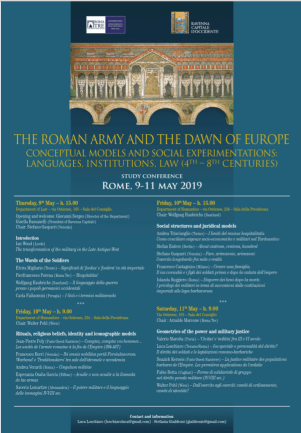
Affiche - The Romand Army

Programme :

Thursday, 9th May – h. 15.00
Department of Law
via Ostiense 163 – Sala del Consiglio

Opening and welcome: Giovanni Serges (Director of the Department)

Chair: Stefano Gasparri (Venezia)

INTRODUCTION

Ian Wood (Leeds) – The transformation ofthe military in the Late Antique West

THE WORDS OF THE SOLDIERS

Elvira Migliario (Trento) – Significati di ‘foedus’ e ‘foedera’ in età imperiale
Pierfrancesco Porena (Roma) – ‘Hospitalitas’ Wolfgang Haubrichs (Saarland) – Il linguaggio della guerra presso i popoli germanici occidentali
Carla Falluomini (Perugia) – I Goti e i termini militareschi

Friday, 10th May – h. 9.00
Department of Humanities
via Ostiense, 234 – Sala della Presidenza

Chair: Walter Pohl (Wien)

RITUALS, RELIGIOUS BELIEFS, IDENTITY AND ICONOGRAPHIC MODELS

Jean-Pierre Poly (Paris Ouest-Nanterre) – Comptez, comptez vos hommes … Les unités de l’armée romaine à la fin de l’Empire (394-437)
Francesco Borri (Venezia) – Ibi omnis nobilitas periit Foroiulanorum. ‘Warband’ e ‘Traditionskern’ tra sale dell’idromele e accademia
Andrea Verardi (Roma) – Cingulum mili-tiae Esperanza Osaba García (Bilbao) – Acudir o non acudir a la llamada de las armas
Saverio Lomartire (Alessandria) – Il potere militare e il linguaggio delle immagini IV-VIII sec.

Friday, 10th May – h. 15.00
Department of Humanties
Via Ostiense, 234 – Sala della Presidenza

Chair: Wolfgang Haubrichs (Saarland)

SOCIAL STRUCTURES AND JURIDICAL MODELS

Andrea Trisciuoglio (Torino) – I limiti del munus hospitalitatis. Come conciliare esigenze socio- economiche e militari nel Tardoantico
Stefan Esders (Berlin) – About Castrum, centena, hundred
Stefano Gasparri (Venezia) – Fare, arimannie, arimanni: l’esercito longobardo fra mito e realtà
Francesco Castagnino (Milano) – Creare una famiglia. Il ius connubii e i figli dei soldati prima e dopo la caduta dell’impero
Iolanda Ruggiero (Roma) – Disporre dei beni dopo la morte. I privilegi dei militari in tema di successioni dalle costituzioni imperiali alle leges barbarorum

Saturday, 11th May – h. 9.00
via Ostiense 163 – Sala del Consiglio

Chair: Arnaldo Marcone (Roma)

GEOMETRIES OF THE POWER AND MILITARY JUSTICE

Valerio Marotta (Pavia) – ‘Civitas’ e ‘militia’ fra III e VI secolo
Luca Loschiavo (Teramo/Roma) – Ius speciale o personalità del diritto? Il diritto dei soldati e le legislazioni romano-barbariche
Soazick Kerneis (Paris Ouest-Nanterre) – La justice militaire des populations barbares de l’Empire. Les premières applications de l’ordalie
Fabio Botta (Cagliari) – La responsabilità solidale. La responsabilità penale in solido dal ‘contubernium’ alla faida tra clans
Walter Pohl (Wien) – Dall’esercito agli eserciti: cambi di ordinamento, cambi di identità?

Informations pratiques :

Rome
9-11 May 2019

Contact and information :
Luca Loschiavo (loschiavoluca@gmail.com) – Stefania Gialdroni (gialdronis@gmail.com)
Publié dans Colloque | Laisser un commentaire

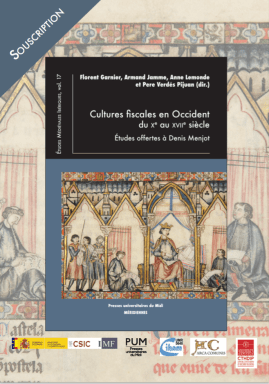
Publication – « Cultures fiscales en occident, du Xe au XVIIe siècle. Études offertes à Denis Menjot », dir. Florent Garnier, Armand Jamme, Anne Lemonde et Pere Verdés Pijuan

Denis Menjot est de ceux qui défrichent de nouveaux champs de la recherche, questionnent des sources pas toujours très bavardes, décryptent les processus de formation et les dynamiques des systèmes fiscaux. Il est encore de ceux qui défendent une histoire globale de la fiscalité et se refusent à n’y voir que techniques et chiffres. Il est enfin de ceux qui s’interrogent et croisent les fils entre histoire et présent. Le prélèvement fiscal, la fraude, la redistribution des ressources sont quelques-uns des champs explorés, intéressant tant l’idée de bien commun au Moyen Âge que celle de civisme fiscal de nos jours.

Menjot - Image

Les 28 contributions réunies en l’honneur de Denis Menjot s’inscrivent dans cette veine et voudraient témoigner de la pérennité de la dynamique qu’il a insufflée. Du Xe au XVIIe siècle pour de multiples espaces en Europe et en faisant jouer différents niveaux d’échelle, des cultures fiscales se donnent à voir. Elles sont d’abord perçues à partir de la construction de discours, de ce dire fiscal dont les retorses subtilités s’insinuent dans les moindres recoins de l’activité humaine. Il s’agit ensuite de des- cendre dans les entrailles du gouvernement des finances et sa mécanique parfois bien complexe, avant de tenter d’évaluer ce que l’on pourrait dénommer « les effets sociaux » tant sur le plan des structures que sur celui de la critique et des contestations, ce qui ramène de toute évidence au discours.

Table des matières et bulletin de souscription : Mélanges – Denis Menjot

Informations pratiques :

Cultures fiscales en occident, du Xe au XVIIe siècle. Études offertes à Denis Menjot, dir. Florent Garnier, Armand Jamme, Anne Lemonde et Pere Verdés Pijuan, Toulouse, presses Universitaires du Midi, 2019 (Études médiévales ibériques). 16 x 24 cm, 450 pages. Prrix : 27 euros.

Publié dans Publications | Laisser un commentaire

Publication – Virtus Zallot, « Con i piedi nel Medioevo. Gesti e calzature nell’arte e nell’immaginario »

Marzo si toglie una spina dal piede, Febbraio si scalda i piedi accanto al fuoco; santi guariscono piedi inguaribili, altri li perdono in crudeli martiri; un re cerca poveri a cui lavarli, sant’Antonio abate non se li è lavati mai; san Francesco rinuncia alle scarpe, un menestrello miracolosamente le riceve in dono. Queste e altre storie sorprendenti e gustose prendono vita nel libro che, anche grazie a un ricco apparato di figure, offre un originale punto di vista per accostarsi al Medioevo. Nella realtà e nell’immaginario, sia in contesti ordinari sia in straordinari accadimenti, piedi e calzature denotavano infatti ruoli e gerarchie sociali e, protagonisti di gesti non solo funzionali ma simbolici, costituivano un preciso linguaggio che, più di quanto si pensi, ancora ci appartiene.

Virtus Zallot è docente di Storia dell’arte medievale e di Pedagogia e didattica dell’arte all’Accademia di Belle Arti Santa Giulia di Brescia. Studiosa di iconografia sacra, collabora con istituzioni culturali ed enti pubblici a progetti di ricerca e valorizzazione del patrimonio artistico.

4760657cover27969

Table des matières :

Prefazione, di Chiara Frugoni
Premessa, di Virtus Zallot
I. Piedi difformi e deformi

1. Piedi mostruosi
2. Piedi diabolici
3. Zampe di donna

II. Piedi che soffrono

1. Storpi
2. Opere di carità
3. Miracoli: rendere «l’andare alli zoppi»
4. Miracoli: riattaccare un piede reciso
5. Miracoli: al sepolcro del santo
6. La spina nel piede
7. Piedi infreddoliti
8. Piedi recisi
9. Piedi torturati
10. Piedi crocifissi

III. Scalzi e calzati

1. Piedi pronti
2. Per dignità o per umiltà
3. I piedi di Gesù e dei discepoli
4. I piedi di san Francesco, i piedi dei francescani
5. Con una scarpa sola

IV. I piedi dei poveri

1. I piedi di Madonna Povertà
2. I piedi dei poveri
3. Donare le scarpe

V. Lavare i piedi

1. Un gesto di ospitalità
2. La lavanda dei piedi di Gesù
3. Ad imitazione di Gesù: accogliere e umilmente servire
4. Ad imitazione di Gesù: curare gli infermi
5. Piedi semplicemente sporchi

VI. Levare i calzari, i calzari levati

1. Non solo per non sporcare
2. Entrare in acqua
3. Accedere al sacro
4. Ricevere il divino
5. Coricarsi
6. Piedi nuziali

VII. Piedi che calpestano

1. Calpestare il nemico
2. Cristo calpesta il male
3. Santi che calpestano il drago o il demonio
4. Martiri che calpestano gli strumenti del martirio o colui che lo ordinò
5. Il bene calpesta il male

VIII. Piedi da riverire

1. Riverire i piedi dei potenti
2. Riverire i piedi dei santi
3. Entro la croce
4. Baciare i piedi
5. Con riverenza supplicare, ringraziare, accudire
6. La santa ai piedi di Gesù
7. I calzari purpurei
8. Reliquiari preziosi

IX. Appoggi

1. Pedane
2. Tessuti
3. Appoggi instabili: sulla sfera
4. Acqua (ed altri appoggi)
5. Orme e impronte

X. L’arte delle scarpe nell’arte

1. Donatori e peccatori
2. Calzolai al lavoro
3. Calzolai santi e santi per i calzolai

Bibliografia generale
Note
Indice dei nomi e dei personaggi

Informations pratiques :

Virtus Zallot, Con i piedi nel Medioevo. Gesti e calzature nell’arte e nell’immaginario, Il Mulino, 2018. pp. 256, 978-88-15-27969-9. Prix : 25 euros.

Source : Il Mulino

Publié dans Publications | Laisser un commentaire

Journée d’étude – Ghent – Kent Research Day: Cross-Channel Exchanges in the Middle Ages

Research in Medieval Studies at Ghent and Kent

On Thursday 25th of April 2019, the Ghent – Kent Research Alliance at the Henri Pirenne Institute organises an exchange day for research in medieval studies. The overarching theme of the day is ‘Cross-Channel Exchanges in the Middle Ages’.

This research day is an excellent opportunity for PhD students and staff in medieval studies from both universities to get to know one another. MA students are invited to join for the keynote or one or more of the panel sessions. Entrance is free.

Capture d’écran 2019-03-30 à 22.54.37

Programme :

8:30 – 9:00: Coffee and walk-in
9:00 – 9:10: Welcome and intro by Ghent & Kent organisers (Steven Vanderputten & Ed Roberts)

9:10 – 9:50: PANEL I: Late medieval Flanders and England
Chair: Edward Roberts (Kent)

1) Milan Pajic (Cambridge / Ghent): Beer Brewers from the Low Countries in Late Medieval England and Transformation of the Brewing Industry
2) Noah Smith (Kent): A Flemish Frontispiece in Oxfordshire: Considering the provenance of the Oxford Chest
9:50 – 10:10: Chaired Q&A and discussion
10:10 – 10:20: Comfort break

10:20 – 11.00: PANEL II: Reconsidering episcopal and monastic mobility
Chair: Robert Gallagher (Kent)

1) Ed Roberts (Kent): Tenth-century bishops and the law in cross-channel perspective
2) Micol Long (Ghent): Monastic Transitus Between Theory and Practice
11.00 – 11:20: Chaired Q&A and discussion
11:20 – 11:30: Comfort break
11:30 – 12:30: KEYNOTE: Emily Guerry (Kent): Wall painting in Paris in the age of Saint Louis

Chair: Steven Vanderputten (Ghent)

12:30 – 12:45: Respondent to keynote: Anna Bergmans (Ghent, emeritus)
12:45 – 13:00: Questions of the audience
13:00 – 14:00: LUNCH (at venue)

14:00 – 14:40: PANEL III: Reform and literature in the early and central Middle Ages
Chair: Micol Long (Cambridge / Ghent)

1) Rob Gallagher (Kent): Latin Literary Culture in Southern England, c. 800 to 1000
2) Steven Vanderputten (Ghent): Tenth-century reforms and the problem of religious distinction in cross-channel perspective
14:40 – 15:00: Chaired Q&A and discussion
15:00 – 15:20: Comfort & coffee break

15:20 – 16:20: PANEL IV: Comparing late medieval institutional cultures
Chair: Milan Pajic (Ghent / Cambridge)

1) Johan Belaen (Ghent): A Two-Speed Religious Order? Comparing the Benedictine General Chapters in 13th-Century England and France
2) Philippa Mesiano (Kent): Papal Mediation in Thirteenth-Century Europe: Pope Alexander IV, King Henry III and the Treaty of Paris (1259)
3) Jack Newman (Kent): Signed, Sealed, Embezzled – Counterfeit Seals, Italian Merchants, and deception of the Crown

16:20 – 16:50: Chaired Q&A and discussion
16:50 – 17:00: Comfort break

17:00 – 17:40: PANEL V: Cross-channel iconography and landscapes
Chair: Emily Guerry (Kent)

1) Han Tame (Kent): The Majestas Domini as an International Iconography
2) Gerben Verbrugghe (Ghent): Little Flanders beyond Wales, Landscape archaeology of Flemish settlement landscapes in the British Isles

17:40 – 18:00: Chaired Q&A and discussion

18:00: NETWORK RECEPTION @ the UFo building: discussion of future plans for the Ghent – Kent international partnership (at UFo building, meet-up with Ghent University medievalists)

19:00: Dinner

Informations pratiques :

When : 25-04-2019 from 08:30 to 19:00
Where : Ghent, Campus Rozier-Plateau, Jozef Plateau Conference Room (Jozef Plateaustraat 22, 9000 Gent)
Language : English
Organizer : Stefan Meysman
Contact : Stefan.Meysman@UGent.be

Source : Universiteit Gent

Publié dans Colloque | Laisser un commentaire

Publication – « Des chartes aux constitutions. Autour de l’idée constitutionnelle en Europe (XIIe-XVIIe siècle) », dir. François Foronda et Jean-Philippe Genet

Par constitution, il est convenu d’entendre un texte établissant la forme organique de l’État, et de tels textes n’existent pas avant le XVIIIe siècle. Peut-on alors parler de « constitutions » pour le Moyen Âge? Empiriquement, communes et monarchies avaient des constitutions: aucun texte juridique ne les décrivait, mais elles existaient bel et bien et on en discutait pied à pied les dispositions. Dès qu’ils les ont connues, les juristes et les théologiens ont discuté les constitutions analysées par Aristote dans sa Politique. Nul ne doute cependant du caractère constitutionnel de la monarchie parlementaire anglaise, que l’on considère aujourd’hui comme une constitution coutumière. Une définition trop stricte conduirait donc à passer sous silence certaines situations et expériences déterminantes dans la conceptualisation et l’application d’une idée constitutionnelle dans l’Europe des États qui se met en place à partir du XIIe siècle. Le choix d’une définition plus large s’impose.

27000100385150L

Table des matières :

Avant-propos – Jean-Philippe Genet et François Foronda
Les constitutions avant le constitutionnalisme – Jean-Philippe Genet

PARTIE I. GÉNÉALOGIES CONSTITUTIONNELLES

Thinking about Power before Magna Carta : the Role of History – Björn Weiler
The Golden Bull of Andrew II – Attila Zsoldos
« Ils lui concédèrent la justice pour le maintien de la paix ». Une image du contrat politique et de l’origine des franchises au sein de la paysannerie gasconne au XIIIe siècle – Frédéric Boutoulle
Cités-États ou simples sujets ? Villes rebelles et villes fidèles dans la constitution du Saint-Empire (XIVe-XVIe siècle) – Gisela Naegle

PARTIE II. LABORATOIRES DE CONSTITUTIONNALITÉ

La experiencia medieval en la construcción del mito constitucional español – José Manuel Nieto Soria
The Scandinavian Election Charters in the Later Middle Ages – Sverre Bagge
La Bulle d’or de 1356, une « constitution » pour l’Empire ? – Pierre Monnet
Les capitulations provençales de Marie de Blois (1385-1390) : une démarche constitutionnelle ? – Michel Hébert
Sistema normativo e partecipazione politica nella Sicilia del tardo Medioevo – Fabrizio Titone
Constitutions, State and Estates : Interactions between Princely Restrictions and Reforms, Privileges of the Governed and the Control of Absolute Power in the Burgundian Low Countries – Jonas Braekevelt

PARTIE III. CONTRÔLES DE CONSTITUTIONNALITÉ

Are there « Constitutional » Ideas in the Rolls of the English Parliament, c. 1340-1422 ? – Christopher Fletcher
Distancia y constitucionalidad. La dinámica política del reino de Aragón en la década de 1440-1450 – Carlos Laliena Corbera
Du contrôle de civilité à l’enregistrement des lois : fondements du contrôle judiciaire du souverain monarchique – Marie-France Renoux-Zagamé

PARTIE IV. CRISES CONSTITUTIONNELLES

Do Constitucionalismo Revolucionário Medievo às Ordenações do Reino de Portugal – José Domingues
Contribuer ou disparaître ! Les états des deux Bourgognes face aux monarchies de France et d’Espagne (1636-1678) – Jérôme Loiseau
The Levellers and the English Constitution in the English Civil War – Rachel Foxley
A Framework for Integrating Overseas Expansion and Constitutional Change in 17th-Century England – William A. Pettigrew

PARTIE V. QUESTIONS DE PRINCIPES

Gli angusti orizzonti. Lessico delle dedizioni e « costituzione materiale » negli stati territoriali italiani: l’esempio della Terraferma veneziana (secolo XV e ss. – Gian Maria Varanini

Constitution et constitutionnalisme (XVIe-XVIIe siècle) – Diego Quaglioni

Jalons pour une archéologie constitutionnelle – François Foronda

Informations pratiques :

Des chartes aux constitutions. Autour de l’idée constitutionnelle en Europe (XIIe-XVIIe siècle), dir. François Foronda et Jean-Philippe Genet, Paris, Publications de la Sorbonne, 2019. 458, pages, 16 x 24 x 3 cm. ISBN : 9791035102784. Prix : 28 euros.

Source : LCPDU

Publié dans Publications | Laisser un commentaire

Offre d’emploi – University Lecturer in Manuscript Studies / Art History / Material Culture (University of Cambridge)

University of Cambridge
Department of Anglo-Saxon, Norse and Celtic

Location: Cambridge
Salary: £40,792 to £51,360 per annum
Hours: Full Time
Contract Type: Permanent
Placed On: 27th March 2019
Closes: 1st May 2019
Job Ref: GH18538

52

The Department of Anglo-Saxon, Norse and Celtic wishes to appoint to a University Lectureship in Manuscript Studies / Art History / Material Culture from 1 September 2019. We seek applicants who have research and teaching interests in any of the geographical areas and cultures covered by the ASNC Department (England before the Norman Conquest, Viking and medieval Scandinavia, the Brittonic- and Gaelic-speaking peoples in the medieval period), and who have expertise in manuscript studies, art history and/or material culture. Relevant areas include, but are not limited to, any aspect of the study of manuscripts and the material text from one or more of the ASNC regions, including palaeography, codicology and epigraphy; any aspect of the art historical study of one or more of the ASNC regions, including art in manuscripts and other media; any aspect of the material culture and archaeology of one or more of the ASNC regions, ranging from the built environment, early agriculture and maritime archaeology to numismatics and textiles.

We are open to a wide range of approaches and expertise, including interdisciplinary work which crosses one or more of the areas outlined above, work which also involves other fields and techniques (including the digital humanities), and/or which unites one or more of these areas with other aspect(s) of the historical, literary and linguistic subjects studied in the ASNC Department.

The successful applicant will have the potential to make a significant contribution to the research and teaching of the Department. They will be able to conduct original research in their field, generating new interpretations, arguments, methods and associations which will have international reach and significance. They will be expected to engage closely with the work of colleagues in ASNC; to generate and participate in new and ongoing collaborations with colleagues in other Faculties and Departments in Cambridge; to develop proposals to attract significant external funding; and to develop the kinds of public and professional engagement that will maximise the impact of their research. Candidates should have a PhD and an exceptional record of research in a relevant subject area, along with high quality publications.

The successful applicant will support and maintain the University’s national and international reputation for excellence in teaching. They will be expected to offer undergraduate and graduate teaching and supervision, as well as to be able to attract applications from the strongest PhD candidates worldwide. The person appointed will also be required to take on certain administrative duties.

Appointments made at University Lecturer level will be permanent, subject to a probationary period of five years.

Three references are required and applicants should ask their referees to send their reports to appointments@english.cam.ac.uk by the closing date.

To apply online for this vacancy and to view further information about the role, please visit : http://www.jobs.cam.ac.uk/job/20861.

Informal enquiries about the post may be directed to Dr Richard Dance, Head of Department (rwd21@cam.ac.uk).

Enquiries concerning the appointments procedure and related matters may be made to the Faculty Administrator at administrator@english.cam.ac.uk).

Interviews are planned for 22 / 23 May 2019.

Please quote reference GH18538 on your application and in any correspondence about this vacancy.

The University actively supports equality, diversity and inclusion and encourages applications from all sections of society.

The University has a responsibility to ensure that all employees are eligible to live and work in the UK.

Source : Jobs.ac.uk

Publié dans Offre d'emploi | Laisser un commentaire

Colloque – Compositeur(s) au Moyen Âge

Au-delà de quelques figures bien connues, l’identité et la personnalité des créateurs de la musique médiévale se laissent difficilement appréhender. La notion même de « compositeur » reste un concept malaisé à manier, en raison du faible nombre d’attributions dans les sources, de la documentation limitée sur ceux qui composaient la musique, et des modes même de composition, collectifs et ouverts, du Moyen Âge. De fait, notre approche de la musique médiévale s’est longtemps tenue à distance de la question des auteurs, et s’est de facto volontiers orientée vers l’étude des processus de création et pratiques d’interprétation, ou a favorisé des notions telles que le genre, le registre, les répertoires, etc. Le colloque propose de dresser un état des lieux et de revenir sur cette question à la lumière des travaux récents ; il invite à revisiter et élargir la notion de compositeur comme outil alternatif d’analyse et de compréhension des répertoires médiévaux.

Capture d’écran 2019-03-30 à 22.32.46

Programme :

Jeudi 23 mai

9:00 Accueil et café des participants
9:40 Mot de bienvenue (organisateurs)

Introduction

9:50-10:20 Mark Everist (University of Southampton) Facere, componere, invenire : vivre en compositeur au Moyen Âge

Session 1 – Compositeurs comme groupes socio-culturels
Présidence : Étienne Anheim (EHESS)

10:20-11:00 Brianne Dolce (Yale University/Universiteit Gent) Who Composed in Medieval Arras? Prosopographical Possibilities in the Necrology of the Confraternity of Jongleurs and Bourgeois
11:00-11:20 Pause
11:20-12:00 Lori Kruckenberg (University of Oregon) ‘Compositio’ in the Hands of Cantrices: Two Case Studies on Musical Composition by Women Religious in Ottonian and Salian Germany
12:00-12:40 Mary Wolinski (Western Kentucky University) Philip the Chancellor, William of Auvergne, and the Preacher’s Art
12:40-14:00 Déjeuner

Session 2 – Compositeurs comme individus : créativité et inspiration
Présidence : Mark Everist (University of Southampton)

14:00-14:40 David Maw (Oriel College, Oxford) Individuating Dissonance: ‘Composerly’ Identity in Fourteenth-Century French Secular Music
14:40-15:20 Charles Brewer (Florida State University) Planctus ante nescia: Questions of Attribution and Inspiration
15:20-15:50 Marie-Geneviève Grossel (Université technologique des Hauts-de-France Valenciennes) Composition/compositeur chez les trouvères, le point de vue du philologue
15:50-16:10 Pause

Session 3 – Compositeurs en réseau : citation et auto-citation
Présidence : Yolanda Plumley (University of Exeter)

16:10-16:50 Catherine A. Bradley (University of Oslo) Adam de la Halle’s Intergeneric Self-Citations
16:50-17:30 Christopher Callahan (Illinois Wesleyan University) Les premiers manuscrits d’auteur comme témoignages du réseau poético-social
19:30 Dîner des conférenciers

Vendredi 24 mai

Session 4 – Compositeurs proclamés : attribution, autorité, auteurisation
Présidence : Anna Zayaruznaya (Yale University)

9:00-9:40 Manon Louviot (Universiteit Utrecht) Genre et autorialité dans le motet Ferre solet/Anatheos de gracia/Ave Maria (XIVe siècle)
9:40-10:20 Margaret Bent (All Souls College, Oxford) Paradox and Typology in Late-medieval Ascriptions and Attributions
10:20-11:00 Yolanda Plumley (University of Exeter) Composing Ars nova Chansons: Encounters between Poets, Composers and Minstrels
11:00-11:20 Pause

Session 5 – Compositeurs dévoilés : méthodes et outils d’identification
Présidence : David Maw (Oriel College, Oxford)

11:20-12:00 James Blasina (Swarthmore College) Composing Chant in Rouen: Ainard of Dives and the Ste-Catherine-du-Mont Office of St. Katherine of Alexandria
12:00-12:40 Karen Desmond (Brandeis University) A Single Compositional Hand in the Ob Rawl Fragments? William of Wicumbe and English Polyphonic Practice c. 1250
12:40-14:30 Déjeuner

Session 6 – Compositeurs cachés : remaniements, adaptations, additions
Présidence : Margaret Bent (All Souls College, Oxford)

14:30-15:10 Federico Zavanelli (University of Southampton) et Giacomo Ferraris (Università degli Studi di Pavia) Rewriting the Tradition: Multiple Transmission of Five Madrigals from the Rossi Codex
15:10-15:50 Joseph Mason (New College, University of Oxford) A Jeu-parti Problem? Multiple Melodies and their Composers at the Arras Puy
15:50-16:10 Pause

Session 7 – Compositeurs identifiés : nouvelles approches biographiques, historiographie
Présidence : Catherine A. Bradley (University of Oslo)

16:10-16:50 Anne Ibos-Augé (C.E.S.C.M. Poitiers) Du « Boscu d’Arras » à Adam de la Halle : la fabrique d’un compositeur
16:50-17:30 Anna Zayaruznaya (Yale University) On the Epochs of Music History and the Spans of Human Lives

Informations pratiques :

Université de Rouen
23 — 24 mai 2019

Comité scientifique
Étienne Anheim (École des Hautes Études en Sciences Sociales)
Catherine Bradley (University of Oslo)
Helen Deeming (Royal Holloway)
David Fiala (Université de Tours, CESR)
Elizabeth Lalou (Université de Rouen, GRHis)
Yolanda Plumley (University of Exeter)

Comité d’organisation
Anne-Zoé Rillon-Marne (Université catholique de l’Ouest, CESCM)
Gaël Saint-Cricq (Université de Rouen, GRHis)

Source : Compositeurs au Moyen Âge

Publié dans Colloque | Laisser un commentaire

Offre d’emploi – Two Postdoc Positions ‘The Multilingual Dynamics of the Literary Culture of Medieval Flanders, ca 1200 – ca 1500’ (1.0 FTE)

Published : 28 Mar
Deadline : 11 Jun
Location : Utrecht

We are looking for two Postdoctoral Researchers in the research project ‘The Multilingual Dynamics of the Literary Culture of Medieval Flanders, ca 1200 – ca 1500’. These two positions are part of a research project funded by the Netherlands Organisation of Scientific Research (NWO). This four-year project seeks to correct the traditional, monolingual view on Flemish literature between ca 1200 and ca 1500. It is the first large-scale investigation devoted to the literary culture of medieval Flanders from a multilingual perspective. A full description of the project can be read here.

The project consists of three subprojects. Since December 1, 2018, a PhD candidate (4 years, 1.0 FTE) studies the literary dynamics resulting from the interaction between Middle Dutch and other languages in Flemish texts, Flemish multi-text manuscripts and booklists from medieval Flanders. From December 1, 2019, onwards, two Postdocs (each 3 years, 1.0 FTE) will carry out the remaining subprojects. Postdoc 1 will focus on Dutch, French and Latin texts that were written by authors in medieval Flanders and texts that were read in that region. Postdoc 2 will study manuscripts containing Dutch, French and Latin texts that scribes produced in medieval Flanders and the manuscripts that circulated in that region. In the deepening and synthesising stages of the project, the findings of the two Postdoc subprojects will be combined.

1200px-Utrecht_University_logo.svg

Tasks

Each of the two Postdocs will be asked to:

  • set up a data collection of texts or manuscripts whose production and/or reception can be assigned to medieval Flanders;
  • apply various theoretical perspectives to the dataset;
  • write two international conference papers;
  • contribute to the organization of the project’s final conference;
  • co-author and co-edit the conference proceedings;
  • contribute to teaching (f.e. tutorials for Research Master students);
  • contribute to the exhibition that is part of the project;
  • write a popularizing essay;
  • deliver a public lecture.

Requirements

  • You have completed a PhD in a field relevant to the project.
  • You have a good research record.
  • You have a working knowledge of medieval languages (French, Dutch, Latin).
  • You have a working knowledge of medieval manuscripts.
  • You have a working knowledge of modern English, French and German.
  • You are able to work both independently and as part of a closely collaborating team.

Conditions of employment

We offer a two temporary positions (1.0 FTE each) for one year, starting on December 1, 2019. Upon good performance, the contract will be extended for another 24 months (36 months in total).

The gross salary – depending on previous qualifications and experience – ranges between €3,389 and €3,637 (scale 10 according to the Collective Labour Agreement Dutch Universities) gross per month for a full-time employment. Salaries are supplemented with a holiday bonus of 8 % and a year-end bonus of 8.3 % per year. We offer a pension scheme, (partly paid) parental leave, collective insurance schemes and flexible employment conditions (multiple choice model).
Employer

A better future for everyone. This ambition motivates our scientists in executing their leading research and inspiring teaching. At Utrecht University, the various disciplines collaborate intensively towards major societal themes. Our focus is on Dynamics of Youth, Institutions for Open Societies, Life Sciences and Sustainability.

The Faculty of Humanities has around 6,000 students and 900 staff members. It comprises four knowledge domains: Philosophy and Religious Studies, History and Art History, Media and Culture Studies, and Languages, Literature and Communication. With its research and education in these fields, the Faculty aims to contribute to a better understanding of the Netherlands and Europe in a rapidly changing social and cultural context. The enthusiastic and committed colleagues and the excellent amenities in the historical city center of Utrecht, where the Faculty is housed, contribute to an inspiring working environment.
Additional information

For additional information on the project, you may contact prof. dr Bart Besamusca (a.a.m.besamusca@uu.nl), dr André Bouwman (a.t.bouwman@library.leidenuniv.nl) or prof. dr Remco Sleiderink (remco.sleiderink@uantwerpen.be). For general information about the two Postdoc positions, please contact the ICON research coordinator Hanneke Jansen (h.m.jansen@uu.nl).

You will be based at the Institute for Cultural Inquiry (ICON) and the Department of Languages, Literature and Communication (TLC), under supervision of prof. dr Bart Besamusca.

Source : Academic Transfer

Publié dans Colloque | Laisser un commentaire

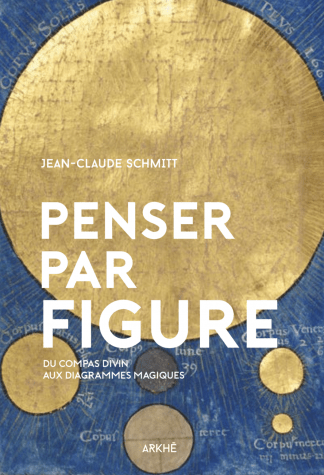
Publication – Jean-Claude Schmitt, « Penser par figures. Du compas divin aux diagrammes magiques »

Pas de journal télévisé, d’article de presse ou de présentation d’entreprise sans une série de courbes, de diagrammes, de graphiques ou d’histogrammes, au point de parfois créer une forme de dépendance intellectuelle aux schémas en tous genres. Et pour cause : ces figures permettent de rendre une idée complexe immédiatement mémorisable par le cerveau humain, épargnant ainsi une longue démonstration. Mais saviez-vous que ce mode de pensée et d’expression, qui tient à la fois de l’image et de l’écriture, existait bien avant Microsoft et ses schémas auto-générés ? Confrontés aux mêmes difficultés que nous, érudits, hommes d’église ou simples artisans ont caché des trésors d’inventivité dans les manuscrits médiévaux où les roues, les arbres, les échelles et autres figures insolites invitent le lecteur à s’introduire, par l’œil et l’esprit, dans le labyrinthe de l’âme et du monde.

penserparfigure-324x475

Historien spécialiste de l’anthropologie historique, Jean-Claude Schmitt est directeur d’études à l’EHESS. Médaille d’argent du CNRS, il a enseigné dans les plus grandes universités américaines et européennes. Il a récemment publié Les Rythmes au Moyen Âge chez Gallimard, 2016. Ses ouvrages sont traduits dans plus d’une quinzaine de langues. Il dirige la collection Oblique/s chez Arkhê.

Informations pratiques :

Jean-Claude Schmitt, Penser par figures. du compas divin aux diagrammes magiques, Paris, Arkhé, 2019 (Oblique(s)). Broché, 188 p., 21 x 14 cm. ISBN : 9782918682455. Prix : 19,50 euros.

Source : Arkhé

Publié dans Publications | Laisser un commentaire

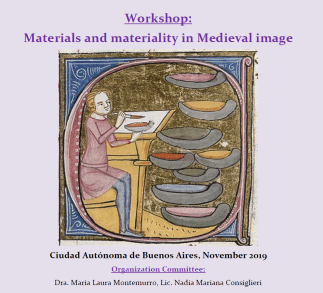
Appel à contribution – Materials and materiality in Medieval image

Ciudad Autónoma de Buenos Aires, November 2019
Organization Committee: Dra. María Laura Montemurro, Lic. Nadia Mariana Consiglieri

Argentine

Medieval studies in Argentina have played a constant development, thriving in both university and institutional frameworks. The particular study of Medieval art has experienced a recent new impulse, awakening a growing interest and commitment among undergraduates and young graduates. Because of this, aiming to provide a meeting point and a forum for both new and experienced researchers, we invite to participate in this Workshop which will focus mainly, but not exclusively, in the arts of the Middle Ages.

As expected in an academic meeting of this scope, we would like to achieve an environment fit for professional improvement and enrichment, incorporating local and foreign lecturers, featuring masterful speeches, academic debates, and practical displays of Medieval art.

In fact, this Workshop invites to rethink and discuss medieval materials and techniques; a subject that has attracted much interest in the academic world during the recent years and that implies an important relevance for the development of Medieval art studies in our country.

Until the end of last century, the dominant perspectives had been focused on the iconographic and iconological analysis; a method developed by Erwin Panofsky. This logocentric conception of the image was founded on the decoding and translation of the supposedly “intrinsic” meaning of a work of art, giving pre-eminence to its direct link with the textual sources. Since then, however, a new theoretical perspective based on medieval materiality and techniques began to be developed. This innovative outlook was born after the so-called “iconic turn” which, through art history, cultural history, the anthropology of images and visual studies, redirected special attention mainly to the physical and material properties of the artistic objects. This viewpoint has shown to be especially fruitful to address Medieval art as to put forward its objectual character, acknowledging also the crucial role of the materials employed in production, circulation and reception of these works.

Therefore, we invite academics, young researchers, undergraduates and art history specialists in different disciplines in the fields of museology, conservation, restoration and patrimony, to send your paper proposals. After the Workshop closure and a selection process of the SAEMED Editorial Committee, some of them, will be published in a special volume.

Proposals must be related with some of the following thematic axes:

❖ The codex as object: dialogues of materialities
❖ Techniques and praxis in Medieval art
❖ Treatises, recipes and books of alchemy
❖ Circulation of objects and materials: exchanges, tensions and expolia
❖ The cult of relics: building and content
❖ Craftsmen, guilds and workshops
❖ Materiality in literary images
❖ Materiality in textual sources
❖ Materiality in music: its forms and expressions
❖ Continuities and breaks in Medieval techniques during the following centuries

Proposals must be submitted to: materialesymaterialidad@gmail.com in an attached file with the following information:

– Name and last name
– Institutional belonging
– Proposal title
– Abstract (no more than 500 words)
– 5 keywords

The submitting of proposal in Spanish, English, French and Portuguese will be until 1st June 2019.

The Workshop will last two days in late November 2019 at the Centro de Investigación en Arte, Materia y Cultura, UNTREF (Av. Antártida Argentina 1355, Ciudad Autónoma de Buenos Aires).

Scientific Committee:

Alicia Migueles Cavero (Universidade Nova de Lisboa)
David Chao Castro (Universidad de Santiago de Compostela)
Marta Cendon Fernández (Universidad de Santiago de Compostela)
María Cristina Correia Leandro Pereira (Universidade de São Paulo)
Paola Corti (Facultad de Artes Liberales – Universidad Adolfo Ibáñez)
Roberto Del Monte (NUME Gruppo di Ricerca sul Medioevo Latino – Università degli Studi di Firenze)
Sergi Sancho Fibla (École des Hautes Études en Sciences Sociales)
Ariel Guiance (Universidad Nacional de Córdoba/IMHICIHU-CONICET)
Patrick Henriet (École Practique des Hautes Études)
Lucia Lahoz-Gutiérrez (Universidad de Salamanca)
Marta Maier (CONICET-UBA/ Centro MATERIA – Universidad Nacional de Tres de Febrero)
Ofelia Manzi (Universidad de Buenos Aires)
Therese Martin (Centro de Ciencias Humanas y Sociales-CCHS-CSIC)
Adriana Martínez (Universidad de Buenos Aires)
Ines Monteira Arias (Universidad Nacional de Educación a Distancia)
Eric Palazzo (Université de Poitiers)
Ángel Pazos-López (Universidad Complutense de Madrid)
Mercedes Perez-Vidal (Heinrich Heine Universitat Düsseldorf)
Daniel Russo (Université de Bourgogne)
Gabriela Siracusano (CONICET-Centro MATERIA – Universidad Nacional de Tres de Febrero)

Publié dans Appel à contributions | Laisser un commentaire