Le RMBLF vous souhaite une excellente année 2019 !

Comme chaque année, le Réseau des Médiévistes Belges de Langue Française (Groupe de contact du FNRS) vous adresse ses meilleurs vœux pour l’année nouvelle ! Nous vous souhaitons une belle et fructueuse année 2019. Nous en profitons pour vous remercier pour votre fidélité à toute épreuve !

Comme l’année dernière, nous tenons à remercier publiquement nos principaux soutiens financiers, à savoir le FNRS et la Fondation Wernaers pour la recherche et la diffusion des connaissances.
Enseignement

En 2018, comme lors des années précédentes, l’Agenda du médiéviste a battu des records, avec 811 annonces publiées et un peu moins de 165 000 consultations cette année (20 000 de plus que l’année dernière !). Si le blog a été consulté dans plus de 150 pays différents, il reste surtout utilisé par les chercheurs européens parlant une langue romane.

Capture d_écran 2018-12-27 à 22.18.12

Nous sommes heureux de constater que les pages les plus consultées sont celles que nous avons crées ou celles relatives à nos propres activités. Signe des temps, les annonces pour des offres d’emploi sont souvent les plus appréciées…

Capture d_écran 2018-12-27 à 22.20.15

Le comité organisateur du RMBLF s’est quelque peu renouvelé cette année, avec l’intégration de trois nouvelles médiévistes : Anh Thy Nguyen, doctorante en Langues et Littératures romanes à l’Université catholique de Louvain, Aleuna Macarenko, doctorante en Histoire de l’Art à l’Université de Liège, et Valentine Jedwab, doctorante en Histoire à l’Université libre de Bruxelles. Elles viennent remplacer deux membres qui ont choisi de prendre un peu de recul, Hélène Haug (Maison d’Érasme) et Nicolas Schroeder (Université libre de Bruxelles).

L’année 2019 s’annonce déjà chargée, avec l’organisation, fin janvier, d’une conférence et d’une masterclass consacrées à l’œuvre de Brueghel. Vous pouvez d’ores et déjà vous y inscrire ici.
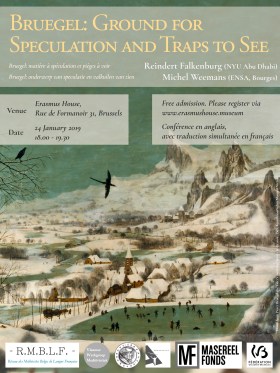
Poster_Keynote_Brueghel

Enfin, n’oubliez pas que nous pouvons relayer vos annonces à caractère scientifique. Pour cela, il suffit de nous contacter à l’adresse suivante : info.rmblf@gmail.com . Votre annonce sera rapidement mise en ligne !
Publié dans Activités du RMBLF | Laisser un commentaire

Appel à contribution – Iconotropy: Symbolic and Material Changes to Cult Images in the Classical and Medieval Ages

Iconotropy is a Greek word which literally means “image turning.” William J. Hamblin (2007) defines the term as “the accidental or deliberate misinterpretation by one culture of the images or myths of another one, especially so as to bring them into accord with those of the first culture.” In fact, iconotropy is commonly the result of the way cultures have dealt with images from foreign or earlier cultures. Numerous accounts from classical antiquity and the Middle Ages detail how cult images were involved in such processes of misinterpretation, both symbolically and materially. Pagan cultures for example deliberately misrepresented ancient ritual icons and incorporated new meanings to the mythical substratum, thus modifying the myth’s original meanings and bringing about a profound change to existing religious paradigms. Iconotropy is a fundamental concept in religious history, particularly of contexts in which religious changes, often turbulent, took place. At the same time, the iconotropic process of appropriating cult images brought with it changes in the materiality of those images.

The earliest approach to the concept was in Robert Graves’s The Greek Myths (1955), where Graves justified his own ideas about the origins of many Greek myths, claiming that classical Greek culture had essentially misinterpreted images from the Bronze Age. In some cases, Graves conjectured a process of iconotropy by which a hypothetical cult image of the matriarchal period had been misinterpreted by Greek culture. More broadly, since the 1970s, cultural anthropologist Leopold Kretzenbacher published a large number of meticulous studies on European religious iconography. In these critical studies, Kretzenbacher focused on reinterpretations of both religious and secular images whose original meaning was lost, forgotten or even ignored on purpose. In Kretzenbacher’s view, iconotropy refers to the conversion of religious iconography from one mode of spiritual organization to another. Apart from Graves’s and Hamblin, scholars have paid only attention to a concept that is fundamental for the articulation of an integrative discourse on the visual culture and anthropology of the ancient and medieval cult image.

The conference hopes to generate new research questions and creative synergies by initiating conversation and the exchange of ideas among scholars in the arts and humanities. We invite researchers from ancient and medieval periods to propose contributions engaging questions on themes such as:
– Changes in the symbolism and materiality of the religious image
– Iconotropy and rituality
– Reinterpretation of non-Western cult images
– Mythology and cult image in Antiquity
– Symbolic and material appropriation of pagan images in the Middle Ages

General information :
The workshop will take place in April 4 and 5 of 2019 at the School of Philosophy and Letters of the Autonomous University of Madrid and the National Museum of Archaeology. Keynote speakers: Prof. Michele Bacci (Universität Freiburg); Prof. Cecilie Brøns (Carlsberg Glyptotek, Copenhague); Prof. Adolfo Domínguez Monedero (UAM); Prof. Alejandro García Avilés (Universidad de Murcia). Participants accepted will presente papers up to a maximum length of twenty minutes.

Deadlines
– January 15, 2019: submition of paper proposals (including title, abstract of 300 words maximum and brief CV)
– February 15, 2019: announcement of accepted proposals
– July 31, 2019: submition of articles for publication

Address for submitions and contact
Paper proposals, questions and articles should be sent to:
icam.uam[at]gmail.com.

Organizers
Jorge Tomás García (UAM) Sandra Sáenz-López Pérez (UAM)
Secretary: David Vendrell Cabanillas (UAM)

Lieu de la manifestation : Autonomous University of Madrid and the National Museum of Archaeology
Organisation : Autonomous University of Madrid
Contact : icam.uam[at]gmail.com

Source : Compitum

Publié dans Appel à contributions | Laisser un commentaire

Appel à contribution – Rollen, Rollenbilder und die soziale Stellung von Frauen in den mittelalterlichen Städten am Rhein: Interdisziplinäre Perspektiven

Ort : Mainz
Veranstaltungsort : Landesmuseum Mainz
Veranstalter : Generaldirektion Kulturelles Erbe Rheinland-Pfalz
Datum : 31.03.2019

Kontakt :
Nadine Hoffmann
Generaldirektion Kulturelles Erbe Rheinland-Pfalz, Erthaler Hof, Schillerstraße 44, 55116 Mainz
nadine.hoffmann@gdke.rlp.de

Während des Hochmittelalters wurden aus bischöflichen Zentren kraftvolle Stadtkommunen. Handwerker, Händler und Kaufleute entwickelten neue Formen der gesellschaftlichen und politischen Organisation. Viele Städte am Rhein erhielten Freiheitsprivilegien durch Kaiser, Könige und ihre bischöflichen Herren. Die jüdischen Gemeinden spielten bei diesem Prozess eine herausragende Rolle. In Speyer, Worms und Mainz entwickelten sich in ganz Europa angesehene Talmudschulen. Unter dem Namen „SchUM“ (Schpira, Warmaisa und Magenza) genossen die drei Gemeinden im aschkenasischen Judentum hohe Autorität in religiös-kultischen und rechtlichen Fragen. Sie errichteten hier Synagogen und Mikwen, die für Mittel- und Osteuropa typenbildend wurden.

Welche Rollen, Rollenbilder und welche soziale Stellung hatten die jüdischen und christlichen Frauen in den sich entwickelnden neuen Formen der gesellschaftlichen und politischen Organisation in den Städten am Rhein? Unterschied sich ihr Status je nach kulturellem und religiösem Kontext? Wie wurden ihre Rollen zum Ausdruck gebracht und wer brachte diese zum Ausdruck? Diese Fragen sollen im Rahmen der interdisziplinären Tagung näher beleuchtet werden. Ziel der Tagung ist, die Rolle und Stellung der jüdischen und christlichen Frauen in der Gesellschaft der mittelalterlichen Städte am Rhein mit Hinblick auf sozialhistorische, kulturelle sowie religiöse Aspekte und Kontexte, mögliche Alleinstellungsmerkmale und/oder Wechselwirkungen herauszuarbeiten und Forschungsdesiderate aufzuzeigen.

Die Tagung bildet einen Brückenschlag zwischen dem aktuell erarbeiteten UNESCO-Welterbeantrag „SchUM-Stätten Speyer, Worms und Mainz“ und der Landesausstellung „Von Karl dem Großen bis Friedrich Barbarossa. Die Kaiser und die Säulen der Macht“, die im September 2020 im Landesmuseum Mainz eröffnet wird.

Entsprechend sind Beiträge unter anderem zu folgenden Themenkomplexen besonders willkommen:

– Die Rollen von Frauen in den mittelalterlichen Städten am Rhein
– Die Rolle der Frau in den sich neu ausbildenden Formen der gesellschaftlichen und politischen Organisation
– Vergleichende Untersuchungen zur Rolle und Stellung der Frau in den jeweiligen kulturellen Kontexten
– Religiöse Rollenbilder und Erfahrungswelten jüdischer und christlicher Frauen
– Das Selbstverständnis jüdischer und christlicher Frauen im Mittelalter
– Alltags- und Geschäftsleben
– (Selbst-)Darstellungen der Frauen in zeitgenössischen Quellen
– Ausdruck des Rollenverständnisses in der Kunst, Architektur und Literatur
– Vermittlung der Geschlechterrollen in Ausstellungen

Wir bitten um Abstracts für Vorträge mit einer Redezeit von 20 Minuten.
Tagungssprachen sind Deutsch und Englisch. Eine Übernahme der Reise- und Übernachtungskosten wird angestrebt. Zudem ist die Herausgabe eines Tagungsbandes geplant.

Tagungsdatum 04.-05.11.2019

Bitte senden Sie Ihre Abstracts sowie eine Kurzvita bis zum 31.03.2019 an:

Nadine Hoffmann
nadine.hoffmann@gdke.rlp.de

Wir freuen uns auf Ihren Beitrag!

Source : H-Soz-Kult

Publié dans Appel à contributions | Laisser un commentaire

Vidéo – « Michel Zink, la profondeur du temps », réal. Rina Sherman

Michel Zink en conversation avec Rina Sherman sur ses lectures d’enfance, dont Les aventures de Huckleberry Finn, roman de Mark Twain, lu pour la première fois à dix ans, puis, l’humiliation, sujet de son dernier livre, L’Humiliation, le Moyen Âge et nous (2017), mais également, ​ les poèmes des troubadours, ​les débuts de la littérature et la conscience de soi, les origines des vieilles chansons, la formation des langues romanes, et de son enseignement d’une vingtaine d’années au collège de France.

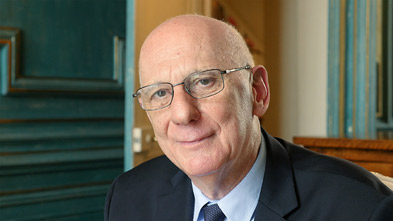
MichelZink-RinaSherman-002corrWeb

Michel Zink, de l’Académie française, est un philologue français, spécialiste de la littérature française du Moyen Âge. Ancien élève de l’Éns-Ulm, il est professeur au Collège de France (chaire de Littératures de la France médiévale) depuis 1994, membre de l’Institut depuis 2000, secrétaire perpétuel de l’Académie des inscriptions et belles-lettres depuis 2011.

Il a enseigné comme professeur invité dans de nombreuses universités européennes, américaines et japonaises. À côté de son œuvre de médiéviste, il a publié des romans et des contes. ​Ouvrages récents : Les Troubadours. Une histoire poétique (2013), D’autres langues que la mienne, dir. (2014), Bienvenue au Moyen Âge (2015), Bérets noirs, bérets rouges (2018).

Informations pratiques :

Michel Zink, la profondeur du temps, réal. Rina Sherman, 2018. Vidéo HD, 99 min, 2018. Prix : 26,99 euros.

Source : Rina Sherman

Publié dans Podcast, Web | Laisser un commentaire

Appel à contribution – Episcopal Patronage from Late Antiquity to c.1500

This time, the Power of the Bishop team are joining with the Episcopus Society for the 2019 conference, exploring the theme of Episcopal Patronage from Late Antiquity to c.1500. We want to put together thematic panels that compare and contrast uses, abuses and outcomes of bishops as patrons across time and geographical boundaries.

We are looking for papers that explore, but are not limited to:

* Art and architecture
* Music and Liturgy
* Manuscripts and Literary Culture
* Saint Cults and Pilgrimage Routes
* Education and Social Advancement
* Socio-political networks, the advancement of families and individuals
* When episcopal patronage goes wrong – the failures and abuses of episcopal patronage and its results

Abstracts should be no more than 500 words.

This year we are accepting abstracts in English, Italian and French.

**If selected then papers and book chapters must be in English**

Email abstracts to: powerofthebishop (at) gmail (dot) com with the subject line ABSTRACT POB4 by no later than 01 February 2019.

Register here: https://www.eventbrite.co.uk/e/pob-4-the-medieval-bishop-as-patron-tickets-53543735755

About Us

The Bishop was a powerful figure in the Middle Ages, and we have explored several facets of episcopal power in our conference series and accompanying edited volumes. Episcopal Power and Local Society, based on the theme of our first conference in 2013, was published by Brepols in 2017. The second volume in the series, Episcopal Personalities, is currently in production with Brepols. The third volume, based on our 2017 conference The Medieval Bishop as Diplomat, is currently being prepared.

We hope to publish selected papers from this conference as fully developed book chapters with an estimated 18-24 month turnaround from the date of the conference. This volume will also be submitted to Brepols for their Church History series, and will undergo peer review. The organising team are also the co-editors of the volumes with Prof Em. Peter Coss and this year we are joined by Assoc Prof Evan Gatti.

All volumes with Brepols undergo peer review.

About the Venue

Sarum College, 19 The Close, Salisbury, SP1 2EE

For the first time we are moving the conference from its home at Cardiff University to the Cathedral Close at Salisbury where we can see Episcopal Patronage in action!

Sarum College has reserved 40 rooms of various types (singles, twins, doubles) on site for delegates and speakers quoting “Power of the Bishop Conference 30-31 May”. These rooms start at around £43 per night for their basic single rooms and can be booked directly with the College on a first-come-first-served basis. Contact them on (+44)1722 424800 or visit their website http://www.sarum.ac.uk for their email address and more information including accessibility requirements.

AV equipment is available in the ground floor lecture room where the conference will be held.

Catering (tea and coffee breaks and lunch) will also be on site in Sarum College. Please let us know about dietary requirements when you register.

There are several other hotels and B&Bs in the city, including the White Hart, the Red Lion, and the King’s Head Inn.

Publié dans Appel à contributions | Laisser un commentaire

Podcast – Steven Vanderputten, « The Dignity of Our Bodies and the Salvation of Our Souls »

Prof Steven Vanderputten (Ghent), « The Dignity of Our Bodies and the Salvation of Our Souls. Scandal, Purity, and the Pursuit of Unity in Late Tenth-Century Monasticism » – lecture given at SAIMS, 19/2/18

SAIMS-Banner1

Source : Soundcloud

Publié dans Podcast | Laisser un commentaire

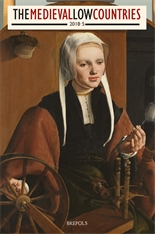
Publication – The Medieval Low Countries – 5 (2018)

The Medieval Low Countries, 5, 2018. approx. VI+333 p., 20 b/w ill. + 11 colour ill., 156 x 234 mm. ISBN: 978-2-503-57855-2. Prix : 77 euros.

dIS-9782503578552-1

Table des matières :

Marcus Roxburgh, Nelleke IJssennagger, Hans Huisman, and Bertil van Os – Where Worlds Collide. A Typological and Compositional Analysis of the Copper-Alloy Mounts from Viking-Age Walcheren

Sean L. Field and Walter Simons – A Prophecy Fulfilled? An Annotated Translation of the Sources on the Death of Crown Prince Louis of France (1276) and the Interrogations of Elizabeth of Spalbeek (1276-78)

Margreet Brandsma – Riches and Power? Princely Widows in the Burgundian Period: The Case of Margaret of Burgundy (1374-1441)

Marie Van Eeckenrode – Représenter une principauté. Le jardinet de Hainaut, entre image de marque et prescription politique (XIVe-XVIe s.)

Hannelore Franck – Foreign Merchants and the Parish. Local Commemoration as a Part of the Integration Process in Late Medieval Bruges?

Anna Dlabačová – Spinning with Passion. The Distaff as an Object for Contemplative Meditation in Netherlandish Religious Culture

Maxime Poulain, Marnix Pieters, and Wim De Clercq – Everyday Life During the Siege of Ostend (1601-04). Ceramics at the Spanish St Isabella Fort

Book Reviews

Source : Brepols

Publié dans Publications | Laisser un commentaire

Podcast – Les universités médiévales, des communautés dédiées au savoir

Accès podcast : ici

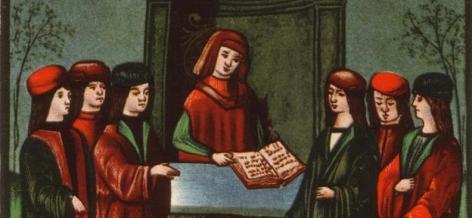
Au Moyen Âge les universités désignent des communautés d’élèves réunies autour d’un maître. Présentes partout en Europe, elles diffusent un savoir et des méthodes de recherches.

L’université a vu le jour au XIIIe siècle en Europe. Elle naît de la transformation d’écoles souvent déjà existantes et crée de véritables communautés qui rassemblent maîtres et étudiants. À Paris, Oxford, Bologne ou Montpellier, tout au long du Moyen Âge, les université rayonnent dans l’Europe entière. Elles formeront des milliers d’hommes et diffuseront un réel savoir. Explications d’Antoine Destemberg, auteur de « L’honneur des universitaires au Moyen Âge » (éd. PUF, 2015).

univesrite_bologne_5

Universitas, une communauté entre maîtres et élèves

Au XIXe siècle, les historiens s’intéressaient principalement aux institutions ou à l’histoire des idées, ce n’est qu’au milieu du XXe siècle que l’on s’est intéressé à l’histoire sociale des universités. Et que l’on s’est mis à observer une véritable communauté. Une communauté de maître et d’élèves : c’est en effet ce qui s’est développé à la fin du XIIe et au début du XIIIe siècle. S’il est impossible de dater précisément l’apparition des premières universités, Bologne, Oxford et Paris sont les plus anciennes. Il faut remonter à 1208 pour trouver dans les documents d’archives les plus anciens le terme universitas.

Le terme universitas est un terme juridique de droit romain qui désigne « une communauté jurée : c’est-à-dire unie par le serment ». Universitas n’est pas réservé au milieu scolaire. Comme l’explique Antoine Destemberg, des communes se font appeler universitas. Toujours est-il que l’université telle qu’elle émerge au Moyen Âge est bien une « agrégation juridique d’une communauté d’intérêts entre maîtres et étudiants ».

Sous l’égide de l’Église

Depuis le milieu du XIe siècle, l’Église a entamé sa réforme grégorienne. Et dans le but de mieux former ses théologiens et ses clercs, elle a développé des structures scolaires, « de façon à avoir des élites intellectuelles capables de porter la réforme ecclésiastique ». C’est ainsi que s’est développé en Europe un réseau d’écoles sous l’égide de l’Église, qui relève uniquement de la juridiction ecclésiale. « À partir du moment où on est à l’université, on est protégé par ces privilèges ecclésiastiques et à partir de là on est clerc. »

Une nouvelle catégorie de population

Une relative stabilité des pouvoirs encourage le développement de l’université, stabilité propice en effet à plus de mobilité sociale et géographique. Maîtres et élèves peuvent se rendre d’une école à l’autre. À une époque où, dès le XIIe siècle la population urbaine s’accroît de façon considérable.

La ville est synonyme « d’une liberté plus grande et d’un mélange des populations ». Elle transforme peu à peu la société féodale. Là où on était paysan, chevalier ou religieux, on peut désormais faire profession d’enseigner. « On a une catégorie particulière qui émerge qui fait profession de penser et d’enseigner. »

Source : RCF Radio

Publié dans Podcast | Laisser un commentaire

Publication – Joan A. Holladay, « Genealogy and the Politics of Representation in the High and Late Middle Ages »

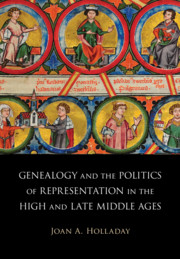
Images and image cycles with genealogical content were everywhere in the high and later Middle Ages. They represent families related by blood as well as successive office holders and appear as family trees and lineages of single figures in manuscripts, on walls and in stained glass, and in sculpture and metalwork. Yet art historians have hardly remarked on the frequency of these images. Considering the physical contexts and functions of these works alongside the goals of their patrons, this volume examines groups of figural genealogies ranging across northern Europe and dating from the mid-twelfth to the mid-fourteenth century. Joan A. Holladay considers how they were used to legitimize rulers and support their political and territorial goals, to reinforce archbishops’ rights to crown kings, to cement relationships between families of founders and their monastic foundations, and to commemorate the dead. The flexibility and legibility of this genre was key to its widespread use.

9781108470186

Table des matières :

1. Rivalling/reviving Rome: environmental genealogies in palace halls
2. Structuring the past: history and genealogy in thirteenth-century England
3. Crowning the king: coronation rights at Cologne and Reims
4. Advertizing allegiances: tombs and tomb cycles
5. Flattering founders: genealogical imagery in cloister chronicles.

Informations pratiques :

Joan A. Holladay, Genealogy and the Politics of Representation in the High and Late Middle Ages, Cambridge, Cambridge University Press, 2019. 253 x 177 mm. 143 b/w illus. 11 colour illus. ISBN : 9781108470186. £ 90.00.

Source : Cambridge University Press

Publié dans Publications | Laisser un commentaire

Conférence – Patrick Boucheron, « Fonder et exclure, ou les ambiguïtés du programme communal. À propos de la Porta romana de Milan (1171) »

Les bas-reliefs de la Porta Romana de Milan constituent un programme sculpté complexe et de grande ampleur, qui est le premier exemple connu d’art  communal. Sa visée est apparemment laïque et commémorative : il s’agit de rappeler la destruction de la ville par Frédéric Barberousse en 1162, l’expulsion de ses habitants et leur retour cinq ans plus tard. En 1167, les Milanais reprenaient pied dans leur histoire et fondaient du même coup l’identité politique de leur commune dans le souvenir cuisant d’un passé récent. Mais les bas-reliefs commandés par les consuls en 1171 donnent aussi à voir une scène étrange, où saint Ambroise chasse les ariens de la ville. La cité se refonde par un geste d’exclusion. L’analyse iconographique de ce décor sculpté tentera d’y déceler le jeu heurté des temporalités et des ambivalences, éclairant du même coup le programme politique de la commune lombarde à un moment décisif de son histoire.

Capture d_écran 2018-12-27 à 13.04.53

Informations pratiques :

Mercredi 16 janvier 2019 à 17 heures 15

Palais provincial de Namur — 2 place Saint-Aubain, 5000 Namur
Invitation valable pour deux personnes. Réponse souhaitée avant le 14 janvier 2019, à l’adresse : collegebelgiquenamur@academieroyale.be

Source : Académie Royale de Belgique

Publié dans Colloque | Laisser un commentaire