Activité du RMBLF – Conférence de Reindert Falkenburg et Michel Weemans, « Bruegel: Ground for speculation, traps to see »

Le jeudi 24 janvier 2019 à 18h, Reindert Falkenburg (New York University Abu Dhabi) et Michel Weemans (École nationale supérieure d’art, Bourges) analyseront les procédés visuels élaborés par Bruegel pour troubler et défier notre regard dans le cadre d’une conférence intitulée Bruegel: Ground for speculation, traps to see.

Cette conférence précédera une masterclass, qui sera organisée le lendemain sur le campus bruxellois de la KULeuven (le programme sera mis en ligne prochainement).

Poster_Keynote_Brueghel

Argumentaire :

Bruegel : matière à spéculation et pièges à voir
Les paysages de Bruegel entraînent le spectateur dans une quête visuelle et mentale du monde visible qui conduit vers le domaine de l’invisible. La conférence mettra en lumière cette caractéristique fondamentale des œuvres de Bruegel. Celles- ci, nous suggèrent Reindert Falkenburg et Michel Weemans, sont conçues comme des exercices de discernement : matière à spéculer et pièges à voir. Conférence en anglais, avec traduction simultanée en français.

Bruegel: onderwerp van speculatie en valkuilen van zien

De landschapskunst van Bruegel neemt haar toeschouwer mee op een visuele en mentale zoektocht naar de zichtbare wereld, die leidt naar het rijk van het onzichtbare. De lezing zal dit fundamentele kenmerk van Bruegels kunst benadrukken. De werken van Bruegel, zoals gesuggereerd wordt door Reindert Falkenburg en Michel Weemans, zijn opgevat als een oefening van het kijken: ze zijn het onderwerp van speculatie en valkuilen van zien. Lezing in het Engels, met simultane vertaling naar het Frans.

Bruegel: Ground for speculation, traps to see
Bruegel’s landscapes take his viewers on a visual and mental quest of the visible world which leads to the realm of the invisible. The lecture will highlight this fundamental characteristic of Bruegel’s work. The works of Bruegel, as Reindert Falkenburg and Michel Weemans suggest, are to be seen as lessons in observation: providing subjects for speculation and traps to see.

Informations pratiques :

Conférence en anglais, avec traduction simultanée en français.

Maison d’Érasme – Erasmushuis
Rue de Formanoir 31 de Formanoirstraat, Bruxelles 1070 Brussel Tel. (+32) 02.521.13.83 – info@erasmushouse.museum http://www.erasmushouse.museum

Entrée libre sur réservation – Toegang gratis mits plaatsbespreking Inscription en ligne : http://www.erasmushouse.museum : Inschrijving online info@erasmushouse.museum – 02.521.13.83

Organisation :
Maison d’Érasme
Het Masereelfonds.
Réseau des Médiévistes Belges de Langue Française
Vlaamse Werkgroep Medievistiek
Bourgmestre et Collège échevinal d’Anderlecht.

Avec le soutien de la Fondation pour la protection du patrimoine culturel, historique et artisanal (Lausanne).

Invitation au format PDF : Falkenburg et Weemans – Maison d’Érasme
Publié dans Activités du RMBLF, Colloque | Laisser un commentaire

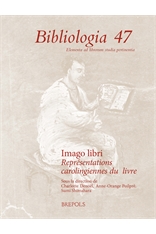
Publication – « Imago libri. Représentations carolingiennes du livre », éd. Charlotte Denoël, Anne-Orange Poilpré et Sumi Shimahara

Le renouveau culturel carolingien confère au livre une place majeure dans la société, qui perdure dans le monde ottonien. Sa production est suffisamment abondante pour que près de 9000 manuscrits de cette époque nous soient parvenus, et le soin apporté à la qualité de leur confection est remarquable. Les manuscrits, précieux ou non, corrigés, glosés, comparés, échangés, servent à l’action, politique ou judiciaire, à la spiritualité, à la réforme religieuse, au développement de l’« humanisme » carolingien. Dans la société et la culture chrétiennes, l’objet-livre revêt un caractère précieux et somptuaire, comme en témoignent sa place de choix au sein des trésors d’église et sa haute valeur monétaire. Il est l’incarnation à la fois de l’autorité sacrée, du pouvoir et du savoir ; investi d’une forte dimension symbolique, il peut aussi être source de conflits et victime de destructions. Polymorphe, il intervient dans de multiples situations : il peut être tour à tour exhibé sous l’aspect d’un rouleau, d’un codex ouvert ou fermé, mangé, foulé aux pieds, dissimulé, utilisé pour prêter des serments… À la fois contenant et contenu, objet et parole, le livre est aussi imaginaire et imaginé. L’enquête collective envisagée ici dépasse la dimension archétypale du livre pour cerner, à travers une approche pluridisciplinaire combinant l’histoire sociale, culturelle et artistique, la spécificité des représentations carolingiennes du livre.

dIS-9782503567679-1

Table des matières :

Charlotte Denoël, Anne-Orange Poilpré et Sumi Shimahara – Introduction

1. Dire et figurer le livre

Charlotte Denoël – L’Épiphanie du Verbe. Essai d’une typologie formelle des représentations du livre au premier Moyen Âge dans les portraits des évangélistes
Bruno Bon et Krysztof Nowak – Autour de Liber : étude (e-)lexicographique
Isabelle Marchesin – Mise en voir mathématique et intermédialité du Verbe dans les Évangiles carolingiens. Genèse d’une tradition iconographique
Lawrence Nees – Design, Default or Defect in Some Perplexing Represented Books

2. Livre, loi et autorité

Stefan Esders – Deux libri legum au service des fonctionnaires du royaume d’Italie à l’époque carolingienne
Anne-Orange Poilpré – Dans et avec le livre : Jérôme, David et les souverains carolingiens
François Bougard – Le livre de l’autorité du siècle
Helmut Reimitz – Livres d’histoire et histoire du livre à l’époque carolingienne

3. Livre et Bible

Yves Christe – Un nouveau Sinaï pour Pierre et Paul
Sumi Shimahara – Le livre dans le Livre : parcours exégétiques
Beatrice E. Kitzinger – Representing the Gospels Beyond the Carolingian Center
Eliza Garrison – Movement and Time in the Egbert Psalter

4. Livre et liturgie

Adam Cohen – The Book and Monastic Reform
Cécile Voyer – Mise en abyme. Le sacramentaire de Marmoutier et ses images
Jean-Pierre Caillet – Le livre dans l’édifice cultuel aux temps carolingiens et ottoniens
Marie-Céline Isaïa – Un simple objet ? Le livre dans l’hagiographie médiolatine (IXe-XIe siècle).

5. Livre, signes, images littéraires

Francesco Stella – Les représentations du livre dans les textes poétiques carolingiens et ottoniens. Naissance de la poésie paratextuelle
Fabrizio Crivello – Tabulae et livres dans les tables des Canons de l’école de la cour de Charlemagne. Questions ouvertes
François Bougard – Le livre dans tous ces états. Conclusions

Index des noms de personnes
Index des noms de lieux
Index des manuscrits

Liste des contributeurs

Informations pratiques :

Imago libri. Représentations carolingiennes du livre, éd. Charlotte Denoël, Anne-Orange Poilpré et Sumi Shimahara, Turnhout, Brepols, 2018 (Bibliologia, 47). 336 p., 26 b/w ill. + 96 colour ill., 11 b/w tables, 210 x 270 mm, 2018
ISBN: 978-2-503-56767-9. Prix : 85 euros.

Source : Brepols

Publié dans Publications | Laisser un commentaire

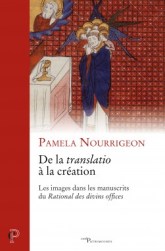
Publication – Pamela Nourrigeon, « De la translatio à la création. Les images dans les manuscrits du Rational des divins offices »

À la fin du XIIIe siècle, Guillaume Durand, alors évêque de Mende, rédige le Rationale divinorum officiorum, qui constitue un texte essentiel sur la liturgie médiévale et son exégèse. Ce traité, commentant la dimension symbolique de la liturgie chrétienne et des éléments qui la composent, connaît une diffusion large et rapide dans tout l’Occident. En 1371, à la demande de Charles V, le texte est traduit en ancien français par Jean Golein sous le titre de Rational des divins offices. Cette traduction s’accompagne de cycles d’images alors que les exemplaires en latin n’avaient presque jamais été illustrés. Le Rational des divins offices marque ainsi une rupture dans l’histoire du texte mais plus encore dans l’histoire du genre qu’est l’exégèse liturgique, restée jusque-là sans images. Ce constat a rendu essentiel la naissance d’une étude sur ce texte et son décor.

Les illustrations des neuf manuscrits conservés du Rational des divins offices forment le cœur de cet ouvrage. Elles sont des témoins exceptionnels pour aborder la façon dont le Moyen Âge a conçu la place et le rôle des images dans une société éminemment chrétienne. Grâce au cheminement thématique du présent ouvrage, le lecteur est amené à comprendre les implications esthétiques, historiques, politiques et théologiques qui sous-tendent la création artistique. Les mécanismes de traduction, l’implication royale, la personnalité du traducteur ou le contexte dévotionnel des XIVe et XVe siècle sont ici traités comme autant de fenêtres ouvrant sur la compréhension des images. Ce livre est une enquête qui tente de retracer une part de l’histoire du processus créatif médiéval.

plat-1-nourrigeon-5bc8a714cc50b

Pamela Nourrigeon, docteur en histoire de l’art médiéval, membre associé du Centre d’études supérieures de civilisation médiévale de Poitiers.

Informations pratiques :

Pamela Nourrigeon, De la translatio à la création. Les images dans les manuscrits du Rational des divins offices, Paris, Éditions du Cerf, 2018 (Cerf Patrimoine). 152 x 229, 328 pages. ISBN : 9782204129671. Prix : 32 euros.

Source : Éditions du Cerf

Publié dans Publications | Laisser un commentaire

Prix – The Verbruggen Prize : best book on medieval military history

Named in honour of Jans F. Verbruggen, one of the foremost scholars in the field of medieval warfare, De Re Militari has created the Verbruggen Prize, given annually for the best book on medieval military history.  All De Re Miltiari members are invited to nominate a book.

Rules:

The prize will be offered annually for the best book on medieval military history published within the prior three years (e.g. books published 2001-2003 will be eligible for the 2004 prize.)

2. Authors or publishers may nominate a book, but for the book to be eligible, one copy of it must reach each of the three committee members by 30 December of the year preceding the award.  The book may be on any aspect of medieval military history, broadly conceived.

3. The Award Committee will base their selection on the following three criteria, in descending order of importance:

a. Importance and originality of the contribution to the field of medieval military history.

b. Quality and depth of scholarship

c. Clarity and quality of prose.

4. Committee members will serve two-year terms.  The committee chair ill nominate a new committee slate at the DRM annual meeting.

5. The prize committee will choose the winner by majority vote by 15 March.  If there is a three-way tie, the President of De Re Militari will cast the tie-breaking vote.  The prize, a monetary award ($150 in 2004) and a framed certificate will be awarded at the De Re Militari Special Session at Kalamazoo.

Current Committee:

  • John France (University of Swansea) (chair)
  •  John Hosler (Morgan State Univ.)
  • Nicolas Prouteau (Université de Poitiers)

past winners

For more information, please contact John France at (J.France@swansea.ac.uk)

Source : De re militari

Publié dans Prix | Laisser un commentaire

Séminaire – Le médiévalisme – Des usages contemporains du Moyen Âge.

Le vendredi 14h à 16h, salle Perroy, à la Sorbonne.
Première séance le 18 janvier 2019

séminaire organisé par Aude Mairey, avec la participation de Joseph Morsel, William Blanc, Vincent Ferré, Laurent Di Filippo

Depuis quelques décennies, le médiévalisme, que l’on peut définir à la suite de Louise d’Arcens comme « la réception, l’interprétation ou la recréation du Moyen Âge européen dans les cultures post-médiévales », est devenue une discipline à part entière, d’abord dans les pays anglophones puis dans l’ensemble de l’Europe occidentale (pour ne s’en tenir qu’à elle). Le champ est vaste : de Victor Hugo à J.R.R. Tolkien, de la recréation d’une architecture néo-gothique aux jeux vidéos populaires, de l’anneau de Jeanne d’Arc à la reconstitution de batailles médiévales, les usages contemporains du Moyen Âge sont nombreux – littéraires, cinématographiques, ludiques, mais aussi politique… Pourtant, alors nos collègues littéraires ont été les premiers à s’emparer de ce champ au sein du monde universitaire, cela n’a pas été le cas (ou à peine) pour les historiens. Ce séminaire se propose donc d’envisager, en complémentarité avec les autres disciplines, tant l’histoire du médiévalisme que la diversité de ses usages actuels.

Les séances sont ouvertes à tous et se tiendront le vendredi de 14h à 16h en salle Perroy, à la Sorbonne.

ABCHLDAR-1

Programme :

18 janvier 2019
Histoire du médiévalisme, 1
Aude Mairey

1er février 2019
Histoire du médiévalisme, 2
Aude Mairey

22 février 2019
Médiévalisme et politique
Intervenant : Joseph Morsel (Université Paris 1)

22 mars 2019
Médiévalisme et cinéma
Intervenant : William Blanc (médiéviste indépendant)

5 avril 2019
Médiévalisme et littérature
Intervenant : Vincent Ferré (Université de Paris Est-Créteil)

19 avril 2019
Les usages ludiques du passé : Le médiévalisme dans les jeux contemporains
Intervenant : Laurent Di Filippo (DynamE, Université de Strasbourg/CREM, Université de Lorraine)

Source : LAMOP

Publié dans Séminaire | Laisser un commentaire

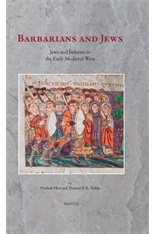
Publication – « Barbarians and Jews. Jews and Judaism in the Early Medieval West », dir. Yitzhak Hen et Thomas F. X. Noble

The essays in this volume attempt to re-evaluate, understand and explain various aspects of Jewish history within the broader historical context of the post-Roman Barbarian world.

The essays in this volume attempt to re-evaluate, understand and explain various aspects of Jewish history within the broader historical context of the post-Roman Barbarian world. They address a wide variety of topics, sources, and geographies, and together they provide a nuanced and more balanced history of the Jews in the early medieval West. Although written independently of one another by some of the most prominent historians of Late Antiquity and the early Middle Ages, the various essays collected here reveal a remarkable tension between the ‘imaginary’ (or ‘hermeneutical’) Jew and the ‘real’ one. As this volume demonstrates, Augustine’s positive theological understanding of Jews and Judaism was often overshadowed by anti-Jewish sentiments, and consequently anti-Jewish invective remained the drive wheel of Christian theology, especially in the context of debates and polemics among the Christians themselves.

dIS-9782503581019-1

Table des matières :

Acknowledgments

List of Abbreviations

Yitzhak Hen, Introduction
Walter Pohl, Disputed Identifications: Jews and the Use of Biblical Models in the Barbarian Kingdoms
Jonathan P. Conant, Jews and Christians in Vandal Africa
Wolfram Drews, Barbarians and Jews in Early Medieval Spain: Shifting Constellations of Religion and Identity
Giancarlo Lacerenza, Between Old and New Barbarians: The Jews of Southern Italy during the ‘Dark Ages’
Yitzhak Hen and Gerda Heydemann, A Double-edged Sword: Jews and the Rhetoric of Power in Ostrogothic Italy
Stefan Esders, The Prophesied Rule of a ‘Circumcised People’: A Travelling Tradition from the Seventh-century Mediterranean
Yaniv Fox, Ego, Bar-Iona: Jews and the Language of Forced Conversion in Columbanian Circles
Rob Meens, Jews in Early Medieval Penitential Literature
Johannes Heil, Friendly Barbarians? The Jews under Christian Rule in Northern Europe
Rosamond McKitterick and Graeme Ward, Knowledge of the History of the Jews in the Early Middle Ages
Piet Hoogeveen, Jewish Double Portraits: Hrabanus Maurus and his Commentary on 1 & 2 Samuel
Ora Limor, Tales from the East: Jewish Episodes in Early Medieval Travel Narratives

Thomas F. X. Noble, Images and the Imaginary Jew in the Early Byzantine World

Informations pratiques :

Barbarians and Jews. Jews and Judaism in the Early Medieval West, dir. Yitzhak Hen et Thomas F. X. Noble, Turnhout, Brepols, 2018 (Diaspora, 4). XII+341 p., 156 x 234 mm, 2018. ISBN: 978-2-503-58101-9. Prix : 85 euros.

Source : Brepols

Publié dans Publications | Laisser un commentaire

Appel à contribution – Medicine, Myth and Magic

EXTENDED DEADLINE FOR SUBMISSIONS: Saturday, January 5th, 2019

Conference Topic: Crossroads of Medicine and Religion
Dates: April 12-14, 2019
Location: McGill University, Montreal, Quebec, Canada.
Submission Deadline: Saturday, January 5th, 2019.
Contact: gradconference.relgstud@mail.mcgill.ca

Description of the conference:
The McGill Centre for Research on Religion (CREOR) graduate student annual conference invites graduate students and emerging scholars to participate in a special edition conference rethinking the relationship between medicine and religion. We invite critical reflections on the complexities and diversity that arises at the crossroads of medicine and religion. We know that since Antiquity medical traditions in Greece, Babylon, Egypt, China and India were intrinsically intertwined with its religious practices. The observation and study of anatomical and mental ailments was not necessarily a distinct science, the lines between medicine, religion, and “magic” remained⎯at times⎯blurry. Myth and ritual were also used to connect the body to sacred spaces. Early modern, and especially post-Enlightenment, thinking sought to bring a clearer divide between medicine and religion. As science and technology progressed it provided the field of medicine with a diagnostic and prognosis system which was purely “rational” and devoid of spiritual beliefs. But the acceptance of this proposition has not been unanimous. Despite the extraordinary advances of post-Enlightenment medicine, both Western and Eastern, does the quest for scientific knowledge leave any room for religious beliefs, traditions and ethics to influence medical practice?

Some questions the conference wishes to consider are: Do Western, Eastern and Indigenous traditions and religions have something to offer in understanding afflictions of the mind and body? Can religious beliefs and scientific methods used by modern medicine ever be reconciled? How has a given tradition’s view of the relationship between medicine and religion evolved over time? What role and influence have religious views had in the history of medical thought? What are the theological and philosophical aspects of the study of the body? How has the relationship between medicine and religion been portrayed in historical, literary, and philosophical writings?

We invite proposals from all areas of study, including history, philosophy, art history, religious studies, sociology, anthropology, psychology, bioethics, and law.

Encouraged topics and themes include, but are not limited to, the following:

  • History of medicine and religion
  • Theological and philosophical aspects of the medical sciences
  • Theology and philosophy of medicine
  • Sociology of medical knowledge
  • Anthropology of medicine
  • Medicine and religion in literature
  • Medicine and “fringe” religious traditions (e.g. Hermetic, heretical, “occult”…)
  • Iconography: Representations of the healer-prophet or healer-saint in art
  • Debates on body and soul informed by medical and theological knowledge
  • Spiritualization of physical illness
  • Indigenous practices and medicine
  • Spiritual and magical healing (e.g. shamanic, taslismanic, etc.)
  • Ethics of healing
  • Religious ethics and medical practices
  • Scriptural Interpretations

This year’s CREOR graduate student conference will be held in collaboration with McGill’s History conference “Angelical Conjunctions: Crossroads of Medicine and Religion, 1200-1800” and running concurrently with the 2019 Eastern International Regional Meeting of the American Academy of Religion conference on “Religion, Harm and Healing”.

The “Angelical Conjunctions” conference will be accompanied by an exhibition of rare books that are relevant to the theme of the conference in McGill University’s Osler Library of Medicine.

Guidelines for proposals:

Please submit a 250 word abstract explaining the topic and main arguments of the paper. All disciplines and fields welcome. Papers must engage in and contribute to the scholarly discourse; works of advocacy or mere summary will not be considered. Presentations should not exceed 20 minutes. Proposals should include all contact information including institutional affiliation and any technical request such as audio-visual equipment. These proposals as well as any questions or requests for further information should be sent to the following address: gradconference.relgstud@mail.mcgill.ca

Publishing Possibility: Following the conference, a select number of high quality papers will be considered for publication in a special volume.

Source : CREOR

Publié dans Appel à contributions | Laisser un commentaire

Colloque – Les Miracles de Notre Dame : du Moyen Âge à nos jours

Institut Catholique de Rennes
Bruz
21-23 mars 2019

Capture d_écran 2018-12-16 à 18.55.08

Programme :

Miracles français du Moyen Âge

14h00 : Jean-Louis Benoit (Université de Bretagne-Sud) : Qu’est-ce qu’un Miracle de Notre Dame ?
14h30 : Camille Bellenger (agrégée doctorante Université Paris 4) : Le corps de la Foi. Croire par les sens dans Les Miracles de Nostre Dame de Gautier de Coinci
15h00 : Marie Geneviève Grossel (Université de Valenciennes): Gautier de Coinci : l’insertion lyrique dans les miracles
15h30 : PAUSE

16h00 : Anna Loba (Université de Poznan, Pologne): « Belle vision et estrange miracle » – la place du miracle marial dans la spiritualité de Philippe de Mézières.
16h30 : Elisabeth Barale (Université de Turin): Les louanges « plus doulces que miel » de Jean Miélot : aux sources de ses Miracles de Notre Dame
17h00 : Juliette Bourdier (Université de Charleston, Etats-Unis) : Miracle marial, pilier du livre d’heures de Courtanvaux c.1460
17h30 : Gabrielle Grandcamp (docteure de l’université du Havre) : Le Miracle, genre « théâtral » ? Marie sur la scène des Miracles de Nostre Dame dramatiques.

Le miracle de Théophile interprété par les étudiants de l’ICR

Vendredi 22 mars
Transmettre et Translater des miracles

09h00 : Anthony John Lappin (Université d’ Uppsala, Suède) : Transmitting the Latin Miracles of the Virgin (twelfth–thirteenth century).
09h30 : Manfred Kropp (Université de Mayence) : Across the sea to distant shores: The voyage of “The Miracles of Our Lady” from West to East
10h00 : Márk Vrabély (Université Lorand Eötvos Hongrie) : Marian miracles in Latin and Hungarian: The Stellarium of Pelbartus de Temesvár
10h30 : Juan Carlos Bayo (Université de Madrid) : ‘The challenges of composing a universal collection of Marian miracles in the vernacular: the case of Gonzalo de Berceo’
11h00 : PAUSE

11h30 : Paula Almeida (Université de Porto) : «Miracles mariaux à la lumière de la littérature de spiritualité au Portugal (XVIe-XVIIIe siècles)»
12h00 : Adelina Angusteva-Tihanov (Université de Manchester) : Marian Miracles on the Margins: Poetic and Visual Transformations of the Virgin’s Miracle Accounts in Late and Post Medieval Russian Culture
12h30 : REPAS

Miracles du Nord et de l’Est

14h00 : Matthew James Driscoll (Université de Copenhague) : Old Icelandic Miracles of the Virgin in the manuscript  AM 634-635 4to
14h30 : Bengt Dahlqvist (Université d’Uppsala) : Marian Miracles in Old Swedish texts
15h00 : Marija Ana Duerrigl et Andrea Radosevic (Old Church slavonic institute Université de Zagreb) : Miracles of Our Lady as a mirror of Croatian medieval narrative prose.
15h30 : PAUSE

16h00 : Ewa Balicka-Witakowsaka  (Université d’Uppsala) : Ethiopic poetry on the Miracles
16h30 : Jonathan Moren (Université d’Uppsala) : Arabic Miracles of Mary from The Mingana Collection: Preliminary Observations
17h00 : Anastasyia Romanova (Université de Saint Petersbourg) : « Short miracle-tales of Russian origin in the XVIIIth century manuscript compilation « Different Signs of Our Lady » (« Raznye yavleniya Presvyatye vladychitzy Nasheya Bogoroditzy »).
17h30 : Stéphane Cermakian (agrégé, docteur université d’Aix-en-Provence) : Marie dans le récit arménien du pseudo Jean l’Evangéliste

Samedi 23 mars
Miracles de Notre-Dame dans la littérature française

09h00 : Laure Darcq (enseignante Université de Montpellier) : La Vierge sur la scène française : légendes et apparitions (1892-1913)
09h30 : Bénédicte Leduc-Penot (ICR) : Etude linguistique et pragmatique du discours de Zola dans son roman Lourdes
10h00 : Pascaline Marie Hamon (agrégée, docteur Paris 3) : Défendre le miracle. La réception de Lourdes de Zola.
10h30 : Carine Roucan (docteur Université de Rouen, enseignante à l’Université du Havre) : Huysmans et Lourdes
11h00 : Gilbert Goizin (agrégé ICR) : Ecrire celle qui pleure. Bloy et La Salette
11h30 : Nelli Solonko (Université Szczecin, Pologne) : dire Marie : La Vierge des poètes et des enfants (Péguy, Milosz, Twardowski)
12h30 : REPAS

Icônes et images de Marie

14h00 : Jerry Root (Université de l’Utah Etats Unis) : Image de la Vierge. La Vierge comme image dans Les Miracles de Notre- Dame.
14h30 : Françoise Laurent (Université Clermont-Auvergne) et Ilsiona Nuh (doctorante Université Clermont-Auvergne) : Miracles iconiques dans les Miracles de Notre-Dame.
15h00 : Auriane Gotrand (doctorante histoire de l’art Université de Clermont-Auvergne) : L’influence des apparitions de la Vierge de Lourdes sur l’iconographie de l’Immaculée Conception.
15h30 : Margaret Dimitrova (Université de Sofia) : The Miracles of the Wonder-Working Icon of the Theotokos Tricherousa in Two Nineteenth-Century Manuscripts in Hilandar Monastery, Mount Athos
16h00 : Cecilia Katunaric (ICR docteur Paris 8) : Nican Mopohua : la piété et les enjeux idéologiques de Notre-Dame de Guadalupe dans la culture latino-américaine
16h30 : CONCLUSION

Publié dans Colloque | Laisser un commentaire

Conférence – Albert Derolez, « Une entreprise scientifique menée à bien : l’édition des catalogues médiévaux de livres en Belgique (Corpus catalogorum Belgii) »

Le lundi 14 janvier 2019, à 13h30, le prof. Albert DEROLEZ (UGent, VUB, ULB) donnera une conférence intitulée Une entreprise scientifique menée à bien : l’édition des catalogues médiévaux de livres en Belgique (Corpus catalogorum Belgii) dans le cadre des conférences organisées par le Centre International de Codicologie et le Groupe de contact du FNRS « Codicologie ».

Capture d_écran 2018-12-15 à 14.20.55

Informations pratiques :

Bibliothèque Royale de Belgique – Koninklijke Bibliotheek van België
Mont des Arts – 1000 Bruxelles
Salle du Conseil (niveau + 2)

Entrée libre

Publié dans Colloque | Laisser un commentaire

Séminaire – Guilds, Labour and the Urban Body Politic: Fabricating Community in the Southern Netherlands, 1300-1800

Wednesday 23 January 2019, 13h-17h
Brussels, the exact venue will be communicated

Capture d_écran 2018-12-15 à 14.35.41

Book Workshop

Guilds, Labour and the Urban Body Politic: Fabricating Community in the Southern Netherlands, 1300-1800

Bert De Munck, University of Antwerp

Presentation of the book by the author

Discussion of the book by:
Phil Withington (University of Sheffield)
Maarten Prak (Utrecht University)
Anne-Laure Van Bruaene (Ghent University)
Heidi Deneweth (VUB)

Organisation by:
Jeroen Puttevils (University of Antwerp) & Wouter Ryckbosch (VUB)
Admission is free, registration (prior to 9 January) is required jeroen.puttevils@uantwerpen.be

Publié dans Séminaire | Laisser un commentaire