Publication – Marion Uhlig, « Le prince des clercs. Barlaam et Josaphat ou l’art du recueil »

Barlaam et Josaphat est l’adaptation christianisée de la vie du Bouddha. Mais qu’est-ce qui justifie son immense succès au Moyen Age, alors qu’on ignorait tout ou presque de cette origine orientale ? Le présent livre souhaite éclairer ce paradoxe en proposant la première étude littéraire complète du texte dans ses plus anciennes versions médiévales en français ainsi que l’analyse de leur environnement manuscrit. Recueil à tiroirs, Barlaam et Josaphat tire un subtil parti des procédés d’enchâssement et d’enchevêtrement narratifs pour constituer une œuvre au sens fort, dont Marion Uhlig démontre la ferme cohérence. Il exerce à ce titre une influence cruciale sur l’élaboration de la littérature vernaculaire aux XIIIe et XIVe siècles, sur les textes comme sur leur mise en recueil dans les manuscrits. A travers une lecture de la légende en contexte, il s’agit d’interroger la conception de la textualité à ce moment déterminant de l’histoire littéraire où s’exerce l’art du recueil.
le-prince-des-clercs

Table des matières :

Remerciements

Introduction
L’Arlésienne de la littérature
Un récit exemplaire
Le recueil dans le recueil

PREMIÈRE PARTIE. LA VITA NOVA

Introduction : sur la bonne voie

Chapitre premier : Une poétique de l’illumination
Introduction : voir plus clair
Au royaume des aveugles
Illuminations
« Préparez au désert le chemin de l’Eternel »
Epilogue : Fiat lux

Chapitre II : Croire aux fables. Enchâssement, salut et métatextualité
Introduction : les vertus du métarécit
Pouvoirs de l’enchâssement
La fable réinvente
Le texte alchimique

Conclusion de la première partie

DEUXIÈME PARTIE. L’ÂGE DES RECUEILS

Introduction : le recueil spéculaire

Préambule : La proie et l’ombre : sur la réception du Barlaam et Josaphat de Gui de Cambrai
« Guyos, ki dist et ki raconte »
Deux poèmes et un problème
Deux poèmes et trois lectures

Chapitre III : Poïesis. Le Barlaam et Josaphat de Gui de Cambrai dans le MS Monte Cassino 329 et Baudouin de Sebourc
Introduction : la vita poïétique
« De Josaphas et d’Avenir »
Les deux rois
Josaphat travesti, ou de Barlaam à Baudouin

Chapitre IV : Un itinéraire de sapience. Le Barlaam et Josaphat de Gui de Cambrai dans le MS Paris, B.N. fr. 1553
Introduction : une apologie du savoir
Le silence est d’or
Le sens de la transmission
Tous des païens !
Tous des Troyens !

Chapitre V : Un vaste débat. Le Josaphaz de Chardri dans les MSS Jesus College 29 et Cotton Caligula A.IX
Introduction : « ’enchâsseur enchâssé »
Deduire et amender
Josaphaz « inside out », ou la légende éviscérée
Josaphat, saint … anglais

Conclusion de la deuxième partie

Conclusion
Du texte au codex, ou d’un recueil à l’autre
Métamorphoses des recueils
L’arcane de la littérature

Annexes
Annexe 1 : Contenu du manuscrit Monte Cassino, Biblioteca della Badia
Annexe 2 : Contenu du manuscrit Paris, Bibliothèque nationale de France, f. fr. 1553 (anc. 7595)
Annexe 3 : Contenu du manuscrit Oxford, Jesus College 29 (part II, fol. 144-257)
Annexe 4 : Contenu du manuscrit London, British Library, Cotton Caligula A.ix

Bibliographie

Index

Informations pratiques :

Marion Uhlig, Le prince des clercs. Barlaam et Josaphat ou l’art du recueil, Genève, Droz, 2018 (Publications Romanes et Françaises, 268). 552 pages, 152 x 222 cm. ISBN : 978-2-600-05827-8. Prix : 29 euros.

Source : Droz
Publié dans Publications | Laisser un commentaire

Publication – Guy Perry, « The Briennes. The Rise and Fall of a Champenois Dynasty in the Age of the Crusades, c. 950–1356 »

The Briennes were a highly important aristocratic family who hailed from the Champagne region of north-eastern France, but whose reach and impact extended across Europe and into the Crusader States in the Middle East. It is a highly dramatic and wide-ranging story of medieval mobility, not only up and down the social ladder, but in geographical terms as well. Although the Briennes were one of the great dynasties of the central Middle Ages, this book represents the first comprehensive history of the family. Taking the form of parallel biographies and arranged broadly chronologically, it explores not only their rise, glory and fall, but also how they helped to shape the very nature of the emerging European state system. This book will appeal to students and scholars of medieval France, the Mediterranean world, the Crusades and the central Middle Ages.

9781107196902

Table des matières :

Introduction
1. ‘Between Bar-sur-Aube and Rosnay’ (c.950–1191)
2. Breakthrough and high point (c.1191–1237)
3. In the pages of Joinville (c.1237–1267)
4. The Angevins and Athens (c.1267–1311)
5. Hubris and nemesis (c.1311–1356)
Conclusion.

Informations pratiques :

Guy Perry, The Briennes. The Rise and Fall of a Champenois Dynasty in the Age of the Crusades, c. 950–1356, Cambridge, Cambridge University Press, 2018. 228 x 152 mm, 8 b/w illus. 7 maps. ISBN : 9781107196902. Prix : 75 £.

Source : Cambridge University Press

Publié dans Publications | Laisser un commentaire

Publication – Nicole Bériou, « Religion et communication. Un autre regard sur la prédication au Moyen Age »

Les paroles des prédicateurs transmises au prisme déformant des sermons modèles ou des prises de notes préservent quelque chose du processus de communication qui est leur raison d’être. Il faut pour le percevoir considérer l’ensemble du système de communication sociale auquel elles appartiennent. Comment, en effet, être écouté et se faire entendre des simples gens sans parler à l’unisson de la liturgie et des images, à la manière d’instruments de musique divers et concertants ? Comment les entretenir efficacement de Dieu, des anges et des saints, sinon par des figures qui parleront à leur imaginaire et en chargeant les mots du quotidien d’autres sens que leur sens immédiat ? Ces voies richement documentées ne doivent pas faire perdre de vue la question difficile mais cruciale de la réception effective. Puisque les mêmes repères culturels sont souvent partagés entre les prédicateurs et ceux qui les écoutent, l’adoption massive des représentations religieuses disséminées dans les sermons s’en trouve facilitée. Mais l’accueil du message est rarement dénué de réinterprétation.

religion-et-communication

Table des matières :

TABLE DES MATIÈRES
REMERCIEMENTS
AVANT-PROPOS
LISTE DES ABRÉVIATIONS

INTRODUCTION
Prédication et communication du message religieux : le tournant du XIIIe siècle

Première partie
LA PRÉDICATION DANS LE SYSTÈME DE COMMUNICATION

CHAPITRE PREMIER – Prédication et liturgie
CHAPITRE II – Latin et langues vernaculaires dans les traces écrites de la parole vive
CHAPITRE III – Les images et la communication de la parole de Dieu
CHAPITRE IV – Les instruments de musique dans l’imaginaire des prédicateurs

Deuxième partie
RENDRE PRÉSENT L’INVISIBLE

CHAPITRE V – Le Christ pèlerin
CHAPITRE VI – La figure de l’ange
CHAPITRE VII – L’eucharistie
CHAPITRE VIII – L’intercession dans les sermons de la Toussaint

Troisième partie
DES SAINTS FAÇONNÉS PAR LA PAROLE

CHAPITRE IX – Sainte Marie Madeleine dans les sermons parisiens
CHAPITRE X – Saint Pierre, patron spécial de Pise au XIIIe siècle
CHAPITRE XI – Pellem pro pelle (Job 2, 4) Les sermons pour la fête de Saint Barthélemy
CHAPITRE XII – Saint Michel dans la prédication
CHAPITRE XIII – Saint François, premier prophète de son ordre
CHAPITRE XIV – Saint François dans la Légende dorée et dans les sermons de Jacques de Voragine
CHAPITRE XV – Sainte Claire : sermons dans l’espace français

ORIGINE DES TEXTES
TABLE DES ILLUSTRATIONS
INDEX BIBLIQUE
INDEX DES NOMS DE PERSONNE
INDEX DES AUTEURS CONTEMPORAINS

Informations pratiques :

Nicole Bériou, Religion et communication. Un autre regard sur la prédication au Moyen Âge, Genève, Droz, 2018 (Titre courant, 64). 120 x 190 cm, 568 pages. ISBN : 978-2-600-00564-7. Prix : 24 euros.

Source : Droz

Publié dans Publications | Laisser un commentaire

Colloque – Ghent Altarpiece, 2nd International Study Day

Ghent University, Aula Academica
Voldersstraat 9, September 11, 2018

The Royal Institute for Cultural Heritage (KIK-IRPA, Brussels) and Ghent University (UGent) are pleased to announce the 2nd Ghent Altarpiece International Study Day on 11 September 2018 in Ghent. This event takes place one day before the renowned Symposium XXI for the Study of Underdrawing and Technology in Painting in Brussels (12-14 September 2018).

The study day is aimed towards a wide range of scholars of Early Netherlandish painting, such as art historians, curators, conservators and scientists.

In the morning session, the speakers will present the spectacular results of the study and conservation of the Ghent Altarpiece’s exterior panels and frames and offer a preview of the study results of the lower interior register. This is followed by an introduction to the website Closer to van Eyck and the complementary project Van Eyck Research in OpeN Access.

After lunch, a visit is proposed to the Ghent Altarpiece at St Bavo’s Cathedral. At the Museum of Fine Arts you can subsequently visit the conservation treatment of the polyptych’s lower interior register.

The 2018 Ghent Altarpiece, 2nd International Study Day is an official IPERION CH event. Travel expenditures from IPERION CH partners are therefore eligible within the IPERION CH travel grant of each member.

Program:

9.30 – 9.40 Introduction: Hilde De Clercq (KIK-IRPA) and Maximiliaan Martens (UGent)

9.40 – 10.00 The Overpaintings: Hélène Dubois (UGent, KIK-IRPA)
10.00 – 10.20 The Conservation Treatment: Livia Depuydt, Bart Devolder, Hélène Dubois, Nathalie Laquière, Claire Mehagnoul, Marie Postec, Françoise Rosier, Griet Steyaert, Jean-Albert Glatigny, Anne-Sophie Augustyniak (KIK-IRPA)
10.20 – 10.40 The Paint Analysis: Jana Sanyova, Cécile Glaude, Steven Saverwyns (KIK-IRPA); Koen Janssens, Geert Van der Snickt (Universiteit Antwerpen); Peter Vandenabeele (UGent)
10.40 – 11.00 The Creative Process: Griet Steyaert, Marie Postec (KIK-IRPA)
11.00 – 11.30 Break

11.30 – 11.50 The Quatrain and Other Inscriptions: Susan Jones, Anne-Sophie Augustyniak, Hélène Dubois (KIK-IRPA)
11.50 – 12.10 Imagining the Original Display: Bart Fransen, Jean-Albert Glatigny (KIK-IRPA)
12.10 – 12.20 Van Eyck Research in OpeN Access: Christina Currie, Bart Fransen, Susan Jones (KIK-IRPA)
12.20 – 12.30 Closer to Van Eyck: Ron Spronk (Queen’s University, Kingston and Radboud Universiteit, Nijmegen), Christina Currie (KIK-IRPA), Ann Dooms (VUB), Bart Fransen (KIK-IRPA)
12.30 – 12.50 Questions: Jørgen Wadum (CATS at SMK)
12.50 – 13.00 Closing Remarks: Cyriel Stroo (KIK-IRPA)
13.00 – 14.00 Free time for lunch

14.00 – 18.00 Possibility to visit (transport is not arranged):
– St Bavo’s Cathedral (open till 18.00): the Ghent Altarpiece
– Museum of Fine Arts (open till 18.00): The lower interior panels
during conservation

Source : Medieval Art Research

Publié dans Colloque | Laisser un commentaire

Appel à contribution – Pieter Bruegel the Elder and his predecessors: Culture and Visual art and in the late 15th and 16th centuries

Masterclass with Reindert Falkenburg and Michel Weemans
Organised by the Vlaamse werkgroep mediëvistiek (VWM) and the Réseau des médiévistes belges de langue française (RMBLF)

Brussels, 24-25 January 2019

2019 marks the 450th anniversary of the death of Pieter Bruegel the Elder (c. 1525/30-1569), one of the most renowned Flemish artists of the 16th century. In Belgium, several exhibitions (at the KBR, the MRBAB-KMSKB, the Mayer van den Bergh Museum, the Castle of Gaasbeek…) and other scientific activities are planned to highlight the artistic production of the master. This “Bruegel year” constitutes a great opportunity for the VWM and the RMBLF to explore this fascinating personality and the artistic, cultural and intellectual context in which he emerged through a vivid dialogue between young and senior scholars. Indeed, we aim at taking part to this celebration by organizing a masterclass with two specialists of Pieter Bruegel’s work, Reindert Falkenburg (NYU Abu Dhabi) and Michel Weemans (ENSA Bourges and EHESS), whose forthcoming book explores the religious and exegetical character of Bruegel’s landscapes and their relationship with landscape painters of the first half of the 16th century such as Hieronymus Bosch, Joachim Patinir or Herri met de Blès (1). This masterclass will gather up to eight young researchers (PhD students, postdocs, young lecturers) coming from various disciplines (art history, literature, history…) who will have the opportunity to present and discuss their work on the visual art and culture at the time of Pieter Bruegel the Elder and his predecessors with both respondents and the audience.

Pieter Bruegel the Elder is a complex artistic figure. Often considered as “both a proponent and an exponent of popular culture” (2) , the Flemish painter was also appreciated and admired by the high nobility whose members praised the exceptional quality of his oeuvre and owned paintings by his hand. His work also enjoyed a great deal of success among a wider audience thanks to the diffusion of his engravings. From an artistic point of view, Bruegel was deeply influenced by the Flemish pictorial tradition of the late 15th and early 16th century, and especially by Hieronymus Bosch. He also played a crucial role in the emergence of genre and landscape painting, a topic which is at the core of the new publication of Michel Weemans and Reindert Falkenburg. Bruegel also had close links with humanists and scholars such as Abraham Ortelius, and with the Antwerp chambers of rhetoric (rederijkerskamers) like the Violieren (the Gillyflower). In other words, he belonged to the Antwerp intellectual circles of his time. His artistic production is deeply influenced by this intellectual and cultural context, just as it nurtured it in return.

Recent scholarship on Bruegel has highlighted the multi-layered complexity of his (painted, printed and drawn) pictures, which are rooted in the rich artistic, cultural and literary context that we will investigate during this masterclass (3). More precisely, we would like Pieter Bruegel the Elder to act as a prism through which young scholars will explore, among others, the visual interactions between artists and between pictorial practices, the relationships between literary groups such as the rederijkers and the visual culture of their time, the social and intellectual networks of Pieter Bruegel and other Flemish artists of the late 15th century and 16th century, the impact of the complex religious context on the artistic production of the time, the links between humanists and artists, the influence of Flemish artists of the previous generations on Bruegel and his contemporaries, etc.

Early career researchers are invited to submit proposals for a 15-minutes paper. The languages of the masterclass will be Dutch, French, and English. A description of the proposed paper (max. one page) and a short CV should be submitted to Micol Long (micol.long@ugent.be) and Ingrid Falque (ingrid.falque@uclouvain.be), no later than October 15. Selected researchers will be notified in the first week of November.

This masterclass is jointly organised by the Vlaamse Werkgroep Mediëvistiek (Flemish Medievalist Association) and the Réseau des Médiévistes belges de Langue Française (Network of French-speaking Belgian Medievalists), with financial support of the F.R.S.-FNRS and the Fondation pour la protection du patrimoine culturel, historique et artisanal (Lausanne). The event will take place In Brussels (precise location to be announced later) on 25 January. On 24 January, Michel Weemans and Reindert Falkenburg will give a public lecture on their forthcoming book. Further practical details will be announced at a later stage.

(1) Reindert L. Falkenburg and Michel Weemans, Bruegel (Paris, Hazan: 2018).
(2) Mark Meadow, Pieter Bruegel the Elder’s Netherlandish Proverbs and the Practice of Rhetoric (Zwolle, Waanders Publishers: 2002), 14.
(3) See among others: Walter S. Gibson, Pieter Bruegel and the Art of Laughter (Berkeley, University of California press: 2006); Todd M. Richardson, Pieter Bruegel the Elder. Art Discourse in the Sixteenth-Century Netherlands (Farnham, Ashgate: 2011); Bertram Kaschek, Weltzeit und Endzeit. Die »Monatsbilder« Piter Bruegels d.Ä. (München, Wilhelm Fink Verlag: 2012); Christina Currie and Dominique Allart, The Brueg(H)el Phenomenon. Paintings by Pieter Bruegel the Elder and Pieter Brueghel the Younger with a Special Focus on Technique and Copying Practice (Brussels, Royal Institute for Cultural Heritage: 2012); Claudia Goldstein, Pieter Bruegel and the Culture of Early Modern Dinner Party (Farnham, Ashgate: 2013); Stephen Graham Hitchins, Art as History, history as Art. Jheronymus Bosch and Pieter Bruegel the Elder Assembling Knowledge not Setting Puzzles (Turnhout, Brepols: 2014); Joseph Leo Koerner, Bosch and Bruegel. From Enemy Painting to Everyday Life (Princeton, Princeton University Press: 2016).

Publié dans Activités du RMBLF, Appel à contributions, Le réseau | Laisser un commentaire

Publication – Étienne Anheim, « Le travail de l’histoire »

Qu’est devenu aujourd’hui le « métier d’historien » dont parlait Marc Bloch ? En suivant le fil d’une expérience individuelle, ce livre s’interroge sur le travail de l’histoire, entendu dans un double sens. C’est d’abord le travail sur l’histoire, comme matériau de recherche, qui pose des questions intellectuelles mais aussi pratiques. Comment devient-on chercheur en histoire ? Que signifie lire, écrire, éditer des textes quand on est historien ? Quels sont les enjeux de l’enseignement de l’histoire ? Pourquoi participer à l’évaluation ou à l’administration au sein des institutions universitaires ? Qu’implique le fait d’intervenir dans la sphère publique ? Ces questions font le quotidien de l’historien autant, voire plus, que la fréquentation des archives et des bibliothèques. En filigrane, le travail de l’histoire désigne aussi, dans un sens qui mêle les dimensions personnelle et professionnelle, l’histoire au travail. Non seulement l’histoire comme flux temporel, qui transforme les êtres et les choses, mais aussi comme discipline, qui produit des effets sur celui qui la pratique et qui est, en retour, travaillé par cette histoire.

28405100546600L

Étienne Anheim, né en 1973, est directeur d’études à l’École des hautes études en sciences sociales (Paris), où il enseigne la sociologie historique de la culture en Europe au Moyen Âge et à la Renaissance. Directeur des Annales. Histoire, Sciences Sociales entre 2011 et 2018, il est aujourd’hui directeur des Éditions de l’EHESS et vice-président de la Fondation des sciences du patrimoine.

Informations pratiques :

Étienne Anheim, Le travail de l’histoire, Paris, Éditions de la Sorbonne, 2018 (Itinéraires). 234 pages, 12,5 x 21,5 cm. ISBN : 979-10-351-0080-3. Prix : 18 euros.

Source : Éditions de la Sorbonne

Publié dans Publications | Laisser un commentaire

Podcast – Fréquence médiévales à la tapisserie de Bayeux. Une broderie pour l’histoire.

Nous avons profité des dernières médiévales de Bayeux, en juillet dernier, pour aller voir la fameuse broderie de Bayeux, appelé à tord tapisserie. Nous avons été accompagné par l’historien François Neveu, coauteur, avec Pierre Boué (que nous avions déjà interviewé ici) de l’excellent ouvrage : La tapisserie de Bayeux mystères et révélations d’une broderie du Moyen Âge. Il accepté de commenter pour vous de bout en bout cet objet iconographique d’exception, lié à l’histoire de Guillaume le Conquérant et de la bataille d’Hastings.

Source : Histoire et images médiévales

Publié dans Podcast | Laisser un commentaire

Podcast – Chris Wickham, « La storia delle origini del Commune di Bologna in una prospettiva europea »

20/10/2016 – Bologna, Aula Absidale di S. Lucia.

Lectio Magistralis di Chris Wickham in occasione di CONCIVES 1116 – 2016 Nono centenario del Comune di Bologna

Publié dans Podcast | Laisser un commentaire

Exposition – Réouverture du Musée Hof van Busleyden. Le palais bourguignon de Malines

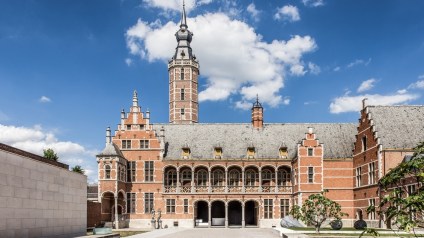
Bienvenue au Museum Hof van Busleyden ! Entrez dans ce grand et magnifique hôtel particulier renaissance à Malines, capitale des Pays-Bas bourguignons. Marchez sur les traces de Jérôme de Busleyden, de Marguerite d’Autriche, d’Erasme et de Thomas More. Échangez des idées et des réflexions sur un monde en plein changement, aujourd’hui comme hier.

hvb-web-01_klein

Le monde s’élargit au quinzième et au seizième siècles. Une nouvelle ère s’annonce, la renaissance, et l’être humain en est le centre de gravité. Tout semble possible, ici comme ailleurs. Cette maison redevient aujourd’hui un lieu de rencontres et de débats, un creuset d’idées nouvelles et un haut lieu de l’art.

Revivez l’étonnante saga des ducs de Bourgogne dans nos contrées et imprégnez-vous de l’atmosphère du hôtel particulier de Busleyden, riche de ses trésors et de ses histoires. Vous y découvrirez comment les Bourguignons considéraient la ville, comment ils régnaient et ce que signifiaient pour eux le génie créatif et l’artisanat. Vous évoluez de salles chargées d’histoires et encore vibrantes des échos du passé en lieux plus intimes et plus silencieux. Vous partez en quête de la véritable Marguerite et tombez en contemplation devant les étonnants et fragiles Jardins Clos.

Ce musée retrace la glorieuse histoire de la ville et nous invite tous à réfléchir sur son avenir. C’est donc un voyage d’incessants aller-retour entre présent et passé qu’il vous propose. Expérimentez à votre gré et entrez en dialogue avec le musée et ses collections sans cesse renouvelées.

L’histoire est loin d’être finie.

 Informations pratiques :

Museum Hof van Busleyden

Frederik de Merodestraat 65
2800 Mechelen

hvb@mechelen.be

+32 15 29 40 30
Heures d’ouverture

lun-mar-ven-sam-dim: 10h – 17h

Source : Museum Hof van Busleyden

Publié dans Exposition | Laisser un commentaire

Publication – Peter C.M. Hoppenbrouwers, « Village Community and Conflict in Late Medieval Drenthe »

Village communities were the heart of the medieval countryside. But how did they operate? This book seeks to find some answers to that question by focusing on late medieval Drenthe, a region situated in a remote corner of the Holy Roman Empire and part of the prince-bishopric of Utrecht. Drenthe was an overwhelmingly localized, rural world. It had no cities, and consisted entirely of small villages. The social and economic importance of traditionally privileged sections of medieval society (clergy and nobility) was limited; free peasant landowners were the dominant social class.

Based on a careful reading of normative sources (Land charters) and thousands of short verdicts given by the so-called ‘Etstoel’ or high court of justice in Drenthe, this book focuses on three types of conflict: conflicts between villages, feud-like violence, and litigations about property. These three types coincide with three levels of involvement: that of village communities as a whole, that of kin groups, and that of households.

The resulting, comprehensive analysis provides a rigorous interrogation of generalized notions of the pre-industrial rural world, offering a snapshot of a typical peasant society in late medieval Europe.
Peter (P.C.M.) Hoppenbrouwers (1954) is Professor of Medieval History at Leiden University. He is the co-author, with Wim Blockmans of Introduction to Medieval Europe 300-1550 (2014; 2nd ed.). His main fields of interest are peasant communities, household and family, local lordship and military organization, and cultures of violence in the medieval Latin West.

Peter (P.C.M.) Hoppenbrouwers (1954) is Professor of Medieval History at Leiden University. He is the co-author, with Wim Blockmans of Introduction to Medieval Europe 300-1550 (2014; 2nd ed.). His main fields of interest are peasant communities, household and family, local lordship and military organization, and cultures of violence in the medieval Latin West.

dIS-9782503575391-1

Table des matières :

List of Illustrations
Abbreviations
Glossary

Chapter 1. Introduction
Chapter 2. Law, Jurisdiction, and Courts of Justice
Chapter 3. Village Communities in Court
Chapter 4. Local Violence: Feuds and Feuding
Chapter 5. The Peasant Family and Intergenerational Property Transfer

Epilogue
Appendix. List of Villages and Districts
Bibliography
Index

Informations pratiques :

P. C.M. Hoppenbrouwers, Village Community and Conflict in Late Medieval Drenthe, Turnhout, Brepols, 2018 (The Medieval Countryside, 20). XVIII+384 p., 14 b/w ill., 156 x 234 mm. ISBN: 978-2-503-57539-1. Prix : 100 euros.

Source : Brepols

Publié dans Le réseau, Publications | Laisser un commentaire