Journée d’étude – The body as a Mirror of the Soul: Physiognomy from Antiquity to the Renaissance

PosterThis workshop will concentrate on physiognomical thought and texts – i.e. the discipline that assesses a person’s character or personality from his or her outer appearance – in a diachronic perspective. It will focus on texts from Antiquity up to the seventeenth century, which were written in different languages (Greek, Arabic, Latin, and the vernacular). Special attention will be paid to the pseudo-Aristotelian Physiognomonica and its reception, which played a central role in this tradition, especially in the Middle Ages and Renaissance. The key questions at stake are firstly which status the discipline of physiognomy – thematically at the crossroads of natural philosophy, medicine and psychology – enjoyed over the centuries, and secondly how the pseudo-Aristotelian text, which enjoyed an authoritative status by its attribution to Aristotle, was approached and connected with other physiognomic treatises by scholars from different time periods and from different disciplines.

This workshop explicitly aims at sketching a larger image of physiognomy as a discipline. This will be done on the one hand by adopting a diachronic perspective: we will focus not only on the medieval tradition in its own value but also consider this tradition as an essential intermediate step between the ancient and renaissance physiognomical tradition. On the other hand, the texts under discussion will be studied not only from a doctrinal but also from a historical and a text-critical perspective. This diachronic and multidisciplinary approach will allow us to detect and to analyze shifts in content, aim, and method that have occurred in the long history of physiognomy and to study the role played by the Aristotelian tradition in this process.
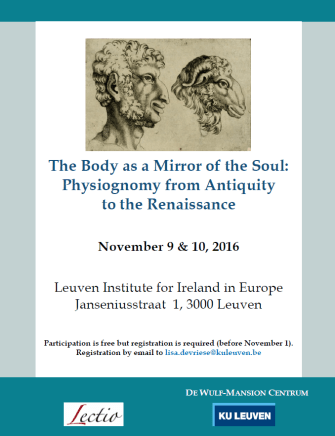
body-as-mirror

Programme :

Wednesday 9 november 2016

09.15 Registration
09.30 PIETER DE LEEMANS (Leuven), Introduction

09.40 Session 1

09.40-10.20: MARIA FERNANDA FERRINI (Macerata), “[Arist.] Physiogn. 812b6 Bekker/812b16 – Förster: οἰνωποί/αἰγωποί. Manuscript tradition and conjecture.”
10.20-11.00: BÉKÉS ENIKŐ (Budapest), “The physiognomy of Apostle Paul”
11.00 Coffee

11.30 Session 2

11.30-12.10: ANTONELLA GHERSETTI (Venezia), “Physiognomy in the Arabic tradition”
12.10-12.50: JOSEPH ZIEGLER (Haifa), “Reflections on the place of astrology in learned physiognomy”
12.50 Lunch

14.10 Session 3

14.10-14.50: DANIELLE JACQUART (Paris), “La tradition galénique de la physiognomonie
médiévale”
14.50-15.30: OLEG VOSKOBOYNIKOV (Moscow), “Michael Scot, Hohenstaufen Court, Physiognomy in text and stone”
15.30 Coffee

16.00 Session 4

16.00-16.40: STEVEN J. WILLIAMS (Las Vegas), “Some observations on the scholarly reception of physiognomy in the thirteenth century: success, and the limits of success”
16.40-17.20: LISA DEVRIESE (LEUVEN),“The reception of Bartholomew of Messina’s translation of ps.-Aristotle’s Physiognomonica”
19.00 Conference dinner

Thursday 10 November 2016

09.00 Session 5

09.00-09.40: JOËL BIARD & CHRISTOPHE GRELLARD (Tours & Paris), “La place des Quaestiones super Phisionomam dans le système philosophique de Jean Buridan”
09.40-10.20: GABRIELLA ZUCCOLIN (Cambridge), “The Speculum physionomiae by Michele Savonarola. A critical edition”
10.20-11.00: LAETITIA MARCUCCI (Marseille), “Physiognomy and the geography of knowledge during the Renaissance period: the paradigmatic and peculiar case of Jean d’Indagine’s Compendium”
11.00 Coffee

11.30 Session 6

11.30-12.10: EVA VIGH (Szeged), “The zoomorphic physiognomy of Giovan Battista Porta”
12.10-12.50: MARTIN PORTER (Lyon), “’The Art of Discerning Others’ (1666): Physiognomy in James Boevey’s ‘Active Philosophy’”
12.50 Concluding Remarks

Informations pratiques :

When : 09 Nov 2016 09:15 AM to 10 Nov 2016 12:50 PM
Where Iers College (Leuven Institute for Ireland in Europe)
Contact Name Lisa Devriese

Contact & registration: lisa.devriese@kuleuven.be

Source : KU Leuven
Publié dans Colloque | Laisser un commentaire

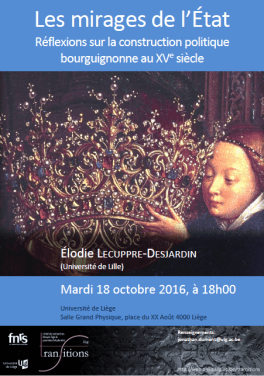
Conférences – Élodie Lecuppre-Desjardin, « Les mirages de l’État. Réflexions sur la construction politique bourguignonne au XVe siècle » et « Les villes des anciens Pays-Bas et la nouveauté »

Le mardi 18 octobre prochain, Élodie Lecuppre-Desjardin interviendra à deux reprises dans le cadre d’activités organisées par l’Unité de recherches « Transitions » (Université de Liège).

mirages-de-letat-bourguigon

D’une part, elle interviendra à l’occasion du séminaire de recherche « Les rouages de l’État bourguignon » (XIVe-XVIe siècles) :

Thème : Vie urbaine
Intervenant : Élodie Lecuppre-Desjardin (Université de Lille)
1. Les villes des anciens Pays-Bas et la nouveauté
2. Actualité, bilan et perspectives
Modérateur : Anne-Laure van Bruaene (Universiteit Gent)

La séance se déroulera de 14h00 à 16h00
Université de Liège, salle Lumière (bât. A1), place du XX Août 4000 Liège
Pour plus d’information, veuillez vous adresser à christophe.masson@ulg.ac.be et jonathan.dumont@ulg.ac.be,
ou consulter le site http://web.philo.ulg.ac.be/transitions/fr/
Comité organisateur : Jonathan Dumont, Alain Marchandisse, Christophe Masson

D’autre part, elle donnera une conférence intitulée « Les mirages de l’État. Réflexions sur la construction politique bourguignonne au XVe siècle ».

Élodie Lecuppre-Desjardin (Université de Lille)
Mardi 18 octobre 2016, à 18h00
Université de Liège
Salle Grand Physique, place du XX Août 4000 Liège
Renseignements:
jonathan.dumont@ulg.ac.be

Source : Transitions

Publié dans Colloque | Laisser un commentaire

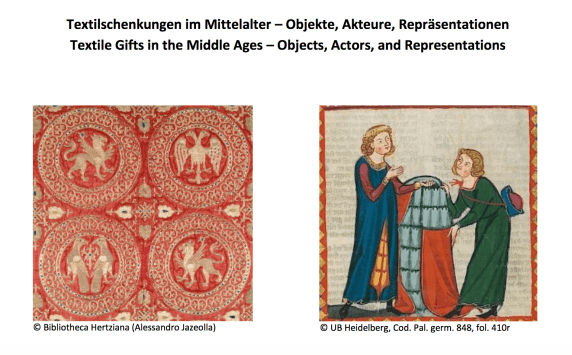
Colloque – Textile Gifts in the Middle Ages – Objects, Actors, and Representations

Gifts of textiles and clothing appeared in diverse contexts and fulfilled various functions in pre-modern Europe. They could be offered in the course of an initiation rite and or an act of social transition, including upon investiture, marriage, or entry into a monastery. Gifts of clothing to the poor, meanwhile, were among the works of charity thematized in the vitae of numerous medieval saints. Sumptuous textiles were sent as resplendent gifts to religious institutions or, like patterned silk textiles from Byzantium, circulated through diplomatic gift exchanges. Gifts of clothing were also distributed within the court as compensation in kind, which supported the structuralization and hierarchization of courtly society. Textile gifts could represent the donor. Especially in the case of clothing previously worn by its donor, the physical presence of the giver might have been woven into the materiality and form of the gifted garment.

The goal of this interdisciplinary conference is to situate the diversity and polysemy of such acts of symbolic communication into the broader context of medieval gift culture. The integration of anthropological and sociological models (Marcel Mauss, Bruno Latour) into an art historical approach allows for gifted artifacts to be taken seriously as independent entities within the giving process as a socially generative form of communication. The conference therefore investigates the relationship between human actors and the “agency” of gifts themselves, exploring how the dynamics of reciprocity and its attendant obligations were charged both visually and materially.

textile-gifts

Programme :

Donnerstag, 3.11.16

10.00 Uhr : Tanja Michalsky: Begrüßung
10.15 Uhr : Christiane Elster (Rom)/Stephanie Luther (Paris): Introduction – Towards an Unpacking of the Medieval Textile Gift
11.00 Uhr : Kaffeepause

Materiality and Agency I
(Moderation: Christiane Elster)

11.30 Uhr : Alžběta Filipová (Brno/Lausanne): The Holy Network. The place of textile in early relic circulation
12.15 Uhr : Jan Keupp (Münster): Der Stoff aus dem Geschenke sind. Zur Materialität der Gabe
13.00 Uhr : Mittagspause

Materiality and Agency II
(Moderation: Tristan Weddigen)

14.30 Uhr : Philine Helas (Rom): Kleiden durch Selbstentkleiden. Ein Exempel der Caritas in der italienischen Kunst zwischen 14. und 15. Jahrhundert
15.15 Uhr : Timothy McCall (Villanova, PA): Worn “nel mezzo del cuore”. Gifts of Luxury Clothing and Embodied Power in Fifteenth-Century Italy
16.00 Uhr : Kaffeepause

16.30 Uhr : Juliane von Fircks (Berlin/Mainz): Between the gift and the market: Imported silk fabrics on their way through Europe (1200-1400)
17.15 Uhr : Cecily Hilsdale (Montreal): Prestation and Proskynesis on Byzantine Silks

Freitag, 4.11.16

Political Gifts and Diplomacy I: Princes and Popes
(Moderation: Stephanie Luther)

9.15 Uhr : Kirsten Frieling (Bielefeld): Verschenkt, vererbt, verordnet. Textile Gaben an spätmittelalterlichen Fürstenhöfen
10.00 Uhr : Lisa Monnas (London): Politics and Patronage: Textile gifts by the Valois Dukes of Burgundy to Our Lady of Tournai
10.45 Uhr : Pippa Salonius (Canterbury, NZ): The Gifts of Kings and Popes: The Ascoli Piceno Cope, its Donors, and its Recipients
11.30 Uhr : Kaffeepause

Political Gifts and Diplomacy II: Byzantine Textiles
(Moderation: Cecily Hilsdale)

12.00 Uhr : Warren T. Woodfin (New York): The Emperor’s Old Clothes: Re-Gifting Byzantine Textiles in the Medieval West
12.45 Uhr : Silvia Leggio (Rom): Alleanze con la seta al tempo del Concilio di Lione (1274): Il Pallio di Michele VIII Paleologo per il Papa Gregorio X
13.30 Uhr : Mittagspause

Transformation and Re-interpretation I: Cathedral
(Moderation: Stefanie Seeberg)

15.00 Uhr : Tanja Kohwagner-Nikolai (Bamberg): Zwischen Memoria und Reliquienverehrung. Überlegungen zum Perspektivwechsel der sog. Kaisergewänder
15.45 Uhr : Patricia Strohmaier (Köln/Leipzig): Ornatus de Grecia – Zur Aneignung von Textilien aus der Schenkung Konrads von Krosigk in Halberstadt
16.30 Uhr : Kaffeepause

Transformation and Re-interpretation II: Cloister
(Moderation: Stefanie Seeberg)

17.00 Uhr : Jörg Richter (Hannover): Textilgeschenke, soziales Netzwerk und Memorialpraxis in niedersächsischen Klöstern
17.45 Uhr : Sabine Schrenk (Bonn): Die Textilreliquien in Sant’Ambrogio, Mailand: Funktionswandel und Präsentationsformen

Samstag, 5.11.16

Gender
(Moderation: Tanja Michalsky)

9.30 Uhr : Stefanie Seeberg (Köln)/Alexandra Gajewski (London): Ideal, Norm und Praxis – Textilschenkungen von Frauen im europäischen Mittelalter
10.15 Uhr : Anna Adashinskaya (Budapest): Textile Gifts of Church Female Donors in the Countries of Late-Byzantine Commonwealth
11.00 Uhr : Kaffeepause

11.30 Uhr : Eleonora Rava (St Andrews), Abiti e corredi nei testamenti pisani (secc. XIII-XIV)
12.15 Uhr : Sara Piccolo Paci (Florenz)/Alessio Palmieri-Marinoni (Sussex): Brunhilde’s Cingulum. Belts and Girdles as Gifts Throughout the Middle Ages

13.00 Uhr : Abschlussdiskussion

Source : Bibliotheca Hertziana

Publié dans Colloque | Laisser un commentaire

Colloque – History and Drama: The Pan-European Tradition

October 26-27, 2016

DramaNet Conference V, organised by Tatiana Korneeva, Jaša Drnovšek and Joachim Küpper Venue: Seminarzentrum der Freien Universität Berlin, Room L115, Habelschwerdter Allee 45, 14195 Berlin
DramaNet office, contact dramanet@fu-berlin.de, +49-30-838-57687
26.10.2016 – 27.10.2016

Seminarzentrum der Freien Universität Berlin
Raum L115
Habelschwerdter Allee 45 / Entrance Otto-von Simson-Str. 26
14195 Berlin

Programme complet : ici

Closing Conference of DamaNet – Early Modern Drama and the Cultural Net

history-and-drama

Mit einer Konferenz zu History and Drama setzt das vom Europäischen Forschungsrat (ERC) geförderte Projekt DramaNet im Oktober den Schlusspunkt unter fünfeinhalb Jahre intensiver Forschung. Ähnlich wie die Bearbeitung von Stoffen für die Theaterbühne ist auch die Geschichtsschreibung ein Medium für soziale und kulturelle (Selbst-)Darstellung. „Wie verhält sich die Geschichtsschreibung zur Bühne ‒ und wie verhält sich Theaterliteratur gegenüber der Geschichte?“

440px-european_research_council_logo-svg

13 Vorträge in insgesamt fünf Panels diskutieren literarische Stoffe, Motive und Strategien aus dem europäischen Drama der Neuzeit. Beleuchtet werden soll dabei jene eigentümliche Beziehung zwischen historisch-literarischen Leitmotiven oder topoi einerseits und der Ausformung von je disparaten nationalen Konventionen andererseits.

Das DramaNet-Projekt unter Leitung von Prof. Küpper ist seit 2011 an der Freien Universität angesiedelt. Zum Abschluss der Arbeit an dem Thema „Early Modern European Drama and the Cultural Net“ findet eine Neuinszenierung durch die Forscher der FU wieder auf¬gefunden Volksschauspiels „Griseldis“ am historischen Ort des Benediktinerstifts Marienberg in Südtirol statt. Das Stück beruht auf der letzten Novelle von Boccaccios ‚Decameron‘ und erlaubt einen besonders guten Einblick in Prozesse literarischer Transkulturation.

Source : Freie Universität Berlin

Publié dans Colloque | Laisser un commentaire

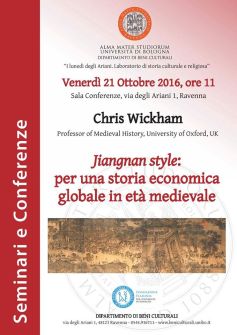
Conférence – Chris Wickham, « Jiangnan style: per una storia economica globale in età medievale »

Jiangnan style: per una storia economica globale in età medievale

Conferenza di Chris Wickham (Professor of Medieval History, University of Oxford, UK)

14542299_684255991750900_1451377752518689735_o

“I lunedì degli Ariani. Laboratorio di storia culturale e religiosa”
21/10/2016 dalle 11:00 alle 13:30

Dove Sala Conferenze del Dipartimento di Beni Culturali, via degli Ariani 1, Ravenna

Source : Universita di Bologna

Publié dans Colloque | Laisser un commentaire

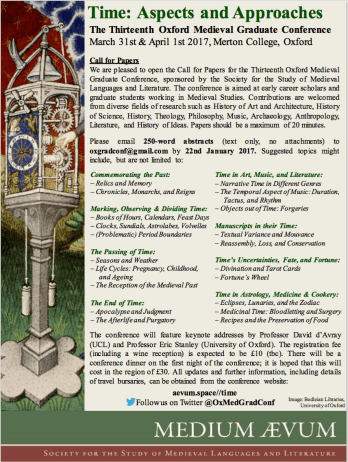
Appel à contribution – Time: Aspects and Approaches. The Thirteenth Oxford Medieval Graduate Conference

March 31st & April 1st 2017, Merton College, Oxford

We are pleased to open the Call for Papers for the Thirteenth Oxford Medieval Graduate Conference, sponsored by the Society for the Study of Medieval Languages and Literature. The conference is aimed at early career scholars and graduate students working in Medieval Studies. Contributions are welcomed from diverse fields of research such as History of Art and Architecture, History of Science, History, Theology, Philosophy, Music, Archaeology, Anthropology, Literature, and History of Ideas. Papers should be a maximum of 20 minutes.

oxford-grad-conf

Please email 250-word abstracts (text only, no attachments) to oxgradconf@gmail.com by 22nd January 2017. Suggested topics might include, but are not limited to:

Commemorating the Past:
– Relics and Memory
– Chronicles, Monarchs, and Reigns

Marking, Observing & Dividing Time:
– Books of Hours, Calendars, Feast Days – Clocks, Sundials, Astrolabes, Volvelles – (Problematic) Period Boundaries

The Passing of Time:
– Seasons and Weather
– Life Cycles: Pregnancy, Childhood,
and Ageing
– The Reception of the Medieval Past

The End of Time:
– Apocalypse and Judgment – The Afterlife and Purgatory
Time in Art, Music, and Literature:
– Narrative Time in Different Genres
– The Temporal Aspect of Music: Duration,
Tactus, and Rhythm
– Objects out of Time: Forgeries

Manuscripts in their Time:
– Textual Variance and Mouvance
– Reassembly, Loss, and Conservation
Time’s Uncertainties, Fate, and Fortune:
– Divination and Tarot Cards – Fortune’s Wheel
Time in Astrology, Medicine & Cookery:
– Eclipses, Lunaries, and the Zodiac
– Medicinal Time: Bloodletting and Surgery – Recipes and the Preservation of Food

The conference will feature keynote addresses by Professor David d’Avray (UCL) and Professor Eric Stanley (University of Oxford). The registration fee (including a wine reception) is expected to be £10 (tbc). There will be a conference dinner on the first night of the conference; it is hoped that this will cost in the region of £30. All updates and further information, including details of travel bursaries, can be obtained from the conference website:
aevum.space//time

Followus on Twitter @OxMedGradConf

Publié dans Appel à contributions | Laisser un commentaire

Colloque – Enseigner la langue et la littérature du Moyen Âge en France en 2016 : Histoire, expériences, perspectives

Journée d’études organisée par la SLLMOO le 5 novembre 2016
Sorbonne, Amphithéâtre Michelet
Accès à l’amphithéâtre Michelet au 46 rue Saint Jacques, 75005 Paris

Dans le cadre du plan Vigipirate, inscription obligatoire avant le 1er novembre 2016 – entrée sur présentation d’un invitation et d’une pièce d’identité

Contact pour l’inscription et l’invitation : veronique.dominguez[à]aliceadsl.fr

sllmoo

Programme :

Introduction : 9h Marie-Madeleine Castellani (Présidente de la SLLMOO, Université de Lille) et Véronique Dominguez (secrétaire de la SLLMOO, Université d’Amiens) : accueil, présentation générale: «La recherche et l’enseignement secondaire: pourquoi, comment ? »

Matinée : Les études médiévales en France : l’Histoire, la littérature et l’académie

9h30 Philippe le Guillou, (Inspection Générale de l’Éducation nationale, écrivain)
10h Jacqueline Cerquiglini-Toulet, (Université Paris 4 Sorbonne, émérite) : « Les études médiévales dans les enseignements en France, une rétrospective »
Discussion
Pause

Études médiévales et programmes scolaires : enjeux
Modératrice : Florence Bouchet (Université de Toulouse)

11h00 Philippe Haugeard (Université d’Orléans), Daniel Guillaume, (IA-
IPR, Académie de Créteil) : « Les nouveaux programmes de français : réapprendre à lire ? »
11h30 Guillaume Oriol, (CPGE, Académie de Bordeaux) : « La place des études médiévales dans la définition des curricula : enseignement secondaire et CPGE »
Discussion
Déjeuner : 12h30-14h

Après-midi : Pratiquer les études médiévales Expériences et perspectives

14h-16h : Table ronde n°1 : Formations générales et continues : l’ancien et le nouveau
Modératrice : Evelyne Ballanfat, IA-IPR (Académie de Créteil)

Langue

Blandine Longhi (ESPE de Paris) : « Quand l’ancien français aide à apprendre le français »
Florence Tanniou (Université Paris-Ouest). « La lettre et la voix : usages médiévaux et pratiques de la langue dans l’enseignement secondaire »

Littérature

Chloé Lelong (Académie de Lyon) : « La littérature médiévale au collège, un continuum didactique ? »
Sandrine Legrand (Académie de Lille) : « Quelle littérature médiévale enseigner dans le secondaire ? »

Interdisciplinarité

Mathilde Grodet (Académie de Créteil) : « Ponts et carrefours. Enjeux de la littérature médiévale dans les pratiques interdisciplinaires »
Pause

16h30-18h : Table ronde n°2 : Récrire pour penser, entre création et pédagogie
Modératrice : Véronique Jacob (directrice de collection parascolaire Gallimard)

Anne-Marie Cadot-Colin, (Université de Bordeaux, écrivain, Association Lire et Faire Lire) : « De Lancelot à Renart : comment adapter sans trahir ? »
Jean-Pierre Tusseau (Université du Québec, auteur aux Classiques Abrégés de l’Ecole des Loisirs) : « Traduire et adapter les textes du Moyen Âge à l’intention des jeunes lecteurs. Quelle nécessité ? Contraintes et limites de l’exercice »

Source : Conjointures

Publié dans Colloque | Laisser un commentaire

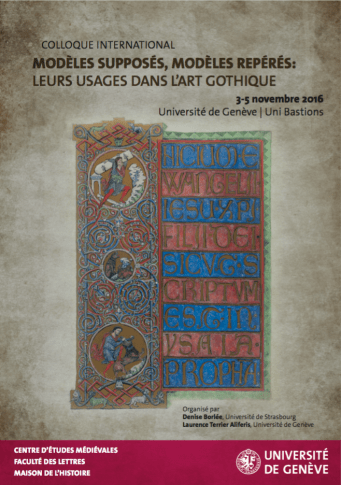
Colloque – Modèles supposés, modèles repérés : leurs usages dans l’art gothique

Colloque international, Université de Genève, 3-5 novembre 2016

Organisé par
Denise Borlée, Université de Strasbourg
Laurence Terrier Aliferis, Université de Genève

http://www.unige.ch/colloque-modeles

modeles-supposes-modeles-reperes

Programme :

Jeudi 3 novembre 2016
Uni Bastions – B111

13h30 Accueil des participants

14h00 Allocutions de Jan Blanc, doyen de la Faculté des Lettres et professeur d’histoire de l’art moderne et de Frédéric Elsig, directeur de l’unité d’histoire de l’art et professeur d’histoire de l’art médiéval, Université de Genève
14h20 Mots de bienvenue et présentation du colloque, Denise Borlée et Laurence Terrier Aliferis

14h35 Introduction. Les modèles gothiques : un état des questions, Laurence Terrier Aliferis, maître-assistante, Université de Genève.

Session 1 : Carnets de modèles
Présidence : Roland Recht

15h00 Anna Pozhidaeva, enseignante et chargée de cours, Université et HSE, Moscou – À propos de la variété des sources iconographiques des Jours de la Création au XIIe siècle en Europe Occidentale : tentative de reconstruction d’un modèle perdu.
15h30 Anne Ritz-Guilbert, enseignante-chercheure École du Louvre, Paris – Les modèles du Bréviaire de Marie de Savoie par le Maître des Vitae Imperatorum.
16h00 Pause

Présidence : Xavier Barral i Altet

16h30 Caroline O. Fowler, chercheur postdoc, Yale University New Haven – Drawing in a World of Strangers ca. 1400.
17h00 Joris C. Heyder, enseignant-chercheur, Université de Bielefeld – Intermediate Leftovers : What Unfinished Miniatures can tell us About the Use of
Pattern Sheets in Late Medieval Manuscript Illumination.

Vendredi 4 novembre 2016
Uni Bastions B111

Session 2 : Variété des supports
Présidence : Jean Wirth

9h00 Daniel Parello, chercheur au Corpus Vitrearum Allemagne, Fribourg-en-Brisgau – Some Thoughts on the Use and Transmission of Models in Glass-painting.
9h30 Eva Maria Breisig, conservatrice, Augustinermuseum, Fribourg-en-Brisgau – The Clay Model of a Female Head and the Art of the Parler in the Upper-Rhine Region.
10h00 Sofia Gans, doctorante, Université de Columbia, New York City – Wood and wax, models and molds : The Vischer Workshop or Nuremberg and late Medieval German Casting Models.
10h30 Pause

Présidence : Jean Wirth

11h00 Denise Borlée, maître de conférences, Université de Strasbourg et Vincent Cousquer, sculpteur, Fondation de l’Oeuvre Notre-Dame de Strasbourg et doctorant, Université de Strasbourg – Du dessin à la ronde-bosse : la tête de saint Pierre de Villard de Honnecourt en 3D. Essai d’histoire de l’art expérimentale.
11h45 Anna Kónya, doctorante, Université d’Europe centrale, Budapest – From Copying to Adaptation. The Uses of Prints in Transylvanian Wall Paintings from the Late Gothic Period (c. 1450-1520).

Session 3 : Dialogues entre l’orfèvrerie et les autres arts
Présidence : Pierre Alain Mariaux

14h00 Benoît van den Bossche, professeur, Université de Liège et Emanuelle Mercier, docteure en histoire de l’art et restauratrice IRPA – L’orfèvrerie comme parangon ? L’enluminure et la statuaire mosanes des XIIe et XIIIe siècles.
14h30 Michele Tomasi, maître d’enseignement et de recherche, Université de Lausanne – Entre commanditaires et artistes, entre pratiques d’atelier et créativité : la question des modèles dans l’orfèvrerie française à la fin du Moyen Âge.
15h00 Pause

Session 4 : Figures d’autorité
Présidence : Marc Schurr

15h30 Christopher R. Lakey, professeur assistant, Université John Hopkins, Baltimore – Diagram as model in the manuscript tradition of Bede’s De rerum natura.
16h00 Pascale Charron, maître de conférences, Université de Tours CESR – La question de la circulation des modèles de Jean Fouquet dans la sculpture tourangelle de la fin du Moyen Âge.
16h30 Alain Salamagne, professeur, Université de Tours CESR – « Pour adviser et memorisier en eulx et par escript » : les modèles dans l’architecture de la fin du Moyen Âge et du début de la Renaissance.

Samedi 5 novembre 2016
Uni Bastions B101

Session 5 : À la recherche des modèles
Présidence : Frédéric Elsig

9h00 Ludovico V. Geymonat, professeur associé invité, Université de Notre-Dame, Indiana – The Use of Models in the Baptistery of Parma.
9h30 Alessandra Costa, assistante, Université de Genève – De l’usage du modèle autour de 1400 : le cas de Giacomo Jaquerio
10h00 Thomas Bohl, conservateur du patrimoine, Paris – Giovanni di Paolo : sources, usages et significations d’un répertoire de modèles singulier.
10h30 Pause

Présidence : Christian Heck

11h00 Dominic E. Delarue, akademischer Rat auf Zeit, Université de Regensburg – The Mental Models of the Montbastons. Reflections on the Generation of Iconographies in the Parisian Book Production of the first half of the 14th century.
11h30 Marc Gil, maître de conférences, Université de Lille 3-IRHIS – Circulation et sources des modèles entre les ateliers de sculpteurs et de peintres autour des chantiers de Châlon-en-Champagne, Provins et Troyes vers 1160-1180.

Session 6 : Production sérielle
Présidence : Frédéric Elsig

14h00 Nicolas Bock, maître d’enseignement et de recherche, Université de Lausanne – Les monuments funéraires à Naples au XIVe siècle.
14h30 Joanna Olchawa, chercheure post-doc, Université d’Osnabrück – « Mechanica is the Knowledge in the Art of Working in Metals… ». Multiple Bronze Artefacts made in Hildesheim in the Thirteenth Century.

15h00 Table ronde présidée par Fabienne Joubert, professeur émérite, Université de Paris IV-Sorbonne et animée par les membres du comité scientifique

16h00 Xavier Barral i Altet, Université de Rennes et de Venise Ca’Foscari, Biblioteca Hertziana Rome – Conclusion

17h00 Verre de l’amitié

La participation au colloque est gratuite

Comité scientifique :

Michele Bacci, Université de Fribourg ; Philippe Cordez, Ludwig-Maximilians-Universität München; Frédéric Elsig, Université de Genève ; Christian Heck, Université de Lille 3 ; Herbert Kessler, Johns Hopkins University ; Pierre Alain Mariaux, Université de Neuchâtel ; Roland Recht, Paris, Collège de France; Marc Schurr, Université de Strasbourg ; Jean Wirth, Université de Genève

Contact : colloque.modeles@gmail.com

Publié dans Colloque | Laisser un commentaire

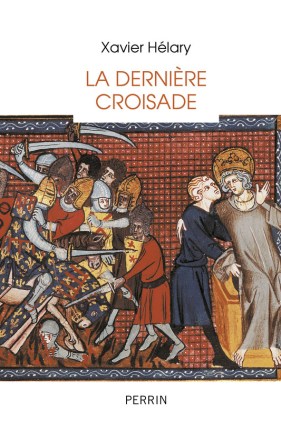
Publication – Xavier Hélary, « La dernière croisade »

Pour la première fois, et dans un contexte géopolitique particulier, la dernière croisade est racontée et expliquée.

25 août 1270 : Saint Louis s’éteint dans le camp de l’armée croisée, près de l’ancienne Carthage. Partis au début du mois de juillet d’Aigues-Mortes, les barons et les chevaliers qui ont pris la croix à la suite du roi de France débarquent à Tunis quelques jours plus tard. Paralysés par l’attente toujours différée du roi de Sicile, épuisés par les chaleurs de l’été tunisien, les croisés sont rapidement décimés par la maladie qui emporte le roi et plusieurs hauts personnages. Après quelques combats menés pour sauver les apparences, l’armée rembarque au mois de novembre. La destruction de la flotte dans un port sicilien par une tempête empêche l’expédition de se poursuivre en Terre sainte. Les survivants n’ont plus d’autre choix que de rentrer en France.

9782262038199

Entreprise à grands frais, précédée de nombreux préparatifs de toutes sortes, la huitième et dernière croisade s’avère un échec complet. C’est le récit d’un désastre qu’entreprend ce livre, depuis la prise de croix de Saint Louis en 1267 jusqu’au retour des croisés au printemps 1271. Un désastre à méditer en ces temps de crispations et de confrontations.

Ancien élève de l’ENS, agrégé d’histoire, Xavier Hélary est professeur d’histoire médiévale à l’université Jean-Moulin Lyon III. Il est l’auteur de Courtrai, ainsi que de L’Armée du roi de France et, avec Philippe Contamine, de Jeanne d’Arc. Histoire et dictionnaire.

Informations pratiques :
Xavier Hélary, La dernière croisade, Paris, Perrin, 2016. 200 pages. ISBN : 9782262038199. 200 pages. Prix : 22 euros.

Source : Perrin

Publié dans Publications | Laisser un commentaire

Appel à contribution – The Emperor and the City: Art in Nuremberg in the 14th century

Germanisches Nationalmuseum, Nurenberg, January 19-22, 2017
Deadline: October 15, 2016

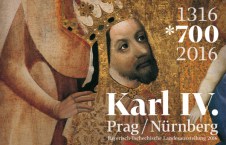
Aus Anlass der ersten Bayerisch-Tschechischen Landesausstellung “Kaiser Karl IV. (1316–1378)”, die in Prag (Nationalgalerie, Wallenstein-Reitschule, 15. 5.-25. 9.2016) und Nürnberg (Germanisches Nationalmuseum 20.10.2016 – 5. 3.2017) stattfindet, wird unter Federführung des Kuratorenteams vom GWZO Leipzig, der Nationalgalerie Prag, des Germanischen Nationalmuseums und des Lehrstuhls für Mittelalterliche Kunstgeschichte der Otto-Friedrich-Universität Bamberg eine Tagung in Nürnberg veranstaltet werden. Aktuelle Forschungsfragen rund um die Themen der Ausstellung mit dem Fokus auf Nürnberg und den benachbarten Herrschaftsschwerpunkten sollen vor Ort diskutiert werden.

karl-iv-d-06-ka

Die Ausstellung legt einen Schwerpunkt auf die verschiedenen Formen herrschaftlicher Repräsentation, wie sie Kaiser Karl IV. in großem Umfang und auf hohem künstlerischen Niveau einsetzte. Pflegte man die Epoche früher durch den Namen der Baumeisterfamilie Parler zu charakterisieren, hat sich das Bild inzwischen dahingehend gewandelt, dass man deren zweifellos bedeutende Aktivitäten als Teil einer viel größer angelegten “Performance” des Kaisers und seiner Parteigänger zu verstehen hat. Auch die dominierende Rolle der böhmischen Hauptstadt Prag ist zwar nicht in Frage zu stellen, aber doch zu ergänzen durch das politisch, offenkundig auch künstlerisch sehr eigenständige Nürnberg, das Karl IV. im Zusammenspiel mit den örtlichen Eliten zu einer zweiten Residenz ausgestaltete.

Die Tagung möchte neue methodische und thematische Perspektiven unter besonderer Berücksichtigung Nürnbergs einschließlich der größeren Region (z. B. den fränkischen Bistümern, Reichsstädten, der Burggrafschaft und dem sog. “Neuböhmen” Karls IV.) diskutieren. Der methodische Schwerpunkt wird auf bildkünstlerischen, architekturhistorischen und historischen Fragen liegen; bevorzugt werden Beiträge, die hier Verbindungen respektive Überschneidungen aufweisen. Es wäre wünschenswert, wenn das Spannungsfeld Herrscher – Stadt, bzw. im Falle Nürnbergs auch das Dreiecksverhältnis Kaiser – Stadt – Burggraf (als Landesherr eines im Wachsen begriffenen Territoriums) zur Sprache käme. Die Rolle einzelner Persönlichkeiten, Institutionen oder Örtlichkeiten kann exemplarisch vorgestellt werden, ebenso können Beispiele vergleichend auch aus den Regierungszeiten der übrigen luxemburgischen Herrscher (Heinrich VII., Johann von Böhmen, Wenzel IV.) wie auch Kaiser Ludwigs IV. des Bayern vorgeschlagen werden.

Eingeladen sind alle, die sich vertieft und innovativ mit Fragen architektonischer und künstlerischer Repräsentation befassen, wobei auch Nachwuchswissenschaftler/innen die Möglichkeit geboten werden soll, ihre Thesen zur Diskussion zu stellen. Für jeden Beitrag sind 20 Min. Redezeit und daran anschließend 20 Min. Diskussion geplant.

Tagungssprachen sind Deutsch und Englisch.

Eine Publikation der Beiträge ist vorgesehen.

How to Submit: Bitte senden Sie ein kurzes Exposé von höchstens einer Normseite nebst einem kurzen CV von ähnlicher Länge per E-Mail bis 15. Oktober 2016 an
folgenden Kontakt:
GWZO, Dr. Markus Hörsch (m.hoersch@web.de)

Organised by:

Geisteswissenschaftliches Zentrum Geschichte und Kultur Ostmitteleuropas an der Universität Leipzig e. V., PD Dr. Jiří Fajt

Germanisches Nationalmuseum, Nürnberg, Generaldirektor Prof. Dr. G.
Ulrich Großmann

Lehrstuhl für Kunstgeschichte, insbesondere Mittelalterliche
Kunstgeschichte, der Otto-Friedrich-Universität Bamberg, Prof. Dr.
Stephan Albrecht

Národní galerie v Praze, Generaldirektor PD Dr. Jiří Fajt

Prof. Dr. Eva Schlotheuber, Heinrich-Heine-Universität Düsseldorf

Source : Medieval Art Research

Publié dans Appel à contributions | Laisser un commentaire