Colloque – Ligues et alliances interurbaines en Europe (XIIe-XVIe siècle)

Le colloque de Rome, qui clôt un programme quinquennal de rencontres sur la diplomatie urbaine au Moyen Âge et l’époque moderne, se propose la question singulière des ligues urbaines qui n’a pas fait l’objet de synthèses comparatives régionales. Si l’on excepte quelques cas bien documentés, notamment en Italie, en Empire ou en Flandres, le sujet a peu retenu l’attention des chercheurs, alors même qu’il porte à l’extrême les enjeux de la diplomatie des villes par l’intensification des réseaux que ces alliances induisent ou par la nature même des objectifs parfois vitaux pour les cités qui en sont à l’origine. La première et la seconde ligues lombardes en sont un bel exemple, mais nullement le seul. Les échelles d’intervention, de méthodes ou d’organisation de ces ligues tout le long de la période considérée restent des questions ouvertes.

La rencontre sera l’occasion de compléter par des études de cas la constitution, les écueils et les limites de cette dynamique inter-urbaine qui posait les organismes urbains en acteurs majeurs de leur histoire, parfois en opposition même aux souverains (comme ce fut le cas lors des Comunidades dans l’Espagne de Charles Quint, en 1520-1522). Le programme s’intéressera aux modalités de création de ces alliances, à leur fonctionnement quotidien (gouvernance, budget, programme) autant qu’à leurs résultats directs ou indirects (hiérarchisation entre les cités, renégociation éventuelle des rapports avec les souverains, etc.). La rencontre de Rome fournira ainsi l’une des premières synthèses à l’échelle européenne sur ces dispositifs inter-urbains dont on ne connaît souvent que les exemples les plus emblématiques, alors même qu’ils ont été une modalité fréquente et flexible des relations entre les cités tout autant qu’un moyen de s’affirmer comme acteurs territoriaux.

Programme : ici
Informations pratiques :

École française de Rome, Piazza Navona, 62
Du 23/06/2022 à 15 h 00 au 24/06/2022 à 19 h 00

Org. Armand Jamme (CIHAM), Paolo Cammarosano (Università degli studi di Trieste), Patrick Gilli (Université de Montpellier)

Partenaires : CIHAM (UMR 5648), Centro Europeo di Ricerche Medievali (Trieste), CEMM (EA 4583)

Source : École française de Rome
Publié dans Colloque | Laisser un commentaire

Colloque – Transformative Bodies in the Premodern World: Experiences and Materials

The theme of this workshop is the transformation of bodies through, with or in relation to experiences and materials. Eight speakers will be in exploring the ways in which past peoples engaged with objects and materials from a variety of disciplinary and geographical backgrounds. The presentations will engage with practices (e.g. ritual, artistic, medicinal) that affected an actual or perceived change (in/of the body of the practitioner or the materials used), for example practices involving the body and/or objects that could act as protection against something or charge objects or materials with apotropaic abilities, but also practices that could act as transformative in other ways. The goal of the workshop is to combine the ritualistic, the religious, the magical and the medicinal understanding of bodies in order to expand our understanding of the premodern way(s) of experiencing and engaging with the sensorial and material realities. While the temporal framework is what in Western historical writing is referred to as the medieval and early modern periods, the geographical framework stretches beyond the Eurocentric scope in order to widen our perspectives and further enrich the debate. The scope of the workshop is highly interdisciplinary and speakers have backgrounds in fields as diverse as the history of science, musicology, archaeology, art history, material culture, history, and religious studies.

Organised by Mads Heilskov (The Courtauld) and Zuzanna Sarnecka (University of Warsaw).

Programme :

13.00: Welcome (Lecture Theatre 2)

13.10: Session 1: Gender and Thing-power

Montserrat Cabré, Universidad de Cantabria: Adorning the female body: divergence and accord in 15th century women’s thinking

Don C. Skemer, Princeton University: Solomon and Faust: Magic Encircling the Body

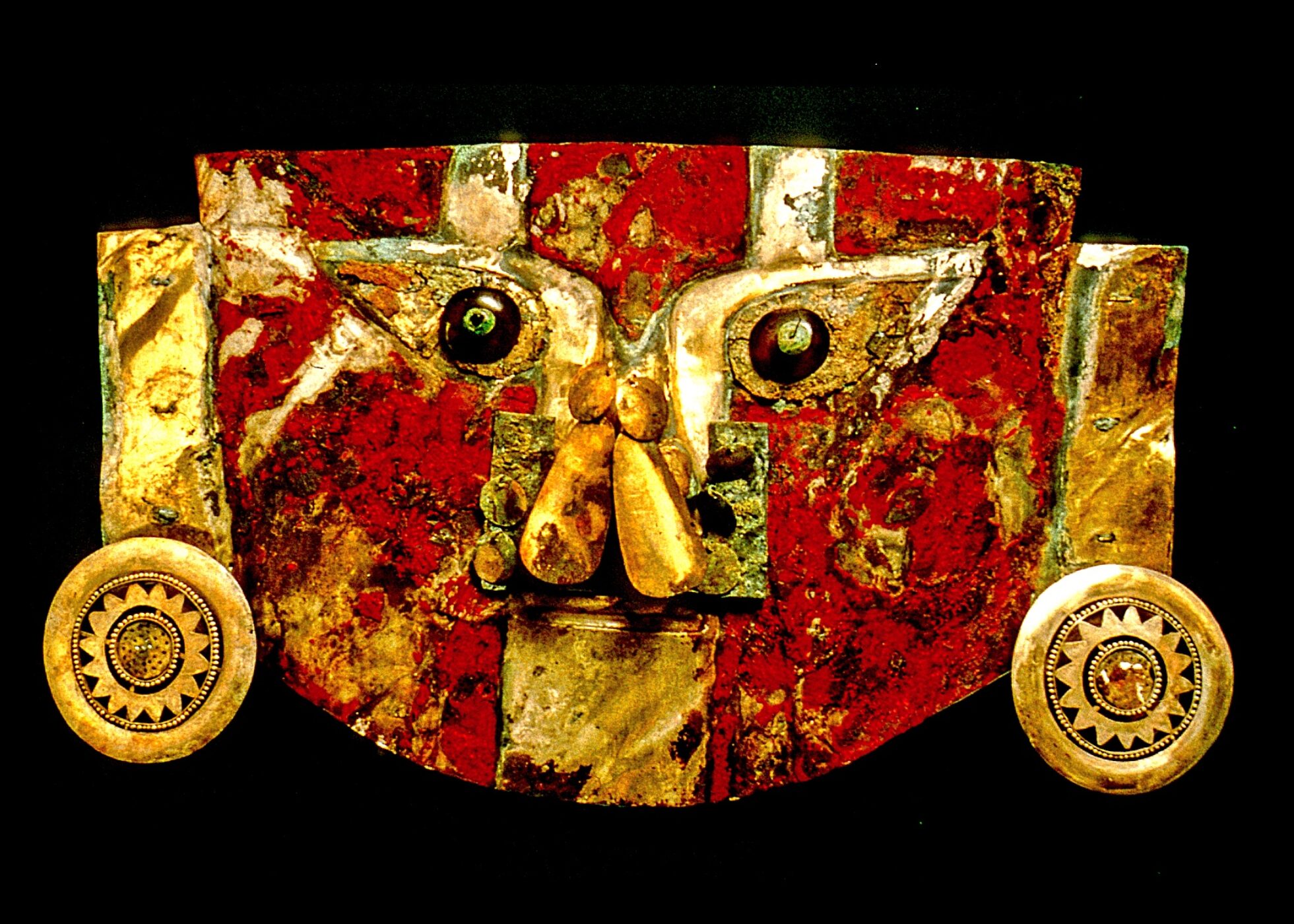
Luciana Carvalho, University of Oxford: Red for Rebirth! The use of cinnabar by the Sicans

Zuzanna Sarnecka, University of Warsaw: Moisture and dryness: Fictive materiality of glazed terracotta sculptures in Renaissance Italy

15.10: Break

15.30: Session 2: Devotion and the Body

Jessica Maratsos, University of Cambridge: The Saintly body: Art, Anatomy, and Reanimation

Antonio Chemotti, KU Leuven (Alamire Foundation) / KBR: Hearing heavenly music during exequies in post-Tridentine Italy

Louisa McKenzie, The Warburg Institute: Making yourself in wax: the metamorphic potential of the wax ex-voto

Mads Heilskov, The Courtauld Institute of Art: Life-Lines: Stylus, Pen, Chisel, Paintbrush

17.30: Closing Remarks

17.45: Wine reception (Research Forum Seminar Room)

Informations pratiques :

1:00pm, 27 Jun 2022

Monday 27th June 2022, 1pm – 7pm BST

Free, booking essential

Lecture Theatre 2, Vernon Square

Booking will close 30 minutes before the event start time

Source : The Courtauld

Publié dans Colloque | Laisser un commentaire

Colloque – Remembratio codicum : Fragments, de manuscrits en archives…

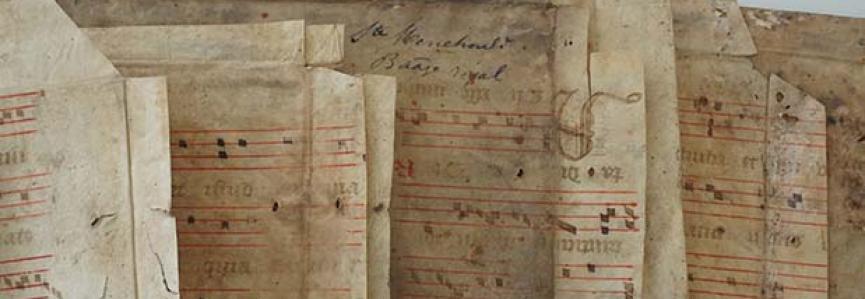
Deux journées d’étude sont organisées jeudi 23 et vendredi 24 juin 2022 à Tours et Angers par l’IRHT (section de musicologie), les Archives départementales d’Indre-et-Loire et du Maine-et-Loire, avec le concours des Archives Nationales, des Bibliothèques municipales d’Angers et de Tours, le soutien du Ministère de la Culture (SLL– Patrimoine Écrit).

L’intérêt pour les fragments et les défets de reliures trouvés dans les feuillets de garde des manuscrits ou dans les couvrures de liasses d’archives, en particulier issus de livres liturgiques pourvus de notations musicales, n’a cessé de croître ces dernières décennies dans les milieux de la recherche sur les manuscrits médiévaux, notamment avec le programme Fragmentarium mené par l’Université de Fribourg en Suisse.

Ces années 2021-2022, l’Institut de recherche et d’histoire des textes, notamment la section de musicologie (Pôle Quadrivium), a pu mettre en œuvre un programme de recherche et de valorisation de ces fragments d’ouvrages démembrés qui furent souvent ces livres d’usage pratique comme les antiphonaires, les livres de chant, dont les statistiques à travers toute l’Europe apportent ces documents par milliers, migrés aussi bien vers les fonds d’Archives, les Bibliothèques et les collections publiques ou privées. Ces démembrements ont commencé au Moyen Âge lui-même, quand les livres d’usages ne répondaient plus aux besoins du moment (changements liturgiques, évolution des pratiques, de notation musicale…). Les moments forts de destruction-remploi se situent bien à la charnière de deux mondes, celui de la fin du Moyen Âge et le début de l’imprimerie, avec un pic aux XVIIe et XVIIIe siècles, quand les instances civiles comme les notaires privés, pouvaient se procurer des parchemins vendus au poids.

En deux pôles importants de la conservation de telles sources, ces journées d’étude souhaitent établir un premier bilan de prometteuses recherches, partagées avec d’autres collègues européens, musicologues et liturgistes. Réunissant autour d’une même table différents acteurs du patrimoine écrit, des ateliers thématiques permettront de croiser les disciplines (écrits archivistiques, codicologie, médiévistique, conservation, restauration, médiation culturelle et valorisation, photographie, humanités numériques, philologie, liturgie, musicologie) pour mettre au point des méthodologies d’approche de ce phénomène singulier dans l’histoire du livre, du document d’archive et du patrimoine écrit, du remploi ou recyclage de manuscrits séculaires voire millénaires, en parchemin.

Programme :

Jeudi 23 juin, Tours, Archives Départementales-Salle Victor Laloux

  • 9h30 – Accueil
  • 10h – Atelier 1 : Origines et pratiques du remploi des livres liturgiques
  • 14h15 – Atelier 2 : exploitation scientifique, médiation et valorisation
  • 17h30 – Concert-lecture (Site des Ursulines)
  • 17h50 – Visite commentée de quelques pièces des Archives d’Indre-et-Loire

Avec les interventions de : Alexis Douchin (Archives Nationales), Lydiane Gueit-Montchal (Archives d’Indre-et-Loire), Gilles Kagan, Jean-François Goudesenne (IRHT), Dominique Gatté, Susana Zapke (Wien Universität), Lucie Moruzzis, Isabelle Scappazzoni (Archives Nationales), Claire Nalin, (Institut national du patrimoine, master), Anna Zakova (doctorante Prague, Université Carlova/IRHT post-doc).

Vendredi 24 juin, Angers, Archives Départementales

  • 9h30 – Accueil aux Archives Départementales
  • 9h45 – Atelier 3 : catalographie et inventaires Atelier 4 : exploitation scientifique, médiation et valorisation
  • 12h15 – Visite commentée de quelques pièces des Archives du Maine-et-Loire

Avec les interventions de : Luc Forlivesi (Ministère de la Culture, Inspection des Patrimoines), Floriana Bardoneschi / Paul-Henri Lecuyer (Archives dép. 49), Gionata Brusa (Vercelli, Biblioteca capitolare / Würzburg Universität), Marc Edouard Gautier (BM Angers).

  • 14h15 Bibliothèque municipale Toussaint Atelier 5 : prospection
  • 15h30 Table-ronde conclusive

Informations pratiques :

23-24 juin 2022

Tours, Archives Départementales-Salle Victor Laloux

Angers, Archives Départementales/Bibliothèque municipale Toussaint

Source : IRHT

Publié dans Publications | Laisser un commentaire

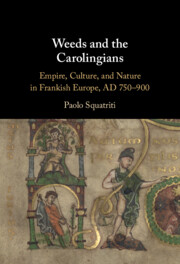
Publication – Paolo Squatriti, « Weeds and the Carolingians Empire. Culture, and Nature in Frankish Europe, AD 750–900 »

Why did weeds matter in the Carolingian empire? What was their special significance for writers in eighth- and ninth-century Europe and how was this connected with the growth of real weeds? In early medieval Europe, unwanted plants that persistently appeared among crops created extra work, reduced productivity, and challenged theologians who believed God had made all vegetation good. For the first time, in this book weeds emerge as protagonists in early medieval European history, driving human farming strategies and coloring people’s imagination. Early medieval Europeans’ effort to create agroecosystems that satisfied their needs and cosmologies that confirmed Christian accounts of vegetable creation both had to come to terms with unruly plants. Using diverse kinds of texts, fresh archaeobotanical data, and even mosaics, this interdisciplinary study reveals how early medieval Europeans interacted with their environments.

Paolo Squatriti is Professor of History at the University of Michigan. His previous publications include Water and Society in Early Medieval Italy (Cambridge, 1998) and Landscape and Change in Early Medieval Italy (Cambridge, 2013). The latter won a prize from the American Association for Italian Studies.

Table des matières :

  1. Weeds, nature, and empire
  2. Weeds on the ground
  3. The time of weeds
  4. The worst of weeds
  5. The botany of paradise in Carolingian Rome
  6. The uses of weeds
  7. The politics of weeding in the Carolingian Empire
    Epilogue.

Informations pratiques :

Paolo Squatriti, Weeds and the Carolingians Empire. Culture, and Nature in Frankish Europe, AD 750–900, Cambridge, Cambridge University Press, 2022. 280 p. ISBN : 9781316512869. Prix : GBP 75.

Source : Cambridge University Press

Publié dans Publications | Laisser un commentaire

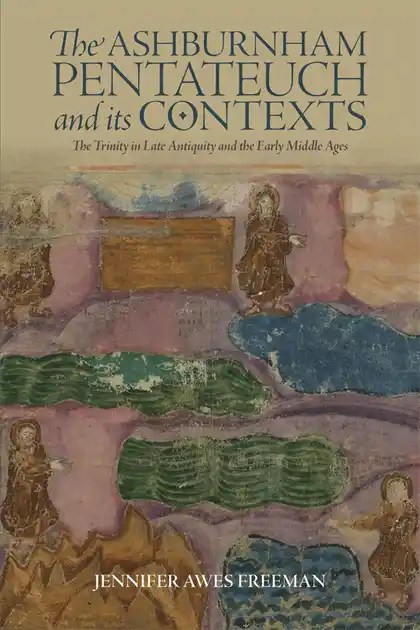
Publication – Jennifer Awes Freeman, « The Ashburnham Pentateuch and its Contexts. The Trinity in Late Antiquity and the Early Middle Ages »

The Ashburnham Pentateuch is an early medieval manuscript of uncertain provenance, which has puzzled and intrigued scholars since the nineteenth century. Its first image, which depicts the Genesis creation narrative, is itself a site of mystery; originally, it presented the Trinity as three men in various vignettes, but in the early ninth century, by which time the manuscript had come to the monastery at Tours, most of the figures were obscured by paint, leaving behind a single creator. In this sense, the manuscript serves as a kind of hinge between the late antique and early medieval periods. Why was the Ashburnham Pentateuch’s anthropomorphic image of the Trinity acceptable in the sixth century, but not in the ninth?

This study examines the theological, political, and iconographic contexts of the production and later modification of the Ashburnham Pentateuch’s creation image. The discussion focuses on materiality, the oft-contested relationship between image and word, and iconoclastic acts as « embodied responses ». Ultimately, this book argues that the Carolingian-era reception and modification of the creation image is consistent with contemporaneous iconography, a concern for maintaining the absolute unity of the Trinity, as well as Carolingian image theory following the Byzantine iconoclastic controversy. Tracing the changes in Trinitarian theology and theories of the image offers us a better understanding of the mutual influences between art, theology, and politics during Late Antiquity and the early Middle Ages.

Jennifer Awes Freeman is Assistant Professor and Program Director of Theology and the Arts at United Theological Seminary of the Twin Cities.

Table des matières :

Introduction: Losing and Finding the Ashburnham Pentateuch

  1. Early Trinitarian Texts and Debates
  2. The Trinity in Early Christian Images
  3. Carolingian Conceptions of the Trinity
  4. Carolingian Image Theory
  5. The Carolingian Reception of the Ashburnham Pentateuch
    Conclusion: Possible Motivations for the Ashburnham Pentateuch Erasures[TS1]
    Coda: The Afterlife [TS2] of the Ashburnham Pentateuch

Informations pratiques :

Jennifer Awes Freeman, The Ashburnham Pentateuch and its Contexts. The Trinity in Late Antiquity and the Early Middle Ages, Woodbridge, Boydell and Brewer, 2022 (Boydell Studies in Medieval Art and Architecture). 244 Pages, 23.4 x 15.6 cm, 8 colour; 39 b/w illus. ISBN : 9781783276844. GBP 75.

Source : Boydell & Brewer

Publié dans Le réseau | Laisser un commentaire

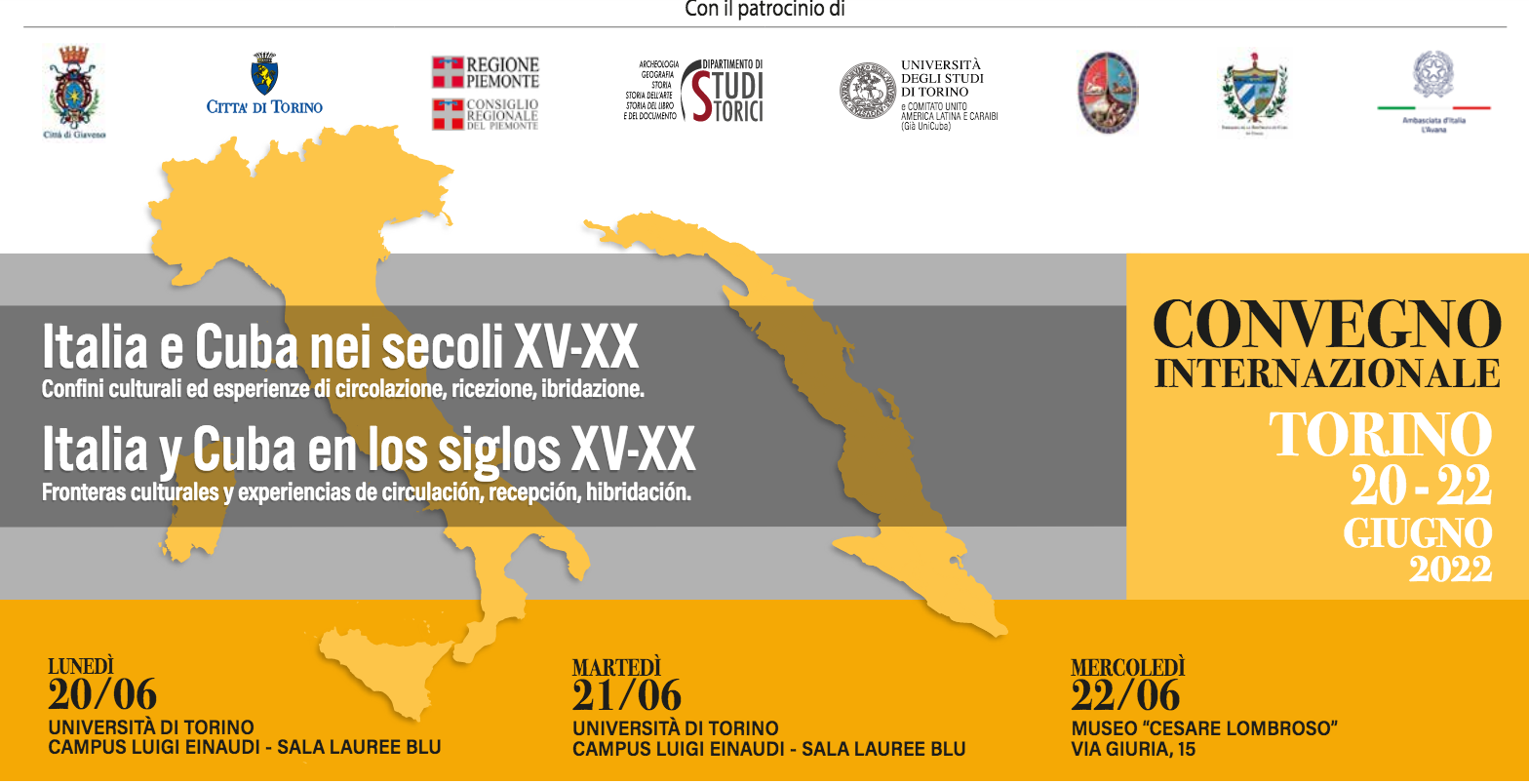
Colloque – Italia – Cuba nei secoli XV-XX: confini culturali ed esperienze di circolazione, ricezione, ibridazione.

Convegno Internazionale
Torino, Campus Luigi Einaudi
20-22 giugno 2022

Programme : ici

Il fenomeno dell’emigrazione italiana a Cuba è databile dalla seconda metà dell’Ottocento nel contesto di un processo migratorio promosso dalle autorità coloniali ai fini del cosiddetto “sbiancamento” della popolazione dell’Isola. Benché numericamente inferiore sia all’emigrazione spagnola sia agli altri flussi migratori italiani in sud America, l’emigrazione italiana a Cuba avviò nuove relazioni familiari non solo all’interno della stessa comunità italiana ma anche con la popolazione autoctona, contribuendo a modificare l’assetto sociale dell’isola. In questo contesto, un emigrante di eccezione fu senz’altro il piemontese Dino Pogolotti, nato a Giaveno nel 1879 da Francesco e Maria Carnino, ed emigrato a New York nel 1895. Sbarcato poi a Cuba in qualità di segretario del console americano Frank Steinhart, Dino fu protagonista dello sviluppo industriale e urbanistico dell’isola, in particolare attraverso la costruzione del celebre Barrio Pogolotti: https://paradapogolotti.it/osservatorio/

Il Convegno che l’Università di Torino ospiterà il 20-21-22 giugno 2022 presso il Campus Luigi Einaudi costituisce una tappa importante di un progetto del Dipartimento di Studi Storici di Torino volto a indagare la circolazione culturale tra Italia e Cuba dal XV sec. ai giorni nostri.

L’ampia diacronia trova supporto nella storiografia più recente che data la formazione di uno spazio atlantico a prima del 1492. La chiave di lettura unitaria del progetto è l’interpretazione della rete di relazioni tra Italia e Cuba come middle ground di un interscambio culturale di lunga durata che ha modificato nei secoli i parametri dell’eurocentrismo e della modernità.

Il Convegno prende avvio dal principio di tutto, cioè dalla scoperta di Cristoforo Colombo che Tzvetan Todorov definì l’incontro «più straordinario della nostra storia» [T. Todorov, La conquista dell’America. Il problema dell’“altro”, Torino, Einaudi 2015, 1ª Ed. Paris 1982], che svelò all’Europa un “altro da sé” completamente sconosciuto e a lungo incomprensibile. Dopo quel principio e le sue prime narrazioni/rappresentazioni quattro-cinquecentesche, il Convegno affronterà le tante variabili di una relazione che ha senz’altro cambiato drammaticamente i destini di quei popoli, ma anche i destini europei e italiani nei diversi ambiti della storia culturale, politica e sociale dalla prima modernità fino al nostro presente.

Il Convegno si svolge sotto il patrocinio dell’Università di Torino, del Dipartimento di Studi Storici e del Comitato UniTo America latina e Caraibi (già UniCuba), delle Ambasciate di Cuba in Italia e dell’Italia a Cuba, della Regione Piemonte e del Consiglio Regionale del Piemonte, del Comune di Torino, del Comune di Giaveno.  Nel contesto dell’accordo-quadro di Cooperazione Internazionale tra l’Ateneo di Torino e l’Università de La Habana, e dell’accordo specifico tra il Dipartimento di Studi Storici e la Facoltà di Filosofia e Storia della stessa Università de La Habana, il Convegno rappresenta una tappa fondamentale del dialogo tra le due Università e del confronto tra le metodologie della ricerca storica nei due paesi, oltre che della tutela della memoria dell’emigrazione piemontese nelle Americhe e nei Caraibi, rispondendo quindi agli obiettivi strategici dell’Ateneo in merito sia all’internazionalizzazione sia al dialogo con il territorio e le sue memorie.

Publié dans Colloque | Laisser un commentaire

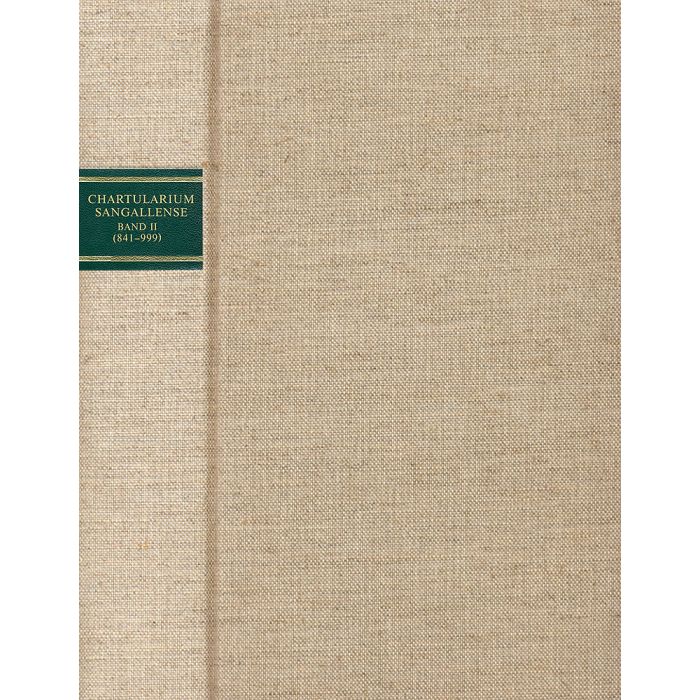
Publication – « Chartularium Sangallense – Band II : 841 – 999 », éd. Peter Erhart, Karl Heidecker, Rafael Wagner et Bernhard Zeller

Die im zweiten Band des »Chartularium Sangallense« enthaltenen Urkunden aus dem Stiftsarchiv St. Gallen sind aufgrund ihrer Rarität von höchster Bedeutung für die Erforschung des Frühmittelalters. Für rund tausend Orte im Bodenseeraum liefern sie den ersten schriftlichen Nachweis ihrer Existenz und werfen Licht in die andernorts »dunklen Jahrhunderte« von den Merowingern über die Karolinger bis hin zu den Ottonen.

Es handelt sich um die erste kritische Neubearbeitung des »Urkundenbuchs der Abtei Sanct Gallen« von 1863/1866. Der zweite Band enthält ein Personennamen-, Orts- und Sachwörterregister, das auch die Urkundentexte von Band I erschließt, sowie eine großformatige Karte mit dem Besitz des Klosters St. Gallen.

Informations pratiques :

Chartularium Sangallense – Band II : 841 – 999, éd. Peter Erhart, Karl Heidecker, Rafael Wagner et Bernhard Zeller, Sigmaringen, Patmos, 2022. 597 p. 20 x 28 cm. ISBN : 978-3-7995-6070-2. prix : 20 euros.

Source : Patmos

Publié dans Publications | Laisser un commentaire

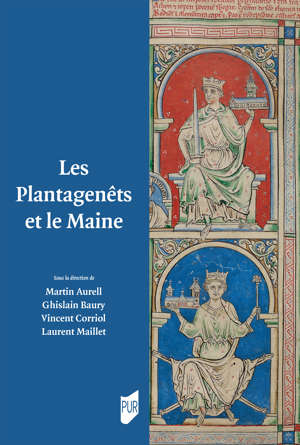
Publication – « Les Plantagenêts et le Maine », dir. Maillet Laurent, Corriol Vincent, Aurell Martin, Baury Ghislain

Situé sur un axe assurant la jonction entre l’Aquitaine au sud et le pôle anglo-normand au nord, le comté du Maine, contrôlé par la dynastie Plantagenêt depuis le début du XIIe siècle, occupe paradoxalement une place marginale dans l’économie et le pouvoir des comtes d’Anjou, devenus rois d’Angleterre avec Henri II. Son statut est paradoxal car, en dépit de sa situation périphérique, ce comté revêt une importance capitale lors de l’affrontement entre Philippe Auguste et les souverains anglais.

Les études réunies ici permettent d’éclairer les différents aspects de l’implantation, de la circulation et de la représentation d’un pouvoir qui ne fait bien souvent que traverser le comté mais n’y réside jamais de manière durable. L’exemple du comté du Maine permet de porter un regard neuf sur l’exercice du pouvoir dans l’ensemble plantagenêt. Il invite aussi à réexaminer les pratiques du pouvoir en termes de représentation locale et de négociations avec les pouvoirs en place, révélant un équilibre subtil des forces en présence que les Plantagenêts s’efforcent de maintenir en leur faveur. C’est enfin l’occasion de révéler les dernières recherches concernant les éléments majeurs du patrimoine manceau, comme l’abbaye de l’Épau, l’hôtel-Dieu de Coëffort ou le portail royal de la cathédrale Saint-Julien du Mans, qui constituent autant de jalons matériels de leur pouvoir.

Table des matières : ici

avec le soutien de Le Mans Université et en partenariat avec la Société Historique et Archéologique du Maine

Martin Aurell est professeur à l’université de Poitiers et directeur du Centre d’études supérieures de civilisation médiévale.

Ghislain Baury et Vincent Corriol sont enseignants-chercheurs à l’université du Mans et membres du laboratoire Temps, mondes, sociétés (TEMOS).

Laurent Maillet, docteur en histoire, est membre associé de TEMOS.

Informations pratiques :

Les Plantagenêts et le Maine, dir. Maillet Laurent, Corriol Vincent, Aurell Martin, Baury Ghislain, Rennes, Presses universitaires de Rennes, 2022. 320 p. ISBN : 9782753582859. Prix : 30 euros.

Source : Presses universitaires de Rennes

Publié dans Publications | Laisser un commentaire

Offre d’emploi – PhD position (M/F) Digital Palaeography / Contrat doctoral (H/F) Paléographie numérique

Assurez-vous que votre profil candidat soit correctement renseigné avant de postuler. Les informations de votre profil complètent celles associées à chaque candidature. Afin d’augmenter votre visibilité sur notre Portail Emploi et ainsi permettre aux recruteurs de consulter votre profil candidat, vous avez la possibilité de déposer votre CV dans notre CVThèque en un clic !

General information

Reference : UPR841-DOMSTU-008
Workplace : AUBERVILLIERS
Date of publication : Friday, June 3, 2022
Scientific Responsible name : Dominique STUTZMANN (UPR 841 IRHT) / Mathieu AUBRY (UMR8049 LIGM)
Type of Contract : PhD Student contract / Thesis offer
Contract Period : 36 months
Start date of the thesis : 1 October 2022
Proportion of work : Full time
Remuneration : 2 135,00 € gross monthly

Description of the thesis topic

Features of medieval scripts (CrEMe “Caractérisation des écritures médiévales” research project).

The PhD candidate will be primarily a humanities student and will have to develop a connection to both project teams (IRHT and LIGM), as well as to two scholarly fields, medieval history and the study of scripts, on the one hand, and computer vision and machine learning, on the other.

As their main scholarly target, the PhD candidate will characterise the diverse Latin scripts of the Middle Ages and study their evolution mechanisms based on the morphology of their signs and letter forms.

They will first adapt existing tools to create “prototypes-based descriptions”, i.e. an average shape and a description of its variations, of the letter forms, and validate their output against palaeographical literature. Based on discussions on the relevance of corpora and script types and applicability of techniques with both supervisors, they will be able to choose their corpora according to their previous expertise or fields of interest. Synchronic studies and comparisons may be relevant (e.g. textualis, cursiva, hybrida, semitextualis), as well as diachronic ones (uncial, semi-uncial, Caroline, praegothica). Depending on the results in this first phase, an additional annotation phase may be required to create valid prototypes. The scope of additional annotations will be informed by the palaeographical literature and the analysis of existing hyperdiplomatic editions, which have identified relevant phenomena to analyse scripts.

In a further development, the PhD candidate will propose a strategy to apply and develop the relevant tools and exploit their outputs by creating prototypes and measuring the formal transformations, based on already available corpora. They will aim at proposing weighted metrics for the palaeographical analysis, integrating the metrics generated by artificial vision (distance between prototypes and between prototypes and their instances) and existing criteria of palaeographical analysis.

From then on, the PhD candidate will extend their study to still unannotated corpora in order to be able to characterise and classify the diverse script types at the scale of the medieval millennium.

The PhD candidate will have the opportunity and required scholarly freedom to devise their own experiments and transfer their colleagues’ outputs to their own research.

Additional information: https://oriflamms.hypotheses.org/1885

Work Context

The PhD position is part of the CrEMe Caractérisation des écritures médiévales research project which gathers two CNRS labs in an interdisciplinary research: Institut de Recherche et d’Histoire des Textes (UPR841) and Laboratoire d’informatique Gaspard Monge (UMR8049).
The project is funded by the MITI (Mission for Transverse and Interdisciplinary Initiatives).
CrEMe gathers researchers and teams pertaining to INSHS (Institute for Humanities and Social Sciences) and INS2I (Institute for Information Sciences) for an interdisciplinary study on handwritten scripts of the Middle Ages.
We will study the evolution of Latin scripts and their mechanisms thanks to deep learning and its application to characterize the features of handwritten artifacts, in a multilingual environment, as well at the level of individual scribes as at the collective level and on a long period. We wish to understand how script types emerge, are canonised, and how script families influence each other. With this aim, we will isolate signs and letter forms as if they were iconographic motives.
In the Humanities field, this research will formalize applicable analysis criteria and thus modify our understanding of script history (script classification, dating, evolution process, morphology and formality). For Information Sciences, this research will contribute to enhance the unsupervised learning techniques of neural networks, so as to produce traceable and interpretable decisions – a major challenge in developing deep learning capabilities well beyond this project.

Constraints and risks

Screen work

Additional Information

Knowledge and Skills
– Solid knowledge on the history medieval book scripts, ability to read them (including cursive instances).
– Basic knowledge of Latin and middle French
– Programming languages: Python ; optional : R.

Source : CNRS

Publié dans Offre d'emploi | Laisser un commentaire

Appel à contribution – Transactions of the Royal Historical Society

Transactions is the flagship academic journal of the Royal Historical Society. First published in 1872, Transactions has been publishing the highest quality scholarship in history for 150 years.

The journal welcomes submissions dealing with any geographical area from the early middle ages to the very recent past, and is interested in articles that cover entirely new ground, thematically or methodologically, as well as those that engage critically on established themes in existing literatures. In line with the RHS’s commitment to supporting postgraduate and early career historians, the journal encourages submissions from younger scholars and seeks to engage constructively and positively with new authors

Transactions welcomes proposals from all historians. If you’re currently working on a research article or a think piece, please consider Transactions as the journal in which to publish your work.

Transactions from 2022

From January 2022 the journal is edited by Dr Kate Smith (Birmingham) and Dr Harshan Kumarasingham (Edinburgh). They are supported by 25 historians who make up the journal’s new appointed UK Editorial and International Advisory Boards.

Transactions is also broadening its range of article formats and the subject areas it covers, to include studies in historical methodologies, pedagogies, policy debates and roundtable discussions. In this way Transactions will more closely reflect the interests of the RHS as a learned society with a membership from within and beyond higher education.

Recently published Transactions articles are available on Cambridge First View.

Submitting an article to Transactions

We welcome submissions of scholarly articles for publication in future issues of the journal. Please read carefully our Guidelines for Authors which provide information on the journal, the format in which to submit an article, and our complaints & appeals procedure.

In addition, the journal’s publisher, Cambridge University Press, provides information concerning its Open Access policy for Transactions and the option that may be available to you an author if your article is accepted for publication.

When ready, please submit your completed article for review here

For general enquiries regarding submissions to Transactions, please email: trhs@royalhistsoc.org.

Latest volume of Transactions (6th series, vol. 31, 2021)

Transactions is currently published each November as a collected volume, by Cambridge University Press. The latest volume (31 in the Sixth Series) was published in November 2021. First view articles are also available via the CUP site.

Volume 31 includes articles by:

Source : Royal Historical Society

Publié dans Le réseau | Laisser un commentaire