Publication – « Political Ritual and Practice in Capetian France. Studies in Honour of Elizabeth A. R. Brown », ed. M. Cecilia Gaposchkin and Jay Rubenstein

This volume demonstrates the continued vitality of the history of the Capetians to the study of the medieval world. In this volume, thirteen of the world’s leading scholars of medieval France explore some of the most important ideas, events, personalities, and artistic creations of the Capetian world (987–1328). From some of the earliest medieval attempts to make narrative treatments of French history, through the invention of the schools, the creation of Gothic architecture, the practices of chivalry, the practice of statecraft, and the promulgation of law codes, the volume offers a panoramic view of the kingdom and the era that has come to define the medieval world in both the scholarly and popular imaginations. The scholars brought together in this volume share as well a common sense of gratitude and an intellectual debt to Elizabeth A. R. Brown, whose own rigour and brilliance has inspired their work and shaped their sense of the past. Political Ritual and Practice in Capetian France is both a tribute to a scholar of real accomplishment and a collection of original scholarship raised upon on the foundations that Elizabeth A. R. Brown herself set down.
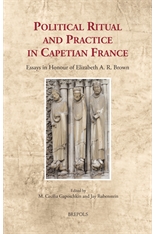
Table des matières :

List of Illustrations, List of Contributors

Introduction
Jay Rubenstein and M. Cecilia Gaposchkin

Sugar: An Abbot’s Fame
Rolf Grosse

Suger, Orderic Vitalis, and the Vexin: Some Observations on Bibliothèque Mazarine MS 2013
Elisabeth van Houts

Countess Blanche, Philip Augustus, and the War of Succession in Champagne, 1201–22
Theodore Evergates

‘Those Who Act More Strictly’: Monks, Jews, and Capetian Religious Politics in the Bibles moralisées
Sara Lipton

Eudes of Châteauroux and the Holy Blood of Neuvy-Saint-Sépulchre
Nicholas Vincent

Philippe of Cahors: Or, What’s in a Name?
William Chester Jordan

Jean d’Acre, Butler of France, Diplomat and High Servant of the Capetian Crown (d. January 8, 1296)
Xavier Hélary

Louis IX, Heraclius, and the True Cross at the Sainte Chapelle
M. Cecilia Gaposchkin

Writing and Illustrating History in Thirteenth Century France: The Chronique de l’anonyme de Béthune and Vincent of Beauvais’s Speculum historiale
Alison Stones

Jacob of Santa Sabina Warns Philip the Fair that Boniface VIII is Antichrist by Means of Scripture and the Oraculum Cyrilli
Robert E. Lerner

The Templar Confessions in Bigorre, December 1307 and March 1308
Sean L. Field

The Capetians and the River Seine (Thirteenth-Fourteenth Century)
Elisabeth Lalou

The Judicial Duel in Later Medieval France: Procedure, Ceremony, and Status
Justine Firnhaber-Baker

Index

Informations pratiques :

Political Ritual and Practice in Capetian France. Studies in Honour of Elizabeth A. R. Brown, ed. M. Cecilia Gaposchkin and Jay Rubenstein, Turnhout, Brepols, 2021 (Cultural Encounters in Late Antiquity and the Middle Ages, 34). 457 p., 27 b/w ill. + 9 colour ill., 2 b/w tables, 3 b/w line art, 156 x 234 mm. ISBN: 978-2-503-59302-9. Prix : 155 euros.

Source : Brepols
Publié dans Publications | Laisser un commentaire

Conférence – On Editing Anglo-Norman Texts: The Verse Psalter, for example

Editing texts written in the Anglo-Norman language will be the focus of this year’s David Trotter Memorial Lecture.

Hosted by the Department of Modern Languages at Aberystwyth University, this year’s lecture will be delivered by Professor Daron Burrows of Oxford University on Thursday 28 October 2021 at 6pm.  The lecture will take place online, making it accessible to a wider audience.

Professor Burrows is Professor of Medieval French at Oxford University, Fellow of St Peter’s College, and a specialist in medieval French and Anglo-Norman language and literature. He is Honorary Secretary of the Anglo-Norman Text Society and Chair of the Advisory Board of the Anglo-Norman Dictionary

His lecture, ‘On Editing Anglo-Norman Texts: The Verse Psalter, for example’, will demonstrate his profound expertise in editing medieval texts written in the Anglo-Norman language – the variant of French that was used in medieval Britain and that pervaded so much of British culture.

Dr Gabor Gelleri, of the Department of Modern Languages at Aberystwyth University said: “The David Trotter Memorial Lecture is one of the highlights of every academic year within the Department of Modern Languages. It was introduced in 2016 to honour the work and the legacy of Professor David Trotter, former Head of the department, a world-leading scholar on the history and regional varieties of French, and the creator of the Anglo-Norman Dictionary team in the department.

“This year, we are delighted to welcome a prominent specialist of Anglo-Norman literature and philology, Professor Daron Burrows of Oxford, who will be sharing with us his experience editing of the rhymed Anglo-Norman Psalter. Past talks in the same series are available at the Anglo-Norman Hub: https://anglo-norman.net/memorial-lecture-introduction.”

Professor David Trotter was a leading international authority on French language and lexicography, a former president of the Société de Linguistique Romane and a corresponding member of the Paris-based Académie des Inscriptions et Belles-Lettres. A graduate of Queen’s College Oxford, he joined Aberystwyth University in 1993 and was Professor of French and Head of the Department of Modern Languages for over two decades. He was Chief Editor of the Anglo-Norman Dictionary between 2002 and 2015.

The David Trotter Memorial Lecture 2021, ‘On Editing Anglo-Norman Texts: The Verse Psalter, for example’ takes place online at 6pm on Thursday 28 October.  The lecture is open to all interested members of the public, students and staff, who are asked to e-mail modernlangs@aber.ac.uk in order to receive a Microsoft Teams invitation.

Source : Aberystwyth University

Publié dans Colloque | Laisser un commentaire

Colloque – Penser l’image en situation. Exposer la peinture medievale à la lumière du jour

Ce colloque part de l’hypothèse suivante : l’œuvre picturale façonne voire construit tant le lieu dans lequel elle est présentée que l’observateur à qui elle s’adresse. Là où cette rencontre est entravée, l’expérience et la compréhension de l’œuvre risquent d’être profondément perturbées. La manifestation et le sens d’une œuvre ne sauraient être indépendants de ses conditions de présentation.

La question est particulièrement délicate pour la présentation des œuvres d’art médiévales, que nous avons tendance aujourd’hui à exposer d’une manière profondément anachronique. Or, alors que dans l’analyse historique des œuvres in situ (mosaïques, fresques), le rôle du lieu d’exposition est toujours davantage pris en considération, le statut des œuvres mobiles (peinture, sculpture) est encore trop souvent laissé de côté. L’analyse des œuvres mobiles est au mieux ramenée à l’étude de leur lieu physique d’origine, et non pas à leurs conditions historiques de présentation et de réception.

Plusieurs développements théoriques récents (acte d’image, situation iconique) nous amènent à reconsidérer le concept d’original dans notre compréhension des œuvres. Il ne s’agit plus de penser l’original comme intrinsèquement lié à son substrat matériel, mais plutôt à partir de l’ensemble des effets produits par l’œuvre. Ce n’est donc pas simplement parce qu’on est matériellement en présence de l’original qu’on peut le rencontrer, il faut encore un éclairage adéquat. En principe, pour les œuvres d’art médiévales, cet éclairage doit être naturel, relativement faible et ne doit pas être diffus. Est-il possible de reconstituer ces conditions avec des moyens techniques ? Certains le prétendent, d’autres le contestent.

Afin de renouveler notre approche nous réunirons des historiens de l’art et des idées, mais aussi des architectes, des restaurateurs et des éclairagistes.

Notre recherche sur les conditions iconotopiques d’exposition semble rejoindre certaines préoccupations qui furent celles de l’historicisme. Il est donc nécessaire de comparer notre approche avec la muséologie historiciste du passé et de pointer les apories de cette dernière. Exposer la peinture médiévale au musée de façon critique et historique ne peut en effet pas signifier une reconstruction complète des lieux d’exposition. Ce colloque entend renouveler la réflexion muséologique sur la conception et l’architecture des lieux d’exposition.

L’étude des œuvres d’art et de leurs conditions historiques de présentation, d’installation et d’éclairage permet de décrire des effets plastiques propres aux images. Elle jette également une lumière nouvelle sur leur iconographie et leur sens. On remarque p. ex. que la situation de contre-jour ne doit être en aucun cas évitée, en particulier pour des œuvres très étudiées (Madone Sixtine de Raphaël, Jugement dernier de Giotto à Padoue), et qu’elle joue un rôle majeur dans la manière dont ces œuvres apparaissent. A travers un choix d’œuvres-clés, on devrait pouvoir montrer ce que cela signifie pour l’étude de leur technique picturale et de leur perception, mais aussi pour leur interprétation. On remarque par là que nos habitudes dans l’exposition des œuvres du moyen-âge tardif et modernes méritent d’être profondément repensées.

Les conditions de présentation, en particulier des collections de peinture, pourraient être fondamentalement reconsidérées en accordant plus d’importance aux propriétés intrinsèques de l’œuvre. L’accrochage des images et leur éclairage pourraient d’abord suivre des critères iconotopiques plutôt que des standards de visibilité supposés répondre aux « attentes du public », et qui risquent de faire écran. Ce n’est pas les œuvres qui devraient s’adapter à leur lieu mais l’inverse.

Programme :

Jeudi, 21 octobre
Centre allemand d’histoire de l’art Paris, 45 Rue des Petits Champs

09.15 Thomas Kirchner: Accueil
09.30 Bruno Haas: Introduction: D‘une technique du regard

10.30 Arnold Nesselrath (Roma): Reflecting on the artists’ light

11.20 Pause

11.40 Franz Engel (Berlin): Iconospheres: Illuminating Raphael

12.30 Déjeuner

14.00 Anca Vasiliu (Paris): Qui voit la lumière? Approches de la pensée antique

14.50 Thomas Le Gouge (Paris): L’image située

15.40 Pause

16.00 Niklaus Largier (Berkeley): Tostareintotheabyssofbright refulgence: Devotional paradigms of aesthetic experience

17.00 Saskia C. Quené (Bern): Light and space in Fra Angelico’s gold

20.00 Diner

Vendredi, 22 octobre
Petit Palais (pour les participants), Av. Winston Churchill

09.00 Atelier au Petit Palais moderé par Bruno Haas

Avec la collaboration de : Rick Drasdo, Solen Jaouen Paï Liu, Florian Rada

Centre allemand d’histoire de l’art Paris

12.30 Déjeuner

14.00 Dominique Vingtain (Avignon): Les fresques du musée du Petit Palais

14.50 David Saunders (London): Scientific precepts of perception, preference and preservation

15.40 Pause

16.00 Muriel Vervat (Firenze): Lessecretsdescouleursdel’ombre:la technique de la peinture ecclésiastique italienne du XIIème au XIVème siècle.

17.00 Résumé: Horst Bredekamp

Samedi, 23 octobre
Université Paris 1 Panthéon-Sorbonne 17 Rue de la Sorbonne, Amphi Lefebvre

10.00 Bruno Haas: Introduction

10.30 Alexander Schwarz (Berlin): Beleuchtungssituationen auf der Museumsinsel und im Haus Bastian: Neue Wege

11.20 Pause

11.40 Horst Bredekamp (Berlin): Das Helle und das Dunkle

12.30 Déjeuner

14.00 Isabelle Marchesin (Paris): Géométrie lumineuse des manuscrits romans

14.50 Serena Romano (Roma): Seeing or understanding. The anachronisms of light

15.40 Pause

16.00 Mario Nanni(Bizzuno) : La metaluce

20.00 Diner
Franz Engel (Berlin), Bruno Haas (Paris), Thomas Le Gouge (Paris), Saskia C. Quené (Bern)

Symposion organisée par
Pour s’inscrire, écrire à : philo-recherche@univ-paris1.fr

Publié dans Le réseau | Laisser un commentaire

Publication — Dante, « La Divine Comédie » (La Pléaide)

La lecture de La Divine Comédie est un voyage. Claudel le définit à merveille : « De celle qu’il aime, Dante n’a pas accepté d’être séparé, et son œuvre n’est qu’une espèce d’effort immense de l’intelligence et de l’imagination pour réunir ce monde de l’épreuve où il se traîne, ce monde des effets, qui, vu d’où nous sommes, semble le domaine du hasard ou d’une mécanique incompréhensible, au monde des causes et des fins. » Le lecteur n’est jamais seul au cours de son ascension. Si Dante a besoin de guides – Virgile, Béatrice, saint Bernard -, il est lui-même l’accompagnateur et le complice de qui le lit. Les expériences qu’il évoque, il considère qu’elles sont communes à tous. Il apprivoise l’imagination en l’entourant d’objets familiers. Une fois encordé au poète, et captif de sa voix, on ne peut demeurer en arrière. « On n’avait pas entendu cette voix depuis l’Antiquité latine », disait Saint-John Perse. Plus qu’un autre sans doute, le lecteur du XXIe siècle est sensible à la conscience artistique qui habite Dante, à la manière dont il invente et manie d’un même geste la langue dont il use – « un acte qui vaut pour tous les temps, celui par lequel la poésie accède à soi » (Yves Bonnefoy). Dans cette édition, publiée à l’occasion du 700e anniversaire de la mort du poète, la traduction de Jacqueline Risset, d’une limpidité sans égale, voisine avec le texte original et bénéficie d’un appareil critique nouveau qui prend appui sur sept siècles de lectures aussi bien que sur les recherches les plus récentes.

Informations pratiques :

Dante, La Divine Comédie, Paris, Gallimard, 2021 (La Pléaide, 659). Trad. de l’italien par Jacqueline Risset. Édition publiée sous la direction de Carlo Ossola avec la collaboration de Jean-Pierre Ferrini, Luca Fiorentini, Ilaria Gallinaro et Pasquale Porro. Parution le 14 Octobre 2021. 1488 pages, rel. Peau, 104 x 169 mm. Prix de lancement : 62 euros.

Source : Gallimard

Publié dans Publications | Laisser un commentaire

Offre d’emploi – Hoogleraar Middelnederlandse literatuur en cultuur

Uren per week: 38 tot 40
Faculteit of dienst: Faculteit Geesteswetenschappen
Afdeling: Departement Talen, Literatuur en Communicatie
Uiterlijk reageren op: 6 november 2021


Functie

De Universiteit Utrecht zoekt een hoogleraar Middelnederlands literatuur en cultuur. De leerstoel maakt deel uit van het Departement Talen, Literatuur en Communicatie van de faculteit Geesteswetenschappen en is geplaatst binnen de afdeling Nederlandse Taal en Cultuur. De focus van het departement ligt op de bestudering van West-Europese talen en culturen in een globale context.

De kern van het onderzoek van de leerstoelhouder betreft de bestudering van de Nederlandstalige literatuur van de Middeleeuwen, met aandacht voor de veeltalige en cultureel diverse Europese context waarin deze literatuur is gesitueerd. Het zwaartepunt van het onderwijs van de leerstoel ligt in de bachelor Nederlandse Taal en Cultuur, de minor Middle Ages en in de tweejarige onderzoeksmaster Ancient, Medieval and Renaissance Studies. De leerstoel vervult een spilfunctie binnen de Utrechtse mediëvistiek. De leerstoelhouder draagt dan ook een brede medeverantwoordelijkheid voor het onderwijs en onderzoek in de mediëvistiek van de faculteit, waarbij een uitstekende afstemming met collega’s binnen en buiten het departement plaatsvindt.

Profiel

De beoogde leerstoelhouder Middelnederlandse literatuur en cultuur:

  • verricht uitmuntend onderzoek met een internationale uitstraling op het gebied van de Middelnederlandse literatuur en cultuur en weet dat onderzoek overtuigend in een bredere culturele context te plaatsen;
  • is een inspirerend docent op alle academische niveaus;
  • geeft leiding aan, stimuleert en vernieuwt het onderzoek en onderwijs op het terrein van de Middelnederlandse literatuur;
  • is succesvol in het verwerven van onderzoeksubsidies;
  • is in staat tot interdisciplinaire samenwerking, zowel met betrekking tot de verschillende mediëvistische expertises binnen de faculteit als buiten de mediëvistiek en faculteit;
  • is in staat en bereid tot het entameren van kennisvaloriserende activiteiten in samenwerking met maatschappelijke en culturele partners;
  • is in staat en bereid in het Nederlands en Engels te onderwijzen;
  • bezit de communicatieve, organisatorische en bestuurlijke vaardigheden die passen bij de senioriteit van de positie;
  • is in staat om op termijn bestuurlijke en organisatorische taken te vervullen, binnen het departement en op het bredere niveau van de faculteit.

Aanbod

Het betreft een dienstverband (1,0 fte) voor de duur van vijf jaar. Bij goed functioneren hoort een dienstverband voor onbepaalde tijd tot de mogelijkheden. Het salaris bedraagt – afhankelijk van opleiding en ervaring – minimaal € 5.843,- en maximaal € 8.508,- (schaal H2 van de cao Nederlandse Universiteiten) bruto per maand bij een fulltime dienstverband. Je ontvangt daarnaast 8% vakantiegeld en een eindejaarsuitkering van 8,3%. Verder heeft de Universiteit Utrecht een aantrekkelijk pakket arbeidsvoorwaarden externe link, waaronder keuze voor een goede balans tussen werk en privé (onder andere een goede verlofregeling), ontwikkelingsmogelijkheden en een uitstekende pensioenregeling.

Over de organisatie

Een betere toekomst voor iedereen. Die ambitie motiveert onze wetenschappers bij hun toponderzoek en het geven van inspirerend onderwijs. Bij de Universiteit Utrecht externe link werken diverse disciplines intensief samen aan maatschappelijk belangrijke thema’s. Onze focus ligt op Dynamics of Youth, Institutions for Open Societies, Life Sciences en Sustainability. 

Aan de faculteit Geesteswetenschappen externe link zijn ongeveer 6.000 studenten en 900 medewerkers verbonden. De faculteit omvat vier kennisdomeinen: filosofie en religiewetenschap, geschiedenis en kunstgeschiedenis, media- en cultuurwetenschappen, en talen, literatuur en communicatie. Met het onderwijs en onderzoek op deze gebieden wil de faculteit bijdragen aan een beter begrip van Nederland en Europa in een sterk veranderende maatschappelijke en culturele context. De enthousiaste en betrokken collega’s en de uitstekende voorzieningen in de historische binnenstad van Utrecht, waar de faculteit is gehuisvest, zorgen voor een inspirerend werkklimaat.

Aanvullende informatie

Een beschrijving van de functie tref je hier externe link aan.

Wil je meer weten over deze functie? Neem dan contact op met Peter Schrijver externe link (departementshoofd Talen, Literatuur & Communicatie), via p.c.h.schrijver@uu.nl externe link.

Solliciteren

Iedereen verdient het om zich thuis te voelen bij onze universiteit. We verwelkomen medewerkers met een grote verscheidenheid aan achtergronden en perspectieven. Heb je interesse om te solliciteren? Stuur je motivatiebrief en cv toe via onderstaande sollicitatieknop.

Je sollicitatie bestaat uit:

  • een sollicitatiebrief;
  • een curriculum vitae en een publicatielijst;
  • een beknopt onderzoeksplan van max. 800 woorden, dat een verbinding laat zien met het profiel van de leerstoel;
  • een beknopte onderwijsvisie van max. 800 woorden, met aandacht voor disciplinair en interdisciplinair onderwijs.

Voor geselecteerde kandidaten zal een proefcollege deel uitmaken van de sollicitatieprocedure. Tevens kan een formeel assessment onderdeel van de procedure zijn.

Uiterlijk reageren op 6 november 2021.

Source : Universiteit Utrecht

Publié dans Offre d'emploi | Laisser un commentaire

Séminaire – Histoire et Anthropologie des sociétés du haut Moyen Âge (VIe-XIe s.)

Histoire et Anthropologie des sociétés du haut Moyen Âge (VIe-XIe s.) – séminaire haut Moyen Âge

Organisé par Geneviève Bührer-Thierry, François Bougard et Régine Le Jan.

Jeudi 15 -17 heures, Sorbonne, salle Perroy, galerie Dumas, escalier R, 2e étage  (sauf indication contraire).

Programme :

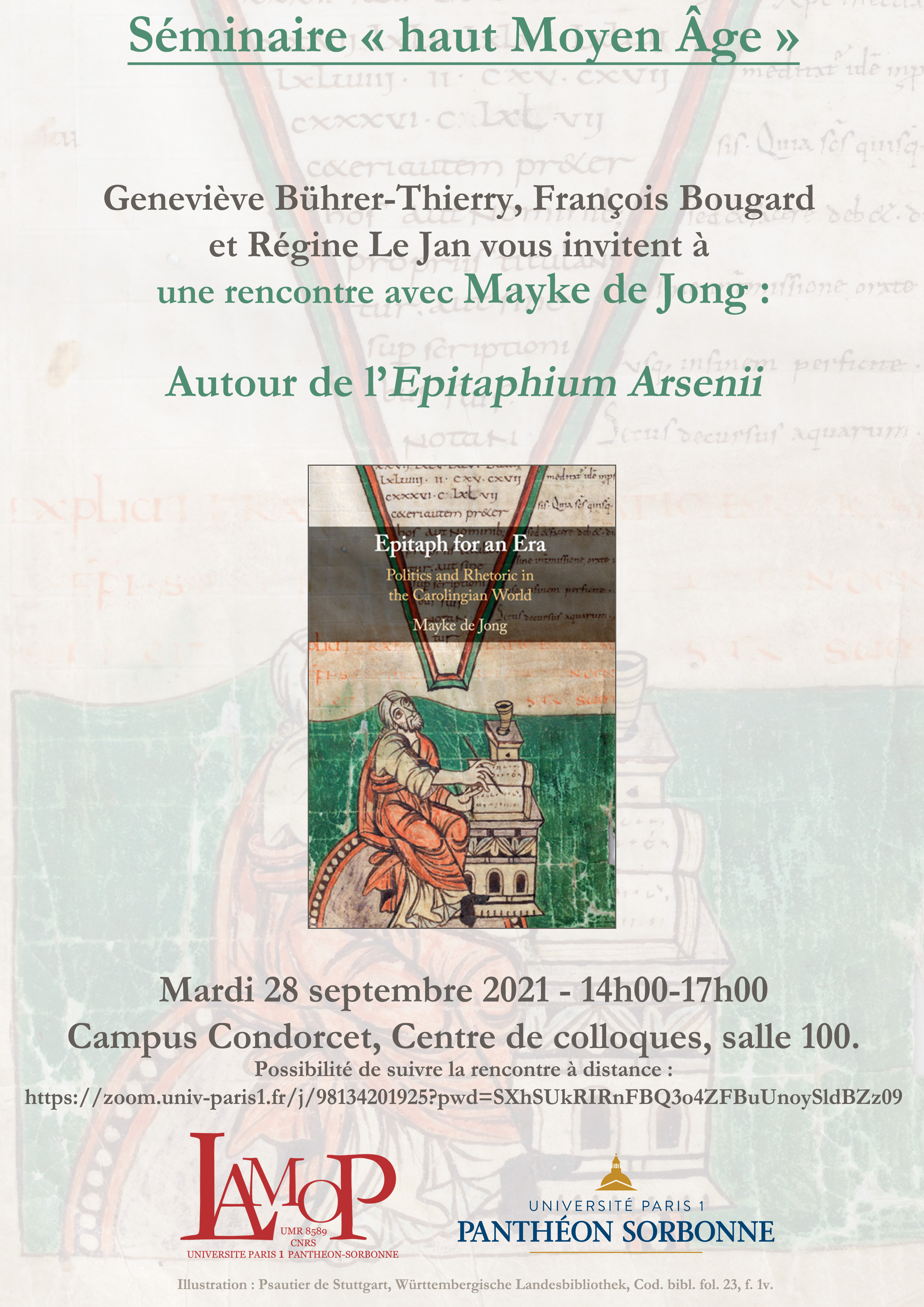
Rencontre avec Mayke de Jong, (Université d’Utrecht) :

Autour de son livre Epitaph for an Era: Rhetoric and Politics and Rhetoric in the Carolingian World, Cambridge, Cambridge University Press, 2019.

Possibilité de suivre la rencontre à distance : https://zoom.univ-paris1.fr/j/98134201925?pwd=SXhSUkRIRnFBQ3o4ZFBuUnoySldBZz09

MdJ

1er-3 octobre à l’abbaye de Fleury, Saint-Benoît-sur-Loire

« Un tombeau de papier pour Théodulf d’Orléans († 821) », colloque organisé par Caroline Chevalier-Royet (Lyon3-CIHAM), Kristina Mitalaité (Lithuanian Culture Research Institut), Sumi Shumahara (Sorbonne-Université-LEGETIMAM) et Claire Tignolet (Paris1-LaMOP)

Jeudi 4 novembre : François Bougard (CNRS-IRHT), « Saint François et l’épreuve du feu, ou le pouvoir du texte, Ve-XVe siècle »

[Samedi 13 novembre à 14h00, salle 6 du Panthéon : soutenance de la thèse de Justine Audebrand : « Frères et sœurs dans l’Europe du haut Moyen Âge (vers 650-vers 1000) »]

Jeudi 2 décembre : Nicolangelo d’Acunto,( Università Cattolica del Sacro Cuore, Milan), « Marché et marchands à Milan au Xe siècle : esquisses d’une restauration ottonienne (D O.I 145) »

[Samedi 4 décembre à 14h00, salle 6 du Panthéon : soutenance de l’Habilitation à Diriger les Recherches d’Isabelle Rosé, « Dominations ecclésiales. Réseaux de pouvoir, réformes monastiques et hérésies cléricales au cours du premier Moyen Âge »]

Jeudi 16 décembre : Atelier des haut-médiévistes : actualités de la recherche en Histoire du haut Moyen Âge : Martin Gravel (Paris8), Warren Pezé (UPEC), Sumi Shimahara (Sorbonne Université)

Source : LAMOP

Publié dans Séminaire | Laisser un commentaire

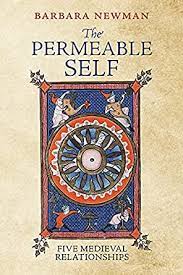
Publication – Barbara Newman, « The Permeable Self. Five Medieval Relationships »

« Barbara Newman’s The Permeable Self takes readers on a journey that explores the inner workings of extremely complex human and symbolic relationships. Centered on the concepts of coinherence and indwelling, her book ranges widely from topics like saintly telepathy, the exchange of hearts, and childbirth to the demonic invasion of human bodies. The common thread is humans’ permeability, their openness to both good and evil others. In clear, accessible, and often witty prose, Newman provides extraordinary insights into the medieval psyche. »—Renate Blumenfeld-Kosinski, author of The Strange Case of Ermine de Reims: A Medieval Woman Between Demons and Saints

« Charles Taylor has contrasted the ‘buffered self’ of a secular age to the ‘porous self’ of other ages. In The Permeable Self Barbara Newman fleshes out medieval understandings of porous personhood in fascinating detail, supplementing, but also correcting, Taylor’s influential account. Her many insights about medieval personhood have profound relevance to debates about the intersubjectivity of modern liberalism and postmodernism’s liquid selves. »—Ryan McDermott, University of Pittsburgh

« The Permeable Self is a brilliant exploration of medieval ways of imagining mind and body. Teaching, love, pregnancy and mental illness look startlingly different when people take for granted that thoughts can enter other bodies directly. That in turn should push readers to ask how modern assumptions shape modern experience in ways so fundamental we may not notice them. One of the most fascinating books I have read this year. »—T. M. Luhrmann, author of How God Becomes Real: Kindling the Presence of Invisible Others

How, Barbara Newman asks, did the myth of the separable heart take such a firm hold in the Middle Ages, from lovers exchanging hearts with one another to mystics exchanging hearts with Jesus? What special traits gave both saints and demoniacs their ability to read minds? Why were mothers who died in childbirth buried in unconsecrated ground? Each of these phenomena, as diverse as they are, offers evidence for a distinctive medieval idea of the person in sharp contrast to that of the modern « subject » of « individual. »

Starting from the premise that the medieval self was more permeable than its modern counterpart, Newman explores the ways in which the self’s porous boundaries admitted openness to penetration by divine and demonic spirits and even by other human beings. She takes up the idea of « coinherence, » a state familiarly expressed in the amorous and devotional formula « I in you and you in me, » to consider the theory and practice of exchanging the self with others in five relational contexts of increasing intimacy. Moving from the outside in, her chapters deal with charismatic teachers and their students, mind-reading saints and their penitents, lovers trading hearts, pregnant mothers who metaphorically and literally carry their children within, and women and men in the throes of demonic obsession. In a provocative conclusion, she sketches some of the far-reaching consequences of this type of personhood by drawing on comparative work in cultural history, literary criticism, anthropology, psychology, and ethics.

The Permeable Self offers medievalists new insight into the appeal and dangers of the erotics of pedagogy; the remarkable influence of courtly romance conventions on hagiography and mysticism; and the unexpected ways that pregnancy—often devalued in mothers—could be positively ascribed to men, virgins, and God. The half-forgotten but vital idea of coinherence is of relevance far beyond medieval studies, however, as Newman shows how it reverberates in such puzzling phenomena as telepathy, the experience of heart transplant recipients who develop relationships with their deceased donors, the phenomenon of psychoanalytic transference, even the continuities between ideas of demonic possession and contemporary understandings of obsessive-compulsive disorder.

In The Permeable Self Barbara Newman once again confirms her status as one of our most brilliant and thought-provoking interpreters of the Middle Ages.

Barbara Newman is John Evans Professor of Latin and Professor of English, Classics, and History at Northwestern University. Among her many books are From Virile Woman to WomanChrist: Studies in Medieval Religion and Literature, God and the Goddesses: Vision, Poetry, and Belief in the Middle Ages, and Making Love in the Twelfth Century: « Letters of Two Lovers » in Context, all available from the University of Pennsylvania Press.

Table des matières :

Introduction. Members of One Another
Chapter 1. Teacher and Student: Shaping Boys
Chapter 2. Saint and Sinner: Reading Minds
Chapter 3. Lovers: Exchanging Hearts
Chapter 4. Mother and Child: Giving Birth
Chapter 5. God and the Devil: Possessing Souls
Conclusion, or Why It Still Matters
Notes
Bibliography
Index
Acknowledgments

Informations pratiques :

Barbara Newman, The Permeable Self. Five Medieval Relationships, University of Pennsylvania Press, 2021. 440 pages. ISBN : 9780812253344. Prix : USD $69.95

Source : University of Pennsylvania Press

Publié dans Publications | Laisser un commentaire

Appel à contribution – Hagiographie bourguignonne 2.0 – corpus électronique et nouvelles recherches

Lundi – 6 décembre 2021 – 14h-18h (heure de Paris)

Cette journée d’études, en plus de faire le point des dernières actualités du programme CBMA, vise à lancer des recherches sur le corpus hagiographique bourguignon en vue de la préparation d’une publication collective. Premier corpus hagiographique latin structuré, documenté, et en cours de lemmatisation, le propos de cette rencontre informelle est de commencer à mettre à l’épreuve différentes démarches méthodologiques pour mieux situer historiquement ces textes, leur chronologie, leurs modes de production et de transmission. La mise en corpus ouvre, en effet, à des possibilités nouvelles d’appréhender ces écrits, de les mettre en relation entre eux et avec d’autres types documentaires, de les soumettre à des analyses sémantiques et à des traitements statistiques, parmi d’autres.

Ouverte à tous les intéressés, cette rencontre privilégiera les contributions optant pour une approche numérique du corpus mis à disposition par le programme CBMA, mais pas exclusivement.

Les propositions de communication (titre et rapide description de 200 mots environ) sont à transmettre dès maintenant et jusqu’au 1er novembre 2021 à eliana.magnani@univ-paris1.fr

La rencontre sera réalisée à distance, sur la plateforme zoom : https://pantheonsorbonne.zoom.us/j/98702819023?pwd=NzNZRkw2d3VYS2VsKzVKY2tRUm5BZz09

Le programme final sera diffusé autour du 15 novembre 2021.

Organisation : Eliana Magnani (CNRS – LaMOP), Coraline Rey, (LEM/CERCOR) Nicolas Perreaux (Université Paris 1 Panthéon-Sorbonne – LaMOP), Gabriel Castanho (UFRJ), Pierre Brochard (CNRS – LaMOP)

Liens utiles :

http://www.cbma-project.eu/

http://www.cbma-project.eu/editions/textes-hagiographiques.html#M

Programmes et compte-rendu des journées précédentes : http://www.cbma-project.eu/publications/les-rencontres-cbma.html

Source : LAMOP

Publié dans Appel à contributions | Laisser un commentaire

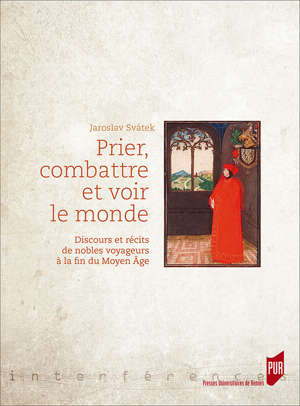
Publication – Jaroslav Svátek, « Prier, combattre et voir le monde. Discours et récits de nobles voyageurs à la fin du Moyen Âge »

Ce livre exhume la mémoire de quatre aventuriers dont les voyages se sont déroulés entre les années 1390 et 1450 : Ogier d’Anglure, Nompar de Caumont, Guillebert de Lannoy et Bertrandon de la Broquière. Pourquoi réunir ces quatre aventuriers dans un même livre ? Ensemble, ils embrassent les différentes formes du voyage nobiliaire et ils commencent à écrire eux-mêmes le récit de leurs voyages et posent les jalons d’un genre littéraire émergent.

Jaroslav Svátek est maître de conférences à la faculté de lettres de l’université Charles de Prague et membre du Centre d’études médiévales de l’Académie des sciences de la République tchèque.

Informations pratiques :

Jaroslav Svátek, Prier, combattre et voir le monde. Discours et récits de nobles voyageurs à la fin du Moyen Âge, Rennes, Presses universitaires de Rennes, 2021 (Interférences). 356 p., 21 x 15,5 cm. ISBN : 9782753582583. Prix : 25 euros.

Source : Presses universitaires de Rennes

Publié dans Publications | Laisser un commentaire

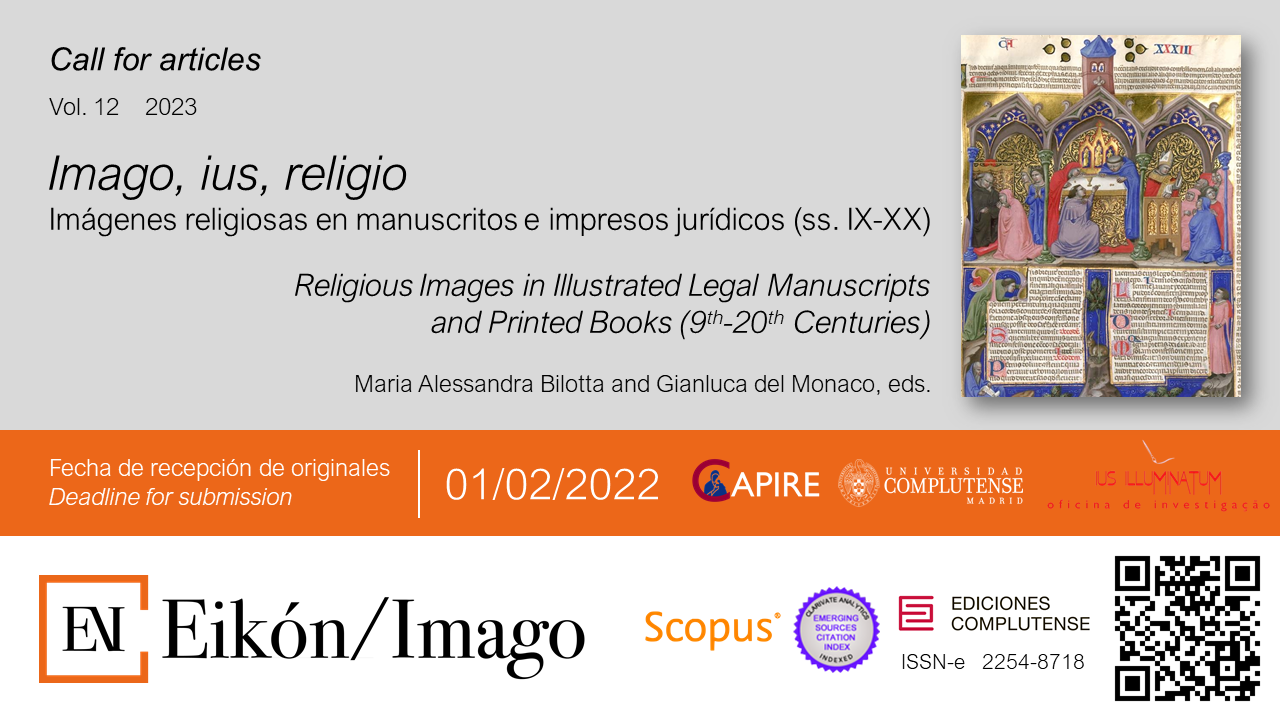
Appel à contribution – Imago, ius, religio. Religious Iconographies in Illustrated Legal Manuscripts & Printed Books (9th -20th Centuries)

Special Guest Editors: Maria Alessandra Bilotta & Gianluca del Monaco

It is not unusual to come across religious iconographies in miniatures as well as borders and based-page scenes in illustrated legal manuscripts and printed books (9th-20th centuries) containing canon, civil or local law texts, like the Livres juratoires or municipal and professional statutes. Some of these iconographies, for instance those in the Decretum Gratiani or the Liber Extra, Gregory IX’s decretals, have been accurately examined. However, a comprehensive survey providing a global and chronological investigation of these depictions is still wanting. Therefore, the journal “Eikon-Imago”, alongside the research team IUS ILLUMINATUM of Institute of Medieval Studies (IEM) of the Faculdade de Ciências Sociais e Humanas at the Universidade NOVA in Lisbon, has decided to devote the 2023 special issue to the study and examination of religious iconographies in legal manuscripts and printed books, so as to create a place for discussion and exchange on the diverse artistic, historical and social aspects of these iconographies.

Proposals can concentrate on the following as well as further related themes:
– The depiction of liturgical space in illustrated legal manuscripts and printed books.
– Text-image relation in legal books (manuscripts and printed volumes).
– The Holy Trinity in legal books (manuscripts and printed volumes).
– The depiction of liturgical rites (Marriage, Eucharist, Benedictions).
– The pope in legal books (manuscripts and printed volumes).
– The bishop in legal books (manuscripts and printed volumes).
– Saints in legal books (manuscripts and printed volumes).
– Monks in legal books (manuscripts and printed volumes).
– Between sacred and profane: religious drolleries in legal manuscripts.
– Mendicant friars in legal books (manuscripts and printed volumes).
– The depiction of religious buildings in legal books (manuscripts and printed volumes).
– The depiction of religious authority in legal books (manuscripts and printed volumes).

Send Papers Deadline: 01/02/2022

Source : Medieval Art Research

Publié dans Appel à contributions | Laisser un commentaire