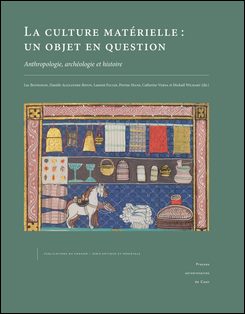
Publication – « La culture matérielle, un objet en question. Anthropologie, archéologie et histoire », dir. Luc Bourgeois, Danièle Alexandre-Bidon, Laurent Feller, Perrine Mane, Catherine Verna et Mickaël Wilmart

Depuis près d’un siècle, la notion de culture matérielle a été utilisée pour aborder la part matérielle des cultures dans des perspectives successives : émanant d’une lecture marxiste née vers 1920, elle participe de l’intérêt porté à la matérialité médiévale et aux techniques par les historiens et les archéologues dans les années 1950-1980. Depuis lors, elle se développe principalement dans le cadre de Material Culture Studies ancrées dans le post-modernisme. Si l’expression « culture matérielle » demeure couramment utilisée, elle semble s’être banalisée et il convient de s’interroger sur sa pertinence actuelle dans le champ des sciences humaines.

_copier_

Principalement centrées sur la période médiévale, les contributions rassemblées dans ce volume font dialoguer archéologues, anthropologues, historiens et géographes pour dresser l’historiographie de la notion de culture matérielle à l’échelle européenne et proposer une série d’études de cas illustrant la « vie des objets » à partir de sources et de terrains variés.

Informations pratiques :

Luc Bourgeois, Danièle Alexandre-Bidon, Laurent Feller, Perrine Mane, Catherine Verna et Mickaël Wilmar (dir.), La culture matérielle, un objet en question. Anthropologie, archéologie et histoire, Turnhout, Brepols, 2018 (Publications du Centre de Recherches Archéologiques et Historiques Médiévales). 22 x 28, rel., ill. coul et N. & B., 264 p. ISBN : 978-2-84133-890-0. 45 €.

Source : Brepols

Publié dans Publications | Laisser un commentaire

Colloque – Altiora te ne quaesieris (Sir. 3, 22). The Medieval Pursuit of Wisdom

The conference Altiora te ne quaesieris (Sir. 3, 22): The Medieval Pursuit of Wisdom aims at discussing various aspects of the medieval search for intellectual and moral perfection. It is open to philosophical and theological considerations related to the concept of wisdom intended in a broad sense, both in its theoretical and practical dimensions. Among the many possible interpretative paths, there is the issue of the cognitive optimism vs the ethical and epistemic limitations of knowledge, the problem of the latent medieval scepticism and of various approaches to the problem of knowability, which is related to the variety of definitions of the scope of the unknown. Another issue concerns the basic motivations of medieval intellectuals, their aims and scientific ambitions, as well as the tension between the condemnation of ignorance, the prohibition of curiosity, and the natural desire for knowledge. Of particular importance is the impact of Aristotle’s theory of science on the medieval views on intellectual research. Furthermore, from a philosophical perspective, wisdom can be considered a matter of inherently and typically human activity; but, when viewed from a theological point of view, scientia and sapientia are gifts beyond the natural human powers. The pursuit of wisdom in the Middle Ages is a provocative issue, open to many other considerations, and it encourages an interdisciplinary debate.

The conference will take place in the historical buildings of the 1000‑year-old Benedictine Abbey near Cracow. It will include five sessions of half-an-hour long papers followed by discussions, a series of short presentations of research projects, a guided tour of the Abbey, and a trip to the historical centre of Cracow.
s

Programme :

Day 1 (Sept. 2)
16.00-18.00

Registration : 18.00
Dinner

Day 2 (Sept. 3)

9.30 : Greetings

9.45-10.50 :SESSION 1: WISDOM AND THEOLOGY
chair: Volker Leppin

Manfred Schulze: Wissen, Theologie, Frömmigkeit. Theologische Methodik bei Gregor von Rimini OESA (†1358)
Pascale Bermon: Sapientia in Theological Texts of the 14th Century, with a Focus on Gregory of Rimini
10.50-11.10 : Coffee break

11.10-12.45 : SESSION 1: WISDOM AND THEOLOGY continuation

Sigrid Müller: “From wisdom to arts and science: The understanding of theological ethics in the Later Middle Ages
Elżbieta Jung: Do the Natural Desire for Knowledge and Loving God Above All Make us Happy. Richard Kilvington in a Dispute Over Semi-pelagianism
Alexandra Baneu: Theology as Science and Wisdom in Pelbartus of Themeswar’s Rosarium
12.45-14.30 : Lunch break

14.30-15.30 : SESSION 2: WISDOM AS MYSTICISM AND CONTEMPLATION

Dietmar Mieth: Meister Eckhart über Wissenschaft und Weisheit
Paul Hellmeier: Der Intellekt ist nicht genug. Das proklische „unum in nobis“ bei Berthold von Moosburg
15.30-15.50 : Coffee break

15.50-18.00 : SESSION 2: WISDOM AS MYSTICISM AND CONTEMPLATION continuation

Christian Trottmann: Sapientiam amavi et exquisivi a juventute mea. Les distinctions entre divers niveaux de sagesse chez Denys le Chartreux et Marquard Sprenger
Giovanni Paolo Maggioni: Ex ore altissimi. Pursuit and transmission of sapientia in medieval hagiographic legends and visions.

18.00 : Dinner

Day 3 (Sept. 4)

9.30 : SESSION 3: WISDOM AND PHILOSOPHY

Mikołaj Olszewski: Sapientia or sapientiae
Maria Burger: Selbsterkenntnis durch Gotteserkenntnis. Der Imago-Dei-Traktat des Albertus Magnus
10.50-11.10 : Coffee break

11.10-12.45 : SESSION 3: WISDOM AND PHILOSOPHY (continuation)

Henryk Anzulewicz: Zum Begriff der Perfectio bei Albertus Magnus
Katja Krause: Envisioning the Usefulness of Science in the Middle Ages
Steven Harvey: Maimonides’ Seeming Disinterest in Phronesis

12.45-14.30 : Lunch break

14.30-16.10 : SESSION 4: SHORT PAPERS

Anne Greule, Lisa-Maria Knothe: Knowledge and temporal felicity in Albert the Great and Alan of Lille (together with L.-M. Knothe)
Agnes Karpinski: Dreams and Divination as Scientific Objects in Commentaries on Aristotle
Łukasz Tomanek: Marsilius of Inghen on limitations of natural knowledge of God
Thanasis Rinotas: …et sapientiam conferre perhibetur: Stones and Wisdom in the Work of Albertus Magnus
Magdalena Bieniak: Langton Project Presentation
16.10-16.30 : Coffee break

16.30-18.00 : IGTM membership annual meeting

18.00 : Dinner

Day 4 (Sept. 5)

9.30-10.50 : SESSION 5: BONAVENTURE ON WISDOM

Andrea Di Maio: At the Crossroads between the Two Biblical Trees. Studiosity vs. Curiosity according to Bonaventure
Agnieszka Kijewska: The Book of the Scripture and the Book of Nature as a Path to Wisdom
Thomas Prügl: A lost inaugural lecture of Saint Bonaventure?
10.50-11.10 : Coffee break

11.10-12.45 : SESSION 5: BONAVENTURE ON WISDOM continuation

Magdalena Płotka: Joyful pursuit of wisdom in St. Bonaventure
Shawn Colberg: Wisdom and Conformity: Reading as Journey in the Theology of Saint Bonaventure
12.45-14.30 : Lunch break

14.30-15.30 : SESSION 6: THOMAS AQUINAS ON WISDOM

Bernhard Blankenhorn: Aquinas’ Summa Contra Gentiles, book III on the desire to see God: A Re-Reading in Light of Henri de Lubac and Lawrence Feingold
Michał Mrozek : The Role of Sapientia in Aquinas’s Moral Considerations of Summa Theologiae
15.30-15.50 : Coffee break

15.50-18.00 : SESSION 7: THE CARTHUSIANS ON WISDOM

Mikhail Khorkov: Controversies on Wisdom in the Erfurt Carthusian Treatises on Mystical Theology from the 15th Century / Kontroversen um die Weisheit in den Abhandlungen zur mystischen Theologie der Erfurter Kartäuser des 15. Jh.
Krijn Pansters: Eremitic Ethics: Wisdom From Behind Walls
Marieke Abram: How Philosophical is Mystical Theology? Denis the Carthusian on ‘scientia’, ‘sapientia’, and ‘contemplatio

18.00 : The reception

Informations pratiques :

2-6 September 2018

The conference will take place in the historical buildings of the 1000‑year-old Benedictine Abbey near Cracow.

It is located very close to Cracow, 10 min ride from the Kraków Balice airport and 20 min ride from the city center.

Source : IGTM 2018

Publié dans Colloque | Laisser un commentaire

Exposition – Savants et croyants. Les Juifs d’Europe du nord au Moyen Âge

25 Mai 2018 – 16 Septembre 2018

Musée des Antiquités – Rouen

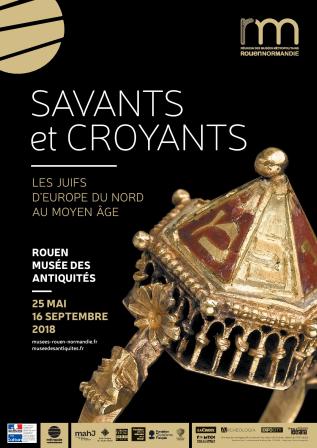
A l’occasion de la réouverture après restauration de la « Maison Sublime » de Rouen, le plus ancien monument juif conservé sur le territoire français, le Musée des Antiquités propose la première exposition jamais consacrée, en France comme à l’étranger, à la vie intellectuelle et la culture juives du Moyen-Âge.

affiche_4-page-001

Les échanges culturels et artisitiques entre les communautés juives et chrétiennes, tissés de façon étroite entre la Normandie et l’Angleterre, mettent en évidence les fondamentaux du judaïsme mais aussi les polémiques entre culture juive et culture chrétienne qui nous éclairent sur les persécutions anti-juives.

Grâce à de rares témoignages de la vie quotidienne (mobiliers, ustensiles domestiques, bijoux, documents fiscaux…), vous découvrirez une culture juive implantée de façon très précoce en Europe du Nord, dont Rouen fut un des foyers majeurs.

De façon inédite, à l’aide d’une sélection d’oeuvres phares (manuscrits, archives, épigraphie, témoignages, objets d’art…) et d’outils multimédias, le musée s’interrogera sur l’existence d’un art juif et sur ses rapports avec les principaux courants artistiques du Moyen-Âge.

Source : Musée des Antiquités

Publié dans Exposition | Laisser un commentaire

Colloque – The Medieval Literary Canon in the Digital Age

Programme : here

An often repeated promise of the digital humanities, in the wake of the “computational turn”, is that the wide availability and accessibility of historical texts enables scholars to breach the restrictions of a literary canon. Such a potential for literary computing, which was in 1992 first set forward as a “new” philology by its godfather Roberto Busa SJ, prominently returns in the works of computing literary theorists such as John Burrows, Jerome McGann and Franco Moretti. Their assertions that quantification entails a “widening of the canon” and eventually the advance of a “new philology”, easily invoke medievalists’ inquisitiveness. How, exactly, can the digital humanities provide such insights for the Middle Ages?

Firstly, one can question if the Middle Ages have not irrevocably lost a privileged position in the modern-day literary canon altogether. The Middle Ages seemingly take up a background position in Moretti’s methodology as an anomalous precedent to the type of literary (re)production that is typical to a literary market in the age of the printing press. This type of text is printed on a scale determined by supply and demand, a condition which appropriates it for digitization today. Even within medieval scholarship, much of the digital scholarship still seems to hinge on well-conserved and therefore well-known theological and literary authorities, whose texts have been reproduced continuously in subsequent editions and translations.

poster-mcda-768x1087

Secondly, over the last decades, medieval studies have become very sensitive to the materiality of textual transmission in the Middle Ages. This is reflected in the New Philology, coined as such by Stephen G. Nichols, which gained momentum in the 1990s. This New Philology, noticeably influenced by post-structuralist theory from the 1960s, drew explicit attention to the conviction that one cannot separate medieval texts from their manuscript context and to reader response. It postulated that analyzing and understanding the various physical appearances of medieval written texts is an essential hermeneutic criterion, and argued that gaining an overview of all stages allowed them to be chained together into a reception history. At first glance, such a “praise of the variant” appears antithetical with the virtual, normative and reductive character of a digital environment, where only little attention has gone out to readers. Yet, both Franco Moretti as Stephen G. Nichols explicitly present their “new” philology – the digital and material respectively – as a cure to a similar ailment: both their “manifestos” symbolically overthrow Ernst Robert Curtius’ iconic Europäische Literatur und Lateinisches Mittelalter. The means by which they aspire to change Curtius’ “old” philology, however, are very different.

As voices increasingly proclaim the emancipation of the digital humanities from their merely supportive role, and as the tools for digital medieval studies proliferate (e.g. digital scholarly editing, computational stylistics, digital palaeography, digital stemmatology, …), this conference seeks out a confrontation between the two “new” philologies and their respective approaches towards a canon that has been formed under an “old” philology. It welcomes research that both problematizes the specialized character of medieval literary production, and yet demonstrates the potential for computational criticism to “breach” or “widen” the medieval canon through digital tools. At the same time, the conference aims to tackle the following questions:

– How has the digital era changed our reading of medieval literature?
– How, exactly, can we understand computational approaches to the Middle Ages as radically transforming our disciplines?
– Are digital approaches bound to remain auxiliary in nature?
– Does it make sense to speak in terms of “new” and “old”, “digital” and “traditional”, “distant” and “close” readings? If so, where should one locate the differences? If not, where should one locate the overlaps?
– To what extent is the New Philology’s advocacy for an object-oriented approach respected or disregarded in computational criticism?
– How can theoretical concepts such as Franco Moretti’s “distant reading” question the medieval canon and the underlying principles or instances that have calibrated it towards an evaluative instrument (Gr. κανών, a “measuring rod”)?
– Which are the governing powers that underpin medieval canon formation, and are these in any way institutionalized (schools, markets, authorities, …)? How are they best described and/or best captured?

Informations pratiques :

17-18 September 2018

The conference will be held in the Jozef Plateau Conference Room of the Plateau-Rozier building (Campus Book Tower, Ghent University). The venue is located in the city centre, within walking distance of public transportation (Jozef Plateaustraat 22, 9000 Ghent).

Enter the building through the main entrance, go left in front of the central staircase on the ground floor, the room is at the end of the hallway. The building is accessible for people with disabilities (treshold ramps).

You can register by sending an email to jedgusse.degussem@ugent.be. Registration closes on Monday, September 3rd.

There is a € 40,00 registration fee for both days, including coffee breaks and lunches. Conference speakers and members of the Henri Pirenne Institute for Medieval Studies are exempt from this fee.

This conference is organized by the Henri Pirenne Institute for Medieval Studies (HPIMS) of Ghent University in collaboration with the research group RELICS (Ghent University) and the University of Antwerp (Department of Literature). It is supported by the Scientific Research Network Digital Humanities Flanders (DHu.f), funded by Research Foundation – Flanders (FWO).

Source : The Henri Pirenne Medieval Institute

Publié dans Colloque | Laisser un commentaire

Publication – Rose-Marie Ferré, « L’iconographie du Livre du Cœur d’amour épris de René d’Anjou »

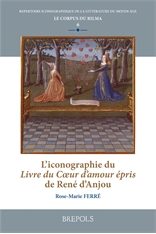
Le cycle iconographique quasiment complet du Livre du Cœeur d’amour épris est ici envisagé de concert avec le texte, en révèlant ainsi toute sa richesse et sa singularité.

Ce volume est consacré à l’une des œuvres majeures de René d’Anjou conservée aujourd’hui dans le manuscrit français 24399 de la Bibliothèque nationale de France. En un songe allégorique qui est aussi quête chevaleresque, le Cœur personnifié veut rejoindre l’aimée. Les enluminures, par une mise en image efficace et dynamique du texte, rendent surtout la profonde mélancolie, en cette fin du Moyen Âge, d’un sentiment amoureux qui affronte de multiples épreuves.

Comme dans le Mortifiement de Vaine Plaisance, composé deux ans plus tôt et premier volet de ce diptyque littéraire, le cœur (organe supplicié pour le Mortifiement ou Chevalier dépité dans le roman de 1457) n’aura d’autre choix que le renoncement final et la douleur. À cet égard, animé d’un vrai souci spirituel, René d’Anjou fait édifier à la même époque, aux Cordeliers d’Angers, une chapelle dédiée à saint Bernardin de Sienne (1453), pensée comme tombeau pour son cœur. Les sujets évoqués dans le traité de théologie morale ou dans les péripéties sentimentales du chevalier Cœur ne sont pas ainsi sans rappeler les sujets exprimés et représentés dans le petit sanctuaire, échos d’une réflexion sur la Passion du Christ, la rédemption, la Vaine Gloire et le salut de l’âme.

dIS-9782503580029-1

Rose-Marie Ferré est Maître de Conférences en Histoire de l’art médiéval à l’Université Paris-Sorbonne (Paris IV). Ses recherches portent sur les paramètres de la commande artistique, les questions d’iconographie et de transmission culturelle à la fin du Moyen Âge.

Table des matières :

Une mise en scène allégorique de la quête amoureuse
René d’Anjou, du prince à l’écrivain
Le personnage politique
L’homme de religion et de spiritualité
Le grand commanditaire
L’écrivain
Les œuvres attribuées

Le Mortifiement de Vaine Plaisance
Le Livre du Cœur d’Amour épris : épopée et courtoisie
Un cœur pluriel
Une écriture métaphorique
Un texte enluminé : données historiques sur le manuscrit et comparaison avec le manuscrit de Vienne.

Le cycle iconographique

Bibliographie
Glossaire
Index

Informations pratiques :

Rose-Marie Ferré, L’iconographie du Livre du Cœur d’amour épris de René d’Anjou, Turnhout, Brepols, 2018 (Répertoire Iconographique de la Littérature du Moyen Age, 6).

Source : Brepols

Publié dans Le réseau, Publications | Laisser un commentaire

Publication – Sophie Brouquet-Cassagnes, « Capétiennes. Les reines de France au Moyen Âge (Xe-XIVe siècles) »

L’intérêt pour l’histoire des reines de France est récent. Si quelques souveraines, comme Aliénor d’Aquitaine, Blanche de Castille ou Isabeau de Bavière, se sont vues consacrer des biographies, beaucoup d’autres demeurent de parfaites inconnues. Ce n’est pourtant pas faute de sources. Elles sont partout présentes dans les enluminures, la littérature, les cérémonies, les processions, les entrées royales.

Le présent ouvrage souhaite combler cette lacune en présentant les personnalités variées et multiples des reines qui ont fait la dynastie capétienne au travers de leurs vies. Il propose aussi des thématiques renouvelées comme le métier de reine, l’accès au pouvoir, les rapports au sein du couple et de la famille royale, ainsi que le mécénat et la dévotion des Capétiennes.

Table des matières : ici

Docteure en histoire et docteur en histoire de l’art, Sophie Brouquet-Cassagnes consacre son travail à l’histoire du genre et des femmes, et plus particulièrement aux femmes, la violence et le pouvoir. Elle a notamment publié Chevaleresses, une chevalerie au féminin (Perrin, 2013).

Informations pratiques :

Sophie Brouquet-Cassagnes, Capétiennes. Les reines de France au Moyen Âge (Xe-XIVe siècles), Paris, Champs-Vallon, 2018 (Époques). 15,5 x 24, 288 pages. ISBN : 979-10-267-06922-1. 23 €.

Source : Champs-Vallon

Publié dans Publications | Laisser un commentaire

Publication – « Anseys de Gascogne. Chanson de geste du milieu du XIIIe siècle », éd. Jean-Charles Herbin et Annie Triaud

Anseÿs de Gascogne est une chanson de geste composée au milieu du XIIIe siècle, vraisemblablement en Flandre francophone. Elle se propose implicitement (avec Yonnet de Metz et la Vengeance Fromondin) comme l’une des conclusions possibles de la Geste des Loherains, mais elle n’en respecte nullement l’intention, puisque les Lorrains y sont menés à leur perte. OEuvre d’un poète cultivé bien au fait des exigences formelles de la chanson de geste, elle intègre quelques développements non épiques (enchanteurs, légende du Bois de la Croix, etc.) – et laisse transparaître des intentions politiques en donnant la part belle au comte de Flandre et aux seigneurs du Nord au détriment du roi de France et des Lorrains.

Capture d_écran 2018-06-08 à 14.14.18

Jean-Charles Herbin est professeur émérite de l’Université de Valenciennes et du Hainaut-Cambrésis. Spécialiste de la Geste des Loherains, il a publié notamment Hervis de Mes, la Vengeance Fromondin, Yonnet de Metz, la Prose des Loherains de l’Arsenal, et travaille sur les proses laissées par David Aubert et Philippe de Vigneulles.

Annie Triaud est Docteur d’État en Littérature française du Moyen Âge. Outre son enseignement de littérature, elle a mené une carrière d’attachée universitaire hors de France, assurant le développement et l’expansion du français comme langue institutionnelle. Après des premiers travaux sur l’Eneas, elle s’est intéressée aux Loherains.

Informations pratiques :

Jean-Charles Herbin et Annie Triaud (éd.), Anseys de Gascogne. Chanson de geste du milieu du XIIIe siècle, Paris, Honoré Champion, 2018 (Classiques français du moyen Âge, 184). 814 pages, 11 X 17,5 cm. ISBN : 9782745347688. Prix : 65 euros.

Source : Honoré Champion

Publié dans Publications | Laisser un commentaire

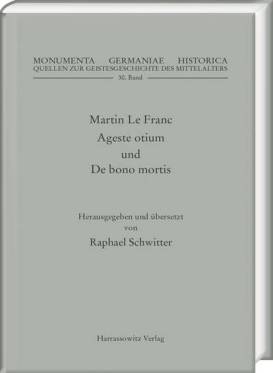
Publication – Martin Le Franc, « Agreste otium und De bono mortis », éd Raphael Schwitter

Das lateinische Werk des französischen Frühhumanisten Martin Le Franc (1408–1461) gehört zu den jüngsten Entdeckungen der neulateinischen Literatur. Der vorliegende Band bietet jeweils die Editio princeps von Le Francs Dialogen Agreste otium und De bono mortis nebst einer deutschen Übersetzung und einen detaillierten Kommentar. Die ausführliche Einleitung zeichnet Le Francs Leben entlang der Quellen nach und stellt sein vom italienischen Humanismus geprägtes Literaturschaffen in einen breiteren kulturhistorischen Rahmen. Während der Autor in De bono mortis, in der Tradition des selbstbetrachtenden Trostdialogs, durch dialektische Selbstbesinnung eine persönliche Verlusterfahrung zu überwinden sucht, verarbeitet er im Agreste otium mit dem Hundertjährigen Krieg, dem Basler Konzil und der Bedeutung von Fatum und Fortuna für das Leben der Menschen jene zeitgenössischen Kernthemen, die auch sein breit rezipiertes französischsprachiges Œuvre auszeichnen. Durch sein nunmehr vollständig erschlossenes Werk füllt Le Franc jene Leerstelle aus, welche die moderne Forschung in der Geschichte des französischen Humanismus zwischen 1420 und 1450 feststellte.

44fd56443b

Table des matières : ici

Informations pratiques :

Martin Le Franc, Agreste otium und De bono mortis, éd Raphael Schwitter, Harrassowitz Verlag, 2018. (Quellen zur Geistesgeschichte des Mittelalters 30). CXXXVI und 300 S. 8º. ISBN 978-3-447-10750-1 geb. € 78,—

Source : Monumenta Germaniae Historica

Publié dans Publications | Laisser un commentaire

Publication – John Haines, « Chants du diable, chants du peuple. Voyage en musique dans le Moyen Âge »

Ce livre est une invitation au voyage dans le temps, un voyage en musique dans le Moyen Âge. Comme le chant médiéval semble loin ! Ce voyage, forcément, il nous faut le commencer là où nous sommes, assaillis par le vacarme des temps modernes.

Ô chants évanouis ! Chants d’hommes et surtout de femmes dans leur besogne quotidienne, dans leurs guérisons, divinations et danses ! Voix féminines puissantes, voix envoûtantes reliant la vie à la mort ! Chants retentissant pendant les siècles du Moyen Âge, vous ne retentirez plus jamais ! Mais la trace de votre symphonie immense demeure avec nous, pâle murmure, dans les harangues de l’homme contre les chants du diable.

Ce livre est une invitation à voyager dans le temps, à entendre tous les chants du Moyen Âge et non seulement ceux du grand homme. En partant du vacarme des temps modernes, le lecteur découvrira une panoplie de musiques quotidiennes que les autorités ecclésiastiques nommaient jadis « les chants du diable ».

dIS-9782503579627-1

John Haines is Professor of musicology and medieval studies at the University of Toronto, where he holds a joint appointment at the Faculty of Music and Centre for Medieval Studies.

Informations pratiques :

John Haines, Chants du diable, chants du peuple. Voyage en musique dans le Moyen Âge, Turnhout, Brepols, 2018 (Epitome Musical). 165 p., 110 x 180 mm, 2018. ISBN: 978-2-503-57962-7. Prix : 18 euros.

Source : Brepols

Publié dans Publications | Laisser un commentaire

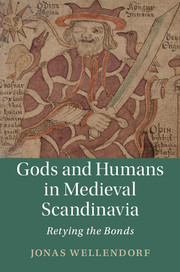
Publication – Jonas Wellendorf,  » Gods and Humans in Medieval Scandinavia. Retying the Bonds »

The coming of Christianity to Northern Europe resulted in profound cultural changes. In the course of a few generations, new answers were given to fundamental existential questions and older notions were invalidated. Jonas Wellendorf’s study, the first monograph in English on this subject, explores the medieval Scandinavian reception and re-interpretation of pre-Christian Scandinavian religion. This original work draws on a range of primary sources ranging from Prose Edda and Saxo Grammaticus’ History of the Danes to less well known literary works including the Saga of Barlaam and the Hauksbók manuscript (c.1300). By providing an in-depth analysis of often overlooked mythological materials, along with translations of all textual passages, Wellendorf delivers an accessible work that sheds new light on the ways in which the old gods were integrated into the Christian worldview of medieval Scandinavia.

Jonas Wellendorf is an assistant professor in the Department of Scandinavian at University of California, Berkeley. He is the author of multiple articles in journals and peer-reviewed anthologies and has also co-edited anthologies and an edition of an Old Norse rhetorical treatise.

9781108424974

Table des matières :

1. Retying the bonds
2. The hierarchy of disbeliefs in antipagan polemics
3. Universalist aspirations in Hauksbók
4. The Byzantine Gods of Saxo Grammaticus
5. Gods and humans in the Prose Edda
Epilogue: Óðinn and Odysseus.

Informations pratiques :

Jonas Wellendorf, Gods and Humans in Medieval Scandinavia. Retying the Bonds, Cambdridge, Cambridge University Press, 2018. 220 pages. 235 x 158 x 16 mm. ISBN : 9781108424974. Prix : 75 £.

Source : Cambridge University Press

Publié dans Publications | Laisser un commentaire