Publication – « Les Auctoritates Aristotelis, leur utilisation et leur influence chez les auteurs médiévaux. État de la question 40 ans après la publication », éd. J. Hamesse et J. Meirinhos

En 1974, à l’époque de la publication du texte des Auctoritates Aristotelis les chercheurs n’avaient pas encore mesuré l’influence que ce florilège avait pu avoir dans bon nombre d’œuvres médiévales. Nombreux étaient ceux qui ne connaissaient même pas ce recueil et qui préféraient se référer directement à l’œuvre même du Stagirite pour identifier des citations. Mais la réalité médiévale était bien différente. En effet, les recherches menées après la parution de l’édition ont modifié considérablement notre conception de l’usage qu’en firent les intellectuels du 13e au 17e siècle. Beaucoup de progrès ont été faits depuis, surtout dans le domaine des éditions critiques de textes philosophiques encore inédits à l’époque. Il suffit de consulter les apparats critiques des sources utilisées par ces auteurs pour constater qu’ils furent nombreux à citer des « auctoritates » d’Aristote, extraites de ce florilège. D’autre part, les recherches réalisées progressivement, montrent que ce recueil a aussi une histoire.

Le but du Colloque était donc de faire un nouvel état de la question et de montrer à l’aide d’exemples pertinents l’usage qui fut fait des citations contenues dans le recueil par divers auteurs de l’époque. D’autre part, les informations glanées dans les divers exposés illustrent parfaitement des moments de son histoire. Les textes contenus dans le volume ne rendent pas stériles les recherches ultérieures mais proposent diverses voies d’accès à la reconstitution de son élaboration, sans épuiser pour autant le sujet. Certaines communications permettent déjà de constater le succès énorme que connut le recueil, non seulement pendant l’époque scolastique, mais aussi jusqu’à la fin du 17e siècle, ce qui peut paraître étrange à première vue.

Table des matières :

José Meirinhos, Préface

Jacqueline Hamesse, Des Parvi flores aux Auctoritates Aristotelis
Maria José Munoz Jiménez, Los manuscritos de las Auctoritates Aristotelis conservados en Espana
José Filipe Silva, What Source: Textbook or Original Text? The Use of florilegia by Robert Kilwardby
Marco Toste, Parvi flores and philosophia practica: Medieval florilegia and the Aristotelian Commentaries of the Arts Faculty
Griet Galle, The use of the Auctoritates Aristotelis in Peter of Auvergne’s questions on De caelo
Pieter De Leemans, Another Aristotelium florilegium (Paris, BnF, lat. 14704)
Alessandra Beccarisi, Eckhart e le Auctoritates Aristotelis
William Duba, Auctoritates and Aristoteles in Peter Auriol
Andrea Robiglio, Dante e le Auctoritates Aristotelis
Christine Boyer, Le prédicateur et ses sources : les auctoritates philosophiques dans les sermons du dominicain Guillaume de Sauqueville
Lorenzo Tromboni, Percorsi paralleli nella lettura dei classici. Girolamo Savonarola e le Auctoritates Aristoteles
Pietro Bassiano Rossi, Dall’ Aristotele di Petrarca e all’ Aristotele di Coluccio Salutati
Guy Guldentops, Nemo / Nihil dat quod non habet : Fortune d’un topos de Platon à Derrida

Luca Bianchi, Conclusions
José Meirinhos, Bibliographie des Auctoritates Aristotelis

Informations pratiques :

Jacqueline Hamesse et José Meirinhos (éd.), Les Auctoritates Aristotelis, leur utilisation et leur influence chez les auteurs médiévaux. État de la question 40 ans après la publication, Turnhout, Brepols, 2017 (Textes et Études du Moyen Âge, 83). IX+362 p., 6 b/w ill., 4 b/w tables, 165 x 240 mm. ISBN: 978-2-503-56738-9. Prix : 55 euros.

Source : Brepols

Publié dans Publications | Laisser un commentaire

Colloque – Medialatinitas 2017

Universität Wien • Philologisch-Kulturwissenschaftliche Fakultät
Institut für Klassische Philologie, Mittel- und Neulatein
Universitätsring 1, 1010 Wien, Österreich
medialatinitas2017.mittellatein[at]univie.ac.at

cropped-en-tete1

Programme :

Sunday 17 September

10:00-13:00 International Medieval Latin Committee Meeting (Private)
14:00-16:00 Registration in the Aula of the Hauptgebäude, Universität Wien
[Monday – Thursday in the Garderobe of the Festsaal]
16:00 Welcome and Remarks (Großer Festsaal)
Danuta Shanzer and Christine Ratkowitsch (Conference Organizers)
Jan Ziolkowski (President, IMLC)

17:00 Plenary 1: Peter Stotz, Zürich (Großer Festsaal)
„Ziele und Stile unseres Forschens: Rückblick und Umschau – eine Skizze“
Introduction: Kurt Smolak
18:15 Wine Reception (Arkadenhof)

Monday 18 September

09:00-10:30 1st Session
10:30-11:00 Break
11:00-12:30 2nd Session
12:30-14:00 Lunch
14:00-15:30 3rd Session
15:30-16:00 Break
16:00-17:30 4th Session
17:45-19:00 Plenary 2: C. Stephen Jaeger (Großer Festsaal)
“John the Evangelist and the Grand Style in the Medieval Latin Sermon“
Introduction: Matthias Meyer
19:30 Reception hosted by the Mayor of Vienna (Rathaus)

Tuesday 19 September

09:00-10:30 5th Session
10:30-11:00 Break
11:00-12:30 6th Session
12:30-14:00 Lunch
14:00-15:30 7th Session
15:30-16:00 Break
16:00-17:30 8th Session
17:45-19:00 Plenary 3: Pascale Bourgain, École Nationale des Chartes (Großer Festsaal)
“La naissance des littératures nationales et leur passage par le latin”
Introduction: Danuta Shanzer
20:00 Concert (Großer Festsaal)

Wednesday 20 September

09:00-10:30 9th Session
10:30-11:00 Break
11:00-12:30 10th Session
12:30-14:00 Lunch
14:00-17:00 Free Afternoon or Workshops (Registration required in advance):
o Classical Text Editor (Stefan Hagel, OeAW)
o Latin Editing Workshop (Dorothea Weber and CSEL Team, Rita Beyers for the CCSL)
o Einführung in das lexikographische Arbeiten (Helena Leithe-Jasper, Monica Niederer and Carolinne White)
o Klosterneuburg Bibliotheksbesuch/Goldener Altar (Martin Haltrich and Martina Pippal)
o Neidhart Fresken (Neidhart Frescoes)
o Schatzkammer (Treasury)

Thursday 21 September

09:00-10:30 11th Session
10:30-11:00 Break
11:00-12:30 12th Session
12:30-14:00 Lunch
14:00-15:30 13th Session
15:30-16:00 Break
16:00-17:30 14th Session
19:00 Congress Dinner (Heuriger Fuhrgassl-Huber, Neustift)

Friday 22 September

Excursion to Carnuntum (led by Ortolf Harl)
08:30 Bus leaves
10: 00 Braunsberg: view and topography
11:30 Museum Carnuntinum
12:30 Archäologischer Park Petronell-Carnuntum (opportunity for lunch)
15:00 Sightseeing: Zivilamphitheater and Heidentor
17:00 Heuriger (Dinner)
19:00 Leave for Vienna
20:30 Return

Excursion to Savaria-Szombathely and Ják (led by Renate Pillinger and Martina Pippal)
08:30 Bus leaves
11:00-12:30 Sightseeing in Szombathely: Platz des antiken Theaters, Perintbrücke, Iseum, Synagoge (Renate Pillinger)
12:30–13:00 Snack
13:00–16:00 Sightseeing in Szombathely: Kathedrale, Kaiserpalast, Savariamuseum, Martinskirche
16:30 Leave for Ják
17:00–18:00 Ják (Martina Pippal)
18:00 Leave for Köszeg
18:40-20:30 Dinner in Köszeg (Burgkeller)
20:30 Leave for Vienna
22:00 Return

Source : Compitum


Publié dans Colloque | Laisser un commentaire

Publication – Gaël Chenard, « L’Administration d’Alphonse de Poitiers (1241-1271) »

Les archives qu’Alphonse de Poitiers, frère de saint Louis, a léguées, sont un objet d’étude précieux. Ces documents éclairent les moyens de gouvernement dont dis- pose un prince territorial et donnent un contrepoint intéressant à l’histoire un peu trop lisse du saint roi qui faisait face à de nombreuses oppositions.

Capture d_écran 2017-08-15 à 12.46.53

The archives bequeathed by Alphonse de Poitiers, the brother of Louis IX (Saint Louis), are an invaluable object of study. These documents, which shed light on the levers of government that a provincial prince could avail himself of, o er a counterpoint to the overly smooth account of the Saint-King who in fact had to face a great deal of opposition.

Informations pratiques :

Gaël Chenard, L’Administration d’Alphonse de Poitiers (1241-1271), Paris, Classiques Garnier (Bibliothèque d’histoire médiévale, 18). 584 p., 15 x 22 cm Broché, ISBN 978-2-406-06016-1, 58 € Relié, ISBN 978-2-406-06017-8, 95 €.

Source et bon de commande : Academia.edu

Publié dans Publications | Laisser un commentaire

Appel à contribution – Beyond the Ornament: Abstraction in Medieval Art

Case Western Reserve University
Deadline-CFP: 15 sept. 2017

Call for papers: Beyond the Ornament: Abstraction in Medieval Art

Editor: Elina Gertsman, Case Western Reserve University

Deadline for submitting a proposal (up to 700 words) and a brief bio: September 15, 2017
Notification of submission status: September 30, 2017
Submission of completed texts (around 6000 words): December 15, 2018

Scholars are invited to contribute essays to an anthology on medieval manifestations of the abstract. Since Henri Focillon’s eloquent meditation on la vie des formes, originally published in 1939, the subject of abstraction in medieval art has been largely reduced to the study of ornament and questions of style, with occasional forays into the discussion of sacred geometry and exploration of the late Gothic hard style. This collection, which conceives of the long Middle Ages globally, seeks to re-open the question of medieval abstractions, interrogating the term itself and asking about the ways it can be fruitfully applied to pre-modern material culture. It is expected that contributors will approach the concept of medieval abstraction from a multitude of perspectives—formal, semiotic, iconographic, material, phenomenological, epistemological. Scholars whose expertise lies in Islamic, Byzantine, and Asian art are particularly encouraged to submit a proposal.

Abstraction haunts medieval art, both withdrawing figuration and suggesting elusive presence. How does it make or destroy meaning in the process? Is it by detaching itself from matter and foregrounding the figurative? Is it by dissolving the figurative into matter, by calling attention to the surface and to its planar artifice? Do the figurative and the abstract collapse upon each other? In what way does abstraction represent or deny? In which way should we even approach this term? Does abstraction suggest the failure of figuration, the faltering of iconography, and can it truly escape the semiotics of color or form? To what extent is abstraction beholden to the field of mathematics? To other disciplines? Does medieval abstraction function because it is imperfect, incomplete, and uncorrected—and therefore cognitively, visually demanding? Just how closely are medieval abstraction and vision connected, and to what extent is the abstract predicated on theorization of the unrepresentable and imperceptible? Is there something intrinsic about the connection between abstraction and the divine? How much can the abstract really comprehend and elide with the aniconic? Does medieval abstraction pit aesthetics against, say, liturgy, or does it enrich it, or frame it, or both? How, finally, does it define its viewers, medieval and modern? These questions provide but a starting point for the possible approaches to the volume’s theme.

Please direct all queries and submissions to elina.gertsman@case.edu

Source : ArtHist

Publié dans Appel à contributions | Laisser un commentaire

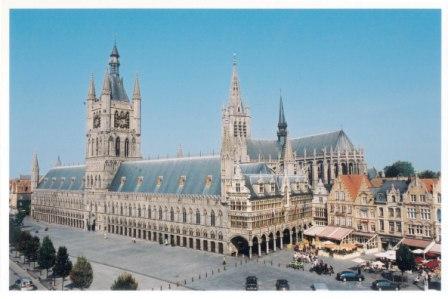
Journée d’étude – Beyond Proto-Industry. The Social Organisation of Pre-Industrial Textile Production in Town and Countryside. Case study: the Flemish West-Quarter.

International Workshop
Ypres, Sunday 10 September 2017

Pre-conference workshop EURHO Leuven Conference, with the support of FWO Flanders, CORN Comparative Rural History Network & In Flanders Fields Museum

This pre-conference workshop seeks to reassess the concept of ‘proto-industry’ in relation to pre-industrial textile production in the Flemish West-Quarter. Textile production was one of the major industries in many parts of pre-industrial Europe. During the urban take-off of the eleventh and twelfth centuries, large-scale textile production had come to be concentrated in towns, but from the thirteenth century onwards, the countryside increasingly became the venue for textile manufacture. In the county of Flanders, many urban industries were struggling to compete with their rural counterparts, and only a few cities were able to maintain a successful cloth industry. Indeed, between the thirteenth and nineteenth centuries, market-oriented textile production became the main industrial activity in the countryside in many places in Europe. While in some rural regions textile manufacture clearly remained a form of by-employment closely linked to the seasonal cycle of agricultural labour, others saw a real specialization in textile production. Based on this process, Franklin Mendels coined the term ‘proto-industrialization’, the fast growth and specialization of traditional industry, which he considered a phase that preceded and facilitated the factory industrialization of the late eighteenth- and nineteenth centuries. Mendels’s original study has since been heavily debated, but proto-industrialization as a concept has remained prominent in historiography of the pre-industrial economy.

Yet in the southwestern part of the county Flanders, the so-called West-Quarter, the late medieval industrial development of the countryside did not really conform to a pattern of proto-industrial by-employment. It was not characterized by the production of lower-quality fabrics by peasants pursuing strategies to generate additional income. In fact, between the late-fifteenth and early seventeenth century, it was the burgeoning town Hondschoote that grew into the most important Flemish production center of light drapery, leaving rural producers by the wayside. At the same time, some villages in the castellany Bailleul, particularly Nieuwkerke, became leading producers of medium-quality woollen cloth. Meanwhile, Ypres, the largest city in the region, for all its complaints about rural competition, remained one of the few Flemish towns with an economically viable industry of luxury woollens. This begs the question: what happened here, and how does the economic development of this region, both rural and urban, fit within the wider framework of European proto-industry? These issues will be addressed in the course of this workshop.

This workshop forms a prelude to the panel Beyond proto-industry: rural textile industries throughout pre-industrial Europe at the Rural History Conference 2017 (Louvain, 11-14 September 2017), which will offer a European-wide perspective on some of the same topics discussed here. The event will take place in the Lakenhalle, the medieval cloth hall, of Ypres. It consists of a number of lectures about textile industries of the Flemish West-Quarter, followed by a Round Table discussion with a panel of international experts on the history of textiles and rural history more generally. The workshop will conclude with a trip to some of the pre-industrial textile villages in the vicinity of Ypres.

116

Programme :

Sunday 10 September 2017
Ypres Lakenhalle

10:00-11:30 Variations of Flemish Textile Production

Part A: Rural Textiles

Tim Soens: The Flemish Agro-Systems and their potential as labour pool for textile industries.
Jim van der Meulen: The Nieuwkerke Drapery: between collective action and entrepreneurship
Eline Van Onacker and Maïka De Keyzer : Peasants without proto-industry? Wool and textiles in the Campine area.

Part B: Urban Textiles

Peter Stabel: Oudenaarde tapestries between town and countryside: Pirenne revisited, Pirenne restored
Wout Saelens: The Urban Textile Guilds: the corporative model and its problems.
11: 30: Coffee break

11:45: Round Table: explaining regional variations in the social organization and resilience of pre-industrial textile production.

Confirmed Participants: Ulrich Pfister; Erik Thoen; Thijs Lambrecht; Jan Dumolyn; Bruno Blondé; Reinoud Vermoesen; Paul Trio; Dominiek Dendooven.

12:30: Lunch
14: 00: Visit to Nieuwkerke and the textile producing villages of the Flemish West-Country.
17: 00: Departure for Leuven
19: 00: Arrival in Leuven.

Source : Vlaamse Werkgroep Mediëvistiek

Publié dans Colloque | Laisser un commentaire

Appel à contribution – Pictor/Miniator: Working across media, 1250–1500

Schoenberg Institute for Manuscript Studies Sponsored Session at the 53rd International Congress on Medieval Studies, Western Michigan University, Kalamazoo, May 10-13, 2018
Deadline: 20 September 2017
michelino_molinari_da_besozzo_-_st-_luke_painting_the_virgin_-_google_art_project

The multimedia fluidity of artists and artisans in the later Middle Ages is an area ripe for investigation. Across diverse regions in Europe and beyond, many illuminators, both named and anonymous, engaged in forms of art-making in addition to the decoration of manuscript books. Some painted frescoes, panels, and ephemera, while others provided designs and supervised the production of stained glass, enamels, tapestries, and other objects. With some frequency, those who specialized in other media were in turn called upon to illuminate books. While modern studies have focused on individual examples of such multi-media talent, the broader implications of this intermedial fluency remain obscure: within the wider art-historical canon, manuscript illumination as an art form is largely seen as derivative or prone to influence from large-scale media.

This session seeks to re-examine the relationship between manuscript illumination and other fields of artistic endeavor in the later Middle Ages. How did artists themselves consider the differing characteristics and ontologies of these varied supports? How did painters adapt their style and working method when engaging with other media and other categories of object? Did the presence of local guild regulations curtail or encourage multi-media practice, and how did this compare region-to-region or to contexts outside of Western Europe? Beyond evident differences in scale, pricing, and technique, interesting issues arise regarding patronage and audience: how different was the clientele for manuscripts compared to that for painting, for example? How did the relative accessibility and visibility of differing art forms affect the visual solutions achieved? Is a book-bound image “freer” or more experimental than a publically visible one?

The session asks these and other questions relevant to those studying the social contexts of art production, the dynamics of reception, materiality, and the technical characteristics of objects. It seeks to be open-minded in terms of methodological approach, and aims to bring together scholars working on diverse material, in order to initiate a larger conversation that can impact the discipline of art history as a whole.
Please send proposals with a one-page abstract and a completed Participant Information Form (http://www.wmich.edu/medievalcongress/submissions) to Nicholas Herman (hermanni@upenn.edu) by 20 September 2017.

Source : Medieval Art Research

Publié dans Appel à contributions | Laisser un commentaire

Colloque – Simon de Montfort († 1218) : le croisé, son lignage et son temps

The career of Simon of Montfort encompassed the entirety of Western Europe—as well as the Levantine crusade—at the turn of the thirteenth century. Born and raised in the orbit of the French royal court at Paris, he inherited and was dispossessed of an English earldom and the royal stewardship. Moreover, he twice took the cross: first to the Holy Land on the ill-fated Fourth Crusade, where he publicly dissented from the diversion to Constantinople, and later against the heretics in the Midi, where he established a semi-independent crusader principality. All this came to an end with his death before the walls of Toulouse eight hundred years ago, yet his life did not fail to leave a mark on his contemporaries nor on posterity. Most of Christendom hailed him as a pious hero, an ideal miles Christi, both during his lifetime and after his supposed martyrdom, struggling against heretical depravity. However, in the Midi and Spain his reputation was frequently that of a brigand, a barbarian, a greedy and unscrupulous foreign interloper. The latter judgement, with some exceptions, has largely been his legacy since the nineteenth century. But the Simon of Montfort that this conference will seek to discuss is a man of contradictions: the principled crusader to the East who mutilated a defeated garrison in the Languedoc, the victor over the king of Aragon who voluntarily submitted his conquests to the king of France, the man who despoiled legitimate lords in the south while providing legal protections for widows and clergy. This conference will centre on studying Simon both as a product of his time and an agent who helped to form it, an actor in his lifetime and a cipher for posterity, the successor to a dynasty and the origin of inheritances across Europe, a conqueror and a failure.

Simon_Leicester-246x300

Programme :

Jeudi 3 mai / 9h-12h

Martin Aurell, Gregory Lippiatt, Laurent Macé : Introduction

Simon et la croisade albigeoise

Jean-Louis Biget (École Normale Supérieure) : Tenir le pays : Montfort entre villes et châteaux d’Occitanie
Gregory Lippiatt (University of East Anglia (Norwich-CESCM) : The Statutes of Pamiers: Simon and Baronial Reform in Early Thirteenth-Century Europe
Martín Alvira (Universidad complutense de Madrid) : Simon et Pierre II d’Aragon : faits et mémoire
Damian Smith (Saint Louis University, Missouri) : James I of Aragon, Simon and the Papacy (1211-1218)

Jeudi 3 mai / 14h-18h

Simon : le baron, ses hommes et ses représentations

Christine Chana Keck (Université de Frankfort) : L’entourage de Simon
Nicholas Vincent (University of East Anglia, Norwich) : Simon as Earl of Leicester
Laurent Macé (Université de Toulouse-Jean Jaurès) : Princeps et monarcha : le sceau de majesté de Simon (1216-1218)
Daniel Power (University of Swansea) : La croisade albigeoise après Simon (1218-1224)

Vendredi 4 mai / 9h-12h

Les fils de Simon, la Gascogne et l’Angleterre

Lindy Grant (University of Reading) : Amaury V (d. 1241), his Siblings, and the Capetians
Sophie Ambler (University of Lancaster) : Simon VI (†1265) and Montfortian Identity
Amicie Pélissié du Rausas, Université de Poitiers-CESCM, « Le gouvernement de Simon VI en Gascogne (1248-1252) »
Rodolphe Billaud (University of Canterbury) : Simon VI et l’occupation du comté de Chester (1264-1265)

Vendredi 4 mai / 14h-17h

La culture des Montfort

Catalina Girbea (Université de Bucarest-CESCM) : Les Montfort d’Italie, commanditaires de manuscrits arthuriens
Björn Weiler (University of Abersystwyth) : Mathew Paris and the Montfort Family
Alexis Charansonnet (Université de Lyon II) : Saints ou démons ? L’image posthume des Montfort au XIIIe siècle
Martin Aurell (Université de Poitiers-CESCM) : Conclusions

Informations pratiques :

Colloque international : « Simon de Montfort († 1218) : le croisé, son lignage et son temps »

Date : Jeudi 3 et vendredi 4 mai 2018

Lieu : CESCM, Hôtel Berthelot – 24 rue de la Chaîne, Poitiers

Source : CESCM

Publié dans Colloque | Laisser un commentaire

Appel à contribution – Giving and Receiving Care in Times of War

International Medieval Congress – Leeds
July 2018

During conflicts, bodies and minds are subjected to injury. Although a truism, this aspect of the experience of medieval warfare is somewhat underexplored. Recent studies of wounds and wounding and the incidence and experience of sickness during military campaigns have begun to focus attention on how medieval combatants and non-combatants suffered bodily and mental damage in times of war. At the same time, new work has put this experience in a medical context, examining contemporary sources to see how the experience of infirmity in times of war was recorded and interpreted by observers in the medieval medical framework of humoralism. However, there is scope for further investigation across the whole medieval period, and in particular on the experience of the incapacitated as recipients of bodily, psychological, medical and spiritual care.

Giving and receiving care

The experience of the injured, sick, and incapacitated is one half of any medical history; the identity and practice of those who offer care to them is the other half. The role of carer is a complex one. Carers might have significant knowledge of nursing or medicine, or be thrust into the role of carer by circumstance. They may experience physical and emotional labour in offering care to the incapacitated, and need care themselves. Recent work on the history of medical practitioners shows us that we should look beyond those identified as ‘medics’ in contemporary to fully understand the landscape of medical care in the Middle Ages, but such pluralistic approaches have not yet been fully exploited, nor applied to the context of care in warfare.

It is the aim of these proposed sessions to explore the role, agency, behaviour, and subjective experience of recipients and givers of care in times of warfare throughout the whole medieval period, taking in the early, central and later Middle Ages. Submissions from an interdisciplinary background are particularly welcomed, including, but not limited to, work on narrative texts, literary works, documentary records, artistic sources, religious texts and others. Geographical and linguistic scope is not limited. Proposals will be considered for inclusion in a possible publication.

Topics for discussion could include:
• The identity of caregivers, both formal and informal
• Theidentityofthoserequiringcare
• Care of the wounded and care of the sick
• Gendered aspects of giving and receiving care
• Transportation of the sick, wounded, incapacitated
• Treatment of the dead
• Caringforenemies,orprisonersofwar
• Physical and psychological care
• Spiritual care
• The depiction of care in literary or artistic sources
• The care of injured, incapacitated or disabled combatants
and non-combatants
• Thecareofanimalsinamilitarycontext
• The relationship between nursing and medical
care/treatment
• Theabsenceofcare

Abstracts of up to 300 words should be directed, to J.Phillips@leeds.ac.uk by 04 September 2017.

Source : Academia.edu

Publié dans Le réseau | Laisser un commentaire

Colloque – Crusading and the Crusader Movement in the Peripheries of the Christian West 1100–1500

Veranstaltungsort : Herder-Institut für historische Ostmitteleuropaforschung
Veranstalter : Christian-Albrechts-Universität zu Kiel, Abteilung für Osteuropäische Geschichte, Kiel, Germany; Herder-Institut für historische Ostmitteleuropaforschung, Marburg, Germany; University of Ostrava, Department of History, Faculty of Arts, in cooperation with the Centre for the Research of Medieval Society and Culture VIVARIUM, Ostrava, Czech Republic
Datum : 05.10.2017 – 07.10.2017

There is a long history of research on the medieval crusades, their historical concepts, their course, and their social and regional range. For a long time, however, West European (and especially Ger-man) medieval studies followed conceptual approaches, which closely followed the 19th Century understanding of the classical age of the Levant crusades between 1096 and 1291, and therefore regarded the period of the crusades in a very narrow sense (cf. Jaspert/Tebruck 2016). Thereby, the phenomenon of the crusader movement is limited temporally to the High Middle Ages and, spatially, to the crusades of the French, English, Italian and German crusaders into the Holy Land and the Eastern Mediterranean. However, for contemporaries, the term crusade had a much broader range than the description of the military campaigns for the protection or rather the reconquest of Christianity’s sacred sites in the Holy Land. With the term cruciatae the Popes also legitimated armed endeavours outside of the Levant. With only a few exceptions, these latter campaigns have only received limited attention in Western studies of the crusades (Housley 2017, Murray 2014, Fonnesberg-Schmidt 2007). In recent years, however, new insights have been made into the crusading movement in Poland (Gładysz 2014).

Already during the planning of the Second Crusade 1146/47, the Saxon princes (especially Henry the Lion and Albert the Bear) could achieve a theological justification for the planed military campaigns into Slavic areas of settlement between the Elbe and Oder rivers and a comparison with the simultaneous crusade into the Holy Land by Bernard of Clairvaux. The so-called “Preußen- and Litauerfahrten” of the Teutonic Order, which enjoyed great popularity among the European nobility from the 13th century onwards (one need only think of the Prussian campaigns of the Bohemian king Ottokar II), also gained their legitimation as crusades from the Holy See. The same applied to military conflicts with the Mongols and Tatars, the Ruthenes and Muscovites or the Orthodox peoples of Southeastern Europe.

All in all, it appears that the crusade term as a legitimating concept of the bellum iustum gained cur-rency from the 11th century onwards everywhere at the peripheries of the Christian West: The Re-conquista on the Iberian peninsula, i. e. the reconquest of the once Christian territories from the Muslim Moors, as well as the theatres of war in the northeast of the European continent – the so-called “Northern Crusades” of the Danes and Swedes – were marked as crusades. As was the case with the crusades into the Levant, crusade bulls were issued by the Papacy for the campaigns against the Moors, against the Prussian, Lithuanian and Finnish pagans, against the Orthodox “schismatics” or the Monogol-Tatar infideles, and Western Christianity was called upon to take the Cross.

The planned conference seeks to take a comparative look at these peripheral phenomena and to contribute a new accentuation of the comprehension of the crusader movement to regionally-focussed research in this area. The following interests and approaches should be taken into consid-eration here:

  • Which military campaigns were propagated as crusades in the peripheries of the Christian West?
  • What efforts were made to gain recognition for them as crusades and what effects did these have?
  • Which values did the crusader movement have for the societies at the fines christianitatis?
  • What role did the cruciatae have for the strengthening of an all-Western sense of togetherness and solidarity, and what role did they have for creation of a crusader and frontier identity?
  • How, in concrete terms, was the crusade rhetoric reflected in the culture, writings and language of the appropriate countries?
  • Further research desiderata, which have not yet been comparatively contrasted, are the interde-pendencies, parallels as well as differences between the crusades in the peripheries of Latin Christianity.

Programme :

Thursday 5th October

09.00 Welcome and Introduction
09.30 Norbert Kersken (Marburg) – German and Polish Crusaders against the Polabian Slavs
10.15 Oliver Auge (Kiel) – The Conquest of Rügen Island 1168 – a Danish Crusade?
11.00 Coffee Break

11.15 Jens E. Olesen (Greifswald) – The Swedish Crusades towards Finland from a Baltic Perspective
12.00 Christian Krötzl (Tampere) – Crusades, Mission and the Cult of Saints in the Eastern Baltic
12.45 Lunch Break

13.45 Iben Fonnesberg-Schmidt (Aalborg) – Papal Curia’s Perception of Crusading in the Baltic Region
14.30 Robert Antonin (Ostrava) – The Crusade and anti-Pagan Rhetoric in the Foreign Policy and Propaganda of the Last Přemyslids
15.15 Dalibor Janiš (Ostrava) – The Lords of Cimburg and the Crusades to Prussia in the 14th and 15th Centuries
16.00 Coffee Break

16.15 Georg Strack (Munich) – Tarragona or Jerusalem? Pope Urban II and the Target(s) of the Early Crusaders
17.00 Paul Srodecki (Kiel/Ostrava) – Andrés Dias de Escobar and the Ideological Parallels between the Iberian Reconquista and the « Reisen » of the Teutonic Order
17.45 Klaus Herbers (Erlangen) – Kreuzzug und Missionierung – Portugals Aufbruch in neue Welten im 15. Jahrhundert
18.30 Coffee Break

18.45 Key lecture, Norman Housley (Leicester) – Communication between Centre and Periphery in Fifteenth Century Crusading

Friday 6th October

09.00 Alan V. Murray (Leeds) – Chivalry and Internationalism in the Crusading Movement after 1291
09.45 Darius von Güttner-Sporzynski (Melbourne) – Was the Periphery Reluctant in Accepting the Idea of Crusade? The Case of Poland under the Piast Dynasty
10.30 Coffee Break

10.45 Andrzej Marzec (Cracow) – Infideles et perfidi schismatici. Crusades and Christianization as Political Tools in the Hands of Polish Kings in the 14th century
11.30 Sven Jaros (Leipzig) – Against Tatari, Rutheni et Litfani, hostes fidei. Role and Ambivalence of the Crusading Idea Concerning the Polish Integration of Ruthenia in the 2nd Half of the 14th Century
12.15 Adam Szweda (Toruń) – Die Kreuzzugsidee als Gegenstand der Beziehungen zwischen Polen und dem Deutschen Orden nach 1466
13.00 Lunch Break

14.00 Sergey Polekhov (Moscow) – Zwischen Kreuzzügen und Bündnissen: Die Politik des Großfürsten Witolds von Litauen (1392–1430) gegen die östlichen Nachbarn
14.45 Darius Baronas (Vilnius) – Lithuanian Participation in the Crusading Movement in the Long Fifteenth Century
15.30 Rimvydas Petrauskas (Vilnius) – Ziel- oder Ausgangsort? Das Großfürstentum Litauen als verlängerter Arm der Kreuzzugsbewegung vom Ende des 14. bis zum Beginn des 16. Jahrhunderts
16.15 Coffee Break

16.30 Nora Berend (Cambridge) – The Centrality of the Crusading Periphery: Hungarian Rhetoric about the Crusades
17.15 Attila Bárány (Debrecen) – Hungary and the “passagium particulare” after Nicopolis (1396-1437)
18.00 Mark Whelan (London) – A New Frontier for the Teutonic Order? Sigismund of Luxemburg and the Kingdom of Hungary, c.1425-1435

Saturday 7th October

09.00 Zdzisław Pentek (Poznań) – Warum kamen so wenige Kreuzfahrer in das Heilige Land aus Osteuropa?
09.45 Neven Budak (Zagreb) – Crusades in the Kingdom of Hungary, Dalmatia and Croatia – Imaginary, Abused, Failed
10.30 Emir O. Filipović (Sarajevo) – Converting Heretics into Crusaders on the Fringes of Latin Christendom: Shifting Crusading Paradigms in Medieval Bosnia
11.15 Coffee Break

11.30 Nevyan Mitev (Varna) – The Last Crusades on the Balkans from 1443-1444 or the Union between Central and Southeastern Europe against the Ottoman Invasion
12.15 Mihai-D. Grigore (Mainz) – Army Inspection and Crusade. Wallachia and Leo X’s Crusade Plans

13.00 Conference Summary

Source : H-Soz-Kult

Publié dans Colloque | Laisser un commentaire

Publication – Comparative Studies on Medieval Europe – Volume 5. 2017

Comparative Studies on Medieval Europe – Volume 5. 2017
Volume 5. 2017
ISSN Online: 2412-3196
ISBN-13 Online: 978-3-7001-8162-0

Accès : ici

978-3-7001-8162-0

Table des matières :

Walter Pohl – Introduction

Lars Boje Mortensen – The Sudden Success of Prose – a Comparative View of Greek, Latin, Old French and Old Norse
Richard W. Burgess – Michael Kulikowski – Could Isidore’s Chronicle Have Delighted Cicero? A Response

Ilya Afanasyev – Nicholas S. M. Matheou – Revisiting Pre-Modern Ethnicity and Nationhood: Preface
Andrea Ruddick – »Becoming English«: Nationality, Terminology, and Changing Sides in the Late Middle Ages
Yannis Stouraitis – Reinventing Roman Ethnicity in High and Late Medieval Byzantium
Claire Weeda – The Characteristics of Bodies and Ethnicity c. 900-1200
James M. Harland – Rethinking Ethnicity and ›Otherness‹ in Early Anglo-Saxon England
Patrick Wadden – Church, Apostle and People in Early Ireland
Mihailo St. Popović – Veronika Polloczek – Digitising Patterns of Power (DPP): Applying Digital Tools in the Analysis of Political and Social Transformations in the Historical Region of Macedonia (12th–14th Centuries)
Matthias Tischler – Patrick Marschner – The Bible in Historical Perception and Writing of the Transcultural Iberian Societies, Eighth to Twelfth Centuries page 195

Source : Medieval Worlds

Publié dans Publications | Laisser un commentaire