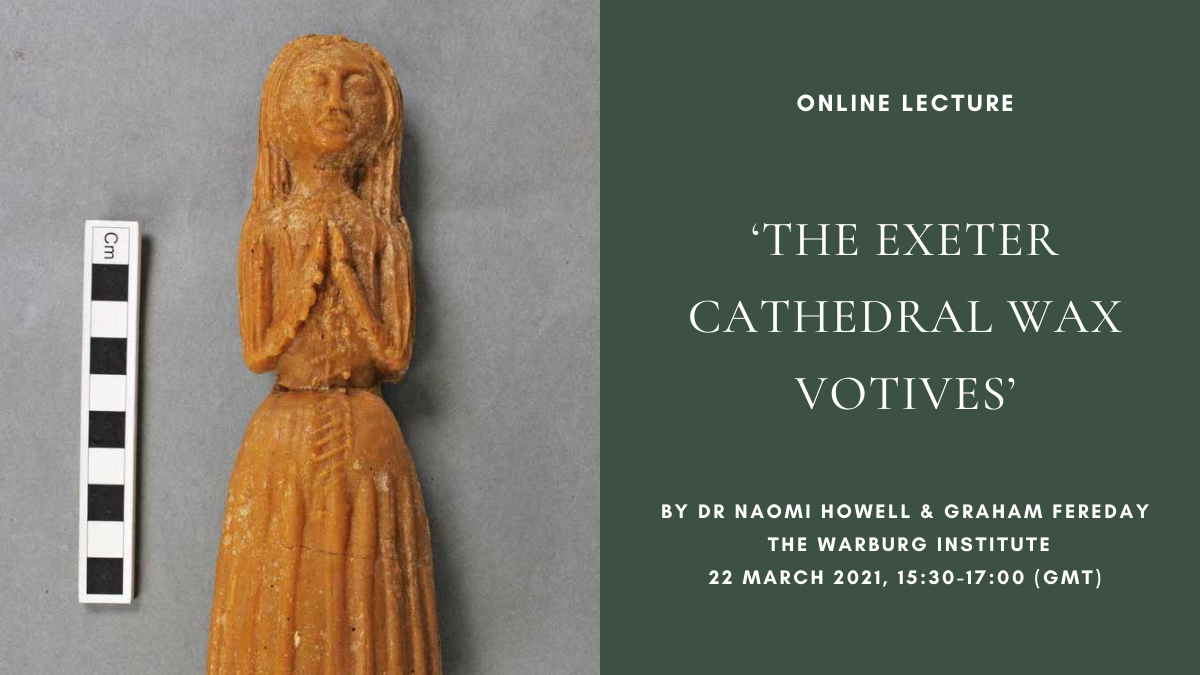
In 1943, following the bombing of Exeter Cathedral, a trove of wax votive objects was found at the tomb of Bishop Edmund Lacey. Many were in small fragments, but one whole figure remained – a unique survival of what was once a vibrant religious practice. In this seminar, Dr Naomi Howell and Graham Fereday from Exeter University will discuss the history, study and ongoing conservation of these extremely rare, fragile objects using a combination of high-definition photography, 360-degree videos and 3D-printed models. Combining medieval history and digital humanities, this seminar offers students and others who are interested an opportunity to discover more about this important archaeological find. Presented in conjunction with Exeter Cathedral Library and Archives.
This event is part of the A Material World: Devotion events series, which brings together academics and heritage professionals from a wide range of disciplines to discuss issues concerning historical devotional materials, their conservation, presentation, display, and reconstruction.
Organisers: Rembrandt Duits (Acting Curator, The Photographic Collection, The Warburg Institute) and Louisa McKenzie (PhD student, The Warburg Institute).
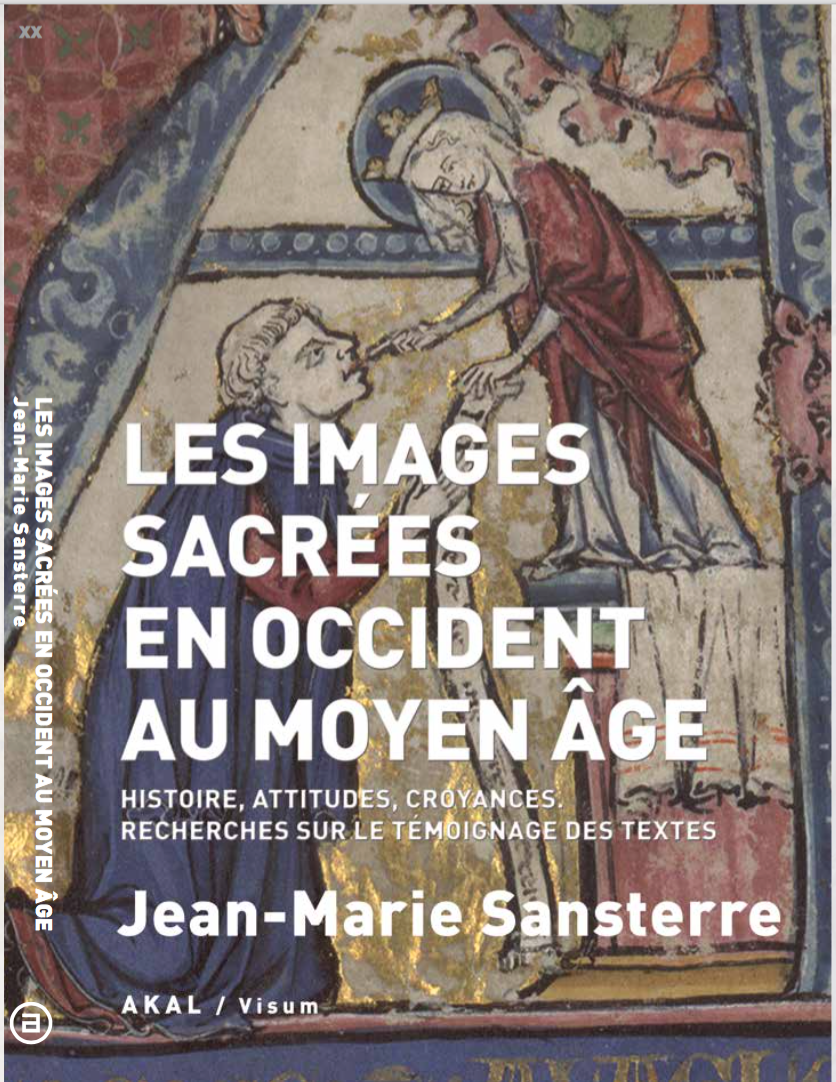
Suivant une voie moyenne entre recueil et synthèse, le livre propose une vue d’ensemble de recherches basées sur un considérable travail d’heuristique sans cesse élargi, dont l’avant-propos évoque la genèse, les étapes et les limites. L’ouvrage s’efforce de présenter avec cohérence une matière largement remaniée faite d’études de cas, d’analyses nuancées de dynamiques diverses, de bilans partiels, d’ouvertures et de pistes de recherche pour une période allant du vie aux premières décennies du XVIe siècle. Sous le titre «Vénération des images et miracles dans le haut Moyen Âge: Rome, l’Italie et les pays transalpins», la première partie fusionne deux travaux datant des débuts de la recherche avec bon nombre de modifications et de mises à jour. La deuxième rassemble, avec moins d’interventions, diverses études significatives concernant des crucifix et d’autres images du Christ. La troisième, la plus longue et la plus restructurée, porte sur la consécration des images, sur les rapports et l’importance respective des représentations des saints autres que la Vierge et de leurs reliques ainsi que sur le recours de plus en plus marqué aux effigies de la Mère de Dieu. À l’initiative des éditeurs scientifiques de la série ouverte par ce livre, celui-ci est pourvu d’un ample dossier iconographique réalisé par Fuensanta Murcia Nicolás, postdoctorante à l’Université de Murcia.
Historien médiéviste, Jean-Marie Sansterre est professeur ordinaire émérite à l’Université Libre de Bruxelles. Depuis quelque vingt-cinq ans, il s’est de plus en plus attaché à mettre en évidence l’apport de nombreux textes pour l’étude des attitudes et des croyances à l’égard des images sacrées dans l’Occident médiéval et au début de l’époque moderne. Ses recherches récentes portent aussi sur les pèlerinages mariaux ainsi que sur le rôle respectif des images et des reliques dans la diffusion du pouvoir thaumaturgique des saints.
Informations pratiques :
Jean-Marie Sansterre, Les images sacrées en Occident au Moyen Âge. Histoire, attitudes, croyances. Recherches sur le témoignage des textes, Madrid, Ediciones Akal, 2020 (Visum). 425 pages, 68 figures en noir et blanc. ISBN: 978-84-460-5040-7. Prix : 25 euros.
Location: Sheffield Salary: £41,526 to £49,553 per annum. Potential to progress to £55,750 per annum through sustained exceptional contribution. (Grade 8) Hours: Full Time Contract Type: Permanent Closes: 24th March 2021 Contract: Open-ended
We are looking for an ambitious individual to join the department to develop our research, teaching and knowledge exchange in early medieval history. We are seeking candidates who would add a new dimension to existing coverage in the department, and whose research and teaching on the period ca. 300- ca. 800 will contribute to ongoing departmental initiatives, such as decolonising the curriculum and globalising our outlook. In the first year, the successful candidate will teach the Level 2 options ‘The Fall of the Roman Empire in the West’ and ‘Warriors, Saints and Heroes in Early Medieval Britain’, as well as contribute to team-taught modules. Beyond the first year, the candidate will develop their own modules for both undergraduate and graduate programmes that complement the Medieval Section’s existing offering. The successful candidate will have a strong track record of research and teaching, and ideally of knowledge exchange, and will have a PhD in Medieval History or a related subject area, or equivalent experience.
You will join a dynamic core team of ancient and medieval historians that includes Dr. Casey Strine (ancient Near Eastern history and migration), Prof. Julia Hillner (law and society in late antiquity), Dr. Charles West (Europe between the 7th and 12th centuries), Dr. Danica Summerlin (law, politics and the church in the central middle ages), and Prof. Martial Staub (citizenship and migration in the late middle ages).
You will have teaching and research strengths within your field and will be expected to contribute to the Department’s presence within the Faculty of Arts and Humanities, the wider University and, through outreach and knowledge exchange, in Sheffield and beyond. The willingness to communicate to a variety of audiences beyond the purely academic is also useful for this position.
The Department of History is one of the most active centres for historical research in the country, with a distinguished record of internationally outstanding and innovative historical research. The 2014 Research Excellence Framework (REF) puts the Department of History third in its overall rankings and second on the quality of its publications, 42% of which were judged to be 4* or ‘world-leading’.
We have an international reputation for high quality and innovative learning and teaching, delivered by staff who are both committed to providing an outstanding student experience and who are at the cutting edge of research in their own disciplines.
We’re one of the best not-for-profit organisations to work for in the UK. The University’s Total Reward Package includes a competitive salary, a generous Pension Scheme and annual leave entitlement, as well as access to a range of learning and development courses to support your personal and professional development.
We build teams of people from different heritages and lifestyles whose talent and contributions complement each other to greatest effect. We believe diversity in all its forms delivers greater impact through research, teaching and student experience.
Follow @sheffielduni and @ShefUniJobs on Twitter for more information about what makes the University of Sheffield a remarkable place to work.
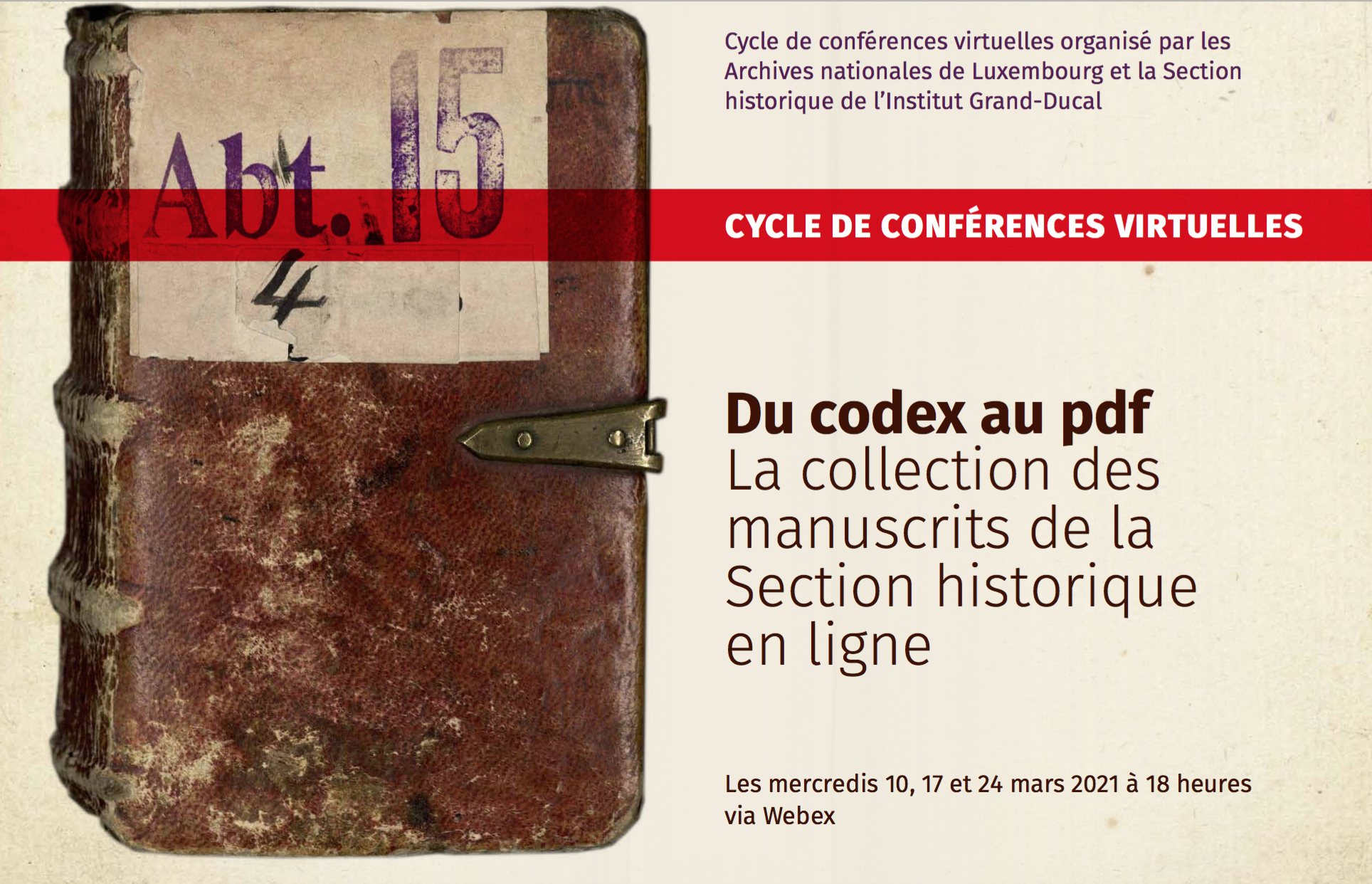
Cycle de conférences virtuelles organisé par les Archives nationales de Luxembourg et la Section historique de l’Institut Grand-Ducal Les mercredis 10, 17 et 24 mars 2021 à 18 heures via Webex
Inscription : Veuillez envoyer un e-mail à relations.publiques@an.etat.lu afin de recevoir le lien Webex qui vous permettra de suivre la (ou les) conférence(s) de votre choix.
L’idée de donner un renouveau à la collection des manuscrits de la Section historique de l’Institut Grand-Ducal a été à l’origine du projet de numérisation et de mise en ligne, entamé dès 2016 par les Archives nationales de Luxembourg (ANLux), avec le support de la Section historique. Cette collection qui comporte actuellement 633 manuscrits originaux, conserve du manuscrit médiéval au cahier de notes d’érudits du 19e siècle un patrimoine écrit d’une richesse incroyable.
Jusque-là accessible uniquement sur microfilms grâce à l’inventaire publié par Nicolas van Werveke dans les Publications de la Section historique et diverses listes dactylographiées, cette collection est désormais consultable en ligne et inventoriée en détail dans la base de données des ANLux, permettant un meilleur accès au chercheur aussi bien par mot-clé que par la nouvelle arborescence des manuscrits selon thème.
Le cycle de conférences virtuelles, lors desquelles un manuscrit choisi par l’orateur sera particulièrement mis en vitrine, permettra au grand public de découvrir sous sa nouvelle forme numérique cette collection de manuscrits exceptionnelle et sa grande plus-value pour la recherche historique.
Programme :
10 mars 2021 Luxemburg in Ägypten, Ägypten in Luxemburg. Johann Engling und die hölzerne Frau (DE) Manon SCHUTZ, University of Oxford Vorgestelltes Manuskript: Sammelhandschrift mit Aufsätzen von Johann Engling, Die ägyptische Holz gur im historischen Museum zu Luxemburg (SHL-Abt15-0385, 1873)
La conférence sera précédée d’une présentation du projet de numérisation de la collection des manuscrits de la Section historique (LU et DE).
17 mars 2021 Un écrit ordinaire, mais non moins intéressant. Le cartulaire de Henri François (milieu du 16e s.) (FR) Gilles GENOT, Conservateur au Lëtzebuerg City Museum Manuscrit présenté : Cartulaire du receveur d’Arlon Henri François, (SHL-Abt15-0311, 16e s.)
24 mars 2021 Le « livre du chapitre » de Marienthal (FR) Thomas FALMAGNE, Collaborateur scientifique de la Réserve précieuse de la Bibliothèque nationale du Luxembourg Manuscrit présenté : Kalendarium, Martyrologium und Regel des Dominikanerinnen-klosters Marienthal (SHL-Abt15-0467, 13e – 17e s.)
Dans sa prédication, Augustin d’Hippone adapte-t-il ses commentaires bibliques et, si oui, selon quels critères ? Pour répondre à cette question, cet ouvrage étudie l’exégèse d’une vingtaine de sermons prêchés sur l’Évangile de Matthieu. Un premier chapitre les replace dans leurs contextes d’énonciation, historiques, géographiques, polémiques et liturgiques. Les chapitres suivants procèdent à une enquête dans la tradition patristique et dans l’œuvre augustinienne pour, le cas échéant, mettre en lumière la spécificité des interprétations ; la dimension rhétorique est aussi prise en compte.
Ces sermons assument par leurs interprétations scripturaires la situation concrète de l’assemblée et s’insèrent dans la dynamique de la liturgie dont ils reçoivent la matière du commentaire et la finalité qui l’oriente. Leur exégèse se situe à l’intersection entre la Parole de Dieu qu’elle prolonge et met en œuvre (chapitres 2 à 4) et les réponses qu’elle cherche à susciter de la part des auditeurs (chapitres 5 à 7). Cette volonté d’édifier les auditeurs, à la fois personnellement et communautairement, en visant tout autant un progrès spirituel et une orthopraxie découlant de la vérité confessée, contribue à éclairer l’adaptation du prédicateur dans les Sermons sur Matthieu.
Table des matières :
Ante omnia Sigles Introduction
Chapitre 1. Prolégomènes. Contextes des Sermones in Matthaeum
Première partie: Per ministrum sermonis. La médiation du prédicateur Introduction Chapitre 2. Médiations et annonce (S. 66). Mt 11, 2-11. Lc 7, 18-28 Chapitre 3. Ministerium sermonis. Le ministère du prédicateur Chapitre 4. “Petite! Quaerite! Pulsate!” Enseigner l’exégèse Per ministrum sermonis. Conclusion
Seconde partie: Fructus quaeritur. Les fruits de la prédication Introduction Chapitre 5. Images bibliques de la fructification Chapitre 6. Fides. La foi, fruit de la prédication Chapitre 7. Caritas. L’amour de Dieu et du prochain, fruits de la prédication Fructus quaeritur. Conclusions
Conclusion Annexes Indices
Informations pratiques :
Marie Pauliat, Augustin exégète et prédicateur dans les Sermons sur Matthieu, Turnhout, Brepols, 2021 (Collection des Études augustiniennes. Série Antiquité, 205). 722 p., 165 x 250 mm. ISBN: 978-2-85121-303-7. Prix : 89 euros.
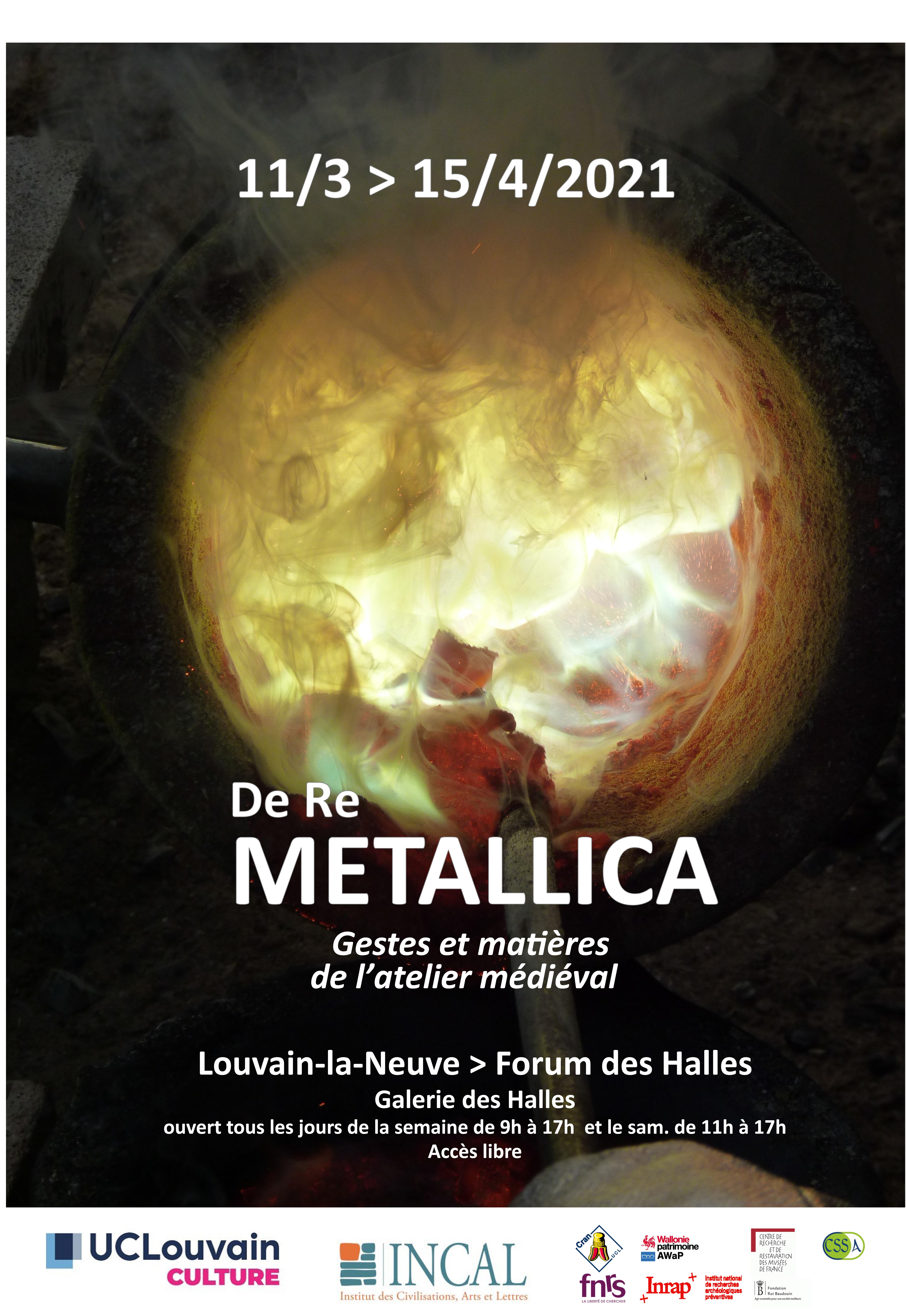
Dans la perspective du 600ème anniversaire de l’Université catholique de Louvain et des 50 ans du Centre de recherches d’archéologie nationale (CRAN/INCAL), l’exposition photographique qui tire son titre du traité fondateur des sciences géologiques, minéralogiques et métallurgiques de Georgius Agricola (1556) – De Re Metallica – valorise les recherches en paléométallurgie conduites par Lise Saussus, chargée de recherches FRS-FNRS. C’est cependant la portée esthétique de l’image du microscope, des macrophotographies ou encore des vues d’ambiance collectées sur le terrain qui est ici mise en avant.
Des canalisations aux téléphones portables, en passant par de nombreuses autres applications insoupçonnées, le cuivre et ses alliages sont aujourd’hui utilisés dans bon nombre de secteurs de l’économie mondiale. À la fin du Moyen Âge, bien que les quantités ne soient pas comparables, ces métaux inondent le marché européen, de la bijouterie fantaisie aux ustensiles de cuisine, sans oublier les cloches, les canons, les statues. Les photographies présentées dans cette exposition sont extraites de carnets de recherche autour de cette métallurgie médiévale, constitués au cours d’une thèse de doctorat et d’un postdoctorat menés à l’UCLouvain.
Ces travaux sont aussi le fruit de collaborations, d’une équipe formée d’archéologues, d’historiens, d’archéométallurgistes et de spécialistes de l’analyse des matériaux. Centrée sur la métallurgie des alliages à base de cuivre entre Meuse et Seine, cette recherche s’intéresse en particulier à la diffusion des objets de cuivre de bronze et de laiton du 5e et 15e siècles, aux cadres de leurs productions, aux techniques de fabrication.
Vaste période durant laquelle le statut des objets change, mais aussi la façon de les consommer, et avec elle le rapport aux choses. La gestion des ressources évolue aussi au Moyen Âge. Alors que les mines de cuivre sont le plus souvent lointaines et le transport coûteux, le commerce et la consommation des objets neufs alimentent d’autres circuits d’approvisionnement : ceux de la récupération et du recyclage. Les villes deviennent de véritables « mines » de métal. Les objets y sont découpés, redécoupés, rassemblés, recyclés, encore et encore, un cycle quasiment sans fin qui résonne aujourd’hui à l’ère de l’obsolescence programmée dans un monde aux ressources inextensibles. Grâce à ses propriétés, près de 40% du cuivre aujourd’hui consommé en Europe provient du recyclage.
La plupart des photographies illustrent des objets ou des déchets de production. Par la restitution des espaces de travail, des techniques, des chaînes opératoires, des capitaux engagés dans les affaires, c’est aussi l’homme au travail que l’on entrevoit dans l’atelier et sur les marchés. L’objectif du chercheur dépasse toutefois le cadre strict de l’activité métallurgique. À travers elle, se dessinent les liens étroits entre économie, modes de vie et pratiques sociales, autant de fragments de la société médiévale qui apparaissent et dont l’altérité se heurte parfois avec celle d’aujourd’hui.
Ces images, collectées ici et là, saisies par l’appareil photographique ou le microscope, sont autant d’indices que l’homme est intimement lié à la matière, aux objets qu’il produit et qu’il utilise dans son quotidien. Elles montrent aussi le lien entre la technique et la poésie, entre l’art et la beauté des matériaux, parfois de façon inattendue au moment d’un cadrage, d’une échelle d’observation, d’une profondeur de champ où le banal devient soudainement déconcertant. Ces clichés révèlent encore que le chercheur peut se laisser surprendre, dans son cheminement, à la recherche « des preuves qui ne seraient point des flammes » comme l’écrivait Gaston Bachelard dans l’avant-propos de La psychanalyse du feu.Le Forum des Halles est situé juste à côté de la gare de Louvain-la-Neuve, dans la Galerie des Halles. Entrée libre du lundi au vendredi de 9h à 17 et le samedi de 11h à 17h.
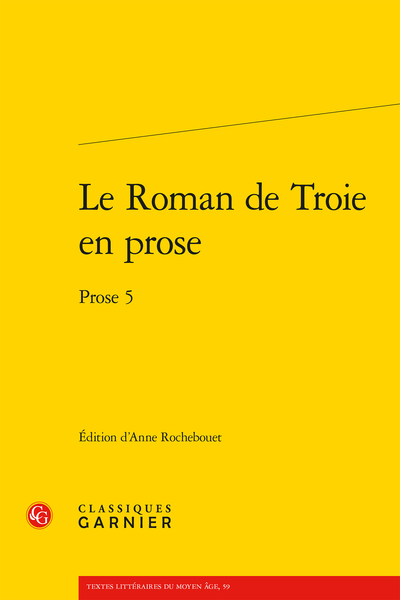
Cet ouvrage est la première édition critique d’ensemble de la cinquième mise en prose du Roman de Troie, insérée dans la seconde rédaction de l’Histoire ancienne jusqu’à César. Elle est accompagnée d’une étude de la tradition manuscrite, d’une analyse linguistique, d’un index des noms propres et d’un glossaire.
Le Roman de Troie en prose. Prose 5, éd. Anne Rochebouet, Paris, Classiques Garnier, 2021 (Textes littéraires du Moyen Âge, n° 59). 1039 p. ISBN : 978-2-406-10321-9. Prix : 49 euros.
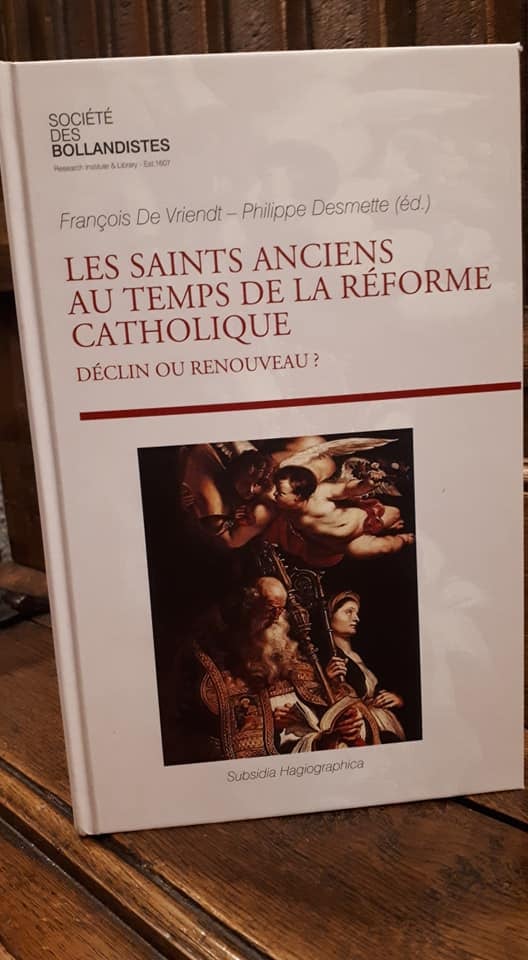
Si tous les saints ont acquis valeur de témoins de la foi aux yeux des fidèles catholiques, leurs actes, leurs attitudes et leurs messages sont des plus variables selon les époques. Les quatorze contributions de cet ouvrage envisagent l’évolution de la popularité des «vieux» saints médiévaux – premiers évêques, martyrs locaux, fondateurs et fondatrices d’abbayes, pieuses vierges, missionnaires antérieurs à l’an mil – à l’époque de la Réforme catholique, aux XVIIe et XVIIIe siècles. Ces témoins des premiers siècles touchent-ils encore les cœurs et les âmes des fidèles, parfois plus d’un millénaire après leur disparition ? Leurs miracles, leurs sanctuaires, leurs reliques suscitent-ils toujours l’adhésion ? Leur ancienneté est-elle gage d’autorité ou désavantage par rapport aux saints modernes et à leurs valeurs ? Les réponses surgiront au détour de nombreux cas de figure choisis en France, dans les Pays-Bas habsbourgeois et le Saint-Empire. Celles-ci éclairent des domaines aussi variés que l’histoire intellectuelle et littéraire, les identités locales, les conceptions religieuses et les supports médiatiques offerts par l’imprimé, la gravure ou la peinture. À travers cette problématique, s’observe le dialogue entre deux âges d’or du catholicisme: celui des origines, à la geste souvent légendaire, et celui de la reconquête des esprits entrepris par l’Église, marqué par une efflorescence des arts et des rites, une uniformisation de la liturgie et un essor de l’érudition.
Les contributeurs au volume sont: • N. Balzamo (Univ. de Neuchâtel) • J.-M. Cauchies (Univ. St-Louis – Univ. catholique de Louvain) • Fr. De Vriendt (Société des Bollandistes) • Ph. Desmette (Univ. St-Louis, Bruxelles) • P. A. Fabre (EHESS, Paris) • Ph. George (Trèsor de la cathédrale de Liège) • F. Henryot (ENS des sciences de l’information et des bibliothèques, Lyon) • J.-P. Gay (Univ. catholique de Louvain) • N. Guyard (Univ. de Lyon) • M. Lindeijer (Société des Bollandistes) • Ph. Martin (Univ. de Lyon)• L. Nys (Univ. Polytechnique des Hauts-de-France, Valenciennes) • A. Soetaert (Katholieke Univ. Leuven)• É. Suire (Univ. de Bordeaux).
Informations pratiques :
Les saints anciens au temps de la Réforme catholique (Europe occidentale, XVIe-XVIIIe s.) Déclin ou renouveau ?, éd. François De Vriendt et Philippe Desmette, Bruxelles, Société des Bollandistes, 2020 (Subsidia hagiographica, 98). XII-284 p., ill. ISBN 978-2-87365-036-0. Prix : 75 euros. Commandes / informations : info@bollandistes.be
Mercredi 7 avril 2021, de 10h00 à 12h00, Séminaire de recherche organisé par l’IHA (Rolf Große) en coopération avec l’EPHE (Laurent Morelle)
Christian Stadermann (université de Mayence), Chilpéric Ier (561-584) dans l’historiogaphie du royaume des Francs, de Grégoire de Tours à Aimoin de Fleury
Présidence: Pascale Bourgain (École nationale des chartes)
En raison de la situation sanitaire, le séminaire aura lieu sous forme de visioconférence. Les personnes désireuses d’assister au séminaire se feront connaître auprès de Rolf Große : rgrosse@dhi-paris.fr (message adressé en copie à Laurent Morelle : Laurent.Morelle@ephe.psl.eu).
L’IHA et l’École pratique des hautes études organisent en commun un séminaire d’histoire médiévale où des doctorantes et doctorants en thèse bien avancée, mais aussi de jeunes postdocs viennent présenter leurs recherches en voie d’achèvement ou un dossier de leur thèse. La prestation, toujours en langue française, dure environ 50 minutes. Le séminaire a lieu tous les deux mois, un mardi matin de 10h à 12h.
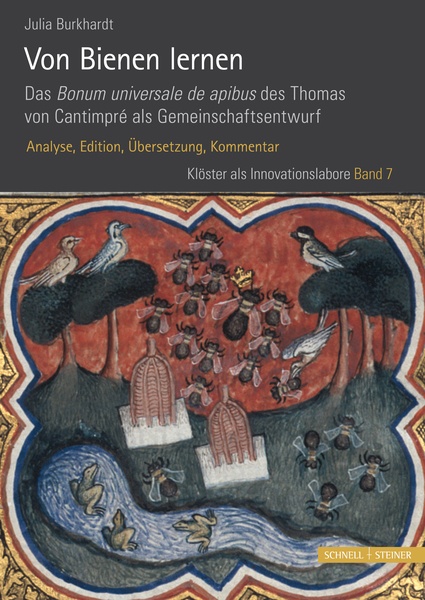
Auf der Suche nach der idealen Gemeinschaft der Menschen stieß der Dominikaner Thomas von Cantimpré im 13. Jahrhundert auf die Bienen. In seinem lateinischen Bienenbuch (Bonum universale de apibus) beschrieb er am Beispiel der Bienen Hierarchien, Vorzüge und Abgründe des sozialen Miteinanders. Angereichert mit unterhaltsamen Anekdoten aus dem mittelalterlichen Lebensalltag sollte sein Handbuch die Arbeit der Dominikaner als Prediger und Lehrmeister unterstützen. Von Bienen lernen diese Idee fand schon im Mittelalter großes Interesse, und so wurde das Bienenbuch im Laufe der Jahrhunderte über einhundert Mal handschriftlich kopiert. Erstmals erscheint das Bienenbuch nun in zwei Bänden, in einer kritisch kommentierten Edition mit deutscher Übersetzung sowie einer Analyse von Werk und Überlieferungsgeschichte.
Informations pratiques :
Julia Burkhardt, Von Bienen lernen. Das Bonum universale de apibus des Thomas von Cantimpré als Gemeinschaftsentwurf. Analyse, Edition, Übersetzung, Kommentar, Schnell und Steiner, 2020 (Klöster als Innovationslabore, 7). 2 vol. 1616 p. 17 x 24 cm, 49 ill. ISBN : 978-3-7954-3505-9. Prix : 76 euros.
Avec le soutien du FNRS, du CRHiDI (UCLouvain – Saint-Louis, Bruxelles), d'INCAL (UCLouvain), de PraME (UNamur), de sociAMM (ULB) et de Transitions (ULiège)







Vous devez être connecté pour poster un commentaire.